EXHIBIT 99.1
Published on December 1, 2025
Exhibit 99.1
BOARD OF GOVERNORS OF THE
FEDERAL RESERVE SYSTEM
Washington, D.C. 20551
FORM 10-K
(Mark One)
| x | ANNUAL REPORT PURSUANT TO SECTION 13 OR 15(d) OF THE SECURITIES EXCHANGE ACT OF 1934 |
For the fiscal year ended December 31, 2024
OR
| ¨ | TRANSITION REPORT PURSUANT TO SECTION 13 OR 15(d) OF THE SECURITIES EXCHANGE ACT OF 1934 |
For the transition period from ______________ to ______________
FDIC Certificate No. 11813
CADENCE BANK
(Exact name of registrant as specified in its charter)
| Mississippi | 64-0117230 | |
| (State or other jurisdiction of incorporation or | (I.R.S. Employer Identification No.) | |
| organization) | ||
| One Mississippi Plaza, 201 South Spring Street | ||
| Tupelo, Mississippi | 38804 | |
| (Address of principal executive offices) | (Zip Code) |
Registrant’s telephone number, including area code: (662) 680-2000
Securities registered pursuant to Section 12(b) of the Act:
| Title of Each Class | Trading Symbol(s) | Name of Each Exchange on Which Registered | ||
| Common stock, $2.50 par value per share | CADE | New York Stock Exchange | ||
| 5.50% Series A Non-Cumulative Perpetual Preferred Stock, par value $0.01 per share | CADE Pr A | New York Stock Exchange |
Securities registered pursuant to Section 12(g) of the Act: None.
Indicate by check mark if the registrant is a well-known seasoned issuer, as defined in Rule 405 of the Securities Act. Yes x No ¨
Indicate by check mark if the registrant is not required to file reports pursuant to Section 13 or Section 15(d) of the Act. Yes ¨ No x
Indicate by check mark whether the registrant (1) has filed all reports required to be filed by Section 13 or 15(d) of the Securities Exchange Act of 1934 during the preceding 12 months (or for such shorter period that the registrant was required to file such reports), and (2) has been subject to such filing requirements for the past 90 days. Yes x No ¨
Indicate by check mark whether the registrant has submitted electronically every Interactive Data File required to be submitted pursuant to Rule 405 of Regulation S-T (§ 232.405 of this chapter) during the preceding 12 months (or for such shorter period that the registrant was required to submit such files). Yes x No ¨
Indicate by check mark whether the registrant is a large accelerated filer, an accelerated filer, a non-accelerated filer, a smaller reporting company, or an emerging growth company. See the definitions of “large accelerated filer,” “accelerated filer,” “smaller reporting company,” and “emerging growth company” in Rule 12b-2 of the Exchange Act.
| Large accelerated filer x | Accelerated filer ¨ |
| Non-accelerated filer ¨ | Smaller reporting company ¨ |
| Emerging growth company ¨ |
If an emerging growth company, indicate by check mark if the registrant has elected not to use the extended transition period for complying with any new or revised financial accounting standards provided pursuant to Section 13(a) of the Exchange Act. ¨
Indicate by check mark whether the registrant has filed a report on and attestation to its management’s assessment of the effectiveness of its internal control over financial reporting under Section 404(b) of the Sarbanes-Oxley Act (15 U.S.C. 7262(b)) by the registered public accounting firm that prepared or issued its audit report. Yes x No ¨
If securities are registered pursuant to Section 12(b) of the Act, indicate by check mark whether the financial statements of the registrant included in the filing reflect the correction of an error to previously issued financial statements. ¨
Indicate by check mark whether any of those error corrections are restatements that required a recovery analysis of incentive-based compensation received by any of the registrant’s executive officers during the relevant recovery period pursuant to §240.10D-1(b). ¨
Indicate by check mark whether the registrant is a shell company (as defined in Rule 12b-2 of the Act). Yes ¨ No x
The aggregate market value of the registrant’s common stock held by non-affiliates of the registrant on June 30, 2024 was $5.1 billion, based on the last reported sale price per share of the registrant’s common stock as reported on the New York Stock Exchange on June 30, 2024.
As of February 18, 2025, the registrant had outstanding 183,525,441 shares of common stock, par value $2.50 per share, and 6,900,000 shares of its 5.50% Series A Non-Cumulative Perpetual Preferred Stock, par value $0.01 per share.
DOCUMENTS INCORPORATED BY REFERENCE
To the extent stated herein, portions of the Definitive Proxy Statement on Schedule 14A to be used in connection with the registrant’s 2025 Annual Meeting of Shareholders, scheduled to be held April 23, 2025, are incorporated by reference into Part III of this annual report on Form 10-K.
| 1 |
CADENCE BANK
FORM 10-K
For the Fiscal Year Ended December 31, 2024
TABLE OF CONTENTS
| 2 |
Glossary of Defined Terms
ACH - Automated Clearing House
ACL - Allowance for credit losses
AFS - Available for sale
AI - Artificial intelligence
ALM - Asset/liability management
ALCO - Asset/Liability Management Committee
AOCI - Accumulated other comprehensive income (loss)
ASC - Accounting Standards Codification
ASU - Accounting Standards Update
ATM - Automated teller machine
Basel III - Basel Committee’s 2010 Regulatory Capital Framework (Third Accord)
Basel Committee - Basel Committee on Banking Supervision
BHC Act - Bank Holding Company Act of 1956, as amended
Board - the Company’s Board of Directors
BOLI - Bank-owned life insurance
BTFP - Bank Term Funding Program
C&I - Commercial and industrial
CAD - Construction, acquisition and development
CAMT - Corporate alternative minimum tax rate
CDE - Community development entity
CECL - ASU 2016-13, Measurement of Credit Losses on Financial Instruments (“Current Expected Credit Losses”)
CEO - Chief Executive Officer
CET1 - Common Equity Tier 1
CFO - Chief Financial Officer
CFPB - Consumer Financial Protection Bureau
CIO - Chief Information Officer
CIS - Center for Internet Security
CISM - Certified Information Security Manager
CISO - Chief Information Security Officer
CISSP - Certified Information Systems Security Professional
Code - Code of Business Conduct and Ethics
CODM - Chief operating decision maker
Company - Cadence Bank and its subsidiaries
COO - Chief Operating Officer
COSO - Committee of Sponsoring Organizations of the Treadway Commission
COVID-19 - Coronavirus Disease 2019
CPR - Conditional Prepayment Rate
CRA - Community Reinvestment Act of 1977
CRE - Commercial real estate
CSC - Contractual servicing cost
DIF - Deposit Insurance Fund
DOJ - U.S. Department of Justice
EAP - Employee Assistance Program
EIR - Effective interest rate
EPS - Earnings per share
ESG - Environmental, Social and Governance
Exchange Act - Securities Exchange Act of 1934, as amended
EVE - Economic value of equity
FASB - Financial Accounting Standards Board
FDI Act - Federal Deposit Insurance Act
FDIC - Federal Deposit Insurance Corporation
FDICIA - Federal Deposit Insurance Corporation Improvement Act of 1991
FDM - Financial difficulty modification
Federal Reserve - Board of Governors of the Federal Reserve System
FHA - Federal Housing Administration
FHLB - Federal Home Loan Bank
FHLMC - Federal Home Loan Mortgage Corporation
FinCEN - Financial Crimes Enforcement Network
| 3 |
FNMA - Federal National Mortgage Association
FRB - Federal Reserve Bank
FTE - Fully taxable equivalent
GAAP - Generally Accepted Accounting Principles in the United States
GNMA - Government National Mortgage Association
HTC - Historic tax credits
IRA of 2022 - Inflation Reduction Act of 2022
IRR - Interest rate risk
ITM - Interactive teller machine
MBS - Mortgage-backed securities
MDBCF - Mississippi Department of Banking and Consumer Finance
MSR - Mortgage servicing rights
NAV - Net asset value
NII - Net interest income
NM - Not meaningful
NMTC - New market tax credit
NPA - Nonperforming asset(s)
NPL - Nonperforming loan(s)
NSF - Nonsufficient funds
NYSE - New York Stock Exchange
OCC - Office of the Comptroller of the Currency
OREO - Other real estate owned
PCAOB - Public Company Accounting Oversight Board
PCD - Purchased credit deteriorated
PSU - Performance stock unit
ROU - Right of use
RSA - Restricted stock award
RSU - Restricted stock unit
SBA - Small Business Administration
SBIC - Small Business Investment Company
SEC - U.S. Securities and Exchange Commission
SNC - Shared National Credit
SOFR - Secured Overnight Financing Rate
TBA - To be announced
TDR - Troubled debt restructuring
USDA - U.S. Department of Agriculture
VA - U.S. Department of Veterans Affairs
VIE - Variable interest entity
| 4 |
CAUTIONARY NOTE REGARDING FORWARD LOOKING STATEMENTS
Certain statements made in this annual report on Form 10-K (this “Report”) are not statements of historical fact and constitute “forward-looking statements” within the meaning of Section 21E of the Exchange Act, and are subject to the safe harbor created thereby under the Private Securities Litigation Reform Act of 1995 as well as the “bespeaks caution” doctrine. These statements are often, but not always, made through the use of words or phrases such as “anticipate,” “aspire,” “assume,” “believe,” “budget,” “contemplate,” “continue,” “could,” “estimate,” “expect,” “forecast,” “foresee,” “goal,” “hope,” “indicate,” “intend,” “may,” “might,” “outlook,” “plan,” “project,” “projection,” “predict,” “prospect,” “potential,” “roadmap,” “seek,” “should,” “target,” “will,” and “would,” or the negative versions of those words, or other comparable words of a future or forward-looking nature. These forward-looking statements may include, without limitation, discussions regarding general economic, interest rate, real estate market, competitive, employment, and credit market conditions; our assets; business; cash flows; financial condition; liquidity; prospects; results of operations, and the Company’s ability to deploy capital into strategic and growth initiatives; deposit growth interest and fee-based revenue; capital resources; capital metrics; efficiency ratio; valuation of mortgage servicing rights; mortgage production volume; net income; net interest revenue; non-interest revenue; net interest margin; interest expense; non-interest expense; earnings per share; interest rate sensitivity; interest rate risk; balance sheet and liquidity management; off-balance sheet arrangements; fair value determinations; asset quality; credit quality; credit losses; provision and allowance for credit losses, impairments, charge-offs, recoveries and changes in volume; investment securities portfolio yields and values; ability to manage the impact of pandemics and natural disasters; adoption and use of critical accounting policies; adoption and implementation of new accounting standards and their effect on our financial results and our financial reporting; utilization of non-GAAP financial metrics; declaration and payment of dividends; ability to pay dividends or coupons on our 5.5% Series A Non-Cumulative Perpetual Preferred Stock, par value $0.01 per share, or our subordinated notes; mortgage and commission revenue growth; implementation and execution of cost savings initiatives; ability to successfully litigate, resolve or otherwise dispense with threatened, ongoing and future litigation and administrative and investigatory matters; ability to successfully complete pending or future acquisitions or divestitures; dispositions and other strategic growth opportunities and initiatives; ability to successfully integrate and manage acquisitions or divestitures; opportunities and efforts to grow market share; reputation; ability to compete with other financial institutions; ability to recruit and retain key employees and personnel; access to capital markets; investment in other financial institutions; and ability to operate our regulatory compliance programs in accordance with applicable law.
Forward-looking statements are based upon management’s expectations as well as certain assumptions and estimates made by, and information available to, management at the time such statements were made. Forward-looking statements are not historical facts, are not guarantees of future results or performance and are subject to certain known and unknown risks, uncertainties and other factors that are beyond our control and that may cause actual results to differ materially from those expressed in, or implied by, such forward-looking statements. These risks, uncertainties and other factors include, without limitation, general economic, unemployment, credit market and real estate market conditions, and the effect of such conditions on the creditworthiness of borrowers, collateral values, the value of investment securities and asset recovery values; the risks of changes in interest rates and their effects on the level and composition of deposits, loan demand, loan repayment velocity, and the values of loan collateral, securities and interest sensitive assets and liabilities; risks arising from market reactions to the banking environment in general, or to conditions or situations at specific banks; risks arising from perceived instability in the banking sector; the impact of inflation, the failure of assumptions underlying the establishment of reserves for possible credit losses, fair value for loans and other real estate owned; changes in the prices, values and sales volumes of residential and commercial real estate, especially as they relate to the value of collateral supporting the Company’s loans; a deterioration of the credit rating for U.S. long-term sovereign debt, actions that the U.S. government may take to avoid exceeding the debt ceiling, or uncertainties surrounding the debt ceiling and the federal budget; the availability of and access to capital; possible downgrades in our credit ratings or outlook which could increase the costs or availability of funding from capital markets; the ability to attract new or retain existing deposits or to retain or grow loans; potential delays or other problems in implementing and executing our growth, expansion and acquisition or divestment strategies, including delays in obtaining regulatory or other necessary approvals, including in obtaining the approval of any pending transaction, or the failure to realize any anticipated benefits or synergies from any acquisitions or growth strategies; significant turbulence or a disruption in the capital or financial markets; the effect of a fall in stock market prices on our investment banking business and our fee income from our brokerage and wealth management businesses; the ability to grow additional interest and fee income or to control noninterest expense; competitive factors and pricing pressures, including their effect on our net interest margin; changes in legal, financial and/or regulatory requirements (including those related to share repurchases); recently enacted and potential legislation and regulatory actions and the costs and expenses to comply with new and/or existing legislation and regulatory actions, and any related rules and regulations; changes in U.S. Government monetary, fiscal and trade policy, including any changes that may result from U.S. elections; special assessments or changes to regular assessments by banking regulators; possible adverse rulings, judgments, settlements and other outcomes of pending or future litigation or government actions; the ability to keep pace with technological changes, including changes regarding generative artificial intelligence, maintaining cybersecurity and compliance with applicable cybersecurity regulatory requirements; increased competition in the financial services industry, particularly from regional and national institutions, as well as from fintech companies, risks related to our reliance on third parties to provide key components of our business infrastructure, including the risks related to disruptions in services provided by disputes with, or financial difficulties of a third-party vendor, the impact of failure in, or breach of, our operational or security systems or infrastructure, or those of third parties with whom we do business, including as a result of cyber-attacks or an increase in the incidence or severity of fraud, illegal payments, security breaches or other illegal acts impacting us or our customers; natural disasters or acts of war or terrorism; international or political instability (including the impacts related to or resulting from Russia’s military action in Ukraine, or the Israel-Hamas war, including the imposition of additional sanctions and export controls, as well as the broader impacts to financial markets and the global macroeconomic and geopolitical environments); risks related to, and the costs associated with, ESG matters, including the scope and pace of related rulemaking activity; impairment of our goodwill or other intangible assets; adoption of new accounting standards or changes in existing standards; and other factors described in “Part I, Item 1A. Risk Factors” in this Report or as detailed from time to time in the Company’s press and news releases, reports and other filings we file with the federal banking regulators.
| 5 |
The Company faces risks from: possible adverse rulings, judgments, settlements or other outcomes of pending, ongoing and future litigation, as well as governmental, administrative and investigatory matters; the impairment of the company’s goodwill or other intangible assets; losses of key employees and personnel; the diversion of management’s attention from ongoing business operations and opportunities; and the Company’s success in executing its business plans and strategies, and managing the risks involved in all of the foregoing.
Although the Company believes that the expectations reflected in these forward-looking statements are reasonable as of the date of this Report, if one or more events related to these or other risks or uncertainties materialize, or if the Company’s underlying assumptions prove to be incorrect, actual results may prove to be materially different from the results expressed or implied by the forward-looking statements. Accordingly, undue reliance should not be placed on any forward-looking statements. The forward-looking statements speak only as of the date of this Report, and the Company does not undertake any obligation to publicly update or review any forward-looking statement, whether as a result of new information, future developments or otherwise, except as required by applicable law. New risks and uncertainties may emerge from time to time, and it is not possible for the Company to predict their occurrence or how they will affect the Company. All written or oral forward-looking statements attributable to us are expressly qualified in their entirety by this section.
| 6 |
COMPANY OVERVIEW
Cadence Bank (“We,” “Our,” or the “Company”), originally chartered in 1876, is a Mississippi state chartered commercial bank with dual headquarters in Houston, Texas and Tupelo, Mississippi. The Company conducts commercial banking and financial services directly and through its banking-related subsidiaries. The Company operates over 350 commercial banking and mortgage locations in Alabama, Arkansas, Florida, Georgia, Louisiana, Mississippi, Missouri, Tennessee and Texas.
Our common stock and our preferred stock are listed on the New York Stock Exchange under the symbols “CADE” and “CADE Pr A”, respectively. During the fourth quarter of 2021, we changed our corporate name from BancorpSouth Bank to Cadence Bank in connection with our acquisition of Cadence Bancorporation. At December 31, 2024, the Company had total assets of $47.0 billion; total loans, net of unearned income, of $33.7 billion; total deposits of $40.5 billion; and shareholders’ equity of $5.6 billion.
During the fourth quarter of 2024, the Company applied for and became a member of the Federal Reserve System. The Federal Reserve Board of St. Louis is now the Company’s primary federal regulator in place of the FDIC.
The Company’s investor relations website address is https://ir.cadencebank.com. The Company makes available its annual reports on Form 10-K, quarterly reports on Form 10-Q, current reports on Form 8-K, and all amendments to those reports free of charge on its investor website under the caption “Public Filings” as soon as reasonably practicable after such material is electronically filed with, or furnished to, the Federal Reserve. The Company’s websites and the information contained therein or linked thereto are not, and are not intended to be, incorporated into this Report.
PRODUCTS AND SERVICES
LENDING ACTIVITIES
The Company’s lending activities include both commercial and consumer loans. Loan originations are derived from a number of sources including direct solicitation by the Company’s loan officers, existing depositors and borrowers, builders, attorneys, walk-in customers and, in some instances, other lenders, real estate broker referrals and mortgage loan companies. The Company has established systematic procedures for approving and monitoring loans that vary depending on the size and nature of the loan and applies these procedures in a disciplined manner.
Our loan and lease portfolio includes commercial and industrial loans, residential real estate loans, commercial real estate loans and consumer loans. The principal risk associated with each category of loans we make is the creditworthiness of the borrower. Borrower creditworthiness is affected by general economic conditions, the attributes of the borrower and the borrower’s market or industry. Attributes of the relevant business market or industry include the competitive environment, customer and supplier availability, the threat of substitutes and barriers to entry and exit.
Commercial Lending
The Company offers a variety of commercial loan services including term loans, lines of credit, equipment and receivable financing, energy, restaurant, healthcare, technology, SBA, and agricultural loans. A broad range of short-to-medium term commercial loans, both secured and unsecured, are made available to businesses for working capital (including inventory and receivables), business expansion (including acquisition and development of real estate and improvements), and the purchase of equipment and machinery. The Company also makes construction loans to real estate developers for the acquisition, development and construction of residential and commercial properties.
Commercial loans are granted based on the borrower’s ability to generate cash flow to support its debt obligations and other cash related expenses. A borrower’s ability to repay commercial loans is substantially dependent on the success of the business itself and on the quality of its management. As a general practice, the Company takes as collateral a security interest in any available real estate, equipment, inventory, receivables, or other personal property, although such loans may also be made infrequently on an unsecured basis. In many instances, the Company requires personal guarantees of its commercial loans to provide additional credit support.
| 7 |
The Company’s exposure to agricultural lending is minimal. Agricultural loans are generally supported by the financial strength of the borrower and secured by the crops/livestock, crop insurance, equipment or real estate.
Residential Consumer Lending
A portion of the Company’s lending activity consists of the origination of fixed and adjustable-rate residential mortgage loans secured by owner-occupied property located in the Company’s primary market areas. Home mortgage banking is unique in that a broad geographic territory may be served by originators working from strategically placed offices either within the Company’s traditional banking facilities or from other locations. In addition, the Company offers construction loans, second mortgage loans and home equity lines of credit.
The Company finances the construction of individual, owner-occupied houses on the basis of written underwriting and construction loan management guidelines. First mortgage construction loans are made to qualified individual borrowers and are generally supported by a take-out commitment from a permanent lender. The Company makes residential construction loans to individuals who intend to erect owner-occupied housing on a purchased parcel of real estate. The construction phase of these loans has certain risks, including the viability of the contractor, the contractor’s ability to complete the project and changes in interest rates.
Mortgage lending serves to finance residential properties through long-term mortgages, both sold into the secondary market and retained in the bank portfolio. Ongoing efforts to grow the bank portfolio through the company’s Right@Home product for low- to moderate-income borrowers have contributed to the department’s production. Revenue is primarily derived from loan origination and servicing fees paid to the company by government-sponsored enterprises and other investors who purchase the mortgages after origination.
The sale of mortgage loans to the secondary market allows the Company to manage the interest rate risk related to such lending operations. Generally, after the sale of a loan with servicing retained, the Company’s only involvement is to act as a servicing agent. In certain cases, the Company may be required to repurchase mortgage loans upon which customers have defaulted that were previously sold in the secondary market if these loans did not meet the underwriting standards of the entity that purchased the loans.
Non-Residential Consumer Lending
Non-residential consumer loans made by the Company include loans for automobiles, recreation vehicles, boats, personal (secured and unsecured) and deposit account secured loans. Non-residential consumer loans are attractive to the Company because they typically have a shorter term and carry higher interest rates than those charged on other types of loans.
The Company also issues credit cards solicited on the basis of applications received through referrals from the Company’s branches and other marketing efforts. The Company generally has a small portfolio of credit card receivables outstanding. Credit card lines are underwritten using conservative credit criteria, including past credit history and debt-to- income ratios, similar to the credit policies applicable to other personal consumer loans.
The Company grants consumer loans based on employment and financial information solicited from prospective borrowers as well as credit records collected from various reporting agencies. Financial stability and credit history of the borrower are the primary factors the Company considers in granting such loans. The availability of collateral is also a factor considered in making such loans. The geographic area of the borrower is another consideration, with preference given to borrowers in the Company’s primary market areas.
Shared National Credits
The federal banking agencies define a SNC as any loan(s) extended to a borrower by a supervised institution or any of its subsidiaries and affiliates which aggregates $100 million or more and is shared by three or more institutions under a formal lending agreement or a portion of which is sold to two or more institutions, with the purchasing institutions assuming its pro rata share of the credit risk. As part of our commercial focused relationship banking, we may act as an agent or participate in syndicated loan offerings because of the size of the customers and nature of industries we serve. On December 31, 2024, we have $4.1 billion of outstanding SNCs, representing 12.3% of total loans.
For more information regarding the Company’s loans and leases, see “Management’s Discussion And Analysis of Financial Condition And Results Of Operations – Loans and Leases.”
| 8 |
DEPOSITS
We offer our customers a variety of deposit products, including checking accounts, savings accounts, money market accounts, time deposits, and other deposit accounts through multiple channels, including our extensive network of full-service branches, drive-through branches, ATMs, ITMs, and our online, mobile, and telephone banking platforms. At December 31, 2024, our total deposits were $40.5 billion and were comprised of 21.2% in noninterest-bearing deposits and 78.8% in interest bearing deposits. We intend to continue our efforts to provide funding for our business from customer relationship deposits.
The Company has been able to compete effectively for deposits in its primary market areas, while continuing to manage the exposure to higher interest rates. The distribution and market share of deposits by type of deposit and by type of depositor are important considerations in the Company’s assessment of the stability of its funding sources and its access to additional funds. Furthermore, management shifts the mix and maturity of the deposits depending on economic conditions and loan and investment policies in an attempt, within set policies, to minimize cost and maximize net interest margin.
For more information regarding the Company’s deposits, see “Management’s Discussion And Analysis of Financial Condition And Results Of Operations – Deposits.”
OTHER SERVICES
Through Linscomb Wealth Inc., formerly Linscomb & Williams Inc., a subsidiary of Cadence Bank, and Cadence Trust, a division of Cadence Bank, we offer wealth management and other fiduciary and private banking services targeted to affluent clients, including individuals, business owners, families, and professional service companies. In addition to generating fiduciary and investment management fee income, we believe these services enable us to build new relationships and expand existing relationships to grow our deposits and loans. Through our wealth management line of business and our relationship with LPL Financial LLC, we offer financial planning, retirement services and trust and investment management by a team of seasoned advisors, providing access for affluent clients as well as mass market clients, to a wide range of certificates of deposits, mutual funds, estate planning products, insurance and annuities, individual retirement accounts, stocks, bonds, brokerage accounts, money market accounts, investment advisory services, and other financial products and services. Although we do not limit our customers to affluent clients and business owners, the focus of our wealth management line of business is on the “mass affluent” ($500,000 to $2 million in investible assets) and “highly affluent” ($2 million to $5 million in investible assets) markets.
In addition to traditional banking activities and the other products and services specified above, we provide a broad array of financial services to our customers, including: debit and credit card products, treasury management services, merchant services, automated clearing house services, lock-box services, remote deposit capture services, foreign exchange services, and other treasury services.
COMPETITION
Vigorous competition exists in all major areas where the Company is engaged in business. The Company competes for available loans and deposit accounts with banks, thrifts, insurance companies, credit unions, mortgage bankers and finance companies, money market mutual funds, other financial services companies and fintech companies, some of which are not subject to the same degree of regulation and restrictions imposed upon us. None of these competitors are dominant in the entire area served by the Company.
The principal areas of competition in the banking industry center on a financial institution’s ability and willingness to provide credit on a timely and competitively priced basis, to offer a sufficient range of deposit and investment opportunities at competitive prices and maturities, and to offer personal and business financial services of sufficient quality and at competitive prices. Management believes that the Company can compete effectively in all of these areas.
CREDIT POLICIES AND PROCEDURES
In the normal course of business, the Company assumes risks in extending credit. The Company manages these risks through underwriting in accordance with its lending policies, loan review procedures and the diversification of its loan and lease portfolio. Although it is not possible to predict credit losses with certainty, management regularly reviews the characteristics of the loan and lease portfolio to determine its overall risk profile and quality.
| 9 |
The provision for credit losses is the periodic cost (or credit) of providing an allowance or reserve for expected losses on loans and leases. The Board of Directors has appointed a Credit Committee, composed of senior management and credit administration staff which meets on a quarterly basis or more frequently if required to review the recommendations of several internal working groups developed for specific purposes including the allowance for credit losses, specific provision amounts, and charge-offs. The Allowance for Credit Losses (ACL) Group bases its estimates of credit losses on three primary components: (1) estimates of expected losses that exist in various segments of performing loans and leases over the remaining contractual life of the loan portfolio using a reasonable and supportable economic forecast; (2) specifically identified losses in individually analyzed credits which are collateral-dependent, which generally include loans internally graded as impaired and PCD Loss loans; and (3) qualitative factors related to economic conditions, portfolio concentrations, regulatory policy updates and other relevant factors that address estimates of expected losses not fully addressed based upon management’s judgment of portfolio conditions.
The Company utilizes credit risk models to estimate the probability of default and loss given default of loans over their remaining life. Credit factors such as financial condition of the borrower and guarantor, recent credit performance, delinquency, liquidity, cash flows, collateral type and value are used by the models to assess credit risk. In some cases, such as credit cards, a loss rate model is used where lifetime loss rates are applied. Estimates of expected losses are influenced by the historical net losses experienced by the Company for loans and leases of comparable creditworthiness and structure. Specific loss assessments are performed for loans and leases based upon the collateral protection. The Company’s reasonable and supportable eight quarter economic forecast is utilized to estimate credit losses before reverting to longer term historical loss experience. The Company subscribes to various economic services and publications to assist with the development of inputs used in the modeling and qualitative framework for the ACL calculation. The economic forecasts consider changes in real gross domestic product, unemployment rate, interest rates, valuations for residential and commercial real estate, and other indicators that may be correlated with the Company’s expected credit losses.
During 2024, the impact of inflation and higher interest rates resulted in concern that similar economic conditions may continue into 2025, and the heightened risk of future customer loan defaults remains. The ACL estimate includes both portfolio changes and changes in economic conditions experienced during the period as well as forecasted to occur. The unemployment rate has the highest weighting within the Company’s credit modeling framework. The Company’s forecast for unemployment includes a range between 4.17% and 5.83% through the fourth quarter of 2026. The Company considers several forecasts from external sources with management weighting the forecast mix 60% baseline and 40% downside in the fourth quarter of 2024. In addition, qualitative factors such as changes in economic conditions, concentrations of risk, and changes in portfolio risk resulting from regulatory changes are considered in determining the adequacy of the level of the ACL. Attention is paid to the quality of the loan and lease portfolio through a formal loan review process. An independent loan review department of the Company is responsible for reviewing the credit rating and classification of individual credits and assessing trends in the portfolio, adherence to internal credit policies and procedures and other factors that may affect the overall adequacy of the ACL. The ACL Group is responsible for ensuring that the allowance for credit losses provides adequate coverage of expected losses. The ACL Group meets at least quarterly to determine the amount of adjustments to the ACL, and it is comprised of senior management from the Company’s Credit Administration, Risk, and Finance departments.
The Impairment Group is responsible for evaluating individual loans that have been specifically identified through various channels, including examination of the Company’s watch list, past due listings, and loan officer assessments. An analysis is prepared to assess the extent the loan is collateral-dependent and whether a loss exposure exists, which is reviewed by the Impairment Group. The Impairment Group reviews all loans where a borrower is considered to be experiencing financial difficulty if the loan is $1.0 million or greater to determine if it is probable that the Company will be unable to collect the contractual principal and interest on the loan. The fair value of the underlying collateral is considered if the loan is collateral-dependent. The Impairment Group meets at least quarterly, and it is made up of senior management from the Company’s Credit Administration, Risk and Finance departments.
In March 2022, the FASB issued ASU No. 2022-02, which eliminated the TDR accounting model for creditors that have adopted ASC 326. The guidance became effective for the Company beginning January 1, 2023, and the Company elected to adopt the guidance via the modified retrospective transition method. With the removal of the TDR model, all loan modifications are now accounted for under the general loan modification guidance in Subtopic 310-20. The update also requires enhanced disclosures regarding loan modifications for borrowers experiencing financial difficulty.
Loans of $1.0 million or more that are identified as collateral-dependent, which generally include loans internally graded as impaired or PCD Loss loans, are reviewed by the Impairment Group which approves the amount of specific reserve, if any, and/or charge-off amounts. The evaluation of real estate loans generally focuses on the fair value of underlying collateral less estimated costs to sell obtained from appraisals, as the repayment of these loans may be dependent on the liquidation of the collateral. In certain circumstances, other information such as comparable sales data is deemed to be a more reliable indicator of fair value of the underlying collateral than the most recent appraisal. In these instances, such information is used in determining the specific provision recorded for the loan. For commercial and industrial loans, the evaluation generally focuses on these considerations, as well as the projected liquidation of any pledged collateral. Our larger corporate and specialized industry loans are underwritten to the underlying enterprise value of the borrower. The value is in the equity of the business as a going concern. Many valuation approaches are used in these situations including discounted cash flow, multiple of cash flow, or comparable sales approaches. The Impairment Group reviews the results of each evaluation and approves the final specific provision amounts, which are then included in the analysis of the adequacy of the ACL in accordance with ASC 326.
| 10 |
A new appraisal is generally ordered for loans $1.0 million or greater that have characteristics of potential specific provision, such as delinquency or other loan-specific factors identified by management, when a current appraisal (dated within the prior 12 months) is not available or when a current appraisal uses assumptions that are not consistent with the expected disposition of the loan collateral. To measure a specific provision properly at the time that a loan is reviewed, a bank officer may estimate the collateral fair value based upon earlier appraisals received from outside appraisers, sales contracts, approved foreclosure bids, comparable sales, officer estimates or current market conditions until a new appraisal is received. This estimate can be used to determine the extent of the specific provision on the loan. After a loan is determined to be collateral-dependent, it is management’s policy to obtain an updated appraisal on at least an annual basis for impaired loans with a remaining recorded investment of $200 thousand and greater. Management performs a review of the pertinent facts and circumstances of each collateral-dependent loan, such as changes in outstanding balances, information received from loan officers and receipt of re-appraisals, at least quarterly. As of each review date, management considers whether additional provision and/or charge-offs should be recorded based on recent activity related to the loan-specific collateral as well as other relevant comparable assets. Any adjustment to reflect further exposure, either because management’s periodic review or as a result of an updated appraisal, are made through recording additional ACL provisions and/or charge-offs.
When a guarantor is relied upon as a source of repayment, it is the Company’s policy to analyze the strength of the guaranty. This analysis varies based on circumstances but may include a review of the guarantor’s personal and business financial statements and credit history, a review of the guarantor’s tax returns and the preparation of a cash flow analysis of the guarantor.
Any loan or portion thereof which is classified as “loss” or which is determined by management to be uncollectible because of factors such as the borrower’s failure to pay interest or principal, the borrower’s financial condition, economic conditions in the borrower’s industry or the inadequacy of underlying collateral, is charged off.
The Company excludes accrued interest from interest income when it is determined that it is probable that all contractual principal and interest will not be collected for loans.
REGULATION AND SUPERVISION
The following discussion sets forth certain material elements of the regulatory framework applicable to the Company. This discussion is a brief summary of the regulatory environment in which the Company operates and is not designed to be a complete discussion of all statutes and regulations affecting the Company’s operations. Regulation of financial institutions is intended primarily for the protection of depositors, the Deposit Insurance Fund and the safety and soundness of the U.S. financial system and generally is not intended for the protection of shareholders. Changes in applicable laws, and their implementation and application by regulatory agencies, cannot necessarily be predicted but could have a material and adverse effect on the Company’s assets, business, cash flows, financial condition, liquidity, prospects and results of operations.
GENERAL
The Company is incorporated under the laws of the State of Mississippi and is subject to the applicable provisions of Mississippi banking laws, the laws of the various states in which it operates, and federal law. The Company is subject to the supervision and examination of the Federal Reserve, CFPB, and the MDBCF. The Company’s deposits are insured by the FDIC to the fullest extent allowed by law, and the FDIC has back-up supervisory authority over the Company. Violations of laws and regulations, or other unsafe and unsound practices, may result in regulatory agencies imposing fines or penalties, cease and desist orders, or other enforcement actions. Under certain circumstances, these agencies may enforce these remedies directly against officers, directors, employees, and other parties participating in the affairs of a bank. Like all banks, we are regulated extensively under federal and state law. Under federal and state laws and regulations pertaining to the safety and soundness of insured depository institutions, the Federal Reserve and the MDBCF have the authority to compel or restrict certain actions on our part if they determine that we have insufficient capital or other resources, or are otherwise operating in a manner that may be deemed to be inconsistent with safe and sound banking practices. Under this authority, our regulators can require us or our subsidiaries to enter into informal or formal supervisory agreements, including board resolutions, memoranda of understanding, written agreements and consent or cease and desist orders, pursuant to which we would be required to take identified corrective actions to address cited concerns and to refrain from taking certain actions. Formal enforcement actions, such as formal agreements, consent orders and cease and desist orders are public and can negatively affect our reputation.
| 11 |
If we become subject to and are unable to comply with the terms of any regulatory actions or directives, supervisory agreements, or orders, then we could become subject to additional, heightened supervisory actions and orders, possibly including prompt corrective action restrictions and/or other regulatory actions, including prohibitions on the payment of dividends on our common stock and preferred stock. If our regulators were to take such supervisory actions, then we could, among other things, become subject to significant restrictions on our ability to develop any new business, as well as restrictions on our existing business, and we could be required to raise additional capital, dispose of certain assets and liabilities within a prescribed period of time, or both. The terms of any such action could have a material negative effect on our business, reputation, operating flexibility, financial condition, and the value of our common stock and preferred stock.
CHANGE IN CONTROL
Federal law restricts the amount of voting stock of a bank that a person may acquire without the prior approval of banking regulators. Under the Change in Bank Control Act and the laws of the State of Mississippi, as well as the regulations thereunder, a person or group must give advance notice to the Federal Reserve and MDBCF before acquiring control of the Company. Upon receipt of such notice, the Federal Reserve and/or MDBCF may approve or disapprove the acquisition. The Change in Bank Control Act creates a rebuttable presumption of control if a person or group acquires the power to vote 10% or more of our outstanding common stock. The overall effect of such laws is to make it more difficult to acquire a bank by tender offer or similar means than it might be to acquire control of another type of corporation. Consequently, shareholders of the Company may be less likely to benefit from the rapid increases in stock prices that may result from tender offers or similar efforts to acquire control of other companies. Investors should be aware of these requirements when acquiring shares of our stock.
GOVERNANCE AND FINANCIAL REPORTING OBLIGATIONS
We are required to comply with various corporate governance and financial reporting requirements under the Sarbanes-Oxley Act of 2002, as well as rules and regulations adopted by the SEC, the PCAOB, and the NYSE. In particular, we are required to include management and independent registered public accounting firm reports on internal controls as part of our Annual Report on Form 10-K in order to comply with Section 404 of the Sarbanes-Oxley Act. We have evaluated our controls, including compliance with the SEC rules on internal controls, and have and expect to continue to spend significant amounts of time and resources on compliance with these rules. Our failure to comply with these internal control rules may materially adversely affect our reputation, ability to obtain the necessary certifications to financial statements, and the values of our securities.
CONSUMER FINANCIAL PROTECTION BUREAU
The CFPB is granted broad rulemaking, supervisory and enforcement powers under various federal consumer financial protection laws, including the Equal Credit Opportunity Act, Truth in Lending Act, Real Estate Settlement Procedures Act, Fair Credit Reporting Act, Fair Debt Collection Practices Act, the Consumer Financial Privacy provisions of the Gramm-Leach- Bliley Act, and certain other statutes. The CFPB has examination and primary enforcement authority under the consumer financial protection laws with respect to depository institutions with $10.0 billion or more in assets, including the Company.
The CFPB regulates the origination of mortgages, mortgage disclosures, mortgage servicing, foreclosures, and overdrafts, as well as many other consumer issues. The CFPB has authority to enforce a prohibition of unfair, deceptive, or abusive practices in connection with the offering of consumer financial products. Additionally, the CFPB has proposed or will be proposing additional regulations, or modifying existing regulations, that directly relate to our business. Although it is difficult to predict at this time the extent to which the CFPB’s rules impact the operations and financial condition of the Company, such rules may have a material impact on the Company’s compliance costs, compliance risk, and fee income.
In March 2023, the CFPB issued a final rule to implement Section 1071 of the Dodd-Frank Act, which requires lenders to collect, and report information about lending to “women owned, minority-owned and small businesses.” This rule is due to take effect in stages depending upon lending volume of the depository institution beginning in 2025. However, the final rule has been subject to ongoing court challenges and may be revised by the CFPB. In December 2024, the CFPB finalized a rule that would substantially limit overdraft fees that larger institutions such as the Bank may charge consumers, with an effective date of October 1, 2025. If implemented, this rule would impact the Bank’s non-interest income. However, this rule has been challenged in court and may be revised by the CFPB. The CFPB issued a final rule in March 2024 that capped credit card late fees charged by certain larger card issuers at $8.00. However, this final rule was subsequently enjoined by a court in Texas, and the litigation has continued. The Company is monitoring these developments, as well as executive orders and other directives from the executive branch regarding the CFPB, its supervisory and examination activities, and the regulatory oversight applicable to the banking industry more broadly.
| 12 |
DIVIDENDS
Various federal and state laws limit the amount of dividends that the Company may pay to its shareholders without regulatory approval. Under Mississippi law, the Company must obtain the non-objection of the Commissioner of the MDBCF prior to paying any dividend on the Company’s capital stock. Further, the Company may not pay any dividends if, after paying the dividend, it would be undercapitalized under applicable capital requirements. The Federal Reserve also has the authority to prohibit the Company from engaging in business practices that the Federal Reserve considers to be unsafe or unsound, which, depending on the financial condition of the Company, could include the payment of dividends.
CAPITAL REQUIREMENTS
We are required under federal law to maintain certain minimum capital levels based on ratios of capital to total assets and capital to risk-weighted assets. The required capital ratios are minimums, and the Federal Reserve may determine that based on our size, complexity or risk profile, we must maintain a higher level of capital in order to operate in a safe and sound manner. Risks such as concentration of credit risks and risks arising from non-traditional activities, as well as the institution’s exposure to a decline in the economic value of its capital due to changes in interest rates, and an institution’s ability to manage those risks, are important factors that are to be taken into account in assessing an institution’s overall capital adequacy. The following is a brief description of the relevant provisions of these capital rules and their potential impact on our capital levels.
We are subject to the following risk-based capital ratios: common equity Tier 1 (CET1) risk-based capital ratio, Tier 1 risk-based capital ratio, which includes CET1 and additional Tier 1 capital, and total risk-based capital ratio, which includes Tier 1 and Tier 2 capital. CET1 is primarily comprised of the sum of common stock instruments and related surplus, net of treasury stock plus retained earnings, less certain adjustments and deductions related to goodwill, intangible assets, mortgage servicing assets and deferred tax assets subject to temporary timing differences. Additional Tier 1 capital is primarily comprised of noncumulative perpetual preferred stock. Tier 2 capital consists of instruments disqualified from Tier 1 capital, including qualifying subordinated debt and a limited amount of loan loss reserves up to a maximum of 1.25% of risk-weighted assets, subject to certain eligibility criteria. The minimum capital to risk-weighted assets ratios are as follows: (1) CET1 of 4.5%, (2) Tier 1 capital of 6.0%, and (3) total capital of 8.0%. The capital rules also define the risk-weights assigned to assets and off- balance sheet items to determine the risk-weighted asset components of the risk-based capital rules, including, for example, certain “high volatility” commercial real estate, past due assets, structured securities, and equity holdings.
The leverage capital ratio, which serves as a minimum capital standard, is the ratio of Tier 1 capital to quarterly average total consolidated assets net of goodwill, certain other intangible assets and certain required deduction items. The required minimum leverage ratio for all banks is 4%.
In addition, the regulatory capital rules require a capital conservation buffer of 2.5%, comprised of CET1, above each of the minimum risk-based capital ratio requirements (CET1, Tier 1, and total capital), which is designed to absorb losses during periods of economic stress. This buffer requirement must be met for the Company to be able to pay dividends, engage in share buybacks or make discretionary bonus payments to executive management without restriction.
For more information, see the “Regulatory Capital” section of Item 7. “Management’s Discussion and Analysis of Financial Condition and Results of Operations” of this Annual Report on Form 10-K.
PROMPT CORRECTIVE ACTION
The FDICIA requires federal bank regulatory authorities to take “prompt corrective action” with respect to depository institutions that do not meet minimum capital requirements. For these purposes, FDICIA establishes five capital tiers: “well capitalized,” “adequately capitalized,” “undercapitalized,” “significantly undercapitalized,” and “critically undercapitalized.”
An institution is deemed to be:
| ● | “well capitalized” if it has a total risk-based capital ratio of 10% or greater, a Tier 1 risk-based capital ratio of 8.0% or greater, a Tier 1 leverage ratio of 5.0% or greater, and a common equity Tier 1 risk-based capital ratio of 6.5% or greater, and is not subject to a regulatory order, agreement or directive to meet and maintain a specific capital level for any capital measure; |
| 13 |
| ● | “adequately capitalized” if it has a total risk-based capital ratio of 8.0% or greater, a Tier 1 risk-based capital ratio of 6.0% or greater, a Tier 1 leverage ratio of 4.0% or greater, and a common equity Tier 1 risk-based capital ratio of 4.5% or greater, and the institution does not meet the definition of a “well capitalized” institution; |
| ● | “undercapitalized” if it does not meet the definition of an “adequately capitalized” institution; |
| ● | “significantly undercapitalized” if it has a total risk-based capital ratio that is less than 6.0%, a Tier 1 risk-based capital ratio that is less than 4.0%, a Tier 1 leverage ratio that is less than 3.0%, and a common equity Tier 1 risk based capital ratio that is less than 3.0%; and |
| ● | “critically undercapitalized” if it has a ratio of tangible equity, as defined in the regulations, to total assets that is equal to or less than 2%. |
Throughout 2024, the Company’s regulatory capital ratios were in excess of the levels established for “well capitalized” institutions.
FDICIA generally prohibits a depository institution from making any capital distribution, including payment of a cash dividend, if the depository institution would be “undercapitalized” after such payment. “Undercapitalized” institutions are subject to growth limitations and are required by the appropriate, primary federal regulator to submit a capital restoration plan.
If an “undercapitalized” institution fails to submit an acceptable plan, it is treated as if it is “significantly undercapitalized.” “Significantly undercapitalized” institutions may be subject to a number of requirements and restrictions, including orders to sell sufficient voting stock to become “adequately capitalized,” requirements to reduce total assets, and cessation of receipt of deposits from correspondent banks.
“Critically undercapitalized” institutions may not, beginning 60 days after becoming “critically undercapitalized,” make any payment of principal or interest on their subordinated debt. In addition, “critically undercapitalized” institutions are subject to appointment of a receiver or conservator within 90 days of becoming so classified.
Under FDICIA, a depository institution that is not “well capitalized” is generally prohibited from accepting brokered deposits and offering interest rates on deposits higher than the prevailing rate in its market. The Company is “well capitalized,” and the FDICIA brokered deposit rule did not adversely affect its ability to accept brokered deposits. The Company had $2.1 billion in brokered deposits at December 31, 2024.
FDIC INSURANCE
The deposits of the Company are insured by the DIF, which the FDIC administers, up to applicable limits, which currently are set at $250,000 per depositor, per insured bank, for each account ownership category. To fund the DIF, FDIC- insured banks are required to pay deposit insurance assessments to the FDIC. The deposit insurance assessment base is based on an insured institution’s average consolidated total assets minus its average tangible equity. The FDIC uses a “scorecard” system to determine deposit insurance premiums for institutions like the Company that have more than $10 billion in assets. Each scorecard has a performance score and a loss-severity score that is combined to produce a total score. The FDIC is authorized to make discretionary adjustments to the total score based upon significant risk factors that are not adequately captured in the scorecard, which is translated into a premium rate.
Insurance of deposits may be terminated by the FDIC upon a finding that an institution has engaged in unsafe and unsound practices, is in an unsafe or unsound condition to continue operations, or has violated any applicable law, regulation, rule, order or condition imposed by the FDIC. In addition, the Federal Deposit Insurance Act provides that, in the event of the liquidation or other resolution of an insured depository institution, the claims of depositors of the institution, including the claims of the FDIC as subrogee of insured depositors, and certain claims for administrative expenses of the FDIC as a receiver, will have priority over other general unsecured claims against the institution.
On October 18, 2022, the FDIC adopted a final rule, applicable to all insured depository institutions, to increase initial base deposit insurance assessment rate schedules uniformly by two basis points. The final rule was effective for the first quarter of 2023. The increase in the assessment rate schedules in intended to increase the likelihood that the reserve ratio of the DIF reaches the statutory minimum of 1.35% by the statutory deadline of September 30, 2028. The new assessment rate schedules will remain in effect unless and until the reserve ratio meets or exceeds 2% in order to support growth in the DIF in progressing toward the FDIC’s long-term goal of a 2% Designated Reserve Ratio. Progressively lower assessment rate schedules will take effect when the reserve ratio reaches 2%, and again when it reaches 2.5%.
| 14 |
In November 2023, the FDIC issued a final rule to implement a special assessment to recover losses to the DIF incurred as a result of bank failures earlier that year and the FDIC’s use of the systemic risk exception to cover certain deposits that were otherwise uninsured. The special assessment was based on estimated uninsured deposits as of December 31, 2022 (excluding the first $5.0 billion) and was assessed at a quarterly rate of 3.36 basis points, over eight quarterly assessment periods, beginning in the first quarter of 2024. As a result of this final rule, the Company recorded a liability of $36.2 million related to this assessment and expensed this amount in the fourth quarter of 2023. This amount was based on our estimate of the full amount of the assessment at that time. In February 2024, the FDIC notified insured depository institutions that their loss estimate related to the aforementioned bank failures had increased. In June 2024, due to the increased estimate of losses, the FDIC announced that it projected that the special assessment will be collected for an additional two quarters beyond the initial eight-quarter collection period, at a lower rate. This updated assessment was made under the FDIC’s final rule whereby the estimated loss pursuant to the systemic risk determination can be periodically adjusted. The FDIC has also retained the ability to cease collection early, extend the special assessment collection period, and impose a final shortfall special assessment. The extent to which any such additional future assessments will impact our future deposit insurance expense is currently uncertain. During 2024, the Company recorded a liability of $4.6 million related to the additional special assessment and expensed during the same period.
STANDARDS FOR SAFETY AND SOUNDNESS
The Federal Deposit Insurance Act requires the federal bank regulatory agencies to prescribe, by regulation or guideline, operational and managerial standards for all insured depository institutions relating to: (1) internal controls; (2) information systems and audit systems; (3) loan documentation; (4) credit underwriting; (5) interest rate risk exposure; and (6) asset quality. The federal banking agencies have adopted regulations and Interagency Guidelines Establishing Standards for Safety and Soundness to implement these required standards. These guidelines set forth the safety and soundness standards used to identify and address problems at insured depository institutions before capital becomes impaired. Under the regulations, if a regulator determines that a bank fails to meet any standards prescribed by the guidelines, the regulator may require the bank to submit an acceptable plan to achieve compliance, consistent with deadlines for the submission and review of such safety and soundness compliance plans.
INTERSTATE BANKING AND BRANCHING LEGISLATION
Federal law allows banks to establish and operate a de novo branch in a state other than the bank’s home state if the law of the state where the branch is to be located would permit establishment of the branch if the bank were chartered by that state, subject to standard regulatory review and approval requirements. Federal law also allows the Company to acquire an existing branch in a state in which the Company is not headquartered and does not maintain a branch if the Federal Reserve and MDBCF approve the branch or acquisition, and if the law of the state in which the branch is located or to be located would permit the establishment of the branch if the Company were chartered by that state.
Once a bank has established branches in a state through an interstate merger transaction or through de novo branching, the bank may then establish and acquire additional branches within that state to the same extent that a state-chartered bank is allowed to establish or acquire branches within the state. Current federal law authorizes interstate acquisitions of banks without geographic limitation. Further, a bank headquartered in one state is authorized to merge with a bank headquartered in another state, as long as neither of the states have opted out of such interstate merger authority prior to such date, and subject to any state requirement that the target bank shall have been in existence and operating for a minimum period of time, not to exceed five years, and subject to certain deposit market-share limitations.
AFFILIATE TRANSACTIONS AND INSIDER LOANS
The Company is subject to Regulation W, which comprehensively implements statutory restrictions on transactions between a bank and its affiliates. Regulation W combines the Federal Reserve’s interpretations and exemptions relating to Sections 23A and 23B of the Federal Reserve Act. Regulation W and Section 23A place limits on the amount of loans or extensions of credit to, investments in, or certain other transactions with affiliates, and on the amount of advances to third parties collateralized by the securities or obligations of affiliates. Regulation W and Section 23B prohibit a bank from, among other things, engaging in certain transactions with affiliates unless the transactions are on terms substantially the same, or at least as favorable to the bank, as those prevailing at the time for comparable transactions with non-affiliated companies.
| 15 |
The Company is also subject to certain restrictions on extensions of credit to executive officers, directors, certain principal shareholders and their related interests. Such extensions of credit must be made on substantially the same terms, including interest rates and collateral, as those prevailing at the time for comparable transactions with third parties and must not involve more than the normal risk of repayment or present other unfavorable features.
COMMUNITY REINVESTMENT ACT
The CRA provides an incentive for regulated financial institutions to meet the credit needs of their local community or communities, including low and moderate income neighborhoods, consistent with the safe and sound operation of such financial institutions. The regulations provide that the appropriate banking regulator will assess reports under CRA in connection with applications for establishment of domestic branches, acquisitions of banks or mergers involving financial holding companies. An unsatisfactory rating under CRA may serve as a basis to deny an application to acquire or establish a new bank, to establish a new branch or to expand banking services. Cadence Bank received an “Outstanding” CRA rating on its most recent exam by the FDIC.
On October 24, 2023, the OCC, Federal Reserve, and FDIC issued a final rule to modernize their respective CRA regulations. The revised rules substantially alter the methodology for assessing compliance with the CRA, with material aspects taking effect January 1, 2026 and revised data reporting requirements taking effect January 1, 2027. Among other things, the revised rules evaluate lending outside traditional assessment areas generated by the growth of non-branch delivery systems, such as online and mobile banking, apply a metrics-based benchmarking approach to assessment, and clarify eligible CRA activities. The final rules may make it more challenging and/or costly for the Company to receive a rating of at least “satisfactory” on its CRA exam. The revised CRA regulations have been subject to an injunction since March 29, 2024. The effective dates will be extended for each day the injunction remains in place, pending the resolution of the lawsuit.
ANTI-TERRORISM AND MONEY LAUNDERING
Pursuant to federal law, the Company is required to: (i) establish an anti-money laundering program; (ii) establish due diligence policies, procedures and controls with respect to its private banking accounts and correspondent banking accounts involving foreign individuals and certain foreign financial institutions; and (iii) avoid establishing, maintaining, administering or managing correspondent accounts in the United States for, or on behalf of, foreign financial institutions that do not have a physical presence in any country. The Company is also required to follow certain minimum standards to verify the identity of customers, both foreign and domestic, when a customer opens an account. In addition, federal law encourages cooperation among financial institutions, regulatory authorities and law enforcement authorities with respect to individuals, entities and organizations engaged in, or reasonably suspected of engaging in, terrorist acts or money laundering activities. Federal banking regulators are required, when reviewing bank acquisition and merger applications, to take into account the effectiveness of the anti-money laundering activities of the applicants.
On January 1, 2021, the Anti-Money Laundering Act of 2020 (the “AML Act”) was passed. The AML Act includes significant changes to anti-money laundering rules, including the creation of a national registry maintained by FinCEN that banks may rely on to comply with customer due diligence requirements, enhancement of cooperation between banks and law enforcement, and improvement of corporate transparency. Passage of the AML Act started a rulemaking and policy development process that includes the Corporate Transparency Act and a rulemaking that requires companies to report beneficial ownership to FinCEN for the first time in the history of federal law. The Company continues to monitor developments related to these rules.
CONSUMER PRIVACY, DATA SECURITY, AND OTHER CONSUMER PROTECTION LAWS
Federal law generally prohibits disclosure of non-public consumer information to non-affiliated third parties unless the consumer has been given the opportunity to object and has not objected to such disclosure. Financial institutions are further required to disclose their privacy policies to customers annually. Financial institutions, however, will be required to comply with state law if it is more protective of consumer privacy than federal law.
Federal law also directed federal regulators to prescribe standards for the security of consumer information. The Company is subject to such standards, as well as standards for notifying customers in the event of a security breach. The Company utilizes credit bureau data in underwriting activities. Use of such data is regulated under the Fair Credit Reporting Act and Regulation V on a uniform, nationwide basis, including credit reporting, prescreening, and sharing of information between affiliates and the use of credit data. The Fair and Accurate Credit Transactions Act, which amended the Fair Credit Reporting Act, permits states to enact identity theft laws that are not inconsistent with the conduct required by the provisions of that Act. Customers must be notified when unauthorized disclosure involves sensitive customer information that may be misused.
| 16 |
The federal banking regulators regularly issue guidance regarding cybersecurity intended to enhance cyber risk management standards among financial institutions. As a result, financial institutions are expected to establish multiple lines of defense and to ensure their risk management processes address the risk posed by potential threats to the institution. A financial institution’s management is expected to maintain sufficient processes to effectively respond and recover the institution’s operations after a cyber-attack. A financial institution is also expected to develop appropriate processes to enable recovery of data and business operations if a critical service provider of the institution falls victim to this type of cyber-attack. Our information security protocols are designed in part to adhere to the requirements of this guidance.
On November 18, 2021, the federal banking agencies issued a new rule effective in 2022 that requires banks to notify their regulators within 36 hours of a “computer-security incident” that rises to the level of a “notification incident.”
A notification incident includes, among other things, a computer-security incident that materially disrupts or degrades, or is reasonable likely to materially disrupt or degrade, a banking organization’s operations or activities or its ability to deliver products or services to a material portion of its customer base. The final rule also requires a bank service provider to notify a banking organization of certain material disruptions in services provided to the banking organization.
State regulators have also been increasingly active in implementing privacy and cybersecurity standards and regulations. Recently, several states have adopted regulations requiring certain financial institutions to implement cybersecurity programs and providing detailed requirements with respect to these programs, including data encryption requirements. Many states have also recently implemented or modified their data breach notification and data privacy requirements. We expect this trend of state-level activity in those areas to continue and are continually monitoring developments in the states in which our customers are located.
The Company is also subject, in connection with its deposit, lending and leasing activities, to numerous federal and state laws aimed at protecting consumers, including the Home Mortgage Disclosure Act, the Real Estate Settlement Procedures Act, the Equal Credit Opportunity Act, the Truth in Lending Act, the Truth in Savings Act, the Fair Housing Act, the Fair Credit Reporting Act, the Electronic Funds Transfer Act, the Currency and Foreign Transactions Reporting Act, the National Flood Insurance Act, the Flood Protection Act, laws and regulations governing unfair, deceptive, and/or abusive acts and practices, the Service Members Civil Relief Act, the Housing and Economic Recovery Act, and the Credit Card Accountability Act, among others, as well as various state laws.
COMMERCIAL REAL ESTATE LENDING CONCENTRATION
The federal banking agencies have promulgated guidance governing concentrations in commercial real estate lending for financial institutions. The guidance provides that a bank has a concentration in commercial real estate lending if (i) total reported loans for construction, land development and other land represent 100% or more of total risk-based capital or (ii) total reported loans secured by multifamily and non-farm residential properties and loans for construction, land development and other land represent 300% or more of total risk-based capital and the bank’s commercial real estate loan portfolio has increased 50% or more during the prior 36 months. If a concentration is present, management must employ heightened risk management practices including board and management oversight and strategic planning, development of underwriting standards, risk assessment and monitoring through market analysis and stress testing and increasing capital requirements.
INCENTIVE COMPENSATION
The Dodd-Frank Act required the federal banking agencies and the SEC to establish joint rules or guidelines for financial institutions with more than $1 billion in assets, such as us, which prohibit incentive compensation arrangements that the agencies determine to encourage inappropriate risks by the institution. The federal banking agencies issued proposed rules in 2011 and previously issued guidance on sound incentive compensation policies. In 2016, the federal banking agencies and the SEC proposed rules that would, depending upon the assets of the institution, directly regulate incentive compensation arrangements and would require enhanced oversight and recordkeeping. At December 31, 2024, these rules have not been implemented.
The scope and content of banking regulators’ policies on executive compensation are continuing to develop and are likely to continue evolving in the near future. It cannot be determined at this time whether compliance with such policies will adversely affect the Company’s ability to hire, retain and motivate its key employees.
| 17 |
In October 2022, the SEC adopted a final rule directing national securities exchanges and associations, including the NYSE, to implement listing standards that require listed companies to adopt policies mandating the recovery or “clawback” of excess incentive-based compensation earned by a current or former executive officer during the three fiscal years preceding the date the listed company is required to prepare an accounting restatement, including to correct an error that would result in a material misstatement if the error were corrected in the current period or left uncorrected in the current period. The NYSE’s listing standards pursuant to the SEC’s rule became effective on October 2, 2023. We adopted a compensation recovery policy pursuant to the NYSE listing standards effective October 2, 2023, and included the policy as Exhibit 97.1 to the Form 10-K for the year ended December 31, 2023.
THE VOLCKER RULE
Section 13 of the BHC Act, commonly referred to as the “Volcker Rule,” generally prohibits us and our subsidiaries from (i) engaging in certain proprietary trading, and (ii) acquiring or retaining an ownership interest in or sponsoring a “covered fund,” all subject to certain exceptions. The Volcker Rule also specifies certain limited activities in which we and our subsidiaries may continue to engage and requires us to maintain a compliance program. In 2020, amendments to the proprietary trading and covered funds regulations issued by the federal banking agencies, the SEC, and the Commodity Futures Trading Commission took effect, simplifying compliance and providing additional exclusions and exemptions.
DEBIT INTERCHANGE FEES
Interchange fees, or “swipe” fees, are fees that merchants pay to credit card companies and card-issuing banks such as the Company for processing electronic payment transactions on their behalf. The maximum permissible interchange fee that a non-exempt issuer such as the Company may receive for an electronic debit transaction is the sum of 21 cents per transaction and 5 basis points multiplied by the value of the transaction, subject to an upward adjustment of 1 cent if an issuer certifies that it has implemented policies and procedures reasonably designed to achieve the fraud-prevention standards set forth by the Federal Reserve. In addition, card issuers and networks are prohibited from entering into arrangements requiring that debit card transactions be processed on a single network or only two affiliated networks and allows merchants to determine transaction routing. On October 25, 2023, the Federal Reserve proposed to lower the maximum interchange fee that a large debit card issuer can receive for a debit card transaction. The proposal would also establish a regular process for updating the maximum amount every other year going forward. We continue to monitor the development of these proposed rule revisions.
EFFECT OF GOVERNMENTAL POLICIES
The Company is affected by the policies of regulatory authorities, including the Federal Reserve and the MDBCF. An important function of the Federal Reserve is to regulate the national money supply. Among the instruments of monetary policy used by the Federal Reserve are: (i) purchases and sales of United States government and other securities in the marketplace; (ii) changes in the discount rate, which is the rate any depository institution must pay to borrow from the Federal Reserve; (iii) changes in the reserve requirements of depository institutions; and (iv) indirectly, changes in the federal funds rate, which is the rate at which depository institutions lend money to each other overnight. These instruments are intended to influence economic and monetary growth, interest rate levels, and inflation.
The monetary policies of the Federal Reserve and other governmental policies have had a significant effect on the operating results of commercial banks in the past and are expected to continue to do so in the future. Because of changing conditions in the national and international economy and in the money markets, as well as the result of actions by monetary and fiscal authorities, it is not possible to predict with certainty future changes in interest rates, deposit levels, loan demand, or the business and results of operations of the Company, or whether changing economic conditions will have a positive or negative effect on operations and earnings.
OTHER PROPOSALS
Bills occasionally are introduced in the United States Congress and the Mississippi State Legislature and other state legislatures, and regulations are occasionally proposed by federal and state regulatory agencies, any of which could affect the businesses, financial results and financial condition of the Company. Generally, it cannot be predicted whether or in what form any particular proposals will be adopted or the extent to which the Company may be affected.
| 18 |
RECENT ACQUISITIONS AND TRANSACTION ACTIVITY
On January 22, 2025, the Company entered into an Agreement and Plan of Merger (the “Merger Agreement”) with FCB Financial Corp. pursuant to which FCB Financial Corp., the parent company of First Chatham Bank, will merge with and into the Company with the Company surviving, immediately followed by First Chatham Bank merging with and into the Company with the Company surviving (collectively, the “Merger”). Under the terms of the Merger Agreement, the Company will issue 2,300,000 shares of the Company’s common stock and $23.1 million in cash for all outstanding shares of FCB Financial Corp.’s capital stock, subject to certain conditions and potential adjustments described in the Merger Agreement. The closing of the Merger is conditioned upon customary closing conditions, including receipt of all required regulatory approvals and approval by FCB Financial Corp.’s shareholders. Subject to satisfaction of all closing conditions, the Merger is expected to close during the third quarter of 2025.
On November 30, 2023, the Company completed its previously announced sale of all of the issued and outstanding shares of capital stock of Cadence Insurance, Inc., a former wholly owned subsidiary of the Company that conducted the Company’s insurance agency business (“Cadence Insurance”), to Arthur J. Gallagher Risk Management Services, LLC (“Gallagher”) (the “Sale Transaction”), pursuant to that certain stock purchase agreement, dated as of October 24, 2023, by and among the Company, Cadence Insurance, Gallagher and Arthur J. Gallagher & Co. (the “Stock Purchase Agreement”). See Note 2 for additional details. The transaction resulted in a pre-tax gain of $706.6 million. The gain, along with Cadence Insurance’s historical financial results for periods prior to the sale, is reflected in the Company’s consolidated financial statements as discontinued operations.
The following summarized financial information related to Cadence Insurance has been segregated from continuing operations and reported as discontinued operations for the periods presented.
| (In thousands) | Years Ended December 31, | |||||||
| Discontinued operations: | 2023 | 2022 | ||||||
| Net interest revenue | $ | 128 | $ | 12 | ||||
| Total noninterest revenue | 863,141 | 150,547 | ||||||
| Total noninterest expense | 135,678 | 128,206 | ||||||
| Income from discontinued operations before income tax expense | 727,591 | 22,353 | ||||||
| Income tax expense | 188,971 | 6,433 | ||||||
| Income from discontinued operations, net of tax | $ | 538,620 | $ | 15,920 | ||||
See Note 2 to the consolidated financial statements for information regarding discontinued operations.
Effective May 17, 2024, the Company completed the sale of Cadence Business Solutions, LLC, its payroll processing business unit, resulting in a net gain on sale of approximately $12.0 million. The gain on sale was included in Other noninterest revenue within the accompanying consolidated statements of income.
HUMAN CAPITAL
We recognize that our most valuable asset is our people. One of our top strategic priorities is retaining and developing our talent. This includes providing career development opportunities for all teammates, increasing their sense of belonging, training our next generation of leaders, and succession planning. Our daily goal is to create an environment that makes Cadence Bank a great place to work. Our relationship with our teammates is based on our core values. We have not experienced any material employment-related issues or interruptions of services due to labor disagreements and are not a party to any collective bargaining agreements.
Sourcing Talent
As of December 31, 2024, our full-time equivalent employees numbered 5,335. Our recruiting practices and hiring decisions are among our most important activities. To build a more talented and productive organization, we do not rely only on our individual network for recruiting; instead, we utilize social media, local job fairs, and educational organizations across the United States to find motivated and qualified employees.
| 19 |
Our Board of Directors recognizes the importance of succession planning for our CEO and key executives. The Board annually reviews our succession plans for senior leadership roles to ensure we will continue to have the right leadership talent in place to execute the organization’s long-term strategic plans. We have engaged outside coaches to work with certain high- potential candidates to support their continued development and readiness for broader roles.
Education and Training
We are dedicated to the continual training and development of our employees to ensure we can develop future managers and leaders within our organization. Our training starts immediately with onboarding procedures that focus on safety, responsibility, ethical conduct, and inclusive teamwork.
In addition to onboarding training, we provide extensive ongoing training and career development focused on:
| ● | compliance with our Code of Business Conduct and Ethics; |
| ● | laws and regulations applicable to our business; |
| ● | skills and competencies directly related to employees’ job duties; |
| ● | management skills necessary to develop our next generation of leaders; and |
| ● | responsibility for personal safety and the safety of fellow employees. |
Health and Welfare
We support our teammates and their families’ health by offering full medical, dental, vision, life insurance, and long-term disability plans. We also provide reimbursement accounts such as health and dependent care flexible spending accounts. We provide an Employee Assistance Program (EAP), which includes confidential services to help teammates and their families with personal or work-life issues. EAP is available 24 hours, online or over the phone.
To make our benefits more affordable for lower-compensated teammates, we have a varying contribution structure whereby lower-compensated teammates pay less for coverage. We also provide benefit options for our part-time teammates. Beginning in 2023, we announced a new parental leave policy that further enhances our paid leave for the birth or adoption of a child by providing up to 12 weeks of leave. Additionally, we have revised our bereavement leave to provide more time away for our teammates following the loss of a spouse or child.
During 2024, we continued our wellness initiative, which rewards employees for participation by providing credit toward their health insurance premiums. To participate, teammates partake in various health screenings and/or counseling from a health professional. This initiative allows employees to obtain points by participating in activities such as health screenings as part of their annual wellness exams.
We continued our virtual physical therapy benefits to assist teammates in markets where physical therapy may be inconvenient due to location or schedules. Teammates who participate do not need a physician’s order and may do so in the comfort of their homes. Virtual kits provide electronic monitors to guide exercise and measure results. All programs are conducted under the guidance of a physician through virtual appointments or text within the program mobile app.
Retirement
We provide various resources and services to help our teammates prepare for retirement. We provide an employer- funded pension plan that sets aside a cash contribution for all employees based on a percentage of their eligible pay and a 401(k) plan, with a company match, that includes various investment options.
Beginning in 2024, teammates could also make after-tax contributions, which can be converted to tax-advantaged Roth contributions. Additionally, we introduced a Medicare assistance and education program for teammates considering or preparing for retirement. This program provides teammates with guidance regarding Medicare Part A and Part B enrollment.
Also, in 2024, we introduced the Cadence 401(k) Student Debt Retirement Savings feature to assist our teammates who have student loan debt and want to contribute to their 401(k) plans. This program responds to employees who are balancing student loan payments with retirement savings. Under this program, when eligible teammates enroll, their student loan payments will be used as retirement contributions and count toward their yearly 401(k) employer match.
| 20 |
Inclusion and Belonging
At Cadence, we embrace and celebrate the unique perspectives, backgrounds, and experiences of all our teammates, customers, and communities. We expect our teammates to create a collaborative and inclusive environment that encourages teammate engagement and establishes our company as one that reflects and includes the communities we serve. Through our commitment to inclusion and belonging, we strive to create a welcoming and inclusive environment where everyone feels valued and empowered to succeed. Our teammates are encouraged to bring their authentic selves to work, knowing that their individuality is an asset that contributes to our collective success. We work as one team to leverage each other’s strengths and talents, fostering collaboration and innovation. By embracing inclusivity—one of the Company’s core values—we can deliver products and services to meet the needs of our customers and stakeholders, ensuring that everyone feels heard and represented.
In 2024, we offered live training titled Leading with Inclusion to all our people leaders. The training was so well- received by Company leadership that we made it available to all teammates and offered multiple live sessions that any teammate was welcome to attend. Over 80% of our Company attended leader or individual contributor training.
INFORMATION TECHNOLOGY
The ability to access and use technology is an increasingly competitive factor in the financial services industry. Technology is not only important with respect to delivery of financial services and protection of the security of customer information but also in processing information. We must continually make technology investments to remain competitive in the financial services industry. Those investments have included significant updates to our technology infrastructure, core processing, and deposit operations systems. Accordingly, we continually adapt to the changing technological needs and wants of our clients by investing in our electronic banking platform. We use a combination of online and mobile banking channels to attract and retain clients and expand the convenience of banking with us. In most cases, our clients can initiate banking transactions from the convenience of their personal computer or smart phone, reducing the number of in-branch visits necessary to conduct routine banking transactions. The remote transactions available to our clients include remote image deposit, bill payment, external and internal transfers, ACH origination, and wire transfer. Enhancements to our online account originations capabilities have been a strong focus, specifically around deposits, savings, and credit card products, utilizing secure and convenient electronic signature capabilities where available. We believe that our investments in technology and innovation are consistent with our clients’ needs and will support future migration of our clients’ transactions to these and other developing electronic banking channels. Further, we closely monitor information security for trends and new threats, including cybersecurity risks, and invest significant resources to continuously improve the security and privacy of our systems and data. See “Part 1, Item 1.A., Risk Factors” for additional information regarding technology and cybersecurity risks.
| 21 |
CORPORATE INFORMATION
Shares of Common Stock
Listed on the NYSE
NYSE Symbol: CADE
Shares of Series A Preferred Stock
Listed on NYSE
NYSE Symbol: CADE Pr A
Transfer Agent and Registrar
Computershare Investor Services
150 Royall Street
Canton, MA 02021
Tel: (800) 368-5948
Internet address: www.computershare.com
| 22 |
SUMMARY OF RISK FACTORS
Our operations and financial results are subject to various risks and uncertainties, including, but not limited to, the principal risks summarized below. Many of these risks are beyond our control although efforts are made to manage these risks while simultaneously optimizing operational and financial results. The occurrence of any of the following risks, as well as risks of which we are currently unaware or currently deem immaterial, could materially and adversely affect our assets, business, cash flows, condition (financial or otherwise), liquidity, prospects, results of operations and the trading price of our capital stock. A detailed discussion of our Risk Factors begins on page 25 following this Summary.
RISKS RELATED TO OUR BUSINESS
Market Risk
| ● | Current uncertain economic conditions pose challenges, and could adversely affect our business, financial condition and results of operations; |
| ● | Changes in interest rates could have an adverse impact on our results of operations and financial condition; |
| ● | Inflationary pressures and rising prices may affect our results of operations and financial condition; |
| ● | Our business is highly susceptible to local economic conditions as a result of the geographic concentration of our operations; and |
| ● | By engaging in derivative transactions, we are exposed to credit and market risk, which could adversely affect our profitability and financial condition. |
Credit Risk
| ● | If we do not properly manage our credit risk, our business could be seriously harmed; |
| ● | Our ACL may not be adequate to absorb credit losses in our portfolio, which may adversely impact our business, financial condition and results of operations; |
| ● | We make and hold in our portfolio real estate construction, acquisition and development loans, which are based upon estimates of costs and values associated with the completed project and which pose more credit risk than other types of loans typically made by financial institutions; |
| ● | Many of our loans are to commercial borrowers, which have unique risks compared to other types of loans; |
| ● | Our loan portfolio includes lending in energy and other specialized industries; |
| ● | Sustained low oil prices, volatility in oil prices and downturns in the energy industry, including in Texas, could materially and adversely affect us; |
| ● | A significant portion of our loan portfolio is comprised of loan participations and SNCs, which could have a material adverse effect on our ability to monitor such lending relationships and lead to an increased risk of loss; |
| ● | The amount of our nonperforming and criticized assets may adversely affect our results of operations and financial condition; and |
| ● | The fair value of our investment securities may decline. Factors beyond our control can significantly influence the fair value of our securities and can cause adverse changes to the fair value of these securities. |
Liquidity Risk
| ● | Liquidity risk could impair our ability to fund operations and jeopardize our financial condition; |
| ● | Adverse developments or concerns affecting the financial services industry in general or financial institutions that are similar to us or that may be viewed as being similar to us, such as bank failures and disruption in the United States banking industry, could adversely affect our financial condition and results of operations; |
| ● | We rely on customer deposits as a significant source of funding, and our deposits may decrease in the future; |
| ● | The borrowing needs of our clients may increase, especially during a challenging economic environment, which could result in increased borrowing against our contractual obligations to extend credit; |
| ● | An increased level of indebtedness could affect our ability to meet our obligations and may otherwise restrict our activities; and |
| ● | We rely on the secondary mortgage market for some of our liquidity. |
| 23 |
Strategic Risk
| ● | We compete with financial holding companies, bank holding companies, banks, insurance, fintech companies, other financial services companies and non-bank financial institutions, and consumers may decide not to use banks to complete their financial transactions; |
| ● | Our growth strategy includes risks that could have an adverse effect on our financial performance; |
| ● | If we are unable to manage our growth effectively, our operations could be negatively affected; |
| ● | We face risks in connection with completed or potential acquisitions; |
| ● | We may not realize all of the anticipated benefits of any acquisition; |
| ● | We may not be able to raise additional capital in the future; and |
| ● | If the goodwill that we record in connection with a business acquisition becomes impaired, it could require a charge to earnings. |
Operational Risk
| ● | Our business is, and will continue to be, dependent on technology and an inability to invest in technological improvements or obtain reliable technological support may adversely affect our results of operation and financial condition; |
| ● | The development and use of generative AI presents risks and challenges that may adversely impact the Company’s business; |
| ● | We are subject to a variety of systems-failure and cybersecurity risks that could adversely affect our business and financial performance; |
| ● | We may be adversely affected by the failure of certain third-party vendors to perform; |
| ● | Our earnings could be adversely impacted by incidences of fraud and compliance failures that are not within our direct control; and |
| ● | We are subject to environmental liability risk associated with our lending activities. |
RISKS RELATED TO THE REGULATION OF OUR INDUSTRY
Regulatory Risk
| ● | The banking industry is highly regulated, and current and future legislative or regulatory changes could have a significant adverse effect on our business, financial condition, or results of operations; |
| ● | Regulatory initiatives regarding bank capital requirements may require increased capital; |
| ● | Changes in accounting rules applicable to banks could adversely affect our financial condition and results of operations; |
| ● | Regulators periodically examine our business and we may be required to remediate adverse examination findings, and; |
| ● | The Company is operating under a Consent Order, and failure to comply with the Consent Order could materially and adversely affect our business. |
Compliance Risk
| ● | We are subject to numerous laws designed to protect consumers, including the CRA and fair lending laws, and failure to comply with these laws could lead to a wide variety of sanctions; |
| ● | Federal, state and local consumer lending laws may restrict our ability to originate certain mortgage loans or increase our risk of liability with respect to such loans and could increase our cost of doing business; |
| ● | The expanding body of federal, state and local regulations and/or the licensing of loan servicing, collections or other aspects of our business and our sales of loans to third parties may increase the cost of compliance and the risks of noncompliance and subject us to litigation; and |
| ● | We are subject to laws regarding the privacy, information security, and protection of personal information and any violation of these laws or another incident involving personal, confidential or proprietary information of individuals could damage our reputation and otherwise adversely affect our operations and financial condition. |
| 24 |
GENERAL RISK FACTORS
Economic Conditions
| ● | The fiscal and monetary policies of the U.S. government could have a material adverse effect on our results of operations; |
| ● | The Federal Reserve has implemented significant economic strategies that have impacted interest rates, inflation, asset values, and the shape of the yield curve, over which the Company has no control and which the Company may not be able to adequately anticipate; and, |
| ● | The current economic environment poses significant challenges and could adversely affect our financial condition and results of operations. |
Investment in Our Common Stock and Preferred Stock
| ● | The price of our common stock and preferred stock may fluctuate significantly, which may make it difficult for investors to resell shares of our common stock or preferred stock at a time or price they find attractive; |
| ● | The rights of our common shareholders are generally subordinate to the rights of holders of our debt securities and preferred stock and may be subordinate to the rights of holders of any class of preferred stock or any debt securities that we may issue in the future; |
| ● | Adverse changes in the ratings for our debt securities or preferred stock could have a material adverse effect on our business, financial condition and liquidity and may increase our funding costs or impair our ability to effectively compete for business and clients; |
| ● | Our ability to declare and pay dividends is limited; |
| ● | Our ability to repurchase shares of our common or preferred stock is limited; |
| ● | Our certificate of incorporation and bylaws include provisions that could impede a takeover of the Company; and |
| ● | Shares of our common stock and preferred stock are not deposits insured by the FDIC and are subject to risk of loss and uncertain return on investment. |
Other Risks
| ● | As a public company, we incur significant legal, accounting, insurance, compliance and other expenses. Any deficiencies in our financial reporting or internal controls could materially and adversely affect us, including resulting in material misstatements in our financial statements, and the market price of our common stock; |
| ● | We may be adversely affected by changes in U.S. tax laws; |
| ● | We depend upon key personnel and we may not be able to retain them or attract, assimilate and retain highly qualified employees in the future; |
| ● | We are required to make significant estimates and assumptions in the preparation of our financial statements. These estimates and assumptions may not be accurate and are subject to change; |
| ● | We are involved in legal proceedings and may be the subject of additional litigation or government investigations in the future; the actual cost of legal proceedings may exceed our accruals for them; |
| ● | Reputational and environmental, social, and governance risk may impact our results; |
| ● | Our framework for managing risks may not be effective in mitigating risk and any resulting loss; and |
| ● | Certain weather conditions have the potential to disrupt our business and adversely impact the operations and creditworthiness of our clients. |
RISK FACTORS
Our operations and financial results are subject to various risks and uncertainties, including, but not limited to, the material risks described below. It is impossible to predict or identify all such factors and, as a result, the following factors should not be considered a complete discussion of the risks, uncertainties, or assumptions that could affect us.
In addition, certain statements in the following risk factors constitute forward-looking statements. Please refer to the section entitled “Cautionary Note Regarding Forward-Looking Statements” beginning on page 5 of this Report.
| 25 |
RISKS RELATED TO OUR BUSINESS
Market Risk
Current uncertain economic conditions pose challenges, and could adversely affect our business, financial condition and results of operations.
We are operating in an uncertain economic environment. The pandemic caused a global economic slowdown, and while we have seen economic recovery in the markets we serve, labor shortages and inflation risk are impacting the continued recovery. Continued economic uncertainty, or a recessionary or stagnant economy could result in financial stress on our borrowers, which could adversely affect our business, financial condition, and results of operations. Deteriorating conditions in the regional economies we serve, or in certain sectors of those economies, could still drive losses beyond that which is provided for in our allowance for credit losses. We could also face the following risks in connection with the following events:
| ● | market developments and economic stagnation or slowdown may affect consumer confidence levels and may cause adverse changes in payment patterns, resulting in increased delinquencies and default rates on loans and other credit facilities; |
| ● | the processes we use to estimate the allowance for credit losses and other reserves may prove to be unreliable. Such estimates rely upon complex modeling inputs and judgments, including forecasts of economic conditions, which may be rendered inaccurate and/or no longer subject to accurate forecasting; |
| ● | our ability to assess the creditworthiness of our borrowers may be impaired if the models and approaches we use to select, manage, and underwrite loans become less predictive of future charge-offs; |
| ● | regulatory scrutiny of the banking industry has increased and could continue to increase, leading to increased regulation of the industry that could lead to a higher cost of compliance, limit our ability to pursue business opportunities and increase our exposure to litigation or fines; |
| ● | ineffective monetary policy or other market conditions could cause rapid changes in interest rates and asset values that would have a materially adverse impact on our profitability and overall financial condition; |
| ● | further erosion in the fiscal condition of the U.S. Treasury could lead to new taxes that would limit our ability to pursue growth and return profits to shareholders; and |
| ● | The U.S. government’s decisions regarding its debt ceiling and the possibility that the U.S. could default on its debt obligations, or otherwise cease timely payment of obligations, may cause further interest rate increases, disrupt access to capital markets and deepen recessionary conditions. |
If these conditions or similar ones continue to exist or worsen, we could experience continuing or increased adverse effects on our financial condition.
Changes in interest rates could have an adverse impact on our results of operations and financial condition.
Significant increases in market interest rates on loans, or the perception that an increase may occur, could adversely affect both our ability to originate new loans and our ability to grow. Beginning early in 2022 and continuing throughout 2023, in response to growing signs of inflation, the Federal Reserve increased interest rates rapidly. The Federal Reserve began lowering interest rates in September 2024 in response to declining inflation and labor market concerns, followed by two additional cuts in November and December, although rates nonetheless remain elevated. Rapid changes in interest rates make it difficult for us to balance our loan and deposit portfolios, which may adversely affect our results of operations by, for example, reducing asset yields or spreads, creating operating and system issues, or having other adverse impacts on our business. Decreases in interest rates could result in an acceleration of loan prepayments. Increased market interest rates could also adversely affect the ability of our floating-rate borrowers to meet their higher payment obligations; if this occurred, it could cause an increase in nonperforming assets and charge offs, which could adversely affect our business.
| 26 |
Further, our earnings and financial condition are dependent to a large degree upon net interest income, which is the difference or spread, between interest earned on interest-earning assets and interest paid on interest bearing liabilities. When market rates of interest change, the interest we receive on our assets and the interest we pay on our liabilities may fluctuate. This can cause decreases in our spread and can adversely affect our earnings and financial condition.
Interest rates are highly sensitive to many factors including:
| ● | The rate of inflation; |
| ● | Economic conditions; |
| ● | Federal monetary policies; and |
| ● | Stability of domestic and foreign markets. |
Accordingly, fluctuations in interest rates could adversely affect our interest rate spread, and, in turn, our profitability. If the Federal Reserve were to lower the target federal funds rate to below 0%, such rates could continue to constrain our interest rate spread and may adversely affect our business forecasts. On the other hand, increases in interest rates, to combat inflation or otherwise, may result in a change in the mix of noninterest and interest bearing accounts. All else being equal, if the interest rates on the Company’s interest bearing liabilities increase at a faster pace than the interest rates on our interest-earning assets, the result would be a reduction in net interest income and with it, a reduction in net earnings. Moreover, although we have implemented practices we believe will reduce the potential effects of changes in interest rates on our net interest income, these practices may not always be successful. Accordingly, changes in levels of market interest rates could materially and adversely affect our net interest income and our net interest margin, asset quality, loan and lease origination volume, liquidity, and overall profitability. We cannot assure you that we can minimize our interest rate risk.
In addition, the Company originates residential mortgage loans for sale and for our portfolio. The origination of residential mortgage loans is highly dependent on the local real estate market and the level of interest rates. Increasing interest rates tend to reduce the origination of loans for sale and fee income, which we report as gain on sale of loans. Decreasing interest rates generally result in increased prepayments of loans and mortgage-backed securities, as borrowers refinance their debt in order to reduce their borrowing cost. This typically leads to reinvestment at lower rates than the loans or securities were paying. Changes in market interest rates could also reduce the value of our financial assets. Our financial condition and results of operations could be adversely affected if we are unsuccessful in managing the effects of changes in interest rates.
Inflationary pressures and rising prices may affect our results of operations and financial condition.
Although the U.S. economy experienced declining inflation in 2024, inflation continues to be above the Federal Reserve’s target rate, and inflationary pressures are likely to continue into 2025. Inflation could lead to increased costs to our customers, making it more difficult for them to repay their loans or other obligations, increasing our credit risk. Sustained higher interest rates by the Federal Reserve may be needed to tame persistent inflationary price pressures, which could push down asset prices and weaken economic activity. A deterioration in economic conditions in the United States and our markets could result in an increase in loan delinquencies and nonperforming assets, decreases in loan collateral values and a decrease in demand for our products and services, all of which, in turn, would adversely affect our business, financial condition and results of operations.
Our business is highly susceptible to local economic conditions as a result of the geographic concentration of our operations.
Our business is primarily concentrated in select markets in Alabama, Arkansas, Florida, Georgia, Louisiana, Mississippi, Missouri, Tennessee, and Texas. Our financial condition and results of operations depend largely upon economic conditions in these market areas. Deterioration in economic conditions in the markets we serve could result in one or more of the following: an increase in loan delinquencies; an increase in problem assets and foreclosures; a decrease in the demand for our products and services; and a decrease in the value of collateral for loans, especially real estate collateral, in turn reducing customers’ borrowing power, the value of assets associated with problem loans and collateral coverage. Our markets are also susceptible to severe weather. The occurrence of adverse weather and natural disasters could destroy or cause a decline in the value of assets that serve as collateral and increase the risk of delinquencies, defaults, foreclosures and losses on our loans, damage our facilities and offices, negatively impact regional economic conditions, result in a decline in local loan demand, loan originations and deposit availability and negatively impact our growth strategy. Any one or more of these developments could have a material adverse effect on our business, financial condition or results of operations.
| 27 |
By engaging in derivative transactions, we are exposed to credit and market risk, which could adversely affect our profitability and financial condition.
We manage interest rate risk by, among other things, utilizing derivative instruments to minimize significant unplanned fluctuations in earnings that are caused by interest rate volatility. Hedging interest rate risk is a complex process, requiring sophisticated models and constant monitoring, and is approximate. Due to interest rate fluctuations, hedged assets and liabilities will appreciate or depreciate in market value. The effect of this unrealized appreciation or depreciation will generally be offset by income or loss on the derivative instruments that are linked to the hedged assets and liabilities. By engaging in derivative transactions, we are exposed to credit and market risk. If the counterparty fails to perform, credit risk exists to the extent of the fair value gain in the derivative. Market risk exists to the extent that interest rates change in ways that are significantly different from what we expected when we entered into the derivative transaction. The existence of credit and market risk associated with our derivative instruments could adversely affect our net interest income and, therefore, could have a material effect on our business, financial condition and results of operations. Failure to manage interest rate risk could have a material adverse effect on our business. See “Management’s Discussion and Analysis of Financial Condition and Results of Operations—Quantitative and Qualitative Disclosures about Market Risk.”
Credit Risk
If we do not properly manage our credit risk, our business could be seriously harmed.
There are substantial risks inherent in making any loan or lease, including, but not limited to:
| ● | risks resulting from changes in economic and industry conditions; |
| ● | risks inherent in dealing with borrowers; |
| ● | risks inherent from uncertainties as to the future value of collateral; and |
| ● | the risk of non-payment of loans and leases. |
Although we attempt to minimize our credit risk through prudent loan and lease underwriting procedures and by monitoring concentrations of our loans and leases, there can be no assurance that these underwriting and monitoring procedures will reduce these risks as some of these risks are outside of our control. Moreover, as we continue to expand into new markets, credit administration and loan and lease underwriting policies and procedures may need to be adapted to local conditions. The inability to properly manage our credit risk or appropriately adapt our credit administration and loan and lease underwriting policies and procedures to local market conditions or changing economic circumstances could have an adverse effect on our allowance and provision for credit losses and our financial condition, results of operations and liquidity.
Our ACL may not be adequate to absorb credit losses in our portfolio, which may adversely impact our business, financial condition and results of operations.
Due to any declining economic conditions, our customers may not be able to repay their loans according to the original terms, and the collateral securing the payment of those loans may be insufficient to pay any remaining loan balance. While we maintain our ACL to provide for loan defaults and nonperformance, losses may exceed the value of the collateral securing the loans and the allowance may not fully cover any excess loss.
We make various assumptions and judgments about the collectability of our loan and lease portfolio and utilize these assumptions and judgments when determining the ACL. The determination of the appropriate level of the ACL inherently involves a high degree of subjectivity and requires us to make significant estimates of current credit risks and future trends, all of which may undergo material changes. Deterioration in economic conditions affecting borrowers, new information regarding existing loans, identification of additional problem loans and other factors, both within and outside of our control, may require an increase in the ACL. In addition, bank regulatory agencies periodically review our ACL and may require an increase in the ACL or future provisions for credit losses, based on judgments different than those of management. Significant increases in the ACL will result in a decrease in our net income and capital, and thus could have a material adverse effect on our financial condition and results of operations. See “Item 7. Management’s Discussion and Analysis of Financial Condition and Results of Operations - Results of Operations - Provision for Credit Losses and Allowance for Credit Losses” included herein for more information regarding our process for determining the appropriate level of the ACL.
| 28 |
We make and hold in our portfolio real estate construction, acquisition and development loans, which are based upon estimates of costs and values associated with the completed project and which pose more credit risk than other types of loans typically made by financial institutions.
At December 31, 2024, our real estate construction, acquisition and development loans represented 11.6% of our loan portfolio. These loans have certain risks not present in other types of loans. The primary credit risks associated with real estate construction, acquisition and development loans are underwriting, project and market risks. Project risks include cost overruns, borrower credit risk, project completion risk, general contractor credit risk and environmental and other hazard risks. Market risks are risks associated with the sale of the completed residential and commercial units. They include affordability risk, which means the risk that borrowers cannot obtain affordable financing, product design risk, and risks posed by competing projects. Real estate construction, acquisition and development loans also involve additional risks because funds are advanced upon the security of the project, which is of uncertain value prior to its completion, and costs may exceed realizable values in declining real estate markets. Because of the uncertainties inherent in estimating construction costs and the realizable market value of the completed project and the effects of governmental regulation of real property, it is difficult to evaluate accurately the total funds required to complete a project and the related loan-to-value ratio. As a result, real estate construction, acquisition and development loans often involve the disbursement of substantial funds with repayment dependent, in part, on the success of the ultimate project and the ability of the borrower to sell or lease the property, rather than the ability of the borrower or guarantor to repay principal and interest. If our appraisal of the value of the completed project proves to be overstated or market values or rental rates decline, we may have inadequate security for the repayment of the loan upon completion of construction of the project. If we are forced to foreclose on a project prior to or at completion due to a default, there can be no assurance that we will be able to recover all of the unpaid balance and accrued interest on the loan as well as related foreclosure and holding costs. In addition, we may be required to fund additional amounts to complete the project and may have to hold the property for an unspecified period of time while we attempt to dispose of it. The adverse effects of the foregoing matters upon our real estate construction, acquisition and development portfolio could result in an increase in nonperforming loans related to this portfolio and a resulting increase in charge-offs, which may have a material adverse effect on our financial condition and results of operations.
Many of our loans are to commercial borrowers, which have unique risks compared to other types of loans.
At December 31, 2024, approximately 68.9% of our loan portfolio was comprised of commercial loans. Because payments on these loans are often dependent on the successful operation or development of the property or business involved, their repayment is sensitive to adverse conditions in the real estate market and the general economy. Accordingly, downturns in the real estate market and economy increase the risk related to commercial loans, particularly commercial real estate loans. Future declines in the real estate values in our markets could significantly impair the value of the particular collateral securing our loans and our ability to sell the collateral upon foreclosure for an amount necessary to satisfy the borrower’s obligations to us. This could require increasing our allowance for loan losses to address the decrease in the value of the real estate securing our loans, which could have a material adverse effect on our business, financial condition, results of operations and growth prospects. Commercial loans are also subject to loan specific risks, including risks associated with construction, cost overruns, project completion risk, general contractor credit risk and risks associated with the ultimate sale or use of the completed construction. If a decline in economic conditions, natural disasters affecting commercial development or other issues cause difficulties for our commercial loan borrowers, if we fail to evaluate the credit of these loans accurately when we underwrite them or if we fail to adequately monitor the performance of these loans, our lending portfolio could experience delinquencies, defaults and credit losses that could have a material adverse effect on our business, financial condition or results of operations.
Our loan portfolio includes lending in energy and other specialized industries.
Our loan portfolio includes lending in energy and other specialized industries. At December 31, 2024, 6.1% of our total loans outstanding were to companies operating in the hospitality and healthcare industries, and 4.3% were to companies operating in the energy sector. These industries and businesses are sensitive to economic conditions and complex factors (such as supply chain factors), which may expose us to risks unique to these industries. Oil prices can fluctuate widely on a month-to- month basis in response to a variety of factors that are beyond our control. Factors that contribute to price fluctuations include war and instability in oil-producing regions, worldwide economic conditions, weather conditions, the supply and price of domestic and foreign oil, natural gas and natural gas liquids, consumer demand, the price and availability of alternative fuels, the proximity to, and capacity of, transportation facilities and the effect of worldwide energy conservation measures. Adverse economic conditions or business conditions relating to these industries could negatively impact our operating results more than if our loan portfolio was not concentrated in these industries.
| 29 |
Sustained low oil prices, volatility in oil prices and downturns in the energy industry, including in Texas and Louisiana, could materially and adversely affect us.
The economy in Texas and Louisiana significantly depends on the energy industry. A downturn or lack of growth in the energy industry and energy-related businesses, including sustained low oil prices or the failure of oil prices to rise in the future, could adversely affect our results of operations and financial condition. The economic impacts of COVID-19 initially resulted in pricing pressure on oil and gas and weaker demand for energy lending, however, energy prices have risen significantly during 2024 contributing to the overall inflation rate. These factors and general uncertainty resulting from continued volatility could have other future adverse impacts such as job losses in energy-related industries, lower borrowing needs, higher transaction deposit balances and other effects that are difficult to isolate or quantify. Such impacts could particularly impact states with significant dependence on the energy industry such as Texas and Louisiana, all of which could have a material adverse effect on our business, financial condition and results of operations.
A significant portion of our loan portfolio is comprised of loan participations and SNCs, which could have a material adverse effect on our ability to monitor such lending relationships and lead to an increased risk of loss.
We participate in loans originated by other institutions and in SNCs, broadly defined as loans to larger institutions by a group of participating lenders where the client’s needs are larger than any individual lender can prudently provide, and in which other lenders serve as the agent bank. Additionally, our specialized industries lending includes larger, national companies that tend to be served through SNCs. At December 31, 2024, approximately 12.3% of our total loans, consisted of SNCs. For the vast majority of SNCs, we are not the lead bank. Our reduced control over the monitoring and management of these relationships could lead to increased risk of loss, which could have a material adverse effect on our results of operations.
The amount of our nonperforming and criticized assets may adversely affect our results of operations and financial condition.
As of December 31, 2024 and 2023, our nonperforming assets to total assets were 0.58% and 0.45%, respectively. Total criticized loans as of December 31, 2024 and 2023, were $794.6 million and $844.7 million, respectively (see “Asset Quality” section in Part II, Item 7, Management’s Discussion and Analysis). Increases in nonperforming assets and criticized loans could result in increased provisions for credit losses, lost income, and additional expenses to maintain such assets which could have a material adverse effect on our results of operations.
The fair value of our investment securities may decline.
At December 31, 2024, the fair value of our available for sale securities portfolio was $7.3 billion. Factors beyond our control can significantly influence the fair value of our securities and can cause adverse changes to the fair value of these securities. These factors include rating agency actions, defaults by or other adverse events affecting the issuer, lack of liquidity, changes in market interest rates, and continued instability in the capital markets. A prolonged decline in the fair value of our securities could result in an other-than-temporary impairment write-down, which would affect our results of operations.
Liquidity Risk
Liquidity risk could impair our ability to fund operations and jeopardize our financial condition.
Liquidity is essential to our business. An inability to raise funds through deposits, borrowings, the sale of loans and other sources could have a substantial negative effect on the Company’s liquidity. Our access to funding sources in amounts adequate to finance our activities or on terms which are acceptable to us could be impaired by factors that affect us specifically or the financial services industry or economy in general. A decrease in the level of our business activity as a result of a downturn in the markets in which our loans are concentrated as well as adverse regulatory actions against us could detrimentally impact our access to liquidity sources. In addition, our access to deposits may be affected by the liquidity and/or cash flow needs of depositors, which may be exacerbated in an inflationary, recessionary, or elevated rate environment. Our ability to borrow could also be impaired by factors that are not specific to us, such as a disruption in the financial markets or negative views and expectations about the prospects for the financial services industry generally.
| 30 |
Adverse developments or concerns affecting the financial services industry in general or financial institutions that are similar to us or that may be viewed as being similar to us, such as bank failures and disruption in the United States banking industry, could adversely affect our financial condition and results of operations.
In 2023, several financial institutions failed or required outside liquidity support, often as a result of the inability of the institutions to obtain needed liquidity. The impact of this situation led to heightened risk of additional stress to other financial institutions, and the financial services industry generally as a result of increased lack of confidence in the financial sector. Banking regulators took action in an effort to strengthen public confidence in the banking system, but there can be no assurance that these actions will stabilize the financial services industry and financial markets. While we currently do not anticipate liquidity constraints of the kind that caused certain other financial institutions to fail or require external support, constraints on our liquidity could occur as a result of unanticipated deposit withdrawals, because of market distress or our inability to access other sources of liquidity, including through the capital markets due to unforeseen market dislocations or interruptions.
Moreover, some of our customers may become less willing to maintain deposits at the Bank because of broader market concerns with the level of insurance available on those deposits. Our business and our financial condition and results of operations could be adversely affected by soundness concerns regarding financial institutions generally, and our counterparties specifically, and limitations resulting from further governmental action in an effort to stabilize or provide additional regulation of the financial system, as well as the impact of excessive deposit withdrawals. Actual events involving limited liquidity, defaults, nonperformance or other adverse developments that affect financial institutions, or concerns or rumors about any events of these kinds or other similar events, have in the past and may in the future lead to erosion of customer confidence in the banking system or certain banks, deposit volatility, liquidity issues, stock price volatility and other adverse developments. Any of these impacts, or any other impacts resulting from past bank failures or other related or similar events, could have a material adverse effect on our liquidity and our current and/or projected business operations and financial condition and results of operations.
We rely on customer deposits as a primary source of funding, and our deposits may decrease in the future.
We rely on customer deposits as a significant source of funding. Competition among U.S. banks and non-banks for customer deposits is intense and may increase the cost of deposits (particularly in an elevated rate environment) or prevent new deposits and may otherwise negatively affect our ability to grow our deposit base. Our deposit accounts may decrease in the future, and any such decrease could have a material adverse impact on our sources of funding. Any changes we make to the rates offered on our deposit products to remain competitive with other financial institutions may adversely affect our profitability. The demand for our deposit products may also be reduced due to a variety of factors such as demographic patterns, changes in customer preferences, including customers moving funds out of bank deposits and into alternative investments, such as the stock market, that may be perceived as providing superior expected returns, reductions in consumers’ disposable income, regulatory actions that decrease customer access to particular products or the availability of competing products. In addition, a portion of our deposits are brokered deposits. The levels of these types of deposits that we hold may be more volatile during changing economic conditions.
The borrowing needs of our clients may increase, especially during a challenging economic environment, which could result in increased borrowing against our contractual obligations to extend credit.
A commitment to extend credit is a formal agreement to lend funds to a client as long as there is no violation of any condition established under the agreement. The actual borrowing needs of our clients under these credit commitments have historically been lower than the contractual amount of the commitments. At December 31, 2024, we had $8.6 billion in unfunded credit commitments to our clients. Actual borrowing needs of our clients may exceed our expectations for any numbers of reasons. This could adversely affect our liquidity, which could impair our ability to fund operations and meet obligations as they become due and could have a material adverse effect on our business, financial condition and results of operations.
An increased level of indebtedness could affect our ability to meet our obligations and may otherwise restrict our activities.
Our indebtedness could limit our ability to borrow money for funding loans, capital expenditures, debt service requirements or other corporate purposes; require us to dedicate a substantial portion of our cash flow to payments on our indebtedness; increase our vulnerability to general adverse economic and industry conditions; and limit our ability to respond to business opportunities, including growing our business through acquisitions. In addition, the instruments governing our indebtedness contain certain restrictive covenants including with respect to consolidating or merging the Company or the Bank into another entity or transferring substantially all of their respective assets or properties. Certain of the Company’s debt also contains restrictions on the Company’s ability to assign or grant a security interest in or otherwise dispose of any shares of the voting stock of the Bank. Failure to meet any of these covenants could result in an event of default under these agreements. If an event of default occurs under these agreements, the lenders could elect to declare all amounts outstanding under these agreements to be immediately due and payable.
| 31 |
Total interest expense on subordinated and long-term debt was $13.3 million on a pre-tax basis for 2024. Following paydowns of that debt, at December 31, 2024, the Company had $10.7 million of subordinated and long-term debt outstanding. An increase in interest rates will increase our interest expense on any new debt we issue. See “Item 7A. Quantitative and Qualitative Disclosures about Market Risk.” In addition, we may not be able to refinance our indebtedness on substantially similar terms, or at all, at or prior to the time that it comes due.
We rely on the mortgage secondary market for some of our liquidity.
We originate and sell a portion of our residential mortgage loans. We rely on FNMA and other purchasers to purchase loans in order to reduce our credit risk and provide funding for additional loans we desire to originate. We cannot provide assurance that these purchasers will not materially limit their purchases from us due to capital constraints or other factors, including, with respect to FNMA, a change in the criteria for conforming loans. In addition, various proposals have been made to reform the U.S. residential mortgage finance market, including the role of FNMA. The exact effects of any such reforms are not yet known, but may limit our ability to sell conforming loans to FNMA. In addition, residential mortgage lending is highly regulated, and our inability to comply with all federal and state regulations and investor guidelines regarding the origination, underwriting documentation and servicing of residential mortgage loans may also impact our ability to continue selling residential mortgage loans. If we are unable to continue to sell loans in the secondary market, our ability to fund, and thus originate, additional residential mortgage loans may be adversely affected, which could have a material adverse effect on our business, financial condition or results of operations.
Strategic Risk
We compete with financial holding companies, bank holding companies, banks, insurance, fintech, other financial services companies and non-bank financial institutions, and consumers may decide not to use banks to complete their financial transactions, which could adversely affect our net income.
The banking, insurance and financial services businesses are extremely competitive in our markets. Certain of our competitors, many of which are well-established banks, credit unions, insurance agencies and other large financial institutions, have an advantage over us through substantially greater financial resources, lending limits and larger distribution networks, and are able to offer a broader range of products and services. Other competitors, including fintech companies, many of which are smaller, are privately-held and thus benefit from greater flexibility in adopting or modifying growth or operational strategies than we do. If we fail to compete effectively for deposits, loans, leases and other banking customers in our markets, we could lose substantial market share, suffer a slower growth rate or no growth and our financial condition, results of operations and liquidity could be adversely affected.
Further, technology and other changes now allow parties to complete financial transactions without banks. For example, consumers can pay bills, transfer funds directly and obtain loans without banks. This process could result in the loss of interest and fee income, as well as the loss of customer deposits and the income generated from those deposits.
Non-bank financial technology providers invest substantial resources in developing and designing new technology, particularly digital and mobile technology, and are beginning to offer more traditional banking products either directly or through bank partnerships. Further, clients may choose to conduct business with other market participants who engage in business or offer products in areas we deem speculative or risky, such as cryptocurrencies. Increased competition may negatively affect our earnings by creating pressure to lower prices or credit standards on our products and services requiring additional investment to improve the quality and delivery of our technology and/or reducing our market share, or affecting the willingness of our clients to do business with us.
In addition, the widespread adoption of new technologies, including internet banking services, mobile banking services, payment systems, those related to or involving AI, machine learning, blockchain and other distributed ledger technologies, could require substantial expenditures to modify or adapt our existing products and services as we grow and develop our internet banking and mobile banking channel strategies in addition to remote connectivity solutions. We might not be successful in developing or introducing new products and services, integrating new products or services into our existing offerings, responding or adapting to changes in consumer behavior, preferences, spending, investing and/or saving habits, achieving market acceptance of our products and services, reducing costs in response to pressures to deliver products and services at lower prices or sufficiently developing and maintaining loyal customers.
Further, we may experience a decrease in customer deposits if customers perceive alternative investments, such as the stock market, as providing superior expected returns. When customers move money out of bank deposits in favor of alternative investments, we may lose a relatively inexpensive source of funds, and be forced to rely more heavily on borrowings and other sources of funding to fund our business and meet withdrawal demands, thereby increasing our funding costs and adversely affecting our net interest margin.
| 32 |
Our growth strategy includes risks that could have an adverse effect on our financial performance.
An element of our growth strategy is the acquisition of additional banks, bank holding companies, financial holding companies, and/or other businesses related to the financial services industry that may complement our organizational structure in order to achieve greater economies of scale. The market for acquisitions remains highly competitive. Accordingly, we cannot assure you that appropriate growth opportunities will continue to exist, that we will be able to acquire additional banks, bank holding companies and/or financial holding companies that satisfy our criteria or that any such acquisitions will be on terms favorable to us. To the extent that we are unable to find suitable acquisition candidates, an important component of our growth strategy may be lost.
In addition, acquisitions of financial institutions involve operational risks and uncertainties and acquired companies may have unforeseen liabilities, exposure to asset quality problems, key employee and customer retention problems and other problems that could negatively affect our organization. We may incur substantial costs to expand, and we cannot give assurance such expansion will result in the levels of profits we seek. We may not be able to complete future acquisitions; and, if completed, we may not be able to successfully integrate the operations, management, products and services of the entities that we acquire and eliminate redundancies. The integration process could result in the loss of key employees or disruption of the combined entity’s ongoing business or inconsistencies in standards, controls, procedures and policies that adversely affect our ability to maintain relationships with customers and employees or achieve the anticipated benefits of the transaction. The integration process may also require significant time and attention from our management that they would otherwise direct at servicing existing business and developing new business. Our inability to find suitable acquisition candidates and failure to successfully integrate the entities we acquire into our existing operations may increase our operating costs significantly and adversely affect our business and earnings.
Further, our growth strategy requires that we continue to hire qualified personnel, while concurrently expanding our managerial and operational infrastructure. We cannot assure you that we will be able to hire and retain qualified personnel or that we will be able to successfully expand our infrastructure to accommodate future acquisitions or growth. As a result of these factors, we may not realize the expected economic benefits associated with our acquisitions. This could have a material adverse effect on our financial performance.
If we are unable to manage our growth effectively, our operations could be negatively affected.
If we experience growth in the future, we could face various risks and difficulties, including:
| ● | finding suitable markets for expansion; |
| ● | finding suitable candidates for acquisition; |
| ● | attracting funding to support additional growth; |
| ● | maintaining asset quality; |
| ● | attracting and retaining qualified management and personnel; and |
| ● | maintaining adequate regulatory capital. |
In addition, in order to manage our growth and maintain adequate information and reporting systems within our organization, we must identify, hire and retain additional qualified associates, particularly in the accounting and operational areas of our business.
If we do not manage our growth effectively, our business, financial condition, results of operations and future prospects could be negatively affected, and we may not be able to continue to implement our business strategy and successfully conduct our operations.
We face risks in connection with completed or potential acquisitions.
Historically, we have grown through the acquisition of other financial institutions as well as the development of de novo offices. During 2021, we completed three bank mergers, including our acquisition of Cadence Bancorporation and Cadence Bank, N.A. (collectively, “Legacy Cadence”). On January 22, 2025, we announced the pending acquisition of FCB Financial Corp., the holding company for First Chatham Bank. As appropriate opportunities present themselves, we have pursued and intend to continue to pursue additional acquisitions in the future that we believe are strategic and accretive to earnings. There can be no assurance that we will be able to identify, negotiate, finance or consummate potential acquisitions successfully or, if consummated, integrate such acquisitions with our current business.
| 33 |
We may not realize all of the anticipated benefits of any acquisition.
Our ability to realize the anticipated benefits of any acquisition depend, to a large extent, on our ability to successfully integrate the acquired business. The integration and combination of the acquired business is a complex, costly and time-consuming process. As a result, we have, and continue to devote significant management attention and resources to integrating acquired entities. The integration process may disrupt our business and the business of the acquired institution in ways that limit the full realization of the anticipated benefits of the acquisition. The failure to meet any such challenges involved in completing integration of the acquired businesses and realization of those anticipated benefits could cause an interruption of, or a loss of momentum in, our business activities, and could adversely impact our business, financial condition and results of operations. In addition, completing integration of acquired businesses may still result in material unanticipated problems, expenses, liabilities, loss of customers and diversion of our management’s and employees’ attention. The challenges of combining the operations of other companies include, among others:
| ● | Difficulties in achieving anticipated cost savings, synergies, business opportunities and growth prospects, including the potential adverse impact of any outstanding debt the Company assumes in connection with a merger; |
| ● | Difficulties in the integration of operations and teams; |
| ● | Difficulties in the assimilation and retention of employees; |
| ● | Difficulties in managing the expanded operations of a larger and more complex company; |
| ● | Challenges in keeping existing customers and obtaining new customers; |
| ● | Challenges in attracting and retaining key personnel, including personnel that are considered key to future success; |
| ● | Challenges related to an acquired entity’s credit quality and credit risk; and |
| ● | Challenges in keeping key business relationships in place. |
Many of these factors are outside of our control and any one of them could result in increased costs and liabilities, decreases in expected income and deposits, and diversion of management’s time and energy, which could have a material adverse effect on our business, financial condition and results of operations. Additionally, even if an integration is successful, the full benefits of the transaction may not be realized, including the synergies, cost savings, growth opportunities or earnings accretion that are expected. These benefits may not be achieved within the anticipated time frame, or at all, and additional unanticipated costs may be incurred in the integration of the businesses. These liabilities could include exposure to unexpected asset quality problems, compliance and regulatory violations, key employee and client retention problems and other problems that could result in significant costs to us.
All of these factors could cause dilution to our earnings per share, decrease or delay the expected accretive effect of the transaction, negatively impact the price of our common stock, or have a material adverse effect on our business, financial condition and results of operations.
We may not be able to raise additional capital in the future.
We are required by federal regulatory authorities to maintain adequate levels of capital to support our operations. In addition, we may elect to raise additional capital to support our business or to finance any acquisitions or we may otherwise elect or be required to raise additional capital. As a publicly-traded company, a likely source of additional funds is the capital markets, accomplished generally through the issuance of equity, including common stock, preferred stock, warrants, depository shares, rights, purchase contracts or units, and the issuance of senior or subordinated debt securities. Our ability to raise additional capital, if needed, will depend on conditions in the capital markets, economic conditions and a number of other factors, many of which are outside our control, and on our financial performance. Accordingly, we cannot provide assurance of our ability to raise additional capital if needed or to be able to do so on terms acceptable to us. Any occurrence that may limit its access to the capital markets, such as a decline in the confidence of investors, depositors of the Company or counterparties participating in the capital markets, may adversely affect our capital costs and our ability to raise capital and, in turn, our liquidity. Moreover, if we need to raise capital in the future, we may have to do so when many other financial institutions are also seeking to raise capital and would have to compete with those institutions for investors. If we cannot raise additional capital on favorable terms when needed, it may have a material adverse effect on our financial condition and results of operations.
| 34 |
If the goodwill that we record in connection with a business acquisition becomes impaired, it could require a charge to earnings.
Goodwill represents the amount by which the purchase price exceeds the fair value of net assets acquired in a business combination. We review goodwill for impairment at least annually, or more frequently if events or changes in circumstances indicate the carrying value of the asset might be impaired.
We evaluate goodwill for impairment by comparing the estimated fair value of each reporting unit with its carrying amount, including goodwill. If the carrying amount of a reporting unit exceeds its estimated fair value, an impairment loss is recognized in an amount equal to that excess. Factors that could cause an impairment charge include adverse changes to macroeconomic conditions, declines in the profitability of the reporting unit, or declines in the tangible book value of the reporting unit. Future evaluations of goodwill may result in impairment which could have a material adverse effect on our business, financial condition and results of operations.
Operational Risk
Our business is, and will continue to be, dependent on technology and an inability to invest in technological improvements or obtain reliable technological support may adversely affect our results of operation and financial condition.
The financial services industry is undergoing rapid technological changes with frequent introductions of new technology-driven products and services. In addition to better serving customers, the effective use of technology increases efficiency and enables financial institutions to reduce costs. Our ability to grow and compete will depend in part upon our ability to address the needs of customers by using technology to provide products and services that will satisfy their operational needs, while managing the costs of expanding our technology infrastructure and our geographic footprint. Many competitors have substantially greater resources to invest in technological improvements and third-party support. There can be no assurance that we will be able to effectively implement new technology-driven products and services or be successful in marketing these products and services to our customers. For the foreseeable future, we expect to rely on third-party service providers and on other third parties for services and technical support. If those products and services become unreliable or fail, the adverse impact on customer relationships and operations could be material.
The development and use of generative AI technology presents risks and challenges that may adversely impact the Company’s business.
The Company or its third-party (or fourth party) vendors, clients or counterparties may develop or incorporate AI technology in certain business processes, services, or products. The legal and regulatory environment relating to AI is uncertain and rapidly evolving, both in the U.S. and internationally, and includes regulatory schemes targeted specifically at AI as well as provisions in intellectual property, privacy, consumer protection, employment, and other laws applicable to the use of AI. These evolving laws and regulations could require changes in the Company’s consideration or implementation of AI technology and increase the Company’s compliance costs and the risk of non-compliance. AI models, particularly generative AI models, may produce output or take action that is incorrect, that reflects biases included in the data on which they are trained, that results in the release of private, confidential, or proprietary information, that infringes on the intellectual property rights of others, or that is otherwise harmful. In addition, the complexity of many AI models makes it difficult to understand why they are generating particular outputs. This limited transparency increases the challenges associated with assessing the proper operation of AI models, understanding and monitoring the capabilities of the AI models, reducing erroneous output, eliminating bias, and complying with regulations that require documentation or explanation of the basis on which decisions are made. Further, the Company may rely on AI models developed by third parties, and, to that extent, would be dependent in part on the manner in which those third parties develop and train their models, including risks arising from the inclusion of any unauthorized material in the training data for their models and the effectiveness of the steps these third parties have taken to limit the risks associated with the output of their models, matters over which the Company may have limited visibility. Any of these risks could expose the Company to liability or adverse legal or regulatory consequences and harm the Company’s reputation and the public perception of its business or the effectiveness of its security measures.
We are subject to a variety of systems-failure and cybersecurity risks that could adversely affect our business and financial performance.
Our internal operations are subject to certain risks, including, but not limited to, information systems failures and errors, customer or employee fraud and catastrophic failures resulting from terrorist acts, data piracy or natural disasters. We maintain a system of internal controls and security to mitigate the risks of many of these occurrences and maintain insurance coverage for certain risks. However, should an event occur that is not prevented or detected by our internal controls, and is uninsured against, or in excess of applicable insurance limits, such occurrence could have an adverse effect on our business, financial condition, results of operations, and liquidity.
| 35 |
The computer systems and network infrastructure we use could be vulnerable to unforeseen problems. Our operations are dependent upon the ability to protect our computer equipment against damage from fire, severe storm, power loss, telecommunications failure or a similar catastrophic event. Any damage or failure of our computer systems or network infrastructure that causes an interruption in operations could have an adverse effect on our financial condition, results of operations and liquidity.
In addition, our operations are dependent upon our ability to protect the computer systems and network infrastructure against damage from physical break-ins, security breaches and other disruptive problems caused by internet users or other users. Computer break-ins and other disruptions could jeopardize the security of information stored in and transmitted through our computer systems and networks, which may result in significant liability and reputation risk to us, and may deter potential customers. Although we, with the help of third-party service providers, intend to continue to actively monitor and, where necessary, implement improved security technology and develop additional operational procedures to prevent damage or unauthorized access to our computer systems and network, there can be no assurance that these security measures or operational procedures will be successful. In addition, new developments or advances in computer capabilities and AI or new discoveries in the field of cryptography could enable hackers or data pirates to compromise or breach the security measures we use to protect customer data through more sophisticated cyber threats, including AI-generated phishing attacks and automated vulnerability exploitation. Any failure to maintain adequate security over our customers’ personal and transactional information could expose us to reputational risk or consumer litigation and could have an adverse effect on our financial condition, results of operations and liquidity.
Our risk and exposure to cyber-attacks and other information security breaches remain heightened because of, among other things, the evolving nature of these threats and the prevalence of internet and mobile banking. As cyber threats continue to evolve, we may be required to expend significant additional resources to continue to modify or enhance our protective measures or to investigate and remediate any information security vulnerabilities. Disruptions or failures in the physical infrastructure or operating systems that support our businesses and customers, or cyber-attacks or security breaches of the networks, systems or devices that customers use to access our products and services, could result in customer attrition, regulatory fines, penalties or intervention, reputational damage, reimbursement or other compensation costs, including litigation expense and/or additional compliance costs, any of which could materially and adversely affect our business, results of operations or financial condition.
We may be adversely affected by the failure of certain third-party vendors to perform.
We rely upon certain third-party vendors to provide products and services necessary to maintain our day-to-day operations. These third parties provide key components of our business operations. Accordingly, our operations are exposed to the risk that these vendors might not perform in accordance with applicable contractual arrangements or service level agreements. Any complications caused by these third parties, including those resulting from disruptions in communication services provided by a vendor, failure of a vendor to handle current or higher volumes, cyber-attacks and security breaches at a vendor, failure of a vendor to provide services for any reason, or poor performance of services, could adversely affect our ability to deliver products and services to our customers and otherwise conduct our business. Financial or operational difficulties of a third-party vendor could also hurt our operations if those difficulties interfere with the vendor’s ability to provide services. Furthermore, our vendors could also be sources of operational and information security risk, including from breakdowns or failures of their own systems or capacity constraints. Replacing these third-party vendors could also create significant delay and expense. Problems caused by external vendors could be disruptive to our operations, which could have a material adverse impact on our business and, in turn, our financial condition and results of operations. We maintain a system of policies and procedures designed to monitor vendor risks, including, among other things: (i) changes in the vendor’s organizational structure; (ii) changes in the vendor’s financial condition; (iii) changes in existing products and services or the introduction of new products and services; and (iv) changes in the vendor’s support for existing products and services. While we believe these policies and procedures help to mitigate risk, the failure of an external vendor to perform in accordance with applicable contractual arrangements or service level agreements could be disruptive to our operations, which could have a material adverse effect on our financial condition and results of operations.
| 36 |
Our earnings could be adversely impacted by incidences of fraud and compliance failures that are not within our direct control.
Financial institutions are inherently exposed to fraud risk. A fraud can be perpetrated by a customer of the Company, an employee, a vendor or members of the general public. We are most subject to fraud and compliance risk in connection with the origination of loans, automated clearing house transactions, ATM transactions and checking transactions. Our largest fraud risk, associated with the origination of loans, includes the intentional misstatement of information in property appraisals or other underwriting documentation provided to us by third parties. If any of the information upon which we rely is misrepresented, either fraudulently or inadvertently, and the misrepresentation is not detected prior to asset funding, the value of the asset may be significantly lower than expected, or we may fund a loan we would not have funded or on terms we would not have extended. Whether a misrepresentation is made by the applicant or another third party, we generally bear the risk of loss associated with the misrepresentation. A loan subject to a material misrepresentation is typically unsellable or subject to repurchase if it is sold prior to detection of the misrepresentation. The sources of the misrepresentations are often difficult to locate, and it is often difficult to recover any of the monetary losses we may suffer. Accordingly, the compliance risk is that loans are not originated in compliance with applicable laws and regulations and our standards. There can be no assurance that we can prevent or detect acts of fraud or violation of law or our compliance standards by third parties. Repeated incidences of fraud or compliance failures could adversely impact the performance of our loan portfolio.
We are subject to environmental liability risk associated with our lending activities.
A significant portion of our loan portfolio is secured by real property. During the ordinary course of business, we may foreclose on and take title to properties securing certain loans. In doing so, there is a risk that hazardous or toxic substances could be found on these properties. If hazardous or toxic substances are found, we may be liable for remediation costs, as well as for personal injury and property damage. Environmental laws may require us to incur substantial expenses and may materially reduce the affected property’s value or limit our ability to use or sell the affected property. In addition, future laws or more stringent interpretations or enforcement policies with respect to existing laws may increase our exposure to environmental liability. The remediation costs and any other financial liabilities associated with an environmental hazard could have a material adverse effect on our business, results of operations and financial condition.
RISKS RELATED TO THE REGULATION OF OUR INDUSTRY
Regulatory Risk
The banking industry is highly regulated, and current and future legislative or regulatory changes could have a significant adverse effect on our business, financial condition, or results of operations.
As a state chartered bank, we are subject to extensive federal supervision and regulation. Federal regulation of the banking industry, along with tax and accounting laws, regulations, rules and standards, limit our operations significantly and control the methods by which we conduct business. In addition, compliance with laws and regulations can be difficult and costly, and changes to laws and regulations can impose additional compliance costs. Many of these regulations are intended to protect depositors, customers, the public, the banking system as a whole or the FDIC DIF, not shareholders. Regulatory requirements and discretion affect our lending practices, capital structure, investment practices, dividend policy and many other aspects of our business. There are laws and regulations which restrict transactions between us and our subsidiaries. These requirements may constrain our operations, and the adoption of new laws and changes to or repeal of existing laws may have a further impact on our business, financial condition, results of operations and future prospects. The burdens imposed by federal and state regulations place banks at a competitive disadvantage compared to non-bank competitors. We are also subject to requirements with respect to the confidentiality of information obtained from clients concerning their identities, business and personal financial information, employment, and other matters. We require our personnel to agree to keep all such information confidential and we monitor compliance. Failure to comply with confidentiality requirements could result in material liability and adversely affect our business, financial condition, results of operations and future prospects.
Federal and state regulatory agencies may adopt changes to their regulations or change the manner in which existing regulations are applied. We cannot predict the substance or effect of pending or future legislation or regulation or the application of laws and regulations to our Company. Compliance with current and potential regulation, as well as regulatory scrutiny, may significantly increase our costs, impede the efficiency of our internal business processes, require us to increase our regulatory capital, and limit our ability to pursue business opportunities in an efficient manner by requiring us to expend significant time, effort and resources to ensure compliance and respond to any regulatory inquiries or investigations. In addition, press coverage and other public statements that assert some form of wrongdoing by financial services companies (including press coverage and public statements that do not involve us) may result in regulatory inquiries or investigations, which, independent of the outcome, may be time-consuming and expensive and may divert time, effort and resources from our business. Evolving regulations and guidance concerning executive compensation may also impose limitations on us that affect our ability to compete successfully for executive and management talent.
| 37 |
See the discussion above at “Item 1. Business – Regulation and Supervision” for an additional discussion of the extensive regulation and supervision we are subject to.
Regulatory initiatives regarding bank capital requirements may require increased capital.
Cadence is subject to risk-based and leverage capital requirements. We must maintain certain risk-based and leverage capital ratios as required by our banking regulators, which can change depending on economic conditions and our particular condition, risk profile, growth plans, and regulatory capital guidelines. Failure to meet minimum capital guidelines and/or other regulatory requirements can subject the Company to certain mandatory and possibly additional discretionary actions by regulators that, if undertaken, could have a direct material adverse effect on the Company’s consolidated financial statements. Additional information, including the Company’s and Bank’s compliance with applicable capital adequacy standards is provided in Note 18 to the consolidated financial statements and “Management’s Discussion and Analysis of Financial Condition and Results of Operations—Regulatory Capital.”
Changes in accounting rules applicable to banks could adversely affect our financial condition and results of operations.
From time to time, the FASB and the SEC change the financial accounting and reporting standards that govern the preparation of our consolidated financial statements. These changes can be hard to predict and can materially impact how we record and report our financial condition and results of operations. In some cases, we could be required to apply a new or revised standard retroactively, resulting in a restatement of our prior period financial statements.
Regulators continually examine our business and we may be required to remediate adverse examination findings.
The federal and state banking regulators continually examine our business, including our compliance with laws and regulations, and we may become subject to other regulatory agency examinations in the future. If, as a result of an examination, a federal or state banking agency were to determine that our financial condition, capital resources, asset quality, earnings prospects, management, liquidity, or other aspects of any of our operations had become unsatisfactory, or that we were in violation of any law or regulation, it may require us to take a number of different remedial actions as it deems appropriate. These actions include the power to enjoin “unsafe or unsound” practices, to require affirmative action to correct any conditions resulting from any violation or practice, to issue an administrative order that can be judicially enforced, to direct an increase in our capital, to restrict our growth by preventing us from acquiring other financial institutions or limiting our ability to expand our business by engaging in new activities, to change the asset composition of our portfolio or balance sheet, to assess civil monetary penalties against our officers or directors, to remove officers and directors and, if it is concluded that such conditions cannot be corrected or there is an imminent risk of loss to depositors, to terminate our deposit insurance and place us into receivership or conservatorship. Any regulatory action against us could have a material adverse effect on our business, financial condition and results of operations.
The Company is operating under a Consent Order, and its failure to comply with the Consent Order could materially and adversely affect our business.
On August 30, 2021, Legacy Cadence Bank and the DOJ agreed to a settlement set forth in the consent order related to the investigation by the DOJ of Legacy Cadence Bank’s fair lending program in Harris, Fort Bend and Montgomery Counties located in Houston, Texas during the period between 2014 and 2016 (the “Consent Order”). Under the Consent Order, Legacy Cadence Bank will, among other things, implement a mutually agreed upon Fair Lending Plan, invest $4.17 million in a loan subsidy fund to increase credit opportunities to residents of majority-Black and Hispanic neighborhoods and will devote $1.38 million toward advertising, community outreach, and credit repair and education. Legacy Cadence Bank will also open one full-service branch to serve the banking and credit needs of residents in a majority-Black and Hispanic neighborhood in Houston. In addition, Legacy Cadence Bank will employ a director of community lending and development who will oversee these efforts and work in close consultation with Legacy Cadence Bank’s leadership. The Consent Order was signed by the United States District Court for the Northern District of Georgia, Atlanta Division, on August 31, 2021. Pursuant to Section 5.2(g) of the Agreement and Plan of Merger with Legacy Cadence, dated April 12, 2021, and Paragraph 50 of the Consent Order, Legacy BancorpSouth Bank approved the negotiated settlement, and subsequently, the Company agreed to accept the obligations of the Consent Order. The Consent Order is in effect for five years. For additional information regarding the terms of this settlement and the Consent Order, see Legacy Cadence’s Current Report on Form 8-K that was filed with the SEC on August 30, 2021.
| 38 |
The Company is operating under the Consent Order. Our Board of Directors and senior management team have been working diligently to comply with the Consent Order and believe that they have allocated sufficient resources to address the corrective actions required by the DOJ. Compliance with and resolution of the Consent Order will ultimately be determined by the DOJ. The Company’s failure to comply with the Consent Order and to successfully implement its requirements may cause us to incur additional significant compliance costs, subject us to larger fines, result in serious reputational consequences, additional regulatory enforcement actions, including the imposition of material restrictions on the activities of the Company or the assessment of fines or penalties against the Company and its officers and directors, which could prevent the Company from executing its business strategy and negatively impact its business, or additional enforcement of the Consent Order through court proceedings. Any of these results could have a material and adverse effect on our business, results of operations, financial condition, cash flows and stock price.
Compliance Risk
We are subject to numerous laws designed to protect consumers, including the CRA and fair lending laws, and failure to comply with these laws could lead to a wide variety of sanctions.
The CRA, the Equal Credit Opportunity Act, the Fair Housing Act and other fair lending laws and regulations impose nondiscriminatory lending requirements on financial institutions. The Department of Justice and other federal agencies, including the CFPB, are responsible for enforcing these laws and regulations. A successful regulatory challenge to an institution’s performance under the CRA or fair lending laws and regulations could result in a wide variety of sanctions, including damages and civil money penalties, injunctive relief, restrictions on mergers and acquisitions activity, restrictions on expansion, and restrictions on entering new business lines. As discussed in more detail above, the Company is subject to the Consent Order in connection with Legacy Cadence Bank’s compliance with fair lending laws. In the case of the CRA, the performance of a financial institution in meeting the credit needs of its community and its overall CRA rating are factors that will be taken into consideration when the federal banking agencies evaluate applications related to mergers and acquisitions, as well as branch opening and relocations. Private parties may also have the ability to challenge an institution’s performance under fair lending laws in private class action litigation. Such actions could have a material adverse effect on our business, financial condition and results of operations.
Federal, state and local consumer lending laws may restrict our ability to originate certain mortgage loans or increase our risk of liability with respect to such loans and could increase our cost of doing business.
Federal, state and local laws have been adopted that are intended to eliminate certain lending practices considered “predatory.” These laws prohibit practices such as steering borrowers away from more affordable products, selling unnecessary insurance to borrowers, repeatedly refinancing loans and making loans without a reasonable expectation that the borrowers will be able to repay the loans irrespective of the value of the underlying property. It is our policy not to make predatory loans, but these laws create the potential for liability with respect to our lending and loan investment activities. They increase our cost of doing business and, ultimately, may prevent us from making certain loans and cause us to reduce the average percentage rate or the points and fees on loans that we do make.
The expanding body of federal, state and local regulations and/or the licensing of loan servicing, collections or other aspects of our business and our sales of loans to third parties may increase the cost of compliance and the risks of noncompliance and subject us to litigation.
We service some of our own loans, and loan servicing is subject to extensive regulation by federal, state and local governmental authorities as well as to various laws and judicial and administrative decisions imposing requirements and restrictions on those activities. The volume of new or modified laws and regulations has increased in recent years and, in addition, some individual municipalities have begun to enact laws that restrict loan servicing activities including delaying or temporarily preventing foreclosures or forcing the modification of certain mortgages. If regulators impose new or more restrictive requirements, we may incur additional significant costs to comply with such requirements which may further adversely affect us. In addition, were we to be subject to regulatory investigation or regulatory action regarding our loan modification and foreclosure practices, our financial condition and results of operation could be adversely affected.
| 39 |
We are subject to laws regarding the privacy, information security and protection of personal information and any violation of these laws or another incident involving personal, confidential or proprietary information of individuals could damage our reputation and otherwise adversely affect our operations and financial condition.
Our business requires the collection and retention of large volumes of customer data, including personally identifiable information in various information systems that we maintain and in those maintained by third parties with whom we contract to provide data services. We also maintain important internal company data such as personally identifiable information about our employees and information relating to our operations. We are subject to complex and evolving laws and regulations governing the privacy and protection of personal information of individuals (including customers, employees, suppliers and other third parties). For example, our business is subject to the Gramm-Leach-Bliley Act which, among other things: (i) imposes certain limitations on our ability to share nonpublic personal information about our customers with nonaffiliated third parties; (ii) requires that we provide certain disclosures to customers about our information collection, sharing and security practices and afford customers the right to “opt out” of any information sharing by us with nonaffiliated third parties (with certain exceptions); and (iii) requires that we develop, implement and maintain a written comprehensive information security program containing appropriate safeguards based on our size and complexity, the nature and scope of our activities, and the sensitivity of customer information we process, as well as plans for responding to data security breaches. Various state and federal banking regulators and states have also enacted data security breach notification requirements with varying levels of individual, consumer, regulatory or law enforcement notification in certain circumstances in the event of a security breach. Ensuring that our collection, use, transfer and storage of personal information complies with all applicable laws and regulations can increase our costs. Furthermore, we may not be able to ensure that all of our clients, suppliers, counterparties and other third parties have appropriate controls in place to protect the confidentiality of the information that they exchange with us, particularly where such information is transmitted by electronic means. If personal, confidential or proprietary information of customers or others were to be mishandled or misused (in situations where, for example, such information was erroneously provided to parties who are not permitted to have the information, or where such information was intercepted or otherwise compromised by third parties, including cyber criminals), we could be exposed to litigation or regulatory sanctions under personal information laws and regulations. Concerns regarding the effectiveness of our measures to safeguard personal information, or even the perception that such measures are inadequate, could cause us to lose customers or potential customers for our products and services and thereby reduce our revenues. Accordingly, any failure or perceived failure to comply with applicable privacy or data protection laws and regulations may subject us to inquiries, examinations and investigations that could result in requirements to modify or cease certain operations or practices or in significant liabilities, fines or penalties, and could damage our reputation and otherwise adversely affect our operations and financial condition.
GENERAL RISK FACTORS
Economic Conditions
The fiscal and monetary policies and other actions of the U.S. government could have a material adverse effect on our results of operations.
Our business is significantly affected by fiscal and monetary policies of the U.S. federal government and its agencies, particularly the Federal Reserve. Federal Reserve policies determine in large part the cost of funds for lending and investing and the returned earned on those loans and investments, both of which impact our net interest margin. Federal Reserve policies may also adversely affect borrowers, potentially increasing the risk that they may fail to repay their loans or could adversely create asset bubbles which result from prolonged periods of accommodative policy. This, in turn, may result in volatile markets and rapidly declining collateral values. The monetary policies of the Federal Reserve and other governmental policies have had a significant effect on the operating results of commercial banks in the past and are expected to continue to do so in the future. Changes in any of these policies are influenced by macroeconomic conditions and other factors that are beyond our control. In addition, changes in trade policies by the United States, such as tariffs or retaliatory tariffs, may cause inflation which could impact the prices of products sold by our borrowers and have the potential to reduce demand for their products, impacting their profitability and making it difficult for our borrowers to repay their loans. Adverse economic conditions and government policy responses to such conditions could have a material adverse effect on our business, financial condition and results of operations.
The Federal Reserve implemented significant economic strategies that have impacted interest rates, inflation, asset values, and the shape of the yield curve, over which the Company has no control and which the Company may not be able to adequately anticipate.
In recent years, the Federal Reserve implemented a series of accommodative domestic monetary initiatives through changes to the federal funds target rate. The Federal Reserve reduced rates from 2019 through 2021, then increased rates throughout 2022 and 2023 in response to the significant increase in the domestic inflation rate in the U.S. In 2024, the Federal Reserve began to cut rates, doing so three times, for a total of 1.0%, bringing the rate to 4.5% in December 2024. Further rate changes, increasing or decreasing the rate, are reportedly dependent on the Federal Reserve’s assessment of economic data as it becomes available. The Company cannot predict the nature or timing of future changes in monetary, economic, or other policies or the effect that they may have on the Company’s business activities, financial condition and results of operations. Changes in monetary policy, including changes in interest rates, could influence: (i) the amount of interest we receive on loans and securities; (ii) the amount of interest we pay on deposits and borrowings; (iii) our ability to originate loans and obtain deposits; (iv) the fair value of our assets and liabilities; and (v) the reinvestment risk associated with changes in the duration of our mortgage-backed securities portfolio.
| 40 |
The current economic environment poses significant challenges and could adversely affect our financial condition and results of operations.
We are operating in a challenging and uncertain economic environment. The global credit and financial markets have from time to time experienced extreme volatility and disruptions, including severely diminished liquidity and credit availability, declines in consumer confidence, declines in economic growth, increases in unemployment rates, high rates of inflation, and uncertainty about economic stability. As a result, financial institutions continue to be affected by uncertainty in the real estate market, the credit markets, and the national financial market generally. We retain direct exposure to the commercial and residential real estate markets, and we are affected by events in these markets. The financial markets and the global economy may also be adversely affected by the current or anticipated impact of military conflict, including the current conflict between Russia and Ukraine and the conflicts in the Middle East, which increase volatility in commodity and energy prices, creating supply chain issues and causing instability in financial markets. Sanctions, tariffs, or other economic penalties imposed by the United States and other countries in response to such conflicts could further adversely impact the financial markets and the global economy, and any economic countermeasures by the affected countries or others could exacerbate market and economic instability.
The uncertainty in economic conditions has subjected us and other financial institutions to increased regulatory scrutiny. In addition, deterioration in local economic conditions in our markets could result in losses beyond that provided for in our ACL and result in increased loan delinquencies, problem assets, and foreclosures. This may also result in declining demand for products and services, decreased deposits and increased borrowings under our current contractual obligations to extend credit, all of which would adversely impact our liquidity positions, and declining values for loan collateral, which in turn would reduce customers’ borrowing power and the value of assets and collateral associated with our existing loans.
Investment in Our Common Stock and Preferred Stock
The price of our common stock and preferred stock may fluctuate significantly, which may make it difficult for investors to resell shares of our common stock or preferred stock at a time or price they find attractive.
The price of our common stock and preferred stock may fluctuate significantly as a result of a variety of factors, many of which are beyond our control. In addition to those described in “Cautionary Notice Regarding Forward Looking Statements,” these factors include, among others:
| ● | actual or anticipated quarterly fluctuations in our operating results, financial condition or asset quality; |
| ● | changes in financial estimates or the publication of research reports and recommendations by financial analysts or actions taken by rating agencies with respect to us or other financial institutions; |
| ● | failure to declare dividends on our capital stock from time to time; |
| ● | failure to meet analysts’ revenue or earnings estimates; |
| ● | failure to integrate acquisitions or realize anticipated benefits from acquisitions; |
| ● | strategic actions by us or our competitors, such as acquisitions, restructurings, dispositions or financings; |
| ● | fluctuations in the stock price and operating results of our competitors or other companies that investors deem comparable to us; |
| ● | future sales of our capital stock or other securities; |
| ● | future repurchases of our common or preferred securities; |
| ● | proposed or final regulatory changes or developments; |
| ● | anticipated or pending regulatory investigations, proceedings, or litigation that may involve or affect us; |
| ● | reports in the press or investment community generally relating to our reputation or the financial services industry; |
| ● | domestic and international economic and political factors unrelated to our performance; |
| ● | general market conditions and, in particular, developments related to market conditions for the financial services industry; |
| ● | adverse weather conditions, including floods, tornadoes and hurricanes; and |
| ● | geopolitical conditions such as acts or threats of terrorism or military conflicts. |
| 41 |
In addition, in recent years, the stock market in general has experienced extreme price and volume fluctuations. This volatility has had a significant effect on the market price of securities issued by many companies, including for reasons unrelated to their operating performance. These broad market fluctuations may adversely affect the market price of our capital stock, notwithstanding our operating results. We expect that the market price of our capital stock will continue to fluctuate and there can be no assurances about the levels of the market prices for our capital stock.
General market fluctuations, industry factors and general economic and political conditions and events, such as economic slowdowns or recessions, interest rate changes or credit loss trends, could also cause the stock price of our capital stock to decrease regardless of operating results.
The rights of our common shareholders are generally subordinate to the rights of holders of our debt securities and preferred stock and may be subordinate to the rights of holders of any class of preferred stock or any debt securities that we may issue in the future.
Our Board of Directors has the authority to issue debt securities as well as an aggregate of up to 500,000,000 shares of preferred stock without any further action on the part of our shareholders. Our Board of Directors also has the power, without shareholder approval, to set the terms of any debt securities or series of preferred stock that may be issued, including voting rights, dividend rights, and preferences over our common stock with respect to dividends or in the event of a dissolution, liquidation or winding up and other terms. The shares and subordinated notes have certain rights that are senior to our common stock. Any debt or shares of preferred stock that we may issue in the future may be senior to our common stock. Accordingly, you should assume that any debt securities or preferred stock that we may issue in the future will also be senior to our common stock. Because our decision to issue debt or equity securities or incur other borrowings in the future will depend on market conditions and other factors beyond our control, the amount, timing, nature or success of our future capital raising efforts is uncertain. Holders of our common stock bear the risk that our future issuances of debt or equity securities or our occurrence of other borrowings may negatively affect the market price of our common stock.
In the event that we issue preferred stock or debt securities in the future that has preference over our common stock with respect to payment of dividends or upon our liquidation, dissolution or winding up, or if we issue preferred stock with voting rights that dilute the voting power of our common stock, the rights of the holders of our common stock or the market price of our common stock could be adversely affected.
Adverse changes in the ratings for our debt securities or preferred stock could have a material adverse effect on our business, financial condition and liquidity and may increase our funding costs or impair our ability to effectively compete for business and clients.
The major rating agencies regularly evaluate us and their ratings of our long-term debt and preferred stock based on a number of factors, including our financial strength and conditions affecting the financial services industry generally. In general, rating agencies base their ratings on many quantitative and qualitative factors, including capital adequacy, liquidity, asset quality, business mix and level and quality of earnings, and we may not be able to maintain our current credit ratings and preferred stock ratings. Our ratings remain subject to change at any time, and it is possible that any rating agency will take action to downgrade us in the future.
The ratings for our debt securities and preferred stock impact our ability to obtain funding. Reductions in any of the ratings for our debt securities or preferred stock could adversely affect our ability to borrow funds and raise capital. Downgrades in our ratings could trigger additional collateral or funding obligations, which may adversely impact our liquidity. Therefore, any negative credit rating actions could have a material adverse effect on our business, results of operations, financial condition or liquidity.
Furthermore, our clients and counterparties may be sensitive to the risks posed by a downgrade to our ratings and may terminate their relationships with us, may be less likely to engage in transactions with us, or may only engage in transactions with us at a substantially higher cost. We cannot predict the extent to which client relationships or opportunities for future relationships could be adversely affected due to a downgrade in our ratings. The inability to retain clients or to effectively compete for new business may have a material and adverse effect on our business, results of operations or financial condition.
Additionally, rating agencies themselves have been subject to scrutiny arising from the financial crisis. As a result or for unrelated reasons, the rating agencies may make or may be required to make substantial changes to their ratings policies and practices. Such changes may, among other things, adversely affect the ratings of our securities or other securities in which we have an economic interest.
| 42 |
Our ability to declare and pay dividends is limited.
There can be no assurance of whether or when we may pay dividends on our capital stock in the future. Future dividends, if any, will be declared and paid at the discretion of our Board of Directors and will depend on a number of factors. Although the Company’s asset quality, earnings performance, liquidity and capital requirements will be taken into account before we declare or pay any future dividends on our capital stock, our Board of Directors will also consider our liquidity and capital requirements. In addition, federal and state banking laws and regulations and state corporate laws restrict the amount of dividends we may declare and pay. See “Item 1. Business - Regulation and Supervision” included herein for more information. Finally, so long as any shares of our 5.50% Series A Non-Cumulative Perpetual Preferred Stock, par value $0.01 (“Series A Preferred Stock”) remain outstanding, unless we have paid in full (or declared and set aside funds sufficient for) applicable dividends on the Series A Preferred Stock, we may not declare or pay any dividend on our common stock, other than a dividend payable solely in shares of common stock or in connection with a shareholder rights plan.
Our articles of incorporation and bylaws include provisions that could impede a takeover of the Company.
Certain provisions of our articles of incorporation and bylaws could delay, defer, or prevent a third party from acquiring control of our organization or conduct a proxy contest, even if those events were perceived by many of our shareholders as beneficial to their interests. These provisions:
| ● | enable our Board of Directors to issue additional shares of authorized, but unissued capital stock; |
| ● | enable our Board of Directors to issue “blank check” preferred stock with such designations, rights and preferences as may be determined from time to time by the board; |
| ● | enable our Board of Directors to increase the size of the board and fill the vacancies created by the increase; |
| ● | provide for a plurality voting standard in the election of directors; |
| ● | do not provide for cumulative voting in the election of directors; |
| ● | enable our Board of Directors to amend our bylaws without shareholder approval; |
| ● | do not allow for the removal of directors without cause; |
| ● | limit the right of shareholders to call a special meeting; |
| ● | require advance notice for director nominations and other shareholder proposals; and |
| ● | require prior regulatory application and approval of any transaction involving control of our organization. |
These provisions, as well as our classified or “staggered” board of directors and change-in-control agreements with members of management may discourage potential acquisition proposals and could delay or prevent a change in control, including when our shareholders might otherwise receive a premium over the market price of our shares.
Shares of our common stock and preferred stock are not deposits insured by the FDIC and are subject to risk of loss and uncertain return on investment.
Shares of our common stock and preferred stock are not deposit accounts and are not insured by the FDIC or any other government agency and are subject to investment risk, including the possible loss of all of your investment.
Other Risks
As a public company, we incur significant legal, accounting, insurance, compliance and other expenses. Any deficiencies in our financial reporting or internal controls could materially and adversely affect us, including resulting in material misstatements in our financial statements, and the market price of our common stock.
As a public company, we incur significant legal, accounting, insurance and other expenses. These costs and compliance with the rules of the SEC and the rules of the applicable stock exchange may further increase our legal and financial compliance costs and make some activities more time consuming and costly. SEC rules require that our CEO and CFO periodically certify the existence and effectiveness of our internal control over financial reporting and our independent registered public accounting firm is required to audit the effectiveness of our internal control over financial reporting. This process requires significant documentation of policies, procedures and systems, review of that documentation by our internal auditing and accounting staff and our outside independent registered public accounting firm and testing of our internal control over financial reporting by our internal auditing and accounting staff and our outside independent registered public accounting firm. This process involves considerable time and attention from management, which could prevent us from successfully implementing our business initiatives and improving our business, results of operations and financial condition, may strain our internal resources, and increases our operating costs.
| 43 |
During our testing, we may identify deficiencies that would have to be remediated to satisfy the SEC rules for certification of our internal control over financial reporting. A material weakness is defined by the standards issued by the PCAOB as a deficiency, or combination of deficiencies, in internal control over financial reporting that results in a reasonable possibility that a material misstatement of our annual or interim financial statements will not be prevented or detected on a timely basis. Therefore, we would have to disclose in periodic reports we file with the Federal Reserve any material weakness in our internal control over financial reporting. The existence of a material weakness would preclude management from concluding that our internal control over financial reporting is effective and would preclude our independent auditors from attesting to the effectiveness of our internal control over financial reporting. In addition, disclosures of deficiencies of this type in our Federal Reserve reports could cause investors to lose confidence in our financial reporting, may negatively affect the market price of our common stock, and could result in the delisting of our securities from the securities exchanges on which they trade. Moreover, effective internal controls are necessary to produce reliable financial reports and to prevent fraud. If we have deficiencies in our disclosure controls and procedures or internal control over financial reporting, it may materially and adversely affect us.
We may be adversely affected by changes in U.S. tax laws.
We are subject to federal and applicable state tax regulations. Such tax regulations are often complex and require interpretation and changes in these regulations could negatively impact our results of operations. In the normal course of business, we are routinely subject to examinations and challenges from federal and applicable state tax authorities regarding the amount of taxes due. Federal and state taxing authorities have become increasingly aggressive in challenging tax positions taken by financial institutions. These tax positions may relate to tax compliance, sales and use, franchise, gross receipts, payroll, property and income tax issues, including tax base, apportionment and tax credit planning. The challenges made by tax authorities may result in adjustments to the timing or amount of taxable income or deductions or the allocation of income among tax jurisdictions. If any such challenges are made and are not resolved in our favor, they could have a material adverse effect on our results of operations.
We depend upon key personnel and we may not be able to retain them or attract, assimilate and retain highly qualified employees in the future.
Our success depends in significant part upon the continued service of our senior management team and our continuing ability to attract, assimilate and retain highly qualified and skilled managerial, product development, lending, marketing and other personnel. We have an experienced senior management team and other key personnel that our board of directors believes is capable of managing and growing our business. The loss of the services of any member of our senior management or other key personnel or the inability to hire or retain qualified personnel in the future could adversely affect our business, results of operations and financial condition.
We are required to make significant estimates and assumptions in the preparation of our financial statements. These estimates and assumptions may not be accurate and are subject to change.
The preparation of our consolidated financial statements in conformity with GAAP requires our management to make significant estimates and assumptions that affect the reported amounts of assets and liabilities and disclosures of contingent assets and liabilities at the date of the consolidated financial statements, and the reported amounts of income and expense during the reporting periods. Estimates are made by management in determining, among other things, the accounting for business combinations, estimates of fair value, ACL and valuation of deferred tax assets. If our underlying estimates and assumptions prove to be incorrect or if events occur that require us to revise our previous estimates or assumptions, our financial condition and results of operations may be materially adversely affected.
We are involved in legal proceedings and may be the subject of additional litigation or government investigations in the future; the actual cost of legal proceedings may exceed our accruals for them.
The nature of our business ordinarily results in a certain amount of litigation and investigations by government agencies having oversight over our business. Although we have developed policies and procedures to minimize the impact of legal noncompliance and other disputes and endeavored to provide reasonable insurance coverage, litigation, government investigations and regulatory actions present an ongoing risk.
| 44 |
We cannot predict with certainty the cost of defense, the cost of prosecution or the ultimate outcome of litigation and other proceedings filed by or against us, our directors, management or employees, including remedies or damage awards. On at least a quarterly basis, we assess our liabilities and contingencies in connection with outstanding legal proceedings as well as certain threatened claims (which are not considered incidental to the ordinary conduct of our business) utilizing the latest and most reliable information available. For matters where a loss is not probable or the amount of the loss cannot be estimated, no accrual is established. For matters where it is probable we will incur a loss and the amount can be reasonably estimated, we establish an accrual for the loss. Once established, the accrual is adjusted periodically to reflect any relevant developments. The actual cost of any outstanding legal proceedings and the potential loss, however, may turn out to be substantially higher than the amount accrued. Further, our insurance may not cover all litigation, other proceedings or claims, or the costs of defense. While the final outcome of any legal proceedings is inherently uncertain, based on the information available, advice of counsel and available insurance coverage, if applicable, management believes that the litigation-related expense we have accrued is adequate and that any incremental liability arising from pending legal proceedings, including class action litigation, and threatened claims and those otherwise arising in the ordinary course of business, will not have a material adverse effect on our business or consolidated financial condition. It is possible, however, that future developments could result in an unfavorable outcome for any lawsuit or investigation in which we or our subsidiaries are involved, which may have a material adverse effect on our business or our results of operations for one or more quarterly reporting periods. See “Item 7. Management’s Discussion and Analysis of Financial Condition and Results of Operations-Financial Condition - Certain Litigation and Other Contingencies” for more information regarding material pending legal proceedings and ongoing government investigations.
Reputational and ESG risk may impact our results.
Our ability to originate and maintain deposit accounts is highly dependent upon customer and other external perceptions of our business practices and/or our financial health. Adverse perceptions regarding our business practices and/or our financial health could damage our reputation in both the customer and funding markets, leading to difficulties in generating and maintaining accounts as well as in financing them. Adverse developments with respect to customer or other external perceptions regarding the practices of our competitors, or our industry as a whole, may also adversely impact our reputation. While we carefully monitor internal and external developments for areas of potential reputational risk and have established governance structures to assist in evaluating such risks in our business practices and decisions, adverse reputational impacts on third parties with whom we have important relationships may also adversely impact our reputation. Adverse impacts on our reputation, or the reputation of our industry, may also result in greater regulatory and/or legislative scrutiny, which may lead to laws, regulations or regulatory actions that may change or constrain the manner in which we engage with our customers and the products and services we offer. Adverse reputational impacts or events may also increase our litigation risk.
Our business faces public, investor, activist, legislative and regulatory scrutiny related to ESG. We face risking damage to our brand and reputation if we fail to act responsibly in a number of areas, and investors and shareholder advocates are placing ever increasing emphasis on how corporations address ESG issues in their business strategy when making investment decisions and when developing their investment theses and proxy recommendations. We may incur meaningful costs with respect to our ESG efforts and if such efforts are negatively perceived, our reputation and stock price may suffer.
There are increasing instances of “anti-ESG” legislation, regulation, and litigation related to ESG, which could impact ordinary banking operations and increase litigation risk related to actions we choose to take. If legislatures in the states in which we operate adopt legislation intended to protect certain industries by limiting or prohibiting consideration of business and industry factors in lending activities, certain portions of our lending operations may be impacted.
Our framework for managing risks may not be effective in mitigating risk and any resulting loss.
Our risk management framework seeks to mitigate risk and any resulting loss. We have established processes intended to identify, measure, monitor, report and analyze the types of risk to which we are subject, including liquidity, credit, market, interest rate, operational, legal and compliance, and reputational risk. However, as with any risk management framework, there are inherent limitations to our risk management processes and strategies. There may exist, or develop in the future, risks that we have not appropriately anticipated or identified. Also, breakdowns in our risk management framework could have a material adverse effect on our financial condition and results of operations.
Certain weather conditions have the potential to disrupt our business and adversely impact the operations and creditworthiness of our clients.
We have operations in Alabama, Arkansas, Florida, Georgia, Louisiana, Mississippi, Missouri, Tennessee and Texas, which include areas susceptible to hurricanes, tornados and tropical storms. Such weather conditions can disrupt our operations, result in damage to our branch office locations or negatively affect the local economies in which we operate. We cannot predict whether or to what extent damage caused by future hurricanes, tornados, tropical storms or other adverse weather events will affect our operations or the economies in our market areas, but such weather conditions could result in a decline in loan originations and an increase in the risk of delinquencies, foreclosures or loan losses. Our business or results of operations may be adversely affected by these and other negative effects of devastating hurricanes, tornados, tropical storms or other adverse weather events.
| 45 |
ITEM 1B. UNRESOLVED STAFF COMMENTS.
None.
Cadence Bank’s information security program is designed to protect the security, availability, integrity, and confidentiality of our computer systems, networks, software, and information assets, including client and other sensitive data. The program is comprised of policies, guidelines, and procedures intended to align with regulatory guidance and the Center for Internet Security Controls (“CIS Controls”). CIS Controls are a prescriptive, prioritized, and simplified set of best practices that are used to strengthen cybersecurity. Assessing, identifying, and managing cybersecurity related risks are integrated into our overall enterprise risk management process.
Cybersecurity Risk Management and Strategy
At Cadence Bank, we encourage all associates to be responsible for the security and confidentiality of client information. We communicate this responsibility to associates upon hiring and regularly throughout their employment. We regularly provide associates with information security awareness training, including concerning the recognition and appropriate handling of potential phishing activity which could potentially place client or employee data, or other sensitive company data, at risk. Our Enterprise Risk Management process integrates identification, assessment, and management of cybersecurity risks. Additionally, we maintain procedures for the safe storage, handling, and secure disposal of sensitive information.
Cadence Bank protects its network and information assets with industry-tested security products and processes. Our information security team actively monitors company networks and systems to detect suspicious or malicious activity. Internal and external resources attend to monitoring, investigation, and defense of the Company’s network and computer systems. We conduct vulnerability scans, and contract with third-party vendors to perform penetration tests against the Company’s network. The Company also engages additional expert cyber consultants, as necessary and appropriate. Our Third-Party Risk Management program also engages with different departments within the Company in order to identify and evaluate cyber risks of our vendors and external service providers so that the relevant lines of business can also engage to manage potential cyber risks of the vendor. Our information security program includes review of known cyber issues of our vendors and consideration of any action by the Company in response. Additionally, the Company evaluates potential cyber risks, as appropriate, in its risk assessments.
As part of our information security program, we have adopted a Cyber Crisis and Data Breach Response Plan (Incident Response Plan), which is overseen primarily by our CISO in close collaboration with our CIO, Legal, and other relevant leaders at the Company. The Incident Response Plan sets forth the Company’s processes and procedures for responding to significant cybersecurity incidents and establishes procedures for escalation and reporting of potentially significant cybersecurity incidents to senior management, Legal, and/or our Board Risk Committee, as appropriate.
Our Information Security Event Response Team, which includes senior members of the Legal, Information Security, Enterprise Risk Management, Operations Management, Compliance, Audit, Security, Business Continuity, and Corporate Communications departments, performs, at least annually, exercises to simulate responses to cybersecurity incidents. Each exercise results in lessons learned and subsequent enhancements to the Incident Response Plan.
While we have experienced cybersecurity incidents in the past, to date none have materially affected or are reasonably likely to materially affect the Company or our business strategy, financial position, results of operations and/or cash flows. Despite our efforts, there can be no assurance that our cybersecurity risk management processes and measures described will be fully implemented, complied with, or effective in protecting our systems and information. We face risks from certain cybersecurity threats that, if realized, are reasonably likely to materially affect our business strategy, result of operations or financial condition. See Item 1A. “Risk Factors” for further discussion of the material risks associated with an interruption or breach in our information systems or infrastructure.
| 46 |
Cybersecurity Governance
Our Board of Directors is responsible for overseeing the Company’s business, affairs, and material risks, including risks associated with cybersecurity threats. The Board oversees the Company’s corporate risk governance processes primarily through its committees, and oversight of cybersecurity risks is delegated primarily to our Risk Management Committee. The Risk Management Committee receives cybersecurity and relevant updates from our CISO and CIO on a quarterly basis, as well as relevant risk assessments and reporting on privacy or data breaches. At least annually, our CISO attends a meeting with the Risk Management Committee to update members on material cybersecurity developments and risks. Additionally, the Board receives an information security program summary report quarterly from the CISO, outlining the overall status of our information security program and the Company’s compliance with regulatory guidelines.
The Board’s oversight of cybersecurity risk is supported by our CISO, who reports to the CIO. Our CISO is a veteran information technology executive with decades of experience in the information technology field. The CISO has managed the Company’s information security program for over two decades and worked for the Company for a number of years before he assumed that role. The CISO has a B.S. in Computer Science and minored in Management Information Systems and Math. He is a CISSP and a CISM. Our CIO has more than two decades experience working in the information technology space in the private sector and before that spent a significant number of years working in related fields in the U.S. Air Force. He holds a B.S. in Management Science, and an MBA in Information Technology.
Our CISO is responsible for the Company’s information security program. In this role, the CISO manages the Company’s information security and day-to-day cybersecurity operations and supports the information security risk oversight responsibilities of the Board and its committees. The CISO is a member of the Company’s Operations department and reports to our CIO, who in turn reports to our COO. The CISO attends Risk Management Committee meetings as a permanent invitee, provides cybersecurity and other relevant updates to the Risk Management Committee on a quarterly basis, and meets with the Risk Management Committee in executive session at least annually to update committee members on material cybersecurity developments and risks. The CISO also provides the quarterly information security program summary report to the Board.
At December 31, 2024, the physical properties of the Company are located in the states of Alabama, Arkansas, Florida, Georgia, Louisiana, Mississippi, Missouri, Tennessee and Texas. The Company maintains corporate offices in Houston, Texas and Tupelo, Mississippi, as well as Birmingham, Alabama. The Company’s main office is located at One Mississippi Plaza, 201 South Spring Street in the central business district of Tupelo, Mississippi in a seven-floor, modern, glass, concrete and steel office building owned by the Company. The Company occupies approximately 98% of the space, with the remainder leased to an unaffiliated tenant. The Company also owns an additional 289 buildings that provide space for branch banking, computer operations, lease servicing, mortgage banking, warehouse needs and other general purposes. In addition to the facilities the Company owns, 93 branch-banking, mortgage banking, and operational facilities that are occupied under leases with unexpired terms ranging from one to twenty-six years. Of the owned and leased properties described above, 371 properties are used by the Community and Corporate Banking segments, 117 are used by the Mortgage segment, 41 properties are used by the Banking Services segment, and 14 properties are used by the General Corporate and Other segment. Management considers all of the Company’s owned buildings and leased premises to be in good condition. None of the Company’s properties are subject to material encumbrances.
As reflected in publicly available information, the Company was impacted by the zero-day vulnerability of Progress’ MOVEit software. That has not resulted, and is not expected to result, in a material impact to our business strategy, results of operations or financial condition. The Company has been named as a defendant in class action litigation arising from this incident, which is pending in the District of Massachusetts. Addressing cybersecurity risks is a priority for the Company, and the Company is committed to ongoing enhancement of its systems of internal controls and business continuity and disaster recovery plans. See Item 1A. “Risk Factors” for further discussion of the risks associated with an interruption or breach in our information systems or infrastructure.
Additional information in response to this item is incorporated herein by reference to “Note 21 - Commitments and Contingent Liabilities - Litigation” in the notes to the consolidated financial statements included in Part II., Item 8. “Financial Statements” of this Report.
| 47 |
ITEM 4. MINE SAFETY DISCLOSURES.
None.
| 48 |
PART II—FINANCIAL INFORMATION
ITEM 5. MARKET FOR THE REGISTRANT’S COMMON EQUITY, RELATED STOCKHOLDER MATTERS AND ISSUER PURCHASES OF EQUITY SECURITIES.
MARKET FOR CAPITAL STOCK
The common stock of the Company trades on the NYSE under the symbol “CADE,” and the 5.50% Series A Non- Cumulative Perpetual Preferred Stock trades on the NYSE under the symbol “CADE Pr A.”
HOLDERS OF RECORD
As of February 18, 2025, there were 5,816 shareholders of record of the Company’s common stock.
DIVIDENDS
The Company declared cash dividends each quarter in an aggregate annual amount of $1.00 and $0.94 per share of common stock during 2024 and 2023, respectively. Future dividends, if any, will vary depending on the Company’s profitability, anticipated capital requirements and applicable federal and state regulations. Under Mississippi law, the Company must obtain the non-objection of the Commissioner of the MDBCF prior to paying any dividend on the Company’s common stock. In addition, the Company may not pay any dividends if, after paying the dividend, it would be undercapitalized under applicable capital requirements. The Company is further restricted by the authority federal banking regulators have to prohibit the Company from engaging in business practices that they consider unsafe or unsound, which, depending on the financial condition of the Company, could include the payment of dividends. There can be no assurance that federal banking authorities or other regulatory bodies will not limit or prohibit future dividends. Finally, so long as any shares of our Series A Preferred Stock remain outstanding, unless we have paid in full (or declared and set aside funds sufficient for) applicable dividends on the Series A Preferred Stock, we may not declare or pay any dividend on our common stock, other than a dividend payable solely in shares of common stock or in connection with a shareholder rights plan. See “Item 1. Business - Regulation and Supervision” included herein for more information on restrictions and limitations on the Company’s ability to pay dividends.
ISSUER PURCHASES OF EQUITY SECURITIES
The Company had repurchases of shares of common stock during the quarter ended December 31, 2024 as follows:
| Period |
Total Number of Shares |
Average Price Paid per Share |
Total Number of Shares Purchased as Part of Publicly Announced Plans or Programs(2) |
Maximum Number of Shares that May Yet Be Purchased Under the Plans or Programs(2) |
||||||||||||
| October 31, 2024 | — | $ | — | — | 8,762,979 | |||||||||||
| November 30, 2024 | 261 | 37.97 | — | 8,762,979 | ||||||||||||
| December 31, 2024 | — | — | — | 8,762,979 | ||||||||||||
| Total | 261 | $ | 37.97 | |||||||||||||
| (1) | This column includes no shares redeemed in October 2024, 261 shares redeemed in November 2024, and no shares redeemed in December 2024 from employees for tax withholding purposes for stock compensation. There were no shares repurchased under the stock repurchase program in the fourth quarter of 2024. |
| (2) | On December 13, 2023, the Company announced a share repurchase program whereby the Company may acquire up to an aggregate of 10,000,000 shares of its common stock in the open market at prevailing market prices or in privately negotiated transactions during the period January 2, 2024 through December 31, 2024. The extent and timing of any repurchases depends on market conditions and other corporate, legal and regulatory considerations. Repurchased shares are held as authorized but unissued shares. These authorized but unissued shares will be available for use in connection with the Company’s equity incentive plans, other compensation programs, other transactions or for other corporate purposes as determined by the Company’s Board of Directors. At the time of expiration on December 31, 2024, 1,237,021 had been repurchased under this program. |
| 49 |
RECENT SALES OF UNREGISTERED SECURITIES
From time to time, the Company issues securities in certain transactions that are described in its period and current reports. The securities issued in these transactions are issued in reliance on the exemption provided by Section 3(a)(2) of the Securities Act of 1933, as amended, because the sales involve securities issued by a bank.
STOCK PERFORMANCE GRAPH
The graph below compares the annual percentage change in the cumulative total shareholder return on the Company’s common stock against the cumulative total return of the S&P 500 Index and the KBW Nasdaq Bank Index for a period of five years. The graph assumes an investment of $100 in the Company’s common stock and in each respective index on December 31, 2019 and reinvestment of dividends without commissions. The KBW Nasdaq Bank Index is a modified cap-weighted index consisting of 24 exchange-listed National Market System stocks, representing national money center banks and leading regional institutions. The performance graph represents past performance and should not be considered to be an indication of future performance.
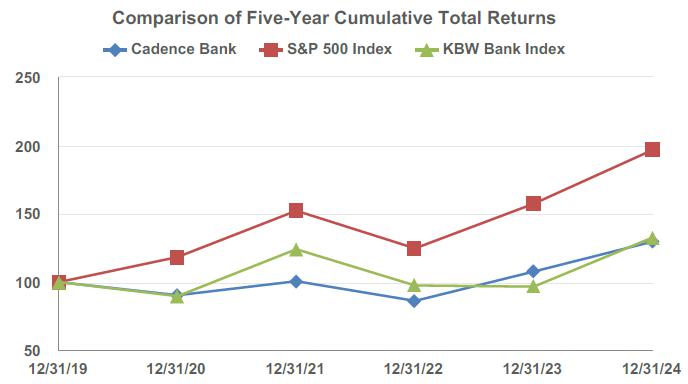
| Period Ending | ||||||||||||||||||||||||
| Index | 12/31/19 | 12/31/20 | 12/31/21 | 12/31/22 | 12/31/23 | 12/31/24 | ||||||||||||||||||
| Cadence Bank | 100.00 | 90.37 | 100.65 | 86.21 | 107.73 | 129.66 | ||||||||||||||||||
| S&P 500 Index | 100.00 | 118.39 | 152.34 | 124.73 | 157.48 | 196.85 | ||||||||||||||||||
| KBW Nasdaq Bank Index | 100.00 | 89.69 | 124.08 | 97.53 | 96.66 | 132.63 | ||||||||||||||||||
This stock performance graph and related information shall not be deemed to be “soliciting material” or to be “filed” or subject to Regulation 14A or 14C of the Exchange Act or to the liabilities of Section 18 of the Exchange Act, except to the extent that the Company specifically requests that such information be treated as soliciting material or specifically incorporates it by reference into such filing.
| 50 |
ITEM 7. MANAGEMENT’S DISCUSSION AND ANALYSIS OF FINANCIAL CONDITION AND RESULTS OF OPERATIONS.
OVERVIEW
The Company is a regional bank with dual headquarters in Houston, Texas and Tupelo, Mississippi with $47.0 billion in total assets at December 31, 2024. The Company has commercial banking operations in Alabama, Arkansas, Florida, Georgia, Louisiana, Mississippi, Missouri, Tennessee, and Texas. The Company and its subsidiaries provide commercial banking, leasing, mortgage origination and servicing, brokerage, trust, and investment advisory services to corporate customers, local governments, individuals, and other financial institutions through an extensive network of branches and offices.
Management’s discussion and analysis provides a narrative discussion of the Company’s financial condition and results of operations. For a complete understanding of the following discussion, refer to the consolidated financial statements and related notes presented elsewhere in this Report. Management’s discussion and analysis should also be read in conjunction with the risk factors included in Item 1A of this Report. This discussion and analysis is based on reported financial information, and certain amounts for prior years have been reclassified to conform with the current financial statement presentation.
The financial condition and operating results of the Company are heavily influenced by economic trends nationally and in the specific markets in which the Company’s subsidiaries provide financial services. Generally, the pressures of the national and regional economic cycle create a difficult operating environment for the financial services industry. During such times, the Company is not immune to pressures and any economic downturn may have a negative impact on the Company and its customers in all of the markets it serves. Management believes future weakness in the economic environment could adversely affect the strength of the credit quality of the Company’s assets. Therefore, management will continue to focus on early identification and resolution of credit issues.
The largest source of the Company’s revenue is derived from its corporate and community banking operations. The financial condition and operating results of the Company are affected by the level and volatility of interest rates on loans, investment securities, deposits, and other borrowed funds, and the impact of economic downturns on loan demand, collateral values, and creditworthiness of existing borrowers. The financial services industry is highly competitive and heavily regulated. The Company’s success depends on its ability to compete aggressively within its markets while maintaining sufficient asset quality and cost controls to generate net income.
The information that follows is provided to enhance comparability of financial information between periods and to provide a better understanding of the Company’s operations.
Significant 2024 Events and Recent Developments
During 2024, our results reflected improved financial performance resulting from various strategic accomplishments and continued success in business development. We continued to generate quality loans, increase our core customer deposits, reduce our debt and attract fee business, while maintaining strong liquidity and capital. We experienced strong revenue growth coupled with lower operating expenses, resulting in enhanced operating efficiency, while continuing to improve our net interest margin and reflect stable credit quality results. Also during 2024, the Company repurchased 1,237,021 shares of our common stock. We believe these results positively position our Company for continued and future success.
Effective May 17, 2024, the Company completed the sale of Cadence Business Solutions, LLC, its payroll processing business, resulting in a net gain on sale of approximately $12.0 million. The gain on sale was included in Other noninterest revenue within the accompanying consolidated statements of income.
In November 2024, Cadence Bank became a member bank of the Federal Reserve Board. As a result of this, the Company’s primary federal regulator is now the Federal Reserve Bank of St. Louis.
On January 22, 2025, the Company announced it entered into a definitive merger agreement with FCB Financial Corp., the bank holding company for First Chatham Bank, a Savannah, Georgia-based community bank. The merger has been unanimously approved by the boards of directors of both companies. Pending regulatory approval, the approval of FCB Financial Corp. shareholders, and the satisfaction of other customary closing conditions, it is anticipated to close during the third quarter of 2025.
| 51 |
NON-GAAP FINANCIAL MEASURES AND RECONCILIATIONS
In addition to financial ratios based on measures defined by GAAP, the Company has identified “total tangible shareholders’ equity,” “tangible common shareholders’ equity,” “total tangible common shareholders’ equity (excluding AOCI),” “total tangible assets,” “total tangible assets (excluding AOCI),” “tangible shareholders’ equity to tangible assets,” “tangible common shareholders’ equity to tangible assets,” “tangible common shareholders’ equity to tangible assets (excluding AOCI),” “tangible common book value per share,” and “tangible book value per common share (excluding AOCI)” as non-GAAP financial measures used when evaluating the performance of the Company.
| ● | Total tangible shareholders’ equity is defined by the Company as total shareholders’ equity less goodwill and other intangible assets, net. |
| ● | Total tangible common shareholders’ equity is defined by the Company as total shareholders’ equity less preferred stock, goodwill, and other intangible assets, net. |
| ● | Total tangible common shareholders’ equity, excluding AOCI, is defined by the Company as total shareholders’ equity less preferred stock, goodwill, other intangible assets, net, and AOCI. |
| ● | Total tangible assets are defined by the Company as total assets less goodwill and other intangible assets, net. |
| ● | Total tangible assets, excluding AOCI, are defined by the Company as total assets less goodwill, other intangible assets, net, and AOCI. |
| ● | Tangible common book value per share is defined by the Company as tangible common shareholders’ equity divided by total shares of common stock outstanding. |
| ● | Tangible book value per common share, excluding AOCI, is defined by the Company as tangible common shareholders’ equity less AOCI divided by total shares of common stock outstanding. |
Management believes the ratios of tangible shareholders’ equity to tangible assets, tangible common shareholders’ equity to tangible assets and tangible common shareholders’ equity to tangible assets (excluding AOCI) to be important to investors who are interested in evaluating the adequacy of the Company’s capital levels. Management also believes that tangible common book value per share and tangible common book value per share (excluding AOCI) are important to investors who are interested in changes from period to period in book value per share exclusive of changes in intangible assets.
| 52 |
The following table reconciles these non-GAAP financial measures as presented above to GAAP financial measures as reflected in the Company’s consolidated financial statements for the periods indicated:
TABLE 1—NON-GAAP FINANCIAL MEASURES
| Year Ended December 31, | ||||||||||||
| (Dollars in thousands, except per share amounts) | 2024 | 2023 | 2022 | |||||||||
| Total tangible assets, excluding AOCI | ||||||||||||
| Total assets | $ | 47,019,190 | $ | 48,934,510 | $ | 48,653,414 | ||||||
| Less: Goodwill | 1,366,923 | 1,367,785 | 1,367,785 | |||||||||
| Other intangible assets, net | 83,190 | 100,191 | 119,579 | |||||||||
| Total tangible assets | $ | 45,569,077 | $ | 47,466,534 | $ | 47,166,050 | ||||||
| Less: AOCI | (694,495 | ) | (761,829 | ) | (1,222,538 | ) | ||||||
| Total tangible assets, excluding AOCI | $ | 46,263,572 | $ | 48,228,363 | $ | 48,388,588 | ||||||
| Total tangible common shareholders’ equity, excluding AOCI | ||||||||||||
| Total shareholders’ equity | $ | 5,569,683 | $ | 5,167,843 | $ | 4,311,374 | ||||||
| Less: Goodwill | 1,366,923 | 1,367,785 | 1,367,785 | |||||||||
| Other intangible assets, net | 83,190 | 100,191 | 119,579 | |||||||||
| Total tangible shareholders’ equity | $ | 4,119,570 | $ | 3,699,867 | $ | 2,824,010 | ||||||
| Less: Preferred stock | 166,993 | 166,993 | 166,993 | |||||||||
| Total tangible common shareholders’ equity | $ | 3,952,577 | $ | 3,532,874 | $ | 2,657,017 | ||||||
| Less: AOCI | (694,495 | ) | (761,829 | ) | (1,222,538 | ) | ||||||
| Total tangible common shareholders’ equity, excluding AOCI | $ | 4,647,072 | $ | 4,294,703 | $ | 3,879,555 | ||||||
| Total common shares outstanding | 183,527,575 | 182,871,775 | 182,437,265 | |||||||||
| Tangible shareholders’ equity to tangible assets | 9.04 | % | 7.79 | % | 5.99 | % | ||||||
| Tangible common shareholders’ equity to tangible assets | 8.67 | % | 7.44 | % | 5.63 | % | ||||||
| Tangible common shareholders’ equity, excluding AOCI, to tangible assets, excluding AOCI | 10.04 | % | 8.90 | % | 8.02 | % | ||||||
| Tangible common book value per share | $ | 21.54 | $ | 19.32 | $ | 14.56 | ||||||
| Tangible book value per common share, excluding AOCI | $ | 25.32 | $ | 23.48 | $ | 21.27 | ||||||
| 53 |
FINANCIAL HIGHLIGHTS
The following table presents financial highlights for the periods indicated:
TABLE 2—FINANCIAL HIGHLIGHTS
| As of and For the Year Ended December 31, | ||||||||||||
| 2024 | 2023 | 2022 | ||||||||||
| Common share data: | ||||||||||||
| Basic earnings (loss) per share from continuing operations | $ | 2.81 | $ | (0.03 | ) | $ | 2.39 | |||||
| Basic earnings per share | 2.81 | 2.92 | 2.47 | |||||||||
| Diluted earnings (loss) per share from continuing operations | 2.77 | (0.03 | ) | 2.37 | ||||||||
| Diluted earnings per share | 2.77 | 2.92 | 2.46 | |||||||||
| Cash dividends per share | 1.00 | 0.94 | 0.88 | |||||||||
| Book value per share | 29.44 | 27.35 | 22.72 | |||||||||
| Tangible common book value per share (1) | 21.54 | 19.32 | 14.56 | |||||||||
| Tangible book value per common share, excluding AOCI (1) | 25.32 | 23.48 | 21.27 | |||||||||
| Dividend payout ratio from continuing operations | 36.10 | % | NM | 37.13 | % | |||||||
| Financial Ratios: | ||||||||||||
| Return on average assets from continuing operations | 1.09 | % | 0.01 | % | 0.94 | % | ||||||
| Return on average assets | 1.09 | 1.11 | 0.97 | |||||||||
| Return on average shareholders’ equity from continuing operations | 9.78 | 0.08 | 9.78 | |||||||||
| Return on average shareholders’ equity | 9.78 | 12.08 | 10.13 | |||||||||
| Return on average common shareholders’ equity from continuing operations | 9.91 | (0.13 | ) | 9.93 | ||||||||
| Return on average common shareholders’ equity | 9.91 | 12.33 | 10.30 | |||||||||
| Total shareholders’ equity to total assets | 11.85 | 10.56 | 8.86 | |||||||||
| Total common shareholders’ equity to total assets | 11.49 | 10.22 | 8.52 | |||||||||
| Tangible common shareholders’ equity to tangible assets (1) | 8.67 | 7.44 | 5.63 | |||||||||
| Tangible common shareholders’ equity, excluding AOCI, to tangible assets, excluding AOCI (1) | 10.04 | 8.90 | 8.02 | |||||||||
| Net interest margin-FTE | 3.30 | 3.08 | 3.15 | |||||||||
| Credit Quality Ratios: | ||||||||||||
| Net charge-offs to average loans and leases | 0.24 | % | 0.23 | % | —% | |||||||
| Provision for credit losses to average loans and leases | 0.21 | 0.25 | 0.02 | |||||||||
| ACL to net loans and leases | 1.37 | 1.44 | 1.45 | |||||||||
| ACL to NPL | 174.09 | 216.54 | 410.22 | |||||||||
| ACL to NPA | 170.38 | 210.46 | 386.04 | |||||||||
| NPL to net loans and leases | 0.78 | 0.67 | 0.35 | |||||||||
| NPA to total assets | 0.58 | 0.45 | 0.23 | |||||||||
| Capital Adequacy Ratios: | ||||||||||||
| Common Equity Tier 1 capital | 12.35 | % | 11.62 | % | 10.22 | % | ||||||
| Tier 1 capital | 12.79 | 12.06 | 10.66 | |||||||||
| Total capital | 13.97 | 14.32 | 12.81 | |||||||||
| Tier 1 leverage capital | 10.41 | 9.30 | 8.43 | |||||||||
| (1) | Non-GAAP financial measure. See “Non-GAAP Financial Measures and Reconciliations.” |
| 54 |
As of December 31, 2024, the target range for the federal funds rate was 4.25% to 4.50%. In the fourth quarter of 2024, the Federal Reserve lowered interest rates by 100 basis points, easing monetary policy for the first time in four years. There could potentially be more rate cuts in 2025, however, the Federal Reserve continues to monitor relevant economic data and economic policy changes. The prior years’ increases in interest rates has had a pronounced effect on both our balance sheet as well as our earnings. As seen in the following sections, the increase in net interest revenue for 2024 compared to 2023 and 2023 compared to 2022 resulted from a combination of higher yields on interest-earning assets and a shift in the mix of interest-earning assets. The increase was partially offset by an increase in interest expense, primarily on deposits due to both a mix shift out of noninterest bearing and into interest bearing, and an increase in deposit rates. See “Net Interest Revenue” for further information.
The Company reported net income available to common shareholders of $514.1 million in 2024, compared to $532.8 million in 2023. Key factors contributing to the $18.7 million decrease in net income available to common shareholders included (1) the $706.6 million gain, included in discontinued operations in 2023, on the sale of Cadence Insurance; mostly offset by (2) the increase in noninterest revenue primarily due to the $435.6 million loss on sale of securities in 2023 as a result of our securities portfolio restructuring during that period; and (3) the decrease in noninterest expense from $1.2 billion in 2023 to $1.0 billion in 2024 as a result of lower deposit insurance, personnel costs and merger costs. Net interest revenue increased slightly, remaining at $1.4 billion in 2024 and 2023. The Company recorded a provision for credit losses of $71.0 million and $80.0 million for 2024 and 2023, respectively.
Net income available to common shareholders was $532.8 million in 2023, compared to $453.7 million in 2022. The primary factor contributing to the $79.1 million increase in net income available to common shareholders in 2023 was the $706.6 million gain on the sale of Cadence Insurance, included in discontinued operations. The gain in discontinued operations was partially offset by the $458.8 million decrease in noninterest revenue in 2023 primarily due to the $435.6 million loss on sale of securities as a result of our securities portfolio restructuring during that period. Also contributing to the decline was an increase in noninterest expense from $1.1 billion in 2022 to $1.2 billion in 2023 due to deposit insurance assessments related to the FDIC special assessment. Net interest revenue remained flat at $1.4 billion for 2023 and 2022. The Company recorded a provision for credit losses of $80.0 million and $7.0 million for 2023 and 2022, respectively.
Net interest revenue for 2024 increased $84.9 million, or 6.3% to $1.4 billion compared to 2023. The increase was primarily related to increased interest rates which resulted in an increase on yields earned on interest-earning assets coupled with growth in average balances in the loan and lease portfolio and other investments. This increase was partially offset by the increase in interest expense due to increased market interest rates paid on average interest bearing liabilities for deposits, as well as a mix shift from noninterest bearing deposits into interest bearing. With the increase in rates paid on average interest bearing liabilities, interest expense increased $152.3 million, or 15.9%, in 2024 compared to 2023. See Table 4 below for more information on yield/ rate analysis.
Net interest revenue for 2023 and 2022 remained relatively flat at $1.4 billion. In 2023, interest revenue increased due to increased interest rates which resulted in an increase on yields earned on interest-earning assets coupled with growth in average balances in the loan and lease portfolio. The increase in interest revenue was mostly offset by the increase in interest expense due to increased market interest rates paid on average interest bearing liabilities for deposits and short-term borrowings, as well as a mix shift from noninterest bearing deposits into interest bearing. Average interest-bearing liabilities increased to $32.7 billion in 2023 from $28.5 billion in 2022. As a result of the increase in average interest-bearing liabilities coupled with the increase in rates paid on average interest bearing liabilities, interest expense increased $749.5 million, or 358.1%, in 2023, compared to 2022. See Table 4 below for more information on yield/rate analysis.
The Company attempts to diversify its revenue streams with noninterest revenue received from wealth management activities, mortgage banking operations, and other activities that generate fee income. Noninterest revenue for 2024 was $356.5 million, compared to negative $116.3 million for 2023. The primary contributor to the increase in noninterest revenue was a decrease in security net losses of $432.7 million as a result of securities portfolio restructuring in 2023. Other factors contributing to the increase included increases in deposit service charges of $11.8 million, wealth management revenue of $8.0 million, and other noninterest revenue of $21.6 million, primarily due to the gain on sale of Cadence Business Solutions, LLC. These increases were partially offset by a $1.7 million decrease in mortgage banking revenue. Excluding security net losses, noninterest revenue for 2024, was $359.5 million, an increase of $40.2 million, or 12.6%, from $319.3 million in 2023. See “Noninterest Revenue” below for more information.
Noninterest revenue for 2023 was negative $116.3 million, compared to $342.5 million for 2022. The primary contributors to the decrease in noninterest revenue from 2022 to 2023 were increased security losses of $435.3 million as a result of our securities portfolio restructuring in 2023 and a decrease in mortgage banking revenue of $25.9 million driven by the rate environment. These decreases were partially offset by a $16.0 million increase in other noninterest revenue across various smaller fee revenue sources. Excluding security gains and losses, noninterest revenue for 2023, was $319.3 million, a decrease of $23.6 million or 6.9% from $342.9 million compared to 2022. See “Noninterest Revenue” below for more information.
Noninterest expense in 2024 decreased 9.6% to $1.0 billion from $1.2 billion in 2023. The decrease in noninterest expense in 2024 compared to 2023 was primarily a result of decreases in salaries and employee benefits, other noninterest expense, deposit insurance assessments, pension settlement expense and merger expense, partially offset by increases in occupancy and equipment and data processing and software. Deposit insurance assessments decreased $32.3 million, or 44.7%, in 2024 compared to 2023, primarily due to the FDIC special assessment recorded in 2023. In 2024, salaries and employee benefits decreased $25.4 million, or 4.0%, compared to 2023 primarily due to an increase in deferred salaries from increased loan production in 2024 and certain contractual one-time compensation payments made in 2023. Decreases in other noninterest expense for 2024 compared to 2023 included decreases in legal, operational losses and various other miscellaneous expenses. See “Noninterest Expense” below for more information.
Noninterest expense in 2023 increased 4.2% to $1.2 billion from $1.1 billion for 2022. The increase in noninterest expense in 2023 compared to 2022 was primarily a result of increases in deposit insurance assessments related to the FDIC special assessment and other noninterest expense, partially offset by decreases in merger expense. In 2023, salaries and employee benefits remained relatively flat compared to 2022. See “Noninterest Expense” below for more information.
| 55 |
RESULTS OF OPERATIONS
The following is a summary of our results of operations for the periods indicated:
TABLE 3—SUMMARY OF RESULTS OF OPERATIONS
| Year Ended December 31, | ||||||||||||
| (Dollars in thousands) | 2024 | 2023 | 2022 | |||||||||
| Earnings Summary: | ||||||||||||
| Interest revenue | $ | 2,547,357 | $ | 2,310,167 | $ | 1,560,581 | ||||||
| Interest expense | 1,111,142 | 958,811 | 209,290 | |||||||||
| Net interest revenue | 1,436,215 | 1,351,356 | 1,351,291 | |||||||||
| Provision for credit losses | 71,000 | 80,000 | 7,000 | |||||||||
| Net interest revenue, after provision for credit losses | 1,365,215 | 1,271,356 | 1,344,291 | |||||||||
| Noninterest revenue | 356,510 | (116,343 | ) | 342,485 | ||||||||
| Noninterest expense | 1,045,528 | 1,155,923 | 1,109,754 | |||||||||
| Income (Loss) from continuing operations, before income taxes | 676,197 | (910 | ) | 577,022 | ||||||||
| Income tax expense (benefit) | 152,593 | (4,594 | ) | 129,705 | ||||||||
| Income from continuing operations | 523,604 | 3,684 | 447,317 | |||||||||
| Income from discontinued operations, before income taxes | — | 727,591 | 22,353 | |||||||||
| Income tax expense from discontinued operations | — | 188,971 | 6,433 | |||||||||
| Income from discontinued operations, net of income taxes | — | 538,620 | 15,920 | |||||||||
| Net income | 523,604 | 542,304 | 463,237 | |||||||||
| Less: preferred dividends | 9,488 | 9,488 | 9,488 | |||||||||
| Net income available to common shareholders | $ | 514,116 | $ | 532,816 | $ | 453,749 | ||||||
Net Interest Revenue
Net interest revenue is the difference between interest revenue earned on assets, such as loans, leases and securities, and interest expense paid on liabilities, such as deposits and borrowings, and continues to provide the Company with its principal source of revenue. Net interest revenue is affected by the general level of interest rates, changes in interest rates and changes in the amount and composition of interest earning assets and interest bearing liabilities. One of the Company’s long-term objectives is to manage interest earning assets and interest bearing liabilities to maximize net interest revenue, while balancing interest rate, credit and liquidity risk. Net interest margin is determined by dividing FTE net interest revenue by average earning assets. For purposes of the following discussion, revenue from tax-exempt loans and investment securities have been adjusted to an FTE basis, using an effective tax rate of 21% for the years ended December 31, 2024, 2023, and 2022.
| 56 |
The following table presents average interest earning assets, average interest bearing liabilities, net interest revenue- FTE, net interest margin-FTE and net interest rate spread for each of the periods presented:
TABLE 4—CONSOLIDATED AVERAGE BALANCES AND YIELD/RATE ANALYSIS
| 2024 | 2023 | 2022 | ||||||||||||||||||||||||||||||||||
| Average | Yield/ | Average | Yield/ | Average | Yield/ | |||||||||||||||||||||||||||||||
| (Dollars in thousands) | Balance | Interest | Rate | Balance | Interest | Rate | Balance | Interest | Rate | |||||||||||||||||||||||||||
| ASSETS | ||||||||||||||||||||||||||||||||||||
| Loans and leases (net of unearned income)(1)(2) | $ | 33,107,659 | $ | 2,166,565 | 6.54 | % | $ | 31,913,925 | $ | 2,006,549 | 6.29 | % | $ | 28,418,658 | $ | 1,344,195 | 4.73 | % | ||||||||||||||||||
| Loans held for sale, at fair value | 111,156 | 6,161 | 5.54 | 85,961 | 4,450 | 5.18 | 122,079 | 7,554 | 6.19 | |||||||||||||||||||||||||||
| Available for sale securities, at fair value: | ||||||||||||||||||||||||||||||||||||
| Taxable | 7,881,989 | 243,466 | 3.09 | 9,971,325 | 208,122 | 2.09 | 13,163,403 | 183,915 | 1.40 | |||||||||||||||||||||||||||
| Tax-exempt (3) | 80,880 | 3,289 | 4.07 | 351,010 | 11,653 | 3.32 | 432,969 | 12,758 | 2.95 | |||||||||||||||||||||||||||
| Other investments | 2,450,623 | 130,499 | 5.33 | 1,629,036 | 83,577 | 5.13 | 923,861 | 16,371 | 1.77 | |||||||||||||||||||||||||||
| Total interest earning assets and revenue | 43,632,307 | 2,549,980 | 5.84 | % | 43,951,257 | 2,314,351 | 5.27 | % | 43,060,970 | 1,564,793 | 3.63 | % | ||||||||||||||||||||||||
| Other assets | 4,812,184 | 5,204,505 | 4,911,883 | |||||||||||||||||||||||||||||||||
| Allowance for credit losses | 471,212 | 451,809 | 439,696 | |||||||||||||||||||||||||||||||||
| Total | $ | 47,973,279 | $ | 48,703,953 | $ | 47,533,157 | ||||||||||||||||||||||||||||||
| LIABILITIES AND SHAREHOLDERS’ EQUITY | ||||||||||||||||||||||||||||||||||||
| Deposits: | ||||||||||||||||||||||||||||||||||||
| Interest bearing demand and money market | $ | 18,739,210 | $ | 573,826 | 3.06 | % | $ | 18,314,649 | $ | 472,723 | 2.58 | % | $ | 18,541,402 | 109,893 | 0.59 | % | |||||||||||||||||||
| Savings | 2,626,539 | 14,922 | 0.57 | 3,028,875 | 14,955 | 0.49 | 3,657,718 | 5,519 | 0.15 | |||||||||||||||||||||||||||
| Time | 8,330,176 | 368,572 | 4.42 | 6,674,231 | 246,476 | 3.69 | 3,545,402 | 24,253 | 0.68 | |||||||||||||||||||||||||||
| Fed funds purchased, securities sold under agreement to repurchase and other | 86,171 | 4,131 | 4.79 | 800,170 | 32,590 | 4.07 | 923,973 | 13,432 | 1.45 | |||||||||||||||||||||||||||
| Short-term FHLB borrowings | — | — | — | 1,389,759 | 68,235 | 4.91 | 1,325,381 | 36,863 | 2.78 | |||||||||||||||||||||||||||
| Short-term BTFP borrowings | 2,845,902 | 136,404 | 4.79 | 2,052,055 | 104,696 | 5.10 | — | — | — | |||||||||||||||||||||||||||
| Subordinated and long-term borrowings | 306,396 | 13,287 | 4.34 | 452,645 | 19,136 | 4.23 | 465,004 | 19,330 | 4.16 | |||||||||||||||||||||||||||
| Total interest bearing liabilities and expense | 32,934,394 | 1,111,142 | 3.37 | % | 32,712,384 | 958,811 | 2.93 | % | 28,458,880 | 209,290 | 0.74 | % | ||||||||||||||||||||||||
| Demand deposits - noninterest bearing | 8,780,004 | 10,610,698 | 13,733,384 | |||||||||||||||||||||||||||||||||
| Other liabilities | 905,176 | 893,438 | 766,490 | |||||||||||||||||||||||||||||||||
| Total liabilities | 42,619,574 | 44,216,520 | 42,958,754 | |||||||||||||||||||||||||||||||||
| Shareholders’ equity | 5,353,705 | 4,487,433 | 4,574,403 | |||||||||||||||||||||||||||||||||
| Total | $ | 47,973,279 | $ | 48,703,953 | $ | 47,533,157 | ||||||||||||||||||||||||||||||
| Net interest revenue-FTE | $ | 1,438,838 | $ | 1,355,540 | $ | 1,355,503 | ||||||||||||||||||||||||||||||
| Net interest margin-FTE | 3.30 | % | 3.08 | % | 3.15 | % | ||||||||||||||||||||||||||||||
| Net interest rate spread | 2.47 | % | 2.33 | % | 2.90 | % | ||||||||||||||||||||||||||||||
| Interest bearing liabilities to interest earning assets | 75.48 | % | 74.43 | % | 66.09 | % | ||||||||||||||||||||||||||||||
| (1) | Includes taxable equivalent adjustment to interest of $1.9 million, $1.7 million and $1.5 million in 2024, 2023 and 2022, respectively, using an effective tax rate of 21% for all periods presented. |
| (2) | Nonaccrual loans are included in loans and leases (net of unearned income). Nonaccrual loans were $264.7 million, $216.1 million and $98.7 million in 2024, 2023 and 2022, respectively. |
| (3) | Includes taxable equivalent adjustment to interest of $0.7 million, $2.4 million and $2.7 million in 2024, 2023 and 2022, respectively, using an effective tax rate of 21% for all periods presented. |
| 57 |
Net interest revenue-FTE increased 6.1% to $1.4 billion in 2024 compared to 2023. The increase in net interest revenue-FTE was primarily due to increased interest rates on loans, investment securities and other investments and the shift in average balances of investment securities to loans, which resulted in an increase on yields earned on interest-earning assets.
This increase was offset by the increase in interest expense due to increased rates paid on average interest bearing deposits and a shift out of noninterest bearing deposits into time deposits. Average loans increased from 72.6% of average interest earning assets in 2023 to 75.9% in 2024.
Net interest revenue-FTE was flat at $1.4 billion in each of 2023 and 2022. The increase in interest revenue-FTE during 2023 was due to the increased interest rates which resulted in an increase on yields earned on interest-earning assets coupled with growth in average balances in the loan and lease portfolio. This increase was offset by the increased rates paid on average interest bearing liabilities for deposits and short-term borrowings, which also increased due to the rise in market interest rates. Average loans increased from 66.0% of average interest-earning assets in 2022 to 72.6% in 2023.
Interest revenue-FTE increased 10.2% to $2.5 billion in 2024, from $2.3 billion in 2023. The increase in interest revenue-FTE for 2024 was primarily a result of the increase in yields earned on loans due to the increase in market rates over the prior year, as well as the securities portfolio repositioning in late 2023 and improved earning asset mix from continued deployment of cash. Additionally, interest revenue-FTE included $11.9 million and $25.9 million in accretion related to the purchase discounts on acquired loans in 2024 and 2023, respectively.
Interest revenue-FTE increased 47.9% to $2.3 billion in 2023 from $1.6 billion in 2022. The increase in interest revenue-FTE for 2023 compared to 2022 was primarily a result of the increase in yields earned on interest-earning assets over the prior year due to the impact of rising interest rates on loan portfolio repricing activity and new loan production, as well as a mix shift as the Company deployed cash flow from lower yielding securities into higher yielding loans and available for sale securities. Additionally, interest revenue-FTE included $25.9 million and $46.8 million in accretion related to the purchase discounts on acquired loans in 2023 and 2022, respectively.
Interest expense increased 15.9% to $1.1 billion in 2024, compared to $958.8 million in 2023. The increase in interest expense for 2024 was primarily a result of the overall rates paid on average interest-bearing deposits increasing 60 basis points for 2024, compared to 2023, which was in response to increased interest rates, combined with customer migration from noninterest bearing deposits into time deposits.
Interest expense increased 358.1% to $958.8 million in 2023 from $209.3 million in 2022. The increase in interest expense for 2023 compared to 2022 was primarily a result of the overall rates paid on average interest-bearing liabilities increasing 219 basis points for 2023, compared to 2022 in response to rising interest rates and deposit competition combined with a mix shift out of noninterest bearing deposits into time deposits.
Net interest margin-FTE for 2024 was 3.30%, an increase of 22 basis points, from 3.08% for 2023, which represented a decrease of 7 basis points from 3.15% in 2022. Net interest revenue-FTE may also be analyzed by segregating the yield/rate and volume components of interest revenue and interest expense. The table below presents the components of our net interest revenue-FTE with the effect that the varying levels of interest-earning assets and interest-bearing liabilities and the applicable rates have had on changes in net interest revenue from 2023 to 2024 and from 2022 to 2023. The changes in net interest revenue-FTE due to both rate and volume have been allocated to volume and rate changes in proportion to the relationship of the absolute dollar amounts of the changes in each.
| 58 |
TABLE 5—RATE/VOLUME ANALYSIS
| 2024 vs 2023 | ||||||||||||||||||||
| Net Interest Revenue | Increase | |||||||||||||||||||
| (In thousands) | 2024 | 2023 | (Decrease) | Volume | Rate | |||||||||||||||
| INTEREST REVENUE | ||||||||||||||||||||
| Loans and leases, net of unearned income | $ | 2,166,565 | $ | 2,006,549 | $ | 160,016 | $ | 76,519 | $ | 83,497 | ||||||||||
| Loans held for sale | 6,161 | 4,450 | 1,711 | 1,379 | $ | 332 | ||||||||||||||
| Available for sale securities: | ||||||||||||||||||||
| Taxable | 243,466 | 208,122 | 35,344 | (49,969 | ) | 85,313 | ||||||||||||||
| Non-taxable | 3,289 | 11,653 | (8,364 | ) | (10,529 | ) | 2,165 | |||||||||||||
| Other | 130,499 | 83,577 | 46,922 | 43,639 | 3,283 | |||||||||||||||
| Total interest revenue-FTE | 2,549,980 | 2,314,351 | 235,629 | 61,039 | 174,590 | |||||||||||||||
| INTEREST EXPENSE | ||||||||||||||||||||
| Demand deposits - interest bearing | 573,826 | 472,723 | 101,103 | 11,184 | 89,919 | |||||||||||||||
| Savings deposits | 14,922 | 14,955 | (33 | ) | (2,127 | ) | 2,094 | |||||||||||||
| Time deposits | 368,572 | 246,476 | 122,096 | 67,889 | 54,207 | |||||||||||||||
| Fed funds purchased, securities sold under agreement to repurchase and other | 4,131 | 32,590 | (28,459 | ) | (33,376 | ) | 4,917 | |||||||||||||
| Short-term FHLB borrowings | — | 68,235 | (68,235 | ) | (34,117 | ) | (34,118 | ) | ||||||||||||
| Short-term BTFP borrowings | 136,404 | 104,696 | 31,708 | 38,381 | (6,673 | ) | ||||||||||||||
| Subordinated and long-term debt | 13,287 | 19,136 | (5,849 | ) | (6,330 | ) | 481 | |||||||||||||
| Total interest expense | 1,111,142 | 958,811 | 152,331 | 41,504 | 110,827 | |||||||||||||||
| Net interest revenue-FTE | $ | 1,438,838 | $ | 1,355,540 | $ | 83,298 | $ | 19,535 | $ | 63,763 | ||||||||||
| 2023 vs 2022 | ||||||||||||||||||||
| Net Interest Revenue | Increase | |||||||||||||||||||
| (In thousands) | 2023 | 2022 | (Decrease) | Volume | Rate | |||||||||||||||
| INTEREST REVENUE | ||||||||||||||||||||
| Loans and leases, net of unearned income | $ | 2,006,549 | $ | 1,344,195 | $ | 662,354 | $ | 180,129 | $ | 482,225 | ||||||||||
| Loans held for sale | 4,450 | 7,554 | (3,104 | ) | (2,000 | ) | $ | (1,104 | ) | |||||||||||
| Available for sale securities: | ||||||||||||||||||||
| Taxable | 208,122 | 183,915 | 24,207 | (51,852 | ) | 76,059 | ||||||||||||||
| Non-taxable | 11,653 | 12,758 | (1,105 | ) | (2,598 | ) | 1,493 | |||||||||||||
| Other | 83,577 | 16,371 | 67,206 | 19,295 | 47,911 | |||||||||||||||
| Total interest revenue-FTE | 2,314,351 | 1,564,793 | 749,558 | 142,974 | 606,584 | |||||||||||||||
| INTEREST EXPENSE | ||||||||||||||||||||
| Demand deposits - interest bearing | 472,723 | 109,893 | 362,830 | (1,360 | ) | 364,190 | ||||||||||||||
| Savings deposits | 14,955 | 5,519 | 9,436 | (1,100 | ) | 10,536 | ||||||||||||||
| Time deposits | 246,476 | 24,253 | 222,223 | 37,135 | 185,088 | |||||||||||||||
| Fed funds purchased, securities sold under agreement to repurchase and other | 32,590 | 13,432 | 19,158 | (2,024 | ) | 21,182 | ||||||||||||||
| Short-term FHLB borrowings | 68,235 | 36,863 | 31,372 | 1,872 | 29,500 | |||||||||||||||
| Short-term BTFP borrowings | 104,696 | — | 104,696 | 104,696 | — | |||||||||||||||
| Subordinated and long-term debt | 19,136 | 19,330 | (194 | ) | (519 | ) | 325 | |||||||||||||
| Total interest expense | 958,811 | 209,290 | 749,521 | 138,700 | 610,821 | |||||||||||||||
| Net interest revenue-FTE | $ | 1,355,540 | $ | 1,355,503 | $ | 37 | $ | 4,274 | $ | (4,237 | ) | |||||||||
| 59 |
Provision for Credit Losses and Allowance for Credit Losses (“ACL”)
An analysis of the ACL for loans for the periods indicated is provided in the following table:
TABLE 6—ACL
| Year Ended December 31, | ||||||||||||
| (In thousands) | 2024 | 2023 | 2022 | |||||||||
| Balance, beginning of period | $ | 468,034 | $ | 440,347 | $ | 446,415 | ||||||
| Charge-offs: | ||||||||||||
| Commercial and industrial | ||||||||||||
| Non-real estate | (76,694 | ) | (72,401 | ) | (17,874 | ) | ||||||
| Owner occupied | (379 | ) | (394 | ) | (824 | ) | ||||||
| Total commercial and industrial | (77,073 | ) | (72,795 | ) | (18,698 | ) | ||||||
| Commercial real estate | ||||||||||||
| Construction, acquisition and development | (779 | ) | (808 | ) | (298 | ) | ||||||
| Income producing | (2,503 | ) | (4,527 | ) | (1,832 | ) | ||||||
| Total commercial real estate | (3,282 | ) | (5,335 | ) | (2,130 | ) | ||||||
| Consumer | ||||||||||||
| Residential mortgages | (3,161 | ) | (2,264 | ) | (1,430 | ) | ||||||
| Other consumer | (6,888 | ) | (6,678 | ) | (7,606 | ) | ||||||
| Total consumer | (10,049 | ) | (8,942 | ) | (9,036 | ) | ||||||
| Total charge-offs | (90,404 | ) | (87,072 | ) | (29,864 | ) | ||||||
| Recoveries: | ||||||||||||
| Commercial and industrial | ||||||||||||
| Non-real estate | 8,004 | 7,541 | 14,165 | |||||||||
| Owner occupied | 511 | 1,582 | 2,292 | |||||||||
| Total commercial and industrial | 8,515 | 9,123 | 16,457 | |||||||||
| Commercial real estate | ||||||||||||
| Construction, acquisition and development | 418 | 622 | 4,352 | |||||||||
| Income producing | 447 | 1,071 | 3,521 | |||||||||
| Total commercial real estate | 865 | 1,693 | 7,873 | |||||||||
| Consumer | ||||||||||||
| Residential mortgages | 1,234 | 2,000 | 3,017 | |||||||||
| Other consumer | 1,549 | 1,688 | 2,566 | |||||||||
| Total consumer | 2,783 | 3,688 | 5,583 | |||||||||
| Total recoveries | 12,163 | 14,504 | 29,913 | |||||||||
| Net (charge-offs) recoveries | (78,241 | ) | (72,568 | ) | 49 | |||||||
| Initial allowance on PCD loans | — | — | (8,117 | ) | ||||||||
| Adoption of new ASU related to modified loans (1) | — | 255 | — | |||||||||
| Provision: | ||||||||||||
| Provision for credit losses related to loans and leases (2) | 71,000 | 100,000 | 2,000 | |||||||||
| Balance, end of period | $ | 460,793 | $ | 468,034 | $ | 440,347 | ||||||
| Loans and leases, net of unearned income - average | $ | 33,107,659 | $ | 31,913,925 | $ | 28,418,658 | ||||||
| Loans and leases, net of unearned income - period end | $ | 33,741,755 | $ | 32,497,022 | $ | 30,349,277 | ||||||
| (1) | Cadence adopted the new accounting guidance effective January 1, 2023, which eliminates the TDR recognition and measurement guidance via the modified retrospective transition method (ASU 2022-02). |
| (2) | Provision (reversal) for unfunded commitments was zero, $(20.0) million and $5.0 million in 2024, 2023 and 2022, respectively. |
| 60 |
TABLE 7—ACL RELATED RATIOS
| Year Ended December 31, | ||||||||||||
| 2024 | 2023 | 2022 | ||||||||||
| RATIOS | ||||||||||||
| Provision for credit losses to average loans and leases, net of unearned income | 0.21 | % | 0.25 | % | 0.02 | % | ||||||
| ACL to loans and leases, net of unearned income | 1.37 | 1.44 | 1.45 | |||||||||
| Nonperforming loans to loans and leases, net of unearned income | 0.78 | 0.67 | 0.35 | |||||||||
| ACL to nonperforming loans | 174.09 | 216.54 | 410.22 | |||||||||
| Net charge-offs (recoveries) to average loans and leases: | ||||||||||||
| Commercial and industrial | ||||||||||||
| Non-real estate | 0.21 | % | 0.20 | % | 0.01 | % | ||||||
| Total commercial and industrial | 0.21 | 0.20 | 0.01 | |||||||||
| Commercial real estate | ||||||||||||
| Construction, acquisition and development | — | — | (0.01 | ) | ||||||||
| Income producing | 0.01 | 0.01 | (0.01 | ) | ||||||||
| Total commercial real estate | 0.01 | 0.01 | (0.02 | ) | ||||||||
| Consumer | ||||||||||||
| Residential mortgages | — | — | (0.01 | ) | ||||||||
| Other consumer | 0.02 | 0.02 | 0.02 | |||||||||
| Total consumer | 0.02 | 0.02 | 0.01 | |||||||||
| Total | 0.24 | % | 0.23 | % | — | % | ||||||
For the years ended December 31, 2024, 2023, and 2022, net charge-offs totaled $78.2 million, compared to net charge-offs of $72.6 million and net recoveries of $49 thousand, respectively. As a percentage of average loans and leases, net charge-offs totaled 0.24% in 2024 compared to 0.23% in 2023. For 2022, net recoveries as a percentage of average loans and leases were insignificant. Net charge-offs in 2024 were primarily in the commercial and industrial non-real estate loan segment and centered in Corporate Banking due to a few larger credits. Net charge-offs in 2023 were also primarily in the commercial and industrial non-real estate loan segment. In 2022, net recoveries were primarily in the commercial real estate segment and residential mortgages class offset somewhat by net charge-offs in the other consumer class.
The Company recorded $71.0 million in provision for credit losses ($71.0 million for loans and zero for unfunded commitments) during 2024, compared to $80.0 million ($100.0 million for loans and $(20.0) million for unfunded commitments) for 2023 and $7.0 million ($2.0 million for loans and $5.0 million for unfunded commitments) during 2022.
The 2024 provision for credit losses is primarily attributable to loan portfolio growth combined with the resolution of a small number of larger problem credits heavily weighted to the Corporate Banking segment of the bank. The 2023 provision for credit losses is primarily attributable to increases in the ACL allocated to the commercial and industrial segment due to higher specific reserves combined with credit migration within the commercial and industrial and consumer segments. The $7.0 million of provision for credit losses recorded during 2022 was related to the provision for unfunded commitments of $5.0 million and $2.0 million for provision related to loans and leases.
The ACL decreased $7.2 million to $460.8 million at December 31, 2024, from $468.0 million at December 31, 2023. This decrease was primarily seen in the commercial and industrial loan segment due to resolutions on some larger problem credits occurring during the year. The ACL to nonperforming loans decreased to 174.09% at December 31, 2024, from 216.54% at December 31, 2023. For more information about the Company’s classified, nonperforming, purchased credit deteriorated, and impaired loans, see “Item 7. Management’s Discussion and Analysis of Financial Condition and Results of Operations - Financial Condition - Loans and Leases” in Part II of this Report.
| 61 |
The breakdown of the ACL by loan and lease segment and class is based, in part, on evaluations of specific loan and lease histories and the impact of forecasted economic conditions on the portfolio segments. Accordingly, because these conditions are subject to change, the allocation is not necessarily indicative of the breakdown of any future allowance for credit losses. Several economic forecasts from external sources are used in the estimation and allocation of the ACL. The forecasts cover an eight-quarter forecast horizon to establish a forecast range and are based on upside, downside, and base case scenarios. A blended scenario is selected by management to reflect the probable economic conditions within the range. As of December 31, 2024, the forecast was weighted more heavily to a base forecast compared to a more balanced forecast weighting between the base and downside scenarios as of December 31, 2023. This was a result of management’s view of the risk of heightened inflation and a recession easing over time.
The Company recognizes that higher interest rates, inflation, and slower economic growth may have short-term, long-term, and regional impacts to the economy. In addition, qualitative factors such as changes in economic conditions, concentrations of risk, and changes in portfolio risk resulting from regulatory changes are considered in determining the adequacy of the level of the ACL (see Notes 1 and 5 to the consolidated financial statements).
TABLE 8—ACL BY SEGMENT AND CLASS
| December 31, 2024 | December 31, 2023 | |||||||||||||||
| % of Loans in | % of Loans in | |||||||||||||||
| Each Category | Each Category | |||||||||||||||
| (Dollars in thousands) | ACL | to Total Loans | ACL | to Total Loans | ||||||||||||
| Commercial and industrial | ||||||||||||||||
| Non-real estate | $ | 183,743 | 25.7 | % | $ | 194,577 | 27.5 | % | ||||||||
| Owner occupied | 35,177 | 13.8 | 31,445 | 13.4 | ||||||||||||
| Total commercial and industrial | 218,920 | 39.5 | 226,022 | 40.9 | ||||||||||||
| Commercial real estate | ||||||||||||||||
| Construction, acquisition and development | 44,703 | 11.6 | 42,118 | 12.0 | ||||||||||||
| Income producing | 64,957 | 17.8 | 69,209 | 17.7 | ||||||||||||
| Total commercial real estate | 109,660 | 29.4 | 111,327 | 29.7 | ||||||||||||
| Consumer | ||||||||||||||||
| Residential mortgages | 125,464 | 30.4 | 124,851 | 28.7 | ||||||||||||
| Other consumer | 6,749 | 0.7 | 5,834 | 0.7 | ||||||||||||
| Total consumer | 132,213 | 31.1 | 130,685 | 29.4 | ||||||||||||
| Total | $ | 460,793 | 100.0 | % | $ | 468,034 | 100.0 | % | ||||||||
| 62 |
Noninterest Revenue
The components of noninterest revenue from continuing operations for the years ended December 31, 2024, 2023, and 2022, and the percentage change between the periods are shown in the following table:
TABLE 9—NONINTEREST REVENUE
| 2024 | 2023 | 2022 | ||||||||||||||||||
| (Dollars in thousands) | Amount | % Change | Amount | % Change | Amount | |||||||||||||||
| Trust and asset management income (1) | $ | 48,507 | 14.1 | % | $ | 42,513 | 11.3 | % | $ | 38,198 | ||||||||||
| Investment advisory fees (1) | 33,660 | 7.2 | 31,403 | 9.9 | 28,580 | |||||||||||||||
| Brokerage and annuity fees(1) | 12,755 | (2.0 | ) | 13,012 | (5.1 | ) | 13,708 | |||||||||||||
| Deposit service charges | 73,497 | 19.1 | 61,718 | (16.0 | ) | 73,478 | ||||||||||||||
| Credit card, debit card and merchant fees | 50,245 | 0.9 | 49,784 | (14.4 | ) | 58,160 | ||||||||||||||
| Mortgage banking, excluding MSR and MSR hedge market value adjustment | 33,455 | (0.9 | ) | 33,763 | (7.3 | ) | 36,434 | |||||||||||||
| MSR and MSR hedge market value adjustment | (16,152 | ) | (9.2 | ) | (14,785 | ) | (275.5 | ) | 8,426 | |||||||||||
| Securities losses, net | (2,962 | ) | 99.3 | (435,652 | ) | NM | (384 | ) | ||||||||||||
| Bank-owned life insurance | 17,716 | 8.7 | 16,294 | 4.5 | 15,594 | |||||||||||||||
| Credit related fees | 27,352 | 1.9 | 26,830 | 0.2 | 26,768 | |||||||||||||||
| SBA income | 12,083 | 22.8 | 9,839 | (35.9 | ) | 15,341 | ||||||||||||||
| Other miscellaneous income | 66,354 | 35.6 | 48,938 | 73.6 | 28,182 | |||||||||||||||
| Total noninterest revenue | $ | 356,510 | 406.4 | % | $ | (116,343 | ) | (134.0 | )% | $ | 342,485 | |||||||||
| (1) | Included in wealth management revenue on the consolidated statements of income. |
|
| NM - not meaningful. | ||
Noninterest revenue for the year ended December 31, 2024 was $356.5 million, an increase of $472.9 million, or 406.4%, from 2023. Trust and asset management income increased $6.0 million for 2024 compared to 2023. The increase was primarily associated with increased fees and new business. Deposit service charges increased $11.8 million for 2024 compared to 2023. The increase was primarily attributable to increases in account analysis charges and in NSF and overdraft charges. Net securities losses decreased $432.7 million for 2024 compared to 2023. The decrease was primarily driven by securities portfolio restructurings that were executed as a part of a balance sheet optimization initiatives during the 2023, including the sale in early 2023 of $1.5 billion in U.S. Treasury available for sale securities generating a realized loss of $51.3 million, and the fourth quarter of 2023 sale of available for sale securities totaling approximately $3.1 billion in par value for a realized loss of approximately $384.5 million. There were $2.9 million in security losses recognized during 2024. Other miscellaneous income includes payroll processing revenue, foreign exchange revenue, wire transfer fees, and other miscellaneous items. Other miscellaneous income increased $17.4 million for 2024 compared to 2023. The increase includes the $12.0 million net gain recognized from the sale of business, $4.7 million net gain on the extinguishment of debt, and a decrease in tax credit investment amortization, offset by a decrease in dividend income during 2024.
Noninterest revenue for the year ended December 31, 2023 was, negative $116.3 million, a decrease of $458.8 million, or 134.0%, from 2022. Credit card, debit card and merchant fees decreased $8.4 million for 2023 compared to 2022. The decrease in 2023 is primarily driven by a decrease in vendor incentive revenue and a decrease in card interchange fees due to lower volume. Deposit service charge revenue decreased $11.8 million for 2023 compared to 2022. The decline is primarily attributable to an $8 million adjustment to deposit service charges, resulting from changes in deposit service charges. Net securities losses increased $435.3 million for 2023 compared to 2022. The increase in 2023 was primarily driven by the securities portfolio restructurings that were executed as a part of a balance sheet optimization initiative. During the first quarter of 2023, approximately $1.5 billion in U.S. Treasury available for sale securities were sold generating a realized loss of approximately $51.3 million. Additionally, in the fourth quarter of 2023, available for sale securities totaling approximately $3.1 billion in par value were sold for a realized loss of approximately $384.5 million. Proceeds from the sales were redeployed in accretive activities including reinvestment in higher-yielding securities, funding loans, and reducing higher cost brokered deposits. Credit related fees increased $0.1 million for 2023 compared to 2022. The increase was primarily driven by volume increases in agency fees, unused line of credit fees and letter of credit fees. Other miscellaneous income increased $20.8 million for 2023 compared to 2022. The increase was primarily driven by increases in dividend income from FHLB stock, earnings from limited partnerships, and advisory fees.
| 63 |
The Company’s revenue from mortgage banking typically fluctuates as mortgage interest rates change and is primarily attributable to two activities - the origination and sale of new mortgage loans and the servicing of sold mortgage loans. Origination revenue is comprised of gains or losses from the sale of mortgage loans held for sale, origination fees, underwriting fees and other fees associated with the origination of mortgage loans. For the years ended December 31, 2024 and 2023, mortgage loan held for sale origination volumes totaled $1.1 billion and $837.1 million, respectively, which produced origination revenue of $9.6 million and $9.9 million, respectively. The decrease in mortgage origination revenue was the result of lower margins on the mortgage loans held for sale that were sold during 2024 compared to 2023. During 2023, there was a production shift resulting in more mortgage loans held for investment rather than those held for sale. During 2024, the focus was shifted to a more even split between the two, which largely contributed to the higher volume of mortgage loans held for sale originated and sold during 2024.
For the years ended December 31, 2023, and 2022, mortgage loan held for sale origination volumes totaled $837.1 million and $1.1 billion, respectively, which produced origination revenue of $9.9 million and $12.9 million, respectively. The timing of increases in market interest rates caused decreases to the margins of loans sold and the volume of mortgage loans originated and sold for the year ended December 31, 2023 compared to 2022. Interest rates during 2023 were higher than 2022 due to the increase in the federal funds target rate set by the Federal Reserve during the last part of 2022 and throughout 2023, which largely contributed to the lower volumes of mortgages originated and sold.
Revenue from the mortgage servicing process includes fees from the actual servicing of mortgage loans. For the years ended December 31, 2024, 2023, and 2022, revenue from the servicing of mortgage loans were $23.8 million, $23.9 million, and $23.6 million respectively.
The Company services a class of residential mortgages that are first lien loans secured by a primary residence or second home. The MSR, which are recognized as a separate asset on the date the corresponding mortgage loan is sold on a servicing retained basis, is recorded at fair value as determined at each accounting period end. At December 31, 2024 and December 31, 2023 the estimated fair value of the MSR was $114.6 million and $106.8 million, respectively.
The Company is susceptible to significant fluctuations in MSR fair value during changing interest rate environments. The Company has an economic hedge in place on its MSR and uses various instruments (including but not limited to Treasury options, SOFR and TBA futures and forwards) to mitigate the interest rate risk associated with the MSR. These hedging instruments are reported at fair value, with adjustments included as part of mortgage banking revenue in the consolidated statements of income. At December 31, 2024, 2023, and 2022, this economic hedge covered approximately 75.1%, 73.1%, and 47.9%, respectively, of the MSR value. Reflecting this sensitivity to interest rates, the fair value of the MSR, including the hedge, experienced a decrease of $16.2 million during 2024, a decrease of $14.8 million during 2023, and an increase of $8.4 million during 2022.
The following table presents the Company’s mortgage banking operations for the periods indicated:
TABLE 10— MORTGAGE BANKING OPERATIONS
| 2024 | 2023 | 2022 | ||||||||||||||||||
| (Dollars in thousands) | Amount | % Change | Amount | % Change | Amount | |||||||||||||||
| Production revenue: | ||||||||||||||||||||
| Origination | $ | 9,617 | (3.0 | )% | $ | 9,910 | (23.0 | )% | $ | 12,869 | ||||||||||
| Servicing | 23,838 | (0.1 | ) | 23,853 | 1.2 | 23,565 | ||||||||||||||
| Total origination and servicing revenue | 33,455 | (0.9 | ) | 33,763 | (7.3 | ) | 36,434 | |||||||||||||
| MSR and hedge market value adjustment | (16,152 | ) | (9.2 | ) | (14,785 | ) | (275.5 | ) | 8,426 | |||||||||||
| Total mortgage banking revenue | $ | 17,303 | (8.8 | )% | $ | 18,978 | (57.7 | )% | $ | 44,860 | ||||||||||
| Origination of mortgage loans held for sale | $ | 1,140 | 36.2 | % | $ | 837 | (23.8 | )% | $ | 1,098 | ||||||||||
| Mortgage loans serviced at quarter-end | $ | 8,043 | 4.4 | % | $ | 7,703 | 0.1 | % | $ | 7,693 | ||||||||||
| 64 |
Noninterest Expense
The components of noninterest expense from continuing operations for the years ended December 31, 2024, 2023, and 2022, and the percentage change between periods is shown in the following table:
TABLE 11—NONINTEREST EXPENSE
| 2024 | 2023 | 2022 | ||||||||||||||||||
| (Dollars in thousands) | Amount | % Change | Amount | % Change | Amount | |||||||||||||||
| Salaries and employee benefits | $ | 609,307 | (4.0 | )% | $ | 634,722 | —% | $ | 634,843 | |||||||||||
| Occupancy and equipment | 114,175 | 2.9 | 110,972 | (3.0 | ) | 114,460 | ||||||||||||||
| Data processing and software | 121,884 | 1.2 | 120,443 | 8.4 | 111,107 | |||||||||||||||
| Merger expense | — | (100.0 | ) | 5,192 | (89.8 | ) | 50,845 | |||||||||||||
| Deposit insurance assessments | 39,922 | (44.7 | ) | 72,224 | 286.0 | 18,712 | ||||||||||||||
| Pension settlement expense | — | (100.0 | ) | 11,826 | 31.1 | 9,023 | ||||||||||||||
| Advertising and public relations | 22,112 | (21.5 | ) | 28,162 | (31.4 | ) | 41,055 | |||||||||||||
| Foreclosed property expense | 1,891 | (24.0 | ) | 2,488 | 199.0 | 832 | ||||||||||||||
| Telecommunications | 5,857 | 1.4 | 5,775 | (12.7 | ) | 6,617 | ||||||||||||||
| Travel and entertainment | 10,015 | (9.0 | ) | 11,004 | (3.5 | ) | 11,407 | |||||||||||||
| Amortization of intangibles | 15,902 | (18.0 | ) | 19,388 | 5.2 | 18,432 | ||||||||||||||
| Professional, consulting and outsourcing | 16,124 | (18.9 | ) | 19,892 | 48.2 | 13,424 | ||||||||||||||
| Legal | 12,279 | (38.9 | ) | 20,093 | 275.6 | 5,350 | ||||||||||||||
| Postage and shipping | 7,128 | (15.6 | ) | 8,443 | 7.3 | 7,868 | ||||||||||||||
| Other miscellaneous expense | 68,932 | (19.2 | ) | 85,299 | 29.7 | 65,779 | ||||||||||||||
| Total noninterest expense | $ | 1,045,528 | (9.6 | )% | $ | 1,155,923 | 4.2 | % | $ | 1,109,754 | ||||||||||
Noninterest expense for the year ended December 31, 2024 was $1.0 billion, a decrease of $110.4 million, or (9.6)%, from 2023. Occupancy and equipment increased $3.2 million for 2024 compared to 2023, primarily due to increases in building maintenance and security related expenses. Data processing and software expense increased $1.4 million for 2024 compared to 2023, largely driven by increases in external data processing volume and mobile and online banking costs, offset by a decrease in software maintenance costs. There were no merger expenses for 2024, compared to $5.2 million for 2023. Merger expenses in 2023 primarily included compensation related expenses. Deposit insurance assessments decreased $32.3 million for 2024 compared to 2023, primarily due to the FDIC special assessment recorded in 2023. Professional, consulting and outsourcing expenses decreased $3.8 million for 2024 compared to 2023, primarily due to decreases in outsourced services costs. Legal expense decreased $7.8 million for 2024 compared to 2023, as a result of a decline in legal settlement costs. Other miscellaneous expense decreased $16.4 million for 2024 compared to 2023, driven by decreases in operational losses ($6.1 million), pension costs ($3.6 million), loan related expenses ($3.2 million), and delivery related expenses ($2.1 million).
Noninterest expense for the year ended December 31, 2023, was $1.2 billion, an increase of $46.2 million, or 4.2%, from 2022. Occupancy and equipment decreased $3.5 million for 2023 compared to 2022, primarily due to a decrease of $4.2 million in building rent expense and a decrease of $1.3 million in equipment maintenance expense offset by an increase of $1.3 million in building maintenance expense. Data processing and software expense increased $9.3 million for 2023 compared to 2022, driven by increases in vendor costs, increased technology initiatives, software maintenance costs, and card processing expenses. Merger expense represents one-time expenses related to effecting the acquisition of another entity. Merger expenses for 2023 totaled $5.2 million compared to $50.8 million in 2022. These expenses in 2023 primarily included compensation related expenses. The expenses in 2022 primarily included costs related to the franchise-wide rebranding of the Company under the Cadence Bank name, as well as employee retention, marketing, and technology related expenses. Deposit insurance assessments increased $53.5 million for 2023 compared to 2022, primarily due to a $36.2 million FDIC special assessment recorded in 2023, and to a lesser extent, increased short-term borrowings and brokered deposits in 2023. Advertising and public relations expense decreased $12.9 million for 2023 compared to 2022, largely driven by incremental merger expenses related to the Company’s rebranding across our footprint. Amortization of intangibles increased $1.0 million for 2023 compared to 2022, primarily due to an adjustment to a core deposit intangible in 2023 resulting from a reassessment of the estimated remaining lives assigned to certain core deposit intangible assets. Professional, consulting and outsourcing increased $6.5 million for 2023 compared to 2022, primarily due to increases in consulting expenses and other professional fees. Legal expense increased $14.7 million for 2023 compared to 2022, largely driven by accruals for the settlement of certain legal matters. Other miscellaneous expense increased $19.5 million for 2023 compared to 2022, primarily driven by increased operational losses ($6.7 million), pension costs ($5.9 million), transit and delivery related fees ($3.3 million), and loan related expenses ($3.7 million).
| 65 |
Salaries and employee benefits expense was the largest category of our noninterest expense. Salaries and employee benefits decreased $25.4 million for 2024 compared to 2023. For 2023, salaries and employee benefits expense decreased $0.1 million compared to 2022. The decrease in 2024 was attributable to an increase in deferred salaries from increased mortgage loan production in 2024 and certain contractual one-time compensation payments made in 2023. The decrease in 2023 was primarily the result of a decrease in employee headcount resulting from the branch optimization project, partially offset by increases in retail incentives due to the Customer Connect program.
The components of salary and employee benefits expense for the periods indicated and the percentage change between years are shown in the following table:
TABLE 12—SALARIES AND EMPLOYEE BENEFITS EXPENSE
| 2024 | 2023 | 2022 | ||||||||||||||||||
| (Dollars in thousands) | Amount | % Change | Amount | % Change | Amount | |||||||||||||||
| Regular salaries, net of deferred salaries | $ | 373,366 | (9.6 | )% | $ | 413,226 | (6.1 | )% | $ | 440,273 | ||||||||||
| Commissions and incentive compensation | 129,816 | 15.1 | 112,772 | 14.8 | 98,244 | |||||||||||||||
| Taxes and employee benefits | 106,125 | (2.4 | ) | 108,724 | 12.9 | 96,326 | ||||||||||||||
| Total salaries and employee benefits | $ | 609,307 | (4.0 | )% | $ | 634,722 | —% | $ | 634,843 | |||||||||||
Income Taxes
The Company recorded an income tax expense from continuing operations of $152.6 million for the year ended December 31, 2024, compared to an income tax benefit from continuing operations of $4.6 million and an income tax expense of $129.7 million for the years ended December 31, 2023 and 2022, respectively. The increase in tax expense in 2024 can be attributed to higher pre-tax income. The tax benefit in 2023 can be attributed to lower pre-tax income as a result of the loss incurred due to the restructure of the securities portfolio.
The Company recorded zero income tax expense related to discontinued operations for the year ended December 31, 2024, compared to an income tax expense from discontinued operations of $189.0 million and $6.4 million for the years ended December 31, 2023 and 2022, respectively. There was no tax expense on discontinued operations in 2024 as the sale of Cadence Insurance closed in November 2023, and reported as a discontinued operation in 2023 and periods prior.
The effective tax rate on continuing operations was 22.6%, 504.8%, and 22.5% for the years ended December 31, 2024, 2023, and 2022, respectively. The decrease in the effective tax rate for 2024 and the increase in the effective tax rate for 2023 were both the result of the securities restructuring, as well as the disposition of Cadence Insurance and the associated gain on the sale being reported in discontinued operations.
In August 2022, the IRA of 2022 was signed into law to address inflation, healthcare costs, climate change and renewal energy incentives, among other things. Included in the IRA of 2022 are provisions for the creation of a 15% CAMT that is effective for tax years beginning January 1, 2023 for corporations with an average annual adjusted financial statement income in excess of $1 billion. For 2024, the Company is not subject to the 15% CAMT.
| 66 |
FINANCIAL CONDITION
The percentage of earning assets to total assets measures the effectiveness of management’s efforts to invest available funds representing the most efficient and profitable uses. Earning assets at December 31, 2024, were $42.4 billion, or 90.1% of total assets, compared with $44.2 billion, or 90.3% of total assets, at December 31, 2023.
TABLE 13—FINANCIAL CONDITION SUMMARY
| (In thousands) | As of and For the Year Ended December 31, 2024 |
As of and For the Year Ended December 31, 2023 |
||||||
| Period-End Balances: | ||||||||
| Total assets | $ | 47,019,190 | $ | 48,934,510 | ||||
| Available for sale securities | 7,293,988 | 8,075,476 | ||||||
| Loans and leases, net of unearned income | 33,741,755 | 32,497,022 | ||||||
| Total deposits | 40,496,201 | 38,497,137 | ||||||
| Securities sold under agreement to repurchase | 23,616 | 451,516 | ||||||
| Short-term BTFP borrowings | — | 3,500,000 | ||||||
| Subordinated and long-term borrowings | 10,706 | 438,460 | ||||||
| Total shareholders’ equity | 5,569,683 | 5,167,843 | ||||||
| Common shareholders’ equity | 5,402,690 | 5,000,850 | ||||||
| Average Balances: | ||||||||
| Total assets | 47,973,279 | 48,703,953 | ||||||
| Available for sale securities | 7,962,869 | 10,322,335 | ||||||
| Loans and leases, net of unearned income | 33,107,659 | 31,913,925 | ||||||
| Total deposits | 38,475,929 | 38,628,453 | ||||||
| Securities sold under agreement to repurchase | 81,092 | 770,777 | ||||||
| Federal funds purchased and short-term BTFP and FHLB borrowings | 2,850,981 | 3,471,207 | ||||||
| Subordinated and long-term borrowings | 306,396 | 452,645 | ||||||
| Total shareholders’ equity | 5,353,705 | 4,487,433 | ||||||
| Common shareholders’ equity | 5,186,712 | 4,320,440 | ||||||
| 67 |
Securities
The Company uses its securities portfolio as a source of revenue and liquidity, and to serve as collateral to secure certain types of deposits and borrowings. These securities, which are available for possible sale, are recorded at fair value. The following table shows the carrying value of the Company’s AFS securities by investment category for the periods indicated:
TABLE 14—AVAILABLE FOR SALE SECURITIES SUMMARY
| December 31, | ||||||||
| (In thousands) | 2024 | 2023 | ||||||
| Available for sale securities: | ||||||||
| U.S. Treasury securities | $ | — | $ | 465,018 | ||||
| U.S. government agency securities | 281,231 | 332,011 | ||||||
| MBS issued or guaranteed by U.S. agencies | ||||||||
| Residential pass-through: | ||||||||
| Guaranteed by GNMA | 66,581 | 75,662 | ||||||
| Issued by FNMA and FHLMC | 3,965,556 | 4,387,101 | ||||||
| Other residential MBS | 934,721 | 727,434 | ||||||
| Commercial MBS | 1,549,641 | 1,742,837 | ||||||
| Total MBS | 6,516,499 | 6,933,034 | ||||||
| Obligations of states and political subdivisions | 132,069 | 137,624 | ||||||
| Corporate debt securities | 47,402 | 67,197 | ||||||
| Foreign debt securities | 316,787 | 140,592 | ||||||
| Total | $ | 7,293,988 | $ | 8,075,476 | ||||
At December 31, 2024, the Company’s AFS securities totaled $7.3 billion compared to $8.1 billion at December 31, 2023. The decrease of $781.5 million, or 9.7%, was primarily driven by the maturities and paydowns of $1.6 billion and the sale of $15.1 million of AFS securities during the period. The decrease was offset by purchases of $751.8 million of higher yielding securities during the period.
Net unrealized losses on AFS securities at December 31, 2024 and December 31, 2023 totaled $853.7 million and $940.2 million, respectively. At December 31, 2024, management believes that the unrealized losses are due to noncredit- related factors, such as changes in interest rates and other market conditions (see Note 3 to the consolidated financial statements).
In 2023, the Company executed securities portfolio restructurings as a part of a balance sheet optimization initiative. During the first quarter of 2023, approximately $1.5 billion in U.S. Treasury AFS securities were sold generating an after-tax realized loss of approximately $39.5 million. Additionally, in the fourth quarter of 2023, AFS securities totaling approximately $3.1 billion in par value were sold for an after-tax realized loss of approximately $294.1 million. Proceeds from the sales were redeployed in accretive activities including reinvestment in higher-yielding securities, funding loans, and lowering higher-cost brokered deposits. Of the December 2023 sales proceeds, $2.1 billion was reinvested in securities.
| 68 |
The following table shows the maturities and weighted average yields for the carrying value of the AFS securities at the dates indicated:
TABLE 15—MATURITY DISTRIBUTION OF AFS SECURITIES
| December 31, 2024 | December 31, 2023 | |||||||||||||||
| (Dollars in thousands) | Estimated Fair Value |
Weighted Average Yield |
Estimated Fair Value |
Weighted Average Yield |
||||||||||||
| U.S. Treasury securities: | ||||||||||||||||
| Due in less than one year | $ | — | — | % | $ | 465,018 | 5.46 | % | ||||||||
| U.S. Treasury securities total | — | — | 465,018 | 5.46 | ||||||||||||
| U.S. government agency securities: | ||||||||||||||||
| Due in one to five years | 8,364 | 3.76 | 12,853 | 4.37 | ||||||||||||
| Due in five to ten years | 204,624 | 4.10 | 249,502 | 4.66 | ||||||||||||
| Due after ten years | 68,243 | 2.14 | 69,656 | 2.22 | ||||||||||||
| U.S. government agency securities total | 281,231 | 3.62 | 332,011 | 4.14 | ||||||||||||
| Obligations of states and political subdivisions: | ||||||||||||||||
| Due in less than one year | — | — | 1,835 | 2.84 | ||||||||||||
| Due in one to five years | 9,295 | 2.92 | 9,153 | 2.95 | ||||||||||||
| Due in five to ten years | 15,563 | 2.22 | 15,655 | 2.22 | ||||||||||||
| Due after ten years | 107,211 | 2.69 | 110,981 | 2.70 | ||||||||||||
| Obligations of states and political subdivisions total | 132,069 | 2.66 | 137,624 | 2.66 | ||||||||||||
| Corporate debt securities: | ||||||||||||||||
| Due in one to five years | — | — | 5,181 | 5.90 | ||||||||||||
| Due in five to ten years | 45,702 | 4.77 | 60,632 | 4.59 | ||||||||||||
| Due after ten years | 1,700 | 4.50 | 1,384 | 4.50 | ||||||||||||
| Corporate debt securities total | 47,402 | 4.76 | 67,197 | 4.69 | ||||||||||||
| Foreign debt securities: | ||||||||||||||||
| Due in one to five years | 87,855 | 3.36 | 51,507 | 2.25 | ||||||||||||
| Due in five to ten years | 228,932 | 5.16 | 89,085 | 5.86 | ||||||||||||
| Foreign debt securities total | 316,787 | 4.66 | 140,592 | 4.54 | ||||||||||||
| Total securities due in less than one year | — | — | 466,853 | 5.45 | ||||||||||||
| Total securities due in one to five years | 105,514 | 3.35 | 78,694 | 2.92 | ||||||||||||
| Total securities due in five to ten years | 494,821 | 4.59 | 414,874 | 4.82 | ||||||||||||
| Total securities due after ten years | 177,154 | 2.50 | 182,021 | 2.53 | ||||||||||||
| MBS | 6,516,499 | 2.87 | 6,933,034 | 2.54 | ||||||||||||
| Total estimated fair value | $ | 7,293,988 | 2.98 | % | $ | 8,075,476 | 2.83 | % | ||||||||
The weighted average yields reported in Table 15 have been calculated using the average daily balance of the related securities. The yields on tax-exempt obligations of states and political subdivisions have been adjusted to a taxable equivalent basis using a 21% tax rate.
| 69 |
Loans and Leases
The Company’s loans and leases held for investment portfolio represents the largest single component of the Company’s earning asset base. Average loans and leases comprised 75.9% and 72.6% of average earning assets during the years ended December 31, 2024 and 2023, respectively. The Company’s lending activities include both commercial and consumer loans and leases. The Company has established systematic procedures for approving and monitoring loans and leases that vary depending on the size and nature of the loan or lease and applies these procedures in a disciplined manner. The Company also acts as agent or participant in syndications and other financing arrangements with other financial institutions. The Company’s loans and leases are widely diversified by borrower and industry. Loans and leases, net of unearned income, totaled $33.7 billion at December 31, 2024, representing a 3.8% increase from $32.5 billion at December 31, 2023.
The following table shows the composition of the Company’s loan and lease portfolio by segment and class at the dates indicated:
TABLE 16—LOANS AND LEASES PORTFOLIO
| (In thousands) | December 31, 2024 | December 31, 2023 | ||||||
| Commercial and industrial | ||||||||
| Non-real estate | $ | 8,670,529 | $ | 8,935,598 | ||||
| Owner occupied | 4,665,015 | 4,349,060 | ||||||
| Total commercial and industrial | 13,335,544 | 13,284,658 | ||||||
| Commercial real estate | ||||||||
| Construction, acquisition and development | 3,909,184 | 3,910,962 | ||||||
| Income producing | 6,015,773 | 5,736,871 | ||||||
| Total commercial real estate | 9,924,957 | 9,647,833 | ||||||
| Consumer | ||||||||
| Residential mortgages | 10,267,883 | 9,329,692 | ||||||
| Other consumer | 213,371 | 234,839 | ||||||
| Total consumer | 10,481,254 | 9,564,531 | ||||||
| Total loans and leases, net of unearned income (1) | $ | 33,741,755 | $ | 32,497,022 | ||||
| (1) | Total loans and leases are net of $21.4 million and $38.4 million of unearned income at December 31, 2024 and December 31, 2023, respectively. |
The following table shows the Company’s loan and lease portfolio by segment and class at the dates indicated by geographical location.
TABLE 17—LOANS AND LEASES BY GEOGRAPHICAL LOCATION
| December 31, 2024 | ||||||||||||||||||||||||||||||||||||||||||||
| (In thousands) | Alabama | Arkansas | Florida | Georgia | Louisiana | Mississippi | Missouri | Tennessee | Texas | Other | Total | |||||||||||||||||||||||||||||||||
| Commercial and industrial | ||||||||||||||||||||||||||||||||||||||||||||
| Non-real estate | $ | 413,359 | $ | 169,534 | $ | 532,224 | $ | 446,812 | $ | 371,543 | $ | 536,651 | $ | 64,846 | $ | 399,346 | $ | 3,478,755 | $ | 2,257,459 | $ | 8,670,529 | ||||||||||||||||||||||
| Owner occupied | 337,580 | 253,538 | 308,545 | 400,342 | 298,787 | 624,950 | 107,443 | 159,058 | 1,708,113 | 466,659 | 4,665,015 | |||||||||||||||||||||||||||||||||
| Total commercial and industrial | 750,939 | 423,072 | 840,769 | 847,154 | 670,330 | 1,161,601 | 172,289 | 558,404 | 5,186,868 | 2,724,118 | 13,335,544 | |||||||||||||||||||||||||||||||||
| Commercial real estate | ||||||||||||||||||||||||||||||||||||||||||||
| Construction, acquisition and development | 230,810 | 65,358 | 438,173 | 543,249 | 36,194 | 169,336 | 45,690 | 180,566 | 1,656,715 | 543,093 | 3,909,184 | |||||||||||||||||||||||||||||||||
| Income producing | 437,146 | 259,767 | 477,493 | 613,337 | 226,849 | 424,078 | 204,119 | 319,560 | 2,298,344 | 755,080 | 6,015,773 | |||||||||||||||||||||||||||||||||
| Total commercial real estate | 667,956 | 325,125 | 915,666 | 1,156,586 | 263,043 | 593,414 | 249,809 | 500,126 | 3,955,059 | 1,298,173 | 9,924,957 | |||||||||||||||||||||||||||||||||
| Consumer | ||||||||||||||||||||||||||||||||||||||||||||
| Residential mortgages | 1,300,485 | 425,602 | 709,335 | 449,117 | 478,947 | 1,214,542 | 210,712 | 796,490 | 4,436,803 | 245,850 | 10,267,883 | |||||||||||||||||||||||||||||||||
| Other consumer | 27,186 | 17,653 | 5,002 | 7,817 | 10,653 | 86,059 | 1,322 | 16,668 | 36,559 | 4,452 | 213,371 | |||||||||||||||||||||||||||||||||
| Total consumer | 1,327,671 | 443,255 | 714,337 | 456,934 | 489,600 | 1,300,601 | 212,034 | 813,158 | 4,473,362 | 250,302 | 10,481,254 | |||||||||||||||||||||||||||||||||
| Total | $ | 2,746,566 | $ | 1,191,452 | $ | 2,470,772 | $ | 2,460,674 | $ | 1,422,973 | $ | 3,055,616 | $ | 634,132 | $ | 1,871,688 | $ | 13,615,289 | $ | 4,272,593 | $ | 33,741,755 | ||||||||||||||||||||||
| 70 |
| December 31, 2023 | ||||||||||||||||||||||||||||||||||||||||||||
| (In thousands) | Alabama | Arkansas | Florida | Georgia | Louisiana | Mississippi | Missouri | Tennessee | Texas | Other | Total | |||||||||||||||||||||||||||||||||
| Commercial and industrial | ||||||||||||||||||||||||||||||||||||||||||||
| Non-real estate | $ | 417,687 | $ | 158,759 | $ | 503,957 | $ | 528,205 | $ | 346,840 | $ | 532,593 | $ | 62,507 | $ | 373,991 | $ | 3,718,233 | $ | 2,292,826 | $ | 8,935,598 | ||||||||||||||||||||||
| Owner occupied | 345,679 | 247,584 | 281,750 | 313,532 | 292,347 | 591,611 | 90,227 | 167,464 | 1,676,272 | 342,594 | 4,349,060 | |||||||||||||||||||||||||||||||||
| Total commercial and industrial | 763,366 | 406,343 | 785,707 | 841,737 | 639,187 | 1,124,204 | 152,734 | 541,455 | 5,394,505 | 2,635,420 | 13,284,658 | |||||||||||||||||||||||||||||||||
| Commercial real estate | ||||||||||||||||||||||||||||||||||||||||||||
| Construction, acquisition and development | 202,977 | 79,365 | 363,597 | 472,953 | 54,985 | 194,535 | 46,014 | 182,393 | 1,799,697 | 514,446 | 3,910,962 | |||||||||||||||||||||||||||||||||
| Income producing | 446,290 | 273,000 | 369,897 | 605,160 | 212,148 | 435,089 | 208,216 | 296,918 | 2,080,393 | 809,760 | 5,736,871 | |||||||||||||||||||||||||||||||||
| Total commercial real estate | 649,267 | 352,365 | 733,494 | 1,078,113 | 267,133 | 629,624 | 254,230 | 479,311 | 3,880,090 | 1,324,206 | 9,647,833 | |||||||||||||||||||||||||||||||||
| Consumer | ||||||||||||||||||||||||||||||||||||||||||||
| Residential mortgages | 1,216,942 | 388,396 | 647,117 | 408,459 | 462,264 | 1,147,388 | 179,119 | 716,384 | 3,898,525 | 265,098 | 9,329,692 | |||||||||||||||||||||||||||||||||
| Other consumer | 31,155 | 18,488 | 5,563 | 6,431 | 11,587 | 87,229 | 1,780 | 17,892 | 49,397 | 5,317 | 234,839 | |||||||||||||||||||||||||||||||||
| Total consumer | 1,248,097 | 406,884 | 652,680 | 414,890 | 473,851 | 1,234,617 | 180,899 | 734,276 | 3,947,922 | 270,415 | 9,564,531 | |||||||||||||||||||||||||||||||||
| Total | $ | 2,660,730 | $ | 1,165,592 | $ | 2,171,881 | $ | 2,334,740 | $ | 1,380,171 | $ | 2,988,445 | $ | 587,863 | $ | 1,755,042 | $ | 13,222,517 | $ | 4,230,041 | $ | 32,497,022 | ||||||||||||||||||||||
Loans Acquired in Mergers and Acquisitions
In connection with past bank acquisitions, the Company acquired loans both with and without evidence of credit quality deterioration since origination. Acquired loans are recorded at their fair value at the time of acquisition with no carryover from the acquired institution’s previously recorded allowance for credit losses.
The fair value for acquired loans recorded at the time of acquisition is based upon several factors including the timing and payment of expected cash flows, as adjusted for estimated credit losses and prepayments, and then discounting these cash flows using comparable market rates. The resulting fair value adjustment is recorded in the form of a premium or discount to the unpaid principal balance of each acquired loan. As it relates to acquired loans that, as of the date of acquisition, have experienced a more-than-insignificant deterioration in credit quality since origination (“PCD”), the net premium or net discount is adjusted to reflect the Company’s ACL recorded for PCD loans at the time of acquisition, and the remaining fair value adjustment not related to credit is accreted or amortized into interest income over the remaining life of the loan. As it relates to acquired loans not classified as PCD (“non-PCD”) loans, the credit loss and yield components of the fair value adjustment are aggregated, and the resulting net premium or net discount is accreted or amortized into interest income over the remaining life of the loan. The Company records an ACL for non-PCD loans at the time of acquisition through provision expense, and therefore, no further adjustments are made to the net premium or net discount for non-PCD loans.
In addition, a grade is assigned to each loan during the valuation process. For acquired loans that are not individually reviewed during the valuation process, such loans are assumed to have characteristics similar to the assigned rating of the acquired institution’s risk rating, adjusted for any estimated differences between the Company’s rating methodology and the acquired institution’s risk rating methodology. Acquired loans that are individually evaluated at the acquisition date are assigned a specific reserve in the same manner as other loans individually evaluated and are assigned an internal grade representing PCD with Loss Exposure.
The following is a discussion of the Company’s segments and classes of loans and leases:
Commercial and Industrial
Non-Real Estate - The Company engages in lending to small and medium-sized business enterprises and government entities through its community banking locations and to regional and national business enterprises through its corporate banking division. C&I loans are loans and leases to finance business operations, equipment and owner-occupied facilities. These include both lines of credit and term loans which are amortized over the useful life of the assets financed. Personal and/or corporate guarantees are generally obtained where available and prudent. Also included in this category are loans to finance agricultural production. The Company recognizes that risk from economic cycles, commodity prices, pandemics, government regulation, supply-chain disruptions, product innovations or obsolescence, operational errors, lawsuits, natural disasters, fraud, losses due to theft or embezzlement, loss of sponsor support, health or loss of key personnel, or competitive situations may adversely affect the scheduled repayment of business loans. In addition, risks in the agricultural sector including crop failures due to weather, insects and other blights, commodity prices, governmental intervention, lawsuits, labor or logistical disruptions. Non-real estate loans decreased 3.0% from December 31, 2023, to December 31, 2024.
| 71 |
Owner Occupied - Owner occupied loans include loans secured by business facilities to finance business operations, equipment, agricultural land and owner-occupied facilities. These include both lines of credit and term loans which are amortized over the useful life of the assets financed. Personal guarantees are generally obtained where available and prudent. The Company recognizes that risk from economic cycles, pandemics, government regulation, supply-chain disruptions, product innovations or obsolescence, operational errors, lawsuits, natural disasters, losses due to theft or embezzlement, health or loss of key personnel, or competitive situations may adversely affect the scheduled repayment of business loans. Owner occupied loans increased 7.3% from December 31, 2023, to December 31, 2024.
Commercial Real Estate
Construction, Acquisition and Development – CAD loans include both term loans and credit lines for construction of commercial, industrial, residential, and multi-family buildings and for purchasing, carrying, and developing land into residential subdivisions or various types of commercial developments, such as industrial, warehouse, retail, office, and multi-family. The Company generally engages in construction and development lending primarily in markets served by its branches. The Company recognizes that risks are inherent in the financing of real estate development and construction. These risks include location, market conditions and price volatility, changes in interest rates, demand for developed land, lots and buildings, desirability of features and styling of completed developments and buildings, competition from other developments and builders, traffic patterns, remote work patterns, governmental jurisdiction, tax structure, availability of utilities, roads, public transportation and schools, availability of permanent financing for homebuyers, zoning, environmental restrictions, lawsuits, economic and business cycle, or labor and reputation of the builder or developer. CAD loans had no significant change from December 31, 2023, to December 31, 2024.
Each CAD loan is underwritten to address: (i) the desirability of the project, its market viability and projected absorption period; (ii) the creditworthiness of the borrower and the guarantor, if applicable, as to liquidity, cash flow and assets available to ensure performance of the loan; (iii) equity contribution to the project; (iv) the developer’s experience and success with similar projects; and (v) the value of the collateral.
Income Producing – Income producing loans include loans to finance income-producing commercial and multi-family properties. Lending in this category is generally limited to properties located in the Company’s market area with only limited exposure to properties located elsewhere. Loans in this category include loans for neighborhood retail centers, medical and professional offices, single retail stores, warehouses and apartments leased generally to local businesses and residents. The underwriting of these loans takes into consideration the occupancy and rental rates as well as the financial health of the borrower. The Company’s exposure to national retail tenants is limited. The Company recognizes that risk from economic cycles, pandemics, delayed or missed rent payments, supply-chain disruptions, operational errors, lawsuits, natural disasters, losses due to theft or embezzlement, health or loss of key personnel, or competitive situations may adversely affect the scheduled repayment of business loans. Income producing loans increased 4.9% from December 31, 2023, to December 31, 2024.
Consumer
Residential Mortgages – Consumer mortgages are first or second-lien loans to consumers secured by a primary residence or second home. This category includes traditional mortgages and home equity loans and revolving lines of credit. The loans are generally secured by properties located primarily in markets served by the Company’s branches. These loans are underwritten in accordance with the Company’s general loan policy and procedures which require, among other things, proper documentation of each borrower’s financial condition, satisfactory credit history, and property value. In addition to loans originated for the Company’s portfolio, the Company originates and services consumer mortgages sold in the secondary market which are underwritten and closed pursuant to investor and agency guidelines. Residential mortgages increased 10.1% from December 31, 2023, to December 31, 2024.
Other Consumer – Other consumer lending includes consumer credit card accounts as well as personal revolving lines of credit and installment loans. The Company offers credit cards primarily to its deposit and loan customers. Consumer installment loans include term loans of up to five years secured by automobiles, boats and recreational vehicles. The Company recognizes that there are risks in consumer lending which include interruptions in the borrower’s personal and investment income due to loss of employment, market conditions, and general economic conditions, deterioration in the health and well-being of the borrower and family members, natural disasters, pandemics, lawsuits, losses, or inability to generate income due to injury, accidents, theft, vandalism, or incarceration. Other consumer loans decreased 9.1% from December 31, 2023, to December 31, 2024.
| 72 |
Selected Loan Maturity and Interest Rate Sensitivity
The maturity distribution of the Company’s loan portfolio is one factor in management’s evaluation of the risk characteristics of the loan and lease portfolio. The interest rate sensitivity of the Company’s loan and lease portfolio is important in the management of net interest margin. The Company attempts to manage the relationship between the interest rate sensitivity of its assets and liabilities to produce an effective interest differential that is not significantly impacted by changes in the level of interest rates (See - Quantitative and Qualitative Disclosures About Market Risk). The following table shows the maturity distribution based on remaining maturities of the Company’s loan and lease portfolio and the interest rate sensitivity of the Company’s loans and leases maturing after one year at the dates indicated:
TABLE 18—INTEREST RATE SENSITIVITY OF LOANS AND LEASES
| December 31, 2024 | ||||||||||||||||||||||||
| Rate Structure for Loans | ||||||||||||||||||||||||
| Maturing Over One Year | ||||||||||||||||||||||||
| Over One | Over Five | |||||||||||||||||||||||
| One Year | Year through | Years through | Over Fifteen | Fixed | Variable | |||||||||||||||||||
| (In thousands) | or Less | Five Years | Fifteen Years | Years | Interest Rate | Interest Rate | ||||||||||||||||||
| Commercial and industrial | ||||||||||||||||||||||||
| Non-real estate | $ | 1,614,062 | $ | 5,789,715 | $ | 1,167,901 | $ | 98,851 | $ | 882,160 | $ | 6,174,307 | ||||||||||||
| Owner occupied | 236,466 | 1,057,772 | 1,926,975 | 1,443,802 | 1,582,554 | 2,845,995 | ||||||||||||||||||
| Total commercial and industrial | 1,850,528 | 6,847,487 | 3,094,876 | 1,542,653 | 2,464,714 | 9,020,302 | ||||||||||||||||||
| Commercial real estate | ||||||||||||||||||||||||
| Construction, acquisition and development | 1,517,658 | 1,168,647 | 543,621 | 679,258 | 346,397 | 2,045,129 | ||||||||||||||||||
| Income producing | 898,518 | 1,600,538 | 1,075,478 | 2,441,239 | 846,873 | 4,270,382 | ||||||||||||||||||
| Total commercial real estate | 2,416,176 | 2,769,185 | 1,619,099 | 3,120,497 | 1,193,270 | 6,315,511 | ||||||||||||||||||
| Consumer | ||||||||||||||||||||||||
| Residential mortgages | 214,528 | 214,603 | 1,098,220 | 8,740,532 | 3,895,731 | 6,157,624 | ||||||||||||||||||
| Other consumer | 35,751 | 167,391 | 9,468 | 761 | 80,291 | 97,329 | ||||||||||||||||||
| Total consumer | 250,279 | 381,994 | 1,107,688 | 8,741,293 | 3,976,022 | 6,254,953 | ||||||||||||||||||
| Total | $ | 4,516,983 | $ | 9,998,666 | $ | 5,821,663 | $ | 13,404,443 | $ | 7,634,006 | $ | 21,590,766 | ||||||||||||
Loans Held-for-Sale
At December 31, 2024 and December 31, 2023, loans held for sale totaled $244.2 million and $186.3 million, respectively. Included in loans held for sale are loans sold to GNMA with an option to repurchase totaling $69.0 million and $56.5 million at December 31, 2024 and December 31, 2023, respectively. The Company records the GNMA loans at fair value on the consolidated balance sheets with a corresponding liability. GNMA optional repurchase programs allow financial institutions to buy back individual delinquent mortgage loans that meet certain criteria (90 days or more past due) from the securitized loan pool for which the institution provides servicing. At the servicer’s option and without GNMA’s prior authorization, the servicer may repurchase such a delinquent loan for an amount equal to 100% of the remaining principal balance of the loan. Under ASC 860, this buyback option is considered a conditional option until the delinquency criteria are met, at which time the option becomes unconditional. When the Company is deemed to have regained effective control over these loans under the unconditional buyback option, the loans can no longer be reported as sold and must be brought back onto the consolidated balance sheet as loans held for sale, regardless of whether the Company intends to exercise the buy-back option. These GNMA loans are not included in the nonperforming loans totals (See Table 19).
| 73 |
Asset Quality
Nonperforming Assets
NPA consists of NPL, OREO, and other repossessed assets. The increase from December 31, 2023 to December 31, 2024 in NPA was driven by the increase of $48.6 million, or 22.5%, in nonaccrual loans and leases (See Tables 20 and 21). The majority of the increase in nonaccrual loans and leases was located in the C&I non-real estate and residential mortgages segments. The increase was offset by the decrease of $0.4 million, or 7.9%, in foreclosed OREO and other NPA. NPA were as follows as of each period presented:
TABLE 19—NONPERFORMING ASSETS
| (In thousands) | December 31, 2024 | December 31, 2023 | ||||||
| Total NPL(1) | $ | 264,692 | $ | 216,141 | ||||
| Foreclosed OREO and other NPA | 5,754 | 6,246 | ||||||
| Total NPA | $ | 270,446 | $ | 222,387 | ||||
| NPL to total loans and leases | 0.78 | % | 0.67 | % | ||||
| NPA to total assets | 0.58 | % | 0.45 | % | ||||
| GNMA loans 90 or more days past due eligible for repurchase | $ | 68,993 | $ | 56,524 | ||||
| Government guaranteed portion of nonaccrual loans and leases covered by the SBA, FHA, VA or USDA | $ | 89,906 | $ | 49,551 | ||||
| Loans and leases 90+ days past due, still accruing | $ | 13,126 | $ | 22,466 | ||||
| (1) | See Tables 20 and 21 for more information regarding NPL. |
Nonperforming Loans
NPL consist of nonaccrual loans and leases. The Company’s policy provides that loans and leases are generally placed in nonaccrual status if, in management’s opinion, payment in full of principal or interest is not expected or payment of principal or interest is more than 90 days past due for commercial loans and 120 days past due for consumer loans, unless the loan or lease is both well-secured and in the process of collection. NPL increased 22.5% at December 31, 2024, compared to December 31, 2023. Excluding the government guaranteed portion of nonaccrual loans and leases, NPL increased 4.9% at December 31, 2024, compared to December 31, 2023. NPL as a percentage of net loans and leases increased from 0.7% at December 31, 2023, to 0.8% at December 31, 2024. NPL trends increased during the year, primarily due to a few larger credits in the corporate bank’s commercial and industrial loan segments. Additionally, residential loans have also seen an increase during the year. With the current forecast, the Company expects a moderate correlation between NPL trends and provision amounts.
Included in NPL at December 31, 2024, were loans of $75.8 million that are individually analyzed collateral-dependent loans for which a specific provision has been considered to address the unsupported exposure. Collateral-dependent loans are typically assigned an internal rating of impaired or PCD (loss). However, additional risk ratings can be used as needed to align with regulatory definitions. PCD (loss) represent loans with evidence of deterioration of credit quality since origination that are acquired, and for which it was probable, at acquisition, that the bank will be unable to collect all contractually required payments. At December 31, 2024, $67.1 million of nonperforming collateral-dependent loans were rated as impaired and $8.7 million were rated as doubtful. Nonperforming collateral-dependent loans had a specific reserve of $16.9 million included in the total ACL of $460.8 million at December 31, 2024, and were net of $1.9 million in partial charge-downs previously taken on these impaired loans. At December 31, 2024, there were no net partial charge-downs previously taken on PCD (loss) loans.
NPL at December 31, 2023, included $100.6 million of impaired loans that had a specific reserve of $41.6 million included in the ACL of $468.0 million at December 31, 2023, and were net of $4.8 million in partial charge-downs previously taken on these impaired loans. PCD (loss) loans included in NPL totaled $1.6 million and had a specific reserve of $62 thousand included in the ACL. Net partial charge-downs previously taken on PCD (loss) loans were immaterial at December 31, 2023.
| 74 |
The following table presents the Company’s NPL by geographical location at the dates indicated:
TABLE 20—NONPERFORMING LOANS AND LEASES BY GEOGRAPHICAL LOCATION
| December 31, 2024 | December 31, 2023 | |||||||||||||||||||||||
| NPL as a | NPL as a | |||||||||||||||||||||||
| % of | % of | |||||||||||||||||||||||
| (In thousands) | Amortized Cost | Total NPL | Amortized Cost | Amortized Cost | Total NPL | Amortized Cost | ||||||||||||||||||
| Alabama | $ | 2,746,566 | $ | 22,394 | 0.82 | % | $ | 2,660,730 | $ | 15,985 | 0.60 | % | ||||||||||||
| Arkansas | 1,191,452 | 2,292 | 0.19 | 1,165,592 | 2,136 | 0.18 | ||||||||||||||||||
| Florida | 2,470,772 | 30,380 | 1.23 | 2,171,881 | 10,204 | 0.47 | ||||||||||||||||||
| Georgia | 2,460,674 | 17,245 | 0.70 | 2,334,740 | 68,894 | 2.95 | ||||||||||||||||||
| Louisiana | 1,422,973 | 5,669 | 0.40 | 1,380,171 | 3,975 | 0.29 | ||||||||||||||||||
| Mississippi | 3,055,616 | 13,702 | 0.45 | 2,988,445 | 12,589 | 0.42 | ||||||||||||||||||
| Missouri | 634,132 | 3,359 | 0.53 | 587,863 | 2,091 | 0.36 | ||||||||||||||||||
| Tennessee | 1,871,688 | 17,672 | 0.94 | 1,755,042 | 3,161 | 0.18 | ||||||||||||||||||
| Texas | 13,615,289 | 69,985 | 0.51 | 13,222,517 | 59,437 | 0.45 | ||||||||||||||||||
| Other | 4,272,593 | 81,994 | 1.92 | 4,230,041 | 37,669 | 0.89 | ||||||||||||||||||
| Total | $ | 33,741,755 | $ | 264,692 | 0.78 | % | $ | 32,497,022 | $ | 216,141 | 0.67 | % | ||||||||||||
The following table provides additional details related to the Company’s loan and lease portfolio and the distribution of NPL by segment and class at the dates indicated:
TABLE 21—NONPERFORMING LOANS AND LEASES BY SEGMENT AND CLASS
| December 31, 2024 | December 31, 2023 | |||||||||||||||||||||||
| NPL as a | NPL as a | |||||||||||||||||||||||
| % of | % of | |||||||||||||||||||||||
| (In thousands) | Amortized Cost | Total NPL | Amortized Cost | Amortized Cost | Total NPL | Amortized Cost | ||||||||||||||||||
| Commercial and industrial | ||||||||||||||||||||||||
| Non-real estate | $ | 8,670,529 | $ | 145,115 | 1.67 | % | $ | 8,935,598 | $ | 131,559 | 1.47 | % | ||||||||||||
| Owner occupied | 4,665,015 | 16,904 | 0.36 | 4,349,060 | 7,097 | 0.16 | ||||||||||||||||||
| Total commercial and industrial | 13,335,544 | 162,019 | 1.21 | 13,284,658 | 138,656 | 1.04 | ||||||||||||||||||
| Commercial real estate | ||||||||||||||||||||||||
| Construction, acquisition and development | 3,909,184 | 8,600 | 0.22 | 3,910,962 | 1,859 | 0.05 | ||||||||||||||||||
| Income producing | 6,015,773 | 18,542 | 0.31 | 5,736,871 | 17,485 | 0.30 | ||||||||||||||||||
| Total commercial real estate | 9,924,957 | 27,142 | 0.27 | 9,647,833 | 19,344 | 0.20 | ||||||||||||||||||
| Consumer | ||||||||||||||||||||||||
| Residential mortgages | 10,267,883 | 75,287 | 0.73 | 9,329,692 | 57,881 | 0.62 | ||||||||||||||||||
| Other consumer | 213,371 | 244 | 0.11 | 234,839 | 260 | 0.11 | ||||||||||||||||||
| Total consumer | 10,481,254 | 75,531 | 0.72 | 9,564,531 | 58,141 | 0.61 | ||||||||||||||||||
| Total | $ | 33,741,755 | $ | 264,692 | 0.78 | % | $ | 32,497,022 | $ | 216,141 | 0.67 | % | ||||||||||||
| 75 |
The following table provides details regarding the aging of the Company’s NPL by segment and class at the dates indicated:
TABLE 22—AGING OF NONACCRUAL LOANS AND LEASES
| December 31, 2024 | ||||||||||||||||||||||||
| 30-59 Days | 60-89 Days | 90+ Days | Total | Total | ||||||||||||||||||||
| (In thousands) | Past Due | Past Due | Past Due | Past Due | Current | Nonaccrual | ||||||||||||||||||
| Commercial and industrial | ||||||||||||||||||||||||
| Non-real estate | $ | 1,943 | $ | 357 | $ | 93,758 | $ | 96,058 | $ | 49,057 | $ | 145,115 | ||||||||||||
| Owner occupied | 574 | 50 | 16,280 | 16,904 | — | 16,904 | ||||||||||||||||||
| Total commercial and industrial | 2,517 | 407 | 110,038 | 112,962 | 49,057 | 162,019 | ||||||||||||||||||
| Commercial real estate | ||||||||||||||||||||||||
| Construction, acquisition and development | — | 21 | 8,579 | 8,600 | — | 8,600 | ||||||||||||||||||
| Income producing | — | 246 | 12,193 | 12,439 | 6,103 | 18,542 | ||||||||||||||||||
| Total commercial real estate | — | 267 | 20,772 | 21,039 | 6,103 | 27,142 | ||||||||||||||||||
| Consumer | ||||||||||||||||||||||||
| Residential mortgages | 5,379 | 7,656 | 56,829 | 69,864 | 5,423 | 75,287 | ||||||||||||||||||
| Other consumer | 13 | 28 | 153 | 194 | 50 | 244 | ||||||||||||||||||
| Total consumer | 5,392 | 7,684 | 56,982 | 70,058 | 5,473 | 75,531 | ||||||||||||||||||
| Total | $ | 7,909 | $ | 8,358 | $ | 187,792 | $ | 204,059 | $ | 60,633 | $ | 264,692 | ||||||||||||
| December 31, 2023 | ||||||||||||||||||||||||
| 30-59 Days | 60-89 Days | 90+ Days | Total | Total | ||||||||||||||||||||
| (In thousands) | Past Due | Past Due | Past Due | Past Due | Current | Nonaccrual | ||||||||||||||||||
| Commercial and industrial | ||||||||||||||||||||||||
| Non-real estate | $ | 10,093 | $ | 8,652 | $ | 93,666 | $ | 112,411 | $ | 19,148 | $ | 131,559 | ||||||||||||
| Owner occupied | 1,031 | 185 | 5,881 | 7,097 | — | 7,097 | ||||||||||||||||||
| Total commercial and industrial | 11,124 | 8,837 | 99,547 | 119,508 | 19,148 | 138,656 | ||||||||||||||||||
| Commercial real estate | ||||||||||||||||||||||||
| Construction, acquisition and development | — | — | 1,859 | 1,859 | — | 1,859 | ||||||||||||||||||
| Income producing | 9,603 | — | 6,362 | 15,965 | 1,520 | 17,485 | ||||||||||||||||||
| Total commercial real estate | 9,603 | — | 8,221 | 17,824 | 1,520 | 19,344 | ||||||||||||||||||
| Consumer | ||||||||||||||||||||||||
| Residential mortgages | 4,782 | 4,315 | 43,255 | 52,352 | 5,529 | 57,881 | ||||||||||||||||||
| Other consumer | 44 | 15 | 128 | 187 | 73 | 260 | ||||||||||||||||||
| Total consumer | 4,826 | 4,330 | 43,383 | 52,539 | 5,602 | 58,141 | ||||||||||||||||||
| Total | $ | 25,553 | $ | 13,167 | $ | 151,151 | $ | 189,871 | $ | 26,270 | $ | 216,141 | ||||||||||||
OREO and Repossessed Assets
OREO consists of properties acquired through foreclosure. Repossessed assets consist of non-real estate assets acquired in partial or full settlement of loans. OREO and repossessed assets totaled $5.8 million and $6.2 million at December 31, 2024, and December 31, 2023, respectively. The decrease of $0.4 million, or 7.9%, was primarily the result of write-downs and sales of OREO during 2024.
Because a portion of the Company’s NPL have been determined to be collateral-dependent, management expects the resolution of a significant number of these loans may necessitate foreclosure proceedings resulting in further additions to OREO. At December 31, 2024, residential mortgages in process of foreclosure increased to $19.7 million compared to $10.9 million at December 31, 2023.
At the time of foreclosure, the fair value of the collateral for loans backed by real estate is typically determined by an appraisal performed by a third-party appraiser holding professional certifications. Such appraisals are then reviewed and evaluated by the Company’s internal appraisal group. A market value appraisal using a 180-360-day marketing period is typically ordered and the OREO is recorded at the time of foreclosure at its market value less estimated selling costs. For residential subdivisions that are not completed, the appraisals reflect the uncompleted status of the subdivision.
| 76 |
Since OREO is carried at the lower of cost or fair value less estimated selling costs on an ongoing basis, new appraisals are generally obtained on at least an annual basis and the OREO carrying values are adjusted accordingly. The type of appraisals typically used for these periodic reappraisals are “Restricted Use Appraisals,” meaning the appraisal is for client use only. Other indications of fair value are also used to attempt to ensure that OREO is carried at fair value. These include listing the property with a broker and acceptance of an offer to purchase from a third-party. If an OREO property is listed with a broker at an amount less than the current carrying value, the carrying value is adjusted to reflect the list price less estimated selling costs and if an offer to purchase is accepted at a price less than the current carrying value, the carrying value is adjusted to reflect that sales price, less estimated selling costs. The majority of the properties in OREO are actively marketed using a combination of real estate brokers, bank staff who are familiar with the particular properties and/or third parties.
Financial Difficulty Modifications
In March 2022, the FASB issued ASU No. 2022-02, eliminating the recognition and measurement guidance on TDRs for creditors that have adopted ASC 326 and requiring them to make enhanced disclosures about loan modifications for borrowers experiencing financial difficulty. The guidance became effective for Cadence beginning January 1, 2023, and was adopted via the modified retrospective transition method.
With the removal of the TDR accounting model, the general loan modification guidance in Subtopic 310-20 is now applied to all loan modifications, including modifications made for borrowers experiencing financial difficulty. Under this guidance, a modification is treated as a new loan only if both 1) the terms of the new loan are at least as favorable to the lender as the terms for comparable loans to other customers with similar collection risks, and 2) modifications to the terms of the original loan are more than minor. If either condition is not met, the modification is accounted for as the continuation of the old loan with any effect of the modification treated as a prospective adjustment to the loan’s effective interest rate. Modifications in scope for borrowers experiencing financial difficulty may include principal forgiveness, other-than-insignificant payment delay, interest rate reduction, or a combination of modifications. During the year ended December 31, 2024, the most common concession related to term extensions. Other concessions included principal forgiveness, payment deferrals, and interest rate reductions.
At December 31, 2024, loans that were modified within the past twelve months for borrowers experiencing financial difficulty totaled $202.3 million, or 0.6%, of total loans and leases, net of unearned income. Loans are considered to be in payment default at 90 or more days past due for purposes of assessing modified loans for default. See Note 4 to the consolidated financial statements for additional information for these loans.
Loan Concentrations
At December 31, 2024, the Company did not have any concentration of loans or leases in excess of 10% of total loans and leases outstanding which were not otherwise disclosed as a category of loans or leases. Loan concentrations are considered to exist when there are amounts loaned to multiple borrowers engaged in similar activities which would cause them to be similarly impacted by economic or other conditions. The Company conducts business in a geographically concentrated area and has a significant amount of loans secured by real estate to borrowers in varying activities and businesses but does not consider these factors alone in identifying loan concentrations. The ability of the Company’s borrowers to repay loans is somewhat dependent upon the economic conditions prevailing in the Company’s market areas.
Internally Assigned Grades on Loans
The Company utilizes an internal loan classification system that is updated to perpetually grade loans according to certain credit quality indicators. These credit quality indicators include, but are not limited to, recent credit performance, delinquency, liquidity, cash flows, debt coverage ratios, collateral type and loan-to-value ratio. See Note 4 to the consolidated financial statements.
| 77 |
The following table provides details of the Company’s loan and lease portfolio by segment, class, and internally assigned grade at the dates indicated:
TABLE 23—GRADES ON LOANS AND LEASES
| December 31, 2024 | ||||||||||||||||||||||||||||
| Special | ||||||||||||||||||||||||||||
| (In thousands) | Pass | Mention | Substandard (1) | Doubtful | Impaired (1) | PCD (Loss) | Total | |||||||||||||||||||||
| Commercial and industrial | ||||||||||||||||||||||||||||
| Non-real estate | $ | 8,208,176 | $ | 106,996 | $ | 311,096 | $ | 8,743 | $ | 31,996 | $ | 3,522 | $ | 8,670,529 | ||||||||||||||
| Owner occupied | 4,610,775 | 815 | 41,363 | — | 10,968 | 1,094 | 4,665,015 | |||||||||||||||||||||
| Total commercial and industrial | 12,818,951 | 107,811 | 352,459 | 8,743 | 42,964 | 4,616 | 13,335,544 | |||||||||||||||||||||
| Commercial real estate | ||||||||||||||||||||||||||||
| Construction, acquisition and development | 3,896,856 | — | 12,262 | — | 66 | — | 3,909,184 | |||||||||||||||||||||
| Income producing | 5,850,702 | 5,094 | 144,084 | — | 15,893 | — | 6,015,773 | |||||||||||||||||||||
| Total commercial real estate | 9,747,558 | 5,094 | 156,346 | — | 15,959 | — | 9,924,957 | |||||||||||||||||||||
| Consumer | ||||||||||||||||||||||||||||
| Residential mortgages | 10,167,830 | 891 | 89,597 | — | 8,154 | 1,411 | 10,267,883 | |||||||||||||||||||||
| Other consumer | 212,865 | — | 506 | — | — | — | 213,371 | |||||||||||||||||||||
| Total consumer | 10,380,695 | 891 | 90,103 | — | 8,154 | 1,411 | 10,481,254 | |||||||||||||||||||||
| Total | $ | 32,947,204 | $ | 113,796 | $ | 598,908 | $ | 8,743 | $ | 67,077 | $ | 6,027 | $ | 33,741,755 | ||||||||||||||
| (1) | In the loan classifications above, $99.0 million of the substandard balance and $11.1 million of the impaired balance are covered by government guarantees from either the SBA, FHA, VA and USDA. |
| December 31, 2023 | ||||||||||||||||||||||||||||
| (In thousands) | Pass |
Special Mention |
Substandard (1) | Loss | Impaired (1) | PCD (Loss) | Total | |||||||||||||||||||||
| Commercial and industrial | ||||||||||||||||||||||||||||
| Non-real estate | $ | 8,450,809 | $ | 101,607 | $ | 294,895 | $ | 13 | $ | 84,457 | $ | 3,817 | $ | 8,935,598 | ||||||||||||||
| Owner occupied | 4,287,190 | 32,409 | 27,070 | — | 1,275 | 1,116 | 4,349,060 | |||||||||||||||||||||
| Total commercial and industrial | 12,737,999 | 134,016 | 321,965 | 13 | 85,732 | 4,933 | 13,284,658 | |||||||||||||||||||||
| Commercial real estate | ||||||||||||||||||||||||||||
| Construction, acquisition and development | 3,894,551 | 3,364 | 13,047 | — | — | — | 3,910,962 | |||||||||||||||||||||
| Income producing | 5,527,388 | 23,727 | 170,217 | — | 15,539 | — | 5,736,871 | |||||||||||||||||||||
| Total commercial real estate | 9,421,939 | 27,091 | 183,264 | — | 15,539 | — | 9,647,833 | |||||||||||||||||||||
| Consumer | ||||||||||||||||||||||||||||
| Residential mortgages | 9,258,002 | 4,066 | 66,050 | — | — | 1,574 | 9,329,692 | |||||||||||||||||||||
| Other consumer | 234,367 | — | 472 | — | — | — | 234,839 | |||||||||||||||||||||
| Total consumer | 9,492,369 | 4,066 | 66,522 | — | — | 1,574 | 9,564,531 | |||||||||||||||||||||
| Total | $ | 31,652,307 | $ | 165,173 | $ | 571,751 | $ | 13 | $ | 101,271 | $ | 6,507 | $ | 32,497,022 | ||||||||||||||
| (1) | In the loan classifications above, $61.1 million of the substandard balance and $8.4 million of the impaired balance is covered by government guarantees from the SBA, FHA, VA and USDA. |
| 78 |
The following tables provides details regarding the aging of the Company’s loan and lease portfolio by internally assigned grade at the dates indicated:
TABLE 24—AGING BY GRADE ON LOANS AND LEASES
| December 31, 2024 | ||||||||||||||||||||
| 30-59 Days | 60-89 Days | 90+ Days | ||||||||||||||||||
| (In thousands) | Current | Past Due | Past Due | Past Due | Total | |||||||||||||||
| Pass | $ | 32,857,689 | $ | 65,955 | $ | 22,789 | $ | 771 | $ | 32,947,204 | ||||||||||
| Special Mention | 113,796 | — | — | — | 113,796 | |||||||||||||||
| Substandard (1) | 368,636 | 24,685 | 40,707 | 164,880 | 598,908 | |||||||||||||||
| Doubtful | 8,743 | — | — | — | 8,743 | |||||||||||||||
| Impaired (1) | 29,908 | 1,904 | — | 35,265 | 67,077 | |||||||||||||||
| PCD (Loss) | 4,932 | 1,095 | — | — | 6,027 | |||||||||||||||
| Total | $ | 33,383,704 | $ | 93,639 | $ | 63,496 | $ | 200,916 | $ | 33,741,755 | ||||||||||
| (1) | In the loan classifications above, $99.0 million of the substandard balance and $11.1 million of the impaired balance are covered by government guarantees from either the SBA, FHA, VA and USDA. |
| December 31, 2023 | ||||||||||||||||||||
| 30-59 Days | 60-89 Days | 90+ Days | ||||||||||||||||||
| (In thousands) | Current | Past Due | Past Due | Past Due | Total | |||||||||||||||
| Pass | $ | 31,559,559 | $ | 51,766 | $ | 20,441 | $ | 20,541 | $ | 31,652,307 | ||||||||||
| Special Mention | 165,173 | — | — | — | 165,173 | |||||||||||||||
| Substandard(1) | 438,423 | 18,518 | 17,893 | 96,917 | 571,751 | |||||||||||||||
| Loss | — | — | 13 | — | 13 | |||||||||||||||
| Impaired(1) | 19,258 | 19,670 | 7,758 | 54,585 | 101,271 | |||||||||||||||
| PCD (Loss) | 4,933 | — | — | 1,574 | 6,507 | |||||||||||||||
| Total | $ | 32,187,346 | $ | 89,954 | $ | 46,105 | $ | 173,617 | $ | 32,497,022 | ||||||||||
| (1) | In the loan classifications above, $61.1 million of the substandard balance and $8.4 million of the impaired balance is covered by government guarantees from the SBA, FHA, VA and USDA. |
At December 31, 2024, pass, substandard, and doubtful grade categories increased while special mention, loss, impaired, and PCD (loss) decreased compared to December 31, 2023. Pass loans increased $1.3 billion, or 4.1%, compared to December 31, 2023. The increase in pass was seen across all loan categories except for slight decreases in C&I non-real estate and other consumer. Substandard loans increased $27.2 million, or 4.7%, at December 31, 2024 compared to December 31, 2023. The increase in substandard was mainly driven by the increase in residential mortgages, C&I non-real estate, and C&I owner occupied, somewhat offset by a decrease in CRE income producing. Special mention loans decreased $51.4 million, or 31.1%, compared to December 31, 2023. The decrease in special mention was driven primarily by a decrease in C&I owner occupied and CRE income producing, somewhat offset by a increase in C&I non-real estate. Impaired loans decreased $34.2 million, or 33.8%, at December 31, 2024 compared to December 31, 2023. The decrease in impaired was primarily driven by a decrease in C&I non-real estate, slightly offset by an increase in C&I owner occupied and residential mortgages. The Company has maintained stable credit results while continuing to grow loans. Of total loans and leases, 98.9% were current on their contractual payments at December 31, 2024.
Collateral for some of the Company’s loans and leases is subject to fair value estimates that can fluctuate with market conditions and other external factors. In addition, while the Company has certain underwriting obligations related to such estimates, the estimates of some real property and other collateral are dependent upon third-party independent appraisers employed as independent contractors of the Company.
| 79 |
Deposits
Deposits originating within the communities served by the Company continue to be the Company’s primary source of funding its earning assets. The Company has been able to compete effectively for deposits in its primary market areas, while continuing to manage the exposure to higher interest rates. The distribution and market share of deposits by type of deposit and by type of depositor are important considerations in the Company’s assessment of the stability of its funding sources and its access to additional funds. Furthermore, management shifts the mix and maturity of the deposits depending on economic conditions and loan and investment policies in an attempt, within set policies, to minimize cost and maximize net interest margin.
The following table presents the Company’s deposits and the percentage change between the periods indicated:
TABLE 25—SUMMARY OF DEPOSITS
| 2024 | 2023 | 2022 | ||||||||||||||||||
| (Dollars in thousands) | Amount | % Change | Amount | % Change | Amount | |||||||||||||||
| Noninterest bearing demand deposits | $ | 8,591,805 | (6.9 | )% | $ | 9,232,068 | (27.5 | )% | $ | 12,731,065 | ||||||||||
| Interest bearing demand and money market deposits | 19,345,114 | 0.4 | 19,276,596 | 1.2 | 19,040,131 | |||||||||||||||
| Savings | 2,588,406 | (4.9 | ) | 2,720,913 | (21.7 | ) | 3,473,746 | |||||||||||||
| Time deposits | 9,970,876 | 37.2 | 7,267,560 | 95.8 | 3,711,672 | |||||||||||||||
| Total deposits | $ | 40,496,201 | 5.2 | % | $ | 38,497,137 | (1.2 | )% | $ | 38,956,614 | ||||||||||
Total deposits experienced an increase of 5.2% at December 31, 2024, compared to December 31, 2023 due to increases in core customer deposits (which excludes brokered deposits and public funds) and brokered deposits, partially offset by a decrease in public funds. Brokered deposits were $2.1 billion at December 31, 2024, an increase of $1.3 billion, or 173.8%, compared to December 31, 2023. This increase reflects the Company’s efforts to raise brokered deposits during 2024 to facilitate the pay off of the $3.5 billion BTFP balance at rates the Company viewed as favorable compared to other alternative funding sources. Total public funds balances were $4.1 billion at December 31, 2024, a decline of $1.5 billion, or 27.2%, compared to December 31, 2023. This decrease primarily reflects a targeted effort to reduce certain less profitable public fund relationships. Core customer deposit balances were $34.3 billion at December 31, 2024, an increase of $2.2 billion, or 6.9%, compared to December 31, 2023. Growth in core customer deposits reflected both organic growth of $1.8 billion as well as transfers from securities sold under agreement to repurchase of $360.0 million compared to December 31, 2023. Noninterest bearing demand deposits decreased $640.3 million, or 6.9%, at December 31, 2024 compared to December 31, 2023. Time deposits increased $2.7 billion, or 37.2%, at December 31, 2024 compared to December 31, 2023 due in part to an increase of $1.5 billion in core customer and public funds deposits and an increase of $1.1 billion in brokered time deposits.
The following table presents the classification of the Company’s deposits on an average basis for each of the periods indicated:
TABLE 26—AVERAGE BALANCE AND YIELD ON DEPOSITS
| 2024 | 2023 | 2022 | ||||||||||||||||||||||
| Average | Average | Average | Average | Average | Average | |||||||||||||||||||
| (Dollars in thousands) | Amount | Rate | Amount | Rate | Amount | Rate | ||||||||||||||||||
| Noninterest bearing demand deposits | $ | 8,780,004 | — | % | $ | 10,610,698 | — | % | $ | 13,733,384 | — | % | ||||||||||||
| Interest bearing demand deposits | 18,739,210 | 3.06 | 18,314,649 | 2.58 | 18,541,402 | 0.59 | ||||||||||||||||||
| Savings | 2,626,539 | 0.57 | 3,028,875 | 0.49 | 3,657,718 | 0.15 | ||||||||||||||||||
| Time | 8,330,176 | 4.42 | 6,674,231 | 3.69 | 3,545,402 | 0.68 | ||||||||||||||||||
| Total deposits | $ | 38,475,929 | $ | 38,628,453 | $ | 39,477,906 | ||||||||||||||||||
| 80 |
Uninsured deposits are defined as the portion of deposit accounts in U.S. offices that exceed the FDIC insurance limit and amounts in any other uninsured investment or deposit account that are classified as deposits and are not subject to any federal or state deposit insurance regimes. The uninsured portion of public funds owned by municipal and state government entities are collateralized by the Company with investment securities and custodial letters of credit from the FHLB of Dallas. The following table segregates our deposits by deposit insurance categories.
TABLE 27—ESTIMATED TOTAL INSURED AND UNINSURED DEPOSITS
| (In thousands) | December 31, 2024 | December 31, 2023 | ||||||
| FDIC insured | $ | 25,840,309 | $ | 22,909,914 | ||||
| Collateralized (uninsured) | 3,901,677 | 5,518,946 | ||||||
| Uninsured (excluding collateralized) | 10,754,215 | 10,068,277 | ||||||
| Total deposits | $ | 40,496,201 | $ | 38,497,137 | ||||
The Company’s estimated uninsured time deposits at December 31, 2024 had maturities as follows:
TABLE 28—MATURITY OF UNINSURED TIME DEPOSITS
| (In thousands) | Amount | |||
| Three months or less | $ | 514,926 | ||
| Over three months through six months | 516,963 | |||
| Over six months through twelve months | 603,563 | |||
| Over 12 months | 86,263 | |||
| Total | $ | 1,721,715 | ||
Borrowings
Short-term Borrowings
The Company has several types of available short-term borrowing arrangements including Federal funds purchased, securities sold under agreements to repurchase, short-term FHLB borrowings and the Federal Reserve discount window. Federal funds purchased are unsecured lines, while the rest of these types of borrowings are collateralized by investment securities and loans. At December 31, 2024 and December 31, 2023, the Company had total short-term borrowings of $23.6 million with a weighted average interest rate of 4.10% and $4.0 billion with a weighted average interest rate of 4.78%, respectively. Cadence’s BTFP borrowing was paid off during the fourth quarter of 2024. See Note 9 to the Company’s consolidated financial statements for additional details.
Long-term Borrowings
Under the terms of the blanket floating lien security agreement with FHLB Dallas, the Company is required to maintain sufficient collateral to secure borrowings. At December 31, 2024, the remaining borrowing availability totaled $13.0 billion. At December 31, 2024, there were no call features on long-term FHLB borrowings. See Note 9 to the Company’s consolidated financial statements for additional details.
During 2024, the Company repurchased $68.0 million of the $300 million Subordinated Notes due November 20, 2029, resulting in a $1.8 million gain on the extinguishment of debt, and called the remaining $215.2 million in the fourth quarter. In addition, the Company repurchased $0.5 million of our Subordinated Notes due June 2029 and called the remaining $138.9 million of these Subordinated Notes due June 2029, resulting in a net gain on the extinguishment of debt of $4.7 million which was reported in other noninterest revenue in the consolidated statements of income. The following is a summary of our long-term borrowings at the dates indicated:
| 81 |
TABLE 29—LONG-TERM BORROWINGS
| (Dollars in thousands) | December 31, 2024 | December 31, 2023 | ||||||
| 4.850% advances from FHLB Dallas, due August 2, 2027 | $ | 706 | $ | 771 | ||||
| 4.125% fixed to floating rate, subordinated notes, due November 20, 2029, callable on November 20, 2024 | — | 283,159 | ||||||
| 7.250% subordinated notes, due June 28, 2029, callable on June 28, 2024 | — | 35,000 | ||||||
| 4.750% subordinated notes, due June 30, 2029, callable on June 30, 2024 | — | 79,352 | ||||||
| 6.250% subordinated notes, due June 28, 2029, callable on June 28, 2024 | — | 25,000 | ||||||
| 5.000% fixed to floating rate, subordinated notes, due June 30, 2030, callable on June 30, 2025 | 10,000 | 10,000 | ||||||
| Purchase accounting adjustment, net of amortization | — | 5,786 | ||||||
| Debt issue costs | — | (608 | ) | |||||
| Total long-term borrowings | $ | 10,706 | $ | 438,460 | ||||
Liquidity and Capital Resources
Liquidity
One of the Company’s goals is to maintain adequate funds to meet increases in loan demand or any potential increase in the normal level of deposit withdrawals. This goal is accomplished primarily by generating cash from the Company’s operating activities and maintaining sufficient short-term liquid assets. These sources, coupled with a stable core deposit base and a historical experience in the capital markets, allow the Company to fund earning assets and maintain the availability of funds. Management believes that the Company’s traditional sources of maturing loans and investment securities, sales of loans held for sale, cash from operating activities and a strong base of core deposits are adequate to meet the Company’s liquidity needs for normal operations over both the short-term and the long-term.
The following table summarizes the Company’s cash and cash equivalents as of the following dates:
TABLE 30—CASH AND CASH EQUIVALENTS
| (In thousands) | December 31, 2024 | December 31, 2023 | ||||||
| Cash and cash equivalents | $ | 1,731,576 | $ | 4,232,265 | ||||
| Cash and cash equivalents as a percentage of: | ||||||||
| Loans and lease, net | 5.1 | % | 13.0 | % | ||||
| Total earning assets | 4.1 | 9.6 | ||||||
| Total assets | 3.7 | 8.6 | ||||||
| Total deposits | 4.3 | 11.0 | ||||||
| Total uninsured deposits | 11.8 | 27.2 | ||||||
During 2024, the Company took advantage of available liquidity present at the beginning of the year, along with the growth in deposits, to paydown borrowing from the BTFP and subordinated debt, enabling the Company to reduce reliance on borrowings and mitigate the impact of increased interest rates on deposits.
| 82 |
The Company had the following sources of contingent liquidity available at December 31, 2024:
TABLE 31—CASH AND SOURCES OF CONTINGENT LIQUIDITY
| (In thousands) | Amount | |||
| Cash and cash equivalents | $ | 1,731,576 | ||
| Unpledged investment securities (at par) (1) | 3,909,447 | |||
| Secured lines of credit availability at the FHLB and Federal Reserve | 14,607,478 | |||
| Unsecured Federal funds lines availability | 2,080,000 | |||
| Total | $ | 22,328,501 | ||
| (1) | The fair value of unpledged investment securities was $3.5 billion at December 31, 2024. |
At December 31, 2024, the Company had irrevocable letters of credit issued by the FHLB totaling $47.5 million, which were used on behalf of our customers.
The ability of the Company to obtain funding from these or other sources could be negatively affected should the Company experience a substantial deterioration in its financial condition or its debt rating or should the availability of short-term funding become restricted as a result of the disruption in the financial markets. Management does not anticipate any short- or long-term changes to its liquidity strategies and believes that the Company has ample sources to meet any liquidity challenges that may arise. The Company has sound and robust risk management practices that include an active ALCO to analyze and manage the Company’s liquidity and interest rate risk (See - Quantitative and Qualitative Disclosures About Market Risk).
Other Liquidity Considerations
The Company’s operating lease obligations represent short and long-term operating lease and rental payments for facilities, certain software and data processing and other equipment (see Note 7 to the consolidated financial statements for more information). Purchase obligations represent obligations to purchase goods and services that are legally binding and enforceable on the Company and that specify all significant terms, including: fixed or minimum quantities to be purchased; fixed, minimum or variable price provisions; and the approximate timing of the transaction.
In the ordinary course of business, the Company enters into various off-balance sheet commitments and other arrangements to extend credit that are not reflected on the consolidated balance sheets of the Company. The business purpose of these off-balance sheet commitments is the routine extension of credit. The Company also faces the risk of deteriorating credit quality of borrowers to whom a commitment to extend credit has been made; however, no significant credit losses are expected from these commitments and arrangements. At December 31, 2024, letters of credit totaled $448.9 million and unfunded extensions of credit totaled $8.6 billion (see Note 21 to the consolidated financial statement for more information). At December 31, 2024, the Company maintained a reserve for unfunded commitments of $8.6 million included in other liabilities.
| 83 |
Cash Obligations
The following table summarizes the Company’s contractual obligations at December 31, 2024. See Notes 1, 7, and 9 to the consolidated financial statements for further disclosures regarding contractual obligations.
TABLE 32—CONTRACTUAL OBLIGATIONS
| Payments Due by Periods | ||||||||||||||||||||
| Less Than | One to Three | Three to Five | More than | |||||||||||||||||
| (In thousands) | Total | One Year | Years | Years | Five Years | |||||||||||||||
| Contractual Obligations: | ||||||||||||||||||||
| Deposits without a stated maturity | $ | 30,525,325 | $ | 30,525,325 | $ | — | $ | — | $ | — | ||||||||||
| Deposits with a stated maturity | 9,970,876 | 9,562,714 | 347,916 | 60,063 | 183 | |||||||||||||||
| Subordinated and long-term borrowings | 10,706 | 61 | 645 | — | 10,000 | |||||||||||||||
| Operating lease obligations | 187,798 | 11,241 | 23,119 | 22,902 | 130,536 | |||||||||||||||
| Securities sold under agreement to repurchase | 23,616 | 23,616 | — | — | — | |||||||||||||||
| Limited partnership investments | 277,421 | 233,178 | 40,758 | 836 | 2,649 | |||||||||||||||
| Total contractual obligations | $ | 40,995,742 | $ | 40,356,135 | $ | 412,438 | $ | 83,801 | $ | 143,368 | ||||||||||
Cash Flow Sources and Uses
Cash equivalents include cash and amounts due from banks, including interest bearing deposits with other banks. At December 31, 2024, cash and cash equivalents totaled $1.7 billion compared to $4.2 billion at December 31, 2023. The ratio of cash and cash equivalents to total assets was 3.7% at December 31, 2024 compared to 8.6% at December 31, 2023.
Cash flows from discontinued operations are not presented separately in the consolidated statements of cash flows.
During 2024, operating activities provided $856.7 million in cash. During 2024, investing activities used $782.2 million in cash. Primary uses of funds in investing activities during 2024 were net funding of loans $1.5 billion and purchases of AFS securities $751.8 million. These items were partially offset by proceeds from maturities, calls and payments of AFS securities of $1.6 billion. During 2024, financing activities used $2.6 billion, which primarily resulted from a decrease of $3.5 billion in BTFP and short-term FHLB advance, a decrease of $427.9 million in securities sold under agreements to repurchase and federal funds purchased and a decrease of $422.6 million in long-term borrowings. These items were partially offset by an increase of $2.0 billion in deposits. During 2024, the Company took advantage of the extra liquidity present at the beginning of the year, along with the growth in deposits to restructure the liability side of the balance sheet. This enabled the Company to reduce reliance on borrowings which mitigated the impact of increased interest rates on deposits.
Regulatory Capital
Regulatory capital at December 31, 2024 and December 31, 2023 was calculated in accordance with standards established by the federal banking agencies as well as the interagency final rule published on September 30, 2020 entitled “Revised Transition of the Current Expected Credit Losses Methodology for Allowances” which delayed the estimated impact on regulatory capital stemming from the adoption of CECL. The agencies granted this relief to allow institutions to focus on lending to customers in light of the economic and other impacts from COVID-19, while also maintaining the quality of regulatory capital. Under the final rule, the Day-1 impact of the adoption of CECL and 25% of subsequent provisions for credit losses (“Day-2 impacts”) were deferred over a two-year period ending January 1, 2022. At that point, the amount is phased into regulatory capital on a pro rata basis over a three-year period ending January 1, 2025.
Additionally, regulatory capital rules include a capital conservation buffer of 2.5% which the Company must maintain on top of its minimum risk-based capital requirements. This buffer applies to all three risk-based capital measurements (CET1, Tier 1 and total capital to risk-weighted assets). A financial institution with a conservation buffer of less than the required amount is subject to limitations on capital distributions, including dividend payments and stock repurchases, and certain discretionary bonus payments to executive officers.
| 84 |
Capital amounts and ratios for the Company at December 31, 2024 and December 31, 2023, are presented in the following table and as shown, exceed the thresholds necessary to be considered “well capitalized.” Management believes that no events or changes have occurred subsequent to the indicated dates that would change this designation.
TABLE 33—REGULATORY CAPITAL
| December 31, 2024 | December 31, 2023 | |||||||||||||||
| (Dollars in thousands) | Amount | Ratio | Amount | Ratio | ||||||||||||
| Common equity Tier 1 capital (to risk-weighted assets) | $ | 4,693,487 | 12.35 | % | $ | 4,363,020 | 11.62 | % | ||||||||
| Tier 1 capital (to risk-weighted assets) | 4,860,480 | 12.79 | 4,530,013 | 12.06 | ||||||||||||
| Total capital (to risk-weighted assets) | 5,306,647 | 13.97 | 5,377,324 | 14.32 | ||||||||||||
| Tier 1 leverage capital (to average assets) | 4,860,480 | 10.41 | 4,530,013 | 9.30 | ||||||||||||
Uses of Capital
Subject to pre-approval from the Federal Reserve and MDBCF, the Company may pursue acquisitions of depository institutions and businesses closely related to banking that further the Company’s business strategies. Management anticipates that consideration for any transactions would include shares of the Company’s common stock, cash or a combination thereof.
On December 13, 2023, the Company announced a share repurchase program whereby the Company may acquire up to an aggregate of 10,000,000 shares of its common stock. The share repurchase program became effective on January 2, 2024, and expired on December 31, 2024. Under this share repurchase program, Cadence’s shares could have been purchased periodically in open market transactions at prevailing market prices, in privately negotiated transactions, or by other means in accordance with federal securities laws. Repurchased shares were held as authorized but unissued shares available for use in connection with the Company’s stock compensation programs, other transactions, or for other corporate purposes as determined by the Company’s Board of Directors. During the year ended December 31, 2024, the Company had repurchased 1,237,021 shares under this program.
During the first quarter of 2024, the Company increased the common stock dividend to $0.25 per share.
The IRA of 2022 includes a provision for an excise tax equal to 1% of the fair market value of any stock repurchased by covered corporations during a taxable year, subject to certain limits and provisions. The excise tax was effective beginning in fiscal year 2023. While we may complete transactions subject to the new excise tax, we do not expect a material impact to our balance sheet or our results of operations.
Impact of Inflation
The consolidated financial statements and related consolidated financial data presented herein have been prepared in accordance with GAAP and practices within the banking industry which require the measurement of financial position and operating results in terms of historical dollars without considering the changes in the relative purchasing power of money over time due to inflation. The effect of inflation on a financial institution differs from the effect on other types of businesses. While a financial institution’s operating expenses are affected by general inflation, the asset and liability structure of a financial institution consists largely of monetary items. Monetary items, such as cash, investments, loans, deposits, and borrowings, are those assets and liabilities which are or will be converted into a fixed number of dollars regardless of changes in prices. As a result, changes in interest rates can be more impactful to a financial institution’s performance than general inflation. Inflation may also have impacts on the Company’s customers, businesses and consumers and their ability or willingness to invest, save or spend, and perhaps on their ability to repay loans. As such, there would likely be impacts on the general appetite for banking products and the credit health to the Company’s customers. See Part 1, Item 1.A., Risk Factors, for additional information regarding the risks of inflation.
Certain Litigation and Other Contingencies
The nature of the Company’s business ordinarily results in certain types of claims, litigation, investigations, and other legal or administrative cases and proceedings. Although the Company and its subsidiaries have policies and procedures to minimize legal noncompliance and the impact of claims and other proceedings and endeavored to procure reasonable amounts of insurance coverage, litigation and regulatory actions present an ongoing risk.
| 85 |
The Company and its subsidiaries engage in lines of business that are heavily regulated and involve a large volume of actual or potential financial transactions with customers or applicants, and the Company is a public company with a large number of shareholders. From time to time, applicants, borrowers, customers, shareholders, former employees, service providers, and other third parties have brought actions against the Company or its subsidiaries, in cases claiming substantial damages. Financial services companies are subject to risks arising from changing regulatory frameworks or expectations, regulatory investigations, class action litigation, and, from time to time, the Company and its subsidiaries have such actions brought against them. The Company and its subsidiaries are also subject to enforcement actions by federal or state regulators, including the CFPB, the DOJ, state attorneys general, and the Federal Reserve or MDBCF, which may be adversely impacted by ongoing litigation in which the Company is involved. Additionally, the Company is, and management expects it to be, engaged in a number of foreclosure proceedings and other collection actions as part of its lending and leasing collections activities, which, from time to time, have resulted in counterclaims against the Company and its subsidiaries. Various legal proceedings have and may arise in the future out of claims against entities to which the Company is a successor as a result of business combinations.
When and as the Company determines it has meritorious defenses to the claims asserted, it vigorously defends against such claims. The Company will consider settlement of claims when, in management’s judgment and in consultation with counsel, it is in the best interests of the Company to do so.
The Company cannot predict with certainty the cost of defense, the cost of prosecution, or the ultimate outcome of litigation or other proceedings filed by or against it, its subsidiaries and its directors, management or employees, including remedies or damage awards. On at least a quarterly basis, the Company assesses its liabilities and contingencies in connection with outstanding legal proceedings as well as certain threatened claims (which are not considered incidental to the ordinary conduct of the Company’s business) utilizing the latest and most reliable information available. For matters where a loss is not probable or the amount of the loss cannot be estimated, the Company will not accrue. For matters where it is probable the Company will incur a loss and the amount can be reasonably estimated, the Company establishes an accrual for the loss. Once established, the accrual is adjusted periodically to reflect any relevant developments. The actual cost of any such matters, however, may turn out to be substantially higher than the amount accrued. Further, the Company’s insurance policies have deductibles and coverage limits, and such policies are unlikely to cover all costs and expenses related to the defense or prosecution of such legal proceedings or any losses arising therefrom.
Although the final outcome of any legal proceedings is inherently uncertain, based on the information available, advice of counsel and available insurance coverage, if applicable, management believes that the litigation-related liability of $12.0 million accrued at December 31, 2024 is adequate and that any incremental change in potential liability arising from the Company’s legal proceedings and threatened claims, including the matters described herein and those otherwise arising in the ordinary course of business, will not have a material adverse effect on the Company’s business or consolidated results of operations or financial condition. It is possible, however, that future developments could result in an unfavorable outcome for, or resolution of any one or more of the legal proceedings in which the Company or its subsidiaries are defendants, which may be material to the Company’s business or consolidated results of operations or financial condition for a particular fiscal period or periods.
On August 30, 2021, Legacy Cadence and the DOJ agreed to a settlement set forth in the consent order related to the investigation by the DOJ of Legacy Cadence Bank’s fair lending program in Harris, Fort Bend, and Montgomery Counties located in Houston, Texas during the period between 2014 and 2016 (the “Consent Order”). The Consent Order was signed by the United States District Court for the Northern District of Georgia, Atlanta Division, on August 31, 2021. Pursuant to Section 5.2(g) of the Agreement and Plan of Merger and Paragraph 50 of the Consent Order, Legacy BancorpSouth Bank approved the negotiated settlement, and subsequently, the Company agreed to accept the obligations of the Consent Order. The Consent Order is in effect for five years. For additional information regarding the terms of this settlement and the Consent Order, see Legacy Cadence Bancorporation’s Current Report on Form 8-K that was filed with the SEC on August 30, 2021.
Recent Pronouncements
Refer to Note 1 “Summary of Significant Accounting Policies” in the consolidated financial statements for a discussion of accounting standards currently effective for 2024 and relevant accounting standards that have been issued but are not currently effective.
| 86 |
CRITICAL ACCOUNTING ESTIMATES
The Company’s consolidated financial statements are prepared in accordance with GAAP, which require the Company to make estimates and assumptions (see Note 1 to the consolidated financial statements). Management bases our estimates on historical experience and on various other assumptions that we believe to be reasonable under current circumstances.
These assumptions form the basis for our judgments about the carrying values of assets and liabilities that are not readily available from independent, objective sources. We evaluate our estimates on an ongoing basis. The use of alternative assumptions may result in significantly different estimates. Additionally, actual results may differ from these estimates.
Accounting policies are an integral part of our consolidated financial statements. A thorough understanding of these accounting policies is essential when reviewing our reported results of operations and our financial position. The critical accounting estimates discussed below involve additional management judgment due to the complexity and subjectivity of the methods and assumptions used.
Allowance for Credit Losses
The Company bases its estimates of credit losses on three primary components: (1) estimates of expected losses that exist in various segments of performing loans and leases over the remaining life of the loan portfolio using a reasonable and supportable economic forecast; (2) specifically identified losses in individually analyzed credits which are collateral-dependent, which generally include loans internally graded as impaired and PCD Loss loans; and (3) qualitative factors related to economic conditions, portfolio concentrations, regulatory policy updates, and other relevant factors that address estimates of expected losses not fully addressed based upon management’s judgment of portfolio conditions.
The Company utilizes credit risk models to estimate the probability of default and loss given default of loans over their remaining lives. The probability of default settings in the models incorporate a risk grading process by utilizing pool-specific historical default rates. In addition, the loss given default assumptions in the models utilize historical losses for different types of collateral on defaulted loans while giving consideration for the loan-to-value ratio at the time of default. The product of the probability of default and loss given default derives a base expected loss rate for each credit. Additionally, in some cases, including credit cards, a loss rate model is used where lifetime loss rates are estimated. The base expected loss rate is adjusted by way of econometric models that measure the direction and magnitude of change in expected loss rates given a change in forecasted economic variables.
The aforementioned credit risk models and econometric models were developed and are recalibrated using historical experience. Credit factors such as financial condition of the borrower and guarantor, recent credit performance, delinquency, liquidity, cash flows, collateral type and collateral value are used by the models to assess credit risk. Estimates of expected losses are influenced by the historical net losses experienced by the Company for loans and leases of comparable creditworthiness and structure. Specific loss assessments are performed for loans and leases based upon the collateral protection. The Company’s reasonable and supportable eight quarter economic forecast is utilized to estimate credit losses before reverting back to longer term historical loss experience.
The ACL represents management’s best estimate, but significant downturns in circumstances relating to loan quality and economic conditions could necessitate additional provisions or a reduction in the ACL. Unanticipated changes and events could have a significant impact on the financial performance of borrowers and their ability to perform as agreed. One of the most significant judgments used in determining the ACL is the reasonable and supportable economic forecast. The economic indices sourced from the economic forecast and used in developing the estimate include the national unemployment rate, changes in the U.S. gross domestic product, changes in commercial real estate prices and changes in home prices. The economic series for unemployment carries the highest weighting and is the most sensitive component of the estimate.
Given the dynamic relationship between macroeconomic variables within our modeling framework, it is difficult to estimate the impact of a change in any one individual variable on the ACL. As a result, management uses a probability- weighted approach that incorporates a baseline and a downside risk economic scenario when formulating the quantitative estimate. The downside scenario is an estimate of various forecast variable estimates that result should certain material downside risks be made manifest during the forecast period. Variables are negatively stressed further than what would be seen in the baseline scenario. Typically, these adverse conditions will result in a negative impact on the allowance and would require increased levels in the allowance if they were to materialize.
| 87 |
However, to illustrate a hypothetical sensitivity analysis, management calculated a quantitative allowance using a 100% weighting applied to a downside risk scenario. Under this scenario, as an example, the unemployment rate increases, to an estimated 5.9% and 5.8% at the end of 2025 and 2026, respectively. These numbers result in unemployment rates that are approximately 1.5% and 1.6% higher than baseline scenario projections of 4.4% and 4.2%, respectively for the same time periods.
To demonstrate the sensitivity to key economic parameters used in the calculation of our ACL at December 31, 2024, management calculated the difference between a 100% base forecast and a 100% downside risk scenario. These calculations are quantitative-only and exclude consideration of qualitative adjustments and produced a model result difference of $107.7 million.
The resulting difference is not intended to represent an expected increase in ACL for a number of reasons including the following:
| ● | Management uses a weighted approach applied to multiple economic scenarios for its ACL estimation process; |
| ● | The highly uncertain economic environment; |
| ● | The difficulty in predicting the inter-relationships between the economic parameters used in the various economic scenarios; and |
| ● | The sensitivity estimate does not account for our qualitative overlays and associated risk profile and size components incorporated by management as part of its overall ACL framework. |
Goodwill and Other Intangible Assets
The acquisition method of accounting requires that assets acquired and liabilities assumed in business combinations are recorded at their fair values. This often involves estimates based on third-party or internal valuations based on discounted cash flow analyses or other valuation techniques, which are inherently subjective. Business combinations also typically result in goodwill, which is subject to ongoing periodic impairment tests based on the fair values of the reporting units to which the goodwill relates. The amortization of definite-lived intangible assets is based upon the estimated economic benefits to be received, which is also subjective. Provisional estimates of fair values may be adjusted for a period of up to one year from the acquisition date if new information is obtained about facts and circumstances that existed as of the acquisition date that, if known, would have affected the measurement of the amounts recognized as of that date. Adjustments recorded during this period are recognized in the current reporting period. Management uses various valuation methodologies to estimate the fair value of these assets and liabilities, and often involves a significant degree of judgment, particularly when liquid markets do not exist for the particular item being valued. Examples of such items include loans, deposits, identifiable intangible assets and certain other assets and liabilities.
Management uses significant estimates and assumptions to value such items, including projected cash flows, repayment rates, default rates and losses assuming default, discount rates, and realizable collateral values. The credit allowance for PCD loans is recognized within business combination accounting. The ACL for non-PCD assets is recognized as provision expense in the same reporting period as the business combination. The valuation of other identifiable intangible assets, including core deposit intangibles, trademarks, and customer list intangibles, requires assumptions such as projected attrition rates, expected revenue and costs, discount rates and other forward-looking factors. The purchase date valuations and any subsequent adjustments also determine the amount of goodwill or bargain purchase gain recognized in connection with the business combination. The use of different assumptions could produce significantly different valuation results, which could have material positive or negative effects on our results of operations. The Company uses the best estimates and assumptions to value assets acquired and liabilities assumed, at the acquisition date, and these estimates are subject to refinement.
Goodwill represents the excess of the consideration paid over the fair value of the net assets acquired in a business combination. The Company assesses goodwill for impairment at the reporting unit level on an annual basis, or more often if an event occurs or circumstances change which indicate there may be impairment. The impairment test compares the estimated fair value of each reporting unit with its net book value. The Company’s annual assessment date is during the Company’s fourth quarter. When a quantitative assessment is deemed necessary, the fair value of the reporting unit is estimated using valuation techniques that market participants would use in an acquisition of the reporting unit, such as estimated discounted cash flows, the quoted market price of our common stock adjusted for a control premium, and observable average price-to forward-earnings and price-to-tangible book multiples of observed transactions. If the unit’s fair value is less than its carrying value, an estimate of the implied fair value of the goodwill is compared to the goodwill’s carrying value and any impairment recognized.
The Company performed a qualitative assessment to determine if it was more likely than not that a reporting unit’s fair value was less than its carrying value during the fourth quarter of 2024. Based on this qualitative assessment, it was determined that no impairment of goodwill was indicated as of the assessment date and no triggering events were identified, therefore, a quantitative analysis was not deemed necessary. See Note 8 to the consolidated financial statements for additional information on the Company’s goodwill and intangibles recorded in the periods presented.
| 88 |
ITEM 7A. QUANTITATIVE AND QUALITATIVE DISCLOSURES ABOUT MARKET RISK.
Interest Rate Risk Management
Market risk reflects the risk of economic loss resulting from changes in interest rates and other relevant market prices. This risk of loss can be reflected in either reduced potential net interest revenue in future periods or diminished market values of financial assets. The Company’s market risk arises primarily from IRR that is inherent in its lending, investment and deposit taking activities.
The main causes of IRR are the differing structural characteristics of our assets, liabilities and off-balance sheet obligations and their cumulative net reaction to changing interest rates. These structural characteristics include timing differences in maturity or repricing and the effect of embedded options such as loan prepayments, securities prepayments and calls, interest rate caps, floors, collars, and deposit withdrawal options. In addition to these sources of IRR, basis risk results from differences in the spreads between various market interest rates and changes in the slope of the yield curve can contribute to additional IRR.
We evaluate IRR and develop guidelines regarding balance sheet composition and re-pricing, funding sources and pricing, and off-balance sheet commitments that aim to moderate IRR. We use financial simulation models that reflect various interest rate scenarios and the related impact on NII and EVE over specified periods of time. NII is a shorter-term indicator while EVE is a longer-term indicator of IRR. We refer to this process as ALM.
The primary objective of ALM is to manage interest rate risk within a desired risk tolerance for potential fluctuations in NII and EVE throughout different interest rate cycles, which we aim to achieve through management of interest rate sensitive earning assets and liabilities. In general, we seek to maintain a desired risk tolerance with asset and liability balances within maturity and repricing characteristics to limit our exposure to acceptable earnings volatility and changes in the value of assets and liabilities as interest rates fluctuate over time. Adjustments to maturity categories can be accomplished either by lengthening or shortening the duration of an individual asset or liability category, or externally with interest rate derivative contracts, such as interest rate swaps, caps, collars, and floors. See “—Interest Rate Exposure” below for a more detailed discussion of our various derivative positions.
Our ALM strategy is formulated and monitored by our ALCO in accordance with policies approved by the Board of Directors. ALCO meets regularly to review, among other things, the sensitivity of our assets and liabilities to interest rate changes, the book and market values of assets and liabilities, unrealized gains and losses, recent purchase and sale activity, maturities of securities and borrowings, and projected future transactions. ALCO also establishes and approves pricing and funding strategies with respect to overall asset and liability composition. ALCO reports regularly to our Risk Committee of the Board of Directors.
Financial simulation models are the primary tools we use to measure IRR exposures. These simulation models incorporate all of our earning assets and liabilities. By examining a range of hypothetical deterministic interest rate scenarios, these models provide management with information regarding the potential impact on NII and EVE caused by changes in interest rates.
The models simulate the cash flows and accounting accruals generated by the financial instruments on our balance sheet, as well as the cash flows generated by the new business that we anticipate over a 60-month forecast horizon. However, past the 36-month mark, the growth of the balances is static in the forecast. Numerous assumptions are made in the modeling process, including balance sheet composition, re-pricing, a combination of market data and internal historical experiences, and maturity characteristics of existing and new business. These assumptions are reviewed regularly. Additionally, loan and investment prepayments, administered rate account elasticity, and other option risks are considered as well as the uncertainty surrounding future customer behavior. Because our modeling is limited by the predictive power of historical data and current assumptions, and because our balance sheet will be actively managed in the event of a change in interest rates, simulation results, including those discussed in “—Interest Rate Exposure” immediately below, are not intended as a forecast of the actual effect of a change in market interest rates on our NII or EVE, or indicative of management’s expectations of actual results in the event of a fluctuation in market interest rates; however, these results are used to help measure the potential risks related to IRR.
| 89 |
Interest Rate Exposure
Based upon the current interest rate environment at December 31, 2024, our simulation model projects our sensitivity to an instantaneous increase or decrease in interest rates over a one-year period as follows:
TABLE 34—INTEREST RATE SENSITIVITY
| Increase (Decrease) | ||||||||||||||||
| (Dollars in millions) | Net Interest Income | Economic Value of Equity | ||||||||||||||
| Change (in Basis Points) in Interest Rates (12-Month Projection) | Amount | Percent | Amount | Percent | ||||||||||||
| + 200 BP | $ | 63.0 | 4.0 | % | $ | (710.0 | ) | (9.0 | )% | |||||||
| + 100 BP | 32.0 | 2.0 | (351.0 | ) | (4.5 | ) | ||||||||||
| - 100 BP | (32.0 | ) | (2.1 | ) | 293.0 | 3.7 | ||||||||||
| - 200 BP | (70.0 | ) | (4.5 | ) | 501.0 | 6.4 | ||||||||||
Both the NII and EVE simulations include assumptions regarding balances, asset prepayment speeds, deposit and borrowings repricing and runoff and interest rate relationships among balances that management believes to be reasonable for the various interest rate environments. Differences in actual occurrences from these assumptions may change our market risk exposure.
See “Table 15 – Maturity Distribution of AFS Securities” that shows the maturities and weighted average yields for the carrying value of the available for sale securities as of December 31, 2024, and “Table 18 - Interest Rate Sensitivity of Loans” that shows the maturity distribution based on remaining maturities of the Company’s loan and lease portfolio and the interest rate sensitivity of the Company’s loans and leases maturing after one year at December 31, 2024.
Derivative Positions
Overview. Our Board of Directors has authorized the ALCO to utilize financial futures, forward sales, options, interest rate swaps, caps, collars, and floors, and other instruments to the extent appropriate, in accordance with regulations and our internal policy. From time to time, we expect to use interest rate swaps, caps, collars, and floors as macro hedges against inherent rate sensitivity in our assets and our liabilities to synthetically alter the maturities or re-pricing characteristics of assets or liabilities to reduce imbalances.
We currently engage in only the following types of hedges: (1) those which enable us to transfer the interest rate risk exposure involved in our daily business activities; and (2) those which serve to alter the market risk inherent in our investment portfolio, mortgage pipeline, mortgage servicing rights, or liabilities and thus help us to manage earnings and market value volatility within approved risk tolerances.
The following is a discussion of our current derivative positions related to IRR.
Interest Rate Lock Commitments. In the ordinary course of business, the Company enters into certain commitments with customers in connection with residential mortgage loan applications for loans the Company intends to sell. Such commitments are considered derivatives under current accounting guidance and are required to be recorded at fair value. The change in fair value of these instruments is reflected currently in the mortgage banking revenue of the consolidated statements of income. The fair value of these derivatives is recorded on the consolidated balance sheets in other assets and other liabilities.
Forward Sales Commitments. The Company enters into forward sales commitments of MBS with investors to mitigate the effect of the interest rate risk inherent in providing interest rate lock commitments to customers. During the period from commitment date to closing date, the Company is subject to the risk that market rates of interest may change. In an effort to mitigate such risk, forward delivery sales commitments, under which the Company agrees to deliver certain MBS, are established. These commitments are non-hedging derivatives in accordance with current accounting guidance and recorded at fair value, with changes in fair value reflected currently in the mortgage banking revenue of the consolidated statements of income. The fair value of these derivatives is recorded on the consolidated balance sheets in other assets and other liabilities.
Mortgage Servicing Right Hedges. The value of our MSR is dependent on changes in market interest rates. In order to mitigate the effects of changes in rates on the value of our MSR, the Company has used various instruments (including but not limited to Treasury options, Treasury, SOFR and TBA futures and forwards, swap futures, etc.) as economic hedges.
Agreements Not Designated as Hedging Derivatives. The Company enters into interest rate swap, floor, cap and collar agreements on commercial loans with customers to meet the financing needs and interest rate risk management needs of its customers. At the same time, the Company enters into offsetting interest rate swap agreements with a financial institution in order to minimize the Company’s interest rate risk. These interest rate agreements are non-hedging derivatives and are recorded at fair value with changes in fair value reflected in noninterest income. The fair value of these derivatives is recorded on the consolidated balance sheets in other assets and other liabilities.
See Note 20 to the consolidated financial statements for additional information regarding our derivative financial instruments.
| 90 |
ITEM 8. FINANCIAL STATEMENTS AND SUPPLEMENTARY DATA.
MANAGEMENT’S REPORT ON INTERNAL CONTROL OVER FINANCIAL REPORTING
To the Board of Directors of Cadence Bank:
The Company’s management is responsible for establishing and maintaining adequate internal control over financial reporting as defined in Rules 13a-15(f) and 15d-15(f) under the Exchange Act. The Company’s internal control over financial reporting is designed to provide reasonable assurance regarding the reliability of financial reporting and the preparation of financial statements for external purposes in accordance with U.S. GAAP. The Company’s internal control over financial reporting includes those policies and procedures that:
(i) pertain to the maintenance of records that, in reasonable detail, accurately and fairly reflect the transactions and dispositions of the assets of the Company;
(ii) provide reasonable assurance that transactions are recorded as necessary to permit preparation of financial statements in accordance with U.S. GAAP, and that receipts and expenditures of the Company are being made only in accordance with authorizations of management and directors of the Company; and
(iii) provide reasonable assurance regarding prevention or timely detection of unauthorized acquisition, use or disposition of the Company’s assets that could have a material effect on the financial statements.
Because of its inherent limitations, internal control over financial reporting may not prevent or detect misstatements. Also, projections of any evaluation of effectiveness to future periods are subject to the risk that controls may become inadequate because of changes in conditions, or that the degree of compliance with the policies or procedures may deteriorate.
Under the supervision and with the participation of management, including the Chief Executive Officer and the Chief Financial Officer, the Company conducted an assessment of the effectiveness of the Company’s internal control over financial reporting as of December 31, 2024. In making this assessment, management used the criteria set forth by the Committee of Sponsoring Organizations of the Treadway Commission (COSO) in Internal Control-Integrated Framework (2013). Based on management’s assessment and those criteria, management believes that the Company maintained effective internal control over financial reporting as of December 31, 2024.
The Company’s independent registered public accounting firm has issued a report on the effectiveness of the Company’s internal control over financial reporting. That report appears on page 95 of this Report.
| Date: | February 21, 2025 | ||
| /s/ James D. Rollins III | |||
| James D. Rollins III | |||
| Chief Executive Officer | |||
| Date: | February 21, 2025 | ||
| /s/ Valerie C. Toalson | |||
| Valerie C. Toalson | |||
| Chief Financial Officer and | |||
| President - Banking Services | |||
| (Principal Accounting Officer) |
| 91 |
Report of Independent Registered Public Accounting Firm
To the Shareholders, Board of Directors and Audit Committee
Cadence Bank
Tupelo, Mississippi
Opinion on the Internal Control over Financial Reporting
We have audited Cadence Bank’s (the “Company”) internal control over financial reporting as of December 31, 2024, based on criteria established in Internal Control - Integrated Framework: (2013) issued by the Committee of Sponsoring Organizations of the Treadway Commission (“COSO”). In our opinion, the Company maintained, in all material respects, effective internal control over financial reporting as of December 31, 2024, based on criteria established in Internal Control - Integrated Framework: (2013) issued by COSO.
We also have audited, in accordance with the standards of the Public Company Accounting Oversight Board (United States) (“PCAOB”), the consolidated financial statements of the Company as of December 31, 2024 and 2023, and for each of the years in the three-year period ended December 31, 2024, and our report dated February 21, 2025, expressed an unqualified opinion on those financial statements.
Basis for Opinion
The Company’s management is responsible for maintaining effective internal control over financial reporting and for its assessment of the effectiveness of internal control over financial reporting, included in the accompanying Management’s Report on Internal Control Over Financial Reporting. Our responsibility is to express an opinion on the Company’s internal control over financial reporting based on our audit.
We are a public accounting firm registered with the PCAOB and are required to be independent with respect to the Company in accordance with the U.S. federal securities laws and the applicable rules and regulations of the Securities and Exchange Commission and the PCAOB.
We conducted our audit in accordance with the standards of the PCAOB. Those standards require that we plan and perform the audit to obtain reasonable assurance about whether effective internal control over financial reporting was maintained in all material respects. Our audit included obtaining an understanding of internal control over financial reporting, assessing the risk that a material weakness exists, and testing and evaluating the design and operating effectiveness of internal control based on the assessed risk. Our audit also included performing such other procedures as we considered necessary in the circumstances. We believe that our audit provides a reasonable basis for our opinion.
Definitions and Limitations of Internal Control over Financial Reporting
A company’s internal control over financial reporting is a process designed to provide reasonable assurance regarding the reliability of financial reporting and the preparation of reliable financial statements for external purposes in accordance with generally accepted accounting principles. A company’s internal control over financial reporting includes those policies and procedures that (1) pertain to the maintenance of records that, in reasonable detail, accurately and fairly reflect the transactions and dispositions of the assets of the company; (2) provide reasonable assurance that transactions are recorded as necessary to permit preparation of financial statements in accordance with generally accepted accounting principles, and that receipts and expenditures of the company are being made only in accordance with authorizations of management and directors of the company; and (3) provide reasonable assurance regarding prevention or timely detection of unauthorized acquisition, use, or disposition of the company’s assets that could have a material effect on the financial statements.
Because of its inherent limitations, internal control over financial reporting may not prevent or detect misstatements. Also, projections of any evaluation of effectiveness to future periods are subject to the risk that controls may become inadequate because of changes in conditions or that the degree of compliance with the policies or procedures may deteriorate.
/s/ Forvis Mazars, LLP
Charlotte, North Carolina
February 21, 2025
| 92 |
Report of Independent Registered Public Accounting Firm
To the Shareholders, Board of Directors and Audit Committee
Cadence Bank
Tupelo, Mississippi
Opinion on the Consolidated Financial Statements
We have audited the accompanying consolidated balance sheets of Cadence Bank and Subsidiaries (the “Company”) as of December 31, 2024 and 2023, the related consolidated statements of income, comprehensive income (loss), shareholders’ equity, and cash flows for each of the years in the three-year period ended December 31, 2024, and the related notes (collectively referred to as the “financial statements”). In our opinion, the consolidated financial statements referred to above present fairly, in all material respects, the financial position of the Company as of December 31, 2024 and 2023, and the results of its operations and its cash flows for each of the years in the three-year period ended December 31, 2024, in conformity with accounting principles generally accepted in the United States of America.
We also have audited, in accordance with the standards of the Public Company Accounting Oversight Board (United States) (“PCAOB”), the Company’s internal control over financial reporting as of December 31, 2024, based on criteria established in Internal Control – Integrated Framework: (2013) issued by the Committee of Sponsoring Organizations of the Treadway Commission and our report dated February 21, 2025, expressed an unqualified opinion thereon.
Basis for Opinion
These financial statements are the responsibility of the Company’s management. Our responsibility is to express an opinion on the Company’s financial statements based on our audits.
We are a public accounting firm registered with the PCAOB and are required to be independent with respect to the Company in accordance with the U.S. federal securities laws and the applicable rules and regulations of the Securities and Exchange Commission and the PCAOB.
We conducted our audits in accordance with the standards of the PCAOB. Those standards require that we plan and perform the audits to obtain reasonable assurance about whether the financial statements are free of material misstatement, whether due to error or fraud.
Our audits included performing procedures to assess the risks of material misstatement of the financial statements, whether due to error or fraud, and performing procedures that respond to those risks. Such procedures include examining, on a test basis, evidence regarding the amounts and disclosures in the financial statements. Our audits also included evaluating the accounting principles used and significant estimates made by management, as well as evaluating the overall presentation of the financial statements. We believe that our audits provide a reasonable basis for our opinion.
Critical Audit Matters
The critical audit matter communicated below arises from the current-period audit of the financial statements that was communicated or required to be communicated to the audit committee and that: (1) relate to accounts or disclosures that are material to the financial statements and (2) involved our especially challenging, subjective, or complex judgments. The communication of critical audit matters does not alter in any way our opinion on the financial statements, taken as a whole, and we are not, by communicating the critical audit matter below, providing separate opinions on the critical audit matter or on the accounts or disclosures to which it relates.
Allowance for Credit Losses
As described in Notes 1, 5 and 6, the Company’s loan portfolio totaled $33.7 billion as of December 31, 2024, and the allowance for credit losses on loans (“ACL”) was $460.8 million. This represents an estimate of expected losses inherent within the Company’s loan portfolio.
The Company bases its estimates of credit losses on three primary components: (1) estimates of expected losses that exist in various segments of performing loans and leases over the remaining life of the loan portfolio using a reasonable and supportable economic forecast; (2) specifically identified losses in individually analyzed credits which are collateral dependent; and (3) qualitative factors related to economic conditions, portfolio concentrations, regulatory policy updates, and other relevant factors that address estimates of expected losses not fully addressed based upon management’s judgment of portfolio conditions. The Company utilizes credit risk models to estimate the probability of default and loss given default of loans over their remaining life. The product of the probability of default and loss given default derives a base expected loss rate for each loan. The base expected loss rate is adjusted by way of econometric models that measure the direction and magnitude of change in expected loss rates given a change in forecasted economic variables.
| 93 |
We identified the valuation of the ACL as a critical audit matter. The principal considerations for our determination of the ACL as a critical audit matter includes the subjectivity and complexity involved in management’s determination of credit loss estimates and assumptions, specifically the determination of weightings applied to the reasonable and supportable forecasts and management’s adjustment in determining the economic conditions qualitative factor. This required an increased auditor effort, including specialized skill and knowledge, and a high degree of auditor subjectivity in evaluating the estimated credit losses for the loan portfolio.
The primary procedures we performed to address this critical audit matter included:
| ● | Evaluated and tested the design and operating effectiveness of controls, including those related to technology, over the ACL, including: |
| ◦ | The completeness and accuracy of inputs into the model used to determine the allowance for credit losses, |
| ◦ | Management’s review of a reasonable and supportable forecast, |
| ◦ | Management’s review of the qualitative adjustments to the modeled output, including management’s review of the determination of the economic conditions qualitative adjustment, |
| ● | Evaluated management’s application of qualitative adjustments to the ACL, including testing the accuracy of the supporting calculation and evaluating whether the qualitative factors, including the economic conditions qualitative adjustment, appropriately addressed the risks that were not fully accounted for in the quantitative component of the methodology; |
| ● | Evaluated management’s determination of reasonable and supportable forecast, including testing the application of the forecast and the related scenario weighting, in both the quantitative and qualitative calculation. |
/s/ Forvis Mazars, LLP
We have served as the Company’s auditor since 2019.
Charlotte, North Carolina
February 21, 2025
| 94 |
Consolidated Balance Sheets
Cadence Bank and Subsidiaries
| (In thousands, except share and per share amounts) | December 31, 2024 | December 31, 2023 | ||||||
| ASSETS | ||||||||
| Cash and due from banks | $ | 624,884 | $ | 798,177 | ||||
| Interest bearing deposits with other banks and Federal funds sold | 1,106,692 | 3,434,088 | ||||||
| Total cash and cash equivalents | 1,731,576 | 4,232,265 | ||||||
| Available for sale securities, at fair value | 7,293,988 | 8,075,476 | ||||||
| Loans and leases, net of unearned income | 33,741,755 | 32,497,022 | ||||||
| Allowance for credit losses | 460,793 | 468,034 | ||||||
| Net loans and leases | 33,280,962 | 32,028,988 | ||||||
| Loans held for sale, at fair value | 244,192 | 186,301 | ||||||
| Premises and equipment, net | 783,456 | 802,133 | ||||||
| Goodwill | 1,366,923 | 1,367,785 | ||||||
| Other intangible assets, net | 83,190 | 100,191 | ||||||
| Bank-owned life insurance | 651,838 | 642,840 | ||||||
| Other assets | 1,583,065 | 1,498,531 | ||||||
| TOTAL ASSETS | $ | 47,019,190 | $ | 48,934,510 | ||||
| LIABILITIES | ||||||||
| Noninterest bearing demand deposits | $ | 8,591,805 | $ | 9,232,068 | ||||
| Interest bearing demand and money market deposits | 19,345,114 | 19,276,596 | ||||||
| Savings | 2,588,406 | 2,720,913 | ||||||
| Time deposits | 9,970,876 | 7,267,560 | ||||||
| Total deposits | 40,496,201 | 38,497,137 | ||||||
| Securities sold under agreement to repurchase | 23,616 | 451,516 | ||||||
| Short-term BTFP borrowings | — | 3,500,000 | ||||||
| Subordinated and long-term borrowings | 10,706 | 438,460 | ||||||
| Other liabilities | 918,984 | 879,554 | ||||||
| TOTAL LIABILITIES | 41,449,507 | 43,766,667 | ||||||
| SHAREHOLDERS’ EQUITY | ||||||||
| Series A Non-Cumulative Perpetual Preferred stock, $0.01 par value per share; authorized - 500,000,000 shares; issued and outstanding - 6,900,000 shares for both periods presented | 166,993 | 166,993 | ||||||
| Common stock, $2.50 par value per share; authorized - 500,000,000 shares; issued and outstanding - 183,527,575 and 182,871,775 shares, respectively | 458,819 | 457,179 | ||||||
| Capital surplus | 2,742,913 | 2,743,066 | ||||||
| Accumulated other comprehensive loss | (694,495 | ) | (761,829 | ) | ||||
| Retained earnings | 2,895,453 | 2,562,434 | ||||||
| TOTAL SHAREHOLDERS’ EQUITY | 5,569,683 | 5,167,843 | ||||||
| TOTAL LIABILITIES AND SHAREHOLDERS’ EQUITY | $ | 47,019,190 | $ | 48,934,510 | ||||
See accompanying notes to the consolidated financial statements.
| 95 |
Consolidated Statements of Income
Cadence Bank and Subsidiaries
| Year Ended December 31, | ||||||||||||
| (In thousands, except per share amounts) | 2024 | 2023 | 2022 | |||||||||
| INTEREST REVENUE: | ||||||||||||
| Loans and leases | $ | 2,164,633 | $ | 2,004,812 | $ | 1,342,662 | ||||||
| Available for sale securities: | ||||||||||||
| Taxable | 243,466 | 208,122 | 183,915 | |||||||||
| Tax-exempt | 2,598 | 9,206 | 10,079 | |||||||||
| Loans held for sale | 6,161 | 4,450 | 7,554 | |||||||||
| Short-term investments | 130,499 | 83,577 | 16,371 | |||||||||
| Total interest revenue | 2,547,357 | 2,310,167 | 1,560,581 | |||||||||
| INTEREST EXPENSE: | ||||||||||||
| Interest bearing demand deposits and money market accounts | 573,826 | 472,723 | 109,893 | |||||||||
| Savings | 14,922 | 14,955 | 5,519 | |||||||||
| Time deposits | 368,572 | 246,476 | 24,253 | |||||||||
| Federal funds purchased and securities sold under agreement to repurchase | 4,101 | 32,581 | 13,432 | |||||||||
| Short-term debt | 136,434 | 172,940 | 36,863 | |||||||||
| Subordinated and long-term debt | 13,287 | 19,136 | 19,330 | |||||||||
| Total interest expense | 1,111,142 | 958,811 | 209,290 | |||||||||
| Net interest revenue | 1,436,215 | 1,351,356 | 1,351,291 | |||||||||
| Provision for credit losses | 71,000 | 80,000 | 7,000 | |||||||||
| Net interest revenue, after provision for credit losses | 1,365,215 | 1,271,356 | 1,344,291 | |||||||||
| NONINTEREST REVENUE: | ||||||||||||
| Wealth management | 94,922 | 86,928 | 80,486 | |||||||||
| Deposit service charges | 73,497 | 61,718 | 73,478 | |||||||||
| Credit card, debit card and merchant fees | 50,245 | 49,784 | 58,160 | |||||||||
| Mortgage banking | 17,303 | 18,978 | 44,860 | |||||||||
| Security losses, net | (2,962 | ) | (435,652 | ) | (384 | ) | ||||||
| Other | 123,505 | 101,901 | 85,885 | |||||||||
| Total noninterest revenue | 356,510 | (116,343 | ) | 342,485 | ||||||||
| NONINTEREST EXPENSE: | ||||||||||||
| Salaries and employee benefits | 609,307 | 634,722 | 634,843 | |||||||||
| Occupancy and equipment | 114,175 | 110,972 | 114,460 | |||||||||
| Data processing and software | 121,884 | 120,443 | 111,107 | |||||||||
| Deposit insurance assessments | 39,922 | 72,224 | 18,712 | |||||||||
| Amortization of intangibles | 15,902 | 19,388 | 18,432 | |||||||||
| Pension settlement expense | — | 11,826 | 9,023 | |||||||||
| Merger expense | — | 5,192 | 50,845 | |||||||||
| Other | 144,338 | 181,156 | 152,332 | |||||||||
| Total noninterest expense | 1,045,528 | 1,155,923 | 1,109,754 | |||||||||
| Income (loss) from continuing operations before income taxes | 676,197 | (910 | ) | 577,022 | ||||||||
| Income tax expense (benefit) | 152,593 | (4,594 | ) | 129,705 | ||||||||
| Income from continuing operations | $ | 523,604 | $ | 3,684 | $ | 447,317 | ||||||
| Income from discontinued operations before income taxes | — | 727,591 | 22,353 | |||||||||
| Income tax expense from discontinued operations | — | 188,971 | 6,433 | |||||||||
| Income from discontinued operations, net of income taxes | — | 538,620 | 15,920 | |||||||||
| Net income | 523,604 | 542,304 | 463,237 | |||||||||
| Less: preferred dividends | 9,488 | 9,488 | 9,488 | |||||||||
| Net income available to common shareholders | $ | 514,116 | $ | 532,816 | $ | 453,749 | ||||||
| Basic earnings (loss) per common share from continuing operations | $ | 2.81 | $ | (0.03 | ) | $ | 2.39 | |||||
| Basic earnings per common share | $ | 2.81 | $ | 2.92 | $ | 2.47 | ||||||
| Diluted earnings (loss) per common share from continuing operations | $ | 2.77 | $ | (0.03 | ) | $ | 2.37 | |||||
| Diluted earnings per common share | $ | 2.77 | $ | 2.92 | $ | 2.46 | ||||||
See accompanying notes to the consolidated financial statements.
| 96 |
Consolidated Statements of Comprehensive Income (Loss)
Cadence Bank and Subsidiaries
| Year Ended December 31, | ||||||||||||
| (In thousands) | 2024 | 2023 | 2022 | |||||||||
| Net income | $ | 523,604 | $ | 542,304 | $ | 463,237 | ||||||
| Other comprehensive income (loss), net of tax: | ||||||||||||
| Unrealized gains (losses) on AFS securities: | ||||||||||||
| Net unrealized gains (losses), net of income taxes of $(21,118), $(243,832), and $337,781 | 68,286 | 788,474 | (1,096,614 | ) | ||||||||
| Reclassification adjustment for net losses realized in net income, net of income taxes of $700, $102,901, and $91 | (2,262 | ) | (332,751 | ) | (293 | ) | ||||||
| Net change in unrealized gains (losses) on AFS securities, net of tax | 66,024 | 455,723 | (1,096,907 | ) | ||||||||
| Recognized employee benefit plan net periodic benefit cost, net of income taxes of $(405), $(1,542), and $(4,248) | 1,310 | 4,986 | 13,738 | |||||||||
| Other comprehensive income (loss), net of tax | 67,334 | 460,709 | (1,083,169 | ) | ||||||||
| Comprehensive income (loss) | $ | 590,938 | $ | 1,003,013 | $ | (619,932 | ) | |||||
See accompanying notes to the consolidated financial statements.
| 97 |
Consolidated Statements of Shareholders’ Equity
Cadence Bank and Subsidiaries
| Preferred Stock | Common Stock | Capital | Accumulated Other Comprehensive |
Retained | Total Shareholders’ |
|||||||||||||||||||||||||||
| (In thousands, except share and per share amounts) | Shares | Amount | Shares | Amount |
Surplus |
(Loss) Income |
Earnings |
Equity | ||||||||||||||||||||||||
| Balance at December 31, 2021 | 6,900,000 | $ | 166,993 | 188,337,658 | $ | 470,844 | $ | 2,841,998 | $ | (139,369 | ) | $ | 1,907,521 | $ | 5,247,987 | |||||||||||||||||
| Net income | — | — | — | — | — | — | 463,237 | 463,237 | ||||||||||||||||||||||||
| Other comprehensive loss, net of tax | — | — | — | — | — | (1,083,169 | ) | — | (1,083,169 | ) | ||||||||||||||||||||||
| Equity based compensation, net of forfeitures and shares withheld to cover taxes | — | — | 242,313 | 606 | 35,620 | — | — | 36,226 | ||||||||||||||||||||||||
| Repurchase of stock | — | — | (6,142,706 | ) | (15,357 | ) | (168,227 | ) | — | — | (183,584 | ) | ||||||||||||||||||||
| Preferred dividends declared, $1.38 per share | — | — | — | — | — | — | (9,488 | ) | (9,488 | ) | ||||||||||||||||||||||
| Cash dividends declared, $0.88 per share | — | — | — | — | — | — | (159,835 | ) | (159,835 | ) | ||||||||||||||||||||||
| Balance at December 31, 2022 | 6,900,000 | $ | 166,993 | 182,437,265 | $ | 456,093 | $ | 2,709,391 | $ | (1,222,538 | ) | $ | 2,201,435 | $ | 4,311,374 | |||||||||||||||||
| Net income | — | — | — | — | — | — | 542,304 | 542,304 | ||||||||||||||||||||||||
| Other comprehensive income, net of tax | — | — | — | — | — | 460,709 | — | 460,709 | ||||||||||||||||||||||||
| Equity based compensation, net of forfeitures and shares withheld to cover taxes | — | — | 334,910 | 837 | 30,188 | — | — | 31,025 | ||||||||||||||||||||||||
| Exercise of stock options | — | — | 226,705 | 567 | 5,579 | — | — | 6,146 | ||||||||||||||||||||||||
| Repurchase of stock, net of excise tax | — | — | (127,105 | ) | (318 | ) | (2,092 | ) | — | — | (2,410 | ) | ||||||||||||||||||||
| Preferred dividends declared, $1.38 per share | — | — | — | — | — | — | (9,488 | ) | (9,488 | ) | ||||||||||||||||||||||
| Cash dividends declared, $0.94 per share | — | — | — | — | — | — | (171,622 | ) | (171,622 | ) | ||||||||||||||||||||||
| Cumulative effect of change in accounting principle, net of tax, for ASU 2022-02 | — | — | — | — | — | — | (195 | ) | (195 | ) | ||||||||||||||||||||||
| Balance at December 31, 2023 | 6,900,000 | $ | 166,993 | 182,871,775 | $ | 457,179 | $ | 2,743,066 | $ | (761,829 | ) | $ | 2,562,434 | $ | 5,167,843 | |||||||||||||||||
| Net income | — | — | — | — | — | — | 523,604 | 523,604 | ||||||||||||||||||||||||
| Other comprehensive income, net of tax | — | — | — | — | — | 67,334 | — | 67,334 | ||||||||||||||||||||||||
| Equity based compensation, net of forfeitures and shares withheld to cover taxes | — | — | 1,076,811 | 2,693 | 9,646 | — | — | 12,339 | ||||||||||||||||||||||||
| Exercise of stock options | — | — | 895,289 | 2,238 | 22,353 | — | — | 24,591 | ||||||||||||||||||||||||
| Repurchase of stock, net of excise tax | — | — | (1,316,300 | ) | (3,291 | ) | (32,152 | ) | — | — | (35,443 | ) | ||||||||||||||||||||
| Preferred dividends declared, $1.38 per share | — | — | — | — | — | — | (9,488 | ) | (9,488 | ) | ||||||||||||||||||||||
| Cash dividends declared, $1.00 per share | — | — | — | — | — | — | (182,637 | ) | (182,637 | ) | ||||||||||||||||||||||
| Cumulative effect of change in accounting principle, net of tax, for ASU 2023-02 | — | — | — | — | — | — | 1,540 | 1,540 | ||||||||||||||||||||||||
| Balance at December 31, 2024 | 6,900,000 | $ | 166,993 | 183,527,575 | $ | 458,819 | $ | 2,742,913 | $ | (694,495 | ) | $ | 2,895,453 | $ | 5,569,683 | |||||||||||||||||
See accompanying notes to the consolidated financial statements.
| 98 |
Consolidated Statements of Cash Flows
Cadence Bank and Subsidiaries
| Year Ended December 31, | ||||||||||||
| (In thousands) | 2024 | 2023 | 2022 | |||||||||
| Operating Activities: | ||||||||||||
| Net income | $ | 523,604 | $ | 542,304 | $ |
463,237 | ||||||
| Adjustments to reconcile net income to net cash provided by operations: | ||||||||||||
| Depreciation, amortization, and accretion | 202,566 | 238,607 | 255,821 | |||||||||
| Deferred income tax expense | 8,219 | 892 | 7,822 | |||||||||
| Provision for credit losses | 71,000 | 80,000 | 7,000 | |||||||||
| Gain on sale of loans, net | (21,351 | ) | (17,033 | ) | (46,083 | ) | ||||||
| Gain on disposition of businesses | (14,980 | ) | (706,588 | ) | — | |||||||
| Loss on sales of available for sale securities, net | 2,962 | 435,652 | 384 | |||||||||
| Unrealized gain on limited partnerships, net | (11,003 | ) | (8,024 | ) | (8,169 | ) | ||||||
| Share-based compensation expense | 32,710 | 39,983 | 36,877 | |||||||||
| Proceeds from payments and sales of loans held for sale | 1,234,521 | 1,292,365 | 2,093,204 | |||||||||
| Origination of loans held for sale | (1,224,983 | ) | (1,333,522 | ) | (1,965,956 | ) | ||||||
| Decrease (increase) in accrued interest receivable | 2,010 | (15,247 | ) | (41,193 | ) | |||||||
| Increase in accrued interest payable | 10,171 | 73,149 | 19,050 | |||||||||
| Net (increase) decrease in prepaid pension asset | (4,619 | ) | 5,073 | (5,037 | ) | |||||||
| Decrease (increase) in other assets | 39,145 | (56,172 | ) | 20,567 | ||||||||
| Increase in other liabilities | 22,016 | 4,394 | 75,360 | |||||||||
| Other, net | (15,326 | ) | (12,327 | ) | 15,031 | |||||||
| Net cash provided by operating activities | 856,662 | 563,506 | 927,915 | |||||||||
| Investing Activities: | ||||||||||||
| Proceeds from disposition of business, net of cash transferred | 15,308 | 861,364 | — | |||||||||
| Purchases of available for sale securities | (751,846 | ) | (2,333,245 | ) | (787,318 | ) | ||||||
| Proceeds from sales of available for sale securities | 15,059 | 4,294,947 | 369,614 | |||||||||
| Proceeds from maturities, calls, and payments of available for sale securities | 1,576,542 | 2,021,799 | 2,569,336 | |||||||||
| (Purchases) sales of FRB and FHLB stock, net | (97,864 | ) | 121,243 | (131,055 | ) | |||||||
| Increase in loans, net | (1,486,004 | ) | (2,333,391 | ) | (3,630,970 | ) | ||||||
| Purchases of premises and equipment | (80,074 | ) | (98,283 | ) | (94,499 | ) | ||||||
| Proceeds from sales of premises and equipment | 35,680 | 17,078 | 9,887 | |||||||||
| Proceeds from disposition of foreclosed and repossessed property | 8,092 | 8,269 | 23,392 | |||||||||
| Acquisition of businesses, net of cash paid | — | — | (11,511 | ) | ||||||||
| Proceeds from sales of loans transferred to held for sale | 60,578 | 26,153 | 64,580 | |||||||||
| Net death benefits received on (purchases of) bank owned life insurance | 6,016 | 33 | (17,564 | ) | ||||||||
| Purchases of tax credit investments | (71,703 | ) | (83,813 | ) | (66,637 | ) | ||||||
| Purchases of limited partnership interests | (28,102 | ) | (26,980 | ) | (30,298 | ) | ||||||
| Other, net | 16,160 | (79,126 | ) | 19,967 | ||||||||
| Net cash (used in) provided by investing activities | (782,158 | ) | 2,396,048 | (1,713,076 | ) | |||||||
| 99 |
Consolidated Statements of Cash Flows (continued)
Cadence Bank and Subsidiaries
| Year Ended December 31, | ||||||||||||
| (In thousands) | 2024 | 2023 | 2022 | |||||||||
| Financing Activities: | ||||||||||||
| Increase (decrease) in deposits, net | 1,999,373 | (459,654 | ) | (863,976 | ) | |||||||
| Net change in securities sold under agreement to repurchase and federal funds purchased | (427,900 | ) | (457,220 | ) | (373,452 | ) | ||||||
| Net change in BTFP borrowings and short-term FHLB advances | (3,500,000 | ) | 399,769 | 3,100,231 | ||||||||
| Long-term borrowings called, repurchased, and repaid | (422,560 | ) | (22,536 | ) | (17,844 | ) | ||||||
| Exercise of stock options | 24,591 | 6,146 | — | |||||||||
| Repurchase of common stock | (35,443 | ) | (2,410 | ) | (183,584 | ) | ||||||
| Cash dividends paid on common stock | (182,639 | ) | (171,791 | ) | (160,777 | ) | ||||||
| Cash dividends paid on preferred stock | (9,488 | ) | (9,488 | ) | (9,488 | ) | ||||||
| Cash paid for tax withholding on vested share-based compensation and other | (21,127 | ) | (7,608 | ) | (4,869 | ) | ||||||
| Other, net | — | 1,744 | — | |||||||||
| Net cash (used in) provided by financing activities | (2,575,193 | ) | (723,048 | ) | 1,486,241 | |||||||
| Net (decrease) increase in cash and cash equivalents | (2,500,689 | ) | 2,236,506 | 701,080 | ||||||||
| Cash and cash equivalents at beginning of period | 4,232,265 | 1,995,759 | 1,294,679 | |||||||||
| Cash and cash equivalents at end of period | $ | 1,731,576 | $ | 4,232,265 | $ | 1,995,759 | ||||||
Supplemental Cash Flow Disclosures
Cadence Bank and Subsidiaries
| Year Ended December 31, | ||||||||||||
| (In thousands) | 2024 | 2023 | 2022 | |||||||||
| Supplemental Disclosures | ||||||||||||
| Cash paid during the period for: | ||||||||||||
| Interest | $ | 1,100,972 | $ | 885,661 | $ | 190,241 | ||||||
| Income taxes, net of refunds | 115,078 | 163,452 | 72,445 | |||||||||
| Cash paid for amounts included in lease liabilities | 17,812 | 20,262 | 22,221 | |||||||||
| Non-cash investing activities, at fair value: | ||||||||||||
| Acquisition of real estate and other assets in settlement of loans | 7,917 | 7,531 | 4,337 | |||||||||
| Transfers of loans held for sale to loans | 8,123 | 45,307 | 1,624 | |||||||||
| Transfers of loans to loans held for sale | 102,202 | 26,083 | 23,533 | |||||||||
| Right of use assets obtained (reduced) in exchange for new operating lease liabilities | 7,433 | (657 | ) | 28,663 | ||||||||
| Increase in funding obligations for certain tax credit investments | 60,093 | 152,222 | 83,765 | |||||||||
See accompanying notes to consolidated financial statements.
| 100 |
Notes to Consolidated Financial Statements
Cadence Bank and Subsidiaries
NOTE 1. SUMMARY OF SIGNIFICANT ACCOUNTING POLICIES
Basis of Presentation and Consolidation
The Company is a regional bank with dual headquarters in Houston, Texas and Tupelo, Mississippi with $47.0 billion in total assets at December 31, 2024. The Company has commercial banking operations in Alabama, Arkansas, Florida, Georgia, Louisiana, Mississippi, Missouri, Tennessee, and Texas. The Company and its subsidiaries provide commercial banking, leasing, mortgage origination and servicing, brokerage, trust, and investment advisory services to corporate customers, local governments, individuals, and other financial institutions through an extensive network of branches and offices.
The Company and its subsidiaries follow GAAP, including, where applicable, general practices within the banking industry. The consolidated financial statements include the accounts of the Company and its subsidiaries. Significant intercompany accounts and transactions have been eliminated in consolidation. The assessment of whether or not the Company has a controlling interest (i.e., the primary beneficiary) in a VIE is performed on an on-going basis. All equity investments in non-consolidated VIEs are included in “other assets” in the Company’s consolidated balance sheets (see Note 23 for more information).
Effective May 17, 2024, the Company completed the sale of Cadence Business Solutions, LLC, its payroll processing business unit, resulting in a net gain on sale of approximately $12.0 million. The gain on sale was included in Other noninterest revenue within the accompanying consolidated statements of income.
Certain amounts reported in prior years have been reclassified to conform to the 2024 presentation. These reclassifications did not materially impact the Company’s consolidated financial statements.
In accordance with GAAP, the Company’s management evaluated subsequent events for potential recognition or disclosure in the consolidated financial statements through the date of the issuance of the consolidated financial statements.
Discontinued Operations
On October 24, 2023, the Company entered into the Stock Purchase Agreement regarding the sale of Cadence Insurance to Arthur J. Gallagher Risk Management Services, LLC and Arthur J. Gallagher & Co pursuant to which the Company agreed to sell all of the issued and outstanding shares of capital stock of Cadence Insurance to Gallagher for a purchase price of $904.0 million in cash, subject to customary purchase price adjustments. The transaction closed on November 30, 2023. Cadence Insurance’s operating results have been presented as “discontinued operations” within the accompanying consolidated statements of income. Cash flows from both continuing and discontinued operations are included in the consolidated statements of cash flows. There was no activity from these discontinued operations in 2024. See Note 2 and Note 19 for further discussion.
Nature of Operations
The Company operates under a state bank charter and is subject to regulation by the Federal Reserve Bank of St. Louis. The Company is a regional banking franchise with more than 350 branch locations across the South, Midwest and Texas. Services and products include consumer banking, consumer loans, mortgages, home equity lines and loans, credit cards, commercial and business banking, treasury management, specialized lending, asset-based lending, commercial real estate, equipment financing, correspondent banking, SBA lending, foreign exchange, wealth management, investment and trust services, financial planning, and retirement plan management.
Use of Estimates
The preparation of financial statements in conformity with GAAP requires management to make estimates and assumptions that affect the reported amounts of assets and liabilities and disclosure of contingent assets and liabilities at the date of the financial statements and the reported amounts of revenues and expenses during the reporting period. Actual results could differ from those estimates. Material estimates that are susceptible to significant change in the near term are the ACL, valuation of goodwill, intangible assets, and deferred income taxes.
| 101 |
Securities
AFS Securities
Securities classified as AFS are those debt securities that are intended to be held for an indefinite period of time, but not necessarily to maturity. Any decision to sell a security classified as AFS would be based on various factors, including movements in interest rates, liquidity needs, security risk assessments, changes in the mix of assets and liabilities and other similar factors. These securities are carried at their estimated fair value, and the net unrealized gain or loss is reported as AOCI, net of tax, until realized upon sale. Premiums and discounts are recognized in interest income using the effective interest method.
Realized gains and losses on the sale of securities AFS are determined by specific identification using the cost on a trade date basis and are included in securities (losses) gains, net in the Company’s consolidated statements of income.
The Company evaluates available for sale securities in an unrealized loss position to determine whether the decline in the fair value below the amortized cost basis (impairment) is due to credit-related factors or noncredit-related factors. Any impairment that is not credit related is recognized in other comprehensive income, net of applicable taxes. Credit-related impairment is recognized as an ACL on the balance sheet, limited to the amount by which the amortized cost basis exceeds the fair value with a charge to earnings. In evaluating available for sale securities in unrealized loss positions for impairment, management considers the magnitude and duration of the decline, as well as the reasons for the decline, whether the securities are issued by the federal government or its agencies, whether downgrades by bond rating agencies have occurred, whether the Company would be required to sell the securities before a full recovery of costs and the results of reviews of the issuers’ financial condition, among other facts. See Note 3 for additional information on AFS securities.
Held-to-Maturity Securities
Securities classified as held-to-maturity are those debt securities for which there is a positive intent and ability to hold to maturity. These securities are carried at cost, adjusted for amortization of premium and accretion of discount, computed by the effective interest method. At December 31, 2024 and 2023, the Company did not have any held-to-maturity securities.
Trading Account Securities
Trading account securities are securities that are held for the purpose of selling them at a profit. The Company had no trading account securities at December 31, 2024 and 2023.
Securities Purchased and Sold Under Agreements to Resell or Repurchase
Securities purchased under agreements to resell are accounted for as short-term investments and securities sold under agreements to repurchase are accounted for as collateralized financing transactions and are recorded at the amounts at which the securities were acquired or sold plus accrued interest. The securities pledged as collateral are generally U.S. government and federal agency securities.
FHLB Stock
The Company has ownership in FHLB of Dallas stock which does not have readily determinable fair value and no quoted market value, as ownership is restricted to member institutions, and all transactions take place at par value with the FHLB as the only purchaser. Therefore, the Company accounts for this investment as a long-term asset and carries it at cost. Management’s determination as to whether this investment is impaired is based on management’s assessment of the ultimate recoverability of the par value (cost) rather than recognizing temporary declines in fair value. Investment in FHLB stock is required for membership in the FHLB system and in relation to the level of FHLB advances. FHLB stock is included in other assets in the accompanying consolidated balance sheets.
FRB Stock
In November 2024, the Company became a member of the Federal Reserve System. As a member bank, Cadence is required to purchase and hold shares of capital stock in the Federal Reserve Bank of St. Louis. The capital stock has no readily determinable fair value and no quoted market value since ownership is restricted to member institutions. Therefore, the capital stock is carried at cost. Impairment is based on management’s assessment on the recoverability of the cost rather than recognizing temporary declines in fair value. FRB stock is included in other assets in the accompanying consolidated balance sheets.
| 102 |
Derivative Financial Instruments and Hedging Activities
Derivative instruments are accounted for under the requirements of ASC Topic 815, Derivatives and Hedging. ASC 815 requires companies to recognize derivative instruments as either assets or liabilities in the consolidated balance sheets at fair value. The fair value of derivative positions outstanding is included in other assets and other liabilities in the accompanying consolidated balance sheets and in the net change in each of these financial statement line items in the accompanying consolidated statements of cash flows. The Company does not speculate using derivative instruments. See Note 20 for further discussion and details of derivative financial instruments and hedging activities.
Interest Rate Lock Commitments
In the ordinary course of business, the Company enters into certain commitments with customers in connection with residential mortgage loan applications for loans the Company intends to sell. Such commitments are considered derivatives under current accounting guidance and are required to be recorded at fair value. The change in fair value of these instruments is reflected currently in the mortgage banking revenue of the consolidated statements of income. The fair value of these derivatives is recorded on the consolidated balance sheets in other assets and other liabilities.
Forward Sales Commitments
The Company enters into forward sales commitments of MBS with investors to mitigate the effect of the interest rate risk inherent in providing interest rate lock commitments to customers. During the period from commitment date to closing date, the Company is subject to the risk that market rates of interest may change. In an effort to mitigate such risk, forward delivery sales commitments, under which the Company agrees to deliver certain MBS, are established. These commitments are non-hedging derivatives in accordance with current accounting guidance and recorded at fair value, with changes in fair value reflected currently in the mortgage banking revenue of the consolidated statements of income. The fair value of these derivatives is recorded on the consolidated balance sheets in other assets and other liabilities.
Agreements Not Designated as Hedging Derivatives
The Company enters into interest rate swap, floor, cap and collar agreements on commercial loans with customers to meet the financing needs and interest rate risk management needs of its customers. At the same time, the Company enters into offsetting interest rate swap agreements with a financial institution in order to minimize the Company’s interest rate risk. These interest rate agreements are non-hedging derivatives and are recorded at fair value with changes in fair value reflected in noninterest income. The fair value of these derivatives is recorded on the consolidated balance sheets in other assets and other liabilities.
Foreign Currency Contracts
The Company enters into certain foreign currency exchange contracts on behalf of its clients to facilitate their risk management strategies, while at the same time entering into offsetting foreign currency exchange contracts with another counterparty in order to minimize the Company’s foreign currency exchange risk. The contracts are short term in nature, and any gain or loss incurred at settlement is recorded as other noninterest income. The fair value of these contracts is reported in other assets and other liabilities. The Company does not apply hedge accounting to these contracts.
Risk Participation Agreements
Cadence has both bought and sold credit protection in the form of participations on interest rate swaps (swap participations). These swap participations, which meet the definition of credit derivatives, were entered into in the ordinary course of business to serve the credit needs of customers. Swap participations, whereby Cadence has purchased credit protection, entitle Cadence to receive a payment from the counterparty if the customer fails to make payment on any amounts due to Cadence upon early termination of the swap transaction. For contracts where Cadence sold credit protection, Cadence would be required to make payment to the counterparty if the customer fails to make payment on any amounts due to the counterparty upon early termination of the swap transaction.
Mortgage Servicing Right Hedges
The value of our MSR is dependent on changes in market interest rates. In order to mitigate the effects of changes in rate on the value of our MSR, the Company has used various instruments as an economic hedge. See Notes 17 and 20 for further information.
| 103 |
Counterparty Credit Risk
Derivative contracts involve the risk of dealing with both bank customers and institutional derivative counterparties and their ability to meet contractual terms. Under Company policy, institutional counterparties must be approved by the Company’s Asset/Liability Management Committee. The Company’s credit exposure on derivatives is limited to the net fair value for each counterparty.
Transfers of Financial Assets
Transfers of financial assets are accounted for as sales when control over the transferred assets is surrendered. Control is generally considered to have been surrendered when 1) the transferred assets are legally isolated from the Company or its consolidated affiliates, even in bankruptcy or other receivership, 2) the transferee has the right to pledge or exchange the assets with no conditions that constrain the transferee and provide more than a trivial benefit to the Company, and 3) the Company does not maintain the obligation or unilateral ability to reclaim or repurchase the assets. If these sale criteria are met, the transferred assets are removed from the Company’s balance sheet and a gain or loss on sale is recognized. If not met, the transfer is recorded as a secured borrowing, and the assets remain on the Company’s balance sheet, the proceeds from the transaction are recognized as a liability, and gain or loss on sale is deferred until the sale criterion are achieved.
Loans Held-for-Sale
Mortgage Loans Held-for-Sale
The Company has elected to carry loans held-for-sale at fair value. The fair value of loans held-for-sale is based on commitments outstanding from investors as well as what secondary markets are currently offering for portfolios with similar characteristics. Loans held-for-sale are subjected to recurring fair value adjustments. Loan sales are recognized when the transaction closes, the proceeds are collected, ownership is transferred and, through the sales agreement, continuing involvement consists of the right to service the loan for a fee for the life of the loan, if applicable. Gains and losses on the sale of loans held-for-sale are recorded as part of mortgage banking revenue on the consolidated statements of income. Fees on mortgage loans sold individually in the secondary market, including origination fees, service release premiums, processing and administrative fees, and application fees, are recognized as mortgage banking revenue in the period in which the loans are sold.
Buyers generally have recourse to return a purchased loan to the Company under limited circumstances. Recourse conditions may include early payment default, breach of representations or warranties, and documentation deficiencies. During 2024, 2023, and 2022, an insignificant number of loans were returned to the Company. At December 31, 2024 and 2023, the Company had reserved $1.8 million and $2.3 million, respectively, for probable losses from representation and warranty obligations.
GNMA optional repurchase programs allow financial institutions to buy back individual delinquent mortgage loans that meet certain criteria from the securitized loan pool for which the institution provides servicing. At the servicer’s option and without GNMA’s prior authorization, the servicer may repurchase such a delinquent loan for an amount equal to 100% of the remaining principal balance of the loan. Under ASC 860, this buyback option is considered a conditional option until the delinquency criteria are met, at which time the option becomes unconditional. When the Company is deemed to have regained effective control over these loans under the unconditional buyback option, the loans can no longer be reported as sold and must be brought back onto the consolidated balance sheet as loans held-for-sale, regardless of whether the Company intends to exercise the buy-back option. These loans are reported as held-for-sale in accordance with GAAP with the offsetting liability being reported as other liabilities. Refer to Note 13 for additional information.
Commercial Loans Held-for-Sale
The Company originates certain commercial loans for which a portion is intended for sale. The Company also transfers certain commercial loans to held-for-sale when management has the intent to sell the loan or a portion of the loan in the near term. These held-for-sale loans are recorded at fair value. At the time of transfer, write-downs on the loans are recorded as charge-offs and a new cost basis is established. Any subsequent fair value adjustment is determined on an individual loan basis and is recognized as a valuation allowance with any charges included in other noninterest expense. Gains and losses on the sale of these loans are included in other noninterest income when realized.
| 104 |
Loans and Leases and Related Provision and ACL
Loans and leases are presented in the consolidated financial statements at amortized cost. The components of amortized cost include unpaid principal balance, unamortized discounts and premiums, and unamortized deferred fees and costs. Interest income is recognized based on the principal balance outstanding and the stated rate of the loan. Loan origination fees and certain direct origination costs are capitalized and recognized as an adjustment of the yield on the related loan. Loans acquired through acquisition are initially recorded at fair value. Discounts and premiums created when the loans were recorded at their estimated fair values at acquisition are accreted over the remaining term of the loan as an adjustment to the related loan’s yield. In the event of a loan pay-off, the remaining net deferred origination fees, and unamortized discounts and premiums are automatically recognized into income. Where doubt exists as to the collectability of the loans and leases, interest income is recorded as payment is received.
The Company’s policy provides that loans and leases are generally placed in nonaccrual status if, in management’s opinion, payment in full of principal or interest is not expected or payment of principal or interest is more than 90 days past due for commercial loans and 120 days past due for consumer loans, unless the loan or lease is both well-secured and in the process of collection. Once placed in nonaccrual status, all accrued but uncollected interest related to the current fiscal year is reversed against the appropriate interest and fee income on loans and leases account with any accrued but uncollected interest related to prior fiscal years is charged off against the ACL.
The ACL is maintained through charges to income in the form of a provision for credit losses at a level management believes is adequate to absorb an estimate of expected credit losses over the contractual life of the loan portfolio as of the reporting date. Events that are not within the Company’s control, such as changes in economic conditions, could change subsequent to the reporting date and could cause the ACL to be overstated or understated. The amount of the ACL is affected by loan charge-offs, which decreases the ACL; recoveries on loans previously charged off, which increases the ACL; the provision for credit losses charged to income, which increases the ACL; and the release of provision for credit losses charged to income, which decreases the ACL.
PCD (Loss) is an internal grade for loans with evidence of deterioration of credit quality since origination that are acquired, and for which it is probable, at acquisition, that the bank will be unable to collect all contractually required payments. Specific provisions related to PCD (Loss) loans found in ASC 326 include:
| ● | ASC 326 provides special initial recognition and measurement for the Day One accounting for PCD assets. |
| ● | ASC 326 requires entities that purchase certain financial assets (or portfolios of financial assets) with the intention of holding them for investment to determine whether the assets have experienced more-than-insignificant deterioration in credit quality since origination. |
| ● | More-than-insignificant deterioration will generally be determined by the asset’s delinquency status, credit risk rating, accruing status or other indicators of credit deterioration since origination. |
| ● | An entity initially measures the amortized cost of a PCD asset by adding the acquisition date estimate of expected credit losses to the asset’s purchase price. Because the initial estimate for expected credit losses is added to the purchase price to establish the Day One amortized cost, PCD accounting is commonly referred to as a “gross-up” approach. There is no credit loss expense recognized upon acquisition of a PCD asset; rather the “gross-up” is offset by establishment of the initial allowance. |
| ● | After initial recognition, the accounting for a PCD asset will generally follow the credit loss model. |
| ● | Interest income for a PCD asset is recognized using the EIR calculated at initial measurement. This EIR is determined by comparing the amortized cost basis of the instrument to its contractual cash flows, consistent with ASC 310-20. Accordingly, since the PCD gross-up is included in the amortized cost, the purchase discount related to estimated credit losses on acquisition is not accreted into interest income. Only the noncredit-related discount or premium is accreted or amortized, using the EIR that was calculated at the time the asset was acquired. |
Loans of $1.0 million or more that are identified as collateral-dependent, which generally include loans internally graded as impaired or PCD Loss loans, are reviewed by the Impairment Working Group which approves the amount of specific reserve, if any, and/or charge-off amounts. For loans which are determined to be collateral dependent, the value assigned for collateral support is influenced by current appraisals, foreclosure bid estimates, market conditions, aging of accounts receivable or inventory, equipment documentation, observable market prices, estimates of enterprise or economic value, legal issues, appraisal assumptions and property condition among other factors. For real estate secured loans, collateral support will be determined by the current appraisals ordered and reviewed by the Appraisal Department, less discounts including foreclosure/ bank ownership, taxes and cost to sell. Generally, an individual reserve of the difference between the Bank’s amortized cost and the collateral support is recorded. A reserve of zero is appropriate when the collateral support equals or exceeds the amortized cost of the loan. The Impairment Working Group reviews the results of each evaluation and approves the final specific provision amounts, which are then included in the analysis of the adequacy of the ACL in accordance with ASC 326.
| 105 |
New collateral valuations are generally ordered for loans $1.0 million or greater that have characteristics of potential specific provision, such as delinquency or other loan-specific factors identified by management, when current collateral support (dated within the prior 12 months) is not available or when the current collateral support uses assumptions that are not consistent with the expected disposition of the loan collateral. In order to measure a specific provision properly at the time that a loan is reviewed, a bank officer may estimate the collateral support based upon earlier collateral valuations received from outside appraisers, sales contracts, approved foreclosure bids, comparable sales, officer estimates or current market conditions until a new collateral valuation is received. This estimate can be used to determine the extent of the specific provision on the loan. Management performs a review of the pertinent facts and circumstances of each collateral-dependent loan, such as changes in outstanding balances, information received from loan officers and receipt of re-appraisals, at least quarterly. As of each review date, management considers whether additional provision and/or charge-offs should be recorded based on recent activity related to the loan-specific collateral as well as other relevant comparable assets. Any adjustment to reflect further exposure, either because management’s periodic review or as a result of updated collateral support, is made through recording additional ACL provisions and/or charge-offs.
When a guarantor is relied upon as a source of repayment, the Company analyzes the strength of the guaranty. This analysis varies based on circumstances but may include a review of the guarantor’s personal and business financial statements and credit history, a review of the guarantor’s tax returns, and the preparation of a cash flow analysis of the guarantor. Management will continue to update its analysis on individual guarantors as circumstances change.
In the normal course of business, management may grant modifications to borrowers that are experiencing financial difficulty. Loans identified as meeting the criteria under ASC 310 are identified as an FDM. Any modification, renewal or forbearance on loans assigned a rating of “Special Mention” or worse, and loans of any rating which show evidence of financial difficulty is reviewed to determine whether the borrower is experiencing financial difficulty and if so, which terms of the loan were modified.
If the borrower is experiencing financial difficulty and the loan is modified via forgiveness of principal, reduction in interest rate to a rate below current market rates for issuance, payment extension or deferral for greater than 6 months (including extensions granted in the past 12 months), term or maturity date extension, or combination of these specific modification terms, the modification requires disclosure. See Note 4 for the Company’s reportable modifications.
In the normal course of business, the Company assumes risks in extending credit. The Company manages these risks through underwriting in accordance with its lending policies, loan review procedures and the diversification of its loan and lease portfolio. Although it is not possible to predict credit losses with certainty, management regularly reviews the characteristics of the loan and lease portfolio to determine its overall risk profile and quality.
The provision for credit losses is the periodic cost (or credit) of providing an allowance or reserve for expected losses on loans and leases. The Board of Directors has appointed a Credit Committee, composed of senior management and lending administration staff which meets on a quarterly basis, or more frequently if required, to review the recommendations of several internal working groups developed for specific purposes including the ACL, specific provision amounts, and charge-offs. The ACL Working Group bases its estimates of credit losses on three primary components: (1) estimates of expected losses that exist in various segments of performing loans and leases over the remaining life of the loan portfolio using a reasonable and supportable economic forecast; (2) specifically identified losses in individually analyzed credits which are collateral dependent; and (3) qualitative factors related to economic conditions, portfolio concentrations, regulatory policy updates, and other relevant factors that address estimates of expected losses not fully addressed based upon management’s judgment of portfolio conditions.
For modeling purposes, loans with similar loan characteristics (including but not limited to underwriting factors, borrower financial conditions, credit history, collateral type, market conditions, etc.) are run individually through one of several credit risk models to determine a one year probability of default and loss given default. These two figures are then multiplied to create a one-year expected loss. All loans are then further segmented by portfolio for inclusion in one of several ACL models to estimate the loan’s lifetime losses based on its one-year loss estimate. The lifetime loss estimate generated by the model component includes a macroeconomic forecast that includes several factors over a reasonable and supportable period, which the Company has determined is an eight quarter time period. After the reasonable and supportable period, all loans revert to their historic one year expected loss estimates. The group may also consider the results of alternate models and calculations to ensure that the reserve includes all appropriate risk components.
| 106 |
The Company’s reasonable and supportable eight quarter economic forecast is utilized to estimate credit losses before reverting to longer term historical loss experience. The Company subscribes to various economic services and publications to assist with the development of inputs used in the modeling and qualitative framework for the ACL calculation. The economic forecast considers changes in real gross domestic product, nominal disposable income, unemployment rate, equity valuations and related volatility, valuations for residential and commercial real estate, and other indicators that may be correlated with the Company’s expected credit losses.
The Company excludes accrued interest from interest income when it is determined that it is probable that all contractual principal and interest will not be collected for loans. For loans with available commitments that are not unconditionally cancellable, expected losses are calculated by applying comparable loss rates on funded loans to the unfunded commitment balances. In addition, the loan type and expected line utilization are considered when estimating losses on unfunded commitments.
Attention is paid to the quality of the loan and lease portfolio through a formal loan review process. An independent loan review department of the Company is responsible for reviewing the credit rating and classification of individual credits and assessing trends in the portfolio, adherence to internal credit policies and procedures and other factors that may affect the overall adequacy of the ACL. The ACL Working Group is responsible for ensuring that the ACL provides adequate coverage of expected losses. The ACL Working Group meets at least quarterly to determine the amount of adjustments to the ACL. The ACL Working Group is composed of senior management from the Company’s credit administration, risk, and finance departments. The Impairment Working Group is responsible for evaluating individual loans that have been specifically identified through various channels, including examination of the Company’s watch list, past due listings, and loan officer assessments. For all loans identified, an analysis is prepared to determine if the loan is collateral dependent and the extent of any loss exposure to be reviewed by the Impairment Working Group. The Impairment Working Group reviews all loans restructured in an FDM if the loan is $1.0 million or greater to determine if it is probable that the Company will be unable to collect the contractual principal and interest on the loan. An evaluation of the circumstances surrounding the loan is performed to determine whether the loan was collateral-dependent. The fair value of the underlying collateral is considered if the loan is collateral-dependent. The Impairment Working Group meets at least quarterly. The Impairment Working Group is made up of senior management from the Company’s lending administration, risk, and finance departments.
If a loan to a borrower experiencing financial difficulty is modified, regardless of the modification type, the loan is individually evaluated and reserved for as needed. Should the borrower’s financial condition, collateral protection or performance deteriorate, warranting reassessment of the loan rating or specific provision, additional reserves and/or charge-offs may be required.
Any loan or portion thereof which is classified as “loss” or which is determined by management to be uncollectible, because of factors such as the borrower’s failure to pay interest or principal, the borrower’s financial condition, economic conditions in the borrower’s industry or the inadequacy of underlying collateral, is charged off. See Note 4 for additional information on loans and leases and Note 5 for additional information on the ACL.
Premises and Equipment
Premises and equipment are stated at cost, less accumulated depreciation and amortization. Provisions for depreciation and amortization, computed using straight-line methods, are charged to expense over the estimated useful lives of the assets. Costs of major additions and improvements are capitalized. Expenditures for routine maintenance and repairs are charged to expense as incurred. Upon retirement, sale, or other disposition of property and equipment, the cost and accumulated depreciation are eliminated from the accounts, and any gains or losses are included in income. See Note 6 for additional information.
Leases
The Company leases various premises and equipment. At the inception of the contract, the Company determines if an arrangement is or contains a lease and will recognize on the balance sheet a lease asset for its right to use the underlying asset and a lease liability for the corresponding lease obligation for contracts longer than a year. Both the asset and liability are initially measured at the present value of the future minimum lease payments over the lease term. In determining the present value of lease payments, the Company uses our incremental borrowing rate as the discount rate for the leases.
The Company has elected the practical expedient to not separate non-lease components from lease components and instead to account for both as a single lease component. The Company’s leases do not contain residual value guarantees or material variable lease payments. The Company does not have any material restrictions or covenants imposed by leases that would impact the Company’s ability to pay dividends or cause the Company to incur additional financial obligations.
| 107 |
The Company elected to apply the short-term lease exception to existing leases that meet the definition of a short-term lease (less than 12 months), considering the lease term from the commencement date, not the remaining term at the date of adoption. Certain of the Company’s leases contain options to renew the lease therefore these renewal options are included in the determination of the capitalization period and calculation of the lease liability and ROU asset as they are reasonably certain to be exercised.
Leases for which the Company is the lessor are substantially all accounted for as operating leases and the lease components and non-lease components are accounted for separately. The remaining lease periods vary from one month to five years and the contractual maturities of gross lease receivables were not material to the financial position of our Company. See Note 7 for additional required disclosures under ASC 842.
OREO and Repossessed Assets
OREO consists of properties acquired through foreclosure. Repossessed assets consists of non-real estate assets acquired in partial or full settlement of loans. OREO and repossessed assets totaled $5.8 million and $6.2 million at December 31, 2024 and 2023, respectively, and included in other assets in the accompanying consolidated balance sheets. These assets are recorded at fair value, less estimated costs to sell, on the date of foreclosure or repossession, establishing a new cost basis for the asset. Subsequent to the foreclosure or repossession date the asset is maintained at the lower of cost or fair value. Any write-down to fair value required at the time of foreclosure or repossession is charged to the ACL. Subsequent gains or losses resulting from the sale of the property or additional valuation allowances required due to further declines in fair value are reported in other noninterest expense.
Goodwill and Other Intangible Assets
Goodwill is not amortized but is evaluated for impairment at least annually in the fourth quarter, or more frequently if an event occurs or circumstances change that would more likely than not reduce the fair value of a reporting unit below its carrying amount. As part of its testing, the Company may elect to first assess qualitative factors to determine whether it is more likely than not that the fair value of a reporting unit is less than its carrying amount. If the results of the qualitative assessment indicate that more likely than not a reporting unit’s fair value is less than its carrying amount, the Company determines the fair value of the respective reporting unit (through the application of various quantitative valuation methodologies) relative to its carrying amount to determine whether quantitative indicators of potential impairment are present (i.e., Step 1). The Company may also elect to bypass the qualitative assessment and begin with Step 1. If the results of Step 1 indicate that the fair value of the reporting unit is below its carrying amount, the Company will recognize an impairment loss for the amount that the reporting unit’s carrying amount exceeds its fair value (up to the amount of goodwill recorded). A reporting unit is defined as an operating segment or a component of that operating segment. Reporting units may vary, depending on the level at which performance of the segment is reviewed. If impaired, the asset is written down to its estimated fair value. No impairment charges were recognized in any reporting unit through December 31, 2024. See Note 8 for additional information.
Other identifiable intangible assets consist primarily of core deposit premiums and customer relationships arising from acquisitions. These intangibles were established using the discounted cash flow approach and are being amortized using an accelerated method over the estimated remaining life of each intangible recorded at acquisition. Additionally, trademarks and trade names, considered finite-lived intangible assets, are reviewed for impairment when events or changes in circumstances indicate that the asset’s carrying amount may not be recoverable from undiscounted future cash flows or that it may exceed its fair value. No impairment to these intangible assets has been identified in any period presented.
Servicing Rights Assets
The Company recognizes as assets the rights to service mortgage loans for others, known as MSR. The Company records MSR at fair value for all loans sold on a servicing retained basis with subsequent adjustments to fair value of MSR in accordance with ASC 860. An estimate of the fair value of the Company’s MSR is determined utilizing assumptions about factors such as mortgage interest rates, discount rates, mortgage loan prepayment speeds, market trends and industry demand. Because the valuation is determined by using discounted cash flow models, the primary risk inherent in valuing the MSR is the impact of fluctuating interest rates on the estimated life of the servicing revenue stream. The use of different estimates or assumptions could also produce different fair values. The Company is susceptible to fluctuations in MSR value in changing interest rate environments. MSR are included in the other assets category of the consolidated balance sheet. Changes in the fair value of MSR are recorded as part of mortgage banking revenue on the consolidated statements of income. See Note 17 for additional information.
| 108 |
Cash Surrender Value of Life Insurance
The Company invests in BOLI, which involves the purchasing of life insurance on selected employees. The Company is the owner of the policies and, accordingly, the cash surrender value of the policies is included in total assets and increases in cash surrender values are reported as income in the consolidated statements of income. The cash value accumulation on BOLI is permanently tax deferred if the policy is held to the insured person’s death and certain other conditions are met.
VIE and Other Investments
The Company is deemed to be the primary beneficiary and required to consolidate a VIE if it has a variable interest in the VIE that provides it with a controlling financial interest. For such purposes, the determination of whether a controlling financial interest exists is based on whether a single party has both the power to direct the activities of the VIE that most significantly impact the VIE’s economic performance and the obligation to absorb the losses of the VIE or the right to receive benefits from the VIE that could potentially be significant to the VIE. Conclusions reached regarding which interest holder is a VIE’s primary beneficiary must be continuously evaluated. The Company has determined that certain of its investments meet the definition of VIE.
The Company invests in certain affordable housing projects as a limited partner and accounts for these investments and the related tax credits using either the effective yield method or the proportional amortization method, depending upon the date of the investment. Under the effective yield method, the Company recognizes the tax credits as they are allocated and amortizes the initial costs of the investments to provide a constant effective yield over the period that the tax credits are allocated. Under the proportional amortization method, the Company amortizes the cost of the investment in proportion to the tax credits and other tax benefits received and recognizes the net investment performance in the income statement as a component of income tax expense.
Equity securities with readily determinable fair values not held for trading consist of marketable equity securities which are carried at fair value with changes in fair value reported in net income.
For other investments in limited partnerships without readily determinable fair values, the Company has elected to account for these investments using the practical expedient of the fair value of underlying net asset value. For investments in other limited partnerships without readily determinable fair values that do not qualify for the practical expedient, these investments are accounted for at their cost minus impairment, plus or minus changes resulting from observable price changes in orderly transactions for the identical or a similar investment of the same issuer. Any changes in fair value are reported in net income. See Note 23 for additional information about our variable interest entities and other investments.
Pension and Postretirement Benefits
The Company accounts for its defined benefit pension plans using an actuarial model that uses an approach which allocates pension costs over the service period of employees in the plan. The Company also accounts for its other postretirement benefits by recognizing net periodic postretirement benefit costs as employees render the services necessary to earn their postretirement benefits. The principle underlying the accounting is that employees render service ratably over the service period and, therefore, the income statement effects of the Company’s defined benefit pension and postretirement benefit plans should follow the same pattern. The Company accounts for the over-funded or under-funded status of its defined benefit and other postretirement plans as an asset or liability in its consolidated balance sheets.
The discount rate is the rate used to determine the present value of the Company’s future benefit obligations for its pension and other postretirement benefit plans. The Company determines the discount rate with the assistance of its actuary using the actuary’s proprietary model. The Company determined the discount rate by developing a level equivalent yield using its actuary’s model at December 31, 2024 and incorporating the expected cash flows from the Cadence Bank Retirement Plan (the “Basic Plan”), the Cadence Bank Restoration Plan (the “Restoration Plan”) and the Cadence Bank Supplemental Executive Retirement Plan (the “Supplemental Plan”). See Note 12 for additional information.
The Company offers a 401(k) defined contribution benefit plan to its employees. The plan provides for a 100% match of employee contributions up to five percent of employee compensation. All contributions and related earnings are 100% vested.
| 109 |
As a result of the prior acquisitions, the Company has various legacy unqualified supplemental retirement plans. The plans allow for fixed payment amounts to begin on a monthly or annual basis at a specified age. The annual cost charged to expense and the estimated present value of the projected payments was determined in accordance with the provisions of ASC 710 and ASC 715. The present value of projected payments is recorded as a liability in the Company’s consolidated balance sheets. The Company provided a voluntary deferred compensation plan for certain of its executive and senior officers. Under this plan, the participants were allowed to defer up to 25% of their base compensation and 100% of certain incentive compensation. The Company could, but was not obligated to, contribute to the plan. Amounts contributed to this plan were credited to a separate account for each participant and are subject to a risk of loss in the event of the Company’s insolvency. The Company made no contributions to this plan in 2024, 2023, or 2022.
Share-Based Compensation
The Company administers several long-term incentive compensation plans that provide for the granting of various forms of incentive share-based compensation. The Company values these units at the grant date fair value and recognizes expense over the requisite service period. The Company’s share-based compensation costs are recorded as a component of salaries and employee benefits in the consolidated statements of income. The Company has elected to account for forfeitures of share-based compensation awards as they occur, and compensation cost is recorded assuming all recipients will complete the requisite service period. If an employee forfeits an award because they do not complete the requisite service period, the Company will reverse compensation cost previously recognized in the period the award is forfeited. Upon the exercise of stock options, the granting of restricted stock awards, or the vesting of share-based awards, the Company would fulfill these events by issuing new common shares. At December 31, 2024, the Company believes there are adequate authorized common shares to satisfy anticipated share-based award vesting in 2025. See Note 14 for additional information.
Income Taxes
The Company and its significant subsidiaries are subject to income taxes in federal, state and local jurisdictions, and such corporations account for income taxes under the asset and liability method. Deferred tax assets and liabilities are recognized for the future tax consequences attributable to differences between the financial statement carrying amounts of existing assets and liabilities and their respective tax bases and net operating loss and tax credit carryforwards. Deferred tax assets and liabilities are measured using enacted tax rates expected to apply to taxable income in the years in which those temporary differences are expected to be recovered or settled.
The recognition of a deferred tax asset is dependent upon a “more likely than not” expectation of realization of the deferred tax asset, based upon the analysis of available evidence. The deferred tax asset recoverability is calculated using a consistent approach, which considers the relative impact of negative and positive evidence, including review of historical financial performance, and all sources of future taxable income, such as projections of future taxable income exclusive of future reversals of temporary differences and carryforwards, tax planning strategies, and any carryback availability. A valuation allowance is required to sufficiently reduce the deferred tax asset to the amount that is expected to be realized on a “more likely than not” basis. Changes in the valuation allowance are generally recorded through income. See Note 11 for more information about the Company’s income taxes.
Common Stock Repurchases
The Company purchases shares of its common stock pursuant to share repurchase programs authorized by its Board of Directors. Repurchased shares are available for use in the Company’s share-based compensation programs and other transactions or for other corporate purposes as determined by the Company’s Board of Directors. At the date of repurchase, shareholders’ equity is reduced by the repurchase price. See Note 18 for additional information.
Revenue Recognition
Service Charges on Deposit Accounts
Service charges on deposit accounts consist of non-sufficient funds fees, account analysis fees, and other service charges on deposits which consist primarily of monthly account fees. Non-sufficient funds fees are recognized at the time the account overdraft occurs in accordance with regulatory guidelines. Account analysis fees consist of fees charged to certain commercial demand deposit accounts based upon account activity (and reduced by a credit which is based upon cash levels in the account). The Company’s performance obligation for these fees is satisfied and related revenue recognized, when the service is rendered.
| 110 |
Fees and Other Service Charges
Fees and other service charges primarily consist of debit and credit card income, merchant services and other service fees. These fees are earned at a point in time as the Company’s performance obligation for service charges are satisfied, and related revenue recognized, when the services are rendered.
Assets Under Administration and Asset Management Fees
The Company does not include assets held in fiduciary or agency capacities in the consolidated balance sheets, as such items are not assets of the Company. Fees from asset management activities are recorded on an accrual basis, over the period in which the service is provided. Fees are a function of the market value of assets administered and managed, the volume of transactions, and fees for other services rendered, as set forth in the underlying client agreement. This revenue recognition involves the use of estimates and assumptions, including components that are calculated based on estimated asset valuations and transaction volumes. The Company does not earn performance-based incentives. The Company’s performance obligation for these fees is satisfied, and related revenue recognized, when services are rendered.
Advisory Fees for Brokerage Services
Advisory fees for brokerage services are collected monthly through a third-party vendor at a predetermined rate in the contract. Revenue for such performance obligations are recognized at the time the performance obligations are satisfied and is reflected in the Wealth Management line in the consolidated statements of income.
Credit Related Fees
Credit related fees primarily include fees assessed on the unused portion of commercial lines of credit (“unused commitment fees”) and syndication agent fees. Unused commitment fees are recognized over the period of the related commitment. Syndication agent fees are earned to act as an agent for a period of time, usually one year. Arranger fees are earned to arrange a syndicate of lenders and are generally recognized when the transaction is closed.
Bankcard Fees
Bankcard fees include primarily bankcard interchange revenue, which is recorded when services are provided.
Payroll Processing Revenue
Payroll processing revenue consists principally of payroll processing fees, property and casualty brokerage and employee benefits brokerage. Payroll processing fees are charged as the services are provided and the Company satisfied its performance obligation simultaneously. Property and casualty brokerage include the brokerage of both personal and commercial coverages. The placement of the policy is completion of the Company’s performance obligation and revenue is recognized at that time. The Company’s commission is a percentage of the premium. Employee benefits brokerage consists of assisting companies in designing and managing comprehensive employee benefit programs. The services provided by the Company are collectively benefit management services which are considered a bundle of services that are highly interrelated. Each of the underlying services are activities to fulfill the benefit management service and are not distinct and separate performance obligations. Revenue is recognized over the contract term as services are rendered on a monthly basis. Customer payments are usually received on a monthly basis. This revenue is reflected in Other Income in the consolidated statements of income. During 2024, the Company completed the sale of Cadence Business Solutions, LLC, its payroll processing business unit, which discontinued this revenue stream.
SBA Income
SBA income consists of gains on sales of SBA loans, servicing fees, changes in the fair value of servicing rights, and other miscellaneous fees. Servicing fee income is recorded for fees earned for servicing SBA loans. The fees are based on a contractual percentage of the outstanding principal or a fixed amount per loan and are recorded as income when earned. This revenue is reflected in Other Income in the consolidated statements of income.
Advertising Costs
Advertising costs are expensed when the service is provided. See Note 22 for additional information.
| 111 |
Basic and Diluted EPS
Basic and diluted EPS are calculated in accordance with ASC 260, Earnings Per Share. Basic EPS is computed by dividing income available to common shareholders by the weighted-average number of common shares outstanding for the period. Diluted EPS is computed using the weighted-average number of shares determined for the basic EPS computation plus the shares resulting from the assumed exercise of all outstanding share-based awards using the treasury stock method. See Note 15 for additional information.
Comprehensive Income
Accounting principles generally require that recognized revenue, expenses, gains, and losses be included in net income. Although certain changes in assets and liabilities, such as unrealized gains and losses on available for sale securities, pension liability and cash flow hedges, are reported as a separate component of the shareholders’ equity section of the consolidated balance sheets, such items, along with net income, are components of comprehensive income. See Note 16 for additional information.
Cash Flows
For purposes of reporting cash flows, cash and cash equivalents include cash on hand and amounts due from banks, interest bearing deposits with banks, and federal funds sold. Generally, federal funds are sold for one to seven day periods.
Cash flows from loans, either originated or acquired, are classified at the time according to management’s intent to either sell or hold the loan for the foreseeable future. When management’s intent is to hold the loan for the foreseeable future, the cash flows of that loan are presented as investing cash flows.
Off-Balance Sheet Financial Instruments
In the ordinary course of business, the Company enters into off-balance sheet financial instruments consisting of commitments to extend credit, credit card lines, standby letters of credit and commitments to purchase securities. Such financial instruments are recorded in the consolidated financial statements when they are exercised.
Fair Value of Financial Instruments
Fair value estimates are made at a specific point in time, based on relevant market information and other information about the Company’s financial instruments. These estimates do not reflect any premium or discount that could result from offering for sale, at one time, the entire holdings of a particular financial instrument. Because no market exists for a portion of the financial instruments, fair value estimates are also based on judgments regarding estimated cash flows, current economic conditions, risk characteristics of various financial instruments, and other factors. These estimates are subjective in nature and involve uncertainties and matters of significant judgment and, therefore, cannot be determined with precision. Changes in assumptions could significantly affect the estimates.
Management employs independent third-party pricing services to provide fair value estimates for the Company’s financial instruments. Management uses various procedures to validate that the prices received from pricing services and quotations received from dealers are reasonable for each relevant financial instrument, including reference to relevant broker/ dealer quotes or other market quotes and a review of valuations and trade activity of comparable securities. Consideration is given to the nature of the quotes (e.g., indicative or firm) and the relationship of recently evidenced market activity to the prices provided by the third-party pricing service.
Understanding the third-party pricing service’s valuation methods, assumptions and inputs used by the firm is an important part of the process of determining that reasonable and reliable fair values are being obtained. Management evaluates quantitative and qualitative information provided by the third-party pricing services to assess whether they continue to exhibit the high level of expertise that management relies upon.
Fair value estimates are based on existing financial instruments on the consolidated balance sheets, without attempting to estimate the value of anticipated future business and the value of assets and liabilities that are not considered financial instruments. Significant assets and liabilities that are not considered financial instruments include deferred income taxes, premises and equipment, goodwill and other intangible assets. In addition, the income tax ramifications related to the realization of the unrealized gains and losses on financial instruments can have a significant effect on fair value estimates and have not been considered in any of the estimates. For further information about fair value measurements, see Note 13.
| 112 |
Related Party Transactions
In the normal course of business, loans are made to directors and executive officers and to companies in which they have a significant ownership interest. In the opinion of management, these loans are made on substantially the same terms, including interest rates and collateral, as those prevailing at the time for comparable transactions with other parties, are consistent with sound banking practices, and are within applicable regulatory and lending limitations. The aggregate balances of related party loans and deposits are insignificant at December 31, 2024 and 2023.
Recently Adopted Accounting Pronouncements
ASU No. 2022-03
In June 2022, the FASB issued ASU No. 2022-03, Fair Value Measurement (Topic 820): Fair Value Measurement of Equity Securities Subject to Contractual Sale Restrictions. The amendments in the ASU clarify that a contractual restriction on the sale of an equity security is not considered part of the unit of account of the equity security and, therefore, is not considered in measuring fair value. The ASU introduces new disclosure requirements to provide investors with information about the restriction including the nature and remaining duration of the restriction.
The guidance became effective for Cadence beginning January 1, 2024. Cadence does not include contractual sale restrictions as adjustments to the measured fair value of our equity securities. The adoption of this guidance had no immediate impact to our consolidated financial statements.
ASU No. 2023-01
In March 2023, the FASB issued ASU No. 2023-01, Leases (Topic 842): Common Control Arrangements which amends the accounting for common control leasing arrangements. The ASU requires all entities to amortize leasehold improvements associated with common control leases over the useful life to the common control group.
The guidance became effective for Cadence beginning January 1, 2024. Cadence adopted this guidance on a prospective basis. The adoption of this guidance had no immediate impact to our consolidated financial statements.
ASU No. 2023-02
In March 2023, the FASB issued ASU No. 2023-02, Investments—Equity Method and Joint Ventures (Topic 323): Accounting for Investments in Tax Credit Structures Using the Proportional Amortization Method. The ASU allows entities to elect the proportional amortization method, on a tax-credit-program-by-tax-credit-program basis, for all equity investments in tax credit programs meeting the eligibility criteria in ASC 323-740-25-1. The ASU further prescribes specific information reporting entities must disclose about tax credit investments each period.
This guidance became effective for Cadence beginning January 1, 2024. Cadence adopted this guidance on a modified- retrospective basis. Cadence evaluated all investments for which it still expects to receive income tax credits or other income tax benefits as of January 1, 2024, to determine which investments qualified for the proportional amortization method as of the date the investment was entered into. Based on Cadence’s assessment of investments’ eligibility for proportional amortization as of January 1, 2024, Cadence had NMTC and HTC investments with investment balances of approximately $36 million that were eligible for the proportional amortization method and for which Cadence still expects to receive income tax credits and other income tax benefits of approximately $51 million in future periods.
The Company recorded a cumulative-effect adjustment to retained earnings for the difference between (1) the cumulative amortization recognized for the eligible investments from investment inception through January 1, 2024, under the equity method of accounting, and (2) the cumulative amortization that would be recognized for the same period under the proportional amortization method. The Company’s cumulative adoption adjustment of $1.5 million was recorded to retained earnings and represents the excess amortization expense under the equity method of accounting and removal of the remaining deferred tax liabilities associated with the eligible investments as of January 1, 2024.
ASU No. 2023-07
In November 2023, the FASB issued ASU No. 2023-07, Segment Reporting (Topic 280): Improvements to Reportable Segment Disclosures. The amendments in the ASU improve reportable segment disclosure requirements primarily through enhanced disclosures about significant segment expenses. The amendments in the ASU are effective for annual periods beginning after December 15, 2023. As this guidance is solely disclosure related, there was no quantitative impact to the Company’s consolidated financial statements. See Note 19 for additional information.
| 113 |
Pending Accounting Pronouncements
ASU No. 2023-05
In August 2023, the FASB issued ASU No. 2023-05, Business Combinations—Joint Venture Formations (Subtopic 805-60): Recognition and Initial Measurement. The ASU applies to the formation of entities that meet the definition of a joint venture (or a corporate joint venture) as defined in the FASB ASC Master Glossary. The amendments in the ASU require that a newly formed joint venture, upon formation, would initially measure its assets and liabilities at fair value (with exceptions to fair value measurement that are consistent with the business combinations guidance). The ASU allows a joint venture to apply measurement period guidance in accordance with ASC 805-10, allowing the amounts recognized upon formation to be adjusted for provisional items during the measurement period not to exceed one year from the formation date.
The ASU does not amend the definition of a joint venture, the existing guidance for the accounting by an equity method investor for its investment in a joint venture, or the accounting by a joint venture for contributions received subsequent to formation.
The amendments are effective prospectively for all joint ventures with a formation date on or after January 1, 2025, and early adoption is permitted. A joint venture that was formed before the effective date of the ASU may elect to apply the amendments retrospectively if it has sufficient information. The Company does not anticipate any significant impact from this guidance on its consolidated financial statements.
ASU No. 2023-06
In October 2023, the FASB issued ASU No. 2023-06, Disclosure Improvements: Codification Amendments in Response to the SEC’s Disclosure Update and Simplification Initiative, that incorporates certain SEC disclosure requirements into the FASB Accounting Standards Codification. The amendments in the ASU are expected to clarify or improve disclosure and presentation requirements of a variety of Codification Topics, allow users to more easily compare entities subject to the SEC’s existing disclosures with those entities that were not previously subject to the requirements, and align the requirements in the Codification with the SEC’s regulations.
The ASU modifies the disclosure or presentation requirements of a variety of Topics in the Codification. The requirements are relatively narrow in nature. Some of the amendments represent clarifications to, or technical corrections of, the current requirements.
The effective date for each amendment will be the date on which the SEC removes that related disclosure from its rules. If by June 30, 2027, the SEC has not removed the related disclosure from its regulations, the amendments will be removed from the Codification and not become effective for any entity. As this guidance is solely disclosure related, there will be no quantitative impact to the Company’s consolidated financial statements.
ASU No. 2023-08
In December 2023, the FASB issued ASU No. 2023-08, Intangibles—Goodwill and Other—Crypto Assets (Subtopic 350-60): Accounting for and Disclosure of Crypto Assets. The amendments are intended to improve the accounting for certain crypto assets by requiring an entity to measure those crypto assets at fair value each reporting period with changes in fair value recognized in net income. The amendments also improve the information provided to investors about an entity’s crypto asset holdings by requiring disclosure about significant holdings, contractual sale restrictions, and changes during the reporting period.
The amendments in the ASU are effective for fiscal years beginning after December 15, 2024, including interim periods within those fiscal years. Early adoption is permitted for both interim and annual financial statements that have not yet been issued (or made available for issuance). If amendments are adopted in an interim period, they must be adopted as of the beginning of the fiscal year that includes that interim period. The Company currently does not have and does not anticipate to have exposure to crypto assets and does not expect the adoption of this guidance to have any significant impact on its consolidated financial statements.
| 114 |
ASU No. 2023-09
In December 2023, the FASB issued ASU No. 2023-09, Income Taxes (Topic 740): Improvements to Income Tax Disclosures. The ASU is intended to improve the transparency of income tax disclosures by requiring (1) consistent categories and greater disaggregation of information in the rate reconciliation and (2) income taxes paid disaggregated by jurisdiction. It also includes certain other amendments intended to improve the effectiveness of income tax disclosures.
The amendments in the ASU are effective for annual periods beginning after December 15, 2024. Early adoption is permitted for annual financial statements that have not yet been issued or made available for issuance. As this guidance is solely disclosure related, there will be no quantitative impact to the Company’s consolidated financial statements.
ASU No. 2024-01
In March 2024, the FASB issued ASU No. 2024-01, Compensation-Stock Compensation (Topic 718): Scope Application of Profits Interest and Similar Awards, which provides four cases illustrating the scope application of Topic 718 for profits interest awards. Determining whether a profits interest award should be accounted for as a share-based payment arrangement or other compensation requires judgement based on the facts and circumstances of the specific transaction. The illustrative example includes four fact patterns to demonstrate how an entity would apply the scope guidance in Topic 718 to determine whether profits interest awards should be accounted for in accordance with Topic 718.
The amendments in the ASU are effective for annual periods beginning after December 15, 2024, and interim periods within those annual periods. Early adoption is permitted for both interim and annual financial statements that have not yet been issued or made available for issuance. The amendments should be applied either (1) retrospectively to all prior periods presented in the financial statements or (2) prospectively to profits, interest, and similar awards grated or modified on or after the date at which the entity first applies the amendments. The Company does not believe the adoption of this guidance will have an immediate impact on its consolidated financial statements.
ASU No. 2024-02
In March 2024, the FASB issued ASU No. 2024-02, Codification Improvements--Amendments to Remove References to the Concepts Statements, which contains amendments that remove references to various Concepts Statements. In most instances, the references are extraneous and not required to understand or apply the guidance. In other instances, the references were used in prior Statements to provide guidance in certain topical areas. Generally, the amendments are not intended to result in significant accounting change for most entities. However, the FASB recognized that changes to that guidance may result in accounting change for some entities. Therefore, the FASB provided transition guidance for all the amendments in this Update.
These amendments are effective for public business entities for fiscal years beginning after December 15, 2024. Early application of the amendments is permitted for all entities, for any fiscal year or interim period for which financial statements have not yet been issued (or made available for issuance). If an entity adopts the amendments in an interim period, it must adopt them as of the beginning of the fiscal year that includes that interim period. The Company does not anticipate any impact from guidance on its consolidated financial statements.
ASU No. 2024-03
In November 2024, The FASB issued ASU No. 2024-03, Income Statement—Reporting Comprehensive Income— Expense Disaggregation Disclosures (Subtopic 220-40): Disaggregation of Income Statement Expenses, which requires disclosures in the note to the financial statements regarding specific expenses. The amendments do not change or remove existing disclosure requirements. The amendments improve disclosure requirements through enhanced expense disaggregation.
The amendments require disclosures in each interim and annual reporting periods. The amendments are effective for fiscal year beginning after December 15, 2026, and interim reporting periods beginning after December 15, 2027. Prospective adoption is required, however an entity may choose to adopt retrospectively. Early adoption is permitted. As this guidance is solely disclosure related, there will be no quantitative impact to the Company’s consolidated financial statements.
ASU No. 2024-04
In November 2024, The FASB issued ASU No. 2024-04, Debt—Debt with Conversion and Other Options (Subtopic 470-20): Induced Conversions of Convertible Debt Instruments, which clarifies requirements for determining whether certain settlements of convertible debt instruments, including convertible debt instruments with cash conversion features or convertible debt instruments that are not currently convertible, should be accounted for as an induced conversion.
| 115 |
The amendments are effective for all entities for fiscal years beginning after December 15, 2025. Early adoption is permitted as of the beginning of the annual reporting period for all entities that have adopted ASU 2020-06. If an entity adopts ASU No. 2024-04 in an interim reporting period, it should adopt it as of the beginning of the annual reporting period that includes that interim reporting period. The Company does not anticipate any impact from guidance on its consolidated financial statements.
NOTE 2. DISCONTINUED OPERATIONS
On November 30, 2023, the Company completed the sale of its insurance subsidiary, Cadence Insurance, via a stock purchase agreement with Arthur J. Gallagher Risk Management Services, LLC and Arthur J. Gallagher & Co. for $904 million, subject to customary purchase price adjustments. The transaction resulted in a pre-tax gain of $706.6 million, reported in the fourth quarter of 2023. The gain, along with Cadence Insurance’s historical financial results for periods prior to the sale, is reflected in the Company’s consolidated financial statements as discontinued operations. Cadence Insurance’s operating results have been presented as “Discontinued operations” within the accompanying consolidated financial statements and prior period amounts have been reclassified to conform with the discontinued operations presentation. There was no activity from these discontinued operations in 2024.
The following summarized financial information related to Cadence Insurance has been segregated from continuing operations and reported as discontinued operations for the periods presented.
| (In thousands) | Year Ended December 31, | |||||||
| Discontinued operations: | 2023 | 2022 | ||||||
| Net interest revenue | $ | 128 | $ | 12 | ||||
| Noninterest revenue | ||||||||
| Insurance commissions | 156,501 | 150,275 | ||||||
| Gain on sale of discontinued operations | 706,588 | — | ||||||
| Other | 52 | 272 | ||||||
| Total noninterest revenue | 863,141 | 150,547 | ||||||
| Noninterest expense | ||||||||
| Salaries and employee benefits | 117,129 | 110,180 | ||||||
| Occupancy and equipment | 4,919 | 5,088 | ||||||
| Data processing and software | 2,906 | 2,825 | ||||||
| Amortization of intangibles | 1,972 | 2,058 | ||||||
| Other | 8,752 | 8,055 | ||||||
| Total noninterest expense | 135,678 | 128,206 | ||||||
| Income from discontinued operations before income tax expense | 727,591 | 22,353 | ||||||
| Income tax expense | 188,971 | 6,433 | ||||||
| Income from discontinued operations, net of tax | $ | 538,620 | $ | 15,920 | ||||
| 116 |
NOTE 3. AVAILABLE FOR SALE SECURITIES AND EQUITY SECURITIES
The amortized cost, unrealized gains and losses, and estimated fair value of available for sale securities are presented in the following tables:
| Gross | Gross | Estimated | ||||||||||||||
| Amortized | Unrealized | Unrealized | Fair | |||||||||||||
| (In thousands) | Cost | Gains | Losses | Value | ||||||||||||
| December 31, 2024 | ||||||||||||||||
| U.S. government agency securities | $ | 321,454 | $ | 20 | $ | 40,243 | $ | 281,231 | ||||||||
| MBS issued or guaranteed by U.S. agencies | ||||||||||||||||
| Residential pass-through: | ||||||||||||||||
| Guaranteed by GNMA | 78,279 | — | 11,698 | 66,581 | ||||||||||||
| Issued by FNMA and FHLMC | 4,604,954 | 16 | 639,414 | 3,965,556 | ||||||||||||
| Other residential MBS | 958,911 | 6,110 | 30,300 | 934,721 | ||||||||||||
| Commercial MBS | 1,645,065 | 1,605 | 97,029 | 1,549,641 | ||||||||||||
| Total MBS | 7,287,209 | 7,731 | 778,441 | 6,516,499 | ||||||||||||
| Obligations of states and political subdivisions | 167,743 | 10 | 35,684 | 132,069 | ||||||||||||
| Corporate debt securities | 52,751 | — | 5,349 | 47,402 | ||||||||||||
| Foreign debt securities | 318,539 | 443 | 2,195 | 316,787 | ||||||||||||
| Total available for sale securities | $ | 8,147,696 | $ | 8,204 | $ | 861,912 | $ | 7,293,988 | ||||||||
| Gross | Gross | Estimated | ||||||||||||||
| Amortized | Unrealized | Unrealized | Fair | |||||||||||||
| (In thousands) | Cost | Gains | Losses | Value | ||||||||||||
| December 31, 2023 | ||||||||||||||||
| U.S Treasury securities | $ | 464,793 | $ | 225 | $ | — | $ | 465,018 | ||||||||
| U.S. government agency securities | 370,891 | 218 | 39,098 | 332,011 | ||||||||||||
| MBS issued or guaranteed by U.S. agencies | ||||||||||||||||
| Residential pass-through: | ||||||||||||||||
| Guaranteed by GNMA | 85,806 | 1 | 10,145 | 75,662 | ||||||||||||
| Issued by FNMA and FHLMC | 5,097,172 | 95 | 710,166 | 4,387,101 | ||||||||||||
| Other residential MBS | 756,244 | 2,440 | 31,250 | 727,434 | ||||||||||||
| Commercial MBS | 1,850,447 | 1,413 | 109,023 | 1,742,837 | ||||||||||||
| Total MBS | 7,789,669 | 3,949 | 860,584 | 6,933,034 | ||||||||||||
| Obligations of states and political subdivisions | 172,252 | 13 | 34,641 | 137,624 | ||||||||||||
| Corporate debt securities | 73,941 | — | 6,744 | 67,197 | ||||||||||||
| Foreign debt securities | 144,080 | 6 | 3,494 | 140,592 | ||||||||||||
| Total available for sale securities | $ | 9,015,626 | $ | 4,411 | $ | 944,561 | $ | 8,075,476 | ||||||||
For available for sale securities, gross gains of $7 thousand and gross losses of $3.0 million were recognized in 2024, gross gains of $817 thousand and gross losses of $436.5 million in 2023, and gross gains of $317 thousand and gross losses of $835 thousand were recognized in 2022. There were no impairment charges related to credit losses included in gross realized losses for the years ended December 31, 2024 2023, or 2022.
Available for sale securities with a carrying value of $4.0 billion and $6.6 billion at December 31, 2024 and December 31, 2023, respectively, were pledged to secure public and trust funds on deposit and for other purposes.
Proceeds from the sales of securities available for sale totaled $15.1 million in 2024, $4.3 billion in 2023, and $369.6 million in 2022.
| 117 |
The amortized cost and estimated fair value of available for sale securities at December 31, 2024 by contractual maturity are shown below. Actual maturities may differ from contractual maturities because borrowers may have the right to call or prepay obligations with or without call or prepayment penalties.
| Amortized | Estimated | |||||||
| (In thousands) | Cost | Fair Value | ||||||
| Maturing in one year or less | $ | — | $ | — | ||||
| Maturing after one year through five years | 108,300 | 105,514 | ||||||
| Maturing after five years through ten years | 520,442 | 494,821 | ||||||
| Maturing after ten years | 231,745 | 177,154 | ||||||
| Mortgage-backed securities | 7,287,209 | 6,516,499 | ||||||
| Total available for sale securities | $ | 8,147,696 | $ | 7,293,988 | ||||
At December 31, 2024 and December 31, 2023, approximately 80.4% and 82.5% of securities were in an unrealized loss position, respectively. At December 31, 2024, there were 871 securities in a loss position for more than twelve months, and 33 securities in a loss position for less than twelve months. At December 31, 2023, there were 827 securities in a loss position for more than twelve months, and 91 securities in a loss position for less than twelve months. A summary of available for sale investments with continuous unrealized loss positions for which an allowance for credit losses has not been recorded is as follows:
| Less Than 12 Months | 12 Months or Longer | |||||||||||||||
| Fair | Unrealized | Fair | Unrealized | |||||||||||||
| (In thousands) | Value | Losses | Value | Losses | ||||||||||||
| December 31, 2024 | ||||||||||||||||
| U.S. government agency securities | $ | 74,795 | $ | 221 | $ | 200,798 | $ | 40,022 | ||||||||
| MBS | 249,197 | 2,314 | 5,123,218 | 776,127 | ||||||||||||
| Obligations of states and political subdivisions | 303 | 7 | 121,117 | 35,677 | ||||||||||||
| Corporate debt securities | 7,474 | 2,527 | 37,928 | 2,822 | ||||||||||||
| Foreign debt securities | — | — | 52,806 | 2,195 | ||||||||||||
| Total | $ | 331,769 | $ | 5,069 | $ | 5,535,867 | $ | 856,843 | ||||||||
| Less Than 12 Months | 12 Months or Longer | |||||||||||||||
| Fair | Unrealized | Fair | Unrealized | |||||||||||||
| (In thousands) | Value | Losses | Value | Losses | ||||||||||||
| December 31, 2023 | ||||||||||||||||
| U.S. government agency securities | $ | 103,099 | $ | 563 | $ | 187,683 | $ | 38,535 | ||||||||
| MBS | 730,925 | 9,644 | 5,347,365 | 850,940 | ||||||||||||
| Obligations of states and political subdivisions | — | — | 127,291 | 34,641 | ||||||||||||
| Corporate debt securities | — | — | 46,197 | 6,744 | ||||||||||||
| Foreign debt securities | 69,288 | 1 | 51,507 | 3,493 | ||||||||||||
| Total | $ | 903,312 | $ | 10,208 | $ | 5,760,043 | $ | 934,353 | ||||||||
Management evaluates available for sale securities in unrealized loss positions to determine whether the impairment is due to credit-related factors or noncredit-related factors. Credit loss is defined as the difference between the present value of the cash flows expected to be collected and the amortized cost basis. Management believes that the unrealized losses detailed in the previous tables are due to noncredit-related factors, such as changes in interest rates and other market conditions. Therefore, no allowance for credit losses was recorded related to these securities at December 31, 2024 or December 31, 2023. Additionally, as of December 31, 2024 management had no intent to sell these securities until the full recovery of unrealized losses, which may not be until maturity, and it is more likely than not that the Company would not be required to sell the securities prior to recovery of costs. The fair value is expected to recover as the securities approach their maturity date or repricing date or if market yields for such investments decline.
| 118 |
In 2023, the Company executed a securities portfolio restructuring as a part of a balance sheet optimization initiative. During the first quarter of 2023 approximately $1.5 billion in U.S. Treasury available for sale securities were sold generating an after-tax realized loss of approximately $39.5 million. Additionally, in the fourth quarter of 2023, available for sale securities totaling approximately $3.1 billion in par value were sold for an after-tax realized loss of approximately $294.1 million. Proceeds from the sale were redeployed in accretive activities including reinvestment in higher-yielding securities, funding loans, and reducing brokered deposits.
Reported in other assets in the accompanying consolidated balance sheets, equity investments with readily determinable fair values not held for trading are recorded at fair value, with changes in fair value reported in net income. Additionally, the Company reports equity investments without readily determinable fair values in other assets in the accompanying consolidated balance sheets. These investments include investments in the common stock of the FHLB of Dallas and the Federal Reserve Bank of St. Louis. The Company is required to own stock in the FHLB of Dallas for membership in the FHLB system and in relation to the level of FHLB advances. The company is also required to purchase and hold shares of capital stock in the Federal Reserve Bank of St. Louis for membership in the Federal Reserve System. The Company accounts for these investments as long-term assets and carries them at cost. During the years ended December 31, 2024 and 2023, there were no downward or upward adjustments to these investments for impairments or price changes from observable transactions.
| Gross | Gross | |||||||||||||||
| Unrealized | Unrealized | Carrying | ||||||||||||||
| (In thousands) | Cost | Gains | Losses | Value | ||||||||||||
| December 31, 2024 | ||||||||||||||||
| Equity securities held at cost: | ||||||||||||||||
| Federal Reserve Bank stock | $ | 100,567 | $ | — | $ | — | $ | 100,567 | ||||||||
| Federal Home Loan Bank stock | 10,410 | — | — | 10,410 | ||||||||||||
| Other equity securities | 20,582 | — | — | 20,582 | ||||||||||||
| Total equity securities, held at cost | $ | 131,559 | $ | — | $ | — | $ | 131,559 | ||||||||
| Equity securities held at fair value: | ||||||||||||||||
| Farmer Mac stock | $ | 49 | $ | 543 | $ | — | $ | 592 | ||||||||
| Affordable Housing MBS Exchange Traded Fund | 24,994 | — | 3,908 | 21,086 | ||||||||||||
| Total equity securities, held at fair value | $ | 25,043 | $ | 543 | $ | 3,908 | $ | 21,678 | ||||||||
| Gross | Gross | |||||||||||||||
| Unrealized | Unrealized | Carrying | ||||||||||||||
| (In thousands) | Cost | Gains | Losses | Value | ||||||||||||
| December 31, 2023 | ||||||||||||||||
| Equity securities held at cost: | ||||||||||||||||
| Federal Home Loan Bank stock | $ | 13,113 | $ | — | $ | — | $ | 13,113 | ||||||||
| Other equity securities | 20,582 | — | — | 20,582 | ||||||||||||
| Total equity securities, held at cost | $ | 33,695 | $ | — | $ | — | $ | 33,695 | ||||||||
| Equity securities held at fair value: | ||||||||||||||||
| Farmer Mac stock | $ | 49 | $ | 536 | $ | — | $ | 585 | ||||||||
| Affordable Housing MBS Exchange Traded Fund | 24,994 | — | 3,471 | 21,523 | ||||||||||||
| Total equity securities, held at fair value | $ | 25,043 | $ | 536 | $ | 3,471 | $ | 22,108 | ||||||||
| 119 |
NOTE 4. LOANS AND LEASES
The following table is a summary of our loan and lease portfolio aggregated by segment and class at the periods indicated:
| (In thousands) | December 31, 2024 | December 31, 2023 | ||||||
| Commercial and industrial | ||||||||
| Non-real estate | $ | 8,670,529 | $ | 8,935,598 | ||||
| Owner occupied | 4,665,015 | 4,349,060 | ||||||
| Total commercial and industrial | 13,335,544 | 13,284,658 | ||||||
| Commercial real estate | ||||||||
| Construction, acquisition and development | 3,909,184 | 3,910,962 | ||||||
| Income producing | 6,015,773 | 5,736,871 | ||||||
| Total commercial real estate | 9,924,957 | 9,647,833 | ||||||
| Consumer | ||||||||
| Residential mortgages | 10,267,883 | 9,329,692 | ||||||
| Other consumer | 213,371 | 234,839 | ||||||
| Total consumer | 10,481,254 | 9,564,531 | ||||||
| Total loans and leases, net of unearned income (1) | $ | 33,741,755 | $ | 32,497,022 | ||||
| (1) | Total loans and leases are net of $21.4 million and $38.4 million of unearned income at December 31, 2024 and December 31, 2023, respectively. |
The Company engages in lending to consumers, small and medium-sized business enterprises, and government entities through its community banking locations and to regional and national business enterprises through its corporate banking division. The bank acts as agent or participant in SNC and other financing arrangements with other financial institutions. Loans are issued generally to finance home purchases and improvements, personal expenditures, business investment and operations, construction and development, and income producing properties. Loans are underwritten to be repaid primarily by available cash flow from personal income, investment income, business operations, rental income, or the sale of developed or constructed properties. Collateral and personal guaranties of business owners are generally required as a condition of the financing arrangements and provide additional cash flow and proceeds from asset sales of guarantors in the event primary sources of repayment are no longer sufficient.
While loans are structured to provide protection to the Company if borrowers are unable to repay as agreed, the Company recognizes there are numerous risks that may result in deterioration of the repayment ability of borrowers and guarantors. These risks include failure of business operations due to economic, legal, market, logistical, weather, health, governmental and force majeure events. Concentrations in the Company’s loan and lease portfolio also present credit risks. The impact of a slowing economy, inflation, higher interest rates, and labor and supply chain shortages, poses additional risk to borrowers and financial institutions. As a result of these factors, there is risk for businesses to experience difficulty in meeting repayment obligations, and the Company may experience losses or deterioration in performance in its loan portfolio. For information regarding nonaccrual policies, past-dues or delinquency status, and recognizing write-offs within ACL, refer to “Note 1 - Summary of Significant Accounting Policies” included in Part II., Item 8 for additional information.
The Company has identified the following segments and classes of loans and leases with similar risk characteristics for measuring expected credit losses:
Commercial and Industrial
Non-Real Estate – Commercial and industrial loans are loans and leases to finance business operations, equipment and owner-occupied facilities for small and medium-sized enterprises, as well as larger corporate borrowers. These include both lines of credit and term loans which are amortized over the useful life of the assets financed. Personal and/or corporate guarantees are generally obtained where available and prudent. This category also includes loans to finance agricultural production. The Company recognizes risk from economic cycles, commodity prices, pandemics, government regulation, supply-chain disruptions, product innovations or obsolescence, operational errors, lawsuits, natural disasters, losses due to fraud, theft or embezzlement, loss of sponsor support, health or loss of key personnel or competitive situations may adversely affect the scheduled repayment of business loans. In addition, risks in the agricultural sector including crop failures due to weather, insects and other blights, commodity prices, governmental intervention, lawsuits, labor or logistical disruptions.
| 120 |
Owner Occupied – Owner occupied loans include loans secured by business facilities to finance business operations, equipment and owner-occupied facilities primarily for small and medium-sized enterprises. These include both lines of credit and term loans which are amortized over the useful life of the assets financed. Personal guarantees, if applicable, are generally required for these loans. The Company recognizes that risk from economic cycles, pandemics, government regulation, supply-chain disruptions, product innovations or obsolescence, operational errors, lawsuits, natural disasters, losses due to theft or embezzlement, health or loss of key personnel, or competitive situations may adversely affect the scheduled repayment of business loans.
Commercial Real Estate
Construction, Acquisition and Development – CAD loans include both loans and credit lines for the purpose of purchasing, carrying, and developing land into residential subdivisions or various types of commercial developments, such as industrial, warehouse, retail, office, and multi-family. This category also includes loans and credit lines for construction of residential, multi-family and commercial buildings. The Company generally engages in CAD lending primarily in local markets served by its branches. The Company recognizes that risks are inherent in the financing of real estate development and construction. These risks include location, market conditions and price volatility, change in interest rates, demand for developed land, lots and buildings, desirability of features and styling of completed developments and buildings, competition from other developments and builders, traffic patterns, remote work patterns, governmental jurisdiction, tax structure, availability of utilities, roads, public transportation and schools, availability of permanent financing for homebuyers, zoning, environmental restrictions, lawsuits, economic and business cycle, labor, and reputation of the builder or developer.
Each CAD loan is underwritten to address: (i) the desirability of the project, its market viability and projected absorption period; (ii) the creditworthiness of the borrower and the guarantor as to liquidity, cash flow and assets available to ensure performance of the loan; (iii) equity contribution to the project; (iv) the developer’s experience and success with similar projects; and (v) the value of the collateral.
A substantial portion of CAD loans are secured by real estate in markets in which the Company is located. The Company’s loan policy generally prohibits loans for the sole purpose of carrying interest reserves. Certain of the construction, acquisition and development loans were structured with interest-only terms. A portion of the residential mortgage and CRE portfolios were originated through the permanent financing of construction, acquisition and development loans. Higher interest rates and the potential for slowing economic conditions could negatively impact borrowers’ and guarantors’ ability to repay their debt which would make more of the Company’s loans collateral-dependent.
Income Producing – CRE loans include loans to finance income-producing commercial and multi-family properties. Lending in this category is generally limited to properties located in the Company’s market area with only limited exposure to properties located elsewhere but owned by in-market borrowers. Loans in this category include loans for neighborhood retail centers, medical and professional offices, single retail stores, industrials and apartments leased generally to local businesses and residents. The underwriting of these loans takes into consideration the occupancy and rental rates as well as the financial health of the borrower. The Company’s exposure to national retail tenants is limited. The Company recognizes that risk from economic cycles, pandemics, government restrictions, delayed or missed rent payments, supply-chain disruptions, operational errors, lawsuits, natural disasters, losses due to theft or embezzlement, health or loss of key personnel or competitive situations may adversely affect the scheduled repayment of business loans.
Consumer
Residential Mortgages – Residential mortgages are first or second-lien loans to consumers secured by a primary residence or second home. This category includes traditional mortgages, home equity loans and revolving lines of credit. The loans are generally secured by properties located within the local market area of the community bank which originates and services the loan. These loans are underwritten in accordance with the Company’s general loan policies and procedures which require, among other things, proper documentation of each borrower’s financial condition, satisfactory credit history, and property value. In addition to loans originated through the Company’s branches, the Company originates and services residential mortgages sold in the secondary market which are underwritten and closed pursuant to investor and agency guidelines. At December 31, 2024 and December 31, 2023, residential mortgage loans in process of foreclosure totaled $19.7 million and $10.9 million, respectively. Additionally, the Company held $4.4 million in foreclosed residential properties at both December 31, 2024 and December 31, 2023, respectively.
| 121 |
Other Consumer – Other consumer lending includes consumer credit cards as well as personal revolving lines of credit and installment loans. The Company offers credit cards, primarily to its deposit and loan customers. Consumer installment loans generally includes term loans secured by automobiles, boats and recreational vehicles.
The Company recognizes there are risks in consumer lending which include interruptions in the borrower’s personal and investment income due to loss of employment, market conditions, and general economic conditions, deterioration in the health and well-being of the borrower and family members, natural disasters, pandemics, lawsuits, losses, or inability to generate income due to injury, accidents, theft, vandalism, or incarceration.
Credit Quality
The following tables provide details regarding the aging of the Company’s loan and lease portfolio, net of unearned income, at the periods indicated:
| December 31, 2024 | ||||||||||||||||||||||||||||
| (In thousands) | 30-59 Days Past Due |
60-89 Days Past Due |
90+ Days Past Due |
Total Past Due |
Current | Total Amortized Cost |
90+ Days Past Due still Accruing |
|||||||||||||||||||||
| Commercial and industrial | ||||||||||||||||||||||||||||
| Non-real estate | $ | 13,443 | $ | 28,379 | $ | 101,873 | $ | 143,695 | $ | 8,526,834 | $ | 8,670,529 | $ | 8,115 | ||||||||||||||
| Owner occupied | 10,375 | 3,836 | 16,280 | 30,491 | 4,634,524 | 4,665,015 | — | |||||||||||||||||||||
| Total commercial and industrial | 23,818 | 32,215 | 118,153 | 174,186 | 13,161,358 | 13,335,544 | 8,115 | |||||||||||||||||||||
| Commercial real estate | ||||||||||||||||||||||||||||
| Construction, acquisition and development | 4,254 | 663 | 8,579 | 13,496 | 3,895,688 | 3,909,184 | — | |||||||||||||||||||||
| Income producing | 3,971 | 1,226 | 12,193 | 17,390 | 5,998,383 | 6,015,773 | — | |||||||||||||||||||||
| Total commercial real estate | 8,225 | 1,889 | 20,772 | 30,886 | 9,894,071 | 9,924,957 | — | |||||||||||||||||||||
| Consumer | ||||||||||||||||||||||||||||
| Residential mortgages | 60,009 | 28,937 | 61,578 | 150,524 | 10,117,359 | 10,267,883 | 4,750 | |||||||||||||||||||||
| Other consumer | 1,587 | 455 | 413 | 2,455 | 210,916 | 213,371 | 261 | |||||||||||||||||||||
| Total consumer | 61,596 | 29,392 | 61,991 | 152,979 | 10,328,275 | 10,481,254 | 5,011 | |||||||||||||||||||||
| Total | $ | 93,639 | $ | 63,496 | $ | 200,916 | $ | 358,051 | $ | 33,383,704 | $ | 33,741,755 | $ | 13,126 | ||||||||||||||
| December 31, 2023 | ||||||||||||||||||||||||||||
| 90+ Days | ||||||||||||||||||||||||||||
| 30-59 | 60-89 | Total | Past Due | |||||||||||||||||||||||||
| Days | Days | 90+ Days | Total | Amortized | still | |||||||||||||||||||||||
| (In thousands) | Past Due | Past Due | Past Due | Past Due | Current | Cost | Accruing | |||||||||||||||||||||
| Commercial and industrial | ||||||||||||||||||||||||||||
| Non-real estate | $ | 22,750 | $ | 14,574 | $ | 113,607 | $ | 150,931 | $ | 8,784,667 | $ | 8,935,598 | $ | 19,941 | ||||||||||||||
| Owner occupied | 4,818 | 1,193 | 5,882 | 11,893 | 4,337,167 | 4,349,060 | — | |||||||||||||||||||||
| Total commercial and industrial | 27,568 | 15,767 | 119,489 | 162,824 | 13,121,834 | 13,284,658 | 19,941 | |||||||||||||||||||||
| Commercial real estate | ||||||||||||||||||||||||||||
| Construction, acquisition and development | 1,394 | 1,191 | 1,878 | 4,463 | 3,906,499 | 3,910,962 | 18 | |||||||||||||||||||||
| Income producing | 11,179 | 4,702 | 6,390 | 22,271 | 5,714,600 | 5,736,871 | 29 | |||||||||||||||||||||
| Total commercial real estate | 12,573 | 5,893 | 8,268 | 26,734 | 9,621,099 | 9,647,833 | 47 | |||||||||||||||||||||
| Consumer | ||||||||||||||||||||||||||||
| Residential mortgages | 48,244 | 23,934 | 45,520 | 117,698 | 9,211,994 | 9,329,692 | 2,265 | |||||||||||||||||||||
| Other consumer | 1,569 | 511 | 340 | 2,420 | 232,419 | 234,839 | 213 | |||||||||||||||||||||
| Total consumer | 49,813 | 24,445 | 45,860 | 120,118 | 9,444,413 | 9,564,531 | 2,478 | |||||||||||||||||||||
| Total | $ | 89,954 | $ | 46,105 | $ | 173,617 | $ | 309,676 | $ | 32,187,346 | $ | 32,497,022 | $ | 22,466 | ||||||||||||||
| 122 |
The Company utilizes an internal loan classification system that is continually updated to grade loans according to certain credit quality indicators. These credit quality indicators include, but are not limited to, recent credit performance, delinquency, liquidity, cash flows, debt coverage ratios, collateral type and loan-to-value ratio. The Company’s internal loan classification system is compatible with classifications used by regulatory agencies. Loans may be classified as follows:
Pass: Loans which are performing as agreed with few or no signs of weakness. These loans show sufficient cash flow, capital and collateral to repay the loan as agreed.
Special Mention: Loans where potential weaknesses have developed which could cause a more serious problem if not corrected.
Substandard: Loans where well-defined weaknesses exist that require corrective action to prevent further deterioration. Loans are further characterized by the possibility that the Company will sustain some loss if the deficiencies are not corrected.
Doubtful: Loans having all the characteristics of Substandard and which have deteriorated to a point where collection and liquidation in full is highly questionable.
Loss: Loans that are considered uncollectible or with limited possible recovery.
Impaired: An internal grade for individually analyzed collateral-dependent loans for which a specific provision has been considered to address the unsupported exposure.
PCD (Loss): An internal grade for loans with evidence of deterioration of credit quality since origination that are acquired, and for which it is probable, at acquisition, that the bank will be unable to collect all contractually required payments.
The following tables provide details of the Company’s loan and lease portfolio, net of unearned income, by segment, class and internally assigned grade at the periods indicated:
| December 31, 2024 | ||||||||||||||||||||||||||||
| (In thousands) | Pass | Special Mention |
Substandard(1) | Doubtful | Impaired(1) | PCD (Loss) | Total | |||||||||||||||||||||
| Commercial and industrial | ||||||||||||||||||||||||||||
| Non-real estate | $ | 8,208,176 | $ | 106,996 | $ | 311,096 | $ | 8,743 | $ | 31,996 | $ | 3,522 | $ | 8,670,529 | ||||||||||||||
| Owner occupied | 4,610,775 | 815 | 41,363 | — | 10,968 | 1,094 | 4,665,015 | |||||||||||||||||||||
| Total commercial and industrial | 12,818,951 | 107,811 | 352,459 | 8,743 | 42,964 | 4,616 | 13,335,544 | |||||||||||||||||||||
| Commercial real estate | ||||||||||||||||||||||||||||
| Construction, acquisition and development | 3,896,856 | — | 12,262 | — | 66 | — | 3,909,184 | |||||||||||||||||||||
| Income producing | 5,850,702 | 5,094 | 144,084 | — | 15,893 | — | 6,015,773 | |||||||||||||||||||||
| Total commercial real estate | 9,747,558 | 5,094 | 156,346 | — | 15,959 | — | 9,924,957 | |||||||||||||||||||||
| Consumer | ||||||||||||||||||||||||||||
| Residential mortgages | 10,167,830 | 891 | 89,597 | — | 8,154 | 1,411 | 10,267,883 | |||||||||||||||||||||
| Other consumer | 212,865 | — | 506 | — | — | — | 213,371 | |||||||||||||||||||||
| Total consumer | 10,380,695 | 891 | 90,103 | — | 8,154 | 1,411 | 10,481,254 | |||||||||||||||||||||
| Total | $ | 32,947,204 | $ | 113,796 | $ | 598,908 | $ | 8,743 | $ | 67,077 | $ | 6,027 | $ | 33,741,755 | ||||||||||||||
| (1) | In the loan classifications above, $99.0 million of the substandard balance and $11.1 million of the impaired balance is covered by government guarantees from the SBA, FHA, VA and USDA. |
| 123 |
| December 31, 2023 | ||||||||||||||||||||||||||||
| (In thousands) | Pass | Special Mention |
Substandard (1) | Loss | Impaired (1) | PCD (Loss) | Total | |||||||||||||||||||||
| Commercial and industrial | ||||||||||||||||||||||||||||
| Non-real estate | $ | 8,450,809 | $ | 101,607 | $ | 294,895 | $ | 13 | $ | 84,457 | $ | 3,817 | $ | 8,935,598 | ||||||||||||||
| Owner occupied | 4,287,190 | 32,409 | 27,070 | — | 1,275 | 1,116 | 4,349,060 | |||||||||||||||||||||
| Total commercial and industrial | 12,737,999 | 134,016 | 321,965 | 13 | 85,732 | 4,933 | 13,284,658 | |||||||||||||||||||||
| Commercial real estate | ||||||||||||||||||||||||||||
| Construction, acquisition and development | 3,894,551 | 3,364 | 13,047 | — | — | — | 3,910,962 | |||||||||||||||||||||
| Income producing | 5,527,388 | 23,727 | 170,217 | — | 15,539 | — | 5,736,871 | |||||||||||||||||||||
| Total commercial real estate | 9,421,939 | 27,091 | 183,264 | — | 15,539 | — | 9,647,833 | |||||||||||||||||||||
| Consumer | ||||||||||||||||||||||||||||
| Residential mortgages | 9,258,002 | 4,066 | 66,050 | — | — | 1,574 | 9,329,692 | |||||||||||||||||||||
| Other consumer | 234,367 | — | 472 | — | — | — | 234,839 | |||||||||||||||||||||
| Total consumer | 9,492,369 | 4,066 | 66,522 | — | — | 1,574 | 9,564,531 | |||||||||||||||||||||
| Total | $ | 31,652,307 | $ | 165,173 | $ | 571,751 | $ | 13 | $ | 101,271 | $ | 6,507 | $ | 32,497,022 | ||||||||||||||
| (1) | In the loan classifications above, $61.1 million of the substandard balance and $8.4 million of the impaired balance is covered by government guarantees from the SBA, FHA, VA and USDA. |
The following tables provide credit quality indicators, including gross charge-offs, by class and period of origination (vintage) at December 31, 2024:
| Commercial and Industrial - Non-Real Estate | ||||||||||||||||||||||||||||||||||||
| Period Originated: | ||||||||||||||||||||||||||||||||||||
| Revolving | ||||||||||||||||||||||||||||||||||||
| Loans | ||||||||||||||||||||||||||||||||||||
| Revolving | Converted to | |||||||||||||||||||||||||||||||||||
| (Dollars in thousands) | 2024 | 2023 | 2022 | 2021 | 2020 | Prior | Loans | Term | Total | |||||||||||||||||||||||||||
| Pass | $ | 1,361,684 | $ | 926,422 | $ | 1,036,579 | $ | 695,625 | $ | 209,100 | $ | 563,337 | $ | 3,397,031 | $ | 18,398 | $ | 8,208,176 | ||||||||||||||||||
| Special Mention | 13,242 | 10,942 | — | 23,158 | 18,337 | — | 41,317 | — | 106,996 | |||||||||||||||||||||||||||
| Substandard | 8,855 | 49,842 | 70,136 | 43,832 | 12,370 | 27,648 | 75,638 | 22,775 | 311,096 | |||||||||||||||||||||||||||
| Doubtful | — | — | — | 8,743 | — | — | — | — | 8,743 | |||||||||||||||||||||||||||
| Impaired | — | 1,485 | 2,773 | 9,013 | — | — | 18,725 | — | 31,996 | |||||||||||||||||||||||||||
| PCD (Loss) | — | — | — | — | — | 3,522 | — | — | 3,522 | |||||||||||||||||||||||||||
| Total | $ | 1,383,781 | $ | 988,691 | $ | 1,109,488 | $ | 780,371 | $ | 239,807 | $ | 594,507 | $ | 3,532,711 | $ | 41,173 | $ | 8,670,529 | ||||||||||||||||||
| % Criticized | 1.6 | % | 6.3 | % | 6.6 | % | 10.9 | % | 12.8 | % | 5.2 | % | 3.8 | % | 55.3 | % | 5.3 | % | ||||||||||||||||||
| Gross charge-offs | $ | 1,892 | $ | 7,811 | $ | 22,112 | $ | 15,703 | $ | 956 | $ | 16,786 | $ | 7,416 | $ | 4,018 | $ | 76,694 | ||||||||||||||||||
| Commercial and Industrial - Owner Occupied | ||||||||||||||||||||||||||||||||||||
| Period Originated: | ||||||||||||||||||||||||||||||||||||
| Revolving | ||||||||||||||||||||||||||||||||||||
| Loans | ||||||||||||||||||||||||||||||||||||
| Revolving | Converted to | |||||||||||||||||||||||||||||||||||
| (Dollars in thousands) | 2024 | 2023 | 2022 | 2021 | 2020 | Prior | Loans | Term | Total | |||||||||||||||||||||||||||
| Pass | $ | 704,999 | $ | 607,548 | $ | 893,114 | $ | 756,156 | $ | 402,671 | $ | 1,122,908 | $ | 123,149 | $ | 230 | $ | 4,610,775 | ||||||||||||||||||
| Special Mention | — | — | — | — | 815 | — | — | — | 815 | |||||||||||||||||||||||||||
| Substandard | 2,249 | 5,616 | 6,638 | 5,204 | 2,057 | 18,889 | 710 | — | 41,363 | |||||||||||||||||||||||||||
| Impaired | 394 | 2,335 | 5,911 | 1,053 | — | 1,275 | — | — | 10,968 | |||||||||||||||||||||||||||
| PCD (Loss) | — | — | — | — | — | 1,094 | — | — | 1,094 | |||||||||||||||||||||||||||
| Total | $ | 707,642 | $ | 615,499 | $ | 905,663 | $ | 762,413 | $ | 405,543 | $ | 1,144,166 | $ | 123,859 | $ | 230 | $ | 4,665,015 | ||||||||||||||||||
| % Criticized | 0.4 | % | 1.3 | % | 1.4 | % | 0.8 | % | 0.7 | % | 1.9 | % | 0.6 | % | — | % | 1.2 | % | ||||||||||||||||||
| Gross charge-offs | $ | — | $ | 1 | $ | 263 | $ | 6 | $ | 41 | $ | 67 | $ | 1 | $ | — | $ | 379 | ||||||||||||||||||
| 124 |
| Construction, Acquisition, & Development | ||||||||||||||||||||||||||||||||||||
| Period Originated: | ||||||||||||||||||||||||||||||||||||
| (Dollars in thousands) | 2024 | 2023 | 2022 | 2021 | 2020 | Prior | Revolving Loans |
Revolving Loans Converted to Term |
Total | |||||||||||||||||||||||||||
| Pass | $ | 1,058,203 | $ | 790,695 | $ | 1,261,256 | $ | 592,454 | $ | 50,123 | $ | 76,347 | $ | 64,061 | $ | 3,717 | $ | 3,896,856 | ||||||||||||||||||
| Substandard | 264 | 2,032 | 3,514 | 5,889 | 304 | 259 | — | — | 12,262 | |||||||||||||||||||||||||||
| Impaired | — | — | — | — | 66 | — | — | — | 66 | |||||||||||||||||||||||||||
| Total | $ | 1,058,467 | $ | 792,727 | $ | 1,264,770 | $ | 598,343 | $ | 50,493 | $ | 76,606 | $ | 64,061 | $ | 3,717 | $ | 3,909,184 | ||||||||||||||||||
| % Criticized | — | % | 0.3 | % | 0.3 | % | 1.0 | % | 0.7 | % | 0.3 | % | — | % | — | % | 0.3 | % | ||||||||||||||||||
| Gross charge-offs | $ | — | $ | 19 | $ | 101 | $ | 537 | $ | 35 | $ | 2 | $ | 85 | $ | — | $ | 779 | ||||||||||||||||||
| Commercial Real Estate - Income Producing | ||||||||||||||||||||||||||||||||||||
| Period Originated: | ||||||||||||||||||||||||||||||||||||
| (Dollars in thousands) | 2024 | 2023 | 2022 | 2021 | 2020 | Prior | Revolving Loans |
Revolving Loans Converted to Term |
Total | |||||||||||||||||||||||||||
| Pass | $ | 497,633 | $ | 540,956 | $ | 1,595,416 | $ | 1,192,329 | $ | 511,254 | $ | 1,404,264 | $ | 108,850 | $ | — | $ | 5,850,702 | ||||||||||||||||||
| Special Mention | — | — | 2,881 | — | — | — | 2,213 | — | 5,094 | |||||||||||||||||||||||||||
| Substandard | — | 459 | 468 | 7,690 | 70,889 | 64,084 | 494 | — | 144,084 | |||||||||||||||||||||||||||
| Impaired | — | — | 4,885 | 1,114 | — | 9,894 | — | — | 15,893 | |||||||||||||||||||||||||||
| Total | $ | 497,633 | $ | 541,415 | $ | 1,603,650 | $ | 1,201,133 | $ | 582,143 | $ | 1,478,242 | $ | 111,557 | $ | — | $ | 6,015,773 | ||||||||||||||||||
| % Criticized | — | % | 0.1 | % | 0.5 | % | 0.7 | % | 12.2 | % | 5.0 | % | 2.4 | % | — | % | 2.7 | % | ||||||||||||||||||
| Gross charge-offs | $ | — | $ | — | $ | 3 | $ | 21 | $ | — | $ | 2,479 | $ | — | $ | — | $ | 2,503 | ||||||||||||||||||
| Consumer - Residential Mortgages | ||||||||||||||||||||||||||||||||||||
| Period Originated: | ||||||||||||||||||||||||||||||||||||
| (Dollars in thousands) | 2024 | 2023 | 2022 | 2021 | 2020 | Prior | Revolving Loans |
Revolving Loans Converted to Term |
Total | |||||||||||||||||||||||||||
| Pass | $ | 1,356,015 | $ | 1,477,090 | $ | 1,991,600 | $ | 1,545,259 | $ | 992,426 | $ | 1,734,512 | $ | 1,069,608 | $ | 1,320 | $ | 10,167,830 | ||||||||||||||||||
| Special Mention | 101 | 790 | — | — | — | — | — | — | 891 | |||||||||||||||||||||||||||
| Substandard | 1,549 | 12,696 | 18,477 | 14,661 | 9,145 | 28,774 | 4,295 | — | 89,597 | |||||||||||||||||||||||||||
| Impaired | — | — | — | 3,979 | 1,675 | — | 2,500 | — | 8,154 | |||||||||||||||||||||||||||
| PCD (Loss) | — | — | — | — | — | 1,411 | — | — | 1,411 | |||||||||||||||||||||||||||
| Total | $ | 1,357,665 | $ | 1,490,576 | $ | 2,010,077 | $ | 1,563,899 | $ | 1,003,246 | $ | 1,764,697 | $ | 1,076,403 | $ | 1,320 | $ | 10,267,883 | ||||||||||||||||||
| % Criticized | 0.1 | % | 0.9 | % | 0.9 | % | 1.2 | % | 1.1 | % | 1.7 | % | 0.6 | % | — | % | 1.0 | % | ||||||||||||||||||
| Gross charge-offs | $ | 10 | $ | 325 | $ | 559 | $ | 430 | $ | 81 | $ | 749 | $ | 1,007 | $ | — | $ | 3,161 | ||||||||||||||||||
| Consumer - Other Consumer | ||||||||||||||||||||||||||||||||||||
| Period Originated: | ||||||||||||||||||||||||||||||||||||
| (Dollars in thousands) | 2024 | 2023 | 2022 | 2021 | 2020 | Prior | Revolving Loans |
Revolving Loans Converted to Term |
Total | |||||||||||||||||||||||||||
| Pass | $ | 45,997 | $ | 29,538 | $ | 11,471 | $ | 6,150 | $ | 3,263 | $ | 2,105 | $ | 114,341 | $ | — | $ | 212,865 | ||||||||||||||||||
| Substandard | — | 97 | 48 | 6 | — | 17 | 338 | — | 506 | |||||||||||||||||||||||||||
| Total | $ | 45,997 | $ | 29,635 | $ | 11,519 | $ | 6,156 | $ | 3,263 | $ | 2,122 | $ | 114,679 | $ | — | $ | 213,371 | ||||||||||||||||||
| % Criticized | — | % | 0.3 | % | 0.4 | % | 0.1 | % | — | % | 0.8 | % | 0.3 | % | — | % | 0.2 | % | ||||||||||||||||||
| Gross charge-offs | $ | 3,067 | $ | 395 | $ | 303 | $ | 145 | $ | 14 | $ | 47 | $ | 2,917 | $ | — | $ | 6,888 | ||||||||||||||||||
| 125 |
The following tables provide credit quality indicators, including gross charge-offs, by class and period of origination (vintage) at December 31, 2023.
| Commercial and Industrial - Non-Real Estate | ||||||||||||||||||||||||||||||||||||
| Period Originated: | ||||||||||||||||||||||||||||||||||||
| (Dollars in thousands) | 2023 | 2022 | 2021 | 2020 | 2019 | Prior | Revolving Loans |
Revolving Loans Converted to Term |
Total | |||||||||||||||||||||||||||
| Pass | $ | 1,211,573 | $ | 1,425,415 | $ | 1,069,614 | $ | 279,689 | $ | 228,086 | $ | 610,891 | $ | 3,583,696 | $ | 41,845 | $ | 8,450,809 | ||||||||||||||||||
| Special Mention | — | 10,155 | 30,042 | 11,599 | 2,220 | 16,096 | 31,495 | — | 101,607 | |||||||||||||||||||||||||||
| Substandard | 22,458 | 88,307 | 69,226 | 7,381 | 27,439 | 40,071 | 39,995 | 18 | 294,895 | |||||||||||||||||||||||||||
| Loss | — | — | — | — | — | 13 | — | — | 13 | |||||||||||||||||||||||||||
| Impaired | 635 | 14,187 | 22,057 | — | — | 20,475 | 5,904 | 21,199 | 84,457 | |||||||||||||||||||||||||||
| PCD (Loss) | — | — | — | — | — | 3,817 | — | — | 3,817 | |||||||||||||||||||||||||||
| Total | $ | 1,234,666 | $ | 1,538,064 | $ | 1,190,939 | $ | 298,669 | $ | 257,745 | $ | 691,363 | $ | 3,661,090 | $ | 63,062 | $ | 8,935,598 | ||||||||||||||||||
| % Criticized | 1.9 | % | 7.3 | % | 10.2 | % | 6.4 | % | 11.5 | % | 11.6 | % | 2.1 | % | 33.6 | % | 5.4 | % | ||||||||||||||||||
| Gross charge-offs | $ | 6,064 | $ | 539 | $ | 21,038 | $ | 6,103 | $ | 980 | $ | 9,746 | $ | 27,931 | $ | — | $ | 72,401 | ||||||||||||||||||
| Commercial and Industrial - Owner Occupied | ||||||||||||||||||||||||||||||||||||
| Period Originated: | ||||||||||||||||||||||||||||||||||||
| (Dollars in thousands) | 2023 | 2022 | 2021 | 2020 | 2019 | Prior | Revolving Loans |
Revolving Loans Converted to Term |
Total | |||||||||||||||||||||||||||
| Pass | $ | 535,962 | $ | 974,614 | $ | 844,507 | $ | 472,226 | $ | 309,595 | $ | 1,041,764 | $ | 108,522 | $ | — | $ | 4,287,190 | ||||||||||||||||||
| Special Mention | 6,066 | 5,637 | — | — | 845 | 17,036 | 2,825 | — | 32,409 | |||||||||||||||||||||||||||
| Substandard | 747 | 1,893 | 3,584 | 2,647 | 5,431 | 12,686 | 82 | — | 27,070 | |||||||||||||||||||||||||||
| Impaired | — | — | — | — | — | 1,275 | — | — | 1,275 | |||||||||||||||||||||||||||
| PCD (Loss) | — | — | — | — | 1,116 | — | — | — | 1,116 | |||||||||||||||||||||||||||
| Total | $ | 542,775 | $ | 982,144 | $ | 848,091 | $ | 474,873 | $ | 316,987 | $ | 1,072,761 | $ | 111,429 | $ | — | $ | 4,349,060 | ||||||||||||||||||
| % Criticized | 1.3 | % | 0.8 | % | 0.4 | % | 0.6 | % | 2.3 | % | 2.9 | % | 2.6 | % | — | % | 1.4 | % | ||||||||||||||||||
| Gross charge-offs | $ | — | $ | 169 | $ | 109 | $ | 1 | $ | 5 | $ | 110 | $ | — | $ | — | $ | 394 | ||||||||||||||||||
| Construction, Acquisition & Development | ||||||||||||||||||||||||||||||||||||
| Period Originated: | ||||||||||||||||||||||||||||||||||||
| (Dollars in thousands) | 2023 | 2022 | 2021 | 2020 | 2019 | Prior | Revolving Loans |
Revolving Loans Converted to Term |
Total | |||||||||||||||||||||||||||
| Pass | $ | 984,843 | $ | 1,644,676 | $ | 906,293 | $ | 147,645 | $ | 65,953 | $ | 47,211 | $ | 97,930 | $ | — | $ | 3,894,551 | ||||||||||||||||||
| Special Mention | 824 | 1,552 | — | — | 988 | — | — | — | 3,364 | |||||||||||||||||||||||||||
| Substandard | 52 | 1,785 | 9,674 | 340 | 902 | 158 | 136 | — | 13,047 | |||||||||||||||||||||||||||
| Total | $ | 985,719 | $ | 1,648,013 | $ | 915,967 | $ | 147,985 | $ | 67,843 | $ | 47,369 | $ | 98,066 | $ | — | $ | 3,910,962 | ||||||||||||||||||
| % Criticized | 0.1 | % | 0.2 | % | 1.1 | % | 0.2 | % | 2.8 | % | 0.3 | % | 0.1 | % | — | % | 0.4 | % | ||||||||||||||||||
| Gross charge-offs | $ | — | $ | 28 | $ | 600 | $ | 2 | $ | — | $ | 178 | $ | — | $ | — | $ | 808 | ||||||||||||||||||
| Commercial Real Estate - Income Producing | ||||||||||||||||||||||||||||||||||||
| Period Originated: | ||||||||||||||||||||||||||||||||||||
| (Dollars in thousands) | 2023 | 2022 | 2021 | 2020 | 2019 | Prior | Revolving Loans |
Revolving Loans Converted to Term |
Total | |||||||||||||||||||||||||||
| Pass | $ | 490,336 | $ | 1,358,612 | $ | 1,235,035 | $ | 574,173 | $ | 518,213 | $ | 1,260,960 | $ | 90,059 | $ | — | $ | 5,527,388 | ||||||||||||||||||
| Special Mention | — | 3,221 | 10,349 | — | 6,051 | 4,106 | — | — | 23,727 | |||||||||||||||||||||||||||
| Substandard | — | 24,989 | 6,400 | 35,063 | 34,158 | 69,607 | — | — | 170,217 | |||||||||||||||||||||||||||
| Impaired | — | — | — | — | — | 15,539 | — | — | 15,539 | |||||||||||||||||||||||||||
| Total | $ | 490,336 | $ | 1,386,822 | $ | 1,251,784 | $ | 609,236 | $ | 558,422 | $ | 1,350,212 | $ | 90,059 | $ | — | $ | 5,736,871 | ||||||||||||||||||
| % Criticized | — | % | 2.0 | % | 1.3 | % | 5.8 | % | 7.2 | % | 6.6 | % | — | % | — | % | 3.7 | % | ||||||||||||||||||
| Gross charge-offs | $ | — | $ | — | $ | 1 | $ | — | $ | — | $ | 4,526 | $ | — | $ | — | $ | 4,527 | ||||||||||||||||||
| 126 |
| Consumer - Residential Mortgages | ||||||||||||||||||||||||||||||||||||
| Period Originated: | ||||||||||||||||||||||||||||||||||||
| (Dollars in thousands) | 2023 | 2022 | 2021 | 2020 | 2019 | Prior | Revolving Loans |
Revolving Loans Converted to Term |
Total | |||||||||||||||||||||||||||
| Pass | $ | 1,486,784 | $ | 2,011,519 | $ | 1,686,270 | $ | 1,099,734 | $ | 544,597 | $ | 1,462,355 | $ | 965,626 | $ | 1,117 | $ | 9,258,002 | ||||||||||||||||||
| Special Mention | — | — | 4,066 | — | — | — | — | — | 4,066 | |||||||||||||||||||||||||||
| Substandard | 1,423 | 6,525 | 10,951 | 9,437 | 8,313 | 25,864 | 3,537 | — | 66,050 | |||||||||||||||||||||||||||
| PCD (Loss) | — | — | — | — | — | 1,574 | — | — | 1,574 | |||||||||||||||||||||||||||
| Total | $ | 1,488,207 | $ | 2,018,044 | $ | 1,701,287 | $ | 1,109,171 | $ | 552,910 | $ | 1,489,793 | $ | 969,163 | $ | 1,117 | $ | 9,329,692 | ||||||||||||||||||
| % Criticized | 0.1 | % | 0.3 | % | 0.9 | % | 0.9 | % | 1.5 | % | 1.8 | % | 0.4 | % | — | % | 0.8 | % | ||||||||||||||||||
| Gross charge-offs | $ | 8 | $ | 380 | $ | 483 | $ | 168 | $ | 83 | $ | 591 | $ | 551 | $ | — | $ | 2,264 | ||||||||||||||||||
| Consumer - Other Consumer | ||||||||||||||||||||||||||||||||||||
| Period Originated: | ||||||||||||||||||||||||||||||||||||
| (Dollars in thousands) | 2023 | 2022 | 2021 | 2020 | 2019 | Prior |
Revolving Loans |
Revolving Loans Converted to Term |
Total | |||||||||||||||||||||||||||
| Pass | $ | 57,877 | $ | 25,060 | $ | 14,080 | $ | 8,026 | $ | 3,667 | $ | 2,050 | $ | 123,607 | $ | — | $ | 234,367 | ||||||||||||||||||
| Substandard | — | 67 | 9 | — | 38 | — | 358 | — | 472 | |||||||||||||||||||||||||||
| Total | $ | 57,877 | $ | 25,127 | $ | 14,089 | $ | 8,026 | $ | 3,705 | $ | 2,050 | $ | 123,965 | $ | — | $ | 234,839 | ||||||||||||||||||
| % Criticized | — | % | 0.3 | % | 0.1 | % | — | % | 1.0 | % | — | % | 0.3 | % | — | % | 0.2 | % | ||||||||||||||||||
| Gross charge-offs | $ | 2,780 | $ | 584 | $ | 277 | $ | 210 | $ | 89 | $ | 58 | $ | 2,680 | $ | — | $ | 6,678 | ||||||||||||||||||
The Company’s collateral-dependent loans totaled $81.8 million and $107.8 million at December 31, 2024 and December 31, 2023, respectively. Typically these loans are internally classified as Impaired and PCD Loss. At December 31, 2024, $8.7 million of the total were rated as doubtful. At December 31, 2023, none of these loans were classified as doubtful. At December 31, 2024, most of these loans are within the non-real estate and income producing classes. Additionally, there were a smaller amount of these loans in the owner occupied, CAD, and residential mortgages classes. C&I loans are typically supported by collateral such as real estate, receivables, equipment, inventory, or by an enterprise valuation. Loans within the CRE and Consumer segments are generally secured by commercial and residential real estate.
Loans of $1.0 million or greater are considered for specific provision when management has determined based on current information and events, it is probable that the Company will be unable to collect all amounts due according to the contractual terms of the note and that the loan is collateral-dependent. At December 31, 2024 and December 31, 2023, $59.1 million and $85.3 million, respectively, of collateral-dependent loans had a valuation allowance of $17.3 million and $41.7 million, respectively. The remaining balance of collateral-dependent loans of $22.7 million and $22.5 million at December 31, 2024 and December 31, 2023, respectively, have sufficient collateral supporting the collection of all contractual principal and interest or were charged down to the underlying collateral’s fair value, less estimated selling costs. Therefore, such loans did not have an associated valuation allowance.
NPLs consist of nonaccrual loans and leases. At December 31, 2024 and December 31, 2023, NPLs totaled $264.7 million and $216.1 million, respectively. Within the NPL balance, $89.9 million of the December 31, 2024 balance and $49.6 million of the December 31, 2023 balance is covered by government guarantees from the SBA, FHA, VA or USDA.
The Company’s policy for all loan classifications provides that loans and leases are generally placed in nonaccrual status if, in management’s opinion, payment in full of principal or interest is not expected, unless such loan or lease is both well-secured and in the process of collection.
| 127 |
The following table presents the amortized cost basis of loans on nonaccrual status by segment and class at the periods indicated:
| December 31, 2024 | December 31, 2023 | |||||||||||||||
| Nonaccrual Loans | Nonaccrual Loans | |||||||||||||||
| with No Related | with No Related | |||||||||||||||
| (In thousands) | Nonaccrual Loans | Allowance | Nonaccrual Loans | Allowance | ||||||||||||
| Commercial and industrial | ||||||||||||||||
| Non-real estate | $ | 145,115 | $ | 2,944 | $ | 131,559 | $ | 11,267 | ||||||||
| Owner occupied | 16,904 | 5,128 | 7,097 | 1,275 | ||||||||||||
| Total commercial and industrial | 162,019 | 8,072 | 138,656 | 12,542 | ||||||||||||
| Commercial real estate | ||||||||||||||||
| Construction, acquisition and development | 8,600 | 66 | 1,859 | — | ||||||||||||
| Income producing | 18,542 | 6,569 | 17,485 | 4,416 | ||||||||||||
| Total commercial real estate | 27,142 | 6,635 | 19,344 | 4,416 | ||||||||||||
| Consumer | ||||||||||||||||
| Residential mortgages | 75,287 | 3,979 | 57,881 | — | ||||||||||||
| Other consumer | 244 | — | 260 | — | ||||||||||||
| Total consumer | 75,531 | 3,979 | 58,141 | — | ||||||||||||
| Total | $ | 264,692 | $ | 18,686 | $ | 216,141 | $ | 16,958 | ||||||||
The following table presents the interest income recognized on loans on nonaccrual status by segment and class for the periods indicated:
| Year Ended December 31, | ||||||||||||
| (In thousands) | 2024 | 2023 | 2022 | |||||||||
| Commercial and industrial | ||||||||||||
| Non-real estate | $ | 2,828 | $ | 863 | $ | 710 | ||||||
| Owner occupied | 255 | 178 | 683 | |||||||||
| Total commercial and industrial | 3,083 | 1,041 | 1,393 | |||||||||
| Commercial real estate | ||||||||||||
| Construction, acquisition and development | 100 | 53 | 133 | |||||||||
| Income producing | 431 | 748 | 90 | |||||||||
| Total commercial real estate | 531 | 801 | 223 | |||||||||
| Consumer | ||||||||||||
| Residential mortgages | 2,090 | 1,880 | 1,925 | |||||||||
| Other consumer | 3 | 5 | 90 | |||||||||
| Total consumer | 2,093 | 1,885 | 2,015 | |||||||||
| Total | $ | 5,707 | $ | 3,727 | $ | 3,631 | ||||||
In the normal course of business, management may grant concessions, which would not otherwise be considered, to borrowers that are experiencing financial difficulty. Loans identified as meeting the criteria under ASC 310 are identified as financial difficulty modifications (FDM). Any modification, renewal or forbearance on loans assigned a rating of “Special Mention” or worse, and loans of any rating which show evidence of financial difficulty is reviewed to determine whether the borrower is experiencing financial difficulty and if so, which terms of the loan were modified. If the borrower is experiencing financial difficulty and the loan is modified via forgiveness of principal, reduction in interest rate to a rate below current market rates for issuance, payment extension or deferral for greater than six months (including extensions granted in the past 12 months), term or maturity date extension, or combination of these specific modification terms, the modification requires disclosure.
| 128 |
Under the general loan modification guidance, a modification is treated as a new loan only if both of the following conditions are met: 1) the terms of the new loan are at least as favorable to the lender as the terms for comparable loans to other customers with similar collection risks, and 2) modifications to the terms of the original loan are more than minor. If either condition is not met, the modification is accounted for as the continuation of the old loan with any effect of the modification treated as a prospective adjustment to the loan’s effective interest rate. Modifications in scope for borrowers experiencing financial difficulty may include principal forgiveness, other-than-insignificant payment delay, interest rate reduction, or a combination of modifications. During the year ended December 31, 2024, the most common concession related to term extensions. Other concessions included principal forgiveness, payment deferrals, and interest rate reductions. At December 31, 2024, the Company has an outstanding unfunded commitment balance of $21.1 million to lend to five borrowers experiencing financial difficulty.
Upon determination by the Company that a modified loan (or portion of a loan) has subsequently been deemed uncollectible, the loan (or portion of the loan) is charged off. The amortized cost basis of the loan is reduced by the uncollectible amount and the ACL is adjusted by this amount.
The following tables presents loans that were modified within the past twelve months for borrowers experiencing financial difficulty by segment and class, as well as the percentage of these modified loans compared to overall loans in each segment and class, for the years ended December 31, 2024 and December 31, 2023:
| Year Ended December 31, 2024 | ||||||||||||||||||||||||||||||||||||
| Combination | ||||||||||||||||||||||||||||||||||||
| Term | ||||||||||||||||||||||||||||||||||||
| Combination | Combination | Combination | Extension, | |||||||||||||||||||||||||||||||||
| Payment | Interest Rate | Term | Payment | |||||||||||||||||||||||||||||||||
| Deferral and | Interest | Reduction and | Extension and | Deferral and | Percent of | |||||||||||||||||||||||||||||||
| Principal | Payment | Term | Term | Rate | Payment | Interest Rate | Interest Rate | Total Loan | ||||||||||||||||||||||||||||
| (Dollars in thousands) | Forgiveness | Deferral | Extension | Extension | Reduction | Deferral | Reduction | Reduction | Class | |||||||||||||||||||||||||||
| Commercial and industrial | ||||||||||||||||||||||||||||||||||||
| Non-real estate | $ | 12,865 | $ | 13,100 | $ | 6,463 | $ | 66,110 | $ | — | $ | 113 | $ | 10,519 | $ | — | 1.26 | % | ||||||||||||||||||
| Owner occupied | — | — | — | 1,591 | — | — | 1,370 | — | 0.06 | % | ||||||||||||||||||||||||||
| Total commercial and industrial | 12,865 | 13,100 | 6,463 | 67,701 | — | 113 | 11,889 | — | 0.84 | % | ||||||||||||||||||||||||||
| Commercial real estate | ||||||||||||||||||||||||||||||||||||
| Construction, acquisition and development | — | — | — | — | 7 | — | — | — | — | % | ||||||||||||||||||||||||||
| Income producing | — | — | 30,670 | 45,206 | — | — | — | 13,373 | 1.48 | % | ||||||||||||||||||||||||||
| Total commercial real estate | — | — | 30,670 | 45,206 | 7 | — | — | 13,373 | 0.90 | % | ||||||||||||||||||||||||||
| Consumer | ||||||||||||||||||||||||||||||||||||
| Residential mortgages | — | 22 | — | 202 | 178 | 100 | 400 | — | 0.01 | % | ||||||||||||||||||||||||||
| Other consumer | — | — | 19 | — | — | — | — | — | 0.01 | % | ||||||||||||||||||||||||||
| Total consumer | — | 22 | 19 | 202 | 178 | 100 | 400 | — | 0.01 | % | ||||||||||||||||||||||||||
| Total loans and leases, net of unearned income | $ | 12,865 | $ | 13,122 | $ | 37,152 | $ | 113,109 | $ | 185 | $ | 213 | $ | 12,289 | $ | 13,373 | 0.60 | % | ||||||||||||||||||
| 129 |
| Year Ended December 31, 2023 | ||||||||||||||||||||||||||||
| Combination | Combination | Combination | ||||||||||||||||||||||||||
| Interest Rate | Term | Term | ||||||||||||||||||||||||||
| Reduction and | Extension and | Extension and | Percent of | |||||||||||||||||||||||||
| Payment | Term | Interest Rate | Payment | Interest Rate | Payment | Total Loan | ||||||||||||||||||||||
| (Dollars in thousands) | Deferral | Extension | Reduction | Deferral | Reduction | Deferral | Class | |||||||||||||||||||||
| Commercial and industrial | ||||||||||||||||||||||||||||
| Non-real estate | $ | 32,121 | $ | 70,009 | $ | — | $ | — | $ | 6,583 | $ | 262 | 1.22 | % | ||||||||||||||
| Owner occupied | — | 40 | — | — | — | — | — | |||||||||||||||||||||
| Total commercial and industrial | 32,121 | 70,049 | — | — | 6,583 | 262 | 0.82 | |||||||||||||||||||||
| Commercial real estate | ||||||||||||||||||||||||||||
| Income producing | 1,520 | 27,774 | — | — | 769 | — | 0.52 | |||||||||||||||||||||
| Total commercial real estate | 1,520 | 27,774 | — | — | 769 | — | 0.31 | |||||||||||||||||||||
| Consumer | ||||||||||||||||||||||||||||
| Residential mortgages | 42 | 139 | 299 | 37 | 331 | — | 0.01 | |||||||||||||||||||||
| Other consumer | — | 11 | — | — | — | — | — | |||||||||||||||||||||
| Total consumer | 42 | 150 | 299 | 37 | 331 | — | 0.01 | |||||||||||||||||||||
| Total loans and leases, net of unearned income | $ | 33,683 | $ | 97,973 | $ | 299 | $ | 37 | $ | 7,683 | $ | 262 | 0.43 | % | ||||||||||||||
The following table presents the financial effect of the loan modifications presented above for borrowers experiencing financial difficulty for the following periods:
| Year Ended December 31, 2024 | Year Ended December 31, 2023 | |||||||||||||||||||
| Weighted-Average | Weighted-Average | Weighted-Average | Weighted-Average | |||||||||||||||||
| Principal | Interest Rate | Term Extension (in | Interest Rate | Term Extension (in | ||||||||||||||||
| (Dollars in thousands) | Forgiveness | Reduction | years) | Reduction | years) | |||||||||||||||
| Commercial and industrial | ||||||||||||||||||||
| Non-real estate | $ | 5,835 | 1.42 | % | 1.23 | 0.92 | % | 0.84 | ||||||||||||
| Owner occupied | — | 3.91 | 14.04 | — | 5.04 | |||||||||||||||
| Commercial real estate | ||||||||||||||||||||
| Construction, acquisition and development | — | 2.00 | — | — | — | |||||||||||||||
| Income producing | — | 0.54 | 1.72 | 0.30 | 1.09 | |||||||||||||||
| Consumer | ||||||||||||||||||||
| Residential mortgages | — | 2.49 | 7.60 | 0.24 | 11.17 | |||||||||||||||
| Other consumer | — | 3.69 | 2.18 | 3.25 | 1.42 | |||||||||||||||
| 130 |
The following table provides the amortized cost basis of loans that experienced a payment default during the period and were modified in the 12 months before default to borrowers experiencing financial difficulty:
| Year Ended December 31, 2024 | ||||||||||||
| Combination Term | ||||||||||||
| Extension and Interest | ||||||||||||
| (In thousands) | Payment Deferral | Term Extension | Rate Reduction | |||||||||
| Commercial and industrial | ||||||||||||
| Non-real estate | $ | 164 | $ | — | $ | 1,929 | ||||||
| Commercial real estate | ||||||||||||
| Income producing | — | 9,113 | — | |||||||||
| Consumer | ||||||||||||
| Residential mortgages | — | — | 362 | |||||||||
| Total modified | $ | 164 | $ | 9,113 | $ | 2,291 | ||||||
The Company closely monitors the performance of the loans that are modified to borrowers experiencing financial difficulty to understand the effectiveness of its modification efforts. Loans are considered to be in payment default at 90 or more days past due. The following table depicts the performance of loans that have been modified in the last 12 months:
| Payment Status (Amortized Cost Basis) at December 31, 2024 | ||||||||||||
| (In thousands) | Current | 30-89 Days Past Due | 90+ Days Past Due | |||||||||
| Commercial and industrial | ||||||||||||
| Non-real estate | $ | 80,424 | $ | 26,653 | $ | 2,093 | ||||||
| Owner occupied | 2,961 | — | — | |||||||||
| Commercial real estate | ||||||||||||
| Construction, acquisition and development | 7 | — | — | |||||||||
| Income producing | 89,249 | — | — | |||||||||
| Consumer | ||||||||||||
| Residential mortgages | 495 | 45 | 362 | |||||||||
| Other consumer | 19 | — | — | |||||||||
| Total | $ | 173,155 | $ | 26,698 | $ | 2,455 | ||||||
| 131 |
NOTE 5. ALLOWANCE FOR CREDIT LOSSES
The following table summarizes the changes in the ACL for the periods indicated:
| Year Ended December 31, | ||||||||||||
| (In thousands) | 2024 | 2023 | 2022 | |||||||||
| Balance at beginning of year | $ | 468,034 | $ | 440,347 | $ | 446,415 | ||||||
| Charge-offs | (90,404 | ) | (87,072 | ) | (29,864 | ) | ||||||
| Recoveries | 12,163 | 14,504 | 29,913 | |||||||||
| Initial allowance on PCD loans | — | — | (8,117 | ) | ||||||||
| Adoption of new ASU related to modified loans (1) | — | 255 | — | |||||||||
| Provision for loan losses | 71,000 | 100,000 | 2,000 | |||||||||
| Balance at end of year | $ | 460,793 | $ | 468,034 | $ | 440,347 | ||||||
| (1) | Cadence adopted the new accounting guidance effective January 1, 2023, which eliminates the TDR recognition and measurement guidance via the modified retrospective transition method (ASU 2022-02). See Note 4 for additional information. |
The following tables summarize the changes in the ACL by segment and class for the periods indicated:
| Year Ended December 31, 2024 | ||||||||||||||||||||
| Beginning | Provision | |||||||||||||||||||
| (In thousands) | Balance | Charge-offs | Recoveries | (Release) | Ending Balance | |||||||||||||||
| Commercial and industrial | ||||||||||||||||||||
| Non-real estate | $ | 194,577 | $ | (76,694 | ) | $ | 8,004 | $ | 57,856 | $ | 183,743 | |||||||||
| Owner occupied | 31,445 | (379 | ) | 511 | 3,600 | 35,177 | ||||||||||||||
| Total commercial and industrial | 226,022 | (77,073 | ) | 8,515 | 61,456 | 218,920 | ||||||||||||||
| Commercial real estate | ||||||||||||||||||||
| Construction, acquisition and development | 42,118 | (779 | ) | 418 | 2,946 | 44,703 | ||||||||||||||
| Income producing | 69,209 | (2,503 | ) | 447 | (2,196 | ) | 64,957 | |||||||||||||
| Total commercial real estate | 111,327 | (3,282 | ) | 865 | 750 | 109,660 | ||||||||||||||
| Consumer | ||||||||||||||||||||
| Residential mortgages | 124,851 | (3,161 | ) | 1,234 | 2,540 | 125,464 | ||||||||||||||
| Other consumer | 5,834 | (6,888 | ) | 1,549 | 6,254 | 6,749 | ||||||||||||||
| Total consumer | 130,685 | (10,049 | ) | 2,783 | 8,794 | 132,213 | ||||||||||||||
| Total | $ | 468,034 | $ | (90,404 | ) | $ | 12,163 | $ | 71,000 | $ | 460,793 | |||||||||
| 132 |
| Year Ended December 31, 2023 | ||||||||||||||||||||||||
| Adoption of | ||||||||||||||||||||||||
| new ASU for | ||||||||||||||||||||||||
| Beginning | modified | Provision | Ending | |||||||||||||||||||||
| (In thousands) | Balance | Charge-offs | Recoveries | loans | (Release) | Balance | ||||||||||||||||||
| Commercial and industrial | ||||||||||||||||||||||||
| Non-real estate | $ | 147,669 | $ | (72,401 | ) | $ | 7,541 | $ | 256 | $ | 111,512 | $ | 194,577 | |||||||||||
| Owner occupied | 35,548 | (394 | ) | 1,582 | 2 | $ | (5,293 | ) | 31,445 | |||||||||||||||
| Total commercial and industrial | 183,217 | (72,795 | ) | 9,123 | 258 | 106,219 | 226,022 | |||||||||||||||||
| Commercial real estate | ||||||||||||||||||||||||
| Construction, acquisition and development | 68,902 | (808 | ) | 622 | — | $ | (26,598 | ) | 42,118 | |||||||||||||||
| Income producing | 74,727 | (4,527 | ) | 1,071 | (3 | ) | $ | (2,059 | ) | 69,209 | ||||||||||||||
| Total commercial real estate | 143,629 | (5,335 | ) | 1,693 | (3 | ) | (28,657 | ) | 111,327 | |||||||||||||||
| Consumer | ||||||||||||||||||||||||
| Residential mortgages | 106,142 | (2,264 | ) | 2,000 | — | $ | 18,973 | 124,851 | ||||||||||||||||
| Other consumer | 7,359 | (6,678 | ) | 1,688 | — | $ | 3,465 | 5,834 | ||||||||||||||||
| Total consumer | 113,501 | (8,942 | ) | 3,688 | — | 22,438 | 130,685 | |||||||||||||||||
| Total | $ | 440,347 | $ | (87,072 | ) | $ | 14,504 | $ | 255 | $ | 100,000 | $ | 468,034 | |||||||||||
| Year Ended December 31, 2022 | ||||||||||||||||||||||||
| Initial ACL | ||||||||||||||||||||||||
| Beginning | on PCD | Ending | ||||||||||||||||||||||
| (In thousands) | Balance | Charge-offs | Recoveries | Loans | Provision | Balance | ||||||||||||||||||
| Commercial and industrial | ||||||||||||||||||||||||
| Non-real estate | $ | 138,696 | $ | (17,874 | ) | $ | 14,165 | $ | — | $ | 12,682 | $ | 147,669 | |||||||||||
| Owner occupied | 59,254 | (824 | ) | 2,292 | (551 | ) | (24,623 | ) | 35,548 | |||||||||||||||
| Total commercial and industrial | 197,950 | (18,698 | ) | 16,457 | (551 | ) | (11,941 | ) | 183,217 | |||||||||||||||
| Commercial real estate | ||||||||||||||||||||||||
| Construction, acquisition and development | 52,530 | (298 | ) | 4,352 | — | 12,318 | 68,902 | |||||||||||||||||
| Income producing | 98,327 | (1,832 | ) | 3,521 | (2,012 | ) | (23,277 | ) | 74,727 | |||||||||||||||
| Total commercial real estate | 150,857 | (2,130 | ) | 7,873 | (2,012 | ) | (10,959 | ) | 143,629 | |||||||||||||||
| Consumer | ||||||||||||||||||||||||
| Residential mortgages | 85,734 | (1,430 | ) | 3,017 | (5,554 | ) | 24,375 | 106,142 | ||||||||||||||||
| Other consumer | 11,874 | (7,606 | ) | 2,566 | — | 525 | 7,359 | |||||||||||||||||
| Total consumer | 97,608 | (9,036 | ) | 5,583 | (5,554 | ) | 24,900 | 113,501 | ||||||||||||||||
| Ending Balance | $ | 446,415 | $ | (29,864 | ) | $ | 29,913 | $ | (8,117 | ) | $ | 2,000 | $ | 440,347 | ||||||||||
The following table represents a roll forward of the reserve for unfunded commitments for the periods shown. The reserve for unfunded commitments is classified in other liabilities in the consolidated balance sheets.
| Year Ended December 31, | ||||||||||||
| (In thousands) | 2024 | 2023 | 2022 | |||||||||
| Balance at beginning of period | $ | 8,551 | $ | 28,551 | $ | 23,551 | ||||||
| (Reversal) provision for credit losses for unfunded commitments | — | (20,000 | ) | 5,000 | ||||||||
| Balance at end of period | $ | 8,551 | $ | 8,551 | $ | 28,551 | ||||||
The economic impact of inflation, higher interest rates, volatility in the financial markets, and the potential for a slowing economy poses additional risk to borrowers and financial institutions. These factors add to the risk borrowers may experience difficulty in meeting repayment obligations, and the Company may experience losses or deterioration in performance in its loan portfolio.
| 133 |
The ACL estimate is impacted by both portfolio changes and changes in economic conditions experienced during the period. The unemployment rate has the highest weighting within the Company’s credit risk modeling framework. Economic forecasts, which are obtained from multiple sources, provide upside, downside, and base case scenarios over an eight-quarter forecast horizon to establish a forecast range. Management considers the scenarios and selects a blended scenario which, in management’s opinion, reflects likely economic conditions within that range. The Company recognizes that inflation, higher interest rates and a slowing economy may have short-term, long-term, and regional impacts to the economy. In addition, qualitative factors such as changes in economic conditions, concentrations of risk, and changes in portfolio risk resulting from regulatory changes are considered in determining the adequacy of the level of the ACL.
NOTE 6. PREMISES AND EQUIPMENT
A summary by asset classification at the periods indicated:
| Estimated Useful | December 31, | December 31, | ||||||||
| (In thousands) | Life (Years) | 2024 | 2023 | |||||||
| Land | N/A | $ | 140,792 | $ | 140,771 | |||||
| Buildings and improvements | 5-40 | 557,916 | 541,966 | |||||||
| Leasehold improvements | 5-39 | 46,608 | 39,875 | |||||||
| Equipment, furniture and fixtures | 3-20 | 363,985 | 342,362 | |||||||
| Computer software | 3-5 | 111,973 | 100,040 | |||||||
| Construction in progress | N/A | 26,316 | 47,015 | |||||||
| Right of use - lease | N/A | 204,071 | 199,973 | |||||||
| Subtotal | 1,451,661 | 1,412,002 | ||||||||
| Accumulated depreciation and amortization | 668,205 | 609,869 | ||||||||
| Premises and equipment, net | $ | 783,456 | $ | 802,133 | ||||||
Depreciation expense was $45.1 million, $44.4 million, and $42.8 million for the years ended December 31, 2024, 2023, and 2022, respectively.
Software amortization expense was $9.5 million, $9.8 million, and $9.5 million for the years ended December 31, 2024, 2023, and 2022, respectively.
The Company leases various premises and equipment. At the inception of the contract, the Company determines if an arrangement is or contains a lease and will recognize on the balance sheet a lease asset for its right to use the underlying asset and a lease liability for the corresponding lease obligation for contracts longer than a year. See Note 7 for additional disclosures related to our lease obligations.
NOTE 7. LEASES
The Company leases various premises and equipment. At the inception of the contract, the Company determines if an arrangement is or contains a lease and will recognize on the balance sheet a lease asset for its right to use the underlying asset and a lease liability for the corresponding lease obligation for contracts longer than a year. The Company does not have any commitments that would meet the definition of a finance lease.
| 134 |
At December 31, 2024 and 2023, the weighted average remaining lease term for operating leases was 16.0 years and 16.2 years, respectively, and the weighted average discount rate used in the measurement of operating lease liabilities was 3.7% and 3.5% at December 31, 2024 and 2023, respectively. Lease costs were as follows for the periods presented:
| Year Ended December 31, | ||||||||||||
| (In thousands) | 2024 | 2023 | 2022 | |||||||||
| Operating lease costs | $ | 18,166 | $ | 20,298 | $ | 22,158 | ||||||
| Short-term lease costs | 139 | 108 | 39 | |||||||||
| Variable lease costs | — | 4 | 623 | |||||||||
| Sublease income | (741 | ) | (1,011 | ) | (1,123 | ) | ||||||
| Total operating lease costs | $ | 17,564 | $ | 19,399 | $ | 21,697 | ||||||
There were no leveraged leases or lease transactions with related parties during the years ended December 31, 2024 and 2023. At December 31, 2024 and 2023, the Company had no leases that had not yet commenced.
For leases that may contain renewal options or options to extend the lease term, the Company is reasonably certain to do so, therefore, these extended terms are included in our lease liability calculation. A maturity analysis of operating lease liabilities is included in the table below at December 31, 2024:
| (In thousands) | Amount | |||
| 2025 | $ | 17,740 | ||
| 2026 | 17,867 | |||
| 2027 | 17,071 | |||
| 2028 | 16,703 | |||
| 2029 | 16,462 | |||
| Thereafter | 165,367 | |||
| Total future minimum lease payments | 251,210 | |||
| Discount effect of cash flows | 63,412 | |||
| Present value of net future minimum lease payments | $ | 187,798 | ||
At December 31, 2024 and 2023, the Company’s operating lease ROU assets were $167.4 million and $171.3 million, respectively, and ROU liabilities were $188.0 million and $192.2 million, respectively.
NOTE 8. GOODWILL AND OTHER INTANGIBLE ASSETS
The following tables present the carrying amounts of goodwill assigned to each of the Company’s reporting units at December 31, 2024 and December 31, 2023. Refer to Note 19 for additional information on segments.
| (In thousands) | December 31, 2024 |
December 31, 2023 |
||||||
| Corporate Banking | $ | 401,742 | $ | 401,742 | ||||
| Community Banking | 918,354 | 918,354 | ||||||
| Mortgage | 19,652 | 19,652 | ||||||
| Banking Services | 27,175 | 28,037 | ||||||
| Total | $ | 1,366,923 | $ | 1,367,785 | ||||
The Company’s policy is to assess goodwill for impairment at the reporting unit level on an annual basis or sooner if an event occurs or circumstances change which indicate that the fair value of a reporting unit is below its carrying amount. Impairment is the condition that exists when the carrying amount of the reporting unit exceeds the fair value of that reporting unit. The Company’s annual assessment date is during the Company’s fourth quarter. The Company’s annual goodwill impairment evaluation for 2024 was based on a qualitative assessment and indicated no events or circumstances that would have resulted in an impairment of goodwill for its reporting units.
| 135 |
On May 17, 2024, the Company completed the sale of Cadence Business Solutions, its payroll processing business unit. The payroll processing unit had previously been part of Cadence Insurance, Inc., prior to its sale in November 2023. The sale of the payroll processing business resulted in a $0.9 million decrease in goodwill for the Banking Services unit and a $1.1 million decrease in customer relationship intangibles.
In the current economic environment, forecasting cash flows, credit losses and growth in addition to valuing the Company’s assets with any degree of assurance is very difficult and subject to significant changes over very short periods of time. The Company’s policy is to update its analysis as circumstances change. As market conditions continue to be volatile and unpredictable, impairment of goodwill related to the Company’s reporting units may be necessary in future periods.
The carrying value of other intangible assets was $83.2 million and $100.2 million at December 31, 2024 and December 31, 2023, respectively. The core deposit intangible assets and the customer relationship intangibles are both amortized over an estimated useful life of ten years utilizing an accelerated method. The trade name is considered indefinite- lived and is not subject to amortization.
The following table, which excludes fully amortized intangibles, shows the gross carrying amount and accumulated amortization of the Company’s other intangible assets at December 31, 2024 and December 31, 2023.
| December 31, 2024 | December 31, 2023 | |||||||||||||||||||||||
| Gross | Net | Gross | Net | |||||||||||||||||||||
| Carrying | Accumulated | Carrying | Carrying | Accumulated | Carrying | |||||||||||||||||||
| (In thousands) | Amount | Amortization | Value | Amount | Amortization | Value | ||||||||||||||||||
| Core deposit intangibles | $ | 112,379 | $ | 76,429 | $ | 35,950 | $ | 112,379 | $ | 67,501 | $ | 44,878 | ||||||||||||
| Customer relationship intangibles | 48,250 | 26,518 | 21,732 | 49,349 | 19,544 | 29,805 | ||||||||||||||||||
| Trade names | 25,508 | — | 25,508 | 25,508 | — | 25,508 | ||||||||||||||||||
| Total other intangible assets | $ | 186,137 | $ | 102,947 | $ | 83,190 | $ | 187,236 | $ | 87,045 | $ | 100,191 | ||||||||||||
The following table presents intangible asset amortization expense for the periods indicated.
| Year Ended December 31, | ||||||||||||
| (In thousands) | 2024 | 2023 | 2022 | |||||||||
| Core deposit intangibles | $ | 8,928 | $ | 10,812 | $ | 9,408 | ||||||
| Customer relationship intangibles | 6,974 | 8,576 | 8,374 | |||||||||
| Non-solicitation intangibles | — | — | 650 | |||||||||
| Total intangible asset amortization expense | $ | 15,902 | $ | 19,388 | $ | 18,432 | ||||||
The following table presents the estimated intangible asset amortization expense for the next five years.
| Core | Customer | |||||||||||
| Deposit | Relationship | |||||||||||
| (In thousands) | Intangibles | Intangibles | Total | |||||||||
| 2025 | $ | 8,582 | $ | 5,921 | $ | 14,503 | ||||||
| 2026 | 8,005 | 4,981 | 12,986 | |||||||||
| 2027 | 7,574 | 4,042 | 11,616 | |||||||||
| 2028 | 5,231 | 3,102 | 8,333 | |||||||||
| 2029 | 3,249 | 2,162 | 5,411 | |||||||||
| 136 |
NOTE 9. TIME DEPOSITS AND BORROWINGS
Time deposits with a balance of $250,000 or more totaled $3.2 billion and $2.4 billion at December 31, 2024 and December 31, 2023, respectively.
At December 31, 2024, time deposits that will mature in under one year totaled $9.6 billion. For time deposits with a remaining maturity of more than one year at December 31, 2024, the aggregate amount maturing in each of the following five years and thereafter is presented in the following table:
| (Dollars in thousands) | Amount | |||
| 2026 | $ | 308,487 | ||
| 2027 | 39,429 | |||
| 2028 | 32,507 | |||
| 2029 | 27,556 | |||
| 2030 | 69 | |||
| Thereafter | 114 | |||
| Total | $ | 408,162 | ||
Borrowings with original maturities of one year or less are classified as short-term. The following tables present information relating to short-term debt for the periods presented:
| December 31, 2024 | ||||||||||||||||||||
| End of Period | Year to Date Daily Average | Maximum Outstanding |
||||||||||||||||||
| (Dollars in thousands) | Balance |
Interest Rate |
Balance |
Interest Rate |
at any Month End |
|||||||||||||||
| Federal funds purchased | $ | — | — | % | $ | 5,077 | 5.28 | % | $ | — | ||||||||||
| Securities sold under agreement to repurchase and other | 23,616 | 4.10 | 81,092 | 4.76 | 267,792 | |||||||||||||||
| Bank Term Funding Program | — | — | 2,845,902 | 4.79 | 3,500,000 | |||||||||||||||
| Short-term FHLB advances | — | — | 2 | 5.74 | — | |||||||||||||||
| Total | $ | 23,616 | $ | 2,932,073 | $ | 3,767,792 | ||||||||||||||
| December 31, 2023 | ||||||||||||||||||||
| End of Period | Year to Date Daily Average | Maximum Outstanding |
||||||||||||||||||
| (Dollars in thousands) | Balance |
Interest Rate |
Balance |
Interest Rate |
at any Month End |
|||||||||||||||
| Federal funds purchased | $ | — | — | % | $ | 29,361 | 4.91 | % | $ | 375,000 | ||||||||||
| Securities sold under agreement to repurchase and other | 451,516 | 4.29 | 770,777 | 4.04 | 862,589 | |||||||||||||||
| Bank Term Funding Program | 3,500,000 | 4.84 | 2,052,088 | 5.10 | 3,500,000 | |||||||||||||||
| Short-term FHLB advances | — | — | 1,389,759 | 4.91 | 5,700,228 | |||||||||||||||
| Total | $ | 3,951,516 | $ | 4,241,985 | $ | 10,437,817 | ||||||||||||||
Federal funds purchased generally mature the day following the date of purchase. At December 31, 2024 and December 31, 2023, the Company had established non-binding federal funds borrowing lines of credit with other banks aggregating $2.1 billion, for both periods. Additionally, the Company maintains access to the FRB discount window borrowings which generally mature within 90 days and are collateralized by $2.1 billion in commercial, agriculture, and consumer loans pledged under a borrower-in-custody agreement at December 31, 2024. At December 31, 2024 and December 31, 2023, there were no borrowings from the FRB discount window.
Securities sold under repurchase agreements generally mature within one day from the date of sale. The Company monitors collateral levels on a continuous basis and may be required to provide additional collateral based on the fair value of the underlying securities. Collateral pledged pursuant to these repurchase agreements can include MBS issued or guaranteed by U.S. agencies, U.S. Treasury securities and U.S. government agency securities.
| 137 |
The BTFP was created by the Federal Reserve to support businesses and households by making additional funding available to eligible financial institutions to help assure they have the ability to meet the needs of their depositors. The BTFP offered loans of up to one year in length to banks and other qualifying institutions pledging any collateral eligible for purchase by the FRB. The collateral was valued at its par amount and consisted primarily of MBS and U.S. government agency securities. Cadence’s BTFP borrowing was paid off during the fourth quarter of 2024. The BTFP ceased making new loans in March 2024.
All borrowings from the FHLB are collateralized by commercial, construction, and real estate loans pledged under a blanket floating lien security agreement with the FHLB of Dallas at December 31, 2024 and December 31, 2023. Under the terms of this agreement, the Company is required to maintain sufficient collateral to secure borrowings in an aggregate amount of the lesser of the book value (i.e., unpaid principal balance), after applicable FHLB discounts, of the Company’s eligible commercial and residential loans pledged as collateral, or 35% of the Company’s assets. Loans totaling $24.4 billion and $22.9 billion at December 31, 2024 and December 31, 2023, respectively, were pledged to the FHLB of Dallas. At December 31, 2024, the remaining borrowing availability totaled $13.0 billion. At December 31, 2024, there were no call features on long-term FHLB borrowings. Short-term FHLB borrowings mature within one year following the date of the advance.
The FHLB of Dallas has also issued irrevocable letters of credit totaling $47.5 million at December 31, 2024 on behalf of our customers. Of the total amount, $26.7 million expires on December 17, 2025 and $20.8 million expires on January 30, 2025.
The following table presents the details of the long-term and subordinated debt the Company has outstanding:
| (Dollars in thousands) | December 31, 2024 | December 31, 2023 | ||||||
| 4.850% advances from FHLB Dallas, due August 2, 2027 | $ | 706 | $ | 771 | ||||
| 4.125% fixed to floating rate, subordinated notes, due November 20, 2029, callable on November 20, 2024 | — | 283,159 | ||||||
| 7.250% subordinated notes, due June 28, 2029, callable on June 28, 2024 | — | 35,000 | ||||||
| 4.750% subordinated notes, due June 30, 2029, callable on June 30, 2024 | — | 79,352 | ||||||
| 6.250% subordinated notes, due June 28, 2029, callable on June 28, 2024 | — | 25,000 | ||||||
| 5.000% fixed to floating rate, subordinated notes, due June 30, 2030, callable on June 30, 2025 | 10,000 | 10,000 | ||||||
| Purchase accounting adjustment, net of amortization | — | 5,786 | ||||||
| Debt issue costs | — | (608 | ) | |||||
| Total long-term borrowings | $ | 10,706 | $ | 438,460 | ||||
During 2024, the Company repurchased $68.0 million of the $300 million Subordinated Notes due November 20, 2029, resulting in a $1.8 million gain on the extinguishment of debt, and called the remaining $215.2 million of these Subordinated Notes. Also during 2024, the Company repurchased $0.5 million of our Subordinated Notes due June 2029 and called the remaining $138.9 million of each of the Subordinated Notes due June 2029, resulting in a net gain on the extinguishment of debt of $4.7 million which was reported in other noninterest revenue in the consolidated statements of income.
Contractual annual principal payments on long-term debt for the next five years and thereafter are shown in the following table. These maturities are based upon the amounts owed at December 31, 2024.
| (Dollars in thousands) | FHLB Advances | Subordinated Notes | Total | |||||||||
| 2025 | $ | 61 | $ | — | $ | 61 | ||||||
| 2026 | 40 | — | 40 | |||||||||
| 2027 | 605 | — | 605 | |||||||||
| 2028 | — | — | — | |||||||||
| 2029 | — | — | — | |||||||||
| Thereafter | — | 10,000 | 10,000 | |||||||||
| Total | $ | 706 | $ | 10,000 | $ | 10,706 | ||||||
| 138 |
NOTE 10. PREFERRED STOCK
In November 2019, the Company completed its public offering of 6,900,000 shares of 5.50% Series A Non- Cumulative Perpetual Preferred Stock, par value $0.01 per share, with a liquidation preference of $25 per share of Series A Preferred Stock (the “Series A Preferred Stock”), which represents $172.5 million in aggregate liquidation preference (the “Series A Preferred Stock Offering”). The Company received net proceeds from the Series A Preferred Stock Offering, after deducting the underwriting discount and estimated expenses, of $167.5 million. Holders of the Series A Preferred Stock are entitled to receive, only when, as, and if declared by the Company’s board of directors, non-cumulative cash dividends based upon the liquidation preference of $25 per share of Series A Preferred Stock, and no more, at a rate equal to 5.50% per annum, payable quarterly, in arrears, on February 20, May 20, August 20 and November 20 of each year. The Board of Directors declared total cash dividends of $1.375 per share of Series A Preferred Stock for a total of $9.5 million during years 2024, 2023, and 2022.
Series A Preferred Stock is not subject to any mandatory redemption, sinking fund or other similar provision. The Company may redeem shares of Series A Preferred Stock at its option, subject to regulatory requirements, at a redemption price equal to $25 per share, plus any declared and unpaid dividends. In the event Series A Preferred Stock is redeemed at the liquidation amount, $5.5 million in excess of the liquidation amount over the carrying amount will be recorded as a reduction to net income available to common shareholders.
NOTE 11. INCOME TAXES
The components of income tax expense (benefit) attributable to continuing operations were as follows for the years ended December 31, 2024, 2023 and 2022:
| (In thousands) | 2024 | 2023 | 2022 | |||||||||
| Current: | ||||||||||||
| Federal | $ | 126,226 | $ | (2,355 | ) | $ | 106,628 | |||||
| State | 18,148 | (3,131 | ) | 13,972 | ||||||||
| Deferred: | ||||||||||||
| Federal | 10,521 | 1,208 | 7,245 | |||||||||
| State | (2,302 | ) | (316 | ) | 1,860 | |||||||
| Total | $ | 152,593 | $ | (4,594 | ) | $ | 129,705 | |||||
The Company had income tax receivable (payable) of $18.5 million, $(10.0) million and $(0.5) million at December 31, 2024, 2023 and 2022, respectively.
| 139 |
Income tax expense (benefit) on continuing operations differed from the amounts computed by applying the U.S. federal income tax rate of 21% to income (loss) from continuing operations before income taxes resulting from the following:
| (In thousands) | 2024 | 2023 | 2022 | |||||||||
| Tax expense (benefit) at statutory rates | $ | 142,001 | $ | (191 | ) | $ | 121,175 | |||||
| Increase (decrease) in taxes resulting from: | ||||||||||||
| State income taxes, net of federal tax benefit | 12,519 | (2,723 | ) | 12,508 | ||||||||
| Tax-exempt interest revenue | (1,542 | ) | (1,730 | ) | (2,877 | ) | ||||||
| Tax-exempt earnings on life insurance | (3,422 | ) | (3,135 | ) | (2,640 | ) | ||||||
| Deductible dividends paid on 401(k) plan | (16 | ) | (529 | ) | (537 | ) | ||||||
| Goodwill writeoff | 181 | — | — | |||||||||
| Tax rate change revaluation of deferreds | — | — | 2,470 | |||||||||
| Excess salary disallowance | 5,544 | 4,855 | 3,672 | |||||||||
| Tax credits | (4,225 | ) | (12,926 | ) | (9,728 | ) | ||||||
| FDIC disallowance | 6,876 | 7,332 | 3,797 | |||||||||
| Nondeductible merger costs | — | — | 129 | |||||||||
| Meals and entertainment | 565 | 628 | 441 | |||||||||
| Other, net | (5,888 | ) | 3,825 | 1,295 | ||||||||
| Total | $ | 152,593 | $ | (4,594 | ) | $ | 129,705 | |||||
| 140 |
The tax effects of temporary differences that gave rise to significant portions of the deferred tax assets and deferred tax liabilities at December 31, 2024 and 2023 were as follows:
| (In thousands) | 2024 | 2023 | ||||||
| Deferred tax assets: | ||||||||
| Loans, principally due to allowance for credit losses | $ | 112,244 | $ | 114,341 | ||||
| Other real estate owned | 267 | 2,217 | ||||||
| Loans, fair value adjustment | 3,130 | 5,953 | ||||||
| Securities, fair value adjustment | 4,720 | 5,137 | ||||||
| Accrued liabilities | 34,708 | 34,724 | ||||||
| Net operating loss carryforwards | 5,598 | 6,593 | ||||||
| Lease liability | 43,939 | 44,916 | ||||||
| Other | 5,001 | 3,007 | ||||||
| Unrealized net losses on available for sale-securities | 201,646 | 222,063 | ||||||
| Unrecognized pension expense | 13,886 | 14,291 | ||||||
| Total gross deferred tax assets | 425,139 | 453,242 | ||||||
| Less: valuation allowance | 564 | 615 | ||||||
| Deferred tax assets | 424,575 | 452,627 | ||||||
| Deferred tax liabilities: | ||||||||
| Lease transactions | $ | 1,313 | $ | 1,511 | ||||
| Employment benefits | 17,231 | 12,690 | ||||||
| Premises and equipment, principally due to differences in depreciation | 18,748 | 24,588 | ||||||
| Mortgage servicing rights | 26,917 | 25,134 | ||||||
| Intangible assets | 29,221 | 29,936 | ||||||
| Investments | 6,216 | 7,093 | ||||||
| Deferred net loan fees | 25,360 | 24,106 | ||||||
| Right of use asset | 39,170 | 40,200 | ||||||
| Other | 4,099 | 3,669 | ||||||
| Total gross deferred tax liabilities | 168,275 | 168,927 | ||||||
| Net deferred tax assets | $ | 256,300 | $ | 283,700 | ||||
At December 31, 2024, the Company had a net deferred tax asset of $256.3 million, compared to $283.7 million at December 31, 2023. The changes to gross deferred tax assets and liabilities during 2024 was primarily due to deferred tax adjustments related to the change in market value of available for sale securities.
Based upon the level of historical taxable income and projections for future taxable income over the periods in which deferred tax assets are deductible, management believes it is more likely than not that the Company will realize the benefits of these deductible differences existing at December 31, 2024 with the exception of a state net operating loss carryforward that will not be realized which resulted in a $0.6 million valuation allowance.
At December 31, 2024, the Company has federal net operating loss carryforwards of $23.7 million which will begin to expire in 2030. The Company has state net operating loss carryforwards of $1.4 million which will begin to expire in 2030. The Company believes it is more likely than not the benefit from certain state net operating loss carryforwards will not be realized, and accordingly, has established a pre-tax valuation allowance of $13.2 million, $0.6 million after tax, associated with those net operating losses at December 31, 2024.
The Company recognizes accrued interest related to unrecognized tax benefits and penalties as a component of other noninterest expense. The Company accrued interest of $64 thousand in 2024, $143 thousand in 2023 and $214 thousand in 2022. The Company’s accrued interest and penalties on unrecognized tax benefits was $0.8 million and $0.7 million at December 31, 2024 and 2023, respectively. Accrued interest and penalties are included in other liabilities.
| 141 |
At December 31, 2024 and 2023, the balance of unrecognized tax benefits, if recognized that would reduce the effective tax rate was $1.0 million and $1.2 million, respectively. The Company does not anticipate a significant change to the total amount of unrecognized tax benefits within the next 12 months. The following table presents a summary of the beginning and ending amounts of unrecognized income tax benefits:
| Years ended December 31, | ||||||||||||
| (In thousands) | 2024 | 2023 | 2022 | |||||||||
| Balance at January 1 | $ | 1,242 | $ | 3,077 | $ | 1,441 | ||||||
| Additions based on income tax positions related to current year | — | — | 154 | |||||||||
| Additions for income tax positions for prior years | — | — | — | |||||||||
| Additions from acquisition | — | — | 1,482 | |||||||||
| Reductions for income tax positions of prior years | (244 | ) | — | — | ||||||||
| Statute of limitation expirations | — | — | — | |||||||||
| Settlements | — | (1,835 | ) | — | ||||||||
| Balance at December 31 | $ | 998 | $ | 1,242 | $ | 3,077 | ||||||
Unrecognized state income tax benefits are not adjusted for the federal income tax impact.
The Company is subject to taxation in the United States and various states and local jurisdictions. The Company files a consolidated United States federal return. Based on the laws of the applicable state where the Company conducts business operations, the Company and its applicable subsidiaries either file a consolidated, combined or separate return. The tax years that remain open for examination for the Company’s major jurisdictions of the United States—Federal, Mississippi, Arkansas, Tennessee, Alabama, Louisiana, Texas, Georgia and Missouri—are 2021, 2022 and 2023.
In August 2022, the IRA of 2022 was signed into law to address inflation, healthcare costs, climate change and renewal energy incentives, among other things. Included in the IRA of 2022 are provisions for the creation of a 15% CAMT that is effective for tax years beginning January 1, 2023 for corporations with an average annual adjusted financial statement income in excess of $1 billion. In 2024 and 2023, the Company was not subject to the 15% CAMT.
NOTE 12. PENSION AND OTHER POST RETIREMENT BENEFIT PLANS
The Basic Plan is a non-contributory defined benefit pension plan managed by a trustee covering substantially all full-time employees who have at least one year of service, worked at least 1,000 hours and have attained the age of 18. For such employees hired prior to January 1, 2006, benefits were based on years of service and the employee’s compensation until January 1, 2017, at which time benefits were based on a 2.5% cash balance formula. For such employees hired on or after January 1, 2006, benefits accrue based on a cash balance formula, effective January 1, 2012. The Company’s funding policy is to contribute to the Basic Plan the amount that meets the minimum funding requirements set forth in the Employee Retirement Income Security Act of 1974, plus such additional amounts as the Company determines to be appropriate. The difference between the plan assets and projected benefit obligation is included in other assets or other liabilities, as appropriate. Actuarial assumptions are evaluated periodically.
The Restoration Plan provides for the payment of retirement benefits to certain participants in the Basic Plan. The Restoration Plan is a non-qualified plan that covers any employee whose benefit under the Basic Plan is limited by the provisions of the Internal Revenue Code of 1986, as amended (the “Code”), and any employee who elects to participate in the Cadence Frozen Deferred Compensation Plan, which reduces the employee’s benefit under the Basic Plan. For employees hired prior to January 1, 2006, benefits were based on years of service and the employee’s compensation until January 1, 2017, at which time benefits were based on a 2.5% cash balance formula. For such employees hired on or after January 1, 2006, benefits accrue based on a cash balance formula, effective January 1, 2012. The Supplemental Plan is a non-qualified defined benefit supplemental retirement plan for certain key employees. Benefits commence when the employee retires and are payable over a period of ten years.
The Company measured benefit obligations using the most recent Pri-2012 mortality tables and MP-2021 mortality improvement scale in selecting mortality assumptions at December 31, 2024. The Company uses a December 31 measurement date for its pension and other benefit plans.
| 142 |
In 2023, an amendment was made to the Basic Plan in conjunction with a special voluntary retirement offer specifically designed for long-term participants in the Basic Plan. This amendment to provide enhanced pension benefit protection increased the Basic Plan’s liability by $5.1 million, which the Company recognized immediately as a one-time charge to expense during 2023.
A summary of the three defined benefit retirement plans at and for the years ended December 31, 2024, 2023 and 2022 follows:
| Pension Benefits | ||||||||||||
| (In thousands) | 2024 | 2023 | 2022 | |||||||||
| Change in benefit obligations: | ||||||||||||
| Projected benefit obligations at beginning of year | $ | 241,606 | $ | 238,878 | $ | 323,274 | ||||||
| Service cost | 7,627 | 9,840 | 10,439 | |||||||||
| Interest cost | 11,765 | 12,191 | 7,278 | |||||||||
| Actuarial (gain) loss | 6,026 | 15,387 | (61,610 | ) | ||||||||
| Benefits paid | (10,612 | ) | (11,691 | ) | (10,510 | ) | ||||||
| Administrative expenses paid | (2,058 | ) | (1,319 | ) | (1,033 | ) | ||||||
| Plan amendments | — | 5,088 | — | |||||||||
| Settlements (1) | (15,640 | ) | (26,768 | ) | (28,960 | ) | ||||||
| Projected benefit obligations at end of year | $ | 238,714 | $ | 241,606 | $ | 238,878 | ||||||
| Change in plans’ assets: | ||||||||||||
| Fair value of plans’ assets at beginning of year | $ | 337,803 | $ | 341,629 | $ | 414,067 | ||||||
| Actual return on assets | 27,764 | 33,397 | (34,384 | ) | ||||||||
| Employer contributions | 4,170 | 2,555 | 2,449 | |||||||||
| Benefits paid | (10,612 | ) | (11,691 | ) | (10,510 | ) | ||||||
| Administrative expenses paid | (2,058 | ) | (1,319 | ) | (1,033 | ) | ||||||
| Settlements (1) | (15,640 | ) | (26,768 | ) | (28,960 | ) | ||||||
| Fair value of plans’ assets at end of year | $ | 341,427 | $ | 337,803 | $ | 341,629 | ||||||
| Funded status: | ||||||||||||
| Projected benefit obligations | $ | (238,714 | ) | $ | (241,606 | ) | $ | (238,878 | ) | |||
| Fair value of plans’ assets | 341,427 | 337,803 | 341,629 | |||||||||
| Net amount recognized | $ | 102,713 | $ | 96,197 | $ | 102,751 | ||||||
| (1) | The total lump sums paid during 2024, 2023, and 2022 were $15.6 million, $26.8 million, and $29.0 million, respectively, compared to a settlement threshold of $17.2 million, $19.6 million, and $14.8 million. As a result, there was no charge recognized for 2024 and a charge of $11.8 million and $9.0 million were recognized for 2023 and 2022, respectively. |
The overall funded status of the plans improved slightly during 2024. The slight increase was the result of an increase in the fair value of the plans’ assets as the actual returns on plan assets exceeded payments and settlements coupled with a decrease in the projected benefit obligation due to decreased interest cost and plan amendments.
The weighted-average interest crediting rates for both the Basic Plan and the Restoration Plan were 3.79% in 2024. The Supplemental Plan does not have a minimum interest crediting rate.
| 143 |
Amounts recognized in the consolidated balance sheets consisted of:
| Pension Benefits | ||||||||||||
| (In thousands) | 2024 | 2023 | 2022 | |||||||||
| Prepaid benefit cost | $ | 191,464 | $ | 188,325 | $ | 201,581 | ||||||
| Accrued benefit liability | (29,963 | ) | (31,625 | ) | (31,800 | ) | ||||||
| Accumulated other comprehensive loss adjustment | (58,788 | ) | (60,503 | ) | (67,030 | ) | ||||||
| Net amount recognized | $ | 102,713 | $ | 96,197 | $ | 102,751 | ||||||
Pre-tax amounts recognized in accumulated other comprehensive loss consisted of:
| December 31, | ||||||||
| (In thousands) | 2024 | 2023 | ||||||
| Net prior service benefit | $ | 178 | $ | 191 | ||||
| Net actuarial loss | 58,610 | 60,312 | ||||||
| Total accumulated other comprehensive loss | $ | 58,788 | $ | 60,503 | ||||
The components of net periodic benefit cost for the periods indicated were as follows:
| Year Ended December 31, | ||||||||||||
| (In thousands) | 2024 | 2023 | 2022 | |||||||||
| Service cost | $ | 7,627 | $ | 9,840 | $ | 10,439 | ||||||
| Interest cost | 11,765 | 12,191 | 7,278 | |||||||||
| Expected return on plan assets | (22,966 | ) | (21,969 | ) | (23,003 | ) | ||||||
| Recognized prior service cost | 13 | 13 | 14 | |||||||||
| Recognized net loss | 2,931 | 3,734 | 4,726 | |||||||||
| Settlement loss | — | 11,826 | 9,023 | |||||||||
| Net periodic benefit (credit) cost (1) | $ | (630 | ) | $ | 15,635 | $ | 8,477 | |||||
| (1) | While service cost is included in salaries and employee benefits, the other components of net periodic pension costs are included in other noninterest expense in the consolidated statements of income for the years ended December 31, 2024, 2023, and 2022. |
The weighted-average assumptions used to determine benefit obligations at December 31, 2024 and 2023 were as follows:
| Basic Plan | Restoration Plan | Supplemental Plan | ||||||||||||||||||||||
| 2024 | 2023 | 2024 | 2023 | 2024 | 2023 | |||||||||||||||||||
| Discount rate | 5.60 | % | 5.29 | % | 5.50 | % | 5.22 | % | 5.31 | % | 5.05 | % | ||||||||||||
| Rate of compensation increase | 4.00 | % | 4.00 | % | 4.00 | % | 4.00 | % | 3.50 | % | 3.00 | % | ||||||||||||
The weighted-average assumptions used to determine net periodic benefit cost for 2024, 2023 and 2022 were as follows:
| Basic Plan | ||||||||||||
| 2024 | 2023 | 2022 | ||||||||||
| Discount rate-service cost | 5.35 | % | 5.65 | % | 2.92 | % | ||||||
| Discount rate-interest cost | 5.13 | % | 5.13 | % | 1.95 | % | ||||||
| Rate of compensation increase | 4.00 | % | 4.00 | % | 4.00 | % | ||||||
| Expected rate of return on plan assets | 7.00 | % | 6.50 | % | 6.00 | % | ||||||
| 144 |
| Restoration Plan | ||||||||||||
| 2024 | 2023 | 2022 | ||||||||||
| Discount rate-service cost | 5.71 | % | 5.53 | % | 2.61 | % | ||||||
| Discount rate-interest cost | 5.31 | % | 5.30 | % | 2.26 | % | ||||||
| Rate of compensation increase | 4.00 | % | 4.00 | % | 4.00 | % | ||||||
| Expected rate of return on plan assets | N/A | N/A | N/A | |||||||||
| Supplemental Plan | ||||||||||||
| 2024 | 2023 | 2022 | ||||||||||
| Discount rate-service cost | 5.75 | % | 5.49 | % | 2.24 | % | ||||||
| Discount rate-interest cost | 5.02 | % | 5.28 | % | 1.62 | % | ||||||
| Rate of compensation increase | 3.00 | % | 3.00 | % | 3.00 | % | ||||||
| Expected rate of return on plan assets | N/A | N/A | N/A | |||||||||
The following table presents information related to the Restoration and Supplemental Plans that had accumulated benefit obligations in excess of plan assets at December 31, 2024 and 2023:
| (In thousands) | 2024 | 2023 | ||||||
| Projected benefit obligation | $ | 35,534 | $ | 37,431 | ||||
| Accumulated benefit obligation | 34,376 | 34,861 | ||||||
| Fair value of assets | — | — | ||||||
In selecting the expected long-term rate of return on assets used for the Basic Plan, the Company considered the average rate of earnings expected on the funds invested or to be invested to provide for the benefits of the plan. This included considering the trust asset allocation and the expected returns likely to be earned over the life of the plan. This basis is consistent with the prior year. The discount rate is the rate used to determine the present value of the Company’s future benefit obligations for its pension and other postretirement benefit plans.
Plan assets are managed on a total return basis to meet future obligations. Risk is managed through asset allocation, diversification, asset valuation analysis and maintaining a long-term focus. Assets are invested in multiple asset classes including, but not limited to, domestic equities, international equities and fixed income securities. Factors considered for the Plan’s asset allocation include, but are not limited to, the Plan’s funding status, long-term expected liabilities and expected long-term investment performance. To meet the Plan’s obligation, long-term returns take priority over short term market volatility and uncertainty. The Plan asset allocation, diversification and long-term performance are evaluated by the Retirement Committee multiple times throughout each calendar year.
The Company’s pension plan weighted-average asset allocations at December 31, 2024 and 2023 and the Company’s target allocations for 2025, by asset category, were as follows:
| Plan assets at December 31, | Target for | ||||||||||
| Asset category: | 2024 | 2023 | 2025 | ||||||||
| Equity securities | 49 | % | 49 | % | 33-60% | ||||||
| Debt securities | 47 | % | 47 | % | 40-67% | ||||||
| Cash and equivalents | 5 | % | 4 | % | |||||||
| Total | 100 | % | 100 | % | |||||||
Equity securities held in the Basic Plan included shares of the Company’s common stock with a fair value of $2.8 million (0.83% of total plan assets) and $2.4 million (0.72% of total plan assets) at December 31, 2024 and 2023, respectively. An analysis by management is performed annually to determine whether the Company will make a contribution to the Basic Plan.
| 145 |
The following table presents information regarding expected future benefit payments, which reflect expected service, as appropriate:
| (In thousands) | Pension Benefits |
|||
| Expected future benefit payments: | ||||
| 2025 | $ | 25,061 | ||
| 2026 | 25,577 | |||
| 2027 | 26,032 | |||
| 2028 | 25,515 | |||
| 2029 | 25,693 | |||
| 2030-2034 | 119,808 | |||
The following table presents the fair value of each major category of plan assets held in the Basic Plan at December 31, 2024 and 2023:
| Plan Assets | ||||||||
| (In thousands) | 2024 | 2023 | ||||||
| Investments, at fair value: | ||||||||
| Cash and cash equivalents | $ | 11,459 | $ | 7,822 | ||||
| U.S. agency debt obligations | 20,549 | 13,679 | ||||||
| Mutual funds | 272,349 | 272,589 | ||||||
| U. S. government debt obligations | 6,880 | 5,895 | ||||||
| Common stock of Cadence Bank | 2,834 | 2,434 | ||||||
| Brokered certificates of deposit | 26,711 | 34,703 | ||||||
| Total investments, at fair value | 340,782 | 337,122 | ||||||
| Accrued interest and dividends | 645 | 681 | ||||||
| Fair value of plan assets | $ | 341,427 | $ | 337,803 | ||||
Fair values are determined based on valuation techniques categorized as follows: Level 1 means the use of quoted prices for identical instruments in active markets; Level 2 means the use of quoted prices for identical or similar instruments in markets that are not active or are directly or indirectly observable; Level 3 means the use of unobservable inputs. Quoted market prices, when available, are used to value investments. Pension plan investments include funds which invest in various types of investment securities and in various companies within various markets. Investment securities are exposed to several risks, such as interest rate, market and credit risks. Because of the level of risk associated with certain investment securities, it is at least reasonably possible that changes in the values of investment securities will occur in the near term and that such changes could materially affect the amounts reported.
| 146 |
The following tables set forth the plan investments at fair value at December 31, 2024 and 2023:
| 2024 | ||||||||||||||||
| (In thousands) | Level 1 | Level 2 | Level 3 | Total | ||||||||||||
| Cash and cash equivalents | $ | 11,459 | $ | — | $ | — | $ | 11,459 | ||||||||
| U.S. agency debt obligations | — | 20,549 | — | 20,549 | ||||||||||||
| U.S. government debt obligations | — | 6,880 | — | 6,880 | ||||||||||||
| Mutual funds | 272,349 | — | — | 272,349 | ||||||||||||
| Company common stock | 2,834 | — | — | 2,834 | ||||||||||||
| Brokered certificates of deposit | — | 26,711 | — | 26,711 | ||||||||||||
| Total | $ | 286,642 | $ | 54,140 | $ | — | $ | 340,782 | ||||||||
| 2023 | ||||||||||||||||
| (In thousands) | Level 1 | Level 2 | Level 3 | Total | ||||||||||||
| Cash and cash equivalents | $ | 7,822 | $ | — | $ | — | $ | 7,822 | ||||||||
| U.S. agency debt obligations | — | 13,679 | — | 13,679 | ||||||||||||
| U.S. government debt obligations | — | 5,895 | — | 5,895 | ||||||||||||
| Mutual funds | 272,589 | — | — | 272,589 | ||||||||||||
| Company common stock | 2,434 | — | — | 2,434 | ||||||||||||
| Brokered certificates of deposit | — | 34,703 | — | 34,703 | ||||||||||||
| Total | $ | 282,845 | $ | 54,277 | $ | — | $ | 337,122 | ||||||||
The following investments represented 5% or more of the total plan asset value at December 31, 2024:
| (In thousands) | 2024 | |||
| John Hancock Discip Value Fund | $ | 20,713 | ||
| John Hancock Discip Value Mid Cap Fund | 19,756 | |||
| Curasset Capital Management Core Bond Fund | 30,536 | |||
| Curasset Capital Management Limited Term Inc Fund | 38,021 | |||
| Pioneer Multi-Asset Ultrashort Inc Fund | 20,572 | |||
| First Eagle Global Fund Class R6 | 23,111 | |||
| JP Morgan Equity Income R6 | 24,873 | |||
| JP Morgan Strategic Income Opp Fund | 20,057 | |||
The Company has a defined contribution plan (commonly referred to as a “401(k) Plan”). Employees may contribute a portion of their compensation, as set forth in the 401(k) Plan, subject to the limitations as established by the Code. Employee contributions (up to 5% of defined compensation) are matched dollar-for-dollar by the Company. Employer contributions were $21.2 million, $22.6 million, and $21.4 million for 2024, 2023, and 2022, respectively.
| 147 |
NOTE 13. FAIR VALUE DISCLOSURES
Fair value is defined by U.S. GAAP as the price that would be received to sell an asset or paid to transfer a liability in an orderly transaction between market participants at the measurement date. U.S. GAAP establishes a fair value hierarchy that prioritizes the inputs to valuation techniques used to measure fair value. This hierarchy requires the Company to maximize the use of observable market data, when available, and to minimize the use of unobservable inputs when determining fair value. Each fair value measurement is placed into the proper level based on the lowest level of significant input. These levels are:
| ● | Level 1: Valuation is based upon quoted prices for identical instruments traded in active markets. |
| ● | Level 2: Valuation is based upon quoted prices for similar instruments in active markets, quoted prices for identical or similar instruments in markets that are not active, and model-based valuation techniques for which all significant assumptions are observable in the market. |
| ● | Level 3: Valuation is generated from model-based techniques that use significant assumptions not observable in the market. These unobservable assumptions reflect management’s estimates of assumptions that market participants would use in pricing the asset or liability. Valuation techniques include use of option pricing models, discounted cash flow models, and similar techniques. |
Transfers between fair value levels are recognized at the end of the fiscal quarter in which the associated change in inputs occurs.
Determination of Fair Value
Fair values are based on the price that would be received to sell an asset or paid to transfer a liability in an orderly transaction between market participants at the measurement date. The following describes the assumptions and methodologies used to estimate the fair value of financial instruments recorded at fair value in the consolidated balance sheets and for estimating the fair value of financial instruments for which fair value is disclosed.
Available for sale securities and equity investments. AFS securities and equity investments (with readily determinable fair values) are recorded at fair value on a recurring basis. AFS securities and equity investments that are traded on an active exchange are classified as Level 1. If quoted prices are not available, the Company obtains fair value measurements from an independent pricing service. These fair value measurements consider observable market data that may include benchmark yield curves, reported trades, broker/dealer quotes, issuer spreads and credit information, among other inputs. These securities are classified as Level 2.
Mortgage servicing rights. The Company records MSR at fair value on a recurring basis with subsequent remeasurement of MSR based on change in fair value. An estimate of the fair value of the Company’s MSR is determined by utilizing assumptions about factors such as mortgage interest rates, discount rates, mortgage loan prepayment speeds, market trends and industry demand. All of the Company’s MSR are classified as Level 3.
Derivative instruments. The Company’s derivatives that are traded on an active exchange are classified as Level 1. The majority of the Company’s derivative instruments are measured at fair value based on modeling that utilizes observable market inputs for various interest rates published by leading third-party financial news and data providers. This is observable data that represents the rates used by market participants for instruments entered into at that date; however, they are not based on actual transactions, so they are classified as Level 2. Derivative instruments that are measured at fair value based on either an unobservable market price or a discounted cash flow valuation using the terms of a derivative agreement are classified as Level 3.
Loans held for sale. Loans held for sale are carried at fair value which is based on commitments outstanding from investors as well as what secondary markets are currently offering for portfolios with similar characteristics. Therefore, loans held for sale are subjected to recurring fair value adjustments and are classified as Level 2. The Company obtains quotes, bids, or pricing indications on all or part of these loans directly from the buyers. Premiums and discounts received or to be received on the quotes, bids or pricing indications are indicative of the fact that the cost is lower or higher than fair value.
Investments in limited partnerships. The fair value of certain investments in limited partnerships is estimated using the practical expedient of net asset value. For other investments in limited partnerships that do not qualify for the practical expedient, we use a measurement alternative which measures these investments at cost, less any impairment, plus or minus any changes resulting from observable price changes in orderly transactions for identical or similar investments of the same issuer. The Company classifies these investments in limited partnerships as Level 3.
| 148 |
SBA servicing assets. The fair value of the SBA servicing assets is estimated using the gross coupon less an assumed CSC. The Company classifies SBA servicing assets as Level 3.
Other real estate owned and repossessed assets. OREO is carried at the lower of cost or fair value less estimated selling costs on an ongoing basis and is subjected to nonrecurring fair value adjustments. Estimated fair value is determined on the basis of independent appraisals and other relevant factors. Appraisals that are not based on observable inputs or that require significant adjustments or fair value measurements that are not based on third-party appraisals are considered to be based on significant unobservable inputs. The fair value of repossessed assets is determined using net orderly liquidation valuation on a nonrecurring basis. The Company’s OREO and repossessed assets are classified as Level 3.
Collateral-dependent loans (impaired and purchase credit deteriorated (loss)). Collateral-dependent loans considered for specific reserve are loans for which, based on current information and events, it is probable that the creditor will be unable to collect all amounts due according to the contractual terms of the loan agreement. Collateral-dependent loans include impaired loans and classified purchased credit deteriorated (loss) loans (as defined by management). When a loan is collateral-dependent, the fair value of the loan is determined based on the fair value of the underlying collateral. All of the Company’s collateral-dependent loans are classified as Level 3.
Assets and Liabilities Recorded at Fair Value on a Recurring Basis
The following tables present the balances of the assets and liabilities measured at fair value on a recurring basis:
| December 31, 2024 | ||||||||||||||||
| (In thousands) | Level 1 | Level 2 | Level 3 | Total | ||||||||||||
| Assets: | ||||||||||||||||
| Available for sale securities | $ | — | $ | 7,293,988 | $ | — | $ | 7,293,988 | ||||||||
| Equity investments | 21,678 | — | — | 21,678 | ||||||||||||
| Mortgage servicing rights | — | — | 114,594 | 114,594 | ||||||||||||
| Derivative instruments | — | 32,021 | 1,310 | 33,331 | ||||||||||||
| Loans held for sale | — | 244,192 | — | 244,192 | ||||||||||||
| Investments in limited partnerships | — | — | 118,710 | 118,710 | ||||||||||||
| SBA servicing rights | — | — | 5,785 | 5,785 | ||||||||||||
| Total | $ | 21,678 | $ | 7,570,201 | $ | 240,399 | $ | 7,832,278 | ||||||||
| Liabilities: | ||||||||||||||||
| Derivative instruments | $ | 3,085 | $ | 45,573 | $ | 15 | $ | 48,673 | ||||||||
| December 31, 2023 | ||||||||||||||||
| (In thousands) | Level 1 | Level 2 | Level 3 | Total | ||||||||||||
| Assets: | ||||||||||||||||
| Available for sale securities | $ | — | $ | 8,075,476 | $ | — | $ | 8,075,476 | ||||||||
| Equity investments | 22,108 | — | — | 22,108 | ||||||||||||
| Mortgage servicing rights | — | — | 106,824 | 106,824 | ||||||||||||
| Derivative instruments | 1,809 | 25,836 | 1,858 | 29,503 | ||||||||||||
| Loans held for sale | — | 186,301 | — | 186,301 | ||||||||||||
| Investments in limited partnerships | — | — | 94,998 | 94,998 | ||||||||||||
| SBA servicing rights | — | — | 6,124 | 6,124 | ||||||||||||
| Total | $ | 23,917 | $ | 8,287,613 | $ | 209,804 | $ | 8,521,334 | ||||||||
| Liabilities: | ||||||||||||||||
| Derivative instruments | $ | — | $ | 44,294 | $ | 10 | $ | 44,304 | ||||||||
| 149 |
Level 3 financial instruments typically include unobservable components but may also include some observable components that may be validated to external sources. The table below includes a roll forward of the consolidated balance sheet amounts for the years ended December 31, 2024 and 2023, for changes in the fair value of financial instruments within Level 3 of the valuation hierarchy that are recorded on a recurring basis. The gains or (losses) in the following table (which are reported in Other noninterest income in the consolidated statements of income) may include changes to fair value due in part to observable factors that may be part of the valuation methodology.
| Year Ended December 31, 2024 | ||||||||||||||||
| (In thousands) | Mortgage Servicing Rights |
Investments in Limited Partnerships |
SBA Servicing Rights |
Mortgage Loan Held-For-Sale Interest Rate Lock Commitments (Assets and Liabilities) |
||||||||||||
| Balance at December 31, 2023 | $ | 106,824 | $ | 94,998 | $ | 6,124 | $ | 1,848 | ||||||||
| Net (losses) gains | (6,241 | ) | 11,822 | (1,664 | ) | (553 | ) | |||||||||
| Additions | 14,011 | — | 1,325 | — | ||||||||||||
| Contributions paid | — | 27,079 | — | — | ||||||||||||
| Distributions received | — | (15,189 | ) | — | — | |||||||||||
| Balance at December 31, 2024 | $ | 114,594 | $ | 118,710 | $ | 5,785 | $ | 1,295 | ||||||||
| Net unrealized gains (losses) included in net income for the period related to assets and liabilities held at December 31, 2024 | $ | 6,669 | $ | 11,822 | $ | (1,664 | ) | $ | (553 | ) | ||||||
| Year Ended December 31, 2023 | ||||||||||||||||
| (In thousands) | Mortgage Servicing Rights |
Investments in Limited Partnerships |
SBA Servicing Rights |
Mortgage Loan Held-For-Sale Interest Rate Lock Commitments (Assets and Liabilities) |
||||||||||||
| Balance at December 31, 2022 | $ | 109,744 | $ | 67,533 | $ | 5,585 | $ | 425 | ||||||||
| Net (losses) gains | (12,996 | ) | 8,224 | (1,227 | ) | 1,423 | ||||||||||
| Additions | 10,076 | — | 1,766 | — | ||||||||||||
| Reclassifications | — | (1,120 | ) | — | — | |||||||||||
| Contributions paid | — | 26,750 | — | — | ||||||||||||
| Distributions received | — | (6,411 | ) | — | — | |||||||||||
| Other | — | 22 | — | — | ||||||||||||
| Balance at December 31, 2023 | $ | 106,824 | $ | 94,998 | $ | 6,124 | $ | 1,848 | ||||||||
| Net unrealized (losses) gains included in net income for the period related to assets and liabilities held at December 31, 2023 | $ | (4,158 | ) | $ | 8,224 | $ | (1,227 | ) | $ | 1,423 | ||||||
Fair Value Option
The Company elected to measure commercial real estate loans held for sale and commercial and industrial loans held for sale under the fair value option. Included in these loans are loans guaranteed by the SBA and loans related to syndications. The Company assumed the cost of these loans approximates their fair value due to the short term these instruments remain on the Company’s balance sheet.
The Company also elected to measure residential mortgage loans held for sale at fair value. The election allows for effective offset of the changes in fair values of the loans and the derivative instruments used to hedge them. Included in the residential mortgage loans held for sale portfolio are certain previously sold GNMA loans. Under ASC 860-10-40, certain GNMA loans will not meet sale criteria due to the conditional buyback option becoming unconditional once the delinquency criteria is met when they reach 90 or more days past due. The Company records these loans at fair value on the consolidated balance sheets with an offsetting liability. The Company assumed the cost approximates the fair value. At December 31, 2024 and December 31, 2023, the fair value of the GNMA loans totaled $69.0 million and $56.5 million, respectively.
| 150 |
The following table summarizes the difference between the aggregate fair value and the aggregate unpaid principal balance of loans held for sale:
| December 31, 2024 | December 31, 2023 | |||||||||||||||||||||||
| (In thousands) | Aggregate Fair Value |
Aggregate Unpaid Principal |
Aggregate Fair Value Less Aggregate Unpaid Principal |
Aggregate Fair Value |
Aggregate Unpaid Principal |
Aggregate Fair Value Less Aggregate Unpaid Principal |
||||||||||||||||||
| Residential mortgage loans | $ | 181,622 | $ | 181,622 | $ | — | $ | 157,631 | $ | 156,175 | $ | 1,456 | ||||||||||||
| Commercial and industrial loans | 59,343 | 59,343 | — | 28,464 | 25,807 | 2,657 | ||||||||||||||||||
| Commercial real estate loans | 3,227 | 3,227 | — | 206 | 206 | — | ||||||||||||||||||
| Total | $ | 244,192 | $ | 244,192 | $ | — | $ | 186,301 | $ | 182,188 | $ | 4,113 | ||||||||||||
Net gains and losses resulting from changes in fair value for residential mortgage loans held for sale are recorded in mortgage banking revenue in the consolidated statements of income. For the years ended December 31, 2024 and 2023, the Company had net gains totaling $0.9 million and $2.1 million, respectively.
Net gains and losses resulting from changes in fair value for commercial and industrial loans and commercial real estate loans held for sale are recorded in other noninterest revenue in the consolidated statements of income. For the years ended December 31, 2024 and 2023, the Company had net gains from the sale of these loans totaling $6.4 million and $4.8 million, respectively.
Assets and Liabilities Recorded at Fair Value on a Nonrecurring Basis
From time to time, the Company may be required to measure certain other financial assets at fair value on a nonrecurring basis in accordance with GAAP. These adjustments to fair value usually result from the application of lower of cost or fair value accounting or write-downs of individual assets. The following tables present the balances of assets measured at fair value on a nonrecurring basis:
| December 31, 2024 | ||||||||||||||||
| (In thousands) | Level 1 | Level 2 | Level 3 | Total | ||||||||||||
| Assets: | ||||||||||||||||
| Impaired loans, collateral-dependent(1) | $ | — | $ | — | $ | 75,820 | $ | 75,820 | ||||||||
| Purchased credit deteriorated (loss) loans | — | — | 6,027 | 6,027 | ||||||||||||
| Other real estate and repossessed assets | — | — | 5,754 | 5,754 | ||||||||||||
| (1) | At December 31, 2024, impaired loans, collateral-dependent includes $8.7 million which were classified as doubtful. |
| December 31, 2023 | ||||||||||||||||
| (In thousands) | Level 1 | Level 2 | Level 3 | Total | ||||||||||||
| Assets: | ||||||||||||||||
| Impaired loans, collateral-dependent | $ | — | $ | — | $ | 101,271 | $ | 101,271 | ||||||||
| Purchased credit deteriorated (loss) loans | — | — | 6,507 | 6,507 | ||||||||||||
| Other real estate and repossessed assets | — | — | 6,247 | 6,247 | ||||||||||||
| 151 |
Unobservable Inputs
The following table presents the significant unobservable inputs used in Level 3 fair value measurements for financial assets measured at fair value on a recurring and nonrecurring basis:
| Quantitative Information about Level 3 Fair Value Measurements | ||||||||||||||||
| (In thousands) | Carrying Value |
Valuation Methods |
Unobservable Inputs |
Range | Weighted Average |
|||||||||||
| December 31, 2024 | ||||||||||||||||
| Measured at fair value on a recurring basis: | ||||||||||||||||
| Mortgage servicing rights(1) | $ | 114,594 | Discounted cash flow | Discount rate | 9.7% - 11.3% | 10.1% | ||||||||||
| Repayment speed (CPR) | 6.8 - 12.6 | 8.3 | ||||||||||||||
| Coupon interest rate | 3.2% - 7.9% | 4.2% | ||||||||||||||
| Remaining maturity (months) | 119 - 480 | 342 | ||||||||||||||
| Servicing fee (bps) | 19.0 bps-50.0 bps | 28.7 bps | ||||||||||||||
| Investments in limited partnerships | 118,710 | Practical expedient | Net asset value | NM | NM | |||||||||||
| SBA servicing rights(1) | 5,785 | Coupon less contractual servicing cost | Contractual servicing cost (bps) | 12.5 bps-40.0 bps | 26.3 bps | |||||||||||
| Mortgage loan held-for-sale interest rate lock commitments (assets and liabilities) | 1,295 | Discounted cash flow | Closing ratio | 10.0% - 100% | 46.8% | |||||||||||
| Measured at fair value on a nonrecurring basis: | ||||||||||||||||
| Impaired loans, collateral- dependent(1) | $ | 75,820 | Appraised value, as adjusted | Discount to fair value | 10% - 41% | 30.5% | ||||||||||
| Purchased credit deteriorated (loss) loans(1) | 6,027 | Appraised value, as adjusted | Discount to fair value | 10% - 30% | 24.7% | |||||||||||
| Other real estate and repossessed assets | 5,754 | Appraised value, as adjusted | Estimated closing costs | 7.0% | 7.0% | |||||||||||
| 152 |
| Quantitative Information about Level 3 Fair Value Measurements | ||||||||||||||||
| (In thousands) | Carrying Value |
Valuation Methods |
Unobservable Inputs |
Range | Weighted Average |
|||||||||||
| December 31, 2023 | ||||||||||||||||
| Measured at fair value on a recurring basis: | ||||||||||||||||
| Mortgage servicing rights(1) | $ | 106,824 | Discounted cash flow | Discount rate | 9.8% - 16.0% | 10.3% | ||||||||||
| Repayment speed (CPR) | 6.4 - 100.0 | 8.1 | ||||||||||||||
| Coupon interest rate | 2.8% - 6.8% | 3.9% | ||||||||||||||
| Remaining maturity (months) | 119 - 480 | 338.8 | ||||||||||||||
| Servicing fee (bps) | 19.0 bps-50.0 bps | 28.6 bps | ||||||||||||||
| Investments in limited partnerships | 94,998 | Practical expedient | Net asset value | NM | NM | |||||||||||
| SBA servicing rights(1) | 6,124 | Coupon less contractual servicing cost | Contractual servicing cost (bps) | 12.5 bps-40.0 bps | 26.3 bps | |||||||||||
| Mortgage loan held-for-sale interest rate lock commitments (assets and liabilities) | 1,848 | Discounted cash flow | Closing ratio | 10.0% - 100% | 55.9% | |||||||||||
| Measured at fair value on a nonrecurring basis: | ||||||||||||||||
| Impaired loans, collateral- dependent(1) | $ | 101,271 | Appraised value, as adjusted | Discount to fair value | 0% - 90% | 29.2% | ||||||||||
|
Purchased credit deteriorated (loss) loans(1) |
6,507 | Appraised value, as adjusted | Discount to fair value | 10% - 30% | 24.6% | |||||||||||
| Other real estate and repossessed assets | 6,247 | Appraised value, as adjusted | Estimated closing costs | 7.0% | 7.0% | |||||||||||
| (1) | Weighted averages were calculated using the input attributed and the outstanding balance of the loan. |
Certain assets and liabilities subject to fair value disclosure requirements are not actively traded, requiring management to estimate the fair value. These estimations necessarily require judgement to be applied to the reasonableness and relevancy of comparable market prices, expected future cash flows, and appropriate discount rates.
The short-term nature of certain assets and liabilities result in their carrying value approximating fair value. They include cash and due from banks, interest bearing deposits with other banks and Federal funds sold, accrued interest receivable, non-time deposits, federal funds purchased, securities sold under agreement to repurchase, short-term BTFP borrowings and accrued interest payable.
| 153 |
The following tables present carrying and fair value information of financial instruments for the periods presented:
| December 31, 2024 | ||||||||||||||||||||
| (In thousands) | Carrying Value |
Fair Value | Level 1 | Level 2 | Level 3 | |||||||||||||||
| Assets: | ||||||||||||||||||||
| Cash and due from banks | $ | 624,884 | $ | 624,884 | $ | 624,884 | $ | — | $ | — | ||||||||||
| Interest bearing deposits with other banks and Federal funds sold | 1,106,692 | 1,106,692 | 1,106,692 | — | — | |||||||||||||||
| Available for sale securities and equity securities with readily determinable fair values | 7,315,666 | 7,315,666 | 21,678 | 7,293,988 | — | |||||||||||||||
| Net loans and leases | 33,280,962 | 32,440,220 | — | — | 32,440,220 | |||||||||||||||
| Loans held for sale | 244,192 | 244,192 | — | 244,192 | — | |||||||||||||||
| Accrued interest receivable | 196,670 | 196,670 | — | 26,239 | 170,431 | |||||||||||||||
| Mortgage servicing rights | 114,594 | 114,594 | — | — | 114,594 | |||||||||||||||
| Investments in limited partnerships | 118,710 | 118,710 | — | — | 118,710 | |||||||||||||||
| Other assets | 11,539 | 11,539 | — | — | 11,539 | |||||||||||||||
| Liabilities: | ||||||||||||||||||||
| Deposits | $ | 40,496,201 | $ | 40,495,193 | $ | — | $ | 40,495,193 | $ | — | ||||||||||
| Federal funds purchased and securities sold under agreement to repurchase and other short-term borrowings | 23,616 | 23,616 | 23,616 | — | — | |||||||||||||||
| Accrued interest payable | 110,853 | 110,853 | 3 | 110,850 | — | |||||||||||||||
| Subordinated and long-term borrowings | 10,706 | 10,570 | — | 10,570 | — | |||||||||||||||
| Derivative instruments: | ||||||||||||||||||||
| Assets: | ||||||||||||||||||||
| Commercial loan interest rate contracts | $ | 30,555 | $ | 30,555 | $ | — | $ | 30,555 | $ | — | ||||||||||
| Mortgage loan held-for-sale interest rate lock commitments | 1,310 | 1,310 | — | — | 1,310 | |||||||||||||||
| Mortgage loan forward sale commitments | 816 | 816 | — | 816 | — | |||||||||||||||
| Foreign exchange contracts | 650 | 650 | — | 650 | — | |||||||||||||||
| Liabilities: | ||||||||||||||||||||
| Commercial loan interest rate contracts | $ | 45,070 | $ | 45,070 | $ | — | $ | 45,070 | $ | — | ||||||||||
| Mortgage loan held-for-sale interest rate lock commitments | 15 | 15 | — | — | 15 | |||||||||||||||
| Futures, forwards and options | 3,085 | 3,085 | 3,085 | — | — | |||||||||||||||
| Mortgage loan forward sale commitments | 34 | 34 | — | 34 | — | |||||||||||||||
| Foreign exchange contracts | 469 | 469 | — | 469 | — | |||||||||||||||
| 154 |
| December 31, 2023 | ||||||||||||||||||||
| Carrying | Fair | |||||||||||||||||||
| (In thousands) | Value | Value | Level 1 | Level 2 | Level 3 | |||||||||||||||
| Assets: | ||||||||||||||||||||
| Cash and due from banks | $ | 798,177 | $ | 798,177 | $ | 798,177 | $ | — | $ | — | ||||||||||
| Interest bearing deposits with other banks and Federal funds sold | 3,434,088 | 3,434,088 | 3,434,088 | — | — | |||||||||||||||
| Available for sale securities and equity securities with readily determinable fair values | 8,097,584 | 8,097,584 | 22,108 | 8,075,476 | — | |||||||||||||||
| Net loans and leases | 32,028,988 | 30,933,473 | — | — | 30,933,473 | |||||||||||||||
| Loans held for sale | 186,301 | 186,301 | — | 186,301 | — | |||||||||||||||
| Accrued interest receivable | 198,680 | 198,680 | — | 28,565 | 170,115 | |||||||||||||||
| Mortgage servicing rights | 106,824 | 106,824 | — | — | 106,824 | |||||||||||||||
| Investments in limited partnerships | 94,998 | 94,998 | — | — | 94,998 | |||||||||||||||
| Other assets | 12,371 | 12,371 | — | — | 12,371 | |||||||||||||||
| Liabilities: | ||||||||||||||||||||
| Deposits | $ | 38,497,137 | $ | 38,487,472 | $ | — | $ | 38,487,472 | $ | — | ||||||||||
| Federal funds purchased and securities sold under agreement to repurchase and other short-term borrowings | 451,516 | 451,516 | 451,516 | — | — | |||||||||||||||
| Short-term BTFP borrowings | 3,500,000 | 3,500,000 | 3,500,000 | — | — | |||||||||||||||
| Accrued interest payable | 100,682 | 100,682 | 2,324 | 98,358 | — | |||||||||||||||
| Subordinated and long-term borrowings | 438,460 | 411,651 | — | 411,651 | — | |||||||||||||||
| Derivative instruments: | ||||||||||||||||||||
| Assets: | ||||||||||||||||||||
| Commercial loan interest rate contracts | $ | 25,264 | $ | 25,264 | $ | — | $ | 25,264 | $ | — | ||||||||||
| Mortgage loan held-for-sale interest rate lock commitments | 1,858 | 1,858 | — | — | 1,858 | |||||||||||||||
| Futures, forwards and options | 1,809 | 1,809 | 1,809 | — | — | |||||||||||||||
| Mortgage loan forward sale commitments | 246 | 246 | — | 246 | — | |||||||||||||||
| Foreign exchange contracts | 326 | 326 | — | 326 | — | |||||||||||||||
| Liabilities: | ||||||||||||||||||||
| Commercial loan interest rate contracts | $ | 41,459 | $ | 41,459 | $ | — | $ | 41,459 | $ | — | ||||||||||
| Mortgage loan held-for-sale interest rate lock commitments | 10 | 10 | — | — | 10 | |||||||||||||||
| Mortgage loan forward sale commitments | 2,567 | 2,567 | — | 2,567 | — | |||||||||||||||
| Foreign exchange contracts | 268 | 268 | — | 268 | — | |||||||||||||||
Fair Value of Financial Instruments
GAAP requires that the Company disclose estimated fair values for its financial instruments. Fair value estimates, methods, and assumptions that are used by the Company in estimating fair values of financial instruments that are not disclosed above are set forth below.
Cash and Cash Equivalents. The carrying amounts for cash and cash equivalents approximate fair values due to their immediate and shorter-term maturities. Cash and equivalents include cash and amounts due from banks, including interest-bearing deposits with other banks.
| 155 |
Net Loans. Loans are valued on an individual basis, with consideration given to the loans’ underlying characteristics, including account types, remaining terms, annual interest rates or coupons, interest types, accrual basis, timing of principal and interest payments, current market rates, and remaining balances. A discounted cash flow model is used to estimate the fair value of the loans using assumptions for prepayments speeds, projected default probabilities by risk grade, and estimates of prevailing discount rates. The discounted cash flow approach models the projected cash flows, applying various assumptions regarding interest and payment risks for the loans based on the loan types, payment types and fixed or variable interest rate classifications. Estimated fair values are disclosed through the application of the exit price notion. The assumptions used to estimate fair value are intended to approximate those that a market participant would use in an orderly transaction on the measurement date. All of the Company’s loans and leases are classified as Level 3.
Accrued Interest Receivable and Payable. The carrying amounts for accrued interest receivable and accrued interest payable approximate fair values due to their nature and are classified in the Level hierarchy according to their corresponding asset or liability.
Deposits. The fair values disclosed for demand deposits are, by definition, equal to the amount payable on demand at the reporting date (that is, their carrying amounts). Fair values for time deposits are estimated using a discounted cash flow calculation that uses recent issuance rates over the prior three months and a market rate analysis of recent offering rates for retail products. For wholesale products, brokered pricing offering rates were used. The Company’s deposits are classified as Level 2.
Borrowings. The carrying amounts for federal funds purchased and repurchase agreements approximate fair value because of their short-term maturity and are classified as Level 1. Similarly, the carrying amounts for the Company’s fixed-term BTFP approximate fair value and were classified as Level 1. The fair value of the subordinated debentures was estimated using a discounted cash flow calculation that uses recent issuance rates for similar notes offerings for similar sized issuers. FHLB borrowings and the subordinate notes are classified as Level 2.
Lending Commitments. The Company’s lending commitments are negotiated at prevailing market rates and are relatively short-term in nature. As a matter of policy, the Company generally makes commitments for fixed-rate loans for relatively short periods of time. Therefore, the estimated value of the Company’s lending commitments approximates the carrying amount and is immaterial to the financial statements. The Company’s lending commitments are classified as Level 2. The Company’s off-balance sheet commitments, which include letters of credit totaling $448.9 million and $450.7 million at December 31, 2024 and 2023, respectively, are funded at current market rates at the date they are drawn upon. It is management’s opinion that the fair value of these commitments would approximate their carrying value, if drawn upon. See Note 21 for additional information regarding lending commitments.
Limitations. The fair value estimates are determined as of a specific point in time utilizing various assumptions and estimates. The use of assumptions and various valuation techniques, as well as the absence of secondary markets for certain financial instruments, will likely reduce the comparability of fair value disclosures between financial institutions. The fair values for loans involve the use of various assumptions due to illiquidity in the market as of December 31, 2024 and 2023. These assumptions are considered to reflect inputs that market participants would use in transactions involving these instruments as of the measurement date. The tables above only includes financial instruments of the Company, and, accordingly, the total of the fair value amounts does not represent, and should not be construed to represent, the underlying value of the Company.
NOTE 14. SHARE-BASED COMPENSATION
The Company’s Long-Term Equity Incentive Plan (“Incentive Plan”), Cadence Bank Equity Incentive Plan for Non-Employee Directors, 2021 Long-Term Equity Incentive Plan and the Amended and Restated 2015 Omnibus Incentive Plan (the “2015 Plan” assumed from Legacy Cadence) permit the Company to grant to employees and directors various forms of share-based incentive compensation and were effective during the years ended December 31, 2024, 2023, and 2022. On December 30, 2024, the Cadence Bank 2025 Long-Term Incentive Plan (“the 2025 Plan”) was approved by the shareholders. The 2025 Plan supersedes all four of the incentive plans previously mentioned and is effective starting in fiscal year 2025. At December 31, 2024, 4.5 million shares were available for future grants of share-based compensation under the 2025 Plan.
The Company has primarily granted PSUs, RSUs and RSAs under the Incentive Plan. PSUs entitle the recipient to receive shares of the Company’s common stock upon the achievement of performance goals that are specified in the award over a performance period. The recipient of PSUs is not treated as a shareholder of the Company and is not entitled to vote or receive dividends until the performance conditions stated in the award are satisfied and the shares of stock are issued to the recipient. All PSUs vest over a three-year period and are valued at the fair value of the Company’s stock at the grant date based upon the estimated number of shares expected to vest. In 2022, the Company incorporated a lattice model into the PSU valuation methodology to estimate the fair value of the portion of the award related to market conditions. RSUs entitle the recipient to receive the shares once they are vested but with no voting rights until the shares are received. RSUs generally vest over three- to five-year periods and are eligible to receive dividend equivalents, which accrue and are paid upon vesting. RSAs entitle the recipient to vote the shares of stock but the recipient does not receive the shares until they are fully vested. RSA grants vest over five- to seven-year periods and are entitled to receive dividends.
| 156 |
The following table summarizes the Company’s total share-based compensation expense and related estimated tax benefit for the periods indicated:
| Year Ended December 31, | ||||||||||||
| (In thousands) | 2024 | 2023 | 2022 | |||||||||
| Share-based compensation expense | $ | 32,710 | $ | 39,983 | $ | 37,608 | ||||||
| Tax benefit | 8,651 | 9,198 | 7,755 | |||||||||
Performance Stock Units
The following table summarizes the Company’s PSU activity for the periods indicated:
| Year Ended December 31, | ||||||||||||||||
| 2024 | 2023 | |||||||||||||||
| Weighted | Weighted | |||||||||||||||
| Average Grant | Average Grant | |||||||||||||||
| Shares | Date Fair Value | Shares | Date Fair Value | |||||||||||||
| Nonvested at beginning of period | 1,967,631 | $ | 26.17 | 1,485,603 | $ | 28.54 | ||||||||||
| Granted during the period | 323,293 | 30.26 | 597,979 | 20.39 | ||||||||||||
| Vested during the period | (807,684 | ) | 28.76 | (41,453 | ) | 30.55 | ||||||||||
| Forfeited during the period | (271,634 | ) | 27.04 | (74,498 | ) | 24.51 | ||||||||||
| Nonvested at end of period | 1,211,606 | $ | 25.34 | 1,967,631 | $ | 26.17 | ||||||||||
The Company recorded $11.9 million, $13.6 million, and $10.6 million of compensation expense from continuing operations related to the PSUs in 2024, 2023, and 2022, respectively. At December 31, 2024, there was $10.9 million of unrecognized compensation cost related to PSUs that is expected to be recognized over a weighted average period of 1.70 years.
Restricted Stock Units
The following table summarizes the Company’s RSU activity for the periods indicated:
| Year Ended December 31, | ||||||||||||||||
| 2024 | 2023 | |||||||||||||||
| Weighted | Weighted | |||||||||||||||
| Average Grant | Average Grant | |||||||||||||||
| Shares | Date Fair Value | Shares | Date Fair Value | |||||||||||||
| Nonvested at beginning of period | 3,055,824 | $ | 25.19 | 2,435,802 | $ | 28.53 | ||||||||||
| Granted during the period | 1,064,936 | 28.76 | 1,386,005 | 20.46 | ||||||||||||
| Vested during the period | (810,160 | ) | 28.12 | (528,702 | ) | 28.06 | ||||||||||
| Forfeited during the period | (246,709 | ) | 25.83 | (237,281 | ) | 25.38 | ||||||||||
| Nonvested at end of period | 3,063,891 | $ | 25.61 | 3,055,824 | $ | 25.20 | ||||||||||
The Company recorded $19.9 million, $23.4 million, and $21.3 million of compensation expense from continuing operations related to the RSUs in 2024, 2023, and 2022, respectively. These amounts included $1.0 million, $1.2 million, and $1.5 million related to RSUs issued to the Company’s directors during 2024, 2023, and 2022, respectively. At December 31, 2024, there was $42.3 million of unrecognized compensation cost related to RSUs that is expected to be recognized over a weighted average period of 2.48 years.
| 157 |
Restricted Stock Awards
The following table summarizes the Company’s RSA activity for the periods indicated:
| Year Ended December 31, | ||||||||||||||||
| 2024 | 2023 | |||||||||||||||
| Shares | Weighted Average Grant Date Fair Value |
Shares | Weighted Average Grant Date Fair Value |
|||||||||||||
| Nonvested at beginning of period | 526,868 | $ | 28.14 | 1,055,307 | $ | 29.47 | ||||||||||
| Vested during the period | (248,213 | ) | 27.51 | (441,765 | ) | 31.24 | ||||||||||
| Forfeited during the period | (31,118 | ) | 29.01 | (86,674 | ) | 28.49 | ||||||||||
| Nonvested at end of period | 247,537 | $ | 28.67 | 526,868 | $ | 28.14 | ||||||||||
The Company recorded $945 thousand, $2.4 million, and $5.1 million of compensation expense from continuing operations related to the RSAs in 2024, 2023, and 2022, respectively. At December 31, 2024, there was $682 thousand of unrecognized compensation cost related to RSAs that is expected to be recognized over a weighted average period of 1.09 years.
The following table presents information regarding the vesting of the Company’s nonvested share-based compensation grants outstanding at December 31, 2024:
| Number of Shares | ||||||||||||
| Period Ending | PSU | RSU | RSA | |||||||||
| December 31, 2025 | 447,929 | 378,818 | 211,037 | |||||||||
| December 31, 2026 | 510,306 | 1,611,263 | — | |||||||||
| December 31, 2027 | 253,371 | 695,920 | 36,500 | |||||||||
| December 31, 2028 | — | 361,701 | — | |||||||||
| December 31, 2029 and later | — | 16,189 | — | |||||||||
| Total nonvested shares | 1,211,606 | 3,063,891 | 247,537 | |||||||||
Stock Options
Key employees and directors of the Company may be granted stock options. Compensation expense is measured using estimates of fair value of all share-based awards. No stock options were granted during 2024, 2023, and 2022. During 2024, 895,289 stock options were exercised with a weighted average exercise price of $27.47. The Company recorded no compensation expense related to the stock options for 2024, 2023, and 2022. At December 31, 2024, there were no vested or unexpired options outstanding.
NOTE 15. EARNINGS PER SHARE AND DIVIDEND DATA
Basic and diluted EPS are calculated in accordance with ASC 260, Earnings Per Share. Basic EPS is computed by dividing net income available to common shareholders by the weighted-average number of common shares outstanding for the period. Diluted EPS is computed using the weighted-average number of shares determined for the basic EPS computation plus the shares resulting from the assumed exercise of all outstanding share-based awards using the treasury stock method. There were 62 thousand, 2.6 million, and 119 thousand antidilutive equity awards excluded from dilutive shares for the years ended December 31, 2024, 2023, and 2022, respectively. The antidilutive equity awards are based on the impact to continuing operations available to common shareholders and dictates whether the dilutive effect is considered for the remaining diluted calculations (diluted earnings per common share from discontinued operations and diluted earnings per share).
| 158 |
The following table provides a reconciliation of the numerators and denominators of the basic and diluted EPS computations for the periods indicated:
| Year Ended December 31, | ||||||||||||
| (In thousands, except per share amounts) | 2024 | 2023 | 2022 | |||||||||
| Income from continuing operations | $ | 523,604 | $ | 3,684 | $ | 447,317 | ||||||
| Income from discontinued operations, net of income taxes | — | 538,620 | 15,920 | |||||||||
| Net income | 523,604 | 542,304 | 463,237 | |||||||||
| Less: preferred dividends | 9,488 | 9,488 | 9,488 | |||||||||
| Net income available to common shareholders | $ | 514,116 | $ | 532,816 | $ | 453,749 | ||||||
| Net income (loss) from continuing operations available to common shareholders | $ | 514,116 | $ | (5,804 | ) | $ | 437,829 | |||||
| Weighted average common shares outstanding | 182,682 | 182,609 | 183,510 | |||||||||
| Dilutive effect of stock compensation(1) | 2,910 | — | 988 | |||||||||
| Weighted average diluted common shares | 185,592 | 182,609 | 184,498 | |||||||||
| Basic earnings (loss) per common share from continuing operations | $ | 2.81 | $ | (0.03 | ) | $ | 2.39 | |||||
| Basic earnings per common share from discontinued operations | — | 2.95 | 0.09 | |||||||||
| Basic earnings per common share | 2.81 | 2.92 | 2.47 | |||||||||
| Diluted earnings (loss) per common share from continuing operations (1) | $ | 2.77 | $ | (0.03 | ) | $ | 2.37 | |||||
| Diluted earnings per common share from discontinued operations(1) | — | 2.95 | 0.09 | |||||||||
| Diluted earnings per common share (1) | 2.77 | 2.92 | 2.46 | |||||||||
| (1) | 1.7 million outstanding equity awards are excluded from consideration for the year ended December 31, 2023 due to a net loss from continuing operations attributable to common shareholders because the inclusion of such awards would be antidilutive to net loss from continuing operations available to common shareholders. |
Dividends to shareholders are subject to approval by the applicable regulatory authorities.
NOTE 16. ACCUMULATED OTHER COMPREHENSIVE INCOME (LOSS) (“AOCI”)
Activity within the balances in accumulated other comprehensive income (loss) is shown in the following tables for the periods indicated:
| (In thousands) | Unrealized loss on AFS securities |
Pension and other postretirement benefits |
Accumulated other comprehensive loss |
|||||||||
| Balance at December 31, 2021 | $ | (75,565 | ) | $ | (63,804 | ) | $ | (139,369 | ) | |||
| Net change | $ | (1,096,907 | ) | $ | 13,738 | $ | (1,083,169 | ) | ||||
| Balance at December 31, 2022 | $ | (1,172,472 | ) | $ | (50,066 | ) | $ | (1,222,538 | ) | |||
| Net change | $ | 455,723 | $ | 4,986 | $ | 460,709 | ||||||
| Balance at December 31, 2023 | $ | (716,749 | ) | $ | (45,080 | ) | $ | (761,829 | ) | |||
| Net change | $ | 66,024 | $ | 1,310 | $ | 67,334 | ||||||
| Balance at December 31, 2024 | $ | (650,725 | ) | $ | (43,770 | ) | $ | (694,495 | ) | |||
NOTE 17. MORTGAGE SERVICING RIGHTS
The MSR, which are recognized as a separate asset on the date the corresponding mortgage loan is sold on a servicing retained basis, is recorded at fair value as determined at each accounting period end. An estimate of the fair value of the Company’s MSR is determined utilizing assumptions such as mortgage interest rates, discount rates, mortgage loan prepayment speeds, market trends and industry demand. Data and assumptions used in the fair value calculation related to the MSR were as follows:
| 159 |
| (Dollars in thousands) | December 31, 2024 | December 31, 2023 | December 31, 2022 | |||||||||
| Unpaid principal balance | $ | 8,043,306 | $ | 7,702,592 | $ | 7,682,074 | ||||||
| Weighted-average prepayment speed (CPR) | 8.3 | 8.1 | 7.2 | |||||||||
| Average discount rate (annual percentage) | 10.1 | 10.3 | 10.0 | |||||||||
| Weighted-average coupon interest rate (percentage) | 4.2 | 3.9 | 3.6 | |||||||||
| Weighted-average remaining maturity (months) | 342.3 | 338.8 | 335.0 | |||||||||
| Weighted-average servicing fee (basis points) | 28.7 | 28.6 | 28.4 | |||||||||
Because the valuation is determined by using discounted cash flow models, the primary risk inherent in valuing the MSR is the impact of fluctuating interest rates on the estimated life of the servicing revenue stream. The use of different estimates or assumptions could produce different fair values. At December 31, 2024, 2023, and 2022, the Company had an economic hedge in place designed to cover 75.1%, 73.1%, and 47.9% of the MSR interest rate risk, respectively (see Note 20 for additional information). The Company is susceptible to fluctuations in the fair value of its MSR in changing interest rate environments.
The following table summarizes activity relating to residential mortgage loans sold with servicing retained for the periods indicated:
| Year Ended December 31, | ||||||||||||
| (In thousands) | 2024 | 2023 | 2022 | |||||||||
| Residential mortgage loans sold with servicing retained | $ | 1,093,169 | $ | 746,144 | 1,141,053 | |||||||
| Pretax gains resulting from above loan sales | 14,991 | 12,184 | 30,845 | |||||||||
The Company services a class of residential mortgages that are first lien loans secured by a primary residence or second home. The following table presents changes in the fair value of the MSR related to the activity in this class for the periods indicated:
| Year Ended December 31, | ||||||||||||
| (In thousands) | 2024 | 2023 | 2022 | |||||||||
| Fair value, beginning of period | $ | 106,824 | $ | 109,744 | $ | 69,552 | ||||||
| Originations of servicing assets | 14,011 | 10,076 | 16,289 | |||||||||
| Changes in fair value: | ||||||||||||
| Due to change in valuation inputs or assumptions(1) | 6,669 | (4,158 | ) | 35,695 | ||||||||
| Other changes in fair value(2) | (12,910 | ) | (8,838 | ) | (11,792 | ) | ||||||
| Fair value, end of period | $ | 114,594 | $ | 106,824 | $ | 109,744 | ||||||
| (1) | Primarily reflects changes in prepayment speeds and discount rate assumptions which are updated based on market interest rates. |
| (2) | Primarily reflects changes due to realized cash flows. |
All of the changes to the fair value of the MSR and the related economic hedge are recorded as part of mortgage banking revenue in the consolidated statements of income. As part of mortgage banking revenue, the Company recorded contractual servicing fees of $21.3 million, $21.8 million, and $21.7 million, and late and other ancillary fees of $3.1 million, $2.8 million, and $2.4 million for the years ended December 31, 2024, 2023, and 2022 respectively.
| 160 |
NOTE 18. CAPITAL AND REGULATORY MATTERS
The Company is subject to various regulatory capital requirements administered by the federal and state banking agencies. Regulatory capital ratios at December 31, 2024 and 2023 were calculated in accordance with the Basel III capital framework as well as the interagency final rule published on September 30, 2020 entitled “Revised Transition of the Current Expected Credit Losses Methodology for Allowances.” Failure to meet minimum capital requirements can initiate certain mandatory and possibly additional discretionary actions by regulators that, if undertaken, could have a direct material adverse effect on the Company’s consolidated financial statements. Under capital adequacy guidelines and the regulatory framework for prompt corrective action, the Company must meet specific capital guidelines that involve quantitative measures of the Company’s assets, liabilities and certain off-balance sheet items as calculated under regulatory accounting practices. The Company’s capital amounts and classification are also subject to qualitative judgments by regulators about components, risk weightings and other factors. Quantitative measures are established by regulation to ensure capital adequacy and require the Company to maintain minimum capital amounts and ratios.
Additionally, regulatory capital rules include a capital conservation buffer which the Company must maintain in addition to its minimum risk-based capital requirements. This buffer applies to all three risk-based capital measurements (CET1, Tier 1 and total capital to risk-weighted assets). A financial institution with a conservation buffer of less than the required amount is subject to limitations on capital distributions, including dividend payments, stock repurchases, and certain discretionary bonus payments to executive officers.
The actual capital amounts and ratios for the Company are presented in the following tables and as shown, exceed the thresholds necessary to be considered “well capitalized.” Management believes that no events or changes have occurred subsequent to the indicated dates that would change this designation.
| December 31, 2024 | December 31, 2023 | |||||||||||||||
| (Dollars in thousands) | Amount | Ratio | Amount | Ratio | ||||||||||||
| Actual: | ||||||||||||||||
| Common equity Tier 1 capital (to risk-weighted assets) | $ | 4,693,487 | 12.35 | % | $ | 4,363,020 | 11.62 | % | ||||||||
| Tier 1 capital (to risk-weighted assets) | 4,860,480 | 12.79 | 4,530,013 | 12.06 | ||||||||||||
| Total capital (to risk-weighted assets) | 5,306,647 | 13.97 | 5,377,324 | 14.32 | ||||||||||||
| Tier 1 leverage capital (to average assets) | 4,860,480 | 10.41 | 4,530,013 | 9.30 | ||||||||||||
| Minimum requirement(1): | ||||||||||||||||
| Common equity Tier 1 capital (to risk-weighted assets) | 1,709,652 | 4.50 | 1,690,158 | 4.50 | ||||||||||||
| Tier 1 capital (to risk-weighted assets) | 2,279,536 | 6.00 | 2,253,544 | 6.00 | ||||||||||||
| Total capital (to risk-weighted assets) | 3,039,382 | 8.00 | 3,004,726 | 8.00 | ||||||||||||
| Tier 1 leverage capital (to average assets) | 1,867,273 | 4.00 | 1,949,381 | 4.00 | ||||||||||||
| Well capitalized requirement under prompt corrective action provisions: | ||||||||||||||||
| Common equity Tier 1 capital (to risk-weighted assets) | 2,469,498 | 6.50 | 2,441,340 | 6.50 | ||||||||||||
| Tier 1 capital (to risk-weighted assets) | 3,039,382 | 8.00 | 3,004,726 | 8.00 | ||||||||||||
| Total capital (to risk-weighted assets) | 3,799,227 | 10.00 | 3,755,907 | 10.00 | ||||||||||||
| Tier 1 leverage capital (to average assets) | 2,334,092 | 5.00 | 2,436,727 | 5.00 | ||||||||||||
| (1) | The additional capital conservation buffer in effect was 2.5%. |
On December 13, 2023, the Company announced a share repurchase program whereby the Company may acquire up to an aggregate of 10,000,000 shares of its common stock in the open market at prevailing market prices or in privately negotiated transactions during the period January 2, 2024 through December 31, 2024. At the time of expiration on December 31, 2024, 1,237,021 shares had been repurchased under this program.
The extent and timing of any repurchases depends on market conditions and other corporate, legal and regulatory considerations. Repurchased shares are held as authorized and unissued shares. These authorized but unissued shares are available for use in the Company’s stock compensation programs, other transactions, or for other corporate purposes as determined by the Company’s Board of Directors.
Federal and state banking laws and regulations and state corporate laws restrict the amount of dividends that the Company may declare and pay. Under Mississippi law, the Company cannot pay any dividend on its common stock unless it has received written approval of the Commissioner of the MDBCF. The federal banking agencies have indicated that paying dividends that deplete a depository institution’s capital base to an inadequate level would be an unsafe and unsound banking practice. The Federal Reserve must approve any dividend that exceeds the Company’s current year’s net income plus its retained net income from the prior two calendar years.
| 161 |
NOTE 19. SEGMENT REPORTING
The Company determines operating segments based upon the services offered, the significance of those services to the Company’s financial condition and operating results, and management’s regular review of the operating results of those services. The Company’s CODM is the Company’s CEO. The application and development of management reporting methodologies is a robust process and is subject to periodic enhancements. As these enhancements are made, financial results presented by each reportable segment may be periodically revised. Cadence makes operating decisions based on the following operating segments, as described below.
| ● | Corporate Banking segment focuses on C&I, business banking, and commercial real estate lending to clients in the geographic footprint. |
| ● | Community Banking segment provides a broad range of banking services through the branch network to serve the needs of community businesses and individual consumers in the geographic footprint. |
| ● | Mortgage segment includes mortgage banking activities of originating mortgage loans, selling mortgage loans in the secondary market and servicing the mortgage loans that are sold on a servicing retained basis. |
| ● | Banking Services segment offers individuals, businesses, governmental institutions, and non-profit entities a wide range of solutions to help protect, grow, and transfer wealth. Offerings include credit-related products, trust and investment management, asset management, retirement and savings solutions, estate planning and annuity products. |
| ● | General Corporate and Other segment includes other activities not allocated to other aforementioned operating segments. Additionally, intercompany eliminations are included as they do not reflect normal operations of the other segments The disaggregation of General Corporate and Other better defines the results from the individual segments due to the direct relationship of the internal support provided by the strategic business units within the Bank. |
The Insurance Agencies segment is included in discontinued operations for all periods presented in the consolidated statements of income and consolidated balance sheets, where applicable. The Insurance Agencies segment provided service as agents in the sale of commercial lines of insurance and full lines of property and casualty, life, health, and employee benefit products and services. See Note 2 for additional information about discontinued operations.
Results of continuing operations and selected financial information by operating segment for periods indicated are presented in the following tables. The tables show total noninterest income segregated between contracts with customers within the scope of ASC 606, Revenue from Contracts with Customers, and those within the scope of other GAAP Topics. Additionally, with the adoption of ASU 2023-07, the tables show significant segment expenses within total noninterest expense used by the CODM to assess the performance of each segment.
| 162 |
| (In thousands) | Corporate Banking |
Community Banking |
Mortgage | Banking Services |
General Corporate and Other |
Total Continuing Operations |
||||||||||||||||||
| Results of Continuing Operations | ||||||||||||||||||||||||
| Year Ended December 31, 2024 | ||||||||||||||||||||||||
| Net interest revenue | $ | 458,411 | $ | 1,101,546 | $ | 96,039 | $ | 41,157 | $ | (260,938 | ) | $ | 1,436,215 | |||||||||||
| Provision (release) for credit losses | 35,928 | 10,580 | 12,058 | (2,136 | ) | 14,570 | 71,000 | |||||||||||||||||
| Net interest revenue after provision (release) for credit losses | 422,483 | 1,090,966 | 83,981 | 43,293 | (275,508 | ) | 1,365,215 | |||||||||||||||||
| Noninterest revenue | ||||||||||||||||||||||||
| In Scope of Topic 606 | ||||||||||||||||||||||||
| Trust and asset management income | 1,587 | 24 | — | 49,826 | (2,930 | ) | 48,507 | |||||||||||||||||
| Investment advisory fees | — | — | — | 33,852 | (192 | ) | 33,660 | |||||||||||||||||
| Other brokerage fees | — | — | — | 6,251 | — | 6,251 | ||||||||||||||||||
| Deposit service charges | 14,033 | 54,693 | — | 4,047 | 724 | 73,497 | ||||||||||||||||||
| Credit card, debit card and merchant fees | 259 | 37,268 | — | 7 | 12,711 | 50,245 | ||||||||||||||||||
| Total noninterest revenue (in-scope of Topic 606) | 15,879 | 91,985 | — | 93,983 | 10,313 | 212,160 | ||||||||||||||||||
| Total noninterest revenue (out-of-scope of Topic 606) | 41,078 | 39,349 | 22,037 | 9,777 | 32,109 | 144,350 | ||||||||||||||||||
| Total noninterest revenue | 56,957 | 131,334 | 22,037 | 103,760 | 42,422 | 356,510 | ||||||||||||||||||
| Noninterest expense | ||||||||||||||||||||||||
| Salaries and employee benefits | 84,589 | 232,446 | 23,932 | 54,029 | 214,311 | 609,307 | ||||||||||||||||||
| Occupancy and equipment | 4,256 | 72,939 | 4,285 | 3,249 | 29,446 | 114,175 | ||||||||||||||||||
| Data processing and software | 4,306 | 2,811 | 4,176 | 5,399 | 105,192 | 121,884 | ||||||||||||||||||
| Allocated overhead expenses | 98,168 | 250,727 | 30,523 | 15,774 | (395,192 | ) | — | |||||||||||||||||
| Other segment items(1) | 32,489 | 47,126 | 13,399 | 19,201 | 87,947 | 200,162 | ||||||||||||||||||
| Total noninterest expense | 223,808 | 606,049 | 76,315 | 97,652 | 41,704 | 1,045,528 | ||||||||||||||||||
| Income (loss) from continuing operations before income taxes | 255,632 | 616,251 | 29,703 | 49,401 | (274,790 | ) | 676,197 | |||||||||||||||||
| Income tax expense (benefit) | 60,073 | 144,819 | 6,980 | 11,525 | (70,804 | ) | 152,593 | |||||||||||||||||
| Income (loss) from continuing operations | $ | 195,559 | $ | 471,432 | $ | 22,723 | $ | 37,876 | $ | (203,986 | ) | $ | 523,604 | |||||||||||
| Selected Financial Information | ||||||||||||||||||||||||
| Total assets at end of period | $ | 11,701,718 | $ | 17,422,937 | $ | 5,825,080 | $ | 1,104,128 | $ | 10,965,327 | $ | 47,019,190 | ||||||||||||
| (1) | Other segment items for each reportable segment includes: |
| ● | Corporate Banking —legal expenses, travel expenses and certain overhead expenses. |
| ● | Community Banking—advertising, office supplies, ATM expenses, delivery expenses, professional and consulting fees, legal expenses, telecommunication and postage expenses, travel expenses, and certain overhead expenses. |
| ● | Mortgage—mortgage loan quality control and repurchase expenses, legal expenses, and certain overhead expenses. |
| ● | Banking Services— amortization of intangibles, professional and consulting fees, legal expenses, and certain overhead expenses. |
| ● | General, Corporate and Other— advertising, supplies, regulatory expenses, and certain other overhead expenses. |
| 163 |
| (In thousands) | Corporate Banking |
Community Banking |
Mortgage | Banking Services |
General Corporate and Other |
Total Continuing Operations |
||||||||||||||||||
| Results of Continuing Operations | ||||||||||||||||||||||||
| Year Ended December 31, 2023 | ||||||||||||||||||||||||
| Net interest revenue | $ | 493,091 | $ | 1,276,606 | $ | 82,549 | $ | 47,482 | $ | (548,372 | ) | $ | 1,351,356 | |||||||||||
| Provision (release) for credit losses | 63,735 | 9,949 | 7,325 | 719 | (1,728 | ) | 80,000 | |||||||||||||||||
| Net interest revenue after provision (release) for credit losses | 429,356 | 1,266,657 | 75,224 | 46,763 | (546,644 | ) | 1,271,356 | |||||||||||||||||
| Noninterest revenue | ||||||||||||||||||||||||
| In Scope of Topic 606 | ||||||||||||||||||||||||
| Trust and asset management income | 282 | 21 | — | 45,077 | (2,867 | ) | 42,513 | |||||||||||||||||
| Investment advisory fees | — | — | — | 31,713 | (310 | ) | 31,403 | |||||||||||||||||
| Other brokerage fees | — | — | — | 5,397 | — | 5,397 | ||||||||||||||||||
| Deposit service charges | 12,993 | 55,199 | — | 1,529 | (8,003 | ) | 61,718 | |||||||||||||||||
| Credit card, debit card and merchant fees | 626 | 37,314 | — | 18 | 11,826 | 49,784 | ||||||||||||||||||
| Total noninterest revenue (in-scope of Topic 606) | 13,901 | 92,534 | — | 83,734 | 646 | 190,815 | ||||||||||||||||||
| Total noninterest revenue (out-of-scope of Topic 606) | 39,179 | 16,303 | 23,023 | 9,240 | (394,903 | ) | (307,158 | ) | ||||||||||||||||
| Total noninterest revenue | 53,080 | 108,837 | 23,023 | 92,974 | (394,257 | ) | (116,343 | ) | ||||||||||||||||
| Noninterest expense | ||||||||||||||||||||||||
| Salaries and employee benefits | 87,453 | 246,474 | 26,299 | 53,147 | 221,349 | 634,722 | ||||||||||||||||||
| Occupancy and equipment | 4,313 | 71,754 | 4,392 | 3,307 | 27,206 | 110,972 | ||||||||||||||||||
| Data processing and software | 7,806 | 8,184 | 4,339 | 6,292 | 93,822 | 120,443 | ||||||||||||||||||
| Allocated overhead expenses | 91,190 | 237,153 | 27,513 | 10,950 | (366,806 | ) | — | |||||||||||||||||
| Other segment items(1) | 32,586 | 42,223 | 15,252 | 18,969 | 180,756 | 289,786 | ||||||||||||||||||
| Total noninterest expense | 223,348 | 605,788 | 77,795 | 92,665 | 156,327 | 1,155,923 | ||||||||||||||||||
| Income (loss) from continuing operations | ||||||||||||||||||||||||
| before income taxes | 259,088 | 769,706 | 20,452 | 47,072 | (1,097,228 | ) | (910 | ) | ||||||||||||||||
| Income tax expense (benefit) | 60,886 | 180,881 | 4,806 | 11,041 | (262,208 | ) | (4,594 | ) | ||||||||||||||||
| Income (loss) from continuing operations | $ | 198,202 | $ | 588,825 | $ | 15,646 | $ | 36,031 | $ | (835,020 | ) | $ | 3,684 | |||||||||||
| Selected Financial Information | ||||||||||||||||||||||||
| Total assets at end of period | $ | 11,580,613 | $ | 17,106,224 | $ | 5,032,139 | $ | 1,116,347 | $ | 14,099,187 | $ | 48,934,510 | ||||||||||||
| (1) | Other segment items for each reportable segment includes: |
| ● | Corporate Banking —legal expenses, travel expenses and certain overhead expenses. |
| ● | Community Banking—advertising, office supplies, ATM expenses, delivery expenses, professional and consulting fees, legal expenses, telecommunication and postage expenses, travel expenses, and certain overhead expenses. |
| ● | Mortgage—mortgage loan quality control and repurchase expenses, legal expenses, and certain overhead expenses. |
| ● | Banking Services— amortization of intangibles, professional and consulting fees, legal expenses, and certain overhead expenses. |
| ● | General, Corporate, and Other— pension settlement expense, advertising, supplies, regulatory expenses, and certain other overhead expenses. |
| 164 |
| (In thousands) | Corporate Banking |
Community Banking |
Mortgage | Banking Services |
General Corporate and Other |
Total Continuing Operations |
||||||||||||||||||
| Results of Continuing Operations | ||||||||||||||||||||||||
| Year Ended December 31, 2022 | ||||||||||||||||||||||||
| Net interest revenue | $ | 411,695 | $ | 755,056 | $ | 61,036 | $ | 31,074 | $ | 92,430 | $ | 1,351,291 | ||||||||||||
| Provision (release) for credit losses | 47,981 | (71,911 | ) | 26,582 | (179 | ) | 4,527 | 7,000 | ||||||||||||||||
| Net interest revenue after provision (release) for credit losses | 363,714 | 826,967 | 34,454 | 31,253 | 87,903 | 1,344,291 | ||||||||||||||||||
| Noninterest revenue | ||||||||||||||||||||||||
| In Scope of Topic 606 | ||||||||||||||||||||||||
| Trust and asset management income | 720 | 1 | — | 40,619 | (3,142 | ) | 38,198 | |||||||||||||||||
| Investment advisory fees | — | — | — | 28,830 | (250 | ) | 28,580 | |||||||||||||||||
| Other brokerage fees | — | — | — | 10,800 | — | 10,800 | ||||||||||||||||||
| Deposit service charges | 15,008 | 58,232 | — | 1,661 | (1,423 | ) | 73,478 | |||||||||||||||||
| Credit card, debit card and merchant fees | 522 | 40,855 | — | 18 | 16,765 | 58,160 | ||||||||||||||||||
| Total noninterest revenue (in-scope of Topic 606) | 16,250 | 99,088 | — | 81,928 | 11,950 | 209,216 | ||||||||||||||||||
| Total noninterest revenue (out-of-scope of Topic 606) | 37,370 | 11,873 | 44,725 | 3,003 | 36,298 | 133,269 | ||||||||||||||||||
| Total noninterest revenue | 53,620 | 110,961 | 44,725 | 84,931 | 48,248 | 342,485 | ||||||||||||||||||
| Noninterest expense | ||||||||||||||||||||||||
| Salaries and employee benefits | 77,468 | 249,372 | 31,091 | 50,704 | 226,208 | 634,843 | ||||||||||||||||||
| Occupancy and equipment | 4,077 | 73,179 | 4,190 | 3,613 | 29,401 | 114,460 | ||||||||||||||||||
| Data processing and software | 2,613 | 12,175 | 4,647 | 5,357 | 86,315 | 111,107 | ||||||||||||||||||
| Allocated overhead expenses | 100,668 | 221,592 | 24,068 | 11,447 | (357,775 | ) | — | |||||||||||||||||
| Other segment items(1) | 16,618 | 30,117 | 11,853 | 16,117 | 174,639 | 249,344 | ||||||||||||||||||
| Total noninterest expense | 201,444 | 586,435 | 75,849 | 87,238 | 158,788 | 1,109,754 | ||||||||||||||||||
| Income (loss) from continuing operations before income taxes | 215,890 | 351,493 | 3,330 | 28,946 | (22,637 | ) | 577,022 | |||||||||||||||||
| Income tax expense (benefit) | 50,736 | 82,601 | 783 | 6,770 | (11,185 | ) | 129,705 | |||||||||||||||||
| Income (loss) from continuing operations | $ | 165,154 | $ | 268,892 | $ | 2,547 | $ | 22,176 | $ | (11,452 | ) | $ | 447,317 | |||||||||||
| Selected Financial Information | ||||||||||||||||||||||||
| Total assets at end of period | $ | 10,392,175 | $ | 16,972,114 | $ | 4,249,490 | $ | 1,001,097 | $ | 16,038,538 | $ | 48,653,414 | ||||||||||||
| (1) | Other segment items for each reportable segment includes: |
| ● | Corporate Banking —legal expenses, travel expenses and certain overhead expenses. |
| ● | Community Banking—advertising, office supplies, ATM expenses, delivery expenses, professional and consulting fees, legal expenses, telecommunication and postage expenses, travel expenses, and certain overhead expenses. |
| ● | Mortgage—mortgage loan quality control and repurchase expenses, legal expenses, and certain overhead expenses. |
| ● | Banking Services— amortization of intangibles, professional and consulting fees, legal expenses, and certain overhead expenses. |
| ● | General, Corporate, and Other— pension settlement expense, advertising, supplies, regulatory expenses, and certain other overhead expenses. |
NOTE 20. DERIVATIVE INSTRUMENTS
The Company primarily uses derivatives to manage exposure to market risk, including interest rate risk, credit risk and foreign currency risk, and to assist customers with their risk management objectives. Management may designate certain derivatives as hedging instruments in a qualifying hedge accounting relationship. The Company’s derivative instruments consist of economic hedges for which the Company has elected not to apply hedge accounting and derivatives held for customer accommodation, or other purposes.
| 165 |
The fair value of derivative positions outstanding is included in other assets and other liabilities in the accompanying consolidated balance sheets and in the net change in each of these financial statement line items in the operating section of the accompanying consolidated statements of cash flows. For derivatives not designated as hedging instruments or determined to be an ineffective hedge under applicable accounting guidance, gains and losses due to changes in fair value are included in noninterest income and the operating section of the consolidated statements of cash flows. For derivatives designated as cash flow hedging instruments, the entire change in the fair value related to the derivative instrument is recognized as a component of other comprehensive income and subsequently reclassified into interest income when the forecasted transaction affects income. At December 31, 2024 and December 31, 2023, there were no derivatives designated under hedge accounting. The notional amounts and estimated fair values for the periods indicated were as follows:
| December 31, 2024 | December 31, 2023 | |||||||||||||||||||||||||||||||
| Fair Value | Fair Value | |||||||||||||||||||||||||||||||
| Weighted | Weighted | |||||||||||||||||||||||||||||||
| Average | Average | |||||||||||||||||||||||||||||||
| Notional | Other | Other | Maturity | Notional | Other | Other | Maturity | |||||||||||||||||||||||||
| (In thousands) | Amount | Assets | Liabilities | (years) | Amount | Assets | Liabilities | (years) | ||||||||||||||||||||||||
| Commercial loan interest rate contracts | $ | 3,781,868 | $ | 30,555 | $ | 45,070 | 4.2 | $ | 2,682,401 | $ | 25,264 | $ | 41,459 | 4.5 | ||||||||||||||||||
| Mortgage loan held-for-sale interest rate lock commitments | 151,231 | 1,310 | 15 | 0.1 | 125,339 | 1,858 | 10 | 0.1 | ||||||||||||||||||||||||
| Futures, forwards and options (used to hedge MSR, see Note 17) | 230,000 | — | 3,085 | 0.2 | 147,000 | 1,809 | — | 0.2 | ||||||||||||||||||||||||
| Mortgage loan forward sale commitments | 179,000 | 816 | 34 | 0.1 | 235,323 | 246 | 2,567 | 0.1 | ||||||||||||||||||||||||
| Foreign exchange contracts | 55,542 | 650 | 469 | 0.5 | 48,846 | 326 | 268 | 0.3 | ||||||||||||||||||||||||
| Total derivatives | $ | 4,397,641 | $ | 33,331 | $ | 48,673 | $ | 3,238,909 | $ | 29,503 | $ | 44,304 | ||||||||||||||||||||
The Company is party to collateral support agreements with certain derivative counterparties. Such agreements require that the Company maintain collateral based on the fair values of derivative transactions. In the event of default by the Company, the counterparty would be entitled to the collateral. At December 31, 2024, and 2023, the Company was required to post $60.9 million and $56.8 million, respectively, in cash or qualifying securities as collateral for its derivative transactions. Of this, $60.9 million was included in interest bearing deposits with other banks at December 31, 2024. At December 31, 2023, $50.0 million was included in interest bearing deposits with other banks and $6.8 million was included in other assets. In addition, the Company had recorded the obligation to return cash collateral provided by counterparties of $23.1 million and $16.3 million at December 31, 2024, and 2023, respectively, within deposits on the Company’s consolidated balance sheet. Certain financial instruments, such as derivatives, may be eligible for offset in the consolidated balance sheet and/or subject to master netting arrangements or similar agreements. The Company’s derivative transactions with upstream financial institution counterparties are generally executed under International Swaps and Derivative Association master agreements which include “right of set-off” provisions. In such cases, there is generally a legally enforceable right to offset recognized amounts and there may be an intention to settle such amounts on a net basis. Nonetheless, the Company does not generally offset such financial instruments for financial reporting purposes.
The Company enters into certain interest rate contracts on commercial loans, which include swaps, floors, caps and collars that are not designated as hedging instruments. These derivative contracts relate to transactions in which the Company enters into an interest rate contract with a loan customer while at the same time entering into an offsetting interest rate contract with another financial institution. In connection with each swap transaction, the Company agrees to pay interest to the customer on a notional amount at a variable interest rate and receive interest from the customer on a similar notional amount at a fixed interest rate. At the same time, the Company agrees to pay another financial institution the same fixed interest rate on the same notional amount and receive the same variable interest rate on the same notional amount. The interest rate swap, floor, cap and collar transactions allow the Company to manage its interest rate risk. Because the Company acts as an intermediary for its customers, changes in the fair value of the underlying derivative contracts generally offset and do not significantly impact the Company’s consolidated statements of income. The Company is exposed to credit loss in the event of nonperformance by the parties to the interest rate contracts. However, the Company does not anticipate nonperformance by the counterparties. The estimated fair value has been recorded as an asset and a corresponding liability in the accompanying consolidated balance sheets at December 31, 2024 and 2023.
The Company has both bought and sold credit protection in the form of participations on interest rate swaps (swap participations). These swap participations, which meet the definition of credit derivatives, were entered into in the ordinary course of business to serve the credit needs of customers. Swap participations, whereby the Company has purchased credit protection, entitle the Company to receive a payment from the counterparty if the customer fails to make payment on any amounts due to the Company upon early termination of the swap transaction. For contracts where the Company sold credit protection, the Company would be required to make payment to the counterparty if the customer fails to make payment on any amounts due to the counterparty upon early termination of the swap transaction. Swap participation agreements where the Company is the beneficiary had notional values totaling $205.1 million and $137.2 million at December 31, 2024 and 2023, respectively. Swap participation agreements where the Company is the guarantor had notional values totaling $443.0 million and $425.8 million at December 31, 2024 and 2023, respectively.
| 166 |
The Company enters into interest rate lock commitments with customers in connection with residential mortgage loan applications for loans the Company intends to sell. Additionally, the Company enters into mortgage loan forward sales commitments of MBS with investors to mitigate the effect of interest rate risk inherent in providing interest rate lock commitments to customers. Both the interest rate lock commitments and mortgage loan forward sales commitments are considered derivatives under current accounting guidance and are required to be recorded at fair value. The fair value of these derivatives is recorded on the consolidated balance sheets in other assets and other liabilities. The change in fair value of these instruments is recorded within mortgage banking revenue in the consolidated statements of income. For the years ended December 31, 2024, and 2023, mortgage loans held for sale interest rate lock commitment and mortgage loan forward sales commitment gains totaled $0.9 million, $1.5 million, respectively, compared to losses incurred of $8.0 million during the year ended December 31, 2022.
The Company has an economic hedge in place on its MSR and uses various instruments (including but not limited to Treasury options, SOFR and TBA futures and forwards) to mitigate the interest rate risk associated with the MSR. These hedging instruments are reported at fair value, with adjustments included as part of mortgage banking revenue in the consolidated statements of income. The market value adjustment on MSR hedge totaled net losses of $9.9 million, $1.8 million and $15.5 million for the years ended December 31, 2024, 2023 and 2022, respectively. See Note 17 for additional information.
The Company enters into certain foreign currency exchange contracts on behalf of its clients to facilitate their risk management strategies, while at the same time entering into offsetting foreign currency exchange contracts with another counterparty in order to minimize the Company’s foreign currency exchange risk. The contracts are short term in nature, and any gain or loss incurred at settlement is recorded as other noninterest income. The fair value of these contracts is reported in other assets and other liabilities. Foreign exchange contract net gains totaled $3.9 million, $5.2 million and $4.7 million for the years ended December 31, 2024, 2023 and 2022, respectively.
NOTE 21. COMMITMENTS AND CONTINGENT LIABILITIES
Mortgage Loans Serviced for Others
The Company services mortgage loans for other financial institutions that are not included as assets in the Company’s accompanying consolidated financial statements. Included in the $8.0 billion and $7.7 billion of mortgage loans serviced for investors at December 31, 2024 and December 31, 2023, respectively, was $0.6 million and $1.0 million, respectively, of primary recourse servicing pursuant to which the Company is responsible for any losses incurred in the event of nonperformance by the mortgagor. The Company’s exposure to credit loss in the event of such nonperformance is the unpaid principal balance at the time of default. This exposure is limited by the underlying collateral, which consists of single family residences and either federal or private mortgage insurance.
Lending Commitments
The consolidated financial statements do not reflect various commitments and contingent liabilities which arise in the normal course of banking business and involve elements of credit risk, interest rate risk, and liquidity risk. Such financial instruments are recorded when they are funded. At December 31, 2024 and December 31, 2023, these included $448.9 million and $450.7 million, respectively, in letters of credit and $8.6 billion and $9.7 billion, respectively, in unfunded extensions of credit such as interim mortgage financing, construction credit, credit card, and revolving line of credit arrangements.
Commitments to extend credit and letters of credit include some exposure to credit loss in the event of nonperformance of the customer. Commitments to extend credit are agreements to lend to a customer as long as there is no violation of any condition established in the contract. In addition, the Company has entered into certain contingent commitments to grant loans. Standby letters of credit are conditional commitments issued to guarantee the performance of a customer to a third party. The credit policies and procedures for such commitments are the same as those used for lending activities. Because these instruments have fixed maturity dates and because a number expire without being drawn upon, they generally do not present any significant liquidity risk. The Company did not realize significant credit losses from these commitments and arrangements during the years ended December 31, 2024, 2023, and 2022.
| 167 |
Other Commitments
The Company makes investments in limited partnerships, including certain affordable housing partnerships for which it receives tax credits. At December 31, 2024 and December 31, 2023, unfunded capital commitments totaled $277.4 million and $275.2 million, respectively. See Note 23 for more information.
Litigation
The nature of the Company’s business ordinarily results in certain types of claims, litigation, investigations, and other legal or administrative cases and proceedings. Although the Company and its subsidiaries have policies and procedures to minimize legal noncompliance and the impact of claims and other proceedings, and endeavored to procure reasonable amounts of insurance coverage, litigation and regulatory actions present an ongoing risk.
The Company and its subsidiaries engage in lines of business that are heavily regulated and involve a large volume of actual or potential financial transactions with customers or applicants, and the Company is a public company with a large number of shareholders. From time to time, applicants, borrowers, customers, shareholders, former employees, service providers, and other third parties have brought actions against the Company or its subsidiaries, in cases claiming substantial damages. Financial services companies are subject to risks arising from changing regulatory frameworks or expectations, regulatory investigations, class action litigation, and, from time to time, the Company and its subsidiaries have such actions brought against them. The Company and its subsidiaries are also subject to enforcement actions by federal or state regulators, including the CFPB, the DOJ, state attorneys general, and the Federal Reserve or MDBCF, which may be adversely impacted by ongoing litigation in which the Company is involved. Additionally, the Company is, and management expects it to be, engaged in a number of foreclosure proceedings and other collection actions as part of its lending and leasing collections activities, which, from time to time, have resulted in counterclaims against the Company and its subsidiaries. Various legal proceedings have and may arise in the future out of claims against entities to which the Company is a successor as a result of business combinations.
When and as the Company determines it has meritorious defenses to the claims asserted, it vigorously defends against such claims. The Company will consider settlement of claims when, in management’s judgment and in consultation with counsel, it is in the best interests of the Company to do so.
The Company cannot predict with certainty the cost of defense, the cost of prosecution, or the ultimate outcome of litigation or other proceedings filed by or against it, its subsidiaries and its directors, management or employees, including remedies or damage awards. On at least a quarterly basis, the Company assesses its liabilities and contingencies in connection with outstanding legal proceedings as well as certain threatened claims (which are not considered incidental to the ordinary conduct of the Company’s business) utilizing the latest and most reliable information available. For matters where a loss is not probable or the amount of the loss cannot be estimated, the Company will not make an accrual. For matters where it is probable the Company will incur a loss and the amount can be reasonably estimated, the Company will accrue for the loss. Once established, the accrual is adjusted periodically to reflect any relevant developments. The actual cost of any such matters, however, may turn out to be substantially higher than the amount accrued. Further, the Company’s insurance policies have deductibles and coverage limits, and such policies are unlikely to cover all costs and expenses related to the defense or prosecution of such legal proceedings or any losses arising therefrom.
Although the final outcome of any legal proceedings is inherently uncertain, based on the information available, advice of counsel and available insurance coverage, if applicable, management believes that the litigation-related liability of $12.0 million accrued at December 31, 2024 is adequate and that any incremental change in potential liability arising from the Company’s legal proceedings and threatened claims, including the matters described herein and those otherwise arising in the ordinary course of business, will not have a material adverse effect on the Company’s business or consolidated results of operations or financial condition. It is possible, however, that future developments could result in an unfavorable outcome for or resolution of any one or more of the legal proceedings in which the Company or its subsidiaries are defendants, which may be material to the Company’s business or consolidated results of operations or financial condition for a particular fiscal period or periods.
On August 30, 2021, Legacy Cadence Bank and the DOJ agreed to a settlement set forth in the consent order related to the investigation by the DOJ of Legacy Cadence Bank’s fair lending program in Harris, Fort Bend, and Montgomery Counties located in Houston, Texas during the period between 2014 and 2016 (the “Consent Order”). The Consent Order was signed by the United States District Court for the Northern District of Georgia, Atlanta Division, on August 31, 2021. Pursuant to Section 5.2(g) of the Agreement and Plan of Merger and Paragraph 50 of the Consent Order, Legacy BancorpSouth Bank approved the negotiated settlement, and subsequently, the Company agreed to accept the obligations of the Consent Order. The Consent Order is in effect for five years. For additional information regarding the terms of this settlement and the Consent Order, see Legacy Cadence’s Current Report on Form 8-K that was filed with the SEC on August 30, 2021.
| 168 |
NOTE 22. OTHER NONINTEREST INCOME AND EXPENSE
The following table details other noninterest income for the periods indicated:
| Year Ended December 31, | ||||||||||||
| (In thousands) | 2024 | 2023 | 2022 | |||||||||
| Credit related fees | $ | 27,352 | $ | 26,830 | $ | 26,768 | ||||||
| Bank-owned life insurance | 17,716 | 16,294 | 15,594 | |||||||||
| SBA income | 12,083 | 9,839 | 15,341 | |||||||||
| Other miscellaneous income | 66,354 | 48,938 | 28,182 | |||||||||
| Total other noninterest income | $ | 123,505 | $ | 101,901 | $ | 85,885 | ||||||
The following table details other noninterest expense for the periods indicated:
| Year Ended December 31, | ||||||||||||
| (In thousands) | 2024 | 2023 | 2022 | |||||||||
| Advertising and public relations | $ | 22,112 | $ | 28,162 | $ | 41,055 | ||||||
| Foreclosed property expense | 1,891 | 2,488 | 832 | |||||||||
| Telecommunications | 5,857 | 5,775 | 6,617 | |||||||||
| Travel and entertainment | 10,015 | 11,004 | 11,407 | |||||||||
| Professional, consulting, and outsourcing | 16,124 | 19,892 | 13,424 | |||||||||
| Legal expense | 12,279 | 20,093 | 5,350 | |||||||||
| Postage and shipping | 7,128 | 8,443 | 7,868 | |||||||||
| Other miscellaneous expense | 68,932 | 85,299 | 65,779 | |||||||||
| Total other noninterest expense | $ | 144,338 | $ | 181,156 | $ | 152,332 | ||||||
NOTE 23. VARIABLE INTEREST ENTITIES AND OTHER INVESTMENTS
Certain NMTC meet the qualifications for consolidation under ASC 810. Consolidation is applicable to this type of investment structure when the entities owned by the tax credit investment fund, managing member, and limited partner of the sub-CDE, are under common control and the limited partner’s related party group has both the power and the obligation to absorb the significant benefits and losses of the sub-CDE. Based on this, the limited partner, which is the Company, is the primary beneficiary of the sub-CDE (VIE) and therefore subject to consolidation. NMTC investment structures which include a managing member not affiliated with the Company are not subject to consolidation.
At December 31, 2024 and December 31, 2023, the Company’s assets of the consolidated VIE that can be used only to settle obligations of the consolidated VIE totaled $5.4 million and $6.5 million, respectively.
The Company is invested in several tax credit projects solely as a limited partner. At December 31, 2024 and December 31, 2023, the Company’s maximum exposure to loss associated with these limited partnerships was limited to its investment. Most of the investments are in affordable housing projects. The partnerships have qualified to receive annual affordable housing federal tax credits that are recognized as a reduction of current tax expense. The Company accounts for these investments and the related tax credits using either the effective yield method or the proportional amortization method, depending upon the date of the investment. Under the effective yield method, the Company recognizes the tax credits as they are allocated and amortizes the initial costs of the investments to provide a constant effective yield over the period the tax credits are allocated. Under the proportional amortization method, the Company amortizes the cost of the investment in proportion to the tax credits and other tax benefits received and recognizes the net investment performance in the income statement as a component of income tax expense. The Company also has, to a lesser degree, investments in NMTC and historic tax credit projects. The Company has elected to account for the NMTC not subject to consolidation and historic tax credits using the flow-through method, which reduces federal income taxes in the year in which the credit arises. At December 31, 2024 and December 31, 2023, the Company recorded total tax credit investments in other assets on its consolidated balance sheets of $387.3 million and $362.0 million, respectively.
| 169 |
Through December 31, 2023, the amortization of the NMTC investments and historic tax credit investments was recorded in other noninterest income on the Company’s consolidated statements of income. The Company adopted the provisions of ASU 2023-02 (see Note 1) as of January 1, 2024 and determined each investments’ eligibility for proportional amortization. For certain NMTC and HTC investments that do not qualify for the proportional amortization method under ASU 2023-02, amortization related to these investments are recorded in other noninterest income in the Company’s consolidated statements of income. The Company recorded amortization of $1.1 million for both the years ended December 31, 2024 and 2023, respectively. The cash flow activity related to these investments are presented in the net income (loss) line in the operating activities section of the consolidated statements of cash flows.
For the investments that qualify for proportional amortization under ASU 2023-02, the Company recognized income tax credits and other income tax benefits for the year ended December 31, 2024 of $37.7 million and $4.6 million, respectively. The total income tax benefits of $42.3 million are partially offset by $33.4 million of investment amortization recognized for the year ended December 31, 2024, for a net income tax benefit of $8.9 million. The Company recorded amortization for these income tax credits of $23.6 million for year ended December 31, 2023, which $5.9 million was reported in noninterest income in the consolidated statements of income and $17.7 million was reported in income tax expense.
The cash flows related to the total income tax benefits are presented in the consolidated statements of cash flows. The net income tax benefit of $8.9 million for the year ended December 31, 2024, was included in the net income (loss) line within operating activities. Investment amortization of $33.4 million for the year ended December 31, 2024, was included in the depreciation and amortization line item, which was an adjustment to reconcile net income (loss) to cash provided by (used for) operating activities. The income tax credits and other income tax benefits of $42.3 million for the year ended December 31, 2024, was included in the net change to other assets or liabilities line item, which was also an adjustment to reconcile net income (loss) to cash provided by (used for) operating activities.
Additionally, the Company has investments in other certain limited partnerships accounted for under the fair value practical expedient of NAV totaling $118.7 million and $95.0 million at December 31, 2024 and December 31, 2023, respectively. Related to these assets recorded at fair value through net income, the Company recognized net gains of $11.9 million and $8.2 million for the years ended December 31, 2024 and 2023, respectively. These investments are made primarily through various SBIC funds as a strategy to provide expansion and growth opportunities to small businesses and community development funds to help serve the credit needs of the low- and moderate-income and underserved within our footprint. Of the total fair value of these limited partnerships, $15.8 million and $11.7 million related to real-estate funds at December 31, 2024 and December 31, 2023, respectively. The remaining $102.9 million and $83.3 million are related to SBIC funds that concentrate in a variety of industries at December 31, 2024 and December 31, 2023, respectively. At December 31, 2024, unfunded commitments related to these investments were $4.6 million and $97.3 million related to the real-estate funds and other SBIC funds, respectively. SBIC funds are generally structured to operate for approximately 10 years. During the life of each SBIC fund, partners can request to withdraw from the fund, and subsequently receive the balance of their investment as the underlying assets are liquidated over the remaining life of the fund. The Company has no current plans to withdraw from any of its SBIC funds.
For other limited partnerships without readily determinable fair values that do not qualify for the practical expedient, Cadence elected the measurement alternative to account for these investments at their cost minus impairment, plus or minus changes resulting from observable price changes in orderly transactions for the identical or a similar investment of the same issuer. These investments totaled $2.6 million and $2.4 million at December 31, 2024 and December 31, 2023, respectively. Other limited partnerships accounted for under the equity method totaled $8.7 million and $9.8 million at December 31, 2024 and December 31, 2023, respectively.
| 170 |
A summary of the Company’s investments in limited partnerships is presented as of the following periods:
| (In thousands) | December 31, 2024 | December 31, 2023 | ||||||
| Tax credit investments (amortized cost) | $ | 387,339 | $ | 361,990 | ||||
| Limited partnerships accounted for under the fair value practical expedient of NAV | 118,710 | 94,998 | ||||||
| Limited partnerships without readily determinable fair values that do not qualify for the practical expedient of NAV accounted for under the cost method | 2,586 | 2,417 | ||||||
| Limited partnerships required to be accounted for under the equity method | 8,664 | 9,785 | ||||||
| Total investments in limited partnerships | $ | 517,299 | $ | 469,190 | ||||
For equity investments carried at cost using the measurement alternative, during the year ended and as of December 31, 2024, there were two write-downs for impairment totaling $119 thousand. During the year ended and as of December 31, 2023, there were no downward or upward adjustments to these investments for impairments or price changes from observable transactions. The carrying amount of these equity investments in limited partnerships measured under this measurement alternative for the specified periods are as follows:
| Year Ended December 31, | ||||||||
| (In thousands) | 2024 | 2023 | ||||||
| Carrying value at the beginning of the year | $ | 2,417 | $ | 1,968 | ||||
| Impairments | (119 | ) | — | |||||
| Reclassifications | 272 | 1,800 | ||||||
| Distributions | (1,007 | ) | (1,559 | ) | ||||
| Contributions | 1,023 | 208 | ||||||
| Carrying value at the end of the year | $ | 2,586 | $ | 2,417 | ||||
| 171 |
ITEM 9. CHANGES IN AND DISAGREEMENTS WITH ACCOUNTANTS ON ACCOUNTING AND FINANCIAL DISCLOSURE.
None.
ITEM 9A. CONTROLS AND PROCEDURES.
CONCLUSION REGARDING THE EFFECTIVENESS OF DISCLOSURE CONTROLS AND PROCEDURES
The Company, with the participation of its management, including the Company’s Chief Executive Officer and Chief Financial Officer, carried out an evaluation of the effectiveness of the design and operation of its disclosure controls and procedures (as defined in Rules 13a-15(e) and 15d-15(e) under the Exchange Act) as of the end of the period covered by this Report.
Based upon that evaluation, and as of the end of the period covered by this Report, the Company’s Chief Executive Officer and Chief Financial Officer concluded that the Company’s disclosure controls and procedures were effective in ensuring that information required to be disclosed in its reports that the Company files or submits to the Federal Reserve under the Exchange Act is recorded, processed, summarized and reported on a timely basis, and to ensure that such information is accumulated and communicated to the Company’s management, including its Chief Executive Officer and Chief Financial Officer, as appropriate, to allow timely decisions regarding required disclosures.
Pursuant to Section 404 of the Sarbanes-Oxley Act, the Company has included a report of management’s assessment of the design and operating effectiveness of its internal controls over financial reporting as part of this Report. The Company’s independent registered public accounting firm reported on the effectiveness of the Company’s internal control over financial reporting. Management’s report and the independent registered public accounting firm’s report are included in Item 8 of this Report under the captions entitled “Management’s Report on Internal Control Over Financial Reporting” and “Report of Independent Registered Public Accounting Firm.”
CHANGES IN INTERNAL CONTROL OVER FINANCIAL REPORTING
There have been no changes in the Company’s internal control over financial reporting that occurred during the three months ended December 31, 2024, covered by this Report that materially affected, or are reasonably likely to materially affect, the Company’s internal control over financial reporting.
Pursuant to Item 408(a) of Regulation S-K, none of the Company’s directors or executive officers adopted, terminated or modified a Rule 10b5-1 trading arrangement or a non-Rule 10b5-1 trading arrangement during the three months ended December 31, 2024.
ITEM 9C. DISCLOSURE REGARDING FOREIGN JURISDICTIONS THAT PREVENT INSPECTIONS.
None.
| 172 |
ITEM 10. DIRECTORS, EXECUTIVE OFFICERS AND CORPORATE GOVERNANCE.
INFORMATION ABOUT OUR EXECUTIVE OFFICERS
The required information is incorporated herein by reference to the information under the captions “Directors and Executive Officers” and “Board of Directors, Committees and Governance” in our Proxy Statement for the Annual Meeting of Shareholders to be held on April 23, 2025 (the “2025 Proxy Statement”), to be filed pursuant to Regulation 14A under the Exchange Act within 120 days of our fiscal year end according to instructions from the Company’s primary federal banking regulator.
MATERIAL CHANGES TO PROCEDURES BY WHICH SECURITY HOLDERS MAY RECOMMEND NOMINEES
The Company has not made any material changes to the procedures by which its shareholders may recommend nominees to the Company’s Board of Directors since the date of the Company’s Definitive Proxy Statement for its 2024 Annual Meeting of Shareholders.
CERTAIN CORPORATE GOVERNANCE DOCUMENTS
The Company has adopted a Code of Business Conduct and Ethics that applies to its directors, officers, and employees. The Company has also adopted Corporate Governance Principles for its Board of Directors. These documents, as well as the links to charters of the Audit Committee, Executive Compensation and Stock Incentive Committee and Nominating and Corporate Governance Committee of the Board of Directors, are available on the Investor Relations page of the Company’s website at https://ir.cadencebank.com under the tabs “Corporate Governance - Governance Documents” and “- Board Committees,” or shareholders may request a free copy of these documents from:
Cadence Bank
Attn: Corporate Secretary
One Mississippi Plaza
201 South Spring Street
Tupelo, Mississippi 38804
(662) 680-2000
The Company intends to disclose any amendments to its Code, or any waiver from a provision of the Code for the Company’s principal executive officer and senior financial officers on the Company’s Investor Relations website in lieu of any filing of such information on Form 8-K.
The other information required by this Item 10 will be presented in, and is incorporated herein by reference to, Cadence’s Definitive Proxy Statement for the 2025 Annual Meeting of Shareholders which will be filed with the Company’s primary federal banking regulator within 120 days of our fiscal year end.
ITEM 11. EXECUTIVE COMPENSATION.
The information required by this Item 11 will be presented in, and is incorporated herein by reference to, Cadence’s Definitive Proxy Statement for the 2025 Annual Meeting of Shareholders which will be filed with the Company’s primary federal banking regulator within 120 days of our fiscal year end.
| 173 |
ITEM 12. SECURITY OWNERSHIP OF CERTAIN BENEFICIAL OWNERS AND MANAGEMENT AND RELATED STOCKHOLDER MATTERS.
The following table provides information at December 31, 2024 with respect to compensation plans (including individual compensation arrangements) under which shares of Company common stock are authorized for issuance:
| Plan Category | Number of Securities to be Issued upon Exercise of Outstanding Options, Warrants and Rights |
Weighted-Average Exercise Price of Outstanding Options, Warrants and Rights |
Number of Securities Remaining Available for Future Issuance under Equity Compensation Plans (excluding securities related to column (a)) |
|||||||||
| (a) | (b) | (c) | ||||||||||
| Equity compensation plans approved by shareholders (1) | — | — | 4,500,000 | |||||||||
| (1) | Excludes 247,537 restricted shares that were nonvested, 3,063,891 restricted stock units that were nonvested and 1,211,606 performance shares that were unearned at December 31, 2024. During the year ended December 31, 2024, equity compensation plans approved by shareholders included the Cadence Bank Equity Incentive Plan for Non-employee Directors, the Cadence Bank Long-Term Equity Incentive Plan, the 2021 Long-Term Equity Incentive Plan and the Amended and Restated 2015 Omnibus Incentive Plan. On December 30, 2024, the Cadence Bank 2025 Long-Term Incentive Plan (“the 2025 Plan”) was approved by the shareholders. The 2025 Plan supersedes all four of the incentive plans previously mentioned and was effective on December 30, 2024. |
The other information required by this Item 12 will be presented in, and is incorporated herein by reference to, Cadence’s Definitive Proxy Statement for the 2025 Annual Meeting of Shareholders which will be filed with the Company’s primary federal banking regulator within 120 days of December 31, 2024.
ITEM 13. CERTAIN RELATIONSHIPS AND RELATED TRANSACTIONS, AND DIRECTOR INDEPENDENCE.
The information required by this Item 13 will be presented in, and is incorporated herein by reference to Cadence’s Definitive Proxy Statement for the 2025 Annual Meeting of Shareholders which will be filed with the Company’s primary federal banking regulator within 120 days of December 31, 2024.
ITEM 14. PRINCIPAL ACCOUNTANT FEES AND SERVICES.
The information required by this Item 14 will be presented in, and is incorporated herein by reference to Cadence’s Definitive Proxy Statement for the 2025 Annual Meeting of Shareholders which will be filed with the Company’s primary federal banking regulator within 120 days of December 31, 2024.
ITEM 15. EXHIBITS AND FINANCIAL STATEMENT SCHEDULES.
| (a) | The following documents are filed as part of this Annual Report on Form 10-K: |
l. Consolidated Financial Statements. Reference is made to Part II, Item 8, of this Annual Report on Form 10-K.
2. Consolidated Financial Statement Schedules. These schedules are omitted as the required information is inapplicable or the information is presented in the consolidated financial statements or related notes.
3. Exhibits. The exhibits to this Annual Report on Form 10-K listed below have been included only with the copy of this report filed with the federal banking regulators.
(2)
| a) | Agreement and Plan of Merger, dated as of April 12, 2021, and as amended on May 27, 2021, by and between BancorpSouth Bank and Cadence Bancorporation. (Filed as Annex A to the Company’s Definitive Proxy Statement/Prospectus on Schedule 14A filed with the FDIC on July 7, 2021, and incorporated herein by reference thereto). |
| b) | Stock Purchase Agreement, dated as of October 24, 2023, by and among Cadence Bank, Cadence Insurance, Inc., Arthur J. Gallagher Risk Management Services, LLC and Arthur J. Gallagher & Co. (solely for purposes of Section 12.16 thereof). (Filed as Exhibit 2.1 to the Company’s Current Report on Form 8-K filed with the FDIC on October 26, 2023, and incorporated herein by reference thereto). |
| 174 |
(3)
| a) | Second Amended and Restated Articles of Incorporation of the Company. (Filed as Exhibit 3.1 to the Company’s Current Report on Form 8-K filed with the Board of Governors of the Federal Reserve System on January 3, 2025, and incorporated herein by reference thereto). |
| b) | Second Amended and Restated Bylaws of the Company. (Filed as Exhibit 3.2 to the Company’s Current Report on Form 8-K filed with the Board of Governors of the Federal Reserve System on January 3, 2025, and incorporated herein by reference thereto). |
(4)
| a) | Specimen Common Stock Certificate. (Filed as Exhibit 4.2 to the Company’s Current Report on Form 8-K filed with the FDIC on November 1, 2017, and incorporated herein by reference thereto). |
| b) | Form of Certificate Representing the Series A Preferred Stock. (Filed as Exhibit 4.1 to the Company’s Form 8-A filed with the FDIC on November 20, 2019, and incorporated herein by reference thereto). |
| c) | Fiscal and Paying Agency Agreement, dated November 20, 2019, between BancorpSouth Bank and U.S. Bank National Association. (Filed as Exhibit 4.2 to the Company’s Form 8-A filed with the FDIC on November 20, 2019, and incorporated herein by reference thereto). |
| d) | Form of Global Subordinated Note, dated November 20, 2019, made by BancorpSouth Bank. (Filed as Exhibit 4.3 to the Company’s Form 8-A filed with the FDIC on November 20, 2019, and incorporated herein by reference thereto). |
| e) | Description of the Company’s Capital Stock. (Filed as Exhibit 4(e) to the Company’s Form 10-K filed with the FDIC on February 27, 2020, and incorporated herein by reference thereto). |
(10)
| a) | BancorpSouth, Inc. Supplemental Executive Retirement Plan, as amended and restated. (Filed with the SEC as Exhibit 10(A) to the Company’s Annual Report on Form 10-K for the year ended December 31, 2008 (file number 1-12991) and incorporated herein by reference thereto). † |
| b) | Amendment to the BancorpSouth, Inc. Supplemental Executive Retirement Plan. (Filed with the SEC as Exhibit 10(a) to the Company’s Quarterly Report on Form 10-Q for the three months ended September 30, 2012 (file number 1-12991) and incorporated herein by reference thereto). † |
| c) | Amended and Restated BancorpSouth Bank Long-Term Equity Incentive Plan. (Filed as Exhibit 10(c) to the Company’s Annual Report on Form 10-K for the year ended December 31, 2020 filed with the FDIC on February 25, 2021 and incorporated herein by reference thereto). † |
| d) | BancorpSouth, Inc. Amended and Restated Executive Performance Incentive Plan., effective January 1, 2020 (Filed as Exhibit 10(e) to the Company’s Annual Report on Form 10-K filed with the FDIC on February 27, 2020 and incorporated herein by reference thereto). † |
| e) | Form of Performance Share Award Agreement. (Filed as Exhibit 10.2 to the Company’s Current Report on Form 8-K filed with the SEC on March 7, 2007 (file number 1-12991) and incorporated herein by reference thereto). † |
| f) | Form of Long-Term Equity Incentive Plan Restricted Stock Agreement. (Filed with the SEC as Exhibit 10(E) to the Company’s Quarterly Report on Form 10-Q for the three months ended March 31, 2013 (file number 1-12991) and incorporated herein by reference thereto). † |
| g) | Amended and Restated BancorpSouth Equity Incentive Plan for Non-Employee Directors. (Filed as Exhibit 10(g) to the Company’s Annual Report on Form 10-K for the year ended December 31, 2020 filed with the FDIC on February 25, 2021 and incorporated herein by reference thereto). † |
| 175 |
| h) | Amendment to BancorpSouth, Inc. Long-Term Equity Incentive Plan. (Filed with the SEC as Exhibit 10(D) to the Company’s Annual Report on Form 10-K for the year ended December 31, 2014 (file number 1-12991) and incorporated herein by reference thereto). † |
| i) | BancorpSouth, Inc. Restoration Plan, as amended and restated. (Filed with the SEC as Exhibit 10(F) to the Company’s Annual Report on Form 10-K for the year ended December 31, 2008 (file number 1-12991) and incorporated herein by reference thereto). † |
| j) | BancorpSouth, Inc. Amended and Restated Deferred Compensation Plan. (Filed with the SEC as Exhibit 10(G) to the Company’s Annual Report on Form 10-K for the year ended December 31, 2008 (file number 1-12991) and incorporated herein by reference thereto). † |
| k) | Description of Dividend Reinvestment Plan. (Filed with the SEC as the Company’s prospectus pursuant to Rule 424(b)(2) filed on January 5, 2004 (Registration No. 033-03009) and incorporated herein by reference thereto). † |
| l) | Form of BancorpSouth Bank Change in Control Agreement. (Filed as Exhibit 10(t) to the Company’s Annual Report on Form 10-K filed with the FDIC on February 27, 2020). † |
| m) | BancorpSouth, Inc. Deferred Directors’ Fee Unfunded Plan, as amended and restated. (Filed with the SEC as Exhibit 10(U) to the Company’s Annual Report on Form 10-K for the year ended December 31, 2008 (file number 1-12991) and incorporated herein by reference thereto). † |
| n) | BancorpSouth Split Dollar Life Insurance Plan, as amended and restated. (Filed as Exhibit 10(gg) to the Company’s Annual Report on Form 10-K filed with the FDIC on February 26, 2018 and incorporated herein by reference thereto). † |
| o) | Cadence Bank, N.A. Consent Order, dated August 30, 2021. (Filed as Exhibit 10(s) to the Company’s Annual Report on Form 10-K filed with the FDIC on February 25, 2022 and incorporated herein by reference thereto). |
| p) | Letter Agreement, dated as of April 12, 2021, by and between BancorpSouth Bank and James D. Rollins, III. (Filed as Exhibit 10.1 to the Company’s Current Report on Form 8-K filed with the FDIC on April 16, 2021 and incorporated herein by reference thereto). † |
| q) | Letter Agreement, dated as of April 12, 2021, by and between BancorpSouth Bank and Chris A. Bagley. (Filed as Exhibit 10.2 to the Company’s Current Report on Form 8-K filed with the FDIC on April 16, 2021 and incorporated herein by reference thereto). † |
| r) | Letter Agreement, dated as of April 12, 2021, by and between BancorpSouth Bank and Rudolph H. Holmes, IV. (Filed as Exhibit 10.4 to the Company’s Current Report on Form 8-K filed with the FDIC on April 16, 2021 and incorporated herein by reference thereto). † |
| s) | Letter Agreement, dated as of April 12, 2021, by and between BancorpSouth Bank and Valerie C. Toalson. (Filed as Exhibit 10.5 to the Company’s Current Report on Form 8-K filed with the FDIC on April 16, 2021 and incorporated herein by reference thereto). † |
| t) | Amendment to the BancorpSouth Amended and Restated Long-Term Equity Incentive Plan. (Filed as Exhibit 99.1 to the Company’s Current Report on Form 8-K filed with the FDIC on March 11, 2021). † |
| u) | BancorpSouth 2021 Long-Term Equity Incentive Plan. (Filed as Exhibit 10.1 to the Company’s Current Report on Form 8-K filed with the FDIC on April 30, 2021 and incorporated herein by reference thereto). † |
| v) | Form of Retention Award Agreement for Performance Units issued pursuant to the BancorpSouth Bank 2021 Long-Term Equity Incentive Plan. (Filed as Exhibit 10.1 to the Company’s Current Report on Form 8-K filed with the FDIC on October 29, 2021 and incorporated herein by reference thereto). |
| w) | Form of Retention Award Agreement for Performance Units issued pursuant to the BancorpSouth Bank 2021 Long-Term Equity Incentive Plan. (Filed as Exhibit 10.2 to the Company’s Current Report on Form 8-K filed with the FDIC on October 29, 2021 and incorporated herein by reference thereto). |
| x) | Retirement and Consulting Agreement, dated December 15, 2023, by and between Cadence Bank and Michael Meyer.(Filed as Exhibit 10(ac) to the Company’s Annual Report on Form 10-K filed with the FDIC on February 23, 2024, and incorporated herein by reference thereto). † |
| y) | Change in Control Agreement, effective January 1, 2024, by and between Cadence Bank and Edward H. Braddock. (Filed as Exhibit 10(ad) to the Company’s Annual Report on Form 10-K filed with the FDIC on February 23, 2024, and incorporated herein by reference thereto).† |
| z) | Cadence Bank 2025 Long-Term Incentive Plan. (Filed as Appendix B to the Company’s 2024 Notice of Special Meeting and Proxy Statement on Form DEF 14A filed with the Board of Governors of the Federal Reserve System on November 19, 2024 and incorporated herein by reference thereto). |
| 176 |
| (19) | Cadence Bank Insider Trading Policy.* |
| (21) | Subsidiaries of the Registrant.* |
| (31.1) | Certification of the Chief Executive Officer of Cadence Bank pursuant to Rule 13a-14 or 15d-14 of the Securities Exchange Act of 1934, as amended, as adopted pursuant to Section 302 of the Sarbanes-Oxley Act of 2002.* |
| (31.2) | Certification of the Chief Financial Officer of Cadence Bank pursuant to Rule 13a-14 or 15d-14 of the Securities Exchange Act of 1934, as amended, as adopted pursuant to Section 302 of the Sarbanes-Oxley Act of 2002.* |
| (32.1) | Certification of the Chief Executive Officer of Cadence Bank pursuant to 18 U.S.C. Section 1350, as adopted pursuant to Section 906 of the Sarbanes-Oxley Act of 2002.** |
| (32.2) | Certification of the Chief Financial Officer of Cadence Bank pursuant to 18 U.S.C. Section 1350, as adopted pursuant to Section 906 of the Sarbanes-Oxley Act of 2002.** |
| (97.1) | Cadence Bank Clawback Policy. (Filed as Exhibit 97.1 to the Company’s Annual Report on Form 10-K filed with the FDIC on February 23, 2024, and incorporated herein by reference thereto). |
| (b) | Exhibits - See exhibit index included in Item 15(a)3 of this Annual Report on Form 10-K. |
| (c) | Financial Statement Schedules - See Item 15(a)2 of this Annual Report on Form 10-K. |
| † | Management contract or compensatory plan or arrangement. |
| * | Filed herewith. |
| ** | Furnished herewith. |
None.
| 177 |
SIGNATURES
Pursuant to the requirements of Section 13 or 15(d) of the Securities Exchange Act of 1934, the registrant has duly caused this report to be signed on its behalf by the undersigned, thereunto duly authorized.
| CADENCE BANK | |||
| DATE: | February 21, 2025 | By: | /s/ James D. Rollins III |
| James D. Rollins III | |||
| Chief Executive Officer | |||
Pursuant to the requirements of the Securities Exchange Act of 1934, this report has been signed below by the following persons on behalf of the registrant and in the capacities and on the dates indicated.
| /s/ James D. Rollins III | Chief Executive Officer (Principal | February 21, 2025 | |
| James D. Rollins III | Executive Officer) and Chairman | ||
| /s/ Valerie C. Toalson | Chief Financial Officer and | February 21, 2025 | |
| Valerie C. Toalson | President - Banking Services | ||
| (Principal Accounting Officer) | |||
| /s/ Fernando G. Araujo | Director | February 21, 2025 | |
| Fernando G. Araujo | |||
| /s/ Shannon A. Brown | Director | February 21, 2025 | |
| Shannon A. Brown | |||
| /s/ Deborah M. Cannon | Director | February 21, 2025 | |
| Deborah M. Cannon | |||
| /s/ Charlotte N. Corley | Director | February 21, 2025 | |
| Charlotte N. Corley | |||
| /s/ Joseph W. Evans | Lead Independent Director | February 21, 2025 | |
| Joseph W. Evans | |||
| /s/ Virginia A. Hepner | Director | February 21, 2025 | |
| Virginia A. Hepner | |||
| /s/ William G. Holliman | Director | February 21, 2025 | |
| William G. Holliman | |||
| /s/ Warren A. Hood Jr. | Director | February 21, 2025 | |
| Warren A. Hood Jr. | |||
| /s/ Keith J. Jackson | Director | February 21, 2025 | |
| Keith J. Jackson | |||
| /s/ Precious W. Owodunni | Director | February 21, 2025 | |
| Precious W. Owodunni | |||
| /s/ Alan W. Perry | Director | February 21, 2025 | |
| Alan W. Perry | |||
| /s/ Alice L. Rodriguez | Director | February 21, 2025 | |
| Alice L. Rodriguez | |||
| /s/ Marc J. Shapiro | Director | February 21, 2025 | |
| Marc J. Shapiro | |||
| /s/ Thomas R. Stanton | Director | February 21, 2025 | |
| Thomas R. Stanton |
| 178 |
| 1. |
No Trading While in Possession of Material, Nonpublic Information.
|
| a. |
“Material” information is any information that a reasonable investor would consider important in a decision to buy, sell, or hold securities. Any information that could reasonably be expected to affect the price of the Company’s securities
should be considered material. Both positive and negative information may be material. Common examples of information that will frequently be regarded as material, include, but are not limited to the following:
|
| (i) |
significant acquisitions;
|
| (ii) |
matters involving significant new products or services;
|
| (iii) |
matters relating to new financing;
|
| (iv) |
gain or loss of a substantial vendor or customer;
|
| (v) |
entering into a significant contract;
|
| (vi) |
projections by a corporation’s officers of future earnings or losses;
|
| (vii) |
significant write-down in assets or increases in reserves;
|
| (viii) |
a pending or proposed merger or acquisition, or a tender offer or exchange offer;
|
| (ix) |
information about a major joint venture;
|
| (x) |
a significant sale of assets;
|
| (xi) |
changes in dividend policies, the declaration of a stock split or the offering of additional securities;
|
| (xii) |
impending bankruptcy or financial liquidity problems;
|
| (xiii) |
changes in management;
|
| (xiv) |
significant litigation;
|
| 179 |
| (xv) |
significant cybersecurity incidents; or
|
| (xvi) |
matters required to be disclosed on a Form 8-K.
|
| b. |
“Nonpublic” information is information that is not generally available to the public. Whether information is generally available to the public is a question of fact.
|
| 2. |
Restrictions on Distribution of Information about the Company.
|
| 3. |
Pre-Clearance of Trades by Executive Officers, Directors, and Certain Other Designated Insiders.
|
| 180 |
| 4. |
“Blackout” Periods During Which Trading Should Not Occur.
|
| 5. |
Other Prohibited Transactions.
|
| 181 |
| 6. |
Exceptions for Certain Transactions Under Company Plans.
|
| 7. |
Section 16 Compliance.
|
| 8. |
Annual Certifications.
|
| 182 |
| 9. |
Questions.
|
| [1] |
The term Company or the Bank means Cadence Bank and its subsidiaries and their affiliates.
|
| [2] |
The term “immediate family member” of you or an Insider includes your or the Insider’s spouse, parents, step-parents, children, step-children, siblings, mothers and fathers-in-law, sons and
daughters-in-law, brothers and sisters-in-law, or anyone (other than domestic employees or tenants) who share your home or the Insider’s home. The term does not consider individuals who are no longer immediate family members as a result of
legal separation or divorce, or those who have died or become incapacitated.
|
| [3] |
The SEC has also successfully prosecuted individuals for insider trading where the individual traded in the securities of a competitor based on inside information about its own company. These
insider-trading theories are akin to use of material non-public information for the purpose of exploiting or manipulating the market.
|
| 183 |
|
I certify that:
|
|
a.
|
I have been provided with a copy of the Insider Trading Policy (the Policy) of Cadence Bank (the Company). I have read and understand the Policy. I understand that my failure to comply in all respects with the
Company’s policies, including the Policy, is the basis for disciplinary action, including termination of my employment or position with the Company.
|
|
b.
|
Since the date of my last certification, or such shorter period of time that I have been an employee of or associated with the Company, I have complied with the Policy.
|
|
c.
|
I will continue to comply with the Policy for as long as I am subject to the Policy.
|
| 184 |
|
Name:
|
Date: | ||||
| Registered Owner (if not held in your name): |
|||||
| Planned Transaction: | |||||||
| Purchase |
Exercise options and pay cash
|
Gift
|
|||||
|
Sale
|
Exercise options and sell stock
|
Entry into 10b5-1 Plan
|
|||||
|
Other:
|
|||||||
|
Estimated Number of Shares or dollar amount of transaction:
|
|
|
|
|
Approval by Trading Approval Team Members:
|
|
X
|
X
|
|
Date Granted:
|
| Transaction must occur by close of business on |
|
| 185 |
|
Name
|
Jurisdiction of Incorporation/
Organization |
Holder of Ownership Interests
|
|
Cadence Holdings, Inc.
|
Mississippi
|
Cadence Bank
|
|
Cadence Community Capital, LLC
|
Mississippi
|
Cadence Bank
|
|
Cadence Investor, LLC
|
Mississippi
|
Cadence Bank
|
|
Linscomb Wealth, Inc.
|
Texas
|
Cadence Bank
|
| 1. |
I have reviewed this annual report on Form 10-K (“this report”) of Cadence Bank;
|
| 2. |
Based on my knowledge, this report does not contain any untrue statement of a material fact or omit to state a material fact necessary to make the statements made, in light of the circumstances under which such statements were made, not
misleading with respect to the period covered by this report;
|
| 3. |
Based on my knowledge, the financial statements, and other financial information included in this report, fairly present in all material respects the financial condition, results of operations and cash flows of the registrant as of, and for,
the periods presented in this report;
|
| 4. |
The registrant’s other certifying officer and I are responsible for establishing and maintaining disclosure controls and procedures (as defined in Exchange Act Rules 13a-15(e) and 15d-15(e)) and internal control over financial reporting (as
defined in Exchange Act Rules 13a-15(f) and 15d-15(f)) for the registrant and have:
|
| 5. |
The registrant's other certifying officer and I have disclosed, based on our most recent evaluation of internal control over financial reporting, to the registrant's auditors and the audit committee of the registrant’s Board of Directors (or
persons performing the equivalent functions):
|
|
/s/ James D. Rollins III
|
|
|
James D. Rollins III
Chief Executive Officer
|
| 1. |
I have reviewed this annual report on Form 10-K (“this report”) of Cadence Bank;
|
| 2. |
Based on my knowledge, this report does not contain any untrue statement of a material fact or omit to state a material fact necessary to make the statements made, in light of the circumstances under which such statements were made, not
misleading with respect to the period covered by this report;
|
| 3. |
Based on my knowledge, the financial statements, and other financial information included in this report, fairly present in all material respects the financial condition, results of operations and cash flows of the registrant as of, and for,
the periods presented in this report;
|
| 4. |
The registrant’s other certifying officer and I are responsible for establishing and maintaining disclosure controls and procedures (as defined in Exchange Act Rules 13a-15(e) and 15d-15(e)) and internal control over financial reporting (as
defined in Exchange Act Rules 13a-15(f) and 15d-15(f)) for the registrant and have:
|
| 5. |
The registrant's other certifying officer and I have disclosed, based on our most recent evaluation of internal control over financial reporting, to the registrant's auditors and the audit committee of the registrant’s Board of Directors (or
persons performing the equivalent functions):
|
|
/s/ Valerie C. Toalson
|
|
|
Valerie C. Toalson
Chief Financial Officer and
President - Banking Services
(Principal Accounting Officer)
|
| February 21, 2025 |
/s/ James D. Rollins III
|
|
James D. Rollins III
|
|
| Chief Executive Officer |
| February 21, 2025 |
/s/ Valerie C. Toalson
|
|
Valerie C. Toalson
Chief Financial Officer and
President - Banking Services
(Principal Accounting Officer)
|