10-K: Annual report [Section 13 and 15(d), not S-K Item 405]
Published on February 13, 2026
UNITED STATES
SECURITIES AND EXCHANGE COMMISSION
WASHINGTON, D.C. 20549
_________________________________________________________________________________________________________________________________________________________________________
FORM 10-K
_________________________________________________________________________________________________________________________________________________________________________
Annual Report Pursuant to Section 13 or 15(d) of the Securities Exchange Act of 1934 | |||||
For the fiscal year ended December 31 , 2025
Commission File Number 1-34073
_________________________________________________________________________________________________________________________________________________________________________

(Exact name of registrant as specified in its charter)
__________________________________________________________________________________________________________________________________________________________________________
| (State or other jurisdiction of incorporation or organization) | (I.R.S. Employer Identification No.) | |||||||||||||
| (Address of principal executive offices) | (Zip Code) | |||||||||||||
Registrant’s telephone number, including area code (614 ) 480-2265
Securities registered pursuant to Section 12(b) of the Act:
| Title of class | Trading Symbol(s) | Name of exchange on which registered | ||||||
Indicate by check mark if the registrant is a well-known seasoned issuer, as defined in Rule 405 of the Securities Exchange Act. x Yes ¨ No
Indicate by check mark if the registrant is not required to file reports pursuant to Section 13 or 15(d) of the Act. ¨ Yes x No
Indicate by check mark whether the registrant (1) has filed all reports required to be filed by Section 13 or 15(d) of the Securities Exchange Act of 1934 during the preceding 12 months (or for such shorter period that the registrant was required to file such reports), and (2) has been subject to such filing requirements for the past 90 days. x Yes ¨ No
Indicate by check mark whether the registrant has submitted electronically every Interactive Data File required to be submitted pursuant to Rule 405 of Regulation S-T (§232.405 of this chapter) during the preceding 12 months (or for such shorter period that the registrant was required to submit such files). x Yes ¨ No
Indicate by check mark whether the registrant is a large accelerated filer, an accelerated filer, a non-accelerated filer, a smaller reporting company, or an emerging growth company. See the definitions of “large accelerated filer”, “accelerated filer”, “smaller reporting company”, and “emerging growth company” in Rule 12b-2 of the Exchange Act.
| x | Accelerated filer | ☐ | |||||||||||||||
| Non-accelerated filer | ☐ | Smaller reporting company | |||||||||||||||
| Emerging growth company | |||||||||||||||||
If an emerging growth company, indicate by check mark if the registrant has elected not to use the extended transition period for complying with any new or revised financial accounting standards provided pursuant to Section 13(a) of the Exchange Act. ¨
Indicate by check mark whether the registrant has filed a report on and attestation to its management’s assessment of the effectiveness of its internal control over financial reporting under Section 404(b) of the Sarbanes-Oxley Act (15 U.S.C. 7262(b)) by the registered public accounting firm that prepared or issued its audit report. ☒
If securities are registered pursuant to Section 12(b) of the Act, indicate by check mark whether the financial statements of the registrant included in the filing reflect the correction of an error to previously issued financial statements. ¨
Indicate by check mark whether any of those error corrections are restatements that required a recovery analysis of incentive-based compensation received by any of the registrant’s executive officers during the relevant recovery period pursuant to §240.10D-1(b). ¨
Indicate by check mark whether the registrant is a shell company (as defined in Rule 12b-2 of the Act).
The aggregate market value of voting and non-voting common equity held by non-affiliates of the registrant as of June 30, 2025, determined by using a per share closing price of $16.76, as quoted by Nasdaq on that date, was approximately $24.1 billion. As of February 1, 2026, there were 2,029,792,391 shares of common stock with a par value of $0.01 outstanding.
Documents Incorporated By Reference
Part III of this Form 10-K incorporates by reference certain information from the registrant’s definitive Proxy Statement for the 2026 Annual Shareholders’ Meeting.
TABLE OF CONTENTS
HUNTINGTON BANCSHARES INCORPORATED
2025 FORM 10-K ANNUAL REPORT
Page Number | ||||||||
PART I | ||||||||
PART II | ||||||||
2025 Form 10-K 3
PART III | ||||||||
PART IV | ||||||||
4 Huntington Bancshares Incorporated
Glossary of Acronyms and Terms
The following listing provides a comprehensive reference of common acronyms and terms used throughout the document:
| 165(d) Resolution Plan | A resolution plan submitted of the Federal Reserve and FDIC on behalf of a covered bank holding company pursuant to Section 165(d) of the Dodd-Frank Act | DOJ | Department of Justice | |||||||||||
2024 Banking Addendum | 2024 Banking Addendum to 2023 Merger Guidelines | EAD | Exposure at Default | |||||||||||
| ACL | Allowance for Credit Losses | ELT | Executive Leadership Team | |||||||||||
| AFS | Available-for-Sale | EOP | End of Period | |||||||||||
AI | Artificial Intelligence | ERM | Enterprise Risk Management | |||||||||||
| ALCO | Asset-Liability Management Committee | ESG | Environmental, Social, and Governance | |||||||||||
| ALLL | Allowance for Loan and Lease Losses | EVE | Economic Value of Equity | |||||||||||
AML | Anti-Money Laundering | FASB | Financial Accounting Standards Board | |||||||||||
| AOCI | Accumulated Other Comprehensive Income (Loss) | FCRA | Fair Credit Reporting Act | |||||||||||
| ASC | Accounting Standards Codification | FDIA | Federal Deposit Insurance Act | |||||||||||
| ASU | Accounting Standards Update | FDIC | Federal Deposit Insurance Corporation | |||||||||||
ATM | Automated Teller Machine | Fed Fund | The targeted rate by the Federal Reserve to secure overnight funding | |||||||||||
| AULC | Allowance for Unfunded Lending Commitments | Federal Reserve | Board of Governors of the Federal Reserve System | |||||||||||
Bank Secrecy Act | Financial Recordkeeping and Reporting of Currency and Foreign Transactions Act of 1970 | FFIEC | Federal Financial Institutions Examination Council | |||||||||||
| Basel III | Refers to the final rule issued by the FRB and OCC and published in the Federal Register on October 11, 2013 | FHC | Financial Holding Company | |||||||||||
| BHC | Bank Holding Company | FHLB | Federal Home Loan Bank | |||||||||||
BHC Act | Bank Holding Company Act of 1956 | FICO | Fair Isaac Corporation | |||||||||||
| Board | Board of Directors | FinCEN | Financial Crimes Enforcement Network | |||||||||||
| C&I | Commercial and Industrial | FINRA | Financial Industry Regulatory Authority, Inc. | |||||||||||
| Cadence | Cadence Bank | FRB | Federal Reserve Bank | |||||||||||
| CCAR | Comprehensive Capital Analysis and Review | FRG | Financial Recovery Group | |||||||||||
| CCB | Capital Conservation Buffer | FTE | Fully-Taxable Equivalent | |||||||||||
| CCPA | California Consumer Privacy Act of 2018, as amended by the California Privacy Act of 2020 | FTP | Funds Transfer Pricing | |||||||||||
| CCyB | Countercyclical Capital Buffer | FVO | Fair Value Option | |||||||||||
| CDI | Core Deposit Intangible | GAAP | Generally Accepted Accounting Principles in the United States of America | |||||||||||
| CDS | Credit Default Swap | GDP | Gross Domestic Product | |||||||||||
| CECL | Current Expected Credit Losses | GLBA | Gramm-Leach-Bliley Act | |||||||||||
| CEO | Chief Executive Officer | HQLA | High-Quality Liquid Assets | |||||||||||
| CET1 | Common Equity Tier 1 | HTM | Held-to-Maturity | |||||||||||
| CFPB | Bureau of Consumer Financial Protection | IDI Resolution Plan | A resolution plan submitted to the FDIC on behalf of a covered insured depository institution pursuant to 12 CFR 360.10 | |||||||||||
| CIRCIA | Cyber Incident Reporting for Critical Infrastructure Act | IRS | Internal Revenue Service | |||||||||||
| CISA | Cybersecurity Information Sharing Act | LCR | Liquidity Coverage Ratio | |||||||||||
| CISA Agency | Cybersecurity and Infrastructure Security Agency | LFI Rating System | Large Financial Institution Rating System | |||||||||||
| CLN | Credit Linked Note | LGD | Loss Given Default | |||||||||||
| CME | Chicago Mercantile Exchange | LIHTC | Low Income Housing Tax Credit | |||||||||||
| CMO | Collateralized Mortgage Obligations | LTV | Loan-to-Value | |||||||||||
| CODM | Chief Operating Decision Maker | MBS | Mortgage-Backed Securities | |||||||||||
| COSO | Committee of Sponsoring Organizations of the Treadway Commission | MD&A | Management’s Discussion and Analysis of Financial Condition and Results of Operations | |||||||||||
| CRA | Community Reinvestment Act | MSA | Metropolitan Statistical Area | |||||||||||
| CRE | Commercial Real Estate | MSR | Mortgage Servicing Right | |||||||||||
| DIF | Deposit Insurance Fund | NAICS | North American Industry Classification System | |||||||||||
| Dodd-Frank Act | Dodd-Frank Wall Street Reform and Consumer Protection Act | NALs | Nonaccrual Loans | |||||||||||
2025 Form 10-K 5
| NCO | Net Charge-off | |||||||||||||
| NII | Net Interest Income | |||||||||||||
| NIM | Net Interest Margin | |||||||||||||
| NM | Not Meaningful | |||||||||||||
| NPAs | Nonperforming Assets | |||||||||||||
| NSFR | Net Stable Funding Ratio | |||||||||||||
| OCC | Office of the Comptroller of the Currency | |||||||||||||
| OCI | Other Comprehensive Income (Loss) | |||||||||||||
OCR | Optimal Customer Relationship | |||||||||||||
OFAC | Office of Foreign Assets Control | |||||||||||||
| OLEM | Other Loans Especially Mentioned | |||||||||||||
OREO | Other Real Estate Owned | |||||||||||||
Patriot Act | Uniting and Strengthening America by Providing Appropriate Tools Required to Intercept and Obstruct Terrorism Act of 2001 | |||||||||||||
PCAOB | Public Company Accounting Oversight Board | |||||||||||||
PCD | Purchased Credit Deteriorated | |||||||||||||
PD | Probability of Default | |||||||||||||
Plan | Huntington Bancshares Retirement Plan | |||||||||||||
Problem Loans | Includes nonaccrual loans and leases, accruing loans and leases past due 90 days or more, modified loans made to borrowers experiencing financial difficulty | |||||||||||||
| REIT | Real Estate Investment Trust | |||||||||||||
Riegle-Neal Act | The Riegle-Neal Interstate Banking and Branching Efficiency Act of 1994 | |||||||||||||
| ROC | Risk Oversight Committee | |||||||||||||
| RV | Recreational Vehicle | |||||||||||||
RWA | Risk-Weighted Assets | |||||||||||||
| SBA | Small Business Administration | |||||||||||||
| SCB | Stress Capital Buffer | |||||||||||||
| SCCL | Single-Counterparty Credit Limit | |||||||||||||
| SEC | Securities and Exchange Commission | |||||||||||||
| SOFR | Secured Overnight Financing Rate | |||||||||||||
| SPE | Special Purpose Entity | |||||||||||||
| TBA | To Be Announced | |||||||||||||
TCF | TCF Financial Corporation | |||||||||||||
| U.S. | United States of America | |||||||||||||
| U.S. Treasury | U.S. Department of the Treasury | |||||||||||||
| Veritex | Veritex Holdings, Inc. | |||||||||||||
| VIE | Variable Interest Entity | |||||||||||||
| XBRL | eXtensible Business Reporting Language | |||||||||||||
6 Huntington Bancshares Incorporated
Huntington Bancshares Incorporated
PART I
When we refer to “Huntington,” “we,” “our,” “us,” and “the Company” in this Annual Report on Form 10-K (this “report”), we mean Huntington Bancshares Incorporated and our consolidated subsidiaries, unless the context indicates that we refer only to the parent company, Huntington Bancshares Incorporated. When we refer to the “Bank” or “Huntington National Bank” in this report, we mean our only bank subsidiary, The Huntington National Bank, and its subsidiaries.
Item 1: Business
General Business Description
We are a multi-state diversified regional bank holding company organized under Maryland law in 1966 and headquartered in Columbus, Ohio. Through the Bank, we are committed to making people’s lives better, helping businesses thrive, and strengthening the communities we serve, and we have been servicing the financial needs of our customers since 1866. Through our subsidiaries, we provide full-service commercial and consumer deposit, lending, and other banking and financial services. These include, but are not limited to, payments, mortgage banking, direct and indirect consumer financing, investment banking, capital markets, advisory, equipment financing, distribution finance, investment management, trust, brokerage, insurance, and other financial products and services. As of December 31, 2025, we operated more than 1,000 branches in 14 states. Following the completion of our merger with Cadence Bank on February 1, 2026, as further discussed below, we operate nearly 1,400 branches in 21 states, with certain businesses operating in extended geographies.
Acquisitions and Mergers
On October 20, 2025, Huntington completed the acquisition of Veritex Holdings, Inc. (“Veritex,” and such transaction, the “Veritex Merger”), a bank holding company headquartered in Dallas, Texas, whereby Veritex merged with and into Huntington, with Huntington as the surviving entity, and Veritex Community Bank merged with and into Huntington National Bank, with Huntington National Bank as the surviving entity. The transaction, which was valued at $1.7 billion, added $12.0 billion in assets, including $9.3 billion in loans, and $10.5 billion in deposits, as of the date of acquisition.
On February 1, 2026, Huntington completed the acquisition of Cadence Bank (“Cadence,” and such transaction, the “Cadence Merger”), a regional bank headquartered in Houston, Texas and Tupelo, Mississippi, whereby Cadence merged with and into Huntington National Bank, with Huntington National Bank as the surviving bank. Under the terms of the agreement (the “Cadence Merger Agreement”), Huntington issued 2.475 shares for each outstanding share of Cadence in a 100% stock transaction. Based on Huntington’s closing price of $17.48 as of January 30, 2026, the consideration is valued at approximately $8.1 billion. Each outstanding share of 5.50% Series A Non-Cumulative Perpetual Preferred Stock of Cadence was converted into the right to receive 1/1000 of a share of a newly created 5.50% Series L Non-Cumulative Perpetual Preferred Stock of Huntington. As of December 31, 2025, Cadence had $54 billion in assets, including $37 billion in loans, and $44 billion in deposits.
Business Segments
Our business segments are based on our internally aligned segment leadership structure, which is how management monitors results and assesses performance. For each business segment, we expect the combination of our business model, investment in products and capabilities, and exceptional service to provide a competitive advantage that supports revenue and earnings growth. Our business model emphasizes the delivery of a complete set of banking products and services offered by larger banks, but distinguished by local delivery and customer service.
2025 Form 10-K 7
A key strategic emphasis has been for our business segments to operate in cooperation to provide products and services to our customers and to build stronger and more profitable relationships using our OCR sales and service process, which aligns to our vision to be the leading people-first, customer-centered bank in the country. The objectives of OCR are to:
•Use a consultative and advisory sales approach to provide solutions that are specific to each customer;
•Leverage each business segment in terms of its products and expertise to benefit customers; and
•Develop prospects who may want to have multiple products and services as part of their relationship with us.
Following is a description of our two business segments, Consumer & Regional Banking and Commercial Banking, along with the Treasury / Other function:
•Consumer & Regional Banking: The Consumer & Regional Banking segment provides a wide array of financial products and services to consumer and business customers including, but not limited to, deposits, lending, payments, mortgage banking, dealer financing, investment management, trust, brokerage, insurance, and other financial products and services. We serve our customers through our network of regional banking and national specialty finance channels, including branches and ATMs, online and mobile banking, our customer call centers, and strategic national partnerships.
We have a “Fair Play” banking philosophy: providing differentiated products and services, built on a strong foundation of customer-friendly products and advocacy. Our brand resonates with consumers and businesses, helping us acquire new customers and deepen relationships with current customers. Our Fair Play banking suite of products includes 24-Hour Grace®, Asterisk-Free Checking®, Money Scout®, $50 Safety Zone®, Standby Cash®, Early Pay, Instant Access, Savings Goal Getter®, and Huntington Heads Up®.
Consumer & Regional Banking offers a comprehensive set of digitally powered consumer and business financial solutions to Consumer Finance, Regional Banking, Branch Banking, and Wealth Management customers.
Consumer Finance provides direct and indirect consumer loans, as well as dealer finance loans and deposits. Direct consumer loan products, including mortgage and home equity, are originated through branch, online, and third-party channels. Indirect consumer loans are originated through deep relationships with dealerships to finance consumer purchases of automobiles, recreational vehicles, marine craft, and powersports. We also provide dealer finance loans (including floorplan loans), deposits, and other financial products to these dealerships and their owners.
Regional Banking, along with our business and specialty banking offerings, is a dynamic part of our business. Regional Banking is defined as serving small to mid-sized businesses. Beyond conventional lending solutions, Huntington offers access to capital markets, practice finance, and SBA lending capabilities. In addition, our payments business provides credit and debit cards and treasury management services to our customers. Huntington continues to develop products and services that are designed specifically to meet the needs of business customers and looks for ways to help companies find solutions to their financing needs.
Branch Banking provides a full range of financial products and services to consumer and business customers through our extensive branch and ATM network.
Wealth Management has a comprehensive product offering, including private banking, wealth management, and legacy planning through investment and portfolio management, fiduciary administration and trust services, institutional custody services, and full-service retail brokerage investments.
In addition, we offer our customers a wide variety of financial solutions, ranging from payment instruments, such as consumer and small business credit and debit cards, payables solutions, including ACH processing and account reconciliation, and receivables solutions, including remote deposit capture, billing services, and lockbox services. We offer merchant services to our business and commercial customers. We also offer our customers money movement services through payment platforms such as Real-Time Payments (RTP®) and Zelle®.
8 Huntington Bancshares Incorporated
•Commercial Banking: The Commercial Banking segment provides expertise through bankers, capabilities, and digital channels, which includes a comprehensive set of product offerings. Our target clients span from mid-market to large corporate customers across a national footprint. The Commercial Banking segment leverages internal partnerships for wealth management, trust, insurance, payments, and treasury management capabilities. In particular, our payments capabilities continue to expand as we develop unique solutions for our diverse client segments, including Huntington ChoicePay. The Commercial Banking segment includes customers in Middle Market Banking, Corporate, Specialty, and Government Banking, Asset Finance, Commercial Real Estate Banking, Capital Markets, and National Settlements.
Middle Market Banking serves the banking needs of mid-sized clients, leveraging our local presence to serve our clients, and extending our full suite of banking products including lending, liquidity, treasury management and other payment services, and capital markets.
Corporate, Specialty, and Government Banking serves medium to large enterprises. We focus on specific industry verticals such as government and non-profits, healthcare, technology and telecommunications, franchises, financial sponsors, Native American financial services, mortgage financial services, fund finance, and global services. Our expertise in these markets allows us to uniquely serve our clients’ sophisticated banking, capital markets, and payments requirements.
Asset Finance serves our clients’ capital expenditure and working capital needs through equipment financing, asset-based lending, distribution finance, structured lending, and municipal financing solutions. Our relationship with large manufacturers is bolstered by a strong commitment to their dealers and financing needs.
Commercial Real Estate Banking provides banking solutions to commercial real estate developers and institutional sponsors across the nation. Within this group, Huntington Community Development improves the quality of life for our communities and the residents of low-to-moderate income neighborhoods by developing and delivering innovative products and services to support affordable housing and neighborhood stabilization, including tax credit investments.
Capital Markets delivers corporate risk management, institutional sales and trading, debt and equity issuance, and additional advisory services.
National Settlements provides products and services to law firms, claims administrators, and regulatory agencies to assist with settlement administration.
•Treasury / Other: The Treasury / Other function includes all other items not included within our two business segments, including technology and operations, as well as other unallocated assets, liabilities, revenues, and expenses.
The financial results for each of our business segments are included in Note 25 - “Segment Reporting” of Notes to Consolidated Financial Statements and are discussed in the “Business Segment Discussion” of our MD&A.
Competition
We compete with other banks and financial services companies such as savings and loans, credit unions, and finance and trust companies, as well as mortgage banking companies, equipment and automobile financing companies (including captive automobile finance companies), insurance companies, mutual funds, investment advisors, brokerage firms, and non-bank lenders both within and outside of our primary market areas. Financial Technology Companies, or FinTechs, are also providing nontraditional, but increasingly strong, competition for our borrowers, depositors, and other customers.
We compete for loans primarily on the basis of value and service by building customer relationships through addressing our customers’ entire suite of banking needs, demonstrating expertise, and providing convenience. We also consider the competitive pricing levels in each of our markets.
2025 Form 10-K 9
We compete for deposits similarly on the basis of value and service and by providing convenience through a banking network of branches and ATMs within our markets and our website at www.huntington.com. We employ customer-friendly practices, such as a $50 Safety Zone®, which prevents customers from being charged an overdraft fee if they overdraw by $50 or less, 24-Hour Grace® account feature for both commercial and consumer accounts, which gives customers an additional business day to cover overdrafts to their account without being charged overdraft fees, Early Pay, which allows customers with direct deposit availability to their paycheck up to two days early, Instant Access, which allows up to $500 of a check deposit available to customers immediately, and Asterisk-Free Checking, where there is no cost to open and no monthly maintenance fees. In addition, customers can qualify for Standby Cash®, which provides a $100 to $500 short-term line of credit free with automatic payments, or a 1% monthly interest charge without automatic payments, based primarily on their checking deposit history, not their credit score. Huntington also created a feature called Money Scout®, which is a tool that analyzes a customer’s spending habits and moves money that is not being used into that customer’s savings account, and has introduced tools, including The Hub and Huntington Heads Up®, to provide customers greater visibility and control over their financial future. These measures fall under our approach of “Fair Play Banking.”
The table below shows our competitive ranking and market share based on deposits of FDIC-insured institutions as of June 30, 2025, in the top 10 MSAs in which we compete.
| MSA | Rank | Deposits (in millions) | Market Share | |||||||||||||||||
| Columbus, OH | 1 | $ | 51,813 | 44 | % | |||||||||||||||
| Detroit, MI | 5 | 17,378 | 9 | |||||||||||||||||
| Cleveland, OH | 2 | 15,900 | 12 | |||||||||||||||||
| Chicago, IL | 11 | 9,658 | 2 | |||||||||||||||||
| Dallas-Fort Worth-Arlington, TX (1) | 10 | 8,565 | 1 | |||||||||||||||||
| Minneapolis-St. Paul, MN | 5 | 6,527 | 3 | |||||||||||||||||
| Indianapolis, IN | 5 | 6,319 | 7 | |||||||||||||||||
| Grand Rapids, MI | 1 | 5,740 | 18 | |||||||||||||||||
| Akron, OH | 1 | 5,328 | 28 | |||||||||||||||||
| Pittsburgh, PA | 7 | 4,794 | 2 | |||||||||||||||||
Source: FDIC.gov, based on June 30, 2025 survey (2). | ||||||||||||||||||||
(1) Market share includes deposits of Veritex, which was acquired by Huntington on October 20, 2025.
(2) Excludes market share information associated with the acquisition of Cadence Bank which was completed on February 1, 2026.
Many of our nonfinancial institution competitors have fewer regulatory constraints, broader geographic service areas, access to a larger pool of capital to deploy, and, in some cases, lower cost structures. In addition, competition for quality customers has intensified as a result of changes in regulation, advances in technology and product delivery systems, and consolidation among financial service providers.
FinTechs continue to emerge in key areas of banking. In addition, larger established technology platform companies continue to evaluate, and in some cases, create businesses focused on banking products. We closely monitor activity in the marketplace to ensure that our products and services are technologically competitive. Further, we continue to invest in and evolve our innovation program to develop, incubate, and launch new products and services driving ongoing differentiated value for our customers. Our overall strategy involves an active corporate development program that seeks to identify partnership and possible investment opportunities in technology-driven companies that can augment our distribution and product capabilities.
10 Huntington Bancshares Incorporated
Regulatory Matters
Regulatory Environment
The banking industry is highly regulated. We are subject to supervision, regulation, and examination by various federal and state regulators, including the Federal Reserve, OCC, SEC, CFPB, FDIC, FINRA, and various state regulatory agencies. The statutory and regulatory framework that governs us is generally intended to protect depositors and customers, the DIF, the U.S. banking and financial system, and financial markets as a whole.
Banking statutes, regulations, and policies are continually under review by the U.S. Congress, state legislatures, and federal and state regulatory agencies. In addition to laws and regulations, state and federal bank regulatory agencies may issue policy statements, interpretive letters, and similar written guidance applicable to Huntington and its subsidiaries. Any change in the statutes, regulations, or regulatory policies applicable to us, including changes in their interpretation or implementation, could have a material effect on our business or organization. The second Trump administration has implemented significantly different policies from the Biden administration, including new proposed regulations and rescissions or withdrawals of previous guidance, and sharply reduced the workforce at the federal banking agencies. The cumulative impact of these changes, and whether they will last over time, is unclear.
Huntington and the Bank each qualify as a Category IV banking organization as of December 31, 2025, which is subject to the least restrictive of the requirements among the categories, because Huntington has $100 billion or more, and less than $250 billion, in total consolidated assets and does not exceed certain risk-based thresholds. If Huntington were to exceed $250 billion in total consolidated assets when averaged over the four most recent consecutive quarters and not exceed certain risk-based thresholds, Huntington and the Bank would each qualify as a Category III banking organization, which is subject to additional requirements. Huntington’s acquisition of Cadence results in Huntington’s total consolidated assets exceeding $250 billion at closing and is expected to cause Huntington’s total average consolidated assets to exceed $250 billion in the fourth quarter of 2026, causing Huntington and the Bank to become subject to the standards applicable to Category III banking organizations, following a transition period.
Our business remains subject to extensive regulation and supervision, and the U.S. banking agencies may issue additional rules to tailor the application of certain other regulatory requirements to BHCs and banks, including Huntington and the Bank.
We are also subject to the disclosure and regulatory requirements of the Securities Act of 1933, as amended, and the Securities Exchange Act of 1934, as amended, both as administered by the SEC, as well as the rules of Nasdaq that apply to companies with securities listed on the Nasdaq Global Select Market.
The following discussion describes certain elements of the comprehensive regulatory framework applicable to us. This discussion is not intended to describe all laws and regulations applicable to Huntington, the Bank, and Huntington’s other subsidiaries.
Supervision, Examination, and Enforcement
Huntington is a BHC under the BHC Act that has elected to be an FHC. FHCs may engage in, and be affiliated with, companies engaging in a broader range of activities than those permitted for a BHC, so long as such activities are (i) financial in nature or incidental to such financial activity or (ii) complementary to a financial activity and that do not pose a substantial risk to the safety and soundness of a depository institution or to the financial system generally. These activities include, for example, securities underwriting, securities dealing, making a market in securities, making merchant banking investments in non-financial companies, and engaging in insurance underwriting and agency activities. To become and remain eligible for FHC status, a BHC and its subsidiary depository institutions must meet certain criteria, including capital, management, and CRA requirements. Failure to meet such criteria could result, depending on which requirements were not met, in restrictions on new financial activities or acquisitions, or in being required to discontinue existing activities that are not generally permissible for BHCs.
Huntington is subject to primary supervision, regulation, and examination by the Federal Reserve, which serves as the primary regulator of our consolidated organization. The primary regulators of our non-bank subsidiaries directly regulate the activities of those subsidiaries, with the Federal Reserve exercising a supervisory role. Such non-bank subsidiaries include, for example, broker-dealers and investment advisers both registered with the SEC.
2025 Form 10-K 11
The Bank is a national banking association chartered under the laws of the U.S. As a national bank, the activities of the Bank are limited to those specifically authorized under the National Bank Act and OCC regulations. The Bank is subject to comprehensive primary supervision, regulation, and examination by the OCC. As a member of the DIF, the Bank is also subject to regulation and examination by the FDIC.
A principal objective of the U.S. bank regulatory regime is to protect depositors and customers, the DIF, the U.S. banking and financial system, and financial markets as a whole, by ensuring the financial safety and soundness of BHCs and banks, including Huntington and the Bank. Bank regulators regularly examine the operations of BHCs and banks. In addition, BHCs and banks are subject to periodic reporting and filing requirements.
The Federal Reserve, OCC, and FDIC have broad supervisory and enforcement authority with regard to BHCs and banks, including the power to conduct examinations and investigations, impose nonpublic supervisory agreements, issue cease and desist orders, impose fines and other civil and criminal penalties, terminate deposit insurance, and appoint a conservator or receiver. In addition, Huntington, the Bank, and other Huntington subsidiaries are subject to supervision, regulation, and examination by the CFPB, which is the primary administrator of most federal consumer financial statutes and Huntington’s primary consumer financial regulator. Supervision and examinations are confidential, and the outcomes of these actions may not be made public.
Bank regulators have various remedies available if they determine that the financial condition, capital resources, asset quality, earnings prospects, management, liquidity, or other aspects of a banking organization’s operations are unsatisfactory. The regulators may also take action if they determine that the banking organization or its management is violating or has violated any law or regulation. The regulators have the power to, among other things, (1) prohibit unsafe or unsound practices, (2) require affirmative actions to correct any violation or practice, (3) issue administrative orders that can be judicially enforced, (4) direct increases in capital, (5) direct the sale of subsidiaries or other assets, (6) limit dividends and distributions, (7) restrict growth, (8) assess civil monetary penalties, (9) remove officers and directors, and (10) terminate deposit insurance.
Engaging in unsafe or unsound practices or failing to comply with applicable laws, regulations, and supervisory agreements could subject the Company, its subsidiaries, and their respective officers, directors, and institution-affiliated parties to the remedies described above, and other sanctions. In addition, the FDIC may terminate a bank’s deposit insurance upon a finding that the bank’s financial condition is unsafe or unsound or that the bank has engaged in unsafe or unsound practices or has violated an applicable rule, regulation, order, or condition enacted or imposed by the bank’s regulatory agency.
Huntington is subject to the Federal Reserve’s LFI Rating System, which places a greater emphasis on capital and liquidity, including related planning and risk management practices, as compared to the supervisory rating system applicable to smaller BHCs. These ratings are confidential. The LFI Rating System includes three components: capital planning and positions, liquidity risk management and positions, and governance and controls, and each component has four potential ratings: broadly meets expectations, conditionally meets expectations, deficient-1, or deficient-2.
In November 2025, the Federal Reserve adopted a final notice to revise its LFI Rating System for large BHCs with total consolidated assets of $100 billion or more. The Federal Reserve’s LFI Rating System prior to the notice provided that any firm that had one or more deficient-1 ratings was not considered “well managed.” The final notice amended the LFI Rating System by considering a firm with no more than one deficient-1 rating to be “well managed.” Firms that do not meet this standard, as well as firms with a deficient-2 rating for any component, would not be deemed “well managed” and would face limitations on certain acquisitions and new activities.
Bank Acquisitions by Huntington
BHCs, such as Huntington, must obtain prior approval of the Federal Reserve in connection with any acquisition that results in the BHC owning or controlling 5% or more of any class of voting securities of a bank or another BHC.
The standards by which bank and financial institution acquisitions would be evaluated may be subject to change. In September 2024, the OCC adopted a final rule and policy statement regarding its review of Bank Merger Act applications for OCC-supervised institutions, including the Bank. In May 2025, the OCC adopted a final rule that restored the ability for Bank Merger Act applicants to file a streamlined application form for certain types of acquisitions and the expedited review process for Bank Merger Act applications, which had been removed by the 2024 final rule, and rescinded the 2024 policy statement.
12 Huntington Bancshares Incorporated
In September 2024, the DOJ withdrew its 1995 Bank Merger Guidelines and issued the 2024 Banking Addendum. The DOJ clarified that it will assess competition considerations in connection with bank and BHC mergers using its 2023 Merger Guidelines, which is the general merger review framework the DOJ now uses to evaluate transactions in all segments of the economy, and the 2024 Banking Addendum. The 2024 Banking Addendum provides guidance on how the DOJ will assess competition in the context of bank and BHC mergers. An analysis under the 2023 Merger Guidelines and 2024 Banking Addendum may include consideration of theories of harm and relevant markets not considered under the 1995 Bank Merger Guidelines, which focused primarily on concentrations of deposits and branches.
Acquisitions of Ownership of the Company
Acquisitions of Huntington’s voting stock above certain thresholds are subject to prior regulatory notice or approval under federal banking laws, including the BHC Act and the Change in Bank Control Act of 1978. Under the Change in Bank Control Act, a person or entity generally must provide prior notice to the Federal Reserve before acquiring the power to vote 10% or more of our outstanding common stock. Investors should be aware of these requirements when acquiring shares in our stock.
Interstate Banking
Under the Riegle-Neal Act, a BHC may acquire banks in states other than its home state, subject to any state requirement that the bank has been organized and operating for a minimum period of time, not to exceed five years, and the requirement that the BHC not control, prior to or following the proposed acquisition, more than 10% of the total amount of deposits of insured depository institutions nationwide or, unless the acquisition is the BHC’s initial entry into the state, more than 30% of such deposits in the state (or such lesser or greater amount set by the state). The Riegle-Neal Act also authorizes banks to merge across state lines, thereby creating interstate branches. A national bank, such as the Bank, with the approval of the OCC may open a branch in any state if the law of that state would permit a state bank chartered in that state to establish the branch.
Enhanced Prudential Standards
BHCs with consolidated assets of more than $100 billion, such as Huntington, are currently subject to certain enhanced prudential standards. As a result, Huntington is subject to more stringent standards, including liquidity and capital requirements, leverage limits, stress testing, resolution planning, and risk management standards, than those applicable to institutions with less than $100 billion in total consolidated assets. Huntington is a Category IV banking organization and therefore is subject to the least restrictive enhanced prudential standards applicable to firms with $100 billion or more in total consolidated assets. Once Huntington exceeds $250 billion in total average consolidated assets, including following consummating the acquisition of Cadence, and not exceed certain risk-based thresholds, Huntington and the Bank will each qualify as a Category III banking organization and become subject to additional enhanced prudential standards, such as limitations on Huntington’s aggregate net credit exposures to any single, unaffiliated company (referred to as SCCL).
Liquidity Requirements
Huntington and the Bank, as Category IV banking organizations with less than $50 billion in weighted short-term wholesale funding, are exempt from the LCR and NSFR requirements.
The LCR would require each of Huntington and the Bank to hold an amount of eligible HQLA that equals or exceeds 100% of its respective projected adjusted net cash outflows over a 30-day period. The LCR would require each of Huntington and the Bank to calculate its respective LCR daily. When Huntington becomes a Category III institution with less than $75 billion in weighted average short-term wholesale funding, Huntington’s and the Bank’s total net cash outflows will be multiplied by an outflow adjustment percentage of 85%. In addition, Huntington will also be required to make quarterly public disclosures of its LCR and certain related quantitative liquidity metrics, along with a qualitative discussion of its LCR.
2025 Form 10-K 13
The NSFR would require each of Huntington and the Bank to maintain an amount of available stable funding, which is a weighted measure of a company’s funding sources over a one-year time horizon, calculated by applying standardized weightings to equity and liabilities based on their expected stability, that is no less than a specified percentage of its required stable funding, which is calculated by applying standardized weightings to assets, derivatives exposures, and certain other items based on their liquidity characteristics. When Huntington becomes a Category III institution with less than $75 billion in weighted average short-term wholesale funding, Huntington and the Bank will be each required to maintain available stable funding in an amount at least equal to 85% of its required stable funding. In addition, Huntington will be required to make public disclosures of its NSFR every second and fourth quarter, including certain quantitative metrics and a qualitative discussion of its NSFR drivers and results.
As a Category IV banking organization, Huntington is subject to internal liquidity stress tests and standards. When Huntington becomes a Category III banking organization, Huntington will continue to be subject to internal liquidity stress tests and standards to which Category IV banking organizations are subject, but the frequency of its liquidity stress tests will change from a quarterly basis to a monthly basis.
Long-term Debt Requirements
In August 2023, the U.S. banking agencies issued a proposed rule that would require certain large banking organizations such as Huntington to comply with long-term debt requirements and “clean holding company requirements” similar to those that currently only apply to U.S. global systemically important banking organizations. This proposal would also impose a long-term debt requirement on certain categories of insured depository institutions that are not consolidated subsidiaries of U.S. global systematically important banking organizations, including insured depository institutions with $100 billion or more in total assets, such as the Bank. If adopted, this proposal would require Huntington and the Bank to each maintain a minimum outstanding eligible long-term debt amount of no less than the greater of (i) 6% of total risk-weighted assets, (ii) 2.5% of total leverage exposure (if subject to the supplementary leverage ratio), or (iii) 3.5% of average total consolidated assets. To comply with the requirement, the Bank would be required to issue the minimum amount of eligible long-term debt to Huntington, and Huntington would be required to issue the minimum amount of eligible long-term debt externally. The proposal allows banking organizations to include, as part of the required minimum outstanding eligible long-term debt amounts, certain existing long-term debt. If the rule is finalized as proposed, covered institutions would have three years to comply with the new requirements following a phased-in approach, with 25% of the long-term debt requirement by one year after finalization of the rule, 50% after two years, and 100% after three years.
In addition, if adopted as proposed, the “clean holding company requirements” would limit or prohibit Huntington from entering into certain transactions that could impede its orderly resolution, including, for example, prohibiting Huntington from entering into transactions that could spread losses to subsidiaries and third parties, as well as limiting the amount of the Company’s liabilities that are not eligible long-term debt. The timing and form of any final rule implementing the long-term debt requirements and clean holding company requirements remains uncertain.
14 Huntington Bancshares Incorporated
Regulatory Capital Requirements
Huntington and the Bank are subject to certain risk-based capital and leverage ratio requirements under the U.S. Basel III capital rules adopted by the Federal Reserve, for Huntington, and by the OCC, for the Bank. These quantitative calculations are minimums, and the Federal Reserve and OCC may determine that a banking organization, based on its size, complexity, or risk profile, must maintain a higher level of capital in order to operate in a safe and sound manner.
Under the U.S. Basel III capital rules, Huntington’s and the Bank’s assets, exposures, and certain off-balance sheet items are subject to risk weights used to determine the institutions’ risk-weighted assets. These risk-weighted assets are used to calculate the following minimum capital ratios for Huntington and the Bank:
•CET1 Risk-Based Capital Ratio, equal to the ratio of CET1 capital to risk-weighted assets. CET1 capital primarily includes common shareholders’ equity subject to certain regulatory adjustments and deductions, including goodwill, intangible assets, certain deferred tax assets, and AOCI.
•Tier 1 Risk-Based Capital Ratio, equal to the ratio of Tier 1 capital to risk-weighted assets. Tier 1 capital is primarily comprised of CET1 capital, perpetual preferred stock, and certain qualifying capital instruments.
•Total Risk-Based Capital Ratio, equal to the ratio of total capital, including CET1 capital, Tier 1 capital, and Tier 2 capital, to risk-weighted assets. Tier 2 capital primarily includes qualifying subordinated debt and qualifying ALLL. Tier 2 capital also includes, among other things, certain trust preferred securities.
•Tier 1 Leverage Ratio, equal to the ratio of Tier 1 capital to quarterly average assets (net of goodwill, certain other intangible assets, and certain other deductions).
In addition, when Huntington and the Bank become Category III banking organizations, they will become subject to the Supplementary Leverage Ratio, which is equal to the ratio of Tier 1 capital to total leverage exposure, including on-balance sheet assets as well as certain off-balance sheet items, including loan commitments and potential future exposure of derivative contracts.
The total minimum regulatory capital ratios and well-capitalized minimum ratios are reflected in the table below in this section. The Federal Reserve has not yet revised the well-capitalized standard for BHCs to reflect the higher capital requirements imposed under the U.S. Basel III capital rules. For purposes of the Federal Reserve’s Regulation Y, including determining whether a BHC meets the requirements to be an FHC, BHCs, such as Huntington, must maintain a Tier 1 Risk-Based Capital Ratio of 6.0% or greater and a Total Risk-Based Capital Ratio of 10.0% or greater. If the Federal Reserve were to apply the same or a very similar well-capitalized standard to BHCs as that applicable to the Bank, Huntington’s capital ratios as of December 31, 2025, would exceed such revised well-capitalized standard. The Federal Reserve may require BHCs, including Huntington, to maintain capital ratios substantially in excess of mandated minimum levels, depending upon general economic conditions and a BHC’s particular condition, risk profile, and growth plans.
Failure to be well-capitalized or to meet minimum capital requirements could result in certain mandatory and possible additional discretionary actions by regulators that, if undertaken, could have an adverse material effect on our operations or financial condition. Failure to be well-capitalized or to meet minimum capital requirements could also result in restrictions on Huntington’s or the Bank’s ability to pay dividends or otherwise distribute capital or to receive regulatory approval of applications.
In addition to meeting the minimum capital requirements under the U.S. Basel III capital rules, Huntington and the Bank must maintain the applicable capital buffer (SCB and CCB, respectively) requirements to avoid becoming subject to restrictions on capital distributions and certain discretionary bonus payments to management. Huntington and the Bank are subject to a SCB of 2.5%. Refer to the SCB Requirements section below for further details. The Tier 1 Leverage Ratio is not impacted by the SCB or CCB, and a banking institution may be considered well-capitalized while remaining out of compliance with the SCB or CCB. Further, when Huntington and the Bank become Category III banking organizations, each will become subject to the CCyB. The CCyB is currently set at zero, but could increase up to 2.5%. Any determination to increase the CCyB generally would be effective twelve months after the announcement of such an increase, unless the federal banking agencies set an earlier effective date.
2025 Form 10-K 15
The following table presents the minimum regulatory capital ratios, minimum ratio plus the capital buffer, and well-capitalized minimums compared with Huntington’s and the Bank’s regulatory capital ratios as of December 31, 2025, calculated using the regulatory capital methodology applicable as of the end of 2025.
| Minimum Regulatory Capital Ratio | Minimum Ratio + Capital Buffer (1) | Well-Capitalized Minimums (2) | Actual as of December 31, 2025 | |||||||||||||||||||||||
| Ratios: | ||||||||||||||||||||||||||
| CET1 risk-based capital ratio | Consolidated | 4.5 | % | 7.0 | % | N/A | 10.4 | % | ||||||||||||||||||
| Bank | 4.5 | 7.0 | 6.5 | % | 11.7 | |||||||||||||||||||||
| Tier 1 risk-based capital ratio | Consolidated | 6.0 | 8.5 | 6.0 | 12.0 | |||||||||||||||||||||
| Bank | 6.0 | 8.5 | 8.0 | 12.4 | ||||||||||||||||||||||
| Total risk-based capital ratio | Consolidated | 8.0 | 10.5 | 10.0 | 14.2 | |||||||||||||||||||||
| Bank | 8.0 | 10.5 | 10.0 | 14.0 | ||||||||||||||||||||||
| Tier 1 leverage ratio | Consolidated | 4.0 | N/A | N/A | 9.3 | |||||||||||||||||||||
| Bank | 4.0 | N/A | 5.0 | 9.6 | ||||||||||||||||||||||
(1) Reflects a SCB of 2.5% for both Huntington and the Bank.
(2) Reflects the well-capitalized standard applicable to Huntington under Federal Reserve Regulation Y and the well-capitalized standard applicable to the Bank.
Huntington has the ability to provide additional capital to the Bank to maintain the Bank’s risk-based capital ratios at levels that would be considered well-capitalized.
As of December 31, 2025, Huntington’s and the Bank’s regulatory capital ratios were above the well-capitalized standards and met the applicable capital buffer requirements.
Basel III Endgame Proposal
In July 2023, the U.S. banking agencies issued a proposed rule to implement the Basel III endgame agreement for large banks (2023 Basel III Endgame Proposal). The proposal was aimed at significantly increasing capital requirements for large banks, particularly in the US, by mandating them to hold more capital against potential risks like credit, market, and operational risks.
The Federal Reserve announced that it would publish a re-proposal of its regulations to implement the Basel III endgame agreement. It is uncertain if and when a final rule will be adopted, and if so, whether and to what extent it will differ from the 2023 Basel III Endgame Proposal. As a result, the timing and content of any final rule, and the potential effects of any final rule on Huntington and the Bank, remain uncertain.
Capital Planning and Stress Testing
Huntington is required to develop, maintain, and submit to the Federal Reserve a capital plan every year, which is subject to supervisory review in connection with the Federal Reserve’s CCAR process. Huntington is required to include within its capital plan an assessment of the expected uses and sources of capital and a description of all planned capital actions over a nine-quarter planning horizon, a detailed description of the process for assessing capital adequacy, its capital policy, and a discussion of any expected changes to its business plan that are likely to have a material impact on its capital adequacy. Under the stress buffer requirements, the CCAR process is used to determine a BHC’s SCB requirement. Please refer to the SCB Requirements section below for further details.
16 Huntington Bancshares Incorporated
The Federal Reserve expects BHCs subject to CCAR, such as Huntington, to have sufficient capital to withstand a highly adverse operating environment and to be able to continue operations, maintain ready access to funding, meet obligations to creditors and counterparties, and serve as credit intermediaries. In addition, the Federal Reserve evaluates the planned capital actions of these BHCs, including planned capital distributions such as dividend payments or stock repurchases. This involves a quantitative assessment of capital based on supervisory-run stress tests that assess the ability to maintain capital levels above certain minimum ratios, after taking into consideration all capital actions included in a BHC’s capital plan, under baseline and stressful conditions throughout the nine-quarter planning horizon. As part of CCAR, the Federal Reserve evaluates whether BHCs have sufficient capital to continue operations throughout times of economic and financial market stress and whether they have robust, forward-looking capital planning processes that account for their unique risks. We are generally prohibited from making a capital distribution unless, after giving effect to the distribution, we will meet all minimum regulatory capital ratios. Huntington may increase certain types of capital distributions in excess of the amount included in its capital plan without seeking prior approval from the Federal Reserve as long as it otherwise complies with the automatic restrictions on distributions under the Federal Reserve’s capital rules.
Although the Federal Reserve is no longer allowed to object to the capital plan of a large and non-complex BHC, such as Huntington, on a qualitative, as opposed to quantitative, basis, the Federal Reserve may evaluate the strength of Huntington’s qualitative capital planning process through the regular supervisory process and targeted horizontal reviews of particular aspects of capital planning.
In October 2025, the Federal Reserve proposed revisions to its supervisory stress testing framework through two related proposals. The first proposal would modify the timeline and operation of the annual supervisory stress test, including through revisions to the Federal Reserve’s supervisory stress testing policy statements, and solicits comment on the Federal Reserve’s supervisory stress testing models. The second proposal solicits comment on the Federal Reserve’s proposed scenarios for the 2026 supervisory stress test.
When Huntington and the Bank become Category III banking organizations, each would become required to conduct its own company-run stress test and to publicly disclose the results on a biennial basis.
SCB Requirements
For risk-based capital requirements, Huntington, as a large BHC, is provided an SCB by the Federal Reserve that is determined annually based on the greater of (i) the difference between its starting and minimum projected CET1 Risk-Based Capital Ratio under the severely adverse scenario in the supervisory-run stress test, plus the sum of the dollar amount of Huntington’s planned common stock dividends for each of the fourth through seventh quarters of the planning horizon as a percentage of risk-weighted assets, or (ii) 2.5%. Huntington’s SCB requirement is 2.5%. Huntington submitted its 2025 Capital Plan to the Federal Reserve for supervisory review, as required by the April 5, 2025 deadline. The Federal Reserve informed Huntington that, effective October 1, 2025, its SCB requirement associated with its 2025 Capital Plan is the prescribed minimum SCB of 2.5%, the same SCB requirement Huntington received in 2024. As a Category IV banking organization, Huntington is subject to the Federal Reserve’s supervisory-run stress test on a biennial basis. Although Huntington was not subject to, and did not elect to participate in, the Federal Reserve’s 2025 supervisory-run stress test, its SCB was reviewed for the dividend add-on component of the SCB but its SCB did not change. When Huntington becomes a Category III banking organization, the frequency of being required to participate in the Federal Reserve’s supervisory-run stress test would change from a biennial basis to an annual basis.
Huntington is authorized to make capital distributions that are consistent with the requirements in the Federal Reserve’s capital rule, inclusive of the SCB requirement. Provided that Huntington is otherwise in compliance with automatic restrictions on distributions under the Federal Reserve’s capital rules, Huntington is not required to seek prior approval to make capital distributions in excess of those included in its capital plan.
In April 2025, the Federal Reserve issued a notice of proposed rulemaking to amend its capital planning and stress testing framework applicable to large banking organizations, including Huntington. The proposal would average stress test results over two consecutive years to reduce volatility in the SCB requirement that results from the stress test. The proposal would also modify the annual effective date of the SCB requirement from October 1 to January 1 of the following year to provide banking organizations with additional time to incorporate the results of the stress test into capital planning and management.
2025 Form 10-K 17
Restrictions on Dividends
Huntington is a legal entity separate and distinct from its banking and non-banking subsidiaries. Since our consolidated net income consists largely of net income of Huntington’s subsidiaries, our ability to make capital distributions, including paying dividends and repurchasing shares, depends upon our receipt of dividends from these subsidiaries. Under federal law, there are various limitations on the extent to which the Bank can declare and pay dividends to Huntington, including those related to regulatory capital requirements, general regulatory oversight to prevent unsafe or unsound practices, and federal banking law requirements concerning the payment of dividends out of net profits, surplus, and available earnings. Certain contractual restrictions also may limit the ability of the Bank to pay dividends to Huntington. No assurances can be given that the Bank will, in any circumstances, pay dividends to Huntington.
Huntington’s ability to declare and pay dividends to our shareholders is similarly limited by federal banking law and Federal Reserve regulations and policy. As discussed in the Capital Planning section above, in general, a BHC may pay dividends and repurchase stock only in accordance with a capital plan that has been reviewed by the Federal Reserve and as to which the Federal Reserve has not objected. Additionally, all of Huntington’s preferred stock outstanding has preference over its common stock with respect to payment of dividends.
Huntington and the Bank must maintain the applicable capital buffer requirements to avoid becoming subject to restrictions on capital distributions, including dividends. For more information on the capital buffer requirements, see the SCB Requirements and the Regulatory Capital Requirements sections above.
The Federal Reserve has indicated generally that it may be an unsafe or unsound practice for a BHC to pay dividends unless its net income is sufficient to fund the dividends and its expected rate of earnings retention is consistent with its capital needs, asset quality, and overall financial condition. The Federal Reserve could prohibit or limit the payment of dividends by a BHC if it determines that payment of the dividend would constitute an unsafe or unsound practice.
Volcker Rule
Under the Volcker Rule, we are prohibited from (1) engaging in short-term proprietary trading for our own account and (2) having certain ownership interests in and relationships with hedge funds or private equity funds (covered funds). The Volcker Rule regulations contain exemptions for market-making, hedging, underwriting, and trading in U.S. government and agency obligations, as well as permit certain ownership interests in certain types of covered funds to be retained. They also permit the offering and sponsoring of covered funds under certain conditions. The Volcker Rule regulations impose significant compliance and reporting obligations on banking entities, such as Huntington. We have put in place the compliance programs required by the Volcker Rule, and any holdings in illiquid covered funds are in compliance with the Volcker Rule.
Resolution Planning
Huntington does not exceed $250 billion total average consolidated assets, therefore, Huntington is not required to submit a 165(d) Resolution Plan to the Federal Reserve and the FDIC. Once Huntington exceeds $250 billion in total average consolidated assets, Huntington will be required to submit to the Federal Reserve and the FDIC every three years a 165(d) Resolution Plan for its orderly resolution in the event it faces material financial distress or failure, with submissions alternating between a full resolution plan and a targeted resolution plan. Following review of a plan, the Federal Reserve and the FDIC may jointly determine that a 165(d) Resolution Plan is not credible or would not facilitate an orderly resolution under the U.S. Bankruptcy Code. If Huntington were to fail to adequately address deficiencies jointly identified by the Federal Reserve and FDIC in a timely manner, it may be subject to more stringent capital, leverage, or liquidity requirements, or restrictions on growth, activities, or operations.
18 Huntington Bancshares Incorporated
As an insured depository institution, the Bank is required to file its own resolution plan with the FDIC. In June 2024, the FDIC adopted a final rule to modify the required frequency and informational content of IDI Resolution Plans, which are applicable to insured depository institutions with $50 billion or more in total assets, including the Bank, and describe the insured depository institution’s strategy for a rapid and orderly resolution in the event of material financial distress or failure. As a result of the final rule, the Bank will be required to submit to the FDIC full IDI Resolution Plans every three years and interim targeted information between full resolution plan submissions. In addition, the final rule introduced a credibility standard that will be used to evaluate full IDI Resolution Plan submissions. If the FDIC finds an IDI Resolution Plan to be not credible, it could subject the insured depository institution to an enforcement action. The Bank submitted its first full IDI Resolution Plan under the final rule on July 1, 2025. The Bank will submit an interim supplement in 2026.
Source of Strength
Huntington is required to serve as a source of financial and managerial strength to the Bank and, under appropriate conditions, to commit resources to support the Bank. This support may be required by the Federal Reserve at times when we might otherwise determine not to provide it or when doing so is not otherwise in the interests of Huntington or our shareholders or creditors. The Federal Reserve may require a BHC to make capital injections into a troubled subsidiary bank and may charge the BHC with engaging in unsafe and unsound practices if the BHC fails to commit resources to such a subsidiary bank or if it undertakes actions that the Federal Reserve believes might jeopardize the BHC’s ability to commit resources to such subsidiary bank.
Under these requirements, Huntington may in the future be required to provide financial assistance to the Bank should it experience financial distress. Capital loans by Huntington to the Bank would be subordinate in right of payment to deposits and certain other debts of the Bank. In the event of Huntington’s bankruptcy, any commitment by Huntington to a federal bank regulatory agency to maintain the capital of the Bank would be assumed by the bankruptcy trustee and entitled to a priority of payment.
FDIC as Receiver or Conservator of Huntington
Upon the insolvency of an insured depository institution, such as the Bank, the FDIC may be appointed as the conservator or receiver of the institution. Under the Orderly Liquidation Authority, upon the insolvency of a BHC, such as Huntington, the FDIC may be appointed as conservator or receiver of the BHC, if certain findings are made by the FDIC, the Federal Reserve, and the Secretary of the Treasury, in consultation with the President. Acting as a conservator or receiver, the FDIC would have broad powers to transfer any assets or liabilities of the institution without the approval of the institution’s creditors.
Depositor Preference
The FDIA provides that, in the event of the liquidation or other resolution of an insured depository institution, including the Bank, the claims of depositors of the institution (including the claims of the FDIC as subrogee of insured depositors) and certain claims for administrative expenses of the FDIC as a receiver would have priority over other general unsecured claims against the institution. If the Bank were to fail, insured and uninsured depositors, along with the FDIC, would have priority in payment ahead of unsecured, non-deposit creditors, including Huntington, with respect to any extensions of credit they have made to such insured depository institution.
Transactions between a Bank and its Affiliates
Federal banking laws and regulations impose qualitative standards and quantitative limitations upon certain transactions between a bank and its affiliates, including between a bank and its holding company and companies that the BHC may be deemed to control for these purposes. Transactions covered by these provisions must be on arm’s-length terms and cannot exceed certain amounts which are determined with reference to the Bank’s regulatory capital. Moreover, if the transaction is a loan or other extension of credit, it must be secured by collateral in an amount and quality expressly prescribed by statute, and if the affiliate is unable to pledge sufficient collateral, the BHC may be required to provide it. The coverage and scope of these requirements apply to the credit exposure arising under derivative transactions, repurchase and reverse repurchase agreements, and securities borrowing and lending transactions. Federal banking laws also place similar restrictions on loans and other extensions of credit by FDIC-insured banks, such as the Bank, and their subsidiaries to their directors, executive officers, and principal shareholders.
2025 Form 10-K 19
Lending Standards and Guidance
The federal bank regulatory agencies have adopted uniform regulations prescribing standards for extensions of credit that are secured by liens or interests in real estate or made for the purpose of financing permanent improvements to real estate. Under these regulations, all insured depository institutions, such as the Bank, must adopt and maintain written policies establishing appropriate limits and standards for extensions of credit that are secured by liens or interests in real estate or are made for the purpose of financing permanent improvements to real estate. These policies must establish loan portfolio diversification standards, prudent underwriting standards (including loan-to-value limits) that are clear and measurable, loan administration procedures, and documentation, approval, and reporting requirements. The real estate lending policies must reflect consideration of the federal bank regulatory agencies’ Interagency Guidelines for Real Estate Lending Policies.
Heightened Governance and Risk Management Standards
The OCC has published guidelines to set expectations for the governance and risk management practices of national banks with total assets equal to or greater than $50 billion, including the Bank. The guidelines require covered institutions to establish and adhere to a written governance framework in order to manage and control their risk-taking activities. In addition, the guidelines provide standards for the institutions’ boards of directors to oversee the risk governance framework. As discussed in the “Risk Management and Capital” section of the MD&A, the Bank currently has a written governance framework and associated controls.
On December 23, 2025, the OCC issued a notice of proposed rulemaking that would increase the threshold at which the heightened standards apply from $50 billion to $700 billion in total assets. If finalized as proposed, the Bank would no longer be subject to the OCC's heightened standards unless the OCC made a determination to apply some or all of the heightened standards to the Bank.
Anti-Money Laundering
The Bank Secrecy Act, as amended by the Patriot Act and Anti-Money Laundering Act of 2020, contains anti-money laundering and financial transparency provisions intended to detect and prevent the use of the U.S. financial system for money laundering and terrorist financing activities. The Bank Secrecy Act requires financial institutions such as depository institutions to undertake activities, including maintaining an AML program, verifying the identity of customers, verifying the identity of certain beneficial owners for legal entity customers, monitoring for and reporting suspicious transactions, reporting on cash transactions exceeding specified thresholds, and responding to requests for information by regulatory authorities and law enforcement agencies. The Bank is subject to the Bank Secrecy Act and, therefore, is required to implement compliance policies, procedures, and internal controls, provide its employees with AML training, designate an AML compliance officer, and undergo periodic independent auditing and testing to assess the effectiveness of its AML program, among other requirements. The Bank has implemented an AML compliance program, including policies, procedures, and internal controls that are designed to comply with these AML requirements. Bank regulators continue to focus their examinations on AML compliance, and we will continue to monitor and augment, where necessary, our AML compliance programs, including the Bank’s. The federal banking agencies are required, when reviewing bank and BHC acquisition or merger applications, to take into account the effectiveness of the AML activities of the applicant.
The Anti-Money Laundering Act of 2020, enacted as part of the National Defense Authorization Act, requires the U.S. Treasury to issue National Anti-Money Laundering and Countering the Financing of Terrorism Priorities, and conduct studies and issue regulations that may, over the next few years, significantly alter some of the due diligence, recordkeeping, and reporting requirements that the Bank Secrecy Act imposes on banks. The Anti-Money Laundering Act of 2020 also contains provisions that promote increased information-sharing and use of technology and increases penalties for violations of the Bank Secrecy Act and includes whistleblower incentives, both of which could increase the prospect of regulatory enforcement.
20 Huntington Bancshares Incorporated
OFAC Regulation
OFAC is the primary U.S. regulatory authority responsible for administering economic sanctions that affect transactions with designated foreign countries and territories, nationals, and others, as defined by various Executive Orders and in various legislation. OFAC-administered sanctions take many different forms. For example, sanctions may include: (1) restrictions on trade with or investment in a sanctioned country or territory, including prohibitions against direct or indirect imports from and exports to a sanctioned country or territory, and prohibitions on U.S. persons engaging in financial transactions relating to making investments in, or providing investment-related advice or assistance to, a sanctioned country or territory; and (2) a blocking of assets in which the government or “specially designated nationals” of the sanctioned country or territory, or other sanctioned individuals or entities, have an interest by prohibiting transfers of property subject to U.S. jurisdiction, including property in the possession or control of U.S. persons. OFAC also publishes lists of blocked or designated persons, organizations, and entities, including the Specially Designated Nationals and Blocked Persons List. Blocked assets, for example property and bank deposits, cannot be paid out, withdrawn, set off, or transferred in any manner without a license from OFAC. Failure to comply with these sanctions could have serious legal and reputational consequences. Other jurisdictions and multilateral bodies also administer and impose sanctions.
Cybersecurity and Data Privacy
Federal and state legislation and regulations contain extensive cybersecurity and data privacy provisions. Our regulatory agencies including the CFPB, FDIC, Federal Reserve, and OCC also have oversight over us, the Bank, and our subsidiaries with respect to cybersecurity and data privacy. Huntington and its subsidiaries are subject to the rules and regulations promulgated under the authority of the CFPB and Federal Trade Commission, which regulates unfair or deceptive acts or practices, including with respect to cybersecurity and data privacy. Further, the GLBA, and its regulations such as Regulation P and Regulation S-P, require financial institutions to disclose their data privacy policies and practices relating to sharing personal information and enables retail customers to opt out of our ability to share their personal information with unaffiliated third parties under certain circumstances. The GLBA and its regulations require financial institutions to implement a comprehensive information security program that includes administrative, technical, and physical safeguards to ensure the security and confidentiality of customer records and information. An amendment to Regulation S-P, was adopted by the SEC on May 16, 2024 and requires registered investment advisers and broker-dealers to, among other things, adopt and implement an incident response program as part of their formal cybersecurity policies and procedures and report data breaches to affected individuals whose sensitive customer information was, or is reasonably likely to have been, accessed or used without authorization within 30 days of becoming aware of such data breach. Federal law also makes it a criminal offense, except in limited circumstances, to obtain or attempt to obtain customer information of a financial nature by fraudulent or deceptive means. Moreover, the U.S. Congress has recently considered, and will likely in the future consider, various proposals for more comprehensive cybersecurity and data privacy legislation, to which we may be subject if passed.
Like other lenders, the Bank and other of our subsidiaries also use credit bureau data in their underwriting activities. Use of such data is regulated under the FCRA, and the FCRA also regulates reporting information to credit bureaus, prescreening individuals for credit offers, sharing of information between affiliates, and using affiliate data for marketing purposes. Similar state laws may impose additional requirements on us and our subsidiaries.
2025 Form 10-K 21
The CISA is intended to improve cybersecurity in the U.S. by enhanced sharing of information about security threats among the U.S. government and private sector entities, including financial institutions, and empowers the CISA Agency to oversee this information-sharing process. The CISA also authorizes companies to monitor their own systems notwithstanding any other provision of law and allows companies to carry out defensive measures on their own systems from cyber-attacks or other information or security breaches. The law includes liability protections for companies that share cyber-threat information with third parties so long as such sharing activity is conducted in accordance with the CISA. Although the CISA originally expired on September 30, 2025 and was temporarily reauthorized to remain in effect through January 30, 2026, the long-term status of the CISA remains uncertain pending further action by the U.S. Congress. In addition, the enactment of the CIRCIA in 2022, once rulemaking is complete, will require, among other things, certain companies to report significant cyber incidents to the CISA Agency within 72 hours from the time the company reasonably believes the incident occurred (and within 24 hours of making a ransom payment as a result of a ransomware attack). On April 4, 2024, the CISA Agency proposed a rule under the CIRCIA that would clarify the scope of cyber incidents to be reported and would further define covered entities subject to the CIRCIA to expressly include companies in the financial services industry that are required to report cyber incidents to their primary federal regulators. Although the CIRCIA originally required the CISA Agency to finalize its regulations by October 4, 2025, the CISA Agency has extended such deadline to May 2026.
In addition, the Federal Reserve, OCC, and FDIC require, among other things, a banking organization to notify its primary federal regulator as soon as possible and within 36 hours after identifying a “computer-security incident” that the banking organization believes in good faith could materially disrupt, degrade, or impair its business or operations in a manner that would, among other things, jeopardize the viability of its operations, result in customers being unable to access their deposit and other accounts, result in a material loss of revenue, profit, or franchise value, or pose a threat to the stability of the U.S. financial sector.
Cybersecurity and data privacy are also areas of increasing state legislative focus. For example, under California state law, the CCPA broadly defines personal information and substantially increases the rights of California residents to understand how their personal information is collected, used, and otherwise processed by commercial businesses, such as affording them the right to access and request deletion of their information and to opt out of certain sharing and sales of personal information. The CCPA contemplates civil penalties of up to $2,500 for each violation and up to $7,500 for each intentional violation and includes a private right of action (permitting lawsuits to be brought by private individuals instead of the state Attorney General or other government actor for certain breaches). Numerous other states have enacted, or are considering enacting, comprehensive data privacy laws that share similarities with the CCPA. In addition, laws in all 50 U.S. states require businesses to provide notice under certain circumstances to consumers whose personal information has been disclosed as a result of a data breach.
Our cybersecurity and data privacy policies and procedures for the protection of personal information are in effect across all businesses and geographic locations as applicable. See Item 1C: Cybersecurity for a discussion of our cybersecurity risk management and strategy and cybersecurity governance framework.
FDIC Insurance
The DIF provides insurance coverage for certain deposits, up to a standard maximum deposit insurance amount of $250,000 per depositor, and is funded through assessments on insured depository institutions, based on the risk each institution poses to the DIF. The Bank accepts customer deposits that are insured by the DIF and, therefore, must pay insurance premiums. The FDIC may increase the Bank’s insurance premiums based on various factors, including the FDIC’s assessment of its risk profile.
The FDIC also requires large insured depository institutions, including the Bank, to maintain enhanced deposit account recordkeeping and related information technology system capabilities to facilitate prompt payment of insured deposits if such an institution were to fail.
22 Huntington Bancshares Incorporated
The FDIC, as required under the FDIA, established a plan on September 15, 2020, to restore the DIF reserve ratio to meet or exceed the statutory minimum of 1.35% within eight years. This plan did not include an increase in the deposit insurance assessment rate. Based on the FDIC’s recent projections, however, the FDIC determined that the DIF reserve ratio is at risk of not reaching the statutory minimum by the statutory deadline of September 30, 2028 without increasing the deposit insurance assessment rates. In October 2022, the FDIC adopted a final rule to increase initial base deposit insurance assessment rate schedules uniformly by 2 basis points, beginning on January 1, 2023. The FDIC also concurrently maintained the Designated Reserve Ratio for the DIF at 2%.
In November 2023, the FDIC issued a final rule to implement a special assessment to recoup losses to the DIF associated with bank failures in the first half of 2023. Under the final rule, the assessment base for the special assessment is equal to an insured depository institution’s estimated uninsured deposits reported as of December 31, 2022, adjusted to exclude the first $5 billion of uninsured deposits. On December 16, 2025, the FDIC issued an interim final rule providing that the FDIC will collect the special assessment over an initial seven quarters of the collection period, which began in the second quarter of 2024, at a quarterly rate of 3.36 basis points, and reduce the rate which the special assessment will be collected in the eighth collection quarter, which will have an invoice payment date of March 30, 2026, to 2.97 basis points. Under the interim final rule, upon termination of the FDIC’s receiverships of Silicon Valley Bank and Signature Bank, the FDIC will either provide an offset to insured depository institutions, if the special assessment amount then-collected exceeds losses, or collect from insured depository institutions a one-time final shortfall special assessment, if losses exceed the special assessment amount then-collected. In addition, the FDIC will provide an offset to regular quarterly deposit insurance assessments for banks subject to the special assessment if, following the final resolution of litigation between the FDIC and SVB Financial Trust, the total amount collected through the special assessment exceeds the loss estimate at that time.
Compensation
Our compensation practices are subject to oversight by the Federal Reserve and, with respect to some of our subsidiaries and employees, by other financial regulatory bodies. The scope and content of compensation regulation in the financial industry are continuing to develop, and we expect that these regulations and resulting market practices will continue to evolve over a number of years.
The federal bank regulatory agencies have issued joint guidance on executive compensation designed to ensure that the incentive compensation policies of banking organizations, such as Huntington and the Bank, do not encourage imprudent risk taking and are consistent with the safety and soundness of the organization. The SEC has a rule that directs stock exchanges to require listed companies to implement clawback policies to recover incentive-based compensation from current or former executive officers in the event of certain financial restatements and requires companies to disclose their clawback policies and their actions under those policies.
Community Reinvestment Act
The CRA is intended to encourage banks to help meet the credit needs of their service areas, including low- and moderate-income neighborhoods, consistent with safe and soundness practices. The relevant federal bank regulatory agency, the OCC in the Bank’s case, examines each bank and assigns it a public CRA rating. A bank’s record of fair lending compliance is part of the resulting CRA examination report.
The CRA requires the relevant federal bank regulatory agency to consider a bank’s CRA assessment when considering the bank’s application to conduct certain mergers or acquisitions or to open or relocate a branch office. The Federal Reserve also must consider the CRA record of each subsidiary bank of a BHC in connection with any acquisition or merger application filed by the BHC. An unsatisfactory CRA record could substantially delay or result in the denial of an approval or application by Huntington or the Bank. The Bank received the highest possible overall CRA rating of “Outstanding” in its most recent examination.
In October 2023, the U.S. banking agencies issued a final rule to amend their regulations implementing the CRA. In July 2025, the federal banking agencies issued a notice of proposed rulemaking, which, if finalized, would rescind the CRA final rule issued in October 2023 and reinstate that CRA framework that existed prior to the issuance of that rule. Implementation of the October 2023 final rule, which was subject to an injunction and has not taken effect, would have materially changed the CRA framework, including imposing additional costs and changing how CRA performance would be assessed.
2025 Form 10-K 23
Debit Interchange Fees
We are subject to a statutory requirement that interchange fees for electronic debit transactions that are paid to or charged by payment card issuers, including the Bank, be reasonable and proportional to the cost incurred by the issuer. Interchange fees for electronic debit transactions are limited to 21 cents plus 0.05% of the transaction, plus an additional one cent per transaction fraud adjustment. These fees impose requirements regarding routing and exclusivity of electronic debit transactions. As an issuer with over $10 billion in assets, the Bank is subject to, and in compliance with, Regulation II, which requires, among other things, that debit card issuers should enable all debit card transactions, including card-not-present transactions such as online payments, to be processed on at least two unaffiliated payment card networks.
In October 2023, the Federal Reserve released a notice of proposed rulemaking that would lower the maximum interchange fee that a large debit card issuer can receive on a debit card transaction. Under the proposal, the Federal Reserve would set the components of the maximum interchange fee to amounts lower than those in the currently applicable Regulation II. In addition, the proposal would adopt an approach for future adjustments to the interchange fee cap, which would occur every other year based on issuer cost data gathered from large debit card issuers.
Consumer Protection Regulation and Supervision
We are subject to supervision and regulation by the CFPB with respect to federal consumer protection laws. We are also subject to certain state consumer protection laws, and under the Dodd-Frank Act, state attorneys general and other state officials are empowered to enforce certain federal consumer protection laws and regulations. State authorities have increased their focus on and enforcement of consumer protection rules. These federal and state consumer protection laws apply to a broad range of our activities and to various aspects of our business and include laws relating to interest rates, fair lending, disclosures of credit terms and estimated transaction costs to consumer borrowers, debt collection practices, the use of and the provision of information to consumer reporting agencies, and the prohibition of unfair, deceptive, or abusive acts or practices in connection with the offer, sale, or provision of consumer financial products and services.
In May 2025, President Trump signed a Congressional Review Act resolution that overturned the CFPB’s December 2024 final rule, which would have taken effect October 1, 2025 and imposed certain requirements on overdraft fees, similar to those that apply to credit cards, unless the financial institution limited the amount of overdraft fees to the higher of the amount of costs and losses to provide overdraft services or $5.00.
Corporate Responsibility
The responsible way in which we operate our Company enables us to live Our Purpose of making people’s lives better, helping businesses thrive, and strengthening the communities we serve. We use the platform of Corporate Responsibility to help describe and report on the work we do every day to deliver value for our stakeholders.
As a public company, our economic impact begins with our commitment to creating sustainable, long-term shareholder value through top-tier performance, while maintaining an aggregate moderate-to-low, through-the-cycle risk appetite and a well-capitalized position.
As a regional bank, our economic impact includes helping individuals and families reach their goals of financial stability and homeownership; providing businesses, especially small and mid-sized businesses, with the resources to grow; serving and supporting the underbanked; and working in partnership to create more prosperous and resilient communities.
24 Huntington Bancshares Incorporated
Governance and Ethics
With oversight from our Board of Directors and in furtherance of our business strategy, we are committed to implementing strong Corporate Responsibility practices. The following represents our integrated governance structure with respect to Corporate Responsibility:
| Board of Directors | |||||||||||||||||||||||||||||
Nominating and Corporate Governance Committee | Audit Committee | Human Resource and Compensation Committee | Technology Committee | Risk Oversight Committee | |||||||||||||||||||||||||
ò | |||||||||||||||||||||||||||||
CEO/Executive Leadership Team | |||||||||||||||||||||||||||||
| Risk Management Committee | Disclosure Review Committee | ||||||||||||||||||||||||||||
Each Board-level committee provides oversight of Corporate Responsibility matters as it pertains to their specific areas of expertise and focus. Further, Corporate Responsibility is incorporated throughout our risk management structure.
Our Board of Directors and ELT are committed to executing on our long-term vision and aligning our strategic objectives with the interests of our stakeholders. Our Board members are accomplished leaders, bringing the perspectives, skills, experience, and independent judgment necessary to provide effective oversight and drive continued success. Our Board oversees and approves the strategy, risk appetite, and Code of Business Conduct & Ethics for the entire organization. Our ELT operates our business and enterprise functions with high legal, ethical, and moral standards through clearly stated policies and procedures. Additionally, our leaders set the tone at the top and oversee compliance with our standards and direct the Company’s financial reporting and internal controls.
At the end of 2025, our Board consisted of 12 directors, comprised of our Chairman/President/CEO of Huntington Bancshares Incorporated and President/CEO of Huntington National Bank, our Huntington National Bank Chairman, and 10 independent directors. In connection with the Cadence acquisition, we appointed three new directors, all former directors of Cadence, including two independent directors. Our key risk and governance committees are comprised of a minimum of three independent directors and are chaired by an independent director with the knowledge and expertise to lead the committee. Each year, the Board evaluates its leadership organization to ensure it is best structured to provide oversight of the Company and execute against our strategy objectives.
Corporate Responsibility and Sustainability Executive
Our Corporate Responsibility and Sustainability Executive, who reports to our General Counsel, is responsible for advancing the enterprise corporate responsibility strategy and facilitating its implementation at the business levels, driving a consistent understanding of the strategy throughout the Company, leading regulatory compliance efforts, and overseeing goal setting (when appropriate), reporting, and monitoring. The Corporate Responsibility and Sustainability Executive also identifies innovation and advancement opportunities aligned with strategic planning.
Chief Risk Officer
Our Chief Risk Officer is responsible for providing regular updates on risk management issues to the Board’s Risk Oversight Committee, which could include climate-related credit risks.
Community Development
We are committed to delivering sustainable, long-term shareholder value through financial performance, while maintaining an aggregate moderate-to-low risk appetite and a well-capitalized position. We align our corporate strategy to our purpose of helping others and building upon our market-leading, purpose-driven bank through focused efforts on the environmental and social issues most important to our business and our stakeholders.
2025 Form 10-K 25
In June 2021, we made a five-year $40 billion commitment toward our Community Plan to strengthen small businesses and foster opportunity throughout our footprint. Our Community Plan was developed to support communities by enabling and improving financial opportunities for people, businesses, and neighborhoods through commitments focusing on increasing lending, investing, and services to address areas of need. We have exceeded our commitment through 2025.
Environmental
Huntington supports environmental stewardship, including our commitment to reducing our reliance on natural resources. Our path to a more sustainable future is guided by our environmental and climate strategies, transitioning to renewable sources of energy, improving our energy efficiency, maintaining our renewable energy financing capabilities, and preparing for future regulatory and reporting requirements.
We report our commitment to environmental stewardship in our annual Climate Report, which can be found on our Investor Relations website under the heading “Corporate Responsibility”. The contents of our website, including our Climate Report, are not incorporated by reference into this report.
Human Capital and Inclusion
Huntington aspires to be a Category of One financial services institution: an organization that uniquely combines its culture and performance. Huntington had 20,424 average full-time equivalent colleagues during 2025, whom we encourage to support a shared purpose of making our colleagues’ and customers’ lives better, helping businesses thrive, and strengthening the communities we serve. We believe that our culture enriches the experience of colleagues, enhances our ability to perform as a company, and makes us a destination employer.
We engage with our colleagues to gain valuable feedback on a wide range of subjects related to the experience of working at Huntington, with a strategic focus on culture, trust, and engagement. We value the feedback colleagues choose to share and use the information which focuses on four key areas:
•Engagement
•Development
•Retention, and
•Attraction of talent
Engagement
At Huntington, we have highly engaged colleagues committed to looking out for each other and our customers with a balanced focus on “what we do” and “how we do it.” This synergy has proven to positively impact colleague performance and satisfaction. 2025 marked the eleventh consecutive year we conducted a company-wide engagement survey to measure our colleagues’ experience with a strategic focus on culture, trust, and engagement – and the results were reaffirming. In 2025, 85%, 83%, and 83% of colleagues responded favorably on trust, culture, and engagement, respectively. These results place Huntington in the top quartile of favorability for Culture and Trust among our benchmark peer group. 82% of colleagues responded they would recommend Huntington as a great place to work.
The annual company-wide engagement survey is just one element of our continual colleague feedback program, which includes a variety of listening strategies and surveys. These surveys enhance leader understanding of the colleague experience, position Huntington to respond to colleague needs, and provide strong support to colleagues as they deliver performance in the spirit of our Purpose and Values.
At Huntington, living our shared Purpose extends beyond our daily work. We believe that building connections between colleagues, their families, and our communities creates a meaningful, fulfilling, and inclusive colleague experience. During 2025, Huntington colleagues provided nearly 30,000 volunteer hours to approximately 1,200 organizations across our footprint, including foodbanks, homeless shelters, local schools, senior housing, and afterschool programs.
Our commitment to creating an inclusive environment involves embracing different skills, backgrounds, and perspectives, both in our communities and at work. We execute this strategy in multiple ways, including community engagement and through Inclusion Councils, Business Resource Groups, and Communities of Practice to support our commitment to engage, develop, retain, and attract talent.
26 Huntington Bancshares Incorporated
Development
We have created specialized programs to help our colleagues grow and develop. These programs include an online library that allows colleagues to take ownership of their development via direct access to role-based content. The content is divided into three key areas of development: learning and growth, maximizing performance, and protecting the company. During 2025, colleagues at Huntington completed over 500,000 training hours. Huntington also provided several top talent development programs so that colleagues may further develop and accelerate their career growth. Additionally, we offer our full-time colleagues the ability to obtain post-secondary education with reimbursement of eligible tuition, including through two arrangements where tuition is reimbursed in advance. In addition to these programs, Huntington has also launched a program to capture the skills of all colleagues and match colleagues to internal job opportunities based on those skills.
Retention
Huntington is committed to maintaining a culture where everyone feels welcome, safe, and respected - empowering colleagues to perform at their best. With respect to pay, Huntington offers a minimum hourly rate of $21 per hour and competitive wages at all levels of the organization that we regularly benchmark against the marketplace. Our compensation structure includes benefit plans and programs focused on multiple facets of well-being, including physical, mental, and financial wellness. We also offer Workplace Flex, a program designed to help colleagues to achieve a healthy balance between work and life outside of work. The program includes, when available and appropriate: flexible scheduling (staggered hours, compressed workweeks, part-time schedules, and job-sharing), flexible work location (remote and in-office), and both health and financial wellness support beyond the basic medical/visual/dental programs (adoption and fertility, parental leave, on-site fitness and fitness discounts, mental health and financial counseling services, and support for chronic conditions).
We continue to identify and implement effective practices to promote pay equity, in compliance with laws. Huntington conducts a pay equity analysis annually, evaluating pay for colleagues performing the same work, designed to ensure equity.
Huntington’s inclusive and caring culture is one of the ways we continue to position Huntington as the country’s leading people-first, customer-centered bank.
Collectively, these strategies create a colleague experience that entices colleagues to stay and fulfill their goals with Huntington.
Attraction of Talent
We are dedicated to attracting highly talented colleagues and becoming a destination employer. We embrace a talent attraction model that supports our mission to provide every candidate and hiring manager with an exceptional experience that aligns with our people-first culture. Our Purpose Driven Hiring process is integrated into our leadership development program, which is designed for new leaders within their first 90 days of employment. Purpose Driven Hiring supports our approach to hiring for alignment with Huntington’s leadership behaviors, values, and skills, creating a streamlined, repeatable process that promotes fair treatment for all. We have made investments, including revamping our career site and leveraging a candidate management platform, to enhance communication that elevates the hiring experience for candidates, hiring managers, and recruiters alike. These practices will allow us to secure highly talented colleagues that will help shape our future.
Available Information
We are subject to the informational requirements of the Exchange Act and, in accordance with the Exchange Act, we file annual, quarterly, and current reports, proxy statements, and other information with the SEC. The SEC maintains a website that contains reports, proxy statements, and other information about issuers, like us, who file electronically with the SEC. The address of the website is http://www.sec.gov. The reports and other information, including any related amendments, filed by us with, or furnished by us to, the SEC are also available free of charge on the Investor Relations portion of our website as soon as reasonably practicable after such material is electronically filed with, or furnished to, the SEC. The address of the website is http://www.ir.huntington.com. Except as specifically incorporated by reference into this Annual Report on Form 10-K, information on those websites is not part of this report. Our reports, proxy statements, and other information about us is also available for inspection at the offices of the Nasdaq National Market at 33 Whitehall Street, New York, New York 10004.
2025 Form 10-K 27
Item 1A: Risk Factors
Risk Factors Summary
The following is a summary of material risks that could adversely affect Huntington’s business, financial condition, results of operation, or business.
Credit Risks
•Our ACL level may prove to not be adequate or be negatively affected by credit risk exposures, which could adversely affect our net income and capital.
•Weakness in economic conditions could adversely affect our business.
•Our emphasis on commercial lending may expose us to increased lending risks.
Market Risks
•Changes in interest rates could reduce our net interest income, reduce transactional income, and negatively impact the value of our loans, securities, and other assets. This could have an adverse impact on our cash flows, financial condition, results of operations, and capital.
•Inflation could negatively impact our business, our profitability, and our stock price.
•Industry competition may have an adverse effect on our success.
Liquidity Risks
•Changes in Huntington’s financial condition or in the general banking industry, or changes in interest rates, could result in a loss of depositor confidence.
•We are a holding company and depend on dividends from our subsidiaries for liquidity needs.
•If we lose access to capital markets, we may not be able to meet the cash flow requirements of our depositors, creditors, and borrowers, or have the operating cash needed to fund corporate expansion and other corporate activities.
•A reduction in our credit rating could adversely affect our access to capital and could increase our cost of funds.
•Instability in global economic conditions and geopolitical matters, as well as volatility in financial markets, could have a material adverse effect on our results of operations and financial condition.
Operational Risks
•Our operational or security systems or infrastructure, or those of third parties, could fail or be breached, which could disrupt our business and adversely impact our operations, liquidity, and financial condition, as well as cause legal or reputational harm.
•We face risks from cyber-attacks and other information or security breaches, including denial of service attacks, hacking, social engineering attacks targeting our colleagues, contractors, and customers, malware intrusion or data corruption attempts, and identity theft that could result in the disclosure of confidential, proprietary, personal and other information, any of which could adversely affect our business or reputation, and create significant legal and financial exposure.
•We face significant operational risks which could lead to financial loss, expensive litigation, and loss of confidence by our customers, regulators, and capital markets.
•We grow our business in part by acquiring, from time to time, other financial services businesses and businesses with technologies or other assets valuable to us. Acquisitions present several risks and uncertainties related both to the acquisition transactions themselves and to the integration of the acquired businesses into Huntington after closing.
•Failure to maintain effective internal controls over financial reporting could impair our ability to accurately and timely report our financial results or prevent fraud, resulting in loss of investor confidence and adversely affecting our business and our stock price.
•We rely on quantitative models to measure risks and to estimate certain financial values.
•We rely on third parties to provide key components of our business infrastructure.
28 Huntington Bancshares Incorporated
•Changes in accounting policies, standards, and interpretations could affect how we report our financial condition and results of operations.
•Impairment of goodwill could require charges to earnings, which could result in a negative impact on our results of operations.
•Climate change manifesting as physical or transition risks could adversely affect our operations, businesses, and customers.
•We use AI in connection with our business and operations, which exposes us to inherent risks that may expose us to material harm.
Compliance Risks
•We operate in a highly regulated industry, and the laws and regulations that govern our operations, corporate governance, executive compensation and financial accounting, or reporting, including changes in them, or our failure to comply with them, may adversely affect us and our business model.
•Legislative and regulatory actions taken now or in the future that impact the financial industry may materially adversely affect us by increasing our costs, adding complexity in doing business, impeding the efficiency of our internal business processes, negatively impacting the recoverability of certain of our recorded assets, requiring us to increase our regulatory capital, limiting our ability to pursue business opportunities, and otherwise resulting in a material adverse impact on our financial condition, results of operation, liquidity, or stock price.
•The resolution of significant pending litigation, if unfavorable, could have an adverse effect on our results of operations for a particular period.
•Noncompliance with the Bank Secrecy Act and other anti-money laundering statutes and regulations could cause us material financial loss.
•Cybersecurity and data privacy are areas of heightened legislative and regulatory focus.
Strategic Risks
•We operate in a highly competitive industry which depends on our ability to successfully execute our strategic plan and adapt our products and services to evolving industry standards and consumer preferences.
•We depend on our executive officers and key personnel to continue the implementation of our long-term business strategy and could be harmed by the loss of their services.
•Bank regulations regarding capital and liquidity, including the CCAR assessment process and the U.S. Basel III capital and liquidity standards, could require higher levels of capital and liquidity. Among other things, these regulations could impact our ability to pay common stock dividends, repurchase common stock, attract cost-effective sources of deposits, or require the retention of higher amounts of low yielding securities.
Reputational Risk
•Damage to our reputation could significantly harm our business, including our competitive position and business prospects.
Cadence Merger Risks
•We are expected to incur substantial costs related to the Cadence Merger and integration.
•Combining Huntington and Cadence may be more difficult, costly or time consuming than expected and Huntington and Cadence may fail to realize the anticipated benefits of the Cadence Merger.
•The future results of the combined company following the Cadence Merger may suffer if the combined company does not effectively manage its expanded operations.
•The combined company may be unable to retain Huntington or Cadence personnel successfully.
2025 Form 10-K 29
The risks and uncertainties listed below present risks that could have a material impact on Huntington’s financial condition, results of operations, or its business. Some of these risks and uncertainties are interrelated and the occurrence of one or more of them may exacerbate the effect of others. The risks and uncertainties described below are not the only ones Huntington faces. Additional risks and uncertainties not presently known to Huntington or that Huntington believes to be immaterial may also adversely affect its business. Additionally, refer to factors set forth under the caption “Forward-Looking Statements.” For more information on how we manage risks, see discussion in the “Risk Management” section of our MD&A.
In addition to the other information included or incorporated by reference into this report, readers should carefully consider that the following important factors, among others, could negatively impact our business, future results of operations, and future cash flows materially.
Credit Risks:
Our ACL level may prove to not be adequate or be negatively affected by credit risk exposures, which could adversely affect our net income and capital.
Our business depends on the creditworthiness of our customers. Our ACL of $2.7 billion at December 31, 2025, represented management’s estimate of the current expected losses in our loan and lease portfolio (ALLL), as well as our unfunded lending commitments (AULC). We regularly review our ACL for appropriateness. In doing so, we consider probability of default, loss given default, and exposure at default depending on economic parameters for each month of the remaining contractual term of the credit exposure. The economic parameters are developed using available information relating to past events, current conditions, and reasonable and supportable forecasts. There is no certainty that our ACL will be appropriate over time to cover lifetime losses of the portfolio because of unanticipated adverse changes in the economy, market conditions, or events adversely affecting specific customers, industries, or markets. If the credit quality of our customer base materially decreases, if the risk profile of a market, industry, or group of customers changes materially, or if the ACL is not appropriate, our net income and capital could be materially adversely affected, which could have a material adverse effect on our financial condition and results of operations.
In addition, regulatory review of risk ratings and loan and lease losses may impact the level of our ACL and could have a material adverse effect on our financial condition and results of operations.
Weakness in economic conditions could adversely affect our business.
Continued economic uncertainty and a recessionary or stagnant economy could adversely affect our business, financial condition, and results of operations. Our performance could be negatively affected to the extent there is deterioration in business and economic conditions, including persistent inflation, rising interest rates, supply chain issues, labor shortages, or changes in U.S. trade policies, including the imposition of tariffs and retaliatory tariffs, which have direct or indirect material adverse impacts on us, our customers, and our counterparties. These conditions could result in one or more of the following:
•A decrease in the demand for loans and other products and services offered by us;
•A decrease in customer savings generally, and in the demand for savings and investment products offered by us;
•An increase in the number of customers and counterparties who become delinquent, file for protection under bankruptcy laws, or default on their loans or other obligations to us; and
•An increase in the number of delinquencies, bankruptcies, or defaults could result in a higher level of NPAs, NCOs, provision for credit losses, and valuation adjustments on loans held for sale.
The markets we serve are dependent on industrial and manufacturing businesses and, thus, are particularly vulnerable to adverse changes in economic conditions affecting these sectors.
30 Huntington Bancshares Incorporated
A U.S. government debt default would have a material adverse impact on our business and financial performance, including a decrease in the value of Treasury bonds and other government securities held by us, which could negatively impact Huntington’s and the Bank’s capital positions and their ability to meet regulatory requirements. Other negative impacts of a U.S. government debt default, budget deficit concerns, government shutdown, or related credit ratings downgrades could include volatile capital markets, an adverse impact on the U.S. economy and the U.S. dollar, as well as increased default rates among borrowers in light of increased economic uncertainty. Some of these impacts might occur even in the absence of an actual default or government shutdown as a consequence of extended political negotiations around the threat of such a default or government shutdown.
Our emphasis on commercial lending may expose us to increased lending risks.
At December 31, 2025, 60% of our loan portfolio was comprised of loans in our commercial loan portfolio, which includes commercial and industrial loans, commercial real estate loans, and lease financing. While commercial loans are generally more interest rate sensitive and carry higher yields than residential mortgage loans, these types of loans generally expose a lender to greater risk of non-payment and loss than single-family residential mortgage loans because repayment of the loans often depend on the income stream of the borrowers or successful operation of the property. Such loans typically involve larger loan balances to single borrowers or groups of related borrowers compared to single-family residential mortgage loans. At December 31, 2025, we had $1.7 billion of reserves specifically allocated to loans in our commercial loan portfolio. We also monitor loan concentrations on an individual relationship and industry wide basis to evaluate the amount of risk we have in our loan portfolio.
Market Risks:
Changes in interest rates could reduce our net interest income, reduce transactional income, and negatively impact the value of our loans, securities, and other assets. This could have an adverse impact on our cash flows, financial condition, results of operations, and capital.
Our results of operations depend substantially on net interest income, which is the difference between interest earned on interest earning assets (such as investments and loans) and interest paid on interest bearing liabilities (such as deposits and borrowings). Interest rates are highly sensitive to many factors, including governmental monetary policies, inflation, and domestic and international economic and political conditions. Conditions such as inflation, deflation, recession, unemployment, money supply, and other factors beyond our control may also affect interest rates. In addition, the Federal Reserve’s monetary policies, including changes in the federal funds rate and increasing or reducing the size of its balance sheet, may also affect interest rates. If our interest earning assets mature or reprice faster than interest bearing liabilities in a declining interest rate environment, our net interest income could be materially adversely impacted. Likewise, if interest bearing liabilities mature or reprice more quickly than interest earning assets in a rising interest rate environment, our net interest income could be adversely impacted.
Changes in interest rates can affect the value of loans, securities, assets under management, and other assets, including mortgage servicing rights. An increase in interest rates that adversely affects the ability of borrowers to pay the principal or interest on loans and leases may lead to an increase in NPAs and a reduction of income recognized, which could have a material adverse effect on our results of operations and cash flows. When we place a loan on nonaccrual status, we reverse any accrued but unpaid interest receivable, which decreases interest income. However, we continue to incur interest expense as a cost of funding NALs without any corresponding interest income. In addition, transactional income, including trust income, brokerage income, and gain on sales of loans, can vary significantly from period-to-period based on a number of factors, including the interest rate environment. A decline in interest rates could result in declining net interest margins if longer duration assets reprice faster than deposits.
Rising interest rates reduce the value of our fixed-rate securities. Unrealized losses from available-for-sale securities impact our OCI, shareholders’ equity, and the Tangible Common Equity ratio. Any realized securities losses impact our regulatory capital ratios. For more information, refer to “Market Risk” section of the MD&A.
2025 Form 10-K 31
Certain investment securities, notably mortgage-backed securities, are sensitive to rising and falling interest rates. Generally, when rates rise, prepayments of principal and interest will decrease, and the duration of mortgage-backed securities will increase. Conversely, when rates fall, prepayments of principal and interest will increase, and the duration of mortgage-backed securities will decrease. In either case, interest rates have a significant impact on the value of mortgage-backed securities.
MSR fair values are sensitive to movements in interest rates, as expected future net servicing income depends on the projected outstanding principal balances of the underlying loans, which can be reduced by prepayments. Prepayments usually increase when mortgage interest rates decline and decrease when mortgage interest rates rise.
In addition to volatility associated with interest rates, the Company also has exposure to equity markets related to the investments within our benefit plans and other income from client-based transactions.
Inflation could negatively impact our business, our profitability, and our stock price.
Prolonged periods of inflation may impact our profitability by negatively impacting our fixed costs and expenses, including increasing funding costs and expense related to talent acquisition and retention. Additionally, inflation may lead to a decrease in consumer and clients’ purchasing power and negatively affect the need or demand for our products and services. If significant inflation continues, our business could be negatively affected by, among other things, increased default rates leading to credit losses which could decrease our appetite for new credit extensions. These inflationary pressures could also result in missed earnings and budgetary projections causing our stock price to suffer.
Industry competition may have an adverse effect on our success.
Our profitability depends on our ability to compete successfully. We operate in a highly competitive environment, and we expect competition to intensify. Certain of our competitors are larger and have more resources than we do, enabling them to be more aggressive than us in competing for loans and deposits. Our competitors could be made larger through merger or consolidation. In our market areas, we face competition from other banks and financial service companies that offer similar services. Some of our non-bank competitors are not subject to the same extensive regulations we are and, therefore, may have greater flexibility in competing for business. Technological advances have made it possible for our non-bank competitors to offer products and services that traditionally were banking products and for financial institutions and other companies to provide electronic and internet-based financial solutions, including mobile payments, online deposit accounts, electronic payment processing, and marketplace lending, without having a physical presence where their customers are located. Legislative or regulatory changes also could lead to increased competition in the financial services sector. Our ability to compete successfully depends on a number of factors, including customer convenience, quality of service by investing in new products and services, electronic platforms, personal contacts, pricing, and range of products. If we are unable to successfully compete for new customers and retain our current customers, our business, financial condition, or results of operations may be adversely affected. In particular, if we experience an outflow of deposits as a result of our customers seeking investments with higher yields or greater financial stability, or a desire to do business with our competitors, we may be forced to rely more heavily on borrowings and other sources of funding to operate our business and meet withdrawal demands, thereby adversely affecting our net interest margin. For more information, refer to “Competition” section of Item 1: Business.
Liquidity Risks:
Changes in Huntington’s financial condition or in the general banking industry, or changes in interest rates, could result in a loss of depositor confidence.
Liquidity is the ability to meet cash flow needs on a timely basis at a reasonable cost. The Bank uses its liquidity to extend credit and to repay liabilities as they become due or as demanded by customers.
32 Huntington Bancshares Incorporated
Our primary source of liquidity is our large supply of deposits from consumer and commercial customers. The continued availability of this supply depends on customer willingness to maintain deposit balances with banks in general, and with us in particular. The availability of deposits can also be impacted by regulatory changes (e.g., changes in FDIC insurance, liquidity requirements, etc.), changes in the financial condition of Huntington, other banks, or the banking industry in general, changes in the interest rates our competitors pay on their deposits, and other events which can impact the perceived safety or economic benefits of bank deposits. While we make significant efforts to consider and plan for hypothetical disruptions in our deposit funding, market-related, geopolitical, or other events could impact the liquidity derived from deposits.
We are a holding company and depend on dividends from our subsidiaries for liquidity needs.
Huntington is an entity separate and distinct from the Bank. The Bank conducts most of our operations, and Huntington depends upon dividends from the Bank to service Huntington’s operating costs and to pay dividends to Huntington’s shareholders. The availability of dividends from the Bank is limited by various statutes and regulations. It is possible, depending upon the financial condition, including liquidity and capital adequacy of the Bank, and other factors, that the OCC could limit the payment of dividends or other payments to Huntington by the Bank. In addition, the payment of dividends by our other subsidiaries is also subject to the laws of the subsidiary’s state of incorporation, and regulatory capital and liquidity requirements applicable to such subsidiaries. In the event that the Bank was unable to pay dividends to us, we in turn would likely have to reduce or stop paying dividends on our Preferred and Common Stock. Our failure to pay dividends on our Preferred and Common Stock could have a material adverse effect on the market price of our Preferred and Common Stock. Additional information regarding dividend restrictions is provided in Item 1: Business - “Regulatory Matters.”
If we lose access to capital markets, we may not be able to meet the cash flow requirements of our depositors, creditors, and borrowers, or have the operating cash needed to fund corporate expansion and other corporate activities.
Wholesale funding sources can include securitization, federal funds purchased, securities sold under repurchase agreements, brokered deposits, and long-term debt. The Bank is also a member of the FHLB, which provides members access to funding through advances collateralized with mortgage-related assets. We maintain a portfolio of highly rated, marketable securities that is available as a source of liquidity.
Capital markets disruptions can directly impact the liquidity of Huntington and the Bank. Our ability to access the capital markets, if needed, will depend on a number of factors, including the state of the financial markets. Rising interest rates, disruptions in financial markets, negative perceptions of our business or our financial strength, negative perceptions of the overall banking industry or of other regional banks, or other factors may impact our ability to raise additional capital, if needed, on terms acceptable to us. For example, in the event of future turmoil in the banking industry or other idiosyncratic events, there is no guarantee that the U.S. government will invoke the systemic risk exception, create additional liquidity programs, or take any other action to stabilize the banking industry or provide liquidity. Any diminished ability to access short-term funding or capital markets to raise additional capital, if needed, could subject us to liability, restrict our ability to grow, require us to take actions that would affect our earnings negatively or otherwise adversely affect our business and our ability to implement our business plan, capital plan, and strategic goals.
A reduction in our credit rating could adversely affect our access to capital and could increase our cost of funds.
The credit rating agencies regularly evaluate Huntington and the Bank. Credit ratings are based on a number of factors, including our financial strength and ability to generate earnings, as well as factors not entirely within our control, including conditions affecting the financial services industry, the economy, and changes in rating methodologies. There can be no assurance that we will maintain our current credit ratings. A downgrade of the credit ratings of Huntington or the Bank could adversely affect our access to liquidity and capital, and could significantly increase our cost of funds, trigger additional collateral or funding requirements, and decrease the number of investors and counterparties willing to lend to us or purchase our securities. This could affect our growth, profitability, and financial condition, including liquidity.
2025 Form 10-K 33
Instability in global economic conditions and geopolitical matters, as well as volatility in financial markets, could have a material adverse effect on our results of operations and financial condition.
Instability in global economic conditions and geopolitical matters, as well as volatility in financial markets, could have a material adverse effect on our results of operations and financial condition. The macroeconomic environment in the U.S. is susceptible to global events and volatility in financial markets. For example, global conflicts (including the continuing conflicts involving Ukraine and the Russian Federation and those in the Middle East) or other similar events, as well as government actions or other restrictions in connection with such events, and trade negotiations between the U.S. and other nations could adversely impact economic and market conditions for the Company and its clients and counterparties. In addition, global supply chain disruptions may cause prolonged inflation, adversely impact consumer and business confidence, and adversely affect the economy as well as our financial condition and results.
Operational Risks:
Our operational or security systems or infrastructure, or those of third parties, could fail or be breached, which could disrupt our business and adversely impact our operations, liquidity, and financial condition, as well as cause legal or reputational harm.
The potential for operational risk exposure exists throughout our business and, as a result of our interactions with, and reliance on, third parties, is not limited to our own internal operational functions. Our operational and security systems and infrastructure, including our computer systems, data management, and internal processes, as well as those of third parties, are integral to our performance. We rely on our employees and third parties in our day-to-day and ongoing operations, who may, as a result of human error, misconduct, malfeasance, failure, or breach of our or of third-party systems or infrastructure, expose us to risk. For example, our ability to conduct business may be adversely affected by any significant operational disruptions, compromises or failures of us or of third parties with which we do business or upon which we rely.
We face indirect technology, cybersecurity, data privacy and operational risks relating to the contractors, customers, clients, and other third parties with which we do business or upon which we rely to facilitate or enable our business activities, including, for example, financial counterparties, regulators, and providers of critical infrastructure such as internet access and electrical power. As a result of increasing consolidation, interdependence, and complexity of financial entities and technology systems and infrastructure, a disruption, compromise or failure that significantly degrades, damages or destroys the systems or infrastructure, or the confidential, proprietary, personal and other information stored or processed thereon, of one or more financial entities could have a material impact on counterparties or other market participants, including us. This consolidation, interconnectivity, and complexity increases the risk of operational disruption, compromise or failure. Any third-party disruption, compromise or failure, including any technology failure, cyber-attack or other information or security breach, termination, or constraint could, among other things, adversely affect our ability to effect transactions, service our clients, manage our exposure to risk, or expand our business.
Our financial, accounting, data processing, backup, or other operational or security systems and infrastructure may also fail to operate properly or become disabled or damaged as a result of a number of factors, including events that are wholly or partially beyond our control, which could adversely affect our ability to process transactions, provide services, or otherwise conduct business. Such events may include: sudden increases in customer transaction volume; electrical, telecommunications, or other major service outages; disruptions in client access to our digital platforms and mobile applications; disease pandemics; cyber-attacks or other information or security breaches; software or hardware failures; and events arising from local or larger scale political or social matters, including wars and terrorist attacks. Additional events beyond our control that could impact our business directly or indirectly include natural disasters such as wildfires, earthquakes, and weather events, including tornadoes, hurricanes, and floods. Neither the occurrence nor the potential impact of these events can be predicted, and the frequency and severity of weather events may be impacted by climate changes. In addition, we may need to take our systems or infrastructure off-line if they become subject to a cyber-attack or other information or security breach, such as becoming infected with malware or a computer virus.
34 Huntington Bancshares Incorporated
We frequently update our systems and infrastructure to support our operations and growth and to remain compliant with applicable laws, rules, and regulations. These updates entail significant costs and create risks associated with implementing new systems and integrating them with existing ones, including business interruptions. Implementation and testing of controls related to our computer systems and infrastructure, security monitoring, and retaining and training personnel required to operate our systems and infrastructure also entail significant costs. For more information regarding the Company’s process for assessing, identifying, and managing material risks from cybersecurity threats, refer to Item 1C: Cybersecurity. There can be no guarantee that our updates to our systems and infrastructure or any other measures we take in order to prevent, mitigate or remediate any disruption, compromise or failure of our systems or infrastructure will be successful, adequate or otherwise result in our intended outcomes. For example, in the event that backup systems are utilized, they may not process data as quickly as our primary systems, and some data might not have been saved to backup systems, potentially resulting in a temporary or permanent loss of such data. In addition, our ability to implement backup systems and infrastructure and other safeguards with respect to third-party systems or infrastructure is more limited than with respect to our own systems and infrastructure. Even when a disruption, compromise, or failure is prevented, mitigated, or remediated in a timely manner, doing so may require substantial resources and management attention or other actions that could adversely affect customer satisfaction or retention, as well as harm our reputation. We also cannot be sure that our existing insurance coverage will continue to be available on acceptable terms, or at all, or that our insurers will not deny coverage to any future claim. Operational risk exposures could adversely impact our operations, liquidity, and financial condition, as well as cause reputational harm.
We face risks from cyber-attacks and other information or security breaches, including denial of service attacks, hacking, social engineering attacks targeting our colleagues, contractors, and customers, malware intrusion or data corruption attempts, and identity theft that could result in the disclosure of confidential, proprietary, personal and other information, any of which could adversely affect our business or reputation, and create significant legal and financial exposure.
Our computer and data management systems and network infrastructure, and those of third parties on which we are highly dependent, are subject to cybersecurity risks and could be susceptible to cyber-attacks or other information or security breaches. Our business relies on the secure processing, transmission, storage, and retrieval of confidential, proprietary, personal, and other information in our computer and data management systems and network infrastructure, and in the computer and data management systems and network infrastructure of third parties. In addition, to access our network, products, and services, our customers and other third parties may use personal mobile devices or computing devices that are outside of our network environment and are subject to their own cybersecurity risks.
We, along with our customers, regulators, and other third parties, including other financial services institutions and companies engaged in data processing, have been subject to, and are likely to continue to be the target of, cyber-attacks or other information or security breaches. These cyber-attacks or other information or security breaches include computer viruses, denial of service attacks, hacking, social engineering attacks (including phishing and smishing attacks) targeting our colleagues, contractors, and customers, malware intrusion or data corruption attempts, ransomware, improper access by employees or contractors, identity theft, and other security breaches that could result in the unauthorized release, gathering, monitoring, misuse, loss, destruction, or other processing of confidential, proprietary, personal, and other information of ours, our employees, our customers, or of third parties, damage our systems and infrastructure or otherwise materially disrupt our, our customers’, or other third parties’ network access or business operations. As cyber-attacks or other information or security breaches continue to evolve, we may be required to expend significant additional resources to continue to modify or enhance our protective measures or to investigate and remediate any cybersecurity vulnerabilities or cyber-attacks or other information or security breaches. Despite efforts to ensure the integrity of our systems and implement controls, processes, policies, and other protective measures, we may not be able to anticipate all security breaches, nor may we be able to implement sufficient preventive measures against such cyber-attacks or other information or security breaches, which may result in material losses or consequences for us.
2025 Form 10-K 35
Cybersecurity risks for banking organizations have significantly increased in recent years in part because of the proliferation of new technologies, including AI, and the use of the internet and telecommunications technologies to conduct financial transactions. For example, cybersecurity risks may increase in the future as we continue to increase our mobile-payment and other internet-based product offerings and expand our internal usage of web-based products and applications. In addition, cybersecurity risks have significantly increased in recent years in part due to the increased sophistication and activities of cyber threat actors, such as organized crime affiliates, terrorist organizations, state-sponsored actors, hostile foreign governments, disgruntled employees or vendors, activists, and other external parties, including those involved in corporate espionage, any of whom may enhance their efforts through the use of AI. Even the most advanced internal control environment may be vulnerable to compromise. Due to increasing geopolitical tensions, nation state cyber-attacks and ransomware are both increasing in sophistication and prevalence. Targeted social engineering and email attacks (i.e., “spear phishing” attacks) are becoming more sophisticated and are extremely difficult to prevent. In such an attack, an attacker will attempt to fraudulently induce colleagues, contractors, customers, clients, or other users of our systems and infrastructure to disclose sensitive information in order to gain access to our, our customers’, or our clients’ systems and infrastructure, or the confidential, proprietary, personal, or other information stored or processed thereon. Persistent attackers may succeed in penetrating defenses given enough resources, time, and motive. The techniques used by cyber threat actors change frequently, may not be recognized until launched, and may not be recognized until well after a cyber-attack or other information or security breach has occurred. The speed at which new vulnerabilities are discovered and exploited, often before security patches are published, continues to rise. Remote work further increases the risk that we may experience cyber-attack or other information or security breaches as a result of our colleagues, contractors, and other third parties with which we do business or upon which we rely working remotely on less secure systems and environments.
The risk of a security breach caused by a cyber-attack or other information security breach at a third party with which we do business or upon which we rely, or by unauthorized access by such third party, has also increased in recent years. Additionally, the existence of cyber-attacks or other information or security breaches at such third parties with access to our confidential, proprietary, personal, and other information may not be disclosed to us in a timely manner. Further, our ability to monitor such third parties’ cybersecurity practices is limited. Although we generally have agreements relating to cybersecurity and data privacy in place with third parties, we cannot guarantee that such agreements will prevent a cyber-attack or other information or security breach impacting our confidential, proprietary, personal, or other information, or enable us to obtain adequate or any reimbursement from such third parties in the event we should suffer any disruption, compromise, failure, liability, reputational harm, or other cost or expense. Due to applicable laws and regulations or contractual obligations, we may be held responsible for cyber-attacks or other information or security breaches attributed to such third parties as they relate to the information we share with them.
Cyber-attacks or other information or security breaches, whether directed at us or third parties, may result in a material loss or have material consequences. Furthermore, the public perception that a cyber-attack or other information or security breach on our systems or infrastructure has been successful, whether or not this perception is correct, may damage our reputation with customers, clients, and third parties with which we do business. Risks related to the hacking of confidential, proprietary, personal, and other information and identity theft risks, in particular, could cause serious reputational harm. A successful penetration or circumvention of our cybersecurity measures could cause us serious negative consequences, including: loss of customers, clients, and business opportunities; costs associated with maintaining business relationships after a cyber-attack or other information or security breach; significant business disruption to our operations and business, misappropriation, exposure, or destruction of our confidential, proprietary, personal, and other information, intellectual property, funds, and/or those of our customers or clients; or damage to our, our customers’, our clients’, and/or third parties’ systems or infrastructure. The occurrence of any of these events could result in a violation of applicable data privacy laws and regulations and other laws and regulations, litigation exposure, regulatory fines, penalties or intervention, loss of confidence in our cybersecurity measures, reputational damage, reimbursement or other compensatory costs, additional compliance costs, and could adversely impact our results of operations, liquidity, and financial condition. In addition, we may not have adequate insurance coverage to compensate for losses from a major cyber-attack or other information or security breach. We also cannot be sure that our existing insurance coverage will continue to be available on acceptable terms or at all or that our insurers will not deny coverage to any future claim.
36 Huntington Bancshares Incorporated
We face significant operational risks which could lead to financial loss, expensive litigation, and loss of confidence by our customers, regulators, and capital markets.
We are exposed to many types of operational risks, including the risk of fraud or theft by colleagues or outsiders, unauthorized transactions by colleagues or outsiders, operational errors by colleagues, business disruption, and system failures. Huntington executes against a significant number of controls, a large percent of which are manual and dependent on adequate execution by colleagues and third-party service providers. There is inherent risk that unknown single points of failure through the execution chain could give rise to material loss through inadvertent errors or malicious attack. These operational risks could lead to financial loss, expensive litigation, and loss of confidence by our customers, regulators, and the capital markets.
Moreover, negative public opinion can result from our actual or alleged conduct in any number of activities, including relating to our customers, products, and business practices; corporate governance; acquisitions; and from actions taken by government regulators and community organizations in response to those activities. Negative public opinion can adversely affect our ability to attract and retain customers and can also expose us to litigation and regulatory action.
We grow our business in part by acquiring, from time to time, other financial services businesses and businesses with technologies or other assets valuable to us. Acquisitions present several risks and uncertainties related both to the acquisition transactions themselves and to the integration of the acquired businesses into Huntington after closing.
Acquisitions of other companies or of financial assets, deposits, and other liabilities present risks and uncertainties to us, in addition to those presented by the nature of the business acquired, which may materially and adversely affect our results of operations. Many of the same risks arise when we engage in strategic partnerships. Our ability to analyze the risks presented by prospective acquisitions, as well as our ability to prepare in advance of closing and integration, may be limited to the extent that we cannot gather necessary or desirable information with respect to the business we are acquiring. We may also make certain assumptions related to an acquisition that may prove to be inaccurate and that may limit the anticipated benefits (such as cost savings from synergies or strategic gains from being able to offer enhanced product sets) or make the acquisition more expensive or take longer to complete and integrate than anticipated. Prior to closing, prospective acquirees are also subject to their own risks that we cannot manage or control. Our ability to complete an acquisition may be dependent on regulatory agencies with responsibilities for reviewing or approving the transaction, which could delay, restrictively condition, or result in denial of an acquisition, or otherwise limit the benefits of the acquisition. Changes in regulatory rules or standards or the application of those rules or standards, or future regulatory initiatives designed to promote competition or limit systematic risk and the potential for a financial institution to become too big to fail, may also limit our ability to complete an acquisition.
Acquisitions have their own risks that could impact the success of an acquisition and its integration into Huntington, such as:
•If a significant aspect of the value of the transaction is intellectual property, the extent to which the intellectual property may be utilized or protected and commercialized by Huntington.
•If the acquisition includes loan portfolios, the extent of actual credit losses and the required allowance for credit losses following completion of the acquisition.
•If the acquisition involves entering into new businesses or geographic or other markets, potential limitations on our ability to take advantage of those opportunities because of our inexperience with respect to them.
•The results of litigation and governmental investigations that may be pending at the time of the acquisition or that may be filed or commenced thereafter, because of an acquisition or otherwise, which are often hard to predict.
•Operational and compliance issues at an acquiree may not be fully identified or remediated until after the acquisition closes, potentially resulting in increased costs or penalties.
2025 Form 10-K 37
•Models used by an acquiree, such as for capital planning and credit loss accounting, may be designed or implemented in a manner different than at Huntington, and our necessary reliance on these for a period of time, could materially impact our financial position or results of operations to the extent that our estimates based on these models are inaccurate.
•Enterprise risk management systems, policies, and procedures may be different and less mature than those of Huntington, and our necessary reliance on those for a period of time may limit our ability to identify, monitor, manage, and report risks, or subject us to heightened regulatory, legal, operational, or reputational risk.
After closing, the success of an acquisition is partially dependent on our ability to retain and expand upon the acquired company’s customer base. It is also frequently subject to risks related to human capital, including risks related to integrating the corporate culture of the acquired company and, to the extent being retained, the quality of leadership of the acquired company.
Failure to maintain effective internal controls over financial reporting could impair our ability to accurately and timely report our financial results or prevent fraud, resulting in loss of investor confidence and adversely affecting our business and our stock price.
Effective internal controls over financial reporting are necessary to provide reliable financial reports and prevent fraud. We are subject to regulation that focuses on effective internal controls and procedures. Such controls and procedures are modified, supplemented, and changed from time-to-time as necessitated by our growth and in reaction to external events and developments. Any failure to maintain an effective internal control environment could impact our ability to report our financial results on an accurate and timely basis, which could result in regulatory actions, loss of investor confidence, and an adverse impact on our business and our stock price.
We rely on quantitative models to measure risks and to estimate certain financial values.
Quantitative models may be used to help manage certain aspects of our business and to assist with certain business decisions, including estimating expected lifetime credit losses, measuring the fair value of financial instruments when reliable market prices are unavailable, estimating the effects of changing interest rates and other market measures on our financial condition and results of operations, managing risk, and for capital planning purposes (including during the CCAR capital planning and capital adequacy process). Our measurement methodologies rely on many assumptions, historical analyses, and correlations. These assumptions may not capture or fully incorporate conditions leading to losses, particularly in times of market distress, and the historical correlations on which we rely may no longer be relevant. Additionally, as businesses and markets evolve, our measurements may not accurately reflect this evolution. Even if the underlying assumptions and historical correlations used in our models are adequate, our models may be deficient due to errors in computer code, inaccurate data, misuse of data, or the use of a model for a purpose outside the scope of the model’s design.
All models have certain limitations. Reliance on models presents the risk that our business decisions based on information incorporated from models will be adversely affected due to incorrect, missing, or misleading information. In addition, our models may not capture or fully express the risks we face, may suggest that we have sufficient capitalization when we do not, or may lead us to misjudge the business and economic environment in which we will operate. If our models fail to produce reliable results on an ongoing basis, we may not make appropriate risk management, capital planning, or other business or financial decisions. Strategies that we employ to manage and govern the risks associated with our use of models may not be effective or fully reliable. Also, information that we provide to the public or regulators based on poorly designed models could be inaccurate or misleading.
Banking regulators continue to focus on the models used by banks and bank holding companies in their businesses. Some of our decisions that the regulators evaluate, including distributions to our shareholders, could be affected adversely due to their perception that the quality of the models used to generate the relevant information is insufficient.
38 Huntington Bancshares Incorporated
We rely on third parties to provide key components of our business infrastructure.
We rely on third-party service providers, both domestically and offshore, to leverage subject matter expertise and industry best practice, provide enhanced products and services, and reduce costs. Although there are benefits in entering into third-party relationships with vendors and others, there are risks associated with such activities. When entering a third-party relationship, the risks associated with that activity are not passed to the third party but remain our responsibility. The Risk Oversight Committee of the Board of Directors provides oversight related to the overall risk management process associated with third-party relationships. Management is accountable for the review and evaluation of all new and existing third-party relationships. Management is responsible for ensuring that adequate controls are in place to protect us and our customers from the risks associated with vendor relationships.
Increased risk could occur based on poor planning, oversight, control, and inferior performance or service on the part of the third party and may result in legal costs or loss of business. While we have implemented a vendor management program to actively manage the risks associated with the use of third-party service providers, any problems caused by third-party service providers could adversely affect our ability to deliver products and services to our customers and to conduct our business. Replacing a third-party service provider could also take a long period of time and result in increased expenses.
Changes in accounting policies, standards, and interpretations could affect how we report our financial condition and results of operations.
The FASB, regulatory agencies, and other bodies that establish accounting standards periodically change the financial accounting and reporting standards governing the preparation of our financial statements. Additionally, those bodies that establish and interpret the accounting standards (such as the FASB, SEC, and banking regulators) may change prior interpretations or positions on how these standards should be applied. Any such changes could affect how we report our financial conditions and results of operations.
For further discussion, see Note 2 - “Accounting Standards Update” to the Consolidated Financial Statements.
Impairment of goodwill could require charges to earnings, which could result in a negative impact on our results of operations.
Our goodwill could become impaired in the future. If goodwill were to become impaired, it could limit the ability of the Bank to pay dividends to Huntington, adversely impacting Huntington liquidity and ability to pay dividends to shareholders or repay debt. Assumptions affecting our goodwill impairment evaluation include earnings projections, the discount rates used in the income approach to measure fair value, and observed peer multiples used in estimating the fair value under the market approach. We are required to test goodwill for impairment at least annually or when impairment indicators are present. If an impairment determination is made in a future reporting period, our earnings and book value of goodwill will be reduced by the amount of the impairment. If an impairment loss is recorded, it will have little or no impact on the tangible book value of our common stock, or our regulatory capital levels, but such an impairment loss could significantly reduce the Bank’s earnings and thereby restrict the Bank’s ability to make dividend payments to us without prior regulatory approval, which in turn could impact our ability to pay dividends. At December 31, 2025, the book value of our goodwill was $6.0 billion, substantially all of which was recorded at the Bank. Any such write down of goodwill or other acquisition-related intangibles will reduce Huntington’s earnings, as well.
2025 Form 10-K 39
Climate change manifesting as physical or transition risks could adversely affect our operations, businesses, and customers.
There is an increasing concern over the risks of climate change and related environmental sustainability matters. The physical risks of climate change include discrete events, such as flooding, hurricanes, and wildfires, and longer-term shifts in climate patterns, such as extreme heat, sea level rise, and more frequent and prolonged drought. Under medium or longer-term scenarios, such events, if uninterrupted or unaddressed, could disrupt our operations or those of our customers or third parties on which we rely, including through direct damage to assets and indirect impacts from supply chain disruption and market volatility. Additionally, transitioning to a low-carbon economy may entail extensive policy, legal, technology, and market initiatives. Transition risks, including changes in consumer preferences and additional regulatory requirements or supervisory expectations or taxes, could increase our expenses and undermine our strategies. In addition, our reputation and client relationships may be damaged as a result of our practices related to climate change, including our involvement, or our customers’ involvement, in certain industries or projects, in the absence of mitigation and/or transition measures, associated with causing or exacerbating climate change, as well as any decisions we make to continue to conduct or change our activities in response to considerations relating to climate change. As climate risk is interconnected with all key risk types, we have established a formal climate risk program to embed climate risk considerations into our risk management processes across all established risk pillars, such as market, credit, and operational risks. While the timing and severity of climate change may not be entirely predictable and our risk management processes may not be effective in mitigating climate risk exposure, we continue to build capabilities to identify, assess, and manage climate risks.
We use AI in connection with our business and operations, which exposes us to inherent risks that may expose us to material harm.
We use AI in connection with our business and operations, including through the models we employ. AI is complex and rapidly evolving, and the introduction of AI, a relatively new and emerging technology in the early stages of commercial use, into our business and operations may subject us to new or heightened legal, regulatory, ethical, operational, reputational, or other risks. The models underlying AI may be incorrectly or inadequately designed or implemented and trained on, or otherwise use, data or algorithms that are, and output that may be, incomplete, inadequate, misleading, biased, poor-quality or otherwise flawed, any of which may not be easily detectable. Further, inappropriate or controversial data practices by developers and end-users or other factors adversely affecting public opinion of AI could impair the acceptance of AI, including those incorporated in our business and operations. If the AI that we use is deficient, inaccurate or controversial, we could incur operational inefficiencies, competitive harm, legal and regulatory action, brand or reputational harm, or other adverse impacts on our business and financial results. Further, there can be no assurance that our use of AI will be successful in enhancing our business or operations, be successfully adopted and deployed by our colleague base, or otherwise result in our intended outcomes, and our competitors may incorporate AI into their businesses or operations more quickly or more successfully than us.
AI and the use thereof is also subject to a variety of existing laws and regulations, including fair lending, consumer protection, intellectual property, cybersecurity, data privacy, and equal opportunity, and is expected to be subject to new laws and regulations or new applications of existing laws and regulations. AI is the subject of evolving review by various governmental and regulatory agencies, and changes in laws and regulations governing AI may adversely affect our ability to use AI. Additionally, various federal, state and foreign governments and regulators have implemented, or are considering implementing, general legal and regulatory frameworks for the appropriate use of AI. It is possible that we will not be able to anticipate how to respond to these rapidly developing laws and regulations. Further, if we do not have sufficient rights to use the data or algorithms on which our AI solutions rely or the output generated thereby, we also may incur liability through the violation of applicable laws and regulations, such as fair lending laws and regulations, third-party intellectual property, privacy or other rights, or contracts to which we are a party. We may not be able to sufficiently mitigate or detect any of the foregoing risks or concerns given our and other market participants’ lack of experience with using AI, the pace of technological change, and rapid adoption of AI by our business partners and competitors. Any actual or perceived failure to address risks or concerns relating to the use of AI, whether unfounded or not, could adversely affect our business and operations.
40 Huntington Bancshares Incorporated
Compliance Risks:
We operate in a highly regulated industry, and the laws and regulations that govern our operations, corporate governance, executive compensation and financial accounting, or reporting, including changes in them, or our failure to comply with them, may adversely affect us and our business model.
The banking industry is highly regulated. We are subject to supervision, regulation, and examination by various federal and state regulators, including the Federal Reserve, OCC, SEC, CFPB, FDIC, FINRA, and various state regulatory agencies. The statutory and regulatory framework that governs us is generally intended to protect depositors and customers, the DIF, the U.S. banking and financial system, and financial markets as a whole - not to protect shareholders. These laws and regulations, many of which are discussed in Item 1: Business - “Regulatory Matters,” among other matters, prescribe minimum capital requirements, impose limitations on our business activities (including foreclosure and collection practices), limit the dividend or distributions that we can pay, restrict the ability of institutions to guarantee our debt, and impose certain specific accounting requirements that may be more restrictive and may result in greater or earlier charges to earnings or reductions in our capital than GAAP. Compliance with laws and regulations can be difficult and costly, and changes to laws and regulations often impose additional compliance costs. Such regulation and supervision may increase our costs and limit our ability to pursue business opportunities. Further, our failure to comply with these laws and regulations, even if the failure was inadvertent or reflects a difference in interpretation, could subject us to restrictions on our business activities, fines, and other penalties, any of which could adversely affect our results of operations, capital base, and the price of our securities. Further, any new laws, rules, and regulations could make compliance more difficult or expensive or otherwise adversely affect our business and financial condition.
Under the supervision of the CFPB, our consumer and business banking products and services are subject to heightened regulatory oversight and scrutiny with respect to compliance with consumer laws and regulations. We may face a greater number or wider scope of investigations, enforcement actions, and litigation in the future related to consumer practices, thereby increasing costs associated with responding to or defending such actions. Also, federal and state regulators have been increasingly focused on sales practices of branch personnel, including taking regulatory action against other financial institutions. In addition, increased regulatory inquiries and investigations, as well as any additional legislative or regulatory developments affecting our consumer businesses, and any required changes to our business operations resulting from these developments, could result in significant loss of revenue, require remuneration to our customers, trigger fines or penalties, limit the products or services we offer, limit the fees we are able to charge, require us to increase our prices and, therefore, reduce demand for our products, impose additional compliance costs on us, increase the cost of collection, cause harm to our reputation, or otherwise adversely affect our consumer businesses.
Legislative and regulatory actions taken now or in the future that impact the financial industry may materially adversely affect us by increasing our costs, adding complexity in doing business, impeding the efficiency of our internal business processes, negatively impacting the recoverability of certain of our recorded assets, requiring us to increase our regulatory capital, limiting our ability to pursue business opportunities, and otherwise resulting in a material adverse impact on our financial condition, results of operation, liquidity, or stock price.
Both the scope of the laws and regulations and the intensity of the supervision to which we are subject may increase in times of financial crisis, as well as a result of other factors such as technological and market changes. Compliance with these laws and regulations have resulted in and will continue to result in additional costs, which could be significant, and may have a material and adverse effect on our results of operations. In addition, if we do not appropriately comply with current or future legislation and regulations, especially those that apply to our consumer operations, which has been an area of heightened focus, we may be subject to fines, penalties or judgments, or material regulatory restrictions on our businesses, which could adversely affect operations and, in turn, financial results.
The Trump administration has sought to implement a regulatory reform agenda that is significantly different than that of the Biden administration. There have been changes in rulemaking, supervision, examination, and enforcement priorities of the federal banking agencies. The evolving regulatory and supervisory environment and uncertainty about the timing and scope of future laws, regulations, and policies may contribute to decisions we may make to suspend, reduce, or withdraw from existing businesses, activities, or initiatives, which may result in potential lost revenue or significant restructuring or related costs or exposures.
2025 Form 10-K 41
In addition, regulatory responses in connection with severe market downturns or unforeseen stress events may alter or disrupt our planned future strategies and actions. Adverse developments affecting the overall strength and soundness of other financial institutions, the financial services industry as a whole, and the general economic climate and U.S. Treasury market could have a negative impact on perceptions about the strength and soundness of our business even if we are not subject to the same adverse developments. For example, during 2023, the FDIC took control and was appointed receiver of Silicon Valley Bank, Signature Bank, and First Republic Bank, respectively. The failure of other banks and financial institutions and the measures taken by governments and regulators in response to these events, including increased regulatory scrutiny and heightened supervisory expectations, could adversely impact our business, financial condition, and results of operations.
The resolution of significant pending litigation, if unfavorable, could have an adverse effect on our results of operations for a particular period.
We face legal risks in our businesses, and the volume of claims and amount of damages and penalties claimed in litigation and regulatory proceedings against financial institutions remain high. Substantial legal liability against us could have material adverse financial effects or cause significant reputational harm to us, which in turn could seriously harm our business prospects. It is possible that the ultimate resolution of these matters, if unfavorable, may be material to the results of operations for a particular reporting period.
For more information on litigation risks, see Note 22 - “Commitments and Contingent Liabilities” to the Consolidated Financial Statements.
Noncompliance with the Bank Secrecy Act and other anti-money laundering statutes and regulations could cause us material financial loss.
The Bank Secrecy Act contains anti-money laundering and financial transparency provisions intended to detect and prevent the use of the U.S. financial system for money laundering and terrorist financing activities. The Bank Secrecy Act requires financial institutions to undertake activities including maintaining an anti-money laundering program, verifying the identity of clients, monitoring for and reporting suspicious transactions, reporting on cash transactions exceeding specified thresholds, and responding to requests for information by regulatory authorities and law enforcement agencies. FinCEN, a unit of the Treasury Department that administers the Bank Secrecy Act, is authorized to impose significant civil money penalties for violations of those requirements and has recently engaged in coordinated enforcement efforts with the federal bank regulatory agencies, as well as the DOJ, Drug Enforcement Administration, and IRS.
There is also increased scrutiny of compliance with the rules enforced by the OFAC. If our policies, procedures, and systems are deemed deficient or the policies, procedures, and systems of the financial institutions that we have already acquired or may acquire in the future are deficient, we would be subject to liability, including fines and regulatory actions such as restrictions on our ability to pay dividends and the necessity to obtain regulatory approvals to proceed with certain planned business activities, including acquisition plans, which would negatively impact our business, financial condition, and results of operations. Failure to maintain and implement adequate programs to combat money laundering and terrorist financing could also have serious reputational consequences for us.
For more information regarding the Bank Secrecy Act, Patriot Act, anti-money laundering requirements and OFAC-administered sanctions, refer to Item 1: Business - “Regulatory Matters.”
Cybersecurity and data privacy are areas of heightened legislative and regulatory focus.
As cybersecurity and data privacy risks for banking organizations and the broader financial system have significantly increased in recent years, cybersecurity and data privacy issues have become the subject of increasing legislative and regulatory focus. For more information regarding applicable cybersecurity and data privacy legislation and regulations, refer to Item 1: Business - “Regulatory Matters.”
42 Huntington Bancshares Incorporated
We share, use, collect, disclose and otherwise process personal information of our customers and counterparties, including, but not limited to, personal financial information. The sharing, use, collection, disclosure, and other processing of this type of information is governed by increasingly stringent and evolving legislation and regulations, the intent of which is to protect the privacy of personal information, including personal financial information. We may become subject to new legislation or regulations concerning cybersecurity and data privacy. We could be adversely affected if new legislation or regulations are adopted or if existing legislation or regulations are modified such that we are required to change our business practices, policies, or systems or otherwise incur significant additional costs and expenses in order to comply.
Further, we make public statements about our sharing, use, collection, disclosure, and other processing of personal information through our privacy policies, information provided on our website, and press statements. Although we endeavor to comply with our public statements and documentation, we may at times fail to do so or be alleged to have failed to do so. Our public statements and documentation that provide promises and assurances about cybersecurity and data privacy can subject us to potential government or legal action if they are found to be deceptive, unfair, or misrepresent our actual practices.
If cybersecurity or data privacy legislation or regulations are implemented, interpreted, or applied in a manner inconsistent with our current practices, or if we fail to comply (or are perceived to have failed to comply) with applicable legislation and regulation relating to cybersecurity and data privacy, we may be subject to fines, civil or criminal penalties, sanctions, litigation (including class actions), investigations or inquiries, or regulatory enforcement actions or ordered to change our business practices, policies, or systems in a manner that adversely impacts our operating results.
Strategic Risks:
We operate in a highly competitive industry which depends on our ability to successfully execute our strategic plan and adapt our products and services to evolving industry standards and consumer preferences.
We are subject to intense competition from both other financial institutions and from non-bank entities, including FinTech companies. Technology has lowered the barriers to entry, with customers having a growing variety of traditional and nontraditional alternatives, such as crowdfunding, digital wallets, cryptocurrencies, and money transfer services. The continuous widespread adoption of new technologies, including internet services and mobile applications, and advanced ATM functionality, is influencing how individuals and firms conduct their financial affairs and is changing the delivery channels for financial services. Our “People-First, Customer-Centered” strategic plan considers the implications of these changes in technology and how it may impact our customers. Additionally, these changes require us to adapt our product and services, as well as our distribution of them, to evolving industry standards and customer preferences. Failure to address competitive pressures could make it more difficult for us to attract and retain customers across our businesses.
Our success depends, in part, on our ability to successfully implement our strategic plan as well as adapt existing products and services and develop competitive new products and services demanded by our customers. The widespread adoption of technologies will continue to require substantial investments to modify or adapt existing products and services and to develop new products or services. Additionally, we may not be successful in executing our strategic plan, introducing new products or services, achieving market acceptance of new products or services, anticipating or reacting to customers changing preferences, or attracting and retaining loyal customers.
2025 Form 10-K 43
We depend on our executive officers and key personnel to continue the implementation of our long-term business strategy and could be harmed by the loss of their services.
We believe that our continued growth and future success will depend in large part on the skills of our management team and our ability to motivate and retain these individuals and other key personnel. The loss of service of one or more of our executive officers or key personnel could reduce our ability to successfully implement our long-term business strategy, our business could suffer, and the value of our stock could be materially adversely affected. Leadership changes will occur from time to time, and we cannot predict whether significant resignations will occur or whether we will be able to recruit additional qualified personnel. We believe our management team possesses valuable knowledge about the banking industry and that their knowledge and relationships would be very difficult to replicate. Our success also depends on the experience of our branch managers and lending officers and on their relationships with the customers and communities they serve. The loss of these key personnel could negatively impact our banking operations. The loss of key personnel, or the inability to recruit and retain qualified personnel in the future, could have an adverse effect on our business, financial condition, or operating results.
Bank regulations regarding capital and liquidity, including the CCAR assessment process and the U.S. Basel III capital and liquidity standards, could require higher levels of capital and liquidity. Among other things, these regulations could impact our ability to pay common stock dividends, repurchase common stock, attract cost-effective sources of deposits, or require the retention of higher amounts of low yielding securities.
The Federal Reserve administers CCAR, a periodic forward-looking quantitative assessment of Huntington’s capital adequacy and planned capital distributions and a review of the strength of Huntington’s practices to assess capital needs. The Federal Reserve makes a quantitative assessment of capital based on supervisory-run stress tests that assess the ability to maintain capital levels above each minimum regulatory capital ratio after making all capital actions included in Huntington’s capital plan, under baseline and stressful conditions throughout a nine-quarter planning horizon. The CCAR process is also used to determine Huntington’s SCB requirement. There can be no assurance that the Federal Reserve or OCC will respond favorably to our capital plans, planned capital actions, or stress test results, and the Federal Reserve, OCC, or other regulatory capital requirements may limit or otherwise restrict how we utilize our capital, including common stock dividends and stock repurchases.
We are also required to maintain minimum capital ratios and the Federal Reserve and OCC may determine that Huntington and/or the Bank, based on size, complexity, or risk profile, must maintain capital ratios above these minimums in order to operate in a safe and sound manner. In the event we are required to raise capital to maintain required minimum capital and leverage ratios or ratios above the required applicable minimums, we may be forced to do so when market conditions are undesirable or on terms that are less favorable to us than we would otherwise require. Furthermore, in order to prevent becoming subject to restrictions on our ability to distribute capital or make certain discretionary bonus payments to management, the Bank must maintain a CCB of 2.5%, and Huntington must maintain the applicable SCB determined as part of the CCAR process, which are in addition to our required minimum capital ratios.
We also face the risk of becoming subject to new or more stringent requirements in connection with the introduction of new regulations or modification of existing regulations, which could require us to hold more capital or liquidity or have other adverse effects on our businesses or profitability. For example, proposed changes to applicable capital and liquidity requirements, such as the Basel III Endgame Proposal and the long-term debt proposal, could result in increased expenses or cost of funding, which could negatively affect our financial results or our ability to pay dividends and engage in share repurchases.
For more information regarding CCAR, stress testing, and capital and liquidity requirements, refer to Item 1: Business - “Regulatory Matters.”
44 Huntington Bancshares Incorporated
Reputational Risk:
Damage to our reputation could significantly harm our business, including our competitive position and business prospects.
Our ability to attract and retain customers, clients, investors, and employees is affected by our reputation. Significant harm to our reputation can arise from various sources, including officer, director, or employee misconduct, actual or perceived unethical behavior, conflicts of interest, security breaches, litigation or regulatory outcomes, compensation practices, failing to deliver minimum or required standards of service and quality, failing to address customer and agency complaints, compliance failures, unauthorized release, gathering, monitoring, misuse, loss, destruction or other processing of confidential, proprietary, personal, and other information due to cyber-attacks or other information or security breaches, disruptions, compromises or failures of our systems or infrastructure, perception of our corporate responsibility or environmental practices and disclosures, and the activities of our clients, customers, and counterparties, including vendors. Reputational risk related to corporate policies and practices on corporate responsibility and ESG topics is increasingly complex. Divergent ideological and social views may create competing stakeholder, legislative, and regulatory scrutiny that may impact our reputation or operations. In particular, there is an increasing number of state-level anti-ESG initiatives in the U.S. that may conflict with other regulatory requirements or our various stakeholders’ expectations. Such divergent, sometimes conflicting, views on corporate responsibility and ESG-related matters increase the risk that any action or lack thereof by us on such matters will be perceived negatively by some stakeholders. Actions by the financial service industry generally or by institutions or individuals in the industry can adversely affect our reputation indirectly by association. In addition, adverse publicity or negative information posted on social media, whether or not factually correct, may affect our business prospects. All of these could adversely affect our growth, results of operation, and financial condition.
Cadence Merger Risks:
We are expected to incur substantial costs related to the Cadence Merger and integration.
We have incurred and will incur substantial expenses in connection with the negotiation and completion of the transactions contemplated by the Cadence Merger Agreement. These costs include legal, financial advisory, accounting, consulting and other advisory fees, public company filing fees and other regulatory fees and financial printing and other related costs.
We are expected to incur substantial costs in connection with the related integration of Cadence. There are a large number of processes, policies, procedures, operations, technologies, and systems that may need to be integrated, including purchasing, accounting and finance, payroll, compliance, treasury management, branch operations, vendor management, risk management, lines of business, pricing and benefits. While we have assumed that a certain level of costs will be incurred, there are many factors beyond our control that could affect the total amount or the timing of the integration costs. Moreover, many of the costs that will be incurred are, by their nature, difficult to estimate accurately. These integration costs may result in us taking charges against earnings following the completion of the Cadence Merger, and the amount and timing of such charges are uncertain at present.
Combining Huntington and Cadence may be more difficult, costly or time consuming than expected and Huntington and Cadence may fail to realize the anticipated benefits of the Cadence Merger.
The success of the Cadence Merger will depend, in part, on the ability to realize the anticipated cost savings from combining the businesses of Huntington and Cadence. To realize the anticipated benefits and cost savings from the Cadence Merger, Huntington and Cadence must successfully integrate and combine their businesses in a manner that permits those cost savings to be realized. If Huntington and Cadence are not able to successfully achieve these objectives, the anticipated benefits of the Cadence Merger may not be realized fully or at all or may take longer to realize than expected. In addition, the actual cost savings and anticipated benefits of the Cadence Merger could be less than anticipated, and integration may result in additional unforeseen expenses.
2025 Form 10-K 45
Prior to completion of the Cadence Merger on February 1, 2026, Huntington and Cadence operated independently. It is possible that the integration process could result in the loss of key employees, the disruption of each company’s ongoing businesses or inconsistencies in standards, controls, procedures, and policies that adversely affect the companies’ ability to maintain relationships with clients, customers, depositors, and colleagues or to achieve the anticipated benefits and cost savings of the Cadence Merger. Integration efforts between the two companies may also divert management attention and resources. These integration matters could have an adverse effect on each of Huntington and Cadence during this transition period and for an undetermined period after completion of the Cadence Merger on the combined company.
The future results of the combined company following the Cadence Merger may suffer if the combined company does not effectively manage its expanded operations.
Following the Cadence Merger, the size of the business of the combined company will increase significantly beyond the current size of either Huntington’s or Cadence’s business. The combined company’s future success will depend, in part, upon its ability to manage this expanded business, which may pose challenges for management, including challenges related to the management and monitoring of new operations and associated increased costs and complexity. The combined company may also become subject to higher regulatory and supervisory standards from governmental authorities as a result of the significant increase in the size of its business after the consummation of the Cadence Merger, which will cause Huntington to become subject to standards currently applicable to Category III banking organizations under the Federal Reserve’s Regulation YY, following the applicable transition period. There can be no assurances that the combined company will be successful or that it will realize the expected operating efficiencies, cost savings, revenue enhancements or other benefits currently anticipated from the Cadence Merger.
The combined company may be unable to retain Huntington or Cadence personnel successfully.
The success of the Cadence Merger will depend in part on the combined company’s ability to retain the talents and dedication of key employees currently employed by Huntington and Cadence. It is possible that these employees may decide not to remain with Huntington or Cadence, as applicable. If Huntington and Cadence are unable to retain key employees, including management, who are critical to the successful integration and future operations of the companies, Huntington and Cadence could face disruptions in their operations, loss of existing customers, loss of key information, expertise or know-how and unanticipated additional recruitment costs. In addition, if key employees terminate their employment, or if an insufficient number of employees are retained to maintain effective operations, the combined company’s business activities may be adversely affected and management’s attention may be diverted from successfully integrating the Bank and Cadence to hiring suitable replacements, all of which may cause the combined company’s business to suffer. In addition, Huntington and Cadence may not be able to locate or retain suitable replacements for any key employees who leave any of the companies.
Item 1B: Unresolved Staff Comments
None.
Item 1C: Cybersecurity
46 Huntington Bancshares Incorporated
Consistent with Huntington’s overall ERM policies and practices, our cybersecurity program includes:
•Vigilance: We maintain a global cybersecurity threat operation designed to detect, contain, and respond to cybersecurity threats and incidents in a prompt and effective manner with the goal of minimizing disruptions, compromises, and failures to our business.
•Collaboration: We have established collaboration mechanisms with public and private entities, including intelligence and enforcement agencies, industry groups, and third-party service providers to identify and assess cybersecurity risks.
•Systems Safeguards: We deploy technical safeguards that are designed to protect our information systems from cybersecurity threats, including firewalls, intrusion prevention and detection systems, anti-malware functionality, access controls, and ongoing vulnerability assessments.
•Third-Party Management: We maintain a risk-based approach to identifying and overseeing cybersecurity risks presented by third parties, such as vendors, service providers, and other users of our systems.
•Education: We provide periodic and ongoing training for personnel regarding cybersecurity threats, with such training scaled to reflect the roles, responsibilities, and access of relevant personnel.
•Incident Response Planning: We have established and maintain incident response plans that are designed to address our response to a cybersecurity incident, and such plans are tested at least annually, or more frequently as needed.
•Communication and Coordination: We utilize a cross-functional approach to evaluating the risk from cybersecurity threats and incidents, involving management personnel from our technology, operations, legal, risk management, internal audit, and other key business functions, as well as members of our Board and the Technology Committee of the Board (the “Technology Committee”).
•Governance: The Board’s oversight of cybersecurity risk management is supported by the Technology Committee, which has responsibility for the development, implementation, maintenance, and risk management of the cybersecurity program and regularly interacts with Huntington’s ERM function, individual members of management, and relevant management committees.
A key part of Huntington’s strategy for managing risks from cybersecurity threats is the ongoing assessment and testing of our processes and practices through auditing, assessments, tabletop exercises, and other exercises focused on evaluating effectiveness. We regularly engage third parties to perform assessments on our cybersecurity measures, including cybersecurity maturity assessments and independent reviews of our cybersecurity control environment and operating effectiveness.
The Technology Committee oversees the management of risks from cybersecurity threats, including the policies, processes and practices that management implements to address risks from cybersecurity threats. The Board and the Technology Committee each receive regular presentations and reports on cybersecurity risks, which address a wide range of topics including, for example, recent developments, evolving standards, vulnerability assessments, third-party and independent reviews, the threat environment, technological trends, and cybersecurity considerations arising with respect to peers and vendors. The Board and the Technology Committee are notified by the CEO regarding the occurrence of any potentially material cybersecurity incidents, including ongoing updates, when applicable.
2025 Form 10-K 47
The Chief Information Security Officer works collaboratively across Huntington to implement a program designed to identify and protect our information systems from cybersecurity threats and to promptly detect and respond to cybersecurity incidents. To facilitate this program, multi-disciplinary teams throughout Huntington are deployed to address cybersecurity threats and to respond to cybersecurity incidents in accordance with Huntington’s incident response plan. Through ongoing communications with these multi-disciplinary teams and across Huntington, the Chief Information Security Officer regularly monitors the prevention, detection, mitigation, and remediation of cybersecurity threats and incidents on an ongoing basis and reports such threats and incidents to the CEO, who then reports to the Technology Committee and the Board when appropriate, as discussed above.
We believe our Board and management, including the Chief Information Security Officer, have the appropriate expertise, background, and depth of experience to manage risks arising from cybersecurity threats, including applicable knowledge gained through industry experience, academia, ongoing internal and external training, and regular discussions with consultants and peers with applicable knowledge and expertise. In addition, members of our Board and management hold varying levels of relevant cybersecurity certifications.
While we, and the third parties with whom we work, have experienced cybersecurity incidents, as well as adverse impacts from such incidents, we have not experienced material losses or other material consequences resulting from cybersecurity incidents experienced by us or such third parties. However, we expect to continue to experience cybersecurity incidents resulting in adverse impacts with increased frequency and severity due to the evolving threat environment including the increasing use of AI by cyber threat actors, and there can be no assurance that future cybersecurity incidents, including incidents experienced by our third parties, will not have a material adverse impact on the Corporation, including its business strategy, results of operations and/or financial condition.
Item 2: Properties
Both the Company’s and Bank’s headquarters are located in the Huntington Center, a thirty-seven story office building located in Columbus, Ohio. Of the building’s total office space available, we lease approximately 22%. The lease term expires in 2030, with six five-year renewal options for up to 30 years but with no purchase option. The Bank has an indirect minority equity interest of 18% in the building. Our commercial headquarters is located in the Detroit Tower, a twenty story office building, located in Detroit, Michigan. We lease the entirety of the building’s total office space available. The lease term expires in 2044, with four seven-year renewal options for up to 28 years with no purchase option. The Bank has no ownership interest in the building.
We own or lease numerous other premises for use in conducting business activities, including operations centers, offices, and branches and other facilities. We consider the facilities owned or occupied under lease by our subsidiaries to be adequate for the purposes of our business operations. Additional information regarding our properties is set forth in Note 9 - “Premises and Equipment” and Note 10 - “Operating Leases” of the Notes to Consolidated Financial Statements and is incorporated into this item by reference.
Item 3: Legal Proceedings
Information required by this item is set forth in Note 22 - “Commitments and Contingent Liabilities” of the Notes to Consolidated Financial Statements under the caption “Litigation and Regulatory Matters” and is incorporated into this item by reference.
Item 4: Mine Safety Disclosures
Not applicable.
48 Huntington Bancshares Incorporated
PART II
Item 5: Market for Registrant’s Common Equity, Related Shareholder Matters and Issuer Purchases of Equity Securities
The common stock of Huntington Bancshares Incorporated is traded on the Nasdaq Global Stock Market under the symbol “HBAN.” As of February 1, 2026, we had 32,327 shareholders of record. Huntington did not have any unregistered sales of equity securities during the three months ended December 31, 2025.
Information regarding restrictions on dividends, as required by this Item, is set forth in Item 1: “Business - Regulatory Matters” and in Note 23 - “Other Regulatory Matters” of the Notes to Consolidated Financial Statements and incorporated into this Item by reference.
The following graph shows the changes, over the five-year period, in the value of $100 invested in (i) shares of Huntington’s Common Stock; (ii) the Standard & Poor’s 500 Stock Index (the S&P 500 Index) and (iii) Keefe, Bruyette & Woods (KBW) Bank Index, for the period December 31, 2020, through December 31, 2025. The KBW Bank Index is a market capitalization-weighted bank stock index published by Keefe, Bruyette & Woods. The index is composed of the largest banking companies and includes all money center banks and many regional banks, including Huntington. An investment of $100 on December 31, 2020, and the reinvestment of all dividends, are assumed. The plotted points represent the cumulative total return on the last trading day of the fiscal year indicated.
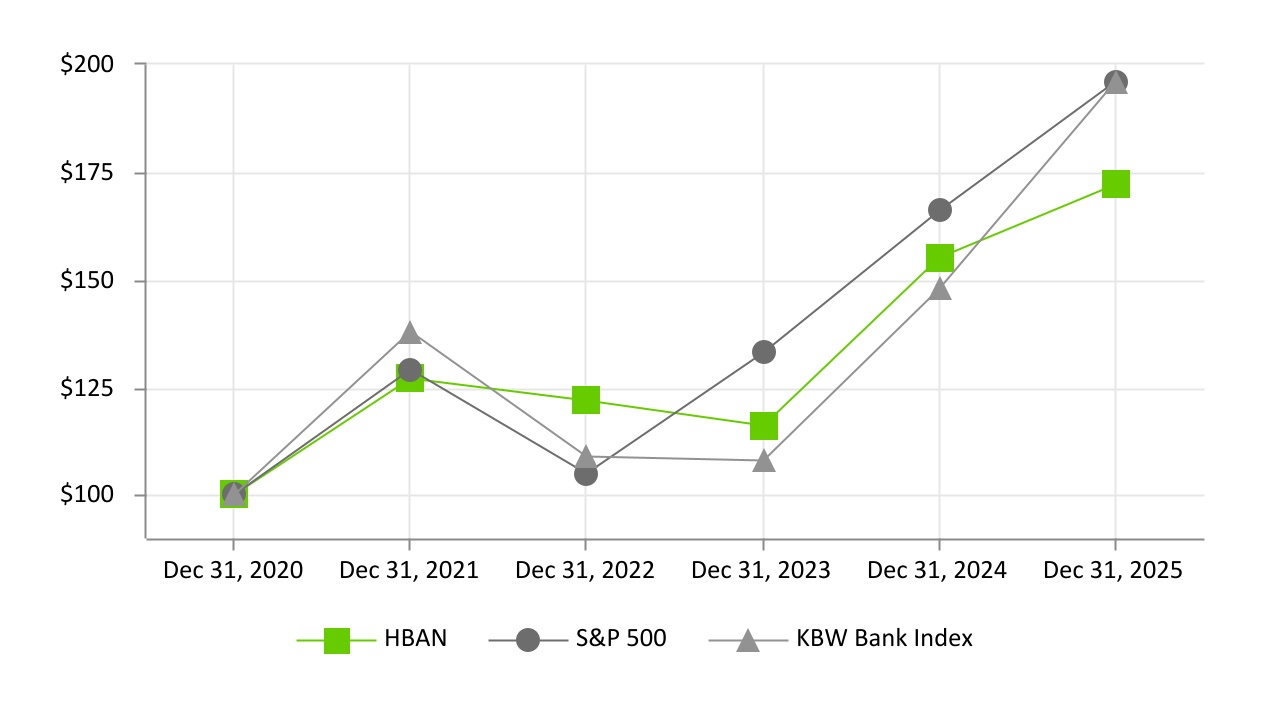
| 2020 | 2021 | 2022 | 2023 | 2024 | 2025 | |||||||||||||||
| HBAN | $100 | $127 | $122 | $116 | $155 | $172 | ||||||||||||||
| S&P 500 | 100 | 129 | 105 | 133 | 166 | 196 | ||||||||||||||
| KBW Bank Index | 100 | 138 | 109 | 108 | 148 | 196 | ||||||||||||||
In April 2025, our Board of Directors authorized the repurchase of up to $1.0 billion of our common shares. The timing of share repurchases depends upon marketplace conditions and other factors, and the program remains subject to the discretion of our Board of Directors.
2025 Form 10-K 49
The following table provides information regarding Huntington’s purchases of its Common Stock during the three-month period ended December 31, 2025.
| Period | Total Number of Shares Purchased | Average Price Paid Per Share | Maximum Number of Shares (or Approximate Dollar Value) that May Yet Be Purchased Under the Plans or Programs (1) | ||||||||||||||
| October 1, 2025 to October 31, 2025 | — | $ | — | $ | 1,000,000,000 | ||||||||||||
| November 1, 2025 to November 30, 2025 | — | — | 1,000,000,000 | ||||||||||||||
| December 1, 2025 to December 31, 2025 | — | — | 1,000,000,000 | ||||||||||||||
| Total | — | $ | — | $ | 1,000,000,000 | ||||||||||||
(1)The number shown represents, as of the end of each period, the approximate dollar value of Common Stock that may yet be purchased under publicly announced share repurchase authorizations.
For information regarding securities authorized for issuance under Huntington’s equity compensation plans, see Part III, Item 12.
Item 6:
[Reserved]
50 Huntington Bancshares Incorporated
Item 7: Management’s Discussion and Analysis of Financial Condition and Results of Operations
INTRODUCTION
This MD&A provides information we believe necessary for understanding our financial condition, changes in financial condition, results of operations, and cash flows. The MD&A should be read in conjunction with the Consolidated Financial Statements, Notes to Consolidated Financial Statements, and other information contained in this report. The forward-looking statements in this section and other parts of this report involve assumptions, risks, uncertainties, and other factors, including statements regarding our plans, objectives, goals, strategies, and financial performance. Our actual results could differ materially from the results anticipated in these forward-looking statements as a result of factors set forth under the caption “Forward-Looking Statements” and those set forth in “Item 1A: Risk Factors”.
In this MD&A we refer to FTE net interest income and FTE total revenue. These financial measures are not required by, or calculated in accordance with GAAP and may not be calculated the same as similarly titled measures used by other companies. These financial measures should thus be considered as supplemental in nature and not considered in isolation or as a substitute for the related financial information prepared in accordance with GAAP. For a further description of these non-GAAP financial measures, see the “Non-GAAP Financial Measures” within the “Additional Disclosures” section below.
EXECUTIVE OVERVIEW
Acquisitions and Divestitures
Veritex Acquisition
Effective October 20, 2025, Huntington completed the acquisition of Veritex Holdings, Inc. (“Veritex”), a bank holding company headquartered in Dallas, Texas, whereby Veritex merged with and into Huntington, with Huntington as the surviving entity. Upon completion of the merger, Huntington issued 107 million shares of its common stock to Veritex shareholders of record as of the merger date, in addition to 1 million shares issued upon the conversion of certain Veritex equity awards, resulting in total consideration from the transaction of $1.7 billion. Historical periods prior to October 20, 2025 reflect results of legacy Huntington operations. Subsequent to closing, results reflect all combined post-acquisition activity. For further information, refer to Note 3 - “Business Combinations” of the Notes to Consolidated Financial Statements.
Cadence Acquisition
Effective February 1, 2026, Huntington completed its previously announced acquisition of Cadence Bank (“Cadence”), a regional bank headquartered in Houston, Texas and Tupelo, Mississippi, whereby Cadence merged with and into Huntington National Bank, with Huntington National Bank as the surviving bank. Under the terms of the agreement, Huntington issued 2.475 shares for each outstanding share of Cadence in a 100% stock transaction. Based on Huntington’s closing price of $17.48 as of January 30, 2026, the consideration is valued at approximately $8.1 billion. Each outstanding share of 5.50% Series A Non-Cumulative Perpetual Preferred Stock of Cadence was converted into the right to receive 1/1000 of a share of a newly created 5.50% Series L Non-Cumulative Perpetual Preferred Stock of Huntington. As of December 31, 2025, Cadence had $54 billion in assets, including $37 billion in loans, and $44 billion in deposits.
2025 Form 10-K 51
2025 Financial Performance Review
Selected Financial Data
| Table 1 - Selected Year-to-Date Income Statement Data | |||||||||||||||||||||||||||||||||||||||||
| Year Ended December 31, | |||||||||||||||||||||||||||||||||||||||||
| Change from 2024 | Change from 2023 | ||||||||||||||||||||||||||||||||||||||||
| (amounts in millions, except per share data) | 2025 | Amount | Percent | 2024 | Amount | Percent | 2023 | ||||||||||||||||||||||||||||||||||
| Interest income | $ | 10,310 | $ | 389 | 4 | % | $ | 9,921 | $ | 1,005 | 11 | % | $ | 8,916 | |||||||||||||||||||||||||||
| Interest expense | 4,319 | (257) | (6) | 4,576 | 1,099 | 32 | 3,477 | ||||||||||||||||||||||||||||||||||
| Net interest income | 5,991 | 646 | 12 | 5,345 | (94) | (2) | 5,439 | ||||||||||||||||||||||||||||||||||
| Provision for credit losses | 463 | 43 | 10 | 420 | 18 | 4 | 402 | ||||||||||||||||||||||||||||||||||
| Net interest income after provision for credit losses | 5,528 | 603 | 12 | 4,925 | (112) | (2) | 5,037 | ||||||||||||||||||||||||||||||||||
| Noninterest income | 2,175 | 135 | 7 | 2,040 | 119 | 6 | 1,921 | ||||||||||||||||||||||||||||||||||
| Noninterest expense | 5,015 | 453 | 10 | 4,562 | (12) | — | 4,574 | ||||||||||||||||||||||||||||||||||
| Income before income taxes | 2,688 | 285 | 12 | 2,403 | 19 | 1 | 2,384 | ||||||||||||||||||||||||||||||||||
| Provision for income taxes | 459 | 16 | 4 | 443 | 30 | 7 | 413 | ||||||||||||||||||||||||||||||||||
| Income after income taxes | 2,229 | 269 | 14 | 1,960 | (11) | (1) | 1,971 | ||||||||||||||||||||||||||||||||||
| Income attributable to non-controlling interest | 18 | (2) | (10) | 20 | — | — | 20 | ||||||||||||||||||||||||||||||||||
Net income attributable to Huntington | 2,211 | 271 | 14 | 1,940 | (11) | (1) | 1,951 | ||||||||||||||||||||||||||||||||||
| Dividends on preferred shares | 124 | (10) | (7) | 134 | (8) | (6) | 142 | ||||||||||||||||||||||||||||||||||
Impact of preferred stock redemptions and repurchases | — | (5) | NM | 5 | 13 | NM | (8) | ||||||||||||||||||||||||||||||||||
| Net income applicable to common shares | $ | 2,087 | $ | 286 | 16 | % | $ | 1,801 | $ | (16) | (1) | % | $ | 1,817 | |||||||||||||||||||||||||||
| Average common shares—basic | 1,479 | 28 | 2 | % | 1,451 | 5 | — | % | 1,446 | ||||||||||||||||||||||||||||||||
| Average common shares—diluted | 1,505 | 29 | 2 | 1,476 | 8 | 1 | 1,468 | ||||||||||||||||||||||||||||||||||
| Net income per common share—basic | $ | 1.41 | $ | 0.17 | 14 | $ | 1.24 | $ | (0.02) | (2) | $ | 1.26 | |||||||||||||||||||||||||||||
| Net income per common share—diluted | 1.39 | 0.17 | 14 | 1.22 | (0.02) | (2) | 1.24 | ||||||||||||||||||||||||||||||||||
Cash dividends declared per common share | 0.62 | — | — | 0.62 | — | — | 0.62 | ||||||||||||||||||||||||||||||||||
Return on average assets | 1.05 | % | 0.99 | % | 1.04 | % | |||||||||||||||||||||||||||||||||||
Return on average common shareholders’ equity | 10.8 | 10.4 | 11.2 | ||||||||||||||||||||||||||||||||||||||
Return on average tangible common shareholders’ equity (1) | 15.7 | 15.7 | 17.6 | ||||||||||||||||||||||||||||||||||||||
Net interest margin (2) | 3.13 | 3.00 | 3.19 | ||||||||||||||||||||||||||||||||||||||
Efficiency ratio (3) | 59.9 | 60.5 | 61.0 | ||||||||||||||||||||||||||||||||||||||
| Revenue and Net Interest Income—FTE (Non-GAAP) | |||||||||||||||||||||||||||||||||||||||||
| Net interest income | $ | 5,991 | $ | 646 | 12 | % | $ | 5,345 | $ | (94) | (2) | % | $ | 5,439 | |||||||||||||||||||||||||||
FTE adjustment (2) | 65 | 12 | 23 | 53 | 11 | 26 | 42 | ||||||||||||||||||||||||||||||||||
Net interest income, FTE (non-GAAP) (2) | 6,056 | 658 | 12 | 5,398 | (83) | (2) | 5,481 | ||||||||||||||||||||||||||||||||||
| Noninterest income | 2,175 | 135 | 7 | 2,040 | 119 | 6 | 1,921 | ||||||||||||||||||||||||||||||||||
Total revenue, FTE (non-GAAP) (2) | $ | 8,231 | $ | 793 | 11 | % | $ | 7,438 | $ | 36 | — | % | $ | 7,402 | |||||||||||||||||||||||||||
(1) Net income applicable to common shares excluding expense for amortization of intangibles for the period divided by average tangible common shareholders’ equity. Average tangible common shareholders’ equity equals average total common shareholders’ equity less average intangible assets and goodwill. Expense for amortization of intangibles and average intangible assets are net of deferred taxes and calculated assuming a 21% tax rate.
(2) Calculated on an FTE basis, which represents a non-GAAP measure, assuming a 21% tax rate.
(3) Noninterest expense less amortization of intangibles divided by the sum of FTE net interest income and noninterest income excluding securities gains (losses).
52 Huntington Bancshares Incorporated
Summary of Results
In 2025, we reported net income of $2.2 billion, or $1.39 per diluted common share, compared with net income in 2024 of $1.9 billion, or $1.22 per diluted common share. The current year reported net income was impacted by acquisition-related expenses totaling $168 million, or $129 million after tax, which reduced diluted earnings by $0.09 per common share.
Net interest income was $6.0 billion in 2025, an increase of $646 million, or 12%, from 2024. FTE net interest income, a non-GAAP financial measure, increased $658 million, or 12%, from 2024. The increase in FTE net interest income reflected a 13 basis point increase in the FTE NIM to 3.13% and a $13.9 billion, or 8%, increase in average earning assets, partially offset by a $12.9 billion, or 9%, increase in average interest-bearing liabilities. The NIM increase was primarily due to a decrease in the cost of funding, partially offset by a decrease in yields on earning assets and net hedging activity.
The provision for credit losses increased $43 million, or 10%, to $463 million for 2025. The ACL was $2.7 billion, or 1.83% of total loans and leases, at December 31, 2025, compared to $2.4 billion, or 1.88% of total loans and leases, at December 31, 2024. The increase in the ACL was driven by current year loan and lease growth, in addition to an ACL recorded for loans acquired in the Veritex transaction, partially offset by a decrease in the overall ACL coverage ratio.
Noninterest income was $2.2 billion, an increase of $135 million, or 7%, from the prior year, driven by a $24 million gain on the sale of a portion of our trust and custody business and increases in customer deposit and loan fees, wealth and asset management revenue, payments and cash management revenue, and capital markets and advisory fees, partially offset by an increase in net losses on sales of securities. Noninterest expense was $5.0 billion, an increase of $453 million, or 10%, from the prior year primarily due to higher personnel costs and outside data processing and other services, in addition to $168 million of acquisition-related expenses, partially offset by lower deposit insurance expense driven by a reduction in the amount of expense associated with the FDIC DIF special assessment due to ongoing adjustments to uninsured deposit losses by the FDIC.
Consolidated Balance Sheet and Capital Ratios
Total assets at December 31, 2025 were $225.1 billion, an increase of $20.9 billion, or 10%, compared to December 31, 2024. The increase in total assets was driven by $10.3 billion of organic loan growth and $9.3 billion of loans acquired as a result of the completion of the Veritex acquisition. Total liabilities at December 31, 2025 were $200.7 billion, an increase of $16.3 billion, or 9%, compared to December 31, 2024. The increase in total liabilities was largely driven by $10.8 billion of liabilities assumed as a result of the completion of the Veritex acquisition and organic deposit growth, partially offset by the run-off of certain higher-cost Veritex deposits.
The tangible common equity to tangible assets ratio increased to 7.1% at December 31, 2025, compared to 6.1% at December 31, 2024, primarily due to an increase in tangible common equity from earnings, net of dividends, an improvement in AOCI, and the net impact of the Veritex acquisition, partially offset by an increase in tangible assets. The CET1 risk-based capital ratio was 10.4% at December 31, 2025, down from 10.5% at December 31, 2024, with the decrease primarily due to an increase in risk-weighted assets and the CECL transition adjustment, partially offset by current period earnings, net of dividends.
2025 Form 10-K 53
Business Overview
General
Our general business objectives are to:
•Deliver our Culture, Purpose, and Vision through a Differentiated Operating Model;
•Build on our vision to be the leading People-First, Customer-Centered bank in the country;
•Deliver top quartile performance through sustainable long-term profitable growth;
•Differentiate our culture, brand, and customer experience through expanded product offerings to drive digital acquisition, deepening, and retention, and leveraging partnerships and technology to grow customers and market share;
•Leverage our regional banking model and national franchise to drive scale, growth and expansion;
•Anticipate evolving customer needs to drive profitable growth;
•Maintain positive operating leverage and execute disciplined capital management; and
•Provide stability and resilience through disciplined risk management, while maintaining an aggregate moderate-to-low risk appetite.
Our 2025 results reflect strong growth across loans, deposits, and value-added fee services, supported by the combination of existing and new businesses, and our partnership with Veritex. Driven by our robust liquidity, capital, and credit, we continued to invest in building existing business relationships, adding new relationships, and expanding capabilities and expertise through both geographic expansion and the addition of new commercial verticals. Credit continues to perform well, consistent with our aggregate moderate-to-low risk appetite. We remain focused on driving our flywheel of value creation to deliver profitable growth and long-term value for our customers, colleagues, and shareholders.
Economy
Economic conditions remained overall healthy during the fourth quarter of 2025, demonstrating resilience despite uncertainty stemming from the longest government shutdown on record and disruptions in the availability of certain economic data. Financial markets reflected this underlying strength, with broad equity indices remaining near record levels and corporate credit spreads continuing to trade near historically tight levels. Trade policy developments, including the use of tariffs, remain an evolving factor for both financial markets and economic activity. While legal and geopolitical developments bear monitoring, market participants have demonstrated an ability to absorb these uncertainties, supported by generally favorable global financial conditions, even amid periods of increased volatility in select international markets.
At its December 2025 meeting, the Federal Reserve lowered the federal funds rate by 25 basis points, marking the third such reduction in 2025. The decision reflects the Federal Reserve’s confidence that inflation, while still above the stated 2% target, remains manageable over the medium term, and that a modest easing in the policy can help sustain economic expansion as labor market conditions normalize. With economic growth continuing at a healthy pace, monetary policy is increasingly viewed as well-positioned to support continued expansion.
Labor market conditions moderated during 2025, with the unemployment rate peaking at 4.5% before improving modestly to 4.4% at the end of the year. Despite some softening in the labor market, overall economic activity remained resilient, with real GDP expanding by 2.0%-2.3% through the first three quarters of 2025. The manufacturing sector showed signs of stabilization following a period of mild contraction and is well-positioned to benefit from renewed investment, supply-chain normalization, and technological advancement. The services sector continued its slow and steady expansion, reinforcing the durability of domestic demand. Consumer spending remained resilient throughout the year, driven by strong spending from higher income households. Looking ahead, government spending initiatives and tax provisions expected to take effect in early 2026 have further improved the economic outlook, leading many economists to reduce their assessed probability for a recession in 2026.
Legislative and Regulatory
A comprehensive discussion of legislative and regulatory matters affecting us can be found in Item 1: Business - “Regulatory Matters” section of this Form 10-K.
54 Huntington Bancshares Incorporated
DISCUSSION OF RESULTS OF OPERATIONS
This section provides a review of financial performance on a consolidated basis. Key consolidated balance sheet and income statement trends are discussed. All earnings per share data are reported on a diluted basis. For additional insight on financial performance, please read this section in conjunction with the “Business Segment Discussion.”
For a discussion of our results of operations for 2024 versus 2023, see “Part II, Item 7: Management’s Discussion and Analysis of Financial Condition and Results of Operations” Discussion of Results of Operations included in our 2024 Annual Report on Form 10-K, filed with the SEC on February 14, 2025.
Average Balance Sheet / Net Interest Income
Our primary source of revenue is net interest income, which is the difference between interest income from earning assets (primarily loans and leases and securities), and interest expense from funding sources (primarily interest-bearing deposits and borrowings). Earning asset balances and related funding sources, as well as changes in the levels of interest rates, impact net interest income. The difference between the average yield on earning assets and the average rate paid for interest-bearing liabilities is the net interest spread. Noninterest-bearing sources of funds, such as demand deposits and shareholders’ equity, also support earning assets. The impact of the noninterest-bearing sources of funds, often referred to as “free funds”, is captured in the net interest margin, which is calculated as net interest income divided by average earning assets. Both the net interest margin and net interest spread are presented on an FTE basis, which means that tax-free interest income has been adjusted to a pretax equivalent income, assuming a 21% tax rate. Information related to major components of our net interest income (FTE) and related yields are presented on the following table.
2025 Form 10-K 55
| Table 2 - Consolidated Average Balance Sheet and Net Interest Margin Analysis | |||||||||||||||||||||||||||||||||||||||||||||||
Year Ended December 31, | |||||||||||||||||||||||||||||||||||||||||||||||
| 2025 | 2024 | ||||||||||||||||||||||||||||||||||||||||||||||
| Average | Interest Income/Expense | Yield/ | Average | Interest Income/ Expense | Yield/ | Change in Average Balances | |||||||||||||||||||||||||||||||||||||||||
| (dollar amounts in millions) | Balances | (FTE) (1) | Rate (1)(2) | Balances | (FTE) (1) | Rate (1)(2) | Amount | Percent | |||||||||||||||||||||||||||||||||||||||
| Assets: | |||||||||||||||||||||||||||||||||||||||||||||||
| Interest-earning deposits with banks | $ | 11,989 | $ | 526 | 4.38 | % | $ | 11,113 | $ | 598 | 5.38 | % | $ | 876 | 8 | % | |||||||||||||||||||||||||||||||
| Securities: | |||||||||||||||||||||||||||||||||||||||||||||||
| Trading account securities | 465 | 17 | 3.75 | 265 | 13 | 5.04 | 200 | 75 | |||||||||||||||||||||||||||||||||||||||
| Available-for-sale securities: | |||||||||||||||||||||||||||||||||||||||||||||||
| Taxable | 23,652 | 1,023 | 4.33 | 24,232 | 1,251 | 5.16 | (580) | (2) | |||||||||||||||||||||||||||||||||||||||
| Tax-exempt | 3,307 | 167 | 5.04 | 2,779 | 141 | 5.08 | 528 | 19 | |||||||||||||||||||||||||||||||||||||||
| Total available-for-sale securities | 26,959 | 1,190 | 4.41 | 27,011 | 1,392 | 5.15 | (52) | — | |||||||||||||||||||||||||||||||||||||||
| Held-to-maturity securities—taxable | 15,906 | 423 | 2.66 | 15,478 | 385 | 2.49 | 428 | 3 | |||||||||||||||||||||||||||||||||||||||
| Other securities | 899 | 47 | 5.28 | 789 | 42 | 5.33 | 110 | 14 | |||||||||||||||||||||||||||||||||||||||
| Total securities | 44,229 | 1,677 | 3.79 | 43,543 | 1,832 | 4.21 | 686 | 2 | |||||||||||||||||||||||||||||||||||||||
| Loans held for sale | 790 | 50 | 6.37 | 597 | 40 | 6.63 | 193 | 32 | |||||||||||||||||||||||||||||||||||||||
Loans and leases (3): | |||||||||||||||||||||||||||||||||||||||||||||||
| Commercial: | |||||||||||||||||||||||||||||||||||||||||||||||
| Commercial and industrial | 61,468 | 3,769 | 6.13 | 52,426 | 3,321 | 6.33 | 9,042 | 17 | |||||||||||||||||||||||||||||||||||||||
| Commercial real estate | 11,698 | 788 | 6.74 | 11,935 | 907 | 7.60 | (237) | (2) | |||||||||||||||||||||||||||||||||||||||
| Lease financing | 5,479 | 365 | 6.67 | 5,190 | 336 | 6.47 | 289 | 6 | |||||||||||||||||||||||||||||||||||||||
| Total commercial | 78,645 | 4,922 | 6.26 | 69,551 | 4,564 | 6.56 | 9,094 | 13 | |||||||||||||||||||||||||||||||||||||||
| Consumer: | |||||||||||||||||||||||||||||||||||||||||||||||
| Residential mortgage | 24,585 | 1,031 | 4.20 | 23,956 | 943 | 3.94 | 629 | 3 | |||||||||||||||||||||||||||||||||||||||
| Automobile | 15,406 | 901 | 5.85 | 13,372 | 726 | 5.43 | 2,034 | 15 | |||||||||||||||||||||||||||||||||||||||
| Home equity | 10,239 | 743 | 7.25 | 10,088 | 780 | 7.73 | 151 | 1 | |||||||||||||||||||||||||||||||||||||||
| RV and marine | 5,869 | 317 | 5.40 | 5,979 | 310 | 5.19 | (110) | (2) | |||||||||||||||||||||||||||||||||||||||
| Other consumer | 1,943 | 208 | 10.63 | 1,557 | 181 | 11.61 | 386 | 25 | |||||||||||||||||||||||||||||||||||||||
| Total consumer | 58,042 | 3,200 | 5.51 | 54,952 | 2,940 | 5.35 | 3,090 | 6 | |||||||||||||||||||||||||||||||||||||||
| Total loans and leases | 136,687 | 8,122 | 5.94 | 124,503 | 7,504 | 6.03 | 12,184 | 10 | |||||||||||||||||||||||||||||||||||||||
| Total earning assets | 193,695 | 10,375 | 5.36 | 179,756 | 9,974 | 5.55 | 13,939 | 8 | |||||||||||||||||||||||||||||||||||||||
| Cash and due from banks | 1,413 | 1,397 | 16 | 1 | |||||||||||||||||||||||||||||||||||||||||||
| Goodwill and other intangible assets | 5,740 | 5,680 | 60 | 1 | |||||||||||||||||||||||||||||||||||||||||||
| All other assets | 9,915 | 9,427 | 488 | 5 | |||||||||||||||||||||||||||||||||||||||||||
| Total assets | $ | 210,763 | $ | 196,260 | $ | 14,503 | 7 | % | |||||||||||||||||||||||||||||||||||||||
Liabilities and shareholders’ equity: | |||||||||||||||||||||||||||||||||||||||||||||||
| Interest-bearing deposits: | |||||||||||||||||||||||||||||||||||||||||||||||
| Demand deposits—interest-bearing | $ | 45,368 | $ | 890 | 1.96 | % | $ | 40,401 | $ | 858 | 2.12 | % | $ | 4,967 | 12 | % | |||||||||||||||||||||||||||||||
| Money market deposits | 62,137 | 1,825 | 2.94 | 54,702 | 1,994 | 3.64 | 7,435 | 14 | |||||||||||||||||||||||||||||||||||||||
| Savings deposits | 15,100 | 50 | 0.33 | 15,141 | 15 | 0.10 | (41) | — | |||||||||||||||||||||||||||||||||||||||
| Time deposits | 13,678 | 517 | 3.78 | 15,343 | 705 | 4.60 | (1,665) | (11) | |||||||||||||||||||||||||||||||||||||||
| Total interest-bearing deposits | 136,283 | 3,282 | 2.41 | 125,587 | 3,572 | 2.84 | 10,696 | 9 | |||||||||||||||||||||||||||||||||||||||
| Short-term borrowings | 1,215 | 50 | 4.11 | 1,147 | 69 | 5.99 | 68 | 6 | |||||||||||||||||||||||||||||||||||||||
| Long-term debt | 17,363 | 987 | 5.68 | 15,224 | 935 | 6.14 | 2,139 | 14 | |||||||||||||||||||||||||||||||||||||||
| Total interest-bearing liabilities | 154,861 | 4,319 | 2.79 | 141,958 | 4,576 | 3.22 | 12,903 | 9 | |||||||||||||||||||||||||||||||||||||||
| Demand deposits—noninterest-bearing | 29,495 | 29,479 | 16 | — | |||||||||||||||||||||||||||||||||||||||||||
| All other liabilities | 4,905 | 5,123 | (218) | (4) | |||||||||||||||||||||||||||||||||||||||||||
Total liabilities | 189,261 | 176,560 | 12,701 | 7 | |||||||||||||||||||||||||||||||||||||||||||
Total Huntington shareholders’ equity | 21,458 | 19,651 | 1,807 | 9 | |||||||||||||||||||||||||||||||||||||||||||
| Non-controlling interest | 44 | 49 | (5) | (10) | |||||||||||||||||||||||||||||||||||||||||||
| Total equity | 21,502 | 19,700 | 1,802 | 9 | |||||||||||||||||||||||||||||||||||||||||||
Total liabilities and equity | $ | 210,763 | $ | 196,260 | $ | 14,503 | 7 | % | |||||||||||||||||||||||||||||||||||||||
| Net interest rate spread | 2.57 | 2.33 | |||||||||||||||||||||||||||||||||||||||||||||
Impact of noninterest-bearing funds on NIM | 0.56 | 0.67 | |||||||||||||||||||||||||||||||||||||||||||||
NII/NIM (FTE) | $ | 6,056 | 3.13 | % | $ | 5,398 | 3.00 | % | |||||||||||||||||||||||||||||||||||||||
(1)Calculated on an FTE basis, which represents a non-GAAP measure, assuming a 21% tax rate.
(2)Yield/rates include the impact of applicable derivatives. Loan and lease and deposit average yield/rates also include the impact of applicable non-deferrable and amortized fees.
(3)For purposes of this analysis, NALs are reflected in the average balances of loans and leases.
56 Huntington Bancshares Incorporated
| Table 2 - Consolidated Average Balance Sheet and Net Interest Margin Analysis (Continued) | |||||||||||||||||||||||||||||||||||||||||||||||
Year Ended December 31, | |||||||||||||||||||||||||||||||||||||||||||||||
| 2024 | 2023 | ||||||||||||||||||||||||||||||||||||||||||||||
| Average | Interest Income/ Expense | Yield/ | Average | Interest Income/ Expense | Yield/ | Change in Average Balances | |||||||||||||||||||||||||||||||||||||||||
| (dollar amounts in millions) | Balances | (FTE) (1) | Rate (1)(2) | Balances | (FTE) (1) | Rate (1)(2) | Amount | Percent | |||||||||||||||||||||||||||||||||||||||
| Assets: | |||||||||||||||||||||||||||||||||||||||||||||||
| Interest-earning deposits with banks | $ | 11,113 | $ | 598 | 5.38 | % | $ | 9,309 | $ | 492 | 5.30 | % | $ | 1,804 | 19 | % | |||||||||||||||||||||||||||||||
| Securities: | |||||||||||||||||||||||||||||||||||||||||||||||
| Trading account securities | 265 | 13 | 5.04 | 77 | 4 | 5.14 | 188 | 244 | |||||||||||||||||||||||||||||||||||||||
| Available-for-sale securities: | |||||||||||||||||||||||||||||||||||||||||||||||
| Taxable | 24,232 | 1,251 | 5.16 | 20,539 | 1,016 | 4.95 | 3,693 | 18 | |||||||||||||||||||||||||||||||||||||||
| Tax-exempt | 2,779 | 141 | 5.08 | 2,720 | 132 | 4.84 | 59 | 2 | |||||||||||||||||||||||||||||||||||||||
| Total available-for-sale securities | 27,011 | 1,392 | 5.15 | 23,259 | 1,148 | 4.93 | 3,752 | 16 | |||||||||||||||||||||||||||||||||||||||
| Held-to-maturity securities—taxable | 15,478 | 385 | 2.49 | 16,507 | 401 | 2.43 | (1,029) | (6) | |||||||||||||||||||||||||||||||||||||||
| Other securities | 789 | 42 | 5.33 | 933 | 53 | 5.70 | (144) | (15) | |||||||||||||||||||||||||||||||||||||||
| Total securities | 43,543 | 1,832 | 4.21 | 40,776 | 1,606 | 3.94 | 2,767 | 7 | |||||||||||||||||||||||||||||||||||||||
| Loans held for sale | 597 | 40 | 6.63 | 554 | 35 | 6.34 | 43 | 8 | |||||||||||||||||||||||||||||||||||||||
Loans and leases (3): | |||||||||||||||||||||||||||||||||||||||||||||||
| Commercial: | |||||||||||||||||||||||||||||||||||||||||||||||
| Commercial and industrial | 52,426 | 3,321 | 6.33 | 49,640 | 2,991 | 6.03 | 2,786 | 6 | |||||||||||||||||||||||||||||||||||||||
| Commercial real estate | 11,935 | 907 | 7.60 | 13,140 | 972 | 7.40 | (1,205) | (9) | |||||||||||||||||||||||||||||||||||||||
| Lease financing | 5,190 | 336 | 6.47 | 5,128 | 289 | 5.63 | 62 | 1 | |||||||||||||||||||||||||||||||||||||||
| Total commercial | 69,551 | 4,564 | 6.56 | 67,908 | 4,252 | 6.26 | 1,643 | 2 | |||||||||||||||||||||||||||||||||||||||
| Consumer: | |||||||||||||||||||||||||||||||||||||||||||||||
| Residential mortgage | 23,956 | 943 | 3.94 | 22,990 | 825 | 3.59 | 966 | 4 | |||||||||||||||||||||||||||||||||||||||
| Automobile | 13,372 | 726 | 5.43 | 12,881 | 561 | 4.36 | 491 | 4 | |||||||||||||||||||||||||||||||||||||||
| Home equity | 10,088 | 780 | 7.73 | 10,156 | 760 | 7.48 | (68) | (1) | |||||||||||||||||||||||||||||||||||||||
| RV and marine | 5,979 | 310 | 5.19 | 5,650 | 271 | 4.79 | 329 | 6 | |||||||||||||||||||||||||||||||||||||||
| Other consumer | 1,557 | 181 | 11.61 | 1,362 | 156 | 11.53 | 195 | 14 | |||||||||||||||||||||||||||||||||||||||
| Total consumer | 54,952 | 2,940 | 5.35 | 53,039 | 2,573 | 4.85 | 1,913 | 4 | |||||||||||||||||||||||||||||||||||||||
| Total loans and leases | 124,503 | 7,504 | 6.03 | 120,947 | 6,825 | 5.64 | 3,556 | 3 | |||||||||||||||||||||||||||||||||||||||
| Total earning assets | 179,756 | 9,974 | 5.55 | 171,586 | 8,958 | 5.22 | 8,170 | 5 | |||||||||||||||||||||||||||||||||||||||
| Cash and due from banks | 1,397 | 1,576 | (179) | (11) | |||||||||||||||||||||||||||||||||||||||||||
| Goodwill and other intangible assets | 5,680 | 5,731 | (51) | (1) | |||||||||||||||||||||||||||||||||||||||||||
| All other assets | 9,427 | 8,663 | 764 | 9 | |||||||||||||||||||||||||||||||||||||||||||
| Total assets | $ | 196,260 | $ | 187,556 | $ | 8,704 | 5 | % | |||||||||||||||||||||||||||||||||||||||
Liabilities and shareholders’ equity: | |||||||||||||||||||||||||||||||||||||||||||||||
| Interest-bearing deposits: | |||||||||||||||||||||||||||||||||||||||||||||||
| Demand deposits—interest-bearing | $ | 40,401 | $ | 858 | 2.12 | % | $ | 39,901 | $ | 703 | 1.76 | % | $ | 500 | 1 | % | |||||||||||||||||||||||||||||||
| Money market deposits | 54,702 | 1,994 | 3.64 | 44,958 | 1,365 | 3.04 | 9,744 | 22 | |||||||||||||||||||||||||||||||||||||||
| Savings deposits | 15,141 | 15 | 0.10 | 17,502 | 3 | 0.02 | (2,361) | (13) | |||||||||||||||||||||||||||||||||||||||
| Time deposits | 15,343 | 705 | 4.60 | 11,042 | 426 | 3.86 | 4,301 | 39 | |||||||||||||||||||||||||||||||||||||||
| Total interest-bearing deposits | 125,587 | 3,572 | 2.84 | 113,403 | 2,497 | 2.20 | 12,184 | 11 | |||||||||||||||||||||||||||||||||||||||
| Short-term borrowings | 1,147 | 69 | 5.99 | 3,081 | 179 | 5.81 | (1,934) | (63) | |||||||||||||||||||||||||||||||||||||||
| Long-term debt | 15,224 | 935 | 6.14 | 13,324 | 801 | 6.01 | 1,900 | 14 | |||||||||||||||||||||||||||||||||||||||
| Total interest-bearing liabilities | 141,958 | 4,576 | 3.22 | 129,808 | 3,477 | 2.68 | 12,150 | 9 | |||||||||||||||||||||||||||||||||||||||
| Demand deposits—noninterest-bearing | 29,479 | 33,985 | (4,506) | (13) | |||||||||||||||||||||||||||||||||||||||||||
| All other liabilities | 5,123 | 5,080 | 43 | 1 | |||||||||||||||||||||||||||||||||||||||||||
| Total liabilities | 176,560 | 168,873 | 7,687 | 5 | |||||||||||||||||||||||||||||||||||||||||||
| Total Huntington shareholders’ equity | 19,651 | 18,634 | 1,017 | 5 | |||||||||||||||||||||||||||||||||||||||||||
| Non-controlling interest | 49 | 49 | — | — | |||||||||||||||||||||||||||||||||||||||||||
| Total equity | 19,700 | 18,683 | 1,017 | 5 | |||||||||||||||||||||||||||||||||||||||||||
| Total liabilities and equity | $ | 196,260 | $ | 187,556 | $ | 8,704 | 5 | % | |||||||||||||||||||||||||||||||||||||||
| Net interest rate spread | 2.33 | 2.54 | |||||||||||||||||||||||||||||||||||||||||||||
| Impact of noninterest-bearing funds on NIM | 0.67 | 0.65 | |||||||||||||||||||||||||||||||||||||||||||||
| NII/NIM (FTE) | $ | 5,398 | 3.00 | % | $ | 5,481 | 3.19 | % | |||||||||||||||||||||||||||||||||||||||
(1)Calculated on an FTE basis, which represents a non-GAAP measure, assuming a 21% tax rate.
(2)Yield/rates include the impact of applicable derivatives. Loan and lease and deposit average yield/rates also include the impact of applicable non-deferrable and amortized fees.
(3)For purposes of this analysis, NALs are reflected in the average balances of loans and leases.
2025 Form 10-K 57
The following table shows changes in fully-taxable equivalent interest income, interest expense, and net interest income due to volume and rate variances for major categories of earning assets and interest-bearing liabilities.
| Table 3 - Change in Net Interest Income Due to Changes in Average Volume and Interest Rates (1) | |||||||||||||||||||||||||||||||||||
| 2025 | 2024 | ||||||||||||||||||||||||||||||||||
| (dollar amounts in millions) | Increase (Decrease) From Previous Year Due To | Increase (Decrease) From Previous Year Due To | |||||||||||||||||||||||||||||||||
| FTE basis (2) | Volume | Yield/Rate | Total | Volume | Yield/Rate | Total | |||||||||||||||||||||||||||||
| Loans and leases | $ | 725 | $ | (107) | $ | 618 | $ | 205 | $ | 474 | $ | 679 | |||||||||||||||||||||||
| Investment securities | 20 | (179) | (159) | 105 | 112 | 217 | |||||||||||||||||||||||||||||
| Other earning assets | 64 | (122) | (58) | 110 | 10 | 120 | |||||||||||||||||||||||||||||
| Total interest income from earning assets | 809 | (408) | 401 | 420 | 596 | 1,016 | |||||||||||||||||||||||||||||
| Deposits | 288 | (578) | (290) | 289 | 786 | 1,075 | |||||||||||||||||||||||||||||
| Short-term borrowings | 4 | (23) | (19) | (116) | 6 | (110) | |||||||||||||||||||||||||||||
| Long-term debt | 125 | (73) | 52 | 116 | 18 | 134 | |||||||||||||||||||||||||||||
| Total interest expense of interest-bearing liabilities | 417 | (674) | (257) | 289 | 810 | 1,099 | |||||||||||||||||||||||||||||
| Net interest income | $ | 392 | $ | 266 | $ | 658 | $ | 131 | $ | (214) | $ | (83) | |||||||||||||||||||||||
(1)The change in interest income or expense due to both rate and volume has been allocated between the factors in proportion to the relationship of the absolute dollar amounts of the change in each.
(2)Calculated assuming a 21% tax rate.
Net Interest Income
Net interest income for 2025 was $6.0 billion, an increase of $646 million, or 12%, from 2024. FTE net interest income, a non-GAAP financial measure, increased $658 million, or 12%, from 2024. The increase in FTE net interest income reflected a 13 basis point increase in the FTE NIM to 3.13% and a $13.9 billion, or 8%, increase in average earning assets, partially offset by a $12.9 billion, or 9%, increase in average interest-bearing liabilities. The NIM increase was primarily due to a decrease in cost of funding, partially offset by a decrease in yields on earning assets and net hedging activity. The increases in average earning assets and interest-bearing liabilities included the impact of earning assets and interest-bearing liabilities acquired in connection with the Veritex transaction.
Average Balance Sheet
Average assets for 2025 were $210.8 billion, an increase of $14.5 billion, or 7%, from 2024. Average assets were impacted by the $12.0 billion of total assets acquired in connection with the Veritex transaction effective October 20, 2025. The increase in average assets was primarily due to increases in average loans and leases of $12.2 billion, or 10%, interest-earning deposits with banks of $876 million, or 8%, and total securities of $686 million, or 2%. The increase in average loans and leases, inclusive of acquired Veritex loans and leases, included growth in average commercial loans and leases of $9.1 billion, or 13%, and in average consumer loans of $3.1 billion, or 6%.
Average liabilities for 2025 were $159.8 billion, an increase of $12.7 billion, or 9%, from 2024. Average liability increases were also impacted by the Veritex acquisition. The increase in average liabilities was primarily due to an increase in average deposits of $12.9 billion, or 9%, driven by an increase in average interest-bearing deposits of $10.7 billion, or 9%, and an increase in average total debt of $2.2 billion, or 13%. The increase in average interest-bearing deposits was driven by increases in average money market deposits and interest-bearing demand deposits, partially offset by a decrease in average time deposits.
Average shareholders’ equity for 2025 was $21.5 billion, an increase of $1.8 billion, or 9%, from 2024, primarily due to earnings, net of dividends, the benefit from a decrease in average accumulated other comprehensive loss, and the impact of common stock issued in connection with the Veritex acquisition.
58 Huntington Bancshares Incorporated
Provision for Credit Losses
The provision for credit losses is the expense necessary to maintain the ACL at levels appropriate to absorb our estimate of credit losses expected over the life of the loan and lease portfolio, securities portfolio, and unfunded lending commitments.
The provision for credit losses in 2025 was $463 million, an increase of $43 million, or 10%, from 2024. The increase in the provision for credit losses over the prior year was driven primarily by current year loan and lease growth, partially offset by a modest reduction in overall ACL coverage ratios in 2025.
The following table presents components of the provision for credit losses.
| Table 4 - Provision for Credit Losses | |||||||||||||||||
| Year Ended December 31, | |||||||||||||||||
| (dollar amounts in millions) | 2025 | 2024 | 2023 | ||||||||||||||
| Provision for loan and lease losses | $ | 466 | $ | 361 | $ | 407 | |||||||||||
Provision (benefit) for unfunded lending commitments | — | 57 | (5) | ||||||||||||||
Provision (benefit) for securities | (3) | 2 | — | ||||||||||||||
| Total provision for credit losses | $ | 463 | $ | 420 | $ | 402 | |||||||||||
Noninterest Income
The following table reflects noninterest income for each of the periods presented.
| Table 5 - Noninterest Income | |||||||||||||||||||||||||||||||||||||||||
| Year Ended December 31, | |||||||||||||||||||||||||||||||||||||||||
| Change from 2024 | Change from 2023 | ||||||||||||||||||||||||||||||||||||||||
| (dollar amounts in millions) | 2025 | Amount | Percent | 2024 | Amount | Percent | 2023 | ||||||||||||||||||||||||||||||||||
| Payments and cash management revenue | $ | 664 | $ | 44 | 7 | % | $ | 620 | $ | 35 | 6 | % | $ | 585 | |||||||||||||||||||||||||||
| Wealth and asset management revenue | 409 | 45 | 12 | 364 | 36 | 11 | 328 | ||||||||||||||||||||||||||||||||||
| Customer deposit and loan fees | 390 | 56 | 17 | 334 | 22 | 7 | 312 | ||||||||||||||||||||||||||||||||||
| Capital markets and advisory fees | 346 | 19 | 6 | 327 | 79 | 32 | 248 | ||||||||||||||||||||||||||||||||||
| Mortgage banking income | 141 | 11 | 8 | 130 | 21 | 19 | 109 | ||||||||||||||||||||||||||||||||||
| Insurance income | 81 | 4 | 5 | 77 | 3 | 4 | 74 | ||||||||||||||||||||||||||||||||||
| Leasing revenue | 66 | (13) | (16) | 79 | (33) | (29) | 112 | ||||||||||||||||||||||||||||||||||
| Net gains (losses) on sales of securities | (58) | (37) | NM | (21) | (14) | NM | (7) | ||||||||||||||||||||||||||||||||||
| Other noninterest income | 136 | 6 | 5 | 130 | (30) | (19) | 160 | ||||||||||||||||||||||||||||||||||
| Total noninterest income | $ | 2,175 | $ | 135 | 7 | % | $ | 2,040 | $ | 119 | 6 | % | $ | 1,921 | |||||||||||||||||||||||||||
Noninterest income was $2.2 billion, an increase of $135 million, or 7%, from the prior year. Customer deposit and loan fees increased $56 million, or 17%, primarily reflecting higher loan commitment fees. Wealth and asset management revenue increased $45 million, or 12%, reflecting higher trust and investment management account income. Payments and cash management revenue increased $44 million, or 7%, reflecting higher merchant acquiring, commercial treasury management, and card transaction revenue. Capital markets and advisory fees increased $19 million, or 6%, primarily due to higher syndication fees and commercial loan production related activities, partially offset by lower advisory fees. Mortgage banking income increased $11 million, or 8%, largely reflecting an increase in saleable spreads. Other noninterest income increased $6 million, or 5%, primarily due to a $24 million gain in 2025 on the sale of a portion of our trust and custody business, partially offset by a decrease in revenue from tax credit syndications. Partially offsetting these increases, net gains (losses) on sales of securities included a net loss of $58 million in 2025, compared to $21 million in 2024, as a result of corporate debt securities repositioning completed in each respective period, and leasing revenue decreased $13 million, or 16%, driven by lower operating lease income.
2025 Form 10-K 59
Noninterest Expense
The following table reflects noninterest expense for each of the periods presented.
| Table 6 - Noninterest Expense | |||||||||||||||||||||||||||||||||||||||||
| Year Ended December 31, | |||||||||||||||||||||||||||||||||||||||||
| Change from 2024 | Change from 2023 | ||||||||||||||||||||||||||||||||||||||||
| (dollar amounts in millions) | 2025 | Amount | Percent | 2024 | Amount | Percent | 2023 | ||||||||||||||||||||||||||||||||||
| Personnel costs | $ | 2,995 | $ | 294 | 11 | % | $ | 2,701 | $ | 172 | 7 | % | $ | 2,529 | |||||||||||||||||||||||||||
| Outside data processing and other services | 772 | 107 | 16 | 665 | 60 | 10 | 605 | ||||||||||||||||||||||||||||||||||
| Equipment | 268 | 1 | — | 267 | 4 | 2 | 263 | ||||||||||||||||||||||||||||||||||
| Net occupancy | 232 | 11 | 5 | 221 | (25) | (10) | 246 | ||||||||||||||||||||||||||||||||||
| Professional services | 155 | 56 | 57 | 99 | — | — | 99 | ||||||||||||||||||||||||||||||||||
| Marketing | 127 | 11 | 9 | 116 | 1 | 1 | 115 | ||||||||||||||||||||||||||||||||||
| Deposit and other insurance expense | 65 | (49) | (43) | 114 | (188) | (62) | 302 | ||||||||||||||||||||||||||||||||||
| Amortization of intangibles | 46 | (1) | (2) | 47 | (3) | (6) | 50 | ||||||||||||||||||||||||||||||||||
| Lease financing equipment depreciation | 13 | (2) | (13) | 15 | (12) | (44) | 27 | ||||||||||||||||||||||||||||||||||
| Other noninterest expense | 342 | 25 | 8 | 317 | (21) | (6) | 338 | ||||||||||||||||||||||||||||||||||
| Total noninterest expense | $ | 5,015 | $ | 453 | 10 | % | $ | 4,562 | $ | (12) | — | % | $ | 4,574 | |||||||||||||||||||||||||||
Number of employees (average full-time equivalent) | 20,424 | 492 | 2 | % | 19,932 | (23) | — | % | 19,955 | ||||||||||||||||||||||||||||||||
Noninterest expense was $5.0 billion, an increase of $453 million, or 10%, from the prior year. Noninterest expense for 2025 included $168 million of acquisition-related expenses, as detailed in the following table. There were no acquisition-related expenses in the years ended December 31, 2024 or 2023.
| Table 7 - Impact of Acquisition-related Expenses | Year Ended December 31, | ||||
| (dollar amounts in millions) | 2025 | ||||
| Personnel costs | $ | 50 | |||
| Outside data processing and other services | 32 | ||||
| Equipment | 3 | ||||
| Professional services | 66 | ||||
| Marketing | 3 | ||||
| Deposit and other insurance expense | 1 | ||||
| Other noninterest expense | 13 | ||||
Total impact of acquisition-related expenses | $ | 168 | |||
Excluding acquisition-related expenses, noninterest expense increased $285 million, or 6%, from the prior year. Personnel costs increased $244 million, or 9%, primarily due to increases in incentive compensation and salary expense, in addition to the impact from adding Veritex employees. Outside data processing increased $75 million, or 11%, primarily due to higher technology and data expense. Partially offsetting these increases, deposit and other insurance expense decreased $50 million, or 44%, driven by a reduction in the amount of expense associated with the FDIC DIF special assessment due to ongoing adjustments to uninsured deposit losses by the FDIC.
Provision for Income Taxes
(This section should be read in conjunction with Note 1 - “Significant Accounting Policies” and Note 18 - “Income Taxes” of the Notes to Consolidated Financial Statements.)
The provision for income taxes was $459 million for 2025, compared with $443 million in 2024. The effective tax rates for 2025 and 2024 were 17.1% and 18.4%, respectively. Both years included the benefits from general business credits, tax-exempt income, tax-exempt bank owned life insurance income, and investments in qualified affordable housing projects. The decrease in the effective tax rate in 2025, compared to 2024, related primarily to increased benefits from general business credits and the benefits of capital losses recognized in 2025.
The net federal deferred tax asset was $856 million, and the net state deferred tax asset was $92 million at December 31, 2025.
60 Huntington Bancshares Incorporated
RISK MANAGEMENT
Risk Management Structure
Our risk management program is structured using three lines of defense, each of which is independent of the others:
•First-line consists of business segments engaged in activities designed to generate revenue or reduce expenses, provide operational support or technology services, or deliver products or services to customers.
•Second-line is Corporate Risk Management.
•Third-line consists of Internal Audit and Credit Review.
Segment Risk Officers are embedded in the first-line and report directly to business unit senior management and indirectly to the Chief Risk Officer. They identify and monitor risk, elevate and remediate issues, establish controls, perform testing, and oversee the self-assessment process. Second-line Corporate Risk Management oversees first-line risk-taking activity, establishes policies, sets operating limits, reviews new or modified products and processes, and is responsible for producing an independent assessment of the Company’s risk position relative to the Board’s risk appetite. Third-line Internal Audit and Credit Review provides additional assurance that risk-related functions are operating as intended.
Risk Governance and Risk Appetite
Our Risk Governance Framework and Risk Appetite Statement are foundational to the risk management program. The Risk Governance Framework defines the three lines of defense structure, roles, responsibilities, and requirements. The Risk Appetite Statement is approved by our Board and defines the level and types of risks we are willing to assume to achieve our corporate objectives through defined risk limits for the seven key risk categories to which we are exposed:
•Credit risk, which is risk of loss due to loan and lease customers or other counterparties not being able to meet their financial obligations under agreed-upon terms.
•Market risk, which includes interest rate and price risk. Interest rate risk is the risk to current or projected financial condition arising from movements in interest rates and considers reprice risk, basis risk, yield curve risk, and options risk. Price risk results from changes in the value of either trading portfolios or other obligations that are entered into as part of distributing risk, primarily associated with market making, dealing, and position taking in interest rate, foreign exchange, equity, commodities, and credit markets.
•Liquidity risk, which is the risk that financial condition or overall safety and soundness is adversely affected by an inability, or perceived inability, to meet obligations when they come due, and includes the inability to access funding sources, manage fluctuations in funding levels, or failure to recognize or address changes in market conditions that affect the Company’s ability to liquidate assets quickly and with minimal loss in value.
•Operational risk, which is the risk of loss and resilience arising from inadequate or failed internal processes, systems, models, data, human error or misconduct, or adverse external events. Operational losses can result from internal fraud, external fraud, inadequate or inappropriate employment practices and workplace safety, failure to meet obligations involving customers, products, and business practices, damage to physical assets, business disruption and systems failures, and failures in execution, delivery, and process management.
•Compliance risk, which is risk arising from violations of laws, rules or regulations, or from non-conformance with laws, regulations, prescribed practices, internal policies and procedures, or ethical standards, and can expose the Company to fines, civil money penalties, payment of damages, and voiding of contracts.
•Strategic risk, which is risk arising from adverse business decisions, poor implementation of business decisions, or lack of responsiveness to changes in the banking industry and operating environment, and is a function of the Company’s strategic goals, business strategies, resources, and quality of implementation.
•Reputation risk, which is risk arising from negative public opinion that may impair the Company’s competitiveness by affecting its ability to establish new relationships or services or continue servicing existing relationships.
2025 Form 10-K 61
The Board has defined our risk appetite as aggregate moderate-to-low on a through-the-cycle basis. While we engage in a limited amount of higher risk activity consistent with our strategic objectives, we ensure those positions are offset by lower risk positions. Our second-line Corporate Risk Management maintains and enforces risk limits established in our Risk Appetite Statement for each of our seven risk pillars, which helps ensure we achieve our aggregate moderate-to-low risk appetite objective.
We have a robust risk assessment process which includes qualitative and quantitative components that assess our inherent risk, control environment, and residual risk, and enables us to report to the Board if we are operating within the risk appetite. The process includes individual assessments from first-line business segments and independent second-line assessments for each risk pillar. These are combined to produce an overall Enterprise Risk Assessment that includes, among other things, top and emerging risks and a determination of whether the Company is operating within its risk appetite.
We have a broad range of controls that are factored into our assessments, including key controls, such as segregation of duties and access management, that are tested regularly. We also have robust authorization and reconciliation procedures, as well as staff education and a disciplined risk assessment process.
Board Oversight
While the Board has three committees that primarily oversee implementation of the risk governance framework and risk appetite, the Risk Oversight Committee, Audit Committee, and Technology Committee, the full Board is engaged in discussing risks and monitoring our risk profile. All committees report their deliberations and actions at each full Board meeting. In addition, all scheduled committee meetings are open to all members of the Board, and committees regularly meet in joint sessions to discuss issues that are broadly applicable. Our Board has unfettered access to senior executive officers, and the Board and committees regularly meet in executive session without management present.
•Our Risk Oversight Committee oversees implementation of the Risk Governance Framework and adherence to the Risk Appetite Statement, which takes the form of approving policies, frameworks, receiving regular reports, and engaging in discussion with Executive Management on topics for each of our risk pillars: credit, liquidity, market, operational, compliance, strategic, and reputation risk. The ROC also oversees capital management and ensures the amount and quality of capital are adequate in relation to expected and unexpected losses. ROC oversees the administration, effectiveness, and independence of our Credit Review function, and the Credit Review Director reports directly to the ROC. Our Chief Risk Officer reports to both the ROC and CEO.
•Our Audit Committee oversees integrity of our consolidated financial statements, including policies, procedures, and practices regarding the preparation of financial statements, the financial reporting process, disclosures, and internal control over financial reporting. The Audit Committee oversees the Internal Audit department and the independent registered public accounting firm’s qualifications and independence; compliance with our Financial Code of Ethics for the CEO and senior financial officers; compliance with corporate securities trading policies; compliance with legal and regulatory requirements; and financial risk exposures in coordination with the ROC. Our Chief Auditor reports directly to the Audit Committee.
•Our Technology Committee oversees technology and cybersecurity strategies and plans and is charged with evaluating the Company’s ability to properly perform all technology functions necessary for its business plan, including projected growth, technology capacity, planning, operational execution, product development, and management capacity. It provides oversight of technology investments and plans to drive efficiency as well as to meet defined standards for risk, information security, and redundancy; oversees allocation of technology costs and ensures that they are understood by the Board; evaluates innovation and technology trends that may affect our strategic plans, including monitoring of overall industry trends; and reviews and provides oversight of our continuity and disaster recovery planning and preparedness.
62 Huntington Bancshares Incorporated
Overlapping or common topics are overseen by more than one committee. On a regular basis, the ROC and Audit Committee meet in joint session to cover matters relevant to both committees’ responsibilities, including reviews of annual and quarterly filings, the methodology and level of the ACL, conduct risk, and others. These committees routinely hold executive sessions with our key officers engaged in both accounting and risk management. In addition, the ROC, Audit Committee, and Technology Committee oversee the effectiveness of management’s efforts to address risk issues in a timely, comprehensive, and sustainable manner, and regularly meet in a joint session to discuss. All directors have access to information provided to each committee and all scheduled meetings are open to all directors.
Further, through our Human Resources and Compensation Committee, our Board seeks to ensure its overall compensation programs are balanced and align the interests of management, creditors, and shareholders. We utilize a variety of compensation-related tools to induce appropriate behavior, including common stock ownership thresholds for the CEO and certain members of senior management, equity deferrals, recoupment provisions, and the right to terminate compensation plans at any time. The Chief Risk Officer has significant input into the design and outcome of incentive compensation plans.
Our Risk Governance structure also includes executive level committees to manage and oversee risk, which include Asset & Liability Management, Risk Management (inclusive of credit risk and strategy), Capital Management, Allowance, Incentive Compensation, Sarbanes-Oxley, and Disclosure Review. These committees are strategic in nature and are supported by subcommittees that are tactical. We believe this structure helps ensure appropriate escalation of issues, overall communication of strategies, and adherence to the Board’s risk appetite.
A comprehensive discussion of risk management and capital matters affecting us can be found in the Risk Factors section included in Item 1A: Risk Factors and the “Regulatory Matters” section of Item 1: Business of this Form 10-K.
Some of the more significant processes used to manage and control credit, market, liquidity, operational, and compliance risks are described in the following sections.
Credit Risk
Credit risk is the risk of financial loss if a counterparty is not able to meet the agreed upon terms of the financial obligation. The majority of our credit risk is associated with lending activities, as the acceptance and management of credit risk is central to profitable lending. We also have credit risk associated with our investment securities portfolios (see Note 4 - "Investment Securities and Other Securities" of the Notes to Consolidated Financial Statements). We engage with other financial counterparties for a variety of purposes including investing, asset and liability management, mortgage banking, and trading activities. A variety of derivative financial instruments, principally interest rate swaps, swaptions, floors, forward contracts, and forward starting interest rate swaps, are used in asset and liability management activities to protect against the risk of adverse price or interest rate movements. We also use derivatives, principally loan sale commitments, in hedging our mortgage loan interest rate lock commitments and mortgage loans held for sale. Like other financial instruments, derivatives contain an element of credit risk, which is the possibility that we will incur a loss because the counterparty fails to meet its contractual obligations. Notional values of interest rate swaps and other off-balance sheet financial instruments significantly exceed the credit risk associated with these instruments and represent contractual balances on which calculations of amounts to be exchanged are based. Credit exposure is limited to the sum of the aggregate fair value of positions that have become favorable to us, including any accrued interest receivable due from counterparties. Potential credit losses are mitigated by derivatives through central clearing parties, careful evaluation of counterparty credit standing, selection of counterparties from a limited group of high quality institutions, collateral agreements, and other contract provisions.
We focus on the early identification, monitoring, and management of all aspects of our credit risk. In addition to the traditional credit risk mitigation strategies of credit policies and processes, market risk management activities, and portfolio diversification, we use quantitative measurement capabilities utilizing external data sources, enhanced modeling technology, and internal stress testing processes. Our disciplined portfolio management processes are central to our commitment to maintaining an aggregate moderate-to-low risk appetite. In our efforts to identify risk mitigation techniques, we have focused on product design features, origination policies, and solutions for delinquent or stressed borrowers.
2025 Form 10-K 63
The maximum level of credit exposure to individual credit borrowers is limited by policy guidelines based on the perceived risk of each borrower or related group of borrowers. Authority to grant commitments sits with the independent credit administration function, with limited exceptions, and is closely monitored and regularly updated. Concentration risk is managed through limits on loan type, industry, and loan quality factors. We focus predominantly on extending credit to consumer and commercial customers with existing or expandable relationships within our primary banking markets, although we will consider lending opportunities outside our primary markets if we believe the associated risks are acceptable and aligned with strategic initiatives. Although we offer a broad set of products, we continue to develop new lending products and opportunities. Each of these new products and opportunities goes through a rigorous development and approval process prior to implementation to ensure our overall objective of maintaining an aggregate moderate-to-low risk portfolio profile.
The checks and balances in the credit process and the separation of the credit administration and risk management functions are designed to appropriately assess and sanction the level of credit risk being accepted, facilitate the early recognition of credit problems when they occur, and provide for effective problem asset management and resolution. For example, we do not extend additional credit to delinquent borrowers except in certain circumstances that substantially improve our overall repayment or collateral coverage position.
Loan and Lease Credit Exposure Mix
At December 31, 2025, our loans and leases totaled $149.6 billion, representing a $19.6 billion, or 15%, increase compared to $130.0 billion at December 31, 2024. The increase was driven by a combination of organic growth and the Veritex acquisition. As of the acquisition date, acquired loans totaled $9.3 billion, including $4.2 billion of commercial real estate loans, $4.0 billion of commercial and industrial loans, and $1.1 billion of residential mortgage loans.
The table below provides the composition of our total loan and lease portfolio.
| Table 8 - Loan and Lease Portfolio Composition | |||||||||||||||||||||||
| At December 31, | |||||||||||||||||||||||
| (dollar amounts in millions) | 2025 | 2024 | |||||||||||||||||||||
| Commercial: | |||||||||||||||||||||||
| Commercial and industrial | $ | 69,442 | 46 | % | $ | 56,809 | 43 | % | |||||||||||||||
| Commercial real estate | 15,209 | 10 | 11,078 | 9 | |||||||||||||||||||
| Lease financing | 5,727 | 4 | 5,454 | 4 | |||||||||||||||||||
| Total commercial | 90,378 | 60 | 73,341 | 56 | |||||||||||||||||||
| Consumer: | |||||||||||||||||||||||
| Residential mortgage | 24,777 | 17 | 24,242 | 19 | |||||||||||||||||||
| Automobile | 16,168 | 11 | 14,564 | 11 | |||||||||||||||||||
| Home equity | 10,395 | 7 | 10,142 | 8 | |||||||||||||||||||
RV and marine | 5,682 | 4 | 5,982 | 5 | |||||||||||||||||||
| Other consumer | 2,242 | 1 | 1,771 | 1 | |||||||||||||||||||
| Total consumer | 59,264 | 40 | 56,701 | 44 | |||||||||||||||||||
| Total loans and leases | $ | 149,642 | 100 | % | $ | 130,042 | 100 | % | |||||||||||||||
64 Huntington Bancshares Incorporated
The following table reflects the composition and maturities of the loan and lease portfolio and the interest rate sensitivity of loans and leases due after one year.
| Table 9 - Maturity Schedule of Loans and Leases and Interest Rate Sensitivity | |||||||||||||||||||||||||||||||||||||||||
Loans and Leases Due After 1 Year | Contractual Maturity Range | ||||||||||||||||||||||||||||||||||||||||
| (dollar amounts in millions) | Fixed Rate | Floating or Adjustable Rate | One Year or Less | One to Five Years | Five to Fifteen Years | After Fifteen Years | Total | ||||||||||||||||||||||||||||||||||
| At December 31, 2025 | |||||||||||||||||||||||||||||||||||||||||
| Commercial: | |||||||||||||||||||||||||||||||||||||||||
| Commercial and industrial | $ | 10,479 | $ | 45,949 | $ | 16,254 | $ | 41,249 | $ | 10,209 | $ | 1,730 | $ | 69,442 | |||||||||||||||||||||||||||
| Commercial real estate | 1,310 | 11,098 | 5,600 | 8,368 | 972 | 269 | 15,209 | ||||||||||||||||||||||||||||||||||
| Lease financing | 4,982 | 412 | 333 | 3,462 | 1,113 | 819 | 5,727 | ||||||||||||||||||||||||||||||||||
| Total commercial | 16,771 | 57,459 | 22,187 | 53,079 | 12,294 | 2,818 | 90,378 | ||||||||||||||||||||||||||||||||||
| Consumer: | |||||||||||||||||||||||||||||||||||||||||
| Residential mortgage | 9,925 | 15,770 | 61 | 148 | 1,359 | 23,209 | 24,777 | ||||||||||||||||||||||||||||||||||
| Automobile | 16,005 | — | 166 | 8,853 | 7,149 | — | 16,168 | ||||||||||||||||||||||||||||||||||
| Home equity | 2,490 | 7,798 | 154 | 186 | 1,937 | 8,118 | 10,395 | ||||||||||||||||||||||||||||||||||
| RV and marine | 5,680 | — | 3 | 247 | 3,070 | 2,362 | 5,682 | ||||||||||||||||||||||||||||||||||
| Other consumer | 978 | 795 | 470 | 1,383 | 229 | 160 | 2,242 | ||||||||||||||||||||||||||||||||||
| Total consumer | 35,078 | 24,363 | 854 | 10,817 | 13,744 | 33,849 | 59,264 | ||||||||||||||||||||||||||||||||||
| Total loans and leases | $ | 51,849 | $ | 81,822 | $ | 23,041 | $ | 63,896 | $ | 26,038 | $ | 36,667 | $ | 149,642 | |||||||||||||||||||||||||||
| Percent of total | 15 | % | 43 | % | 17 | % | 25 | % | 100 | % | |||||||||||||||||||||||||||||||
Total commercial loans and leases were $90.4 billion at December 31, 2025 and represented 60% of our total loan and lease credit exposure at that date. Our commercial loan portfolio is diversified by product type, customer size, and geography, and is comprised of the following (see Commercial Credit discussion):
C&I – C&I loans are made to commercial customers for use in normal business operations to finance working capital needs, equipment purchases, or other projects, and to institutional sponsors supporting REITs. We focus on borrowers doing business within our geographic markets. C&I loans are generally underwritten individually and secured with the assets of the company and/or the personal guarantee of the business owners. The financing of owner-occupied facilities is considered a C&I loan even though there is improved real estate as collateral. This treatment is a result of the credit decision process, which focuses on cash flow from operations of the business to repay the debt. The operation, sale, rental, or refinancing of the real estate is not considered the primary repayment source for these types of loans. As we have expanded our C&I portfolio, we have developed a series of “vertical specialties” to ensure that new products or lending types are embedded within a structured, centralized Commercial Lending area with designated, experienced credit officers. These specialties are comprised of either targeted industries (for example, healthcare, technology & telecom, finance and insurance, etc.) and/or lending disciplines (equipment finance, distribution finance, asset-based lending, etc.), all of which require a high degree of expertise and oversight to effectively mitigate and monitor risk. As such, we have dedicated colleagues and teams focused on bringing value-added expertise to these specialty customers.
2025 Form 10-K 65
CRE – The CRE portfolio includes both CRE commercial and CRE construction loans. CRE commercial loans are loans to developers. We mitigate our risk on these loans by requiring collateral values that exceed the loan amount and underwriting the loan with projected cash flow in excess of the debt service requirement. These loans are made to finance properties such as apartment buildings, office and industrial buildings, and retail shopping centers, and are repaid through cash flows related to the operation, sale, or refinance of the property. Appropriate appraisals are obtained at origination and updated on an as needed basis in compliance with regulatory requirements and our credit policies. CRE construction loans are loans to developers, companies, or individuals used for the construction of a commercial or residential property for which repayment will be generated by the sale or permanent financing of the property. Our CRE construction portfolio primarily consists of multi-family, retail, and warehouse property types. Generally, these loans are for construction projects that have been pre-sold or pre-leased, or have secured permanent financing, as well as loans to real estate companies with significant equity invested in each project. These loans are managed by a specialized real estate lending group that actively monitors the construction phase and manages the loan disbursements according to the predetermined construction schedule.
Lease Financing – Lease financing products are designed to address the diverse financing needs of small to large companies primarily for the acquisition of equipment. Our lease financing portfolio will utilize a variety of origination partners and third-party sources including equipment manufacturers, dealers, or vendors set up under program structures to generate transactions from a nationwide footprint. High level business lines comprise of industrial finance, specialty finance, healthcare finance, technology finance, and specialized transportation, franchise, and government.
Total consumer loans were $59.3 billion at December 31, 2025 and represented 40% of our total loan and lease credit exposure at that date. The consumer portfolio is comprised primarily of residential mortgages, automobile loans, home equity loans and lines-of-credit, and RV and marine finance (see Consumer Credit discussion).
Residential mortgage – Residential mortgage loans represent loans to consumers for the purchase or refinance of a residence. These loans, comprised of both fixed- and adjustable-rate mortgages, are generally financed over a 15-year to 30-year term, and in most cases, are extended to borrowers to finance their primary residence. Applications are underwritten centrally using consistent credit policies and processes. All residential mortgage loan decisions utilize a full appraisal for collateral valuation. Huntington has not originated or acquired residential mortgages that allow negative amortization or allow the borrower multiple payment options. The underwriting for adjustable-rate residential mortgages also incorporates a stress analysis for rising interest rates.
Automobile – Automobile loans are comprised primarily of indirect loans made through automotive dealerships and include exposure in selected states outside of our primary banking markets. The exposure outside of our core footprint states represents 23% of the total exposure, with no individual state representing more than 5% of the total exposure. Applications are underwritten using an automated underwriting system that applies consistent policies and processes across the portfolio.
Home equity – Home equity lending includes both home equity loans and lines-of-credit. This type of lending, which is secured by a first-lien or junior-lien on the borrower’s residence, allows customers to borrow against the equity in their home or refinance existing mortgage debt. Products include closed-end loans which are generally fixed-rate with principal and interest payments, and variable-rate, interest-only lines-of-credit which do not require payment of principal during the 10-year revolving period. The home equity line of credit converts to a 20-year amortizing structure at the end of the revolving period. Applications are underwritten centrally in conjunction with an automated underwriting system. The home equity underwriting criteria is based on minimum credit scores, debt-to-income ratios, and LTV ratios, with current collateral valuations. The underwriting for the floating rate lines of credit also incorporates a stress analysis for rising interest rates.
RV and marine – RV and marine includes loans provided to consumers primarily for the purpose of financing recreational vehicles and boats. Loans are originated on an indirect basis through a series of dealerships across 35 states. The loans are underwritten centrally using an application and decisioning system similar to automobile loans. The current portfolio includes 53% of the balances within our core footprint states.
66 Huntington Bancshares Incorporated
Other consumer – Other consumer loans primarily consist of consumer loans not included above, including credit cards, personal unsecured loans, and overdraft balances. We originate these products within our established set of credit policies and guidelines.
Our loan and lease portfolio is a managed mix of consumer and commercial credits. We manage the overall credit exposure and portfolio composition via a credit concentration policy. The policy designates specific loan types, collateral types, and loan structures to be formally tracked and assigned maximum exposure limits as a percentage of capital. Commercial lending by NAICS categories, specific limits for CRE project types, loans secured by residential real estate, large dollar exposures, and designated high risk loan categories represent examples of specifically tracked components of our concentration management process. As of December 31, 2025, there are no identified concentrations that exceed the assigned exposure limit. Our concentration management policy is approved by the ROC and is used to ensure a high quality, well diversified portfolio that is consistent with our overall objective of maintaining an aggregate moderate-to-low risk appetite. Changes to existing concentration limits and incorporating specific information relating to the potential impact on the overall portfolio composition and performance metrics require the approval of the ROC prior to implementation.
The table below provides our total loan and lease portfolio segregated by industry type. The changes in the industry composition from December 31, 2024 are consistent with the portfolio growth metrics.
| Table 10 - Loan and Lease Portfolio by Industry Type | At December 31, | |||||||||||||||||||||||||
| (dollar amounts in millions) | 2025 | 2024 | ||||||||||||||||||||||||
| Commercial loans and leases: | ||||||||||||||||||||||||||
| Real estate and rental and leasing | $ | 20,237 | 14 | % | $ | 15,242 | 12 | % | ||||||||||||||||||
| Retail trade (1) | 12,181 | 8 | 11,864 | 9 | ||||||||||||||||||||||
| Finance and insurance | 10,489 | 7 | 6,589 | 5 | ||||||||||||||||||||||
| Manufacturing | 8,265 | 6 | 7,261 | 6 | ||||||||||||||||||||||
| Health care and social assistance | 5,920 | 4 | 5,295 | 4 | ||||||||||||||||||||||
| Wholesale trade | 5,842 | 4 | 4,904 | 4 | ||||||||||||||||||||||
| Accommodation and food services | 4,228 | 3 | 3,226 | 2 | ||||||||||||||||||||||
| Other services | 3,617 | 2 | 1,962 | 2 | ||||||||||||||||||||||
| Transportation and warehousing | 3,288 | 2 | 3,324 | 3 | ||||||||||||||||||||||
| Utilities | 3,156 | 2 | 2,406 | 2 | ||||||||||||||||||||||
| Construction | 2,369 | 2 | 1,890 | 1 | ||||||||||||||||||||||
| Professional, scientific, and technical services | 2,296 | 2 | 2,053 | 2 | ||||||||||||||||||||||
| Information | 1,937 | 1 | 1,647 | 1 | ||||||||||||||||||||||
| Arts, entertainment, and recreation | 1,923 | 1 | 1,646 | 1 | ||||||||||||||||||||||
| Admin./support/waste mgmt. and remediation services | 1,844 | 1 | 1,681 | 1 | ||||||||||||||||||||||
| Public administration | 816 | 1 | 705 | 1 | ||||||||||||||||||||||
| Educational services | 738 | — | 539 | — | ||||||||||||||||||||||
| Agriculture, forestry, fishing, and hunting | 410 | — | 478 | — | ||||||||||||||||||||||
| Management of companies and enterprises | 243 | — | 251 | — | ||||||||||||||||||||||
| Mining, quarrying, and oil and gas extraction | 147 | — | 237 | — | ||||||||||||||||||||||
| Unclassified/Other | 432 | — | 141 | — | ||||||||||||||||||||||
| Total commercial loans and leases by industry category | 90,378 | 60 | 73,341 | 56 | ||||||||||||||||||||||
| Residential mortgage | 24,777 | 17 | 24,242 | 19 | ||||||||||||||||||||||
| Automobile | 16,168 | 11 | 14,564 | 11 | ||||||||||||||||||||||
Home equity | 10,395 | 7 | 10,142 | 8 | ||||||||||||||||||||||
RV and marine | 5,682 | 4 | 5,982 | 5 | ||||||||||||||||||||||
| Other consumer loans | 2,242 | 1 | 1,771 | 1 | ||||||||||||||||||||||
| Total loans and leases | $ | 149,642 | 100 | % | $ | 130,042 | 100 | % | ||||||||||||||||||
(1) Amounts include $4.3 billion and $4.2 billion of auto dealer services loans at December 31, 2025 and December 31, 2024, respectively.
2025 Form 10-K 67
Commercial Credit
The primary factors considered in commercial credit approvals are the financial strength of the borrower, assessment of the borrower’s management capabilities, cash flows from operations, industry sector trends, type and sufficiency of collateral, type of exposure, transaction structure, and the general economic outlook. While these are the primary factors considered, there are a number of other factors that may be considered in the decision process. We require the signature approval of both the appropriate line of business leaders and independent credit executives. The risk rating, credit exposure amount, and complexity of the credit determines the threshold for approval. Credit officers who understand each local region and are experienced in the industries and loan structures of the requested credit exposure are involved in all loan decisions and have the primary credit authority, with the exception of small business loans. For small business loans, we utilize a centralized loan approval process for standard products and structures. In this centralized decision environment, certain individuals who understand each local region may make credit-extension decisions to preserve our commitment to the communities in which we operate. In addition to disciplined and consistent judgmental factors, a sophisticated credit scoring process is used as a primary evaluation tool in the determination of approving a loan.
In commercial lending, on-going credit management is dependent on the type and nature of the loan. We monitor all significant exposures. All commercial credit extensions are assigned internal risk ratings reflecting the borrower’s PD and LGD. This two-dimensional rating methodology provides granularity in the portfolio management process. The PD is rated and applied at the borrower level. The LGD is rated and applied based on the specific type of credit extension and the quality and lien position associated with the underlying collateral. The internal risk ratings are assessed at origination and updated at each periodic monitoring event. There is also extensive macro-portfolio management analysis. We review and adjust our risk-rating criteria based on actual experience, which provides us with the current risk level in the portfolio. A centralized portfolio management function monitors and reports on the performance of the entire commercial portfolio, including small business loans, to provide consistent oversight.
In addition to the initial credit analysis conducted during the approval process, our credit review group performs testing to provide an independent review and assessment of the quality and risk of new loan originations. This group is part of our Risk Management area and conducts portfolio reviews on a risk-based cycle to evaluate individual loans, validate risk ratings, and test the consistency of credit processes.
Our standardized loan grading system considers many components that directly correlate to loan quality and likelihood of repayment, one of which is guarantor support. On an at least annual basis, we consider, among other things, the guarantor’s reputation and creditworthiness, where available, along with various key financial metrics such as liquidity and net worth. Our assessment of the guarantor’s credit strength, or lack thereof, is reflected in our risk ratings for such loans, which is directly tied to, and an integral component of, our ACL methodology. When a loan goes to impaired status, viable guarantor support is considered in the determination of a credit loss.
If our assessment of the guarantor’s credit strength yields an inherent capacity to perform, we will seek repayment from the guarantor as part of the collection process and have done so successfully.
Substantially all loans categorized as Classified (See Note 5 - “Loans and Leases” of the Notes to Consolidated Financial Statements) are managed by FRG. FRG is a specialized group of credit professionals that handle the day-to-day management of workouts, commercial recoveries, and problem loan sales. Its responsibilities include developing and implementing action plans, assessing risk ratings, and determining the appropriateness of the allowance, the accrual status, and the ultimate collectability of the Classified loan portfolio.
C&I PORTFOLIO
We manage the risks inherent in the C&I portfolio through origination policies, a defined loan concentration policy with established limits, on-going loan-level and portfolio-level reviews, recourse requirements, and continuous portfolio risk management activities. Our origination policies for the C&I portfolio include loan product-type specific policies such as LTV and debt service coverage ratios, as applicable.
68 Huntington Bancshares Incorporated
The C&I portfolio continues to have solid origination activity while we maintain a focus on high quality originations. We continue to maintain a proactive approach to identifying borrowers that may be facing financial difficulty in order to maximize the potential credit outcomes. Subsequent to the origination of the loan, the credit review group provides an independent review and assessment of the quality of the underwriting and risk of new loan originations.
CRE PORTFOLIO
We manage the risks inherent in this portfolio specific to CRE lending, focusing on the quality of the developer and the specifics associated with each project. Generally, we: (1) limit our loans to 80% of the appraised value of the commercial real estate at origination, (2) require net operating cash flows to be 120% of required interest and principal payments, and (3) if the commercial real estate is non-owner occupied, require that pre-leasing generates break-even interest-only debt service. We actively monitor property-type concentrations and both geographic and property-type performance metrics of all CRE loan types, with a focus on loans identified as higher risk based on the risk rating methodology. Both macro-level and loan-level stress-test scenarios based on existing and forecast market conditions are part of the on-going portfolio management process for the CRE portfolio.
Dedicated real estate professionals originate and manage the portfolio. The portfolio is diversified by property-type and loan size, and this diversification represents a significant portion of the credit risk management strategies employed for this portfolio. Subsequent to the origination of the loan, the credit review group provides an independent review and assessment of the quality of the underwriting and risk of new loan originations.
The following tables present our commercial real estate portfolio by property type and geographic location.
| Table 12 - Commercial Real Estate Portfolio by Property Type | |||||||||||||||||||||||
| At December 31, 2025 | At December 31, 2024 | ||||||||||||||||||||||
| (dollar amounts in millions) | Amount by Property Type | % of Total Loans and Leases | Amount by Property Type | % of Total Loans and Leases | |||||||||||||||||||
| Multi-family | $ | 4,822 | 3 | % | $ | 4,426 | 3 | % | |||||||||||||||
| Warehouse/Industrial | 3,054 | 2 | 1,604 | 2 | |||||||||||||||||||
| Retail | 2,224 | 1 | 1,477 | 1 | |||||||||||||||||||
| Office | 1,804 | 1 | 1,559 | 1 | |||||||||||||||||||
| Hotel | 1,438 | 1 | 817 | 1 | |||||||||||||||||||
| Other | 1,867 | 1 | 1,195 | 1 | |||||||||||||||||||
| Total commercial real estate loans and leases | $ | 15,209 | 9 | % | $ | 11,078 | 9 | % | |||||||||||||||
| Table 13 - Commercial Real Estate Portfolio by Geographic Location | |||||||||||||||||||||||
| At December 31, 2025 | At December 31, 2024 | ||||||||||||||||||||||
| (dollar amounts in millions) | Amount by Location (1) | % of Total CRE loans and leases | Amount by Location (1) | % of Total CRE loans and leases | |||||||||||||||||||
| Texas | $ | 4,090 | 27 | % | $ | 476 | 4 | % | |||||||||||||||
| Ohio | 2,176 | 14 | 1,938 | 17 | |||||||||||||||||||
| Michigan | 1,872 | 12 | 2,148 | 19 | |||||||||||||||||||
| Florida | 830 | 5 | 1,064 | 10 | |||||||||||||||||||
| Illinois | 787 | 5 | 683 | 6 | |||||||||||||||||||
| Colorado | 555 | 4 | 362 | 3 | |||||||||||||||||||
| Pennsylvania | 499 | 3 | 426 | 4 | |||||||||||||||||||
| Wisconsin | 486 | 3 | 342 | 3 | |||||||||||||||||||
| California | 406 | 3 | 387 | 3 | |||||||||||||||||||
| Indiana | 360 | 2 | 297 | 3 | |||||||||||||||||||
| Other | 3,148 | 22 | 2,955 | 28 | |||||||||||||||||||
| Total commercial real estate loans and leases | $ | 15,209 | 100 | % | $ | 11,078 | 100 | % | |||||||||||||||
(1)Geographic location based on location of underlying collateral.
2025 Form 10-K 69
Our CRE portfolio totaled $15.2 billion at December 31, 2025, an increase of $4.1 billion, or 37%, compared to December 31, 2024, driven by loans acquired as a result of the completion of the Veritex acquisition. The CRE portfolio had an associated allowance coverage of 3.7% and 4.3% at December 31, 2025 and December 31, 2024, respectively.
The office sector continues to be an area of uncertainty, and while the sector has begun to recover, the recovery is uneven by market and property type, and demand and property values continue to remain lower than normal. Our office portfolio, which is predominantly suburban and multi-tenant loans, totaled $1.8 billion, or 1% of total loans and leases, as of December 31, 2025, compared to $1.6 billion, or 1% of total loans and leases, at December 31, 2024. We have established ACL reserves of approximately 9% for our CRE office portfolio at both December 31, 2025 and December 31, 2024. At December 31, 2025, there was $14 million of outstanding balances in the office portfolio that were 30 or more days past due.
Appraisal values are obtained in conjunction with all originations and renewals, and on an as-needed basis, in compliance with regulatory requirements and to ensure appropriate decisions regarding the on-going management of the portfolio reflect the changing market conditions. Appraisals are obtained from approved vendors and are reviewed by an internal appraisal review group comprised of certified appraisers to ensure the quality of the valuation used in the underwriting process. We continue to perform on-going portfolio level reviews within the CRE portfolio. These reviews generate action plans based on occupancy levels or leasing revenues associated with the projects being reviewed. This highly individualized process requires working closely with all of our borrowers, as well as an in-depth knowledge of CRE project lending and the market environment.
LEASE FINANCING
We manage the risks inherent in the Lease Financing portfolio through external consumer and business credit scoring solutions, internally developed custom probability of default and loss given default models, continuous portfolio risk management activities, and equipment and customer diversification. Our origination policies are aligned by transaction size with increased use of the personal guarantee of principals and external credit scoring tools for smaller transactions and expanded financial analysis and reporting requirements for larger transactions. Our program focuses on high-quality manufacturer, distributor, vendor, or third party originations sources with in-depth partner diligence. The lease financing group may use manufacturer loss risk share programs that provide additional transaction support, but the origination strategy prioritizes strong customer financial condition.
High level business lines are comprised of Industrial Finance, Specialty Finance, Healthcare Finance, Technology Finance, and Specialized Transportation, Franchise, and Government with multiple segments under each main line. We also have specific equipment types or industries designated as low tolerance with additional front-end guidance and diligence requirements. Subsequent to the origination of the lease, the credit review group provides an independent review and assessment of the quality of the underwriting and risk of new lease originations.
Consumer Credit
Consumer credit approvals are based on, among other factors, the financial strength and payment history of the borrower, type of exposure, and transaction structure. Consumer credit decisions are generally made in a centralized environment utilizing decision models. Importantly, certain individuals who understand each local region have the authority to make credit extension decisions to preserve our focus on the local communities in which we operate. For all classes within the consumer loan portfolio, loans are assigned pool level PD factors based on the FICO range within which the borrower’s credit bureau score falls. The credit bureau score is widely accepted as the standard measure of consumer credit risk used by lenders, regulators, rating agencies, and consumers. The LGD is related to the type of collateral associated with the credit extension, which typically does not change over the course of the loan term. This allows Huntington to maintain a current view of the customer for credit risk management and ACL purposes.
In consumer lending, credit risk is managed from a segment (e.g., loan type, collateral position, geography, etc.) and vintage performance analysis. All portfolio segments are continuously monitored for changes in delinquency trends and other asset quality indicators. We make extensive use of portfolio assessment models to continuously monitor the quality of the portfolio, which may result in changes to future origination strategies. The credit review group conducts ongoing independent credit origination and process reviews to ensure the effectiveness and efficiency of the consumer credit processes.
70 Huntington Bancshares Incorporated
Collection actions by our customer assistance team are initiated as needed through a centrally managed collection and recovery function. We employ a series of collection methodologies designed to maintain a high level of effectiveness, while maximizing efficiency. In addition to the consumer loan portfolio, the customer assistance team is responsible for collection activity on all sold and securitized consumer loans and leases. Collection practices include a single contact point for the majority of the residential real estate secured portfolios.
RESIDENTIAL REAL ESTATE SECURED PORTFOLIOS
The properties securing our residential mortgage and home equity portfolios are primarily located within our geographic footprint. Huntington continues to support our local markets with consistent underwriting across all residential secured products. The residential secured portfolio originations continue to be of high quality. Our portfolio management strategies associated with our Home Savers group allow us to focus on effectively helping our customers with appropriate solutions for their specific circumstances.
Huntington underwrites all residential mortgage applications centrally, with a focus on higher quality borrowers. We do not originate residential mortgages that allow negative amortization or allow the borrower multiple payment options. Residential mortgages are originated based on a completed full appraisal during the credit underwriting process. We update values in compliance with applicable regulations to facilitate our portfolio management, as well as our workout and loss mitigation functions.
We are subject to repurchase risk associated with residential mortgage loans sold in the secondary market. An appropriate level of reserve for representations and warranties related to residential mortgage loans sold has been established to address this repurchase risk inherent in the portfolio.
AUTOMOBILE PORTFOLIO
Our strategy in the automobile portfolio continues to focus on high quality borrowers as measured by both FICO and internal custom scores, combined with appropriate LTVs, terms, and profitability. Our strategy and operational capabilities allow us to appropriately manage the origination quality across the entire portfolio, including our newer markets. Although increased origination volume and entering new markets can be associated with increased risk levels, we believe our disciplined strategy and operational processes significantly mitigate these risks.
We have continued to consistently execute our value proposition and take advantage of available market opportunities. Importantly, we have maintained our high credit quality standards while also maintaining strong origination volume.
RV AND MARINE PORTFOLIO
Our strategy in the RV and marine portfolio focuses on high quality borrowers, combined with appropriate LTVs, terms, and profitability. Although entering new markets can be associated with increased risk levels, we believe our disciplined strategy and operational processes significantly mitigate these risks.
Credit Quality
(This section should be read in conjunction with Note 5 - “Loans and Leases” and Note 6 - “Allowance for Credit Losses” of the Notes to Consolidated Financial Statements.)
We believe the most meaningful way to assess overall credit quality performance is through an analysis of specific performance ratios. This approach forms the basis of the discussion in the sections immediately following: NALs and NPAs, ACL, and NCOs. In addition, we utilize delinquency rates, risk distribution and migration patterns, product segmentation, and origination trends in the analysis of our credit quality performance.
Credit quality performance in 2025 reflected NCOs of $316 million, or 0.23%, of average total loans and leases, a decrease of $56 million, compared to $372 million, or 0.30%, in the prior year. The decrease reflects a $66 million decrease in commercial NCOs, partially offset by a $10 million increase in consumer NCOs. NPAs increased from December 31, 2024 by $123 million, or 15%, to $945 million, with the increase primarily due to a $105 million increase in commercial and industrial NALs, a $24 million increase in residential mortgage NALs, and a $15 million increase in commercial real estate NALs, partially offset by a $30 million decrease in other NPAs. The increase in NPAs during 2025 was in part due to NALs assumed in the Veritex acquisition.
2025 Form 10-K 71
NPAs and NALs
NPAs consist of (1) NALs, which represent loans and leases no longer accruing interest, (2) OREO properties, and (3) other NPAs. Any loan or lease in our portfolio may be placed on nonaccrual status prior to the policies described below when collection of principal or interest is in doubt. Also, when a borrower with discharged non-reaffirmed debt in a Chapter 7 bankruptcy is identified and the loan or lease is determined to be collateral dependent, the loan is placed on nonaccrual status.
Commercial loans and leases are placed on nonaccrual status at 90-days past due, or earlier if repayment of principal and interest is in doubt. With the exception of residential mortgage loans guaranteed by government organizations, which continue to accrue interest, first lien loans secured by residential mortgage collateral are placed on nonaccrual status at 150-days past due. Junior-lien home equity loans are placed on nonaccrual status at the earlier of 120-days past due or when the related first-lien loan has been identified as nonaccrual. Automobile, RV and marine, and other consumer loans are generally fully charged-off at 120-days past due, and if not fully charged-off are placed on non-accrual.
When loans and leases are placed on nonaccrual, any accrued interest is reversed against interest income. When, in our judgment, the borrower’s ability to make required interest and principal payments has resumed and collectability is no longer in doubt, the loan or lease could be returned to accrual status.
The following table presents the details of our NALs and NPAs.
| Table 14 - Nonaccrual Loans and Leases and Nonperforming Assets | |||||||||||
| At December 31, | |||||||||||
| (dollar amounts in millions) | 2025 | 2024 | |||||||||
| Nonaccrual loans and leases (NALs): | |||||||||||
| Commercial and industrial | $ | 562 | $ | 457 | |||||||
| Commercial real estate | 133 | 118 | |||||||||
| Lease financing | 8 | 10 | |||||||||
| Residential mortgage | 107 | 83 | |||||||||
| Automobile | 6 | 6 | |||||||||
| Home equity | 113 | 107 | |||||||||
| RV and marine | 2 | 2 | |||||||||
| Total nonaccrual loans and leases | 931 | 783 | |||||||||
| Other real estate, net | 13 | 8 | |||||||||
| Other NPAs (1) | 1 | 31 | |||||||||
| Total nonperforming assets | $ | 945 | $ | 822 | |||||||
| Nonaccrual loans and leases as a % of total loans and leases | 0.62 | % | 0.60 | % | |||||||
| NPA ratio (2) | 0.63 | 0.63 | |||||||||
(1)Other nonperforming assets include certain impaired investment securities and/or nonaccrual loans held-for-sale.
(2)Nonperforming assets divided by the sum of loans and leases, other real estate owned, and other NPAs.
ACL
Our ACL is comprised of two different components, the ALLL and the AULC, both of which in our judgment are appropriate to absorb lifetime expected credit losses in our loan and lease portfolio.
We use statistically based models that employ assumptions about current and future economic conditions throughout the contractual life of the loan. The process of estimating expected credit losses is based on three key parameters: PD, EAD, and LGD. Beyond the reasonable and supportable period (two to three years), the economic variables revert to a historical equilibrium at a pace dependent on the state of the economy reflected within the economic scenario.
72 Huntington Bancshares Incorporated
Future economic conditions consider multiple macroeconomic scenarios provided to us by an independent third party and are reviewed through the Allowance for Credit Loss Development Methodology Committee described below. These macroeconomic scenarios contain certain variables that are influential to our modeling process, the most significant being unemployment rates and GDP. Management uses a probability-weighted approach that incorporates a baseline, an adverse and a more favorable economic scenario when formulating the quantitative estimate for the allowance. Any changes in probability weights must be supported by appropriate documentation and approval of senior management. Additionally, we consider whether to adjust the modeled estimates to address possible limitations within the models or factors not captured within the macroeconomic scenarios. Lifetime losses for most of our loans and leases are evaluated collectively based on similar risk characteristics such as risk ratings, origination credit bureau scores, delinquency status, and remaining months within loan agreements, among other factors.
The baseline scenario used in the December 31, 2025 ACL determination assumes the labor market has softened with the unemployment rate peaking at 4.8% in the fourth quarter of 2026. Unemployment is expected to remain elevated with only a modest decline to 4.7% in the first half of 2027. The Federal Reserve is projected to continue the current cycle of rate cuts, with gradual cuts forecasted throughout 2026 and 2027 until reaching 2.75% in 2027. The rate is then expected to return to a neutral level of 3.0% by 2028. Inflation is forecasted to remain above the Federal Reserve’s target level of 2%, with only slight declines to 2.7% by the end of 2026. GDP data was limited in the fourth quarter of 2025 due to the government shutdown, with forecasted GDP expected to grow at 2% in 2026.
The table below is intended to show how the forecasted path of forecasted unemployment and forecasted change in GDP in the baseline scenario has changed since the end of 2024.
| Table 15 - Forecasted Key Macroeconomic Variables | ||||||||||||||||||||||||||||||||
| 2024 | 2025 | 2026 | ||||||||||||||||||||||||||||||
| Baseline scenario forecast | Q4 | Q2 | Q4 | Q2 | Q4 | |||||||||||||||||||||||||||
| Unemployment rate (1) | ||||||||||||||||||||||||||||||||
| 4Q 2024 | 4.2% | 4.1% | 4.1% | 4.0% | 4.0% | |||||||||||||||||||||||||||
| 4Q 2025 | N/A | N/A | 4.3 | 4.6 | 4.8 | |||||||||||||||||||||||||||
| Gross Domestic Product (1) | ||||||||||||||||||||||||||||||||
| 4Q 2024 | 2.0% | 2.1% | 2.1% | 1.9% | 2.2% | |||||||||||||||||||||||||||
| 4Q 2025 | N/A | N/A | 0.5 | 2.3 | 1.8 | |||||||||||||||||||||||||||
(1)Values reflect the baseline scenario forecast inputs for each period presented, not updated for subsequent actual amounts.
Management continues to assess the uncertainty in the macroeconomic environment, including ongoing risks in the commercial real estate environment, current inflation levels, the impacts of U.S. trade policies including tariffs, political uncertainty, and geopolitical instability, considering multiple macroeconomic forecasts that reflect a range of possible outcomes. While we have incorporated estimates of economic uncertainty into our ACL, the ultimate impact of specific challenges will have on the economy remains unknown.
Management develops additional analytics to support adjustments to our modeled results. Our Allowance for Credit Loss Development Methodology Committee reviewed model results of each economic scenario for appropriate usage, concluding that the quantitative transaction reserve will continue to utilize scenario weighting. Given the uncertainty associated with key economic scenario assumptions, the December 31, 2025 ACL included a general reserve that consists of various risk profile components, including profiles to capture uncertainty not addressed within the quantitative transaction reserve.
The most significant risk profiles the Company maintains at December 31, 2025 relate to business banking loans within the C&I portfolio and office loans within the CRE portfolio. The business banking risk profile addresses a modest upward trend in default rates resulting from the current interest rate environment and inflationary impacts on business banking customers. The office portfolio risk profile addresses concerns relating to the current interest rate environment, upcoming maturities, falling property values, and uncertainty about demand for office space.
2025 Form 10-K 73
Our Allowance for Credit Loss Development Methodology Committee is responsible for developing the methodology, assumptions, and estimates used in the calculation, as well as determining the appropriateness of the ACL. The ALLL represents the estimate of lifetime expected losses in the loan and lease portfolio at the reported date. The loss modeling process uses an EAD concept to calculate total expected losses on both funded balances and unfunded lending commitments, where appropriate. Losses related to the unfunded lending commitments are then recorded as AULC within other liabilities in the Consolidated Balance Sheet. A liability for expected credit losses for off-balance sheet credit exposures is recognized if Huntington has a contractual obligation to extend the credit and the obligation is not unconditionally cancelable.
The AULC is determined by applying the same quantitative reserve determination process to the unfunded portion of the loan exposures adjusted by an applicable funding expectation.
Our ACL evaluation process includes the on-going assessment of credit quality metrics, and a comparison of certain ACL benchmarks to current performance. For further information, including the ALLL and AULC activity by portfolio segment, refer to Note 6 - “Allowance for Credit Losses” of the Notes to Consolidated Financial Statements.
The table below reflects the allocation of our ACL among our various loan and lease categories as well as certain coverage metrics of the reported ALLL and ACL.
| Table 16 - Allocation of Allowance for Credit Losses | |||||||||||||||||||||||||||||||||||
| At December 31, | |||||||||||||||||||||||||||||||||||
| 2025 | 2024 | ||||||||||||||||||||||||||||||||||
| (dollar amounts in millions) | Allocation of Allowance | % of Total ALLL | % of Total Loans and Leases (1) | Allocation of Allowance | % of Total ALLL | % of Total Loans and Leases (1) | |||||||||||||||||||||||||||||
| Commercial | |||||||||||||||||||||||||||||||||||
| Commercial and industrial | $ | 1,070 | 42 | % | 46 | % | $ | 947 | 42 | % | 43 | % | |||||||||||||||||||||||
| Commercial real estate | 569 | 22 | 10 | 473 | 21 | 9 | |||||||||||||||||||||||||||||
| Lease financing | 92 | 4 | 4 | 64 | 3 | 4 | |||||||||||||||||||||||||||||
| Total commercial | 1,731 | 68 | 60 | 1,484 | 66 | 56 | |||||||||||||||||||||||||||||
| Consumer | |||||||||||||||||||||||||||||||||||
| Residential mortgage | 205 | 9 | 17 | 205 | 9 | 19 | |||||||||||||||||||||||||||||
| Automobile | 181 | 7 | 11 | 145 | 6 | 11 | |||||||||||||||||||||||||||||
| Home equity | 149 | 6 | 7 | 148 | 7 | 8 | |||||||||||||||||||||||||||||
| RV and marine | 136 | 5 | 4 | 150 | 7 | 5 | |||||||||||||||||||||||||||||
| Other consumer | 135 | 5 | 1 | 112 | 5 | 1 | |||||||||||||||||||||||||||||
| Total consumer | 806 | 32 | 40 | 760 | 34 | 44 | |||||||||||||||||||||||||||||
| Total ALLL | 2,537 | 2,244 | |||||||||||||||||||||||||||||||||
| AULC | 206 | 202 | |||||||||||||||||||||||||||||||||
| Total ACL | $ | 2,743 | $ | 2,446 | |||||||||||||||||||||||||||||||
| Total ALLL as % of: | |||||||||||||||||||||||||||||||||||
| Total loans and leases | 1.70 | % | 1.73 | % | |||||||||||||||||||||||||||||||
| Nonaccrual loans and leases | 272 | 286 | |||||||||||||||||||||||||||||||||
| NPAs | 269 | 273 | |||||||||||||||||||||||||||||||||
| Total ACL as % of: | |||||||||||||||||||||||||||||||||||
| Total loans and leases | 1.83 | % | 1.88 | % | |||||||||||||||||||||||||||||||
| Nonaccrual loans and leases | 295 | 312 | |||||||||||||||||||||||||||||||||
| NPAs | 290 | 297 | |||||||||||||||||||||||||||||||||
(1)Percentages represent the percentage of each loan and lease category to total loans and leases.
At December 31, 2025, the ACL was $2.7 billion, or 1.83%, of total loans and leases, compared to $2.4 billion, or 1.88%, at December 31, 2024. The increase in the ACL was driven by loan and lease growth throughout 2025, in addition to an increase recorded for loans acquired in the Veritex transaction, partially offset by a reduction in the ACL coverage ratio. The reduction in the ACL coverage ratio at December 31, 2025, compared to December 31, 2024, was due in part to the addition of Veritex loans, which were initially recognized at fair value, and changes in various risk profiles intended to capture uncertainty not addressed within the quantitative reserve.
74 Huntington Bancshares Incorporated
NCOs
A loan in any portfolio may be charged off prior to reaching the past due status described below if a loss confirming event has occurred. Loss confirming events include, but are not limited to, bankruptcy (unsecured), continued delinquency, foreclosure, or receipt of an asset valuation indicating a collateral deficiency where that asset is the sole source of repayment. Additionally, discharged or collateral dependent non-reaffirmed debt in Chapter 7 bankruptcy filings will result in a charge-off to estimated collateral value, less anticipated selling costs at the time of discharge.
Commercial loans and leases are either charged-off or written down to net realizable value by 90-days past due with the exception of administrative small ticket lease delinquencies. Automobile, RV and marine, and other consumer loans are generally fully charged-off at 120-days past due. First-lien and junior-lien home equity loans are charged-off to the estimated fair value of the collateral, less anticipated selling costs, at 150-days past due and 120-days past due, respectively. Residential mortgages are charged-off to the estimated fair value of the collateral, less anticipated selling costs, at 150-days past due. The remaining balance is in delinquent status until a modification can be completed, or the loan goes through the foreclosure process.
The following table reflects NCO detail.
| Table 17 - Net Charge-off Analysis | |||||||||||||||||
| Year Ended December 31, | |||||||||||||||||
| (dollar amounts in millions) | 2025 | 2024 | 2023 | ||||||||||||||
| Net charge-offs (recoveries) by loan and lease type: | |||||||||||||||||
| Commercial: | |||||||||||||||||
| Commercial and industrial | $ | 159 | $ | 166 | $ | 107 | |||||||||||
| Commercial real estate | (7) | 52 | 57 | ||||||||||||||
| Lease financing | (1) | (1) | (6) | ||||||||||||||
| Total commercial | 151 | 217 | 158 | ||||||||||||||
| Consumer: | |||||||||||||||||
| Residential mortgage | 1 | 1 | 2 | ||||||||||||||
| Automobile | 44 | 35 | 21 | ||||||||||||||
| Home equity | 1 | (1) | (1) | ||||||||||||||
RV and marine | 22 | 22 | 12 | ||||||||||||||
| Other consumer | 97 | 98 | 81 | ||||||||||||||
| Total consumer | 165 | 155 | 115 | ||||||||||||||
| Total net charge-offs | $ | 316 | $ | 372 | $ | 273 | |||||||||||
Net charge-offs (recoveries) as a percentage of average loans: | |||||||||||||||||
| Commercial: | |||||||||||||||||
| Commercial and industrial | 0.26 | % | 0.32 | % | 0.22 | % | |||||||||||
| Commercial real estate | (0.06) | 0.43 | 0.43 | ||||||||||||||
| Lease financing | (0.01) | (0.03) | (0.12) | ||||||||||||||
| Total commercial | 0.19 | 0.31 | 0.23 | ||||||||||||||
| Consumer: | |||||||||||||||||
| Residential mortgage | 0.01 | 0.01 | 0.01 | ||||||||||||||
| Automobile | 0.29 | 0.26 | 0.16 | ||||||||||||||
| Home equity | 0.01 | (0.01) | (0.01) | ||||||||||||||
RV and marine | 0.38 | 0.36 | 0.21 | ||||||||||||||
| Other consumer | 4.98 | 6.32 | 6.03 | ||||||||||||||
| Total consumer | 0.29 | 0.28 | 0.22 | ||||||||||||||
Net charge-offs as a % of average loans and leases | 0.23 | % | 0.30 | % | 0.23 | % | |||||||||||
2025 Form 10-K 75
NCOs were 0.23% of average loans and leases in 2025, down from 0.30% in 2024, largely due to net recoveries on commercial real estate loans. NCOs for commercial loans and leases were lower, with net charge-offs of 0.19% in 2025, compared to 0.31% in 2024, driven by lower commercial real estate NCOs. Consumer net charge-offs were modestly higher, with net charge-offs of 0.29% in 2025, compared to 0.28% in 2024, driven by an increase in the automobile loan portfolio.
Market Risk
Market risk refers to potential losses arising from changes in interest rates, credit spreads, foreign exchange rates, equity prices, and commodity prices, including the correlation among these factors and their volatility. When the value of an instrument is tied to such external factors, the holder faces market risk. We are exposed primarily to interest rate risk as a result of offering a wide array of financial products to our customers, and secondarily to price risk from trading securities, securities owned by our broker-dealer subsidiaries, foreign exchange positions, equity investments, and investments in securities backed by mortgage loans.
We measure market risk exposure via financial simulation models that provide management with insights on the potential impact to net interest income and other key metrics as a result of changes in market interest rates. Models are used to simulate cash flows and accrual characteristics of the balance sheet based on assumptions regarding the slope or shape of the yield curve, the direction and volatility of interest rates, and the changing composition and characteristics of the balance sheet resulting from strategic objectives and customer behavior. Our models incorporate market-based assumptions that include the impact of changing interest rates on prepayment rates of assets and runoff rates of deposits. The models also include our projections of the future volume and pricing of various business lines.
In measuring the financial risks associated with interest rate sensitivity in our balance sheet, we compare a set of alternative interest rate scenarios to the results of a base case scenario derived using market forward rates. The market forward rates reflect the general market consensus regarding the future level and slope of the yield curve across a range of tenor points. The standard set of interest rate scenarios includes two types: “shock” scenarios, which are immediate parallel rate shifts, and “ramp” scenarios, where the parallel shift is applied gradually over the first 12 months of the forecast on a pro-rata basis. In both shock and ramp scenarios with falling rates, we presume that market rates will not go below 0%. The scenarios include all executed interest rate risk hedging activities. Forward-starting hedges are included to the extent that they have been transacted and that they start within the measurement horizon.
A key driver of our interest rate risk profile is our assumption of interest-bearing deposit repricing sensitivity to changes in interest rates, otherwise known as deposit beta. In addition, our interest expense is impacted by the composition of both interest-bearing and noninterest-bearing deposits in relation to our total deposits. Accordingly, we consider the impacts from both interest-bearing and noninterest-bearing deposits on our total deposit beta. Following the start of the current falling rate cycle, which began in the third quarter of 2024, our cumulative total deposit beta (total cost of deposits) through the fourth quarter of 2025 was 35%.
Interest rate risk is measured across a range of scenarios and the results are reported to the ROC at least quarterly. A comprehensive discussion of risk management governance can be found in Item 7: Management’s Discussion and Analysis of Financial Condition and Results of Operations and the “Risk Management” section of this Form 10-K.
We use two approaches to model interest rate risk: net interest income at risk (NII at Risk) and economic value of equity at risk modeling sensitivity analysis (EVE at Risk).
NII at Risk is used by management to measure the risk and impact to earnings over the next 12 months, using a wide range of interest rate scenarios, including instantaneous and gradual, as well as parallel and non-parallel, changes in interest rates. The NII at Risk results included in the table below present select gradual “ramp” -200, -100, +100, and +200 basis point parallel shift scenarios, implied by the forward yield curve over the next 12 months.
76 Huntington Bancshares Incorporated
| Table 18 - Net Interest Income at Risk | |||||||||||||||||||||||||||||||||||
| At December 31, 2025 | At December 31, 2024 | ||||||||||||||||||||||||||||||||||
Federal Funds Rate | Federal Funds Rate | ||||||||||||||||||||||||||||||||||
| Basis point change scenario | Starting Point | Month 12 (1) | NII at Risk (%) | Starting Point | Month 12 (1) | NII at Risk (%) | |||||||||||||||||||||||||||||
| +200 | 3.75 | 5.25 | 2.5 | 4.50 | 6.00 | 2.0 | |||||||||||||||||||||||||||||
| +100 | 3.75 | 4.25 | 0.9 | 4.50 | 5.00 | 0.8 | |||||||||||||||||||||||||||||
| Base | 3.75 | 3.25 | — | 4.50 | 4.00 | — | |||||||||||||||||||||||||||||
| -100 | 3.75 | 2.25 | -0.6 | 4.50 | 3.00 | -0.5 | |||||||||||||||||||||||||||||
| -200 | 3.75 | 1.25 | -1.9 | 4.50 | 2.00 | -1.3 | |||||||||||||||||||||||||||||
(1)Represents the federal funds rate in month 12 given a gradual, parallel “ramp” relative to the base implied forward scenario.
The NII at Risk shows that the balance sheet is asset-sensitive at both December 31, 2025 and December 31, 2024. The primary drivers to the change in sensitivity during 2025 are current and projected balance sheet composition over the simulation horizon and market rates.
EVE at Risk is used by management to measure the impact of interest rate changes on the net present value of assets and liabilities, including derivative exposures, using a wide range of scenarios. The EVE results included in the table below present select immediate -200, -100, +100 and +200 basis point parallel “shock” scenarios from the yield curve term points at the specific point in time that EVE sensitivity is measured.
| Table 19 - Economic Value of Equity at Risk | |||||||||||||||||||||||
| Economic Value of Equity at Risk (%) | |||||||||||||||||||||||
| Basis point change scenario | -200 | -100 | +100 | +200 | |||||||||||||||||||
| At December 31, 2025 | 0.3 | 1.7 | -3.5 | -8.3 | |||||||||||||||||||
| At December 31, 2024 | 5.9 | 4.3 | -5.8 | -12.6 | |||||||||||||||||||
The change in sensitivity from December 31, 2024 was driven primarily by market rates and changes to actual balance sheet composition.
Use of Derivatives to Manage Interest Rate Risk
An integral component of our interest rate risk management strategy is the use of derivative instruments to minimize significant fluctuations in earnings caused by changes in market interest rates. A variety of derivative financial instruments, principally interest rate swaps, swaptions, floors, forward contracts, and forward-starting interest rate swaps, are used in asset and liability management activities to protect against the risk of adverse price or interest rate movements. These instruments provide flexibility in adjusting Huntington’s sensitivity to changes in interest rates without exposure to loss of principal and higher funding requirements.
Table 20 shows all swap and floor positions that are utilized for purposes of managing our exposures to the variability of interest rates. The interest rate variability may impact either the fair value of the assets and liabilities or the cash flows attributable to net interest margin. These positions are used to protect the fair value of assets and liabilities by converting the contractual interest rate on a specified amount of assets and liabilities (i.e., notional amounts) to another interest rate index. The positions are also used to hedge the variability in cash flows attributable to the contractually specified interest rate by converting the variable-rate index into a fixed rate. The volume, maturity, and mix of derivative positions change frequently as we adjust our broader interest rate risk management objectives and the balance sheet positions to be hedged. For further information, including the notional amount and fair values of these derivatives, refer to Note 20 - “Derivative Financial Instruments” of the Notes to Consolidated Financial Statements.
2025 Form 10-K 77
The following presents additional information about the interest rate swaps and floors used in Huntington’s asset and liability management activities.
| Table 20 - Information on Asset Liability Management Instruments | |||||||||||||||||||||||
| Notional Value | Weighted-Average Maturity (years) | Fair Value | Weighted-Average Fixed Rate | ||||||||||||||||||||
| (dollar amounts in millions) | |||||||||||||||||||||||
| At December 31, 2025 | |||||||||||||||||||||||
| Asset conversion swaps | |||||||||||||||||||||||
Securities (1): | |||||||||||||||||||||||
| Pay Fixed - Receive SOFR | $ | 3,987 | 3.92 | $ | 130 | 2.48 | % | ||||||||||||||||
| Pay Fixed - Receive SOFR - forward-starting (2) | 1,160 | 12.47 | 44 | 3.36 | |||||||||||||||||||
Loans: | |||||||||||||||||||||||
| Receive Fixed - Pay SOFR | 15,800 | 2.05 | (2) | 3.18 | |||||||||||||||||||
| Receive Fixed - Pay SOFR - forward-starting (3) | 2,500 | 4.21 | (3) | 3.30 | |||||||||||||||||||
| Liability conversion swaps | |||||||||||||||||||||||
| Receive Fixed - Pay SOFR | 10,599 | 2.97 | (22) | 3.51 | |||||||||||||||||||
Purchased floor spreads (4) | |||||||||||||||||||||||
| Purchased Floor Spread - SOFR | 6,750 | 1.06 | 30 | 2.80 / 3.87 | |||||||||||||||||||
| Purchased Floor Spread - SOFR forward-starting (3) | 3,200 | 3.49 | $ | 51 | 2.83 / 3.83 | ||||||||||||||||||
Basis swaps (5) | |||||||||||||||||||||||
| Pay SOFR - Receive Fed Fund (economic hedges) | 27 | 4.83 | — | 3.81 | |||||||||||||||||||
| Pay Fed Fund - Receive SOFR (economic hedges) | 1 | 9.81 | — | 3.99 | |||||||||||||||||||
Total swap portfolio | $ | 44,024 | $ | 228 | |||||||||||||||||||
| At December 31, 2024 | |||||||||||||||||||||||
| Asset conversion swaps | |||||||||||||||||||||||
Securities (1): | |||||||||||||||||||||||
| Pay Fixed - Receive SOFR | $ | 10,059 | 1.92 | $ | 407 | 1.38 | % | ||||||||||||||||
| Pay Fixed - Receive SOFR - forward-starting (6) | 928 | 7.46 | 45 | 2.81 | |||||||||||||||||||
Loans: | |||||||||||||||||||||||
| Receive Fixed - Pay SOFR | 10,075 | 2.18 | (255) | 2.75 | |||||||||||||||||||
| Receive Fixed - Pay SOFR - forward-starting (7) | 7,225 | 4.03 | (75) | 3.62 | |||||||||||||||||||
| Liability conversion swaps | |||||||||||||||||||||||
| Receive Fixed - Pay SOFR | 7,272 | 3.24 | (197) | 3.30 | |||||||||||||||||||
| Receive Fixed - Pay SOFR - forward-starting (7) | 4,075 | 4.60 | (56) | 3.64 | |||||||||||||||||||
Purchased floor spreads (4) | |||||||||||||||||||||||
| Purchased Floor Spread - SOFR | 6,000 | 1.83 | 24 | 2.79 / 3.87 | |||||||||||||||||||
Basis swaps (5) | |||||||||||||||||||||||
| Pay SOFR - Receive Fed Fund (economic hedges) | 174 | 1.58 | — | 5.19 | |||||||||||||||||||
| Pay Fed Fund - Receive SOFR (economic hedges) | 1 | 10.81 | — | 5.24 | |||||||||||||||||||
| Total swap portfolio | $ | 45,809 | $ | (107) | |||||||||||||||||||
(1)Amounts include interest rate swaps as fair value hedges of fixed-rate investment securities using the portfolio layer method.
(2)Forward starting swaps effective starting from February 2026 to October 2027.
(3)Forward starting swaps and forward-starting floor spreads effective starting from January 2026 to December 2026.
(4)The weighted average fixed rates for floor spreads are the weighted-average strike rates for the upper and lower bounds of the instruments.
(5)Basis swaps have variable pay and variable receive resets. Weighted-average fixed rate column represents pay rate reset.
(6)Forward starting swaps effective starting from April 2025 to October 2027.
(7)Forward starting swaps effective starting from January 2025 to June 2026.
Use of Derivatives to Manage Credit Risk
We may utilize credit derivatives as a tool to manage credit risk within the portfolio by purchasing credit protection over certain types of loan products. When we purchase credit protection, such as a CDS, we pay a fee to the seller, or CDS counterparty, in return for the right to receive a payment if a specified credit event occurs.
78 Huntington Bancshares Incorporated
MSRs
(This section should be read in conjunction with Note 7 - “Mortgage Loan Sales and Servicing Rights” of Notes to Consolidated Financial Statements.)
At December 31, 2025, we had a total of $593 million of capitalized MSRs representing the right to service $34.4 billion in mortgage loans.
MSR fair values are sensitive to movements in interest rates as expected future net servicing income depends on the projected outstanding principal balances of the underlying loans, which can be reduced by prepayments and declines in credit quality. Prepayments usually increase when mortgage interest rates decline and decrease when mortgage interest rates rise. We also employ hedging strategies to reduce the risk of MSR fair value changes. However, volatile changes in interest rates can diminish the effectiveness of these economic hedges. We report changes in the MSR value net of hedge-related trading activity in the mortgage banking income category of noninterest income.
MSR assets are included in servicing rights and other intangible assets in the Consolidated Financial Statements.
Price Risk
Price risk represents the risk of loss arising from adverse movements in the prices of financial instruments that are carried at fair value and are subject to fair value accounting. We have price risk from trading securities, securities owned by our broker-dealer subsidiaries, foreign exchange positions, derivative instruments, and equity investments. We have established loss limits on the trading portfolio, on the amount of foreign exchange exposure that can be maintained, and on the amount of marketable equity securities that can be held.
Liquidity Risk
Liquidity risk is the possibility of us being unable to meet current and future financial obligations in a timely manner. The goal of liquidity management is to ensure adequate, stable, reliable, and cost-effective sources of funds to satisfy changes in loan and lease demand, unexpected levels of deposit withdrawals, investment opportunities, and other contractual obligations. We consider core earnings, strong capital ratios, and credit quality essential for maintaining high credit ratings, which allow us cost-effective access to market-based liquidity. We mitigate liquidity risk by maintaining a large, stable customer deposit base and a diversified base of readily available wholesale funding sources, including secured funding sources from the FHLB and FRB through pledged borrowing capacity, issuance through dealers in the capital markets, and access to deposits issued through brokers. We further mitigate liquidity risk by maintaining liquid assets in the form of cash and cash equivalents and securities.
The Board of Directors is responsible for establishing an acceptable level of liquidity risk at Huntington, including approval of the liquidity risk appetite at least annually. The liquidity risk appetite includes liquidity risk metrics that are designed and monitored to ensure Huntington maintains adequate liquidity to meet current and future funding needs, including during periods of potential stress. The Board receives and reviews information on at least a semi-annual basis to ensure Huntington is operating in accordance with its established risk tolerance. Further, the ALCO is appointed by the ROC to oversee liquidity risk management, including the establishment of liquidity risk policies and additional liquidity risk metrics and limits to support our overall liquidity risk appetite. Liquidity risk appetite metrics monitored by senior management and reported to the Board at least semi-annually, and to ROC on a more frequent basis, include loans as a percentage of customer deposits, a structural funding ratio, internal liquidity stress test coverage ratios, an investment portfolio market value to book value ratio, and a holding company cash coverage ratio. Additional key liquidity risk metrics monitored by senior management and reported to ALCO monthly include unsecured wholesale funding as a percentage of liquid assets, wholesale funding as a percentage of tangible assets, and varying types of internally defined liquidity coverage ratios, including minimum reserve balances at the FRB and U.S. Treasury holdings relative to internal liquidity stress outflows. Our liquidity risk metric monitoring thresholds are evaluated at a minimum annually, and more frequently if conditions warrant.
2025 Form 10-K 79
Liquidity risk is managed centrally by Corporate Treasury with independent oversight of liquidity risk performed by Corporate Risk Management. Our liquidity position is evaluated daily, weekly, and monthly by analyzing the composition of all funding sources, reviewing projected liquidity commitments by future months, and identifying sources and uses of funds. The overall management of our liquidity position is also integrated into consumer and commercial pricing policies to ensure a stable deposit base. Liquidity risk is reviewed and managed continuously for the Bank and the parent company, as well as its subsidiaries. In addition, liquidity working groups meet regularly to identify and monitor liquidity positions, provide policy guidance, review funding strategies, and oversee the adherence to, and maintenance of, contingency funding plans. At December 31, 2025, management believes current sources of liquidity are sufficient to meet Huntington’s on- and off-balance sheet obligations.
We maintain a contingency funding plan that provides for liquidity stress testing, which assesses the potential erosion of funds in the event of an institution-specific event or systemic financial market crisis. Examples of institution specific events could include a downgrade in our public credit rating by a rating agency, a large charge to earnings, declines in profitability or other financial measures, declines in liquidity sources including reductions in deposit balances or access to contingent funding sources, or a significant merger or acquisition. Examples of systemic events unrelated to us that could have an effect on our access to liquidity would be terrorism or war, natural disasters, political events, failure of a major financial institution, or the default or bankruptcy of a major corporation, mutual fund, or hedge fund. Similarly, market speculation or rumors about us, or the banking industry in general, may adversely affect the cost and availability of normal funding sources. The contingency funding plan, which is reviewed and approved by the ROC at least annually, outlines the process for addressing a liquidity crisis and provides for an evaluation of funding sources under various market conditions. It also assigns specific roles and responsibilities and communication protocols for effectively managing liquidity through a problem period and outlines early warning indicators that are used to monitor emerging liquidity stress events.
Deposits
Our largest source of liquidity on a consolidated basis is customer deposits, which provide stable and lower-cost funding. Our customer deposits come from a base of primary bank customer relationships, and we continue to focus on acquiring and deepening those relationships, resulting in a diversified deposit base. Total deposits were $176.6 billion at December 31, 2025, compared to $162.4 billion at December 31, 2024. The $14.2 billion, or 9%, increase in total deposits during 2025, inclusive of $10.5 billion of deposits acquired in the Veritex acquisition, was primarily driven by increases in interest-bearing demand and money market deposits. Certain higher cost Veritex deposits were allowed to run-off following the acquisition. Total deposits included $5.9 billion of brokered deposits primarily consisting of brokered money market and time deposit balances at December 31, 2025, compared to $7.0 billion at December 31, 2024. The level of brokered deposits was below our established liquidity risk metric limits at December 31, 2025.
80 Huntington Bancshares Incorporated
Insured deposits comprised approximately 70% of our total deposits at December 31, 2025, compared to 69% at December 31, 2024. The composition of our deposits is presented in the table below.
| Table 21 - Deposit Composition | |||||||||||||||||||||||
| At December 31, | |||||||||||||||||||||||
| (dollar amounts in millions) | 2025 | 2024 | |||||||||||||||||||||
| By Type: | |||||||||||||||||||||||
| Demand deposits—noninterest-bearing | $ | 32,205 | 18 | % | $ | 29,345 | 18 | % | |||||||||||||||
| Demand deposits—interest-bearing | 48,510 | 27 | 43,378 | 27 | |||||||||||||||||||
| Money market deposits | 65,123 | 37 | 60,730 | 37 | |||||||||||||||||||
Savings deposits | 15,426 | 9 | 14,723 | 9 | |||||||||||||||||||
Time deposits | 15,346 | 9 | 14,272 | 9 | |||||||||||||||||||
| Total deposits | $ | 176,610 | 100 | % | $ | 162,448 | 100 | % | |||||||||||||||
| Total deposits (insured/uninsured): | |||||||||||||||||||||||
| Insured deposits | $ | 123,744 | 70 | % | $ | 112,394 | 69 | % | |||||||||||||||
Uninsured deposits (1) | 52,866 | 30 | 50,054 | 31 | |||||||||||||||||||
| Total deposits | $ | 176,610 | 100 | % | $ | 162,448 | 100 | % | |||||||||||||||
(1)Represents consolidated Huntington uninsured deposits, determined by adjusting the amounts reported in the Bank Call Report (FFIEC 031) by inter-company deposits, which are not customer deposits and are therefore eliminated through consolidation. As of December 31, 2025, the Bank Call Report uninsured deposit balance was $56.9 billion, which includes $4.1 billion of inter-company deposits. As of December 31, 2024, the Bank Call Report uninsured deposit balance was $54.6 billion, which includes $4.5 billion of inter-company deposits.
The majority of our time deposits have a contractual maturity of less than one year. The following table presents the contractual maturities of time deposits in excess of the FDIC insurance limit.
| Table 22 - Maturity of Deposits in Excess of Insurance Limit | |||||||||||||||||||||||||||||
| At December 31, 2025 | |||||||||||||||||||||||||||||
| (dollar amounts in millions) | 3 months or less | 3 months to 6 months | 6 months to 12 months | 12 months or more | Total | ||||||||||||||||||||||||
| Portion of U.S. time deposits in excess of insurance limit | $ | 911 | $ | 906 | $ | 204 | $ | 71 | $ | 2,092 | |||||||||||||||||||
2025 Form 10-K 81
Wholesale Funding
Sources of wholesale funding include non-customer brokered deposits, short-term borrowings, and long-term debt. Our wholesale funding totaled $24.4 billion at December 31, 2025, compared to $23.6 billion at December 31, 2024. The increase from the prior year end was primarily due to a $1.1 billion increase in short-term borrowings, driven by an increase in short-term FHLB borrowings, and a $847 million increase in long-term debt, partially offset by a decrease of $1.1 billion in brokered deposits. The increase in long-term debt was driven by the issuance of $1.5 billion of senior bank notes and $830 million of CLN transactions completed during 2025, partially offset by maturities and repayments. The following table presents additional information on our short-term borrowings. For further information on our long-term debt, refer to Note 11 - “Borrowings” of the Notes to Consolidated Financial Statements.
| 2025 | 2024 | ||||||||||||||||||||||
| (dollar amounts in millions) | Amount | Weighted-average rate | Amount | Weighted-average rate | |||||||||||||||||||
At December 31: | |||||||||||||||||||||||
| Securities sold under agreements to repurchase | $ | 22 | 1.74 | % | $ | 142 | 2.54 | % | |||||||||||||||
| FHLB advances | 1,000 | 3.97 | — | — | |||||||||||||||||||
| Other borrowings | 239 | 5.39 | 57 | 2.25 | |||||||||||||||||||
Average for the years ended December 31: | |||||||||||||||||||||||
| Securities sold under agreements to repurchase | $ | 310 | 2.70 | % | $ | 446 | 3.94 | % | |||||||||||||||
| FHLB advances | 184 | 4.21 | 79 | 5.32 | |||||||||||||||||||
| Other borrowings | 721 | 4.70 | 622 | 7.54 | |||||||||||||||||||
Maximum month-end balance for the years ended December 31: | |||||||||||||||||||||||
| Securities sold under agreements to repurchase | $ | 157 | $ | 763 | |||||||||||||||||||
| FHLB advances | 1,000 | 1,000 | |||||||||||||||||||||
| Other borrowings | 1,005 | 1,685 | |||||||||||||||||||||
Cash and Cash Equivalents and Securities
Cash and cash equivalents were $13.5 billion and $12.8 billion at December 31, 2025 and December 31, 2024, respectively. The $648 million increase in cash and cash equivalents during 2025 was primarily due to an increase in interest-earning deposits at the FRB to support short-term liquidity.
Our investment securities portfolio is evaluated under established ALCO objectives. Changing market conditions could affect the profitability of the portfolio, as well as the level of interest rate risk exposure.
Total investment securities were $41.5 billion at December 31, 2025, compared to $43.7 billion at December 31, 2024. The $2.2 billion decrease in securities compared to December 31, 2024, was largely driven by maturing investment securities not being reinvested, partially offset by an improvement in unrealized losses on AFS securities. At December 31, 2025, the duration of the investment securities portfolio, net of hedging, was 4.2 years. Securities are pledged to secure borrowing capacity with the FHLB and the Federal Reserve, discussed further in the Bank Liquidity and Sources of Funding section below. At December 31, 2025, investment securities with a market value of $11.7 billion were unpledged.
82 Huntington Bancshares Incorporated
The weighted average yield by maturity of the investment securities portfolio is presented in the following table.
| Table 23 - Investment Securities Weighted Average Yield by Maturity | |||||||||||||||||||||||||||||
| At December 31, 2025 | |||||||||||||||||||||||||||||
1 year or less | After 1 year through 5 years | After 5 years through 10 years | After 10 years | Total | |||||||||||||||||||||||||
| (dollar amounts in millions) | Yield (1) | Yield (1) | Yield (1) | Yield (1) | Yield (1) | ||||||||||||||||||||||||
| Available-for-sale securities: | |||||||||||||||||||||||||||||
| U.S. Treasury | 4.00 | % | 4.01 | % | — | % | — | % | 4.01 | % | |||||||||||||||||||
| Federal agencies: | |||||||||||||||||||||||||||||
| Residential MBS | — | 1.43 | 1.59 | 2.23 | 2.21 | ||||||||||||||||||||||||
| Residential CMO | — | — | 2.52 | 3.95 | 3.95 | ||||||||||||||||||||||||
| Commercial MBS | — | 2.55 | 2.09 | 2.91 | 2.79 | ||||||||||||||||||||||||
| Other agencies | 2.53 | 1.71 | 7.53 | 6.37 | 4.43 | ||||||||||||||||||||||||
| Total U.S. Treasury, federal agency, and other agency securities | 3.99 | 3.96 | 1.94 | 2.84 | 3.04 | ||||||||||||||||||||||||
| Municipal securities | 6.35 | 5.18 | 4.60 | 5.00 | 5.13 | ||||||||||||||||||||||||
| Corporate debt | — | 2.43 | 2.67 | — | 2.51 | ||||||||||||||||||||||||
| Asset-backed securities | 3.92 | 1.67 | — | 2.49 | 2.66 | ||||||||||||||||||||||||
| Private-label CMO | — | 0.87 | 2.18 | 2.87 | 2.56 | ||||||||||||||||||||||||
| Other securities/sovereign debt | 5.09 | 5.30 | — | — | 5.23 | ||||||||||||||||||||||||
| Total available-for-sale securities | 4.92 | % | 4.25 | % | 3.53 | % | 2.95 | % | 3.34 | % | |||||||||||||||||||
| Held-to-maturity securities: | |||||||||||||||||||||||||||||
| U.S. Treasury | 4.09 | % | 3.96 | % | — | % | — | % | 3.99 | % | |||||||||||||||||||
| Federal agencies: | |||||||||||||||||||||||||||||
| Residential MBS | — | — | 1.56 | 2.53 | 2.52 | ||||||||||||||||||||||||
| Residential CMO | — | — | 2.70 | 2.53 | 2.53 | ||||||||||||||||||||||||
| Commercial MBS | — | 2.77 | 3.83 | 2.38 | 2.39 | ||||||||||||||||||||||||
| Other agencies | 2.43 | 2.70 | 2.54 | — | 2.53 | ||||||||||||||||||||||||
Total U.S. Treasury, federal agency, and other agency securities | 4.07 | 3.94 | 2.04 | 2.52 | 2.74 | ||||||||||||||||||||||||
| Municipal securities | — | — | — | 2.63 | 2.63 | ||||||||||||||||||||||||
| Total held-to-maturity securities | 4.07 | % | 3.94 | % | 2.04 | % | 2.52 | % | 2.74 | % | |||||||||||||||||||
(1)Weighted average yields were calculated using amortized cost on a fully-taxable equivalent basis, assuming a 21% tax rate where applicable.
Bank Liquidity and Sources of Funding
Our primary sources of funding for the Bank are customer deposits. At December 31, 2025, customer deposits funded 76% of total assets (114% of total loans). To the extent we are unable to obtain sufficient liquidity through customer deposits, cash and cash equivalents, and investment securities, we may meet our liquidity needs through wholesale funding and asset securitization or sale. Additionally, the Bank may also access funding through intercompany notes or parent company deposits placed at the Bank.
The Bank maintains borrowing capacity at both the FHLB and FRB secured by pledged loans and securities. While the Bank does not consider borrowing capacity at the FRB a primary source of funding, it could be used as a potential source of liquidity in a stressed environment or during a market disruption. The amount of available contingent borrowing capacity may fluctuate based on the level of borrowings outstanding and level of assets pledged.
2025 Form 10-K 83
A summary of the Bank’s selected contingent liquidity sources is presented in the following table.
| Table 24 - Selected Contingent Liquidity Sources | |||||||||||
| (dollar amounts in millions) | At December 31, 2025 | At December 31, 2024 | |||||||||
| Unused secured borrowing capacity: | |||||||||||
| FRB | $ | 71,296 | $ | 70,020 | |||||||
| FHLB | 16,212 | 15,524 | |||||||||
| Unpledged investment securities (at market value) | 11,743 | 5,786 | |||||||||
| Interest-earning deposits held at FRB | 11,712 | 11,162 | |||||||||
Selected contingent liquidity sources | $ | 110,963 | $ | 102,492 | |||||||
As of December 31, 2025, we believe the Bank has sufficient liquidity and capital resources to meet its cash flow obligations over the next 12 months and for the foreseeable future.
Parent Company Liquidity
The parent company’s primary financial obligations consist of dividends to shareholders, debt service, income taxes, operating expenses, funding of nonbank subsidiaries, repurchases of our stock, and acquisitions. The parent company obtains funding to meet obligations from dividends and interest received from the Bank, interest and dividends received from direct subsidiaries, net taxes collected from subsidiaries included in the federal consolidated tax return, fees for services provided to subsidiaries, and the issuance of debt instruments.
The parent company had cash and cash equivalents of $3.6 billion and $4.1 billion at December 31, 2025 and December 31, 2024, respectively, which was held in deposit at the Bank. See Note 24 - “Parent-Only Financial Statements” of the Notes to Consolidated Financial Statements for details on parent company cash flows.
On January 21, 2026, our Board of Directors declared a quarterly common stock cash dividend of $0.155 per common share. The dividend is payable on April 1, 2026, to shareholders of record on March 18, 2026. Additionally, on January 21, 2026, our Board of Directors declared quarterly Series B, F, G, H, J, and K preferred stock dividends payable on April 15, 2026 to shareholders of record on April 1, 2026, and on December 8, 2025, declared a quarterly dividend for the Series I Preferred Stock payable on March 2, 2026 to shareholders of record on February 15, 2026. Further, a quarterly dividend for the Series L Preferred Stock, newly created in conjunction with the Cadence acquisition on February 1, 2026, is payable on February 20, 2026 to shareholders of record of the former Cadence Series A Preferred Stock on January 30, 2026. Current quarterly dividend declarations are expected to total approximately $284 million.
During 2025, the Bank paid common and preferred dividends to the parent company of $750 million and $45 million, respectively. To meet any additional liquidity needs, the parent company may issue debt or equity securities. To support the parent company’s ability to issue debt or equity securities, we have filed with the SEC an automatic shelf registration statement covering an indeterminate amount or number of securities to be offered or sold from time to time as authorized by Huntington’s Board of Directors.
As of December 31, 2025, we believe the Company has sufficient liquidity and capital resources to meet its cash flow obligations over the next 12 months and for the foreseeable future.
Credit Ratings
Credit ratings represent evaluations by rating agencies based on a number of factors, including financial strength and the ability to generate earnings, as well as factors not entirely within our control, including conditions affecting the financial services industry, the economy, and changes in rating methodologies. Credit ratings are subject to change at any time. Our credit ratings impact our availability and cost of financing, as well as collateral requirements for certain derivative instruments and deposit products. A downgrade to our credit ratings could adversely affect our access to capital, increase our cost of funds, or trigger additional collateral or funding requirements.
84 Huntington Bancshares Incorporated
The following table presents our credit rating and rating agency outlooks.
| Table 25 - Credit Ratings and Outlook | |||||||||||||||||||||||
| At December 31, 2025 | |||||||||||||||||||||||
| Moody’s | Standard & Poor’s | Fitch | DBRS Morningstar | ||||||||||||||||||||
Huntington Bancshares Incorporated | |||||||||||||||||||||||
Senior unsecured notes | Baa1 | BBB+ | A- | A | |||||||||||||||||||
Subordinated notes | Baa1 | BBB | BBB+ | A (low) | |||||||||||||||||||
Commercial paper | NR | NR | F1 | R-1 (low) | |||||||||||||||||||
Ratings outlook | Negative | Stable | Stable | Positive | |||||||||||||||||||
The Huntington National Bank | |||||||||||||||||||||||
Senior unsecured notes | A3 | A- | A- | A (high) | |||||||||||||||||||
Long-term deposits | A1 | NR (1) | A | A (high) | |||||||||||||||||||
Short-term deposits | P-1 | NR (1) | F1 | R-1 (middle) | |||||||||||||||||||
Ratings outlook | Negative | Stable | Stable | Positive | |||||||||||||||||||
(1) Standard & Poor’s does not provide a depositor rating. The Bank’s issuer credit rating is A-.
Contractual Obligations and Commitments
In the normal course of business, we enter into various contractual obligations and commitments that could impact our liquidity and capital resources. These arrangements include commitments to extend credit, interest rate swaps, floors, financial guarantees contained in standby letters-of-credit issued by the Bank, commitments by the Bank to sell mortgage loans, operating lease payments, and other purchase and marketing obligations.
COMMITMENTS TO EXTEND CREDIT
Commitments to extend credit generally have fixed expiration dates, are variable-rate, and contain clauses that permit Huntington to terminate or otherwise renegotiate the contracts in the event of a significant deterioration in the customer’s credit quality. These arrangements normally require the payment of a fee by the customer, the pricing of which is based on prevailing market conditions, credit quality, probability of funding, and other relevant factors. Since many of these commitments are expected to expire without being drawn upon, the contract amounts are not necessarily indicative of future cash requirements. The interest rate risk arising from these financial instruments is insignificant as a result of their predominantly short-term, variable-rate nature. See Note 22 - “Commitments and Contingent Liabilities” of the Notes to Consolidated Financial Statements for more information.
STANDBY LETTERS-OF-CREDIT
Standby letters-of-credit are conditional commitments issued to guarantee the performance of a customer to a third party. These guarantees are primarily issued to support public and private borrowing arrangements, including commercial paper, bond financing, and similar transactions. Most of these arrangements mature within two years and are expected to expire without being drawn upon. Standby letters-of-credit are included in the determination of the amount of risk-based capital that the parent company and the Bank are required to hold. Through our credit process, we monitor the credit risks of outstanding standby letters-of-credit. When it is probable that a standby letter-of-credit will be drawn and not repaid in full, a loss is recognized in the provision for credit losses. See Note 22 - “Commitments and Contingent Liabilities” of the Notes to Consolidated Financial Statements for more information.
COMMITMENTS TO SELL LOANS
Activity related to our mortgage origination activity supports the hedging of the mortgage pricing commitments to customers and the secondary sale to third parties. In addition, we have commitments to sell residential real estate loans. These contracts mature in less than one year. See Note 22 - “Commitments and Contingent Liabilities” of the Notes to Consolidated Financial Statements for more information.
2025 Form 10-K 85
CONTRACTUAL OBLIGATIONS
We enter into various contractual obligations in the normal course of business, certain of which require future payments that could impact our liquidity and capital resources. These obligations include purchase commitments, which represent substantial agreements to purchase goods or receive services, such as data management, media, and other software and third-party services that are enforceable and legally binding. Purchase commitments totaled $710 million as of December 31, 2025 and $716 million as of December 31, 2024. These obligations additionally include deposits, borrowings, operating lease obligations, commitments to extend credit, commitments to fund certain equity investments, and obligations to fund pension and post-retirement benefit plans. See Note 11 - “Borrowings”, Note 10 - “Operating Leases”, Note 22 - “Commitments and Contingent Liabilities”, Note 21 - “Variable Interest Entities”, and Note 17 - “Benefit Plans” of the Notes to Consolidated Financial Statements for more information.
Operational Risk
Operational risk is the risk of loss due to human error, third-party performance failures, or inadequate or failed internal systems and controls, including the use of financial or other quantitative methodologies that may not adequately predict future results; violations of, or noncompliance with, laws, rules, regulations, prescribed practices, or ethical standards; and external influences such as market conditions, fraudulent activities, disasters, failed business contingency plans, and security risks. We continuously strive to test and strengthen our system of internal controls to ensure compliance with significant contracts, agreements, laws, rules, and regulations, to reduce our exposure to fraud, and to improve the oversight of our operational risk.
To govern operational risks, we have an Operational Risk Committee, a Legal, Regulatory, and Compliance Committee, a Funds Movement Committee, a Fraud Risk Committee, an Information and Technology Risk Committee, an Artificial Intelligence Risk Committee, and a Third Party Risk Management Committee. The responsibilities of these committees, among other duties, include establishing and maintaining management information systems to monitor material risks and to identify potential concerns, risks, or trends that may have a significant impact and ensuring that recommendations are developed to address the identified issues. In addition, we have a Model Risk Oversight Committee that is responsible for policies and procedures describing how model risk is evaluated and managed and the application of the governance process to implement these practices throughout the enterprise. These committees report any significant findings and remediation recommendations to the Risk Management Committee. Potential concerns may be escalated to our ROC and our Audit Committee, as appropriate.
The goal of this framework is to implement effective operational risk monitoring; minimize operational, fraud, and legal losses; minimize the impact of inadequately designed models; and enhance our overall performance.
Cybersecurity
Cybersecurity represents an important component of Huntington’s overall cross-functional approach to risk management. We actively manage a cybersecurity operation designed to detect, contain, and respond to cybersecurity threats and incidents in a prompt and effective manner with the goal of minimizing disruptions to our business. We actively monitor cyberattacks, such as attempts related to online deception and loss of sensitive customer data. We evaluate our technology, processes, and controls to mitigate loss from cyberattacks and, to date, have not experienced any material losses. Cybersecurity threats continue to evolve and increase across the entire digital landscape. We actively monitor our environment for malicious content and implement specific cybersecurity and fraud capabilities, including the monitoring of phishing email campaigns. In addition, we have implemented specific cybersecurity and fraud monitoring of remote connections by geography and volume of connections to detect anomalous remote logins, since a portion of our workforce works remotely from time-to-time.
Our objective for managing cybersecurity risk is to avoid or minimize the impacts of both internal and external threat events or other efforts to penetrate our systems. We work to achieve this objective by hardening networks and systems against attack and by diligently managing visibility and monitoring controls within our data and communications environment to recognize events and respond before the attacker has the opportunity to plan and execute on its own goals. To this end we employ a set of defense in-depth strategies, which include efforts to make us less attractive as a target and less vulnerable to threats, while investing in threat analytic capabilities for rapid detection and response. Potential concerns related to cybersecurity may be escalated to our board-level ROC and/or Technology Committee, as appropriate.
86 Huntington Bancshares Incorporated
As a complement to the overall cybersecurity risk management, we use a number of internal training methods, both formally through mandatory courses and informally through written communications and other updates, to ensure awareness of the risks of cybersecurity threats at all levels across the organization. Internal policies and procedures have been implemented to encourage the reporting of potential phishing attacks or other security risks. We also use third-party services to test the effectiveness of our cybersecurity risk management framework, and any such third parties are required to comply with our policies regarding information security and confidentiality.
Compliance Risk
Financial institutions are subject to many laws, rules, and regulations at both the federal and state levels. These broad-based laws, rules, and regulations include, but are not limited to, expectations relating to anti-money laundering, lending limits, client privacy, fair lending, prohibitions against unfair, deceptive, or abusive acts or practices, protections for military members as they enter active duty, and community reinvestment. We utilize various resources to help ensure expectations are met, including a team of compliance experts dedicated to ensuring our conformance with all applicable laws, rules, and regulations. Our colleagues receive training for several broad-based laws and regulations including, but not limited to, anti-money laundering and customer privacy. Additionally, colleagues engaged in lending activities receive training for laws and regulations related to flood disaster protection, equal credit opportunity, fair lending, and/or other courses related to the extension of credit. We hold ourselves to a high standard for adherence to compliance management and seek to continuously enhance our performance.
CAPITAL
(This section should be read in conjunction with the “Regulatory Matters” section included in Part I, Item 1: Business and Note 23 - “Other Regulatory Matters” of the Notes to Consolidated Financial Statements.)
Our primary capital objective is to maintain appropriate levels of capital within our Board-approved risk appetite to support the Bank's operations, absorb unanticipated losses and declines in asset values, and provide protection to uninsured depositors and debt holders in the event of liquidation, while also funding organic growth and providing appropriate returns to our shareholders. We manage regulatory capital and shareholders’ equity at the Bank and on a consolidated basis. We have an active program for managing capital, and we maintain a comprehensive process for assessing our overall capital adequacy, including the monitoring and reporting of capital risk metrics to the Board and ROC that we believe are useful for evaluating capital adequacy and making capital decisions. In addition to as-reported regulatory capital and tangible common equity metrics, which are discussed in more detail below, we also actively monitor other measures of capital, such as tangible common equity including the mark-to-market impact on HTM securities and CET1 including the impact of AOCI excluding cash flow hedges. We believe our current levels of both regulatory capital and shareholders’ equity are adequate.
Regulatory Capital
We are subject to the Basel III capital requirements including the standardized approach for calculating risk-weighted assets in accordance with subpart D of the final capital rule. The following table presents consolidated risk-weighted assets and other financial data necessary to calculate certain financial ratios, including CET1, which we use to measure capital adequacy.
2025 Form 10-K 87
| Table 26 - Capital Under Current Regulatory Standards | |||||||||||
| At December 31, | |||||||||||
| (dollar amounts in millions) | 2025 | 2024 | |||||||||
| CET1 risk-based capital ratio: | |||||||||||
Total Huntington shareholders’ equity | $ | 24,342 | $ | 19,740 | |||||||
| Regulatory capital adjustments: | |||||||||||
| CECL transitional amount (1) | — | 109 | |||||||||
| Shareholders’ preferred equity and related surplus | (2,741) | (1,999) | |||||||||
| Accumulated other comprehensive loss | 1,904 | 2,866 | |||||||||
| Goodwill and other intangible assets, net of taxes | (5,999) | (5,534) | |||||||||
| Deferred tax assets that arise from tax loss and credit carryforwards | (220) | (55) | |||||||||
| CET1 capital | 17,286 | 15,127 | |||||||||
| Additional tier 1 capital | |||||||||||
| Shareholders’ preferred equity and related surplus | 2,741 | 1,999 | |||||||||
| Tier 1 capital | 20,027 | 17,126 | |||||||||
| Long-term debt and other tier 2 qualifying instruments | 1,480 | 1,641 | |||||||||
| Qualifying allowance for loan and lease losses | 2,086 | 1,798 | |||||||||
| Tier 2 capital | 3,566 | 3,439 | |||||||||
| Total risk-based capital | $ | 23,593 | $ | 20,565 | |||||||
| RWA | $ | 166,684 | $ | 143,650 | |||||||
| CET1 risk-based capital ratio | 10.4 | % | 10.5 | % | |||||||
| Other regulatory capital data: | |||||||||||
| Tier 1 risk-based capital ratio | 12.0 | 11.9 | |||||||||
| Total risk-based capital ratio | 14.2 | 14.3 | |||||||||
| Tier 1 leverage ratio | 9.3 | 8.6 | |||||||||
(1)Huntington elected to temporarily delay certain effects of CECL on regulatory capital pursuant to a rule that allowed BHCs and banks to delay the impact of CECL adoption for two years, followed by a three-year transition period which began January 1, 2022. As of December 31, 2025, the impact of the CECL deferral was fully phased, while 75% of the impact of the CECL deferral was phased in as of December 31, 2024.
| Table 27 - Capital Adequacy—Non-Regulatory (Non-GAAP) | |||||||||||
| At December 31, | |||||||||||
| (dollar amounts in millions) | 2025 | 2024 | |||||||||
| Consolidated capital calculations: | |||||||||||
Total Huntington shareholders’ equity | $ | 24,342 | $ | 19,740 | |||||||
| Goodwill and other intangible assets | (6,142) | (5,657) | |||||||||
| Deferred tax liability on other intangible assets (1) | 30 | 20 | |||||||||
| Total tangible equity (2) | 18,230 | 14,103 | |||||||||
| Preferred equity | (2,731) | (1,989) | |||||||||
| Total tangible common equity (2) | $ | 15,499 | $ | 12,114 | |||||||
| Total assets | $ | 225,106 | $ | 204,230 | |||||||
| Goodwill and other intangible assets | (6,142) | (5,657) | |||||||||
| Deferred tax liability on other intangible assets (1) | 30 | 20 | |||||||||
| Total tangible assets (2) | $ | 218,994 | $ | 198,593 | |||||||
| Tangible equity / tangible asset ratio (2) | 8.3 | % | 7.1 | % | |||||||
| Tangible common equity / tangible asset ratio (2) | 7.1 | 6.1 | |||||||||
| Tangible common equity / RWA ratio (2) | 9.3 | 8.4 | |||||||||
(1)Deferred tax liability related to other intangible assets is calculated at a 21% tax rate.
(2)Tangible equity, tangible common equity, and tangible assets, as well as ratios utilizing these financial measures are non-GAAP financial measures. See Non-GAAP Financial Measures in the Additional Disclosures section.
88 Huntington Bancshares Incorporated
The following table presents certain regulatory capital data at the consolidated and Bank level.
| Table 28 - Regulatory Capital Data (1) | |||||||||||
| At December 31, | |||||||||||
| (dollar amounts in millions) | 2025 | 2024 | |||||||||
| Consolidated: | |||||||||||
| CET1 risk-based capital ratio | 10.4 | % | 10.5 | % | |||||||
| Tier 1 risk-based capital ratio | 12.0 | 11.9 | |||||||||
| Total risk-based capital ratio | 14.2 | 14.3 | |||||||||
| Tier 1 leverage ratio | 9.3 | 8.6 | |||||||||
| CET1 risk-based capital | $ | 17,286 | $ | 15,127 | |||||||
| Tier 1 risk-based capital | 20,027 | 17,126 | |||||||||
| Total risk-based capital | 23,593 | 20,565 | |||||||||
| Total risk-weighted assets | 166,684 | 143,650 | |||||||||
| Bank: | |||||||||||
| CET1 risk-based capital ratio | 11.7 | % | 11.6 | % | |||||||
| Tier 1 risk-based capital ratio | 12.4 | 12.4 | |||||||||
| Total risk-based capital ratio | 14.0 | 14.1 | |||||||||
| Tier 1 leverage ratio | 9.6 | 8.9 | |||||||||
| CET1 risk-based capital | $ | 19,426 | $ | 16,540 | |||||||
| Tier 1 risk-based capital | 20,626 | 17,746 | |||||||||
| Total risk-based capital | 23,165 | 20,240 | |||||||||
| Total risk-weighted assets | 165,701 | 143,128 | |||||||||
(1) Huntington and the Bank elected to temporarily delay certain effects of CECL on regulatory capital pursuant to a rule that allowed BHCs and banks to delay the impact of CECL adoption for two years, followed by a three-year transition period which began January 1, 2022. As of December 31, 2025, the impact of the CECL deferral was fully phased in, while 75% of the impact of the CECL deferral was phased in as of December 31, 2024.
At December 31, 2025, Huntington and the Bank maintained capital ratios in excess of the well-capitalized standards established by the Federal Reserve. Our consolidated CET1 risk-based capital ratio decreased modestly to 10.4% at December 31, 2025, compared to 10.5% at December 31, 2024, as an increase in risk-weighted assets and the impact of the CECL transition adjustment was partially offset by current period earnings, net of dividends. The Bank CET1 risk-based capital ratio increased to 11.7% at December 31, 2025, compared to 11.6% at December 31, 2024, driven by bank net income, partially offset by dividends paid to the parent and an increase in risk-weighted assets. The increase in risk-weighted assets was primarily driven by loan growth, partially offset by the impact of two CLN transactions and the securities repositioning completed during 2025.
We are authorized to make capital distributions that are consistent with the requirements in the Federal Reserve’s capital rule, including the SCB requirement. Our SCB requirement is 2.5%.
Shareholders’ Equity
We generate shareholders’ equity primarily through the retention of earnings, net of dividends and share repurchases. Other potential sources of shareholders’ equity include issuances of common and preferred stock. Our objective is to maintain capital at an amount commensurate with our risk appetite and risk tolerance objectives, to meet both regulatory and market expectations, and to provide the flexibility needed for future growth and business opportunities.
Shareholders’ equity totaled $24.3 billion at December 31, 2025, an increase of $4.6 billion, or 23%, when compared with December 31, 2024. The increase was primarily driven by the equity issued in the Veritex acquisition, earnings, net of dividends, an improvement in accumulated other comprehensive income driven by changes in interest rates, and the issuance of $741 million of perpetual preferred stock during 2025.
2025 Form 10-K 89
Share Repurchases
From time to time the Board of Directors authorizes the Company to repurchase shares of our common stock. Although we announce when our Board authorizes share repurchases, we typically do not give any public notice before we repurchase our shares.
On April 16, 2025, our Board approved the repurchase of up to $1.0 billion of common shares. The repurchase authorization does not have an expiration date and may include open market repurchases, privately negotiated transactions, and accelerated share repurchase programs, and is subject to the Federal Reserve’s capital regulations. The timing of repurchases will be discretionary and depend on several factors, including the macroeconomic and interest rate environment, and the pace of loan growth. No shares have been repurchased under the current repurchase authorization. Additionally, there were no share repurchases during 2024 or 2023.
BUSINESS SEGMENT DISCUSSION
Overview
Our business segments are based on our internally aligned segment leadership structure, which is how management monitors results and assesses performance. We have two business segments: Consumer & Regional Banking and Commercial Banking. All other items not included within our two business segments are reported within the Treasury / Other function, which primarily includes technology and operations and other unallocated assets, liabilities, revenue, and expense.
Business segment results are determined based on our management practices, which assign balance sheet and income statement items to each of the business segments. The process is designed around our organizational and management structure and, accordingly, the results derived are not necessarily comparable with similar information published by other financial institutions.
Revenue Sharing
Revenue is recorded in the business segment responsible for the related product or service. Fee sharing is recorded to allocate portions of such revenue to other business segments involved in selling to or providing service to customers. Results of operations for the business segments reflect these fee-sharing allocations.
Expense Allocation
The management process that develops the business segment reporting utilizes various estimates and allocation methodologies to measure the performance of the business segments. Expenses are allocated to business segments using a two-phase approach. The first phase consists of measuring and assigning unit costs (activity-based costs) to activities related to product origination and servicing. These activity-based costs are then extended, based on volumes, with the resulting amount allocated to business segments that own the related products. The second phase consists of the allocation of overhead costs to the business segments from Treasury / Other. We utilize a full-allocation methodology, where all Treasury / Other expenses, except reported acquisition-related expenses, if any, and a small amount of other residual unallocated expenses, are allocated to the business segments.
Funds Transfer Pricing (FTP)
We use an active and centralized FTP methodology to attribute appropriate net interest income to the business segments. The intent of the FTP methodology is to transfer interest rate risk from the business segments by providing modeled duration funding of assets and liabilities. The result is to centralize the financial impact, management, and reporting of interest rate risk in the Treasury / Other function where it can be centrally monitored and managed. The Treasury / Other function charges (credits) an internal cost of funds for assets held in (or pays for funding provided by) each business segment. The FTP rate is based on prevailing market interest rates for comparable duration assets (or liabilities). The primary components of the FTP rate include a base (market) rate, a liquidity premium, contingent liquidity and collateral charges, and option cost.
90 Huntington Bancshares Incorporated
Net Income (Loss) by Business Segment
Net income (loss) for our business segments and Treasury/Other function for the past three years is presented in the following table.
| Table 29 - Net Income (Loss) by Business Segment | |||||||||||||||||
| Year Ended December 31, | |||||||||||||||||
| (dollar amounts in millions) | 2025 | 2024 | 2023 | ||||||||||||||
| Consumer & Regional Banking | $ | 1,462 | $ | 1,512 | $ | 1,315 | |||||||||||
| Commercial Banking | 1,125 | 1,153 | 1,179 | ||||||||||||||
| Treasury / Other | (376) | (725) | (543) | ||||||||||||||
Net income attributable to Huntington | $ | 2,211 | $ | 1,940 | $ | 1,951 | |||||||||||
Consumer & Regional Banking
| Table 30 - Key Performance Indicators for Consumer & Regional Banking | |||||||||||||||||||||||||||||
| Year Ended December 31, | Change from 2024 | Year Ended December 31, | |||||||||||||||||||||||||||
| (dollar amounts in millions unless otherwise noted) | 2025 | 2024 | Amount | Percent | 2023 | ||||||||||||||||||||||||
| Net interest income | $ | 4,127 | $ | 4,070 | $ | 57 | 1 | % | $ | 3,717 | |||||||||||||||||||
| Provision for credit losses | 309 | 284 | 25 | 9 | 246 | ||||||||||||||||||||||||
Net interest income after provision for credit losses | 3,818 | 3,786 | 32 | 1 | 3,471 | ||||||||||||||||||||||||
| Noninterest income | 1,424 | 1,301 | 123 | 9 | 1,257 | ||||||||||||||||||||||||
Noninterest expense: | |||||||||||||||||||||||||||||
Direct personnel costs | 1,229 | 1,135 | 94 | 8 | 1,138 | ||||||||||||||||||||||||
Other noninterest expense, including corporate allocations | 2,163 | 2,038 | 125 | 6 | 1,926 | ||||||||||||||||||||||||
Total noninterest expense | 3,392 | 3,173 | 219 | 7 | 3,064 | ||||||||||||||||||||||||
Income before income taxes | 1,850 | 1,914 | (64) | (3) | 1,664 | ||||||||||||||||||||||||
| Provision for income taxes | 388 | 402 | (14) | (3) | 349 | ||||||||||||||||||||||||
Net income attributable to Huntington | $ | 1,462 | $ | 1,512 | $ | (50) | (3) | % | $ | 1,315 | |||||||||||||||||||
Number of employees (average full-time equivalent) | 11,308 | 11,191 | 117 | 1 | % | 11,536 | |||||||||||||||||||||||
| Total average assets | $ | 80,570 | $ | 75,021 | $ | 5,549 | 7 | $ | 71,214 | ||||||||||||||||||||
| Total average loans/leases | 74,417 | 69,181 | 5,236 | 8 | 65,349 | ||||||||||||||||||||||||
| Total average deposits | 112,223 | 110,180 | 2,043 | 2 | 105,821 | ||||||||||||||||||||||||
| Net interest margin | 3.61 | % | 3.63 | % | (0.02) | % | (1) | 3.45 | % | ||||||||||||||||||||
| NCOs | $ | 257 | $ | 215 | $ | 42 | 20 | $ | 155 | ||||||||||||||||||||
| NCOs as a % of average loans and leases | 0.35 | % | 0.31 | % | 0.04 | % | 13 | 0.24 | % | ||||||||||||||||||||
| Total assets under management (in billions)—eop | $ | 37.5 | $ | 34.0 | $ | 3.5 | 11 | $ | 29.0 | ||||||||||||||||||||
| Total trust assets (in billions)—eop | 55.7 | 198.7 | (143.0) | (72) | 172.2 | ||||||||||||||||||||||||
Consumer & Regional Banking reported net income of $1.5 billion in 2025, a decrease of $50 million, or 3%, compared to the year-ago period. Segment net interest income increased $57 million, or 1%, primarily due to a $5.2 billion, or 8%, increase in average loans and leases, which includes the loans acquired in the Veritex acquisition. The provision for credit losses increased $25 million, or 9%, driven by a combination of current year loan and lease growth and increased charge-off activity. Noninterest income increased $123 million, or 9%, mostly due to increased wealth and asset management revenue, payments and cash management revenue due to increased merchant acquiring and card transaction revenue, and a gain on the sale of a portion of the trust and custody business that also reduced total trust assets. Noninterest expense increased $219 million, or 7%, primarily due to the allocation of higher indirect expenses in addition to higher direct personnel costs.
2025 Form 10-K 91
Commercial Banking
| Table 31 - Key Performance Indicators for Commercial Banking | |||||||||||||||||||||||||||||
| Year Ended December 31, | Change from 2024 | Year Ended December 31, | |||||||||||||||||||||||||||
| (dollar amounts in millions unless otherwise noted) | 2025 | 2024 | Amount | Percent | 2023 | ||||||||||||||||||||||||
| Net interest income | $ | 2,150 | $ | 2,123 | $ | 27 | 1 | % | $ | 2,162 | |||||||||||||||||||
| Provision for credit losses | 154 | 136 | 18 | 13 | 156 | ||||||||||||||||||||||||
Net interest income after provision for credit losses | 1,996 | 1,987 | 9 | — | 2,006 | ||||||||||||||||||||||||
| Noninterest income | 761 | 716 | 45 | 6 | 646 | ||||||||||||||||||||||||
Noninterest expense: | |||||||||||||||||||||||||||||
Direct personnel costs | 617 | 607 | 10 | 2 | 502 | ||||||||||||||||||||||||
Other noninterest expense, including corporate allocations | 693 | 611 | 82 | 13 | 632 | ||||||||||||||||||||||||
Total noninterest expense | 1,310 | 1,218 | 92 | 8 | 1,134 | ||||||||||||||||||||||||
Income before income taxes | 1,447 | 1,485 | (38) | (3) | 1,518 | ||||||||||||||||||||||||
| Provision for income taxes | 304 | 312 | (8) | (3) | 319 | ||||||||||||||||||||||||
| Income attributable to non-controlling interest | 18 | 20 | (2) | (10) | 20 | ||||||||||||||||||||||||
Net income attributable to Huntington | $ | 1,125 | $ | 1,153 | $ | (28) | (2) | % | $ | 1,179 | |||||||||||||||||||
Number of employees (average full-time equivalent) | 2,246 | 2,408 | (162) | (7) | % | 2,276 | |||||||||||||||||||||||
| Total average assets | $ | 71,447 | $ | 63,652 | $ | 7,795 | 12 | $ | 63,932 | ||||||||||||||||||||
| Total average loans/leases | 62,016 | 55,075 | 6,941 | 13 | 55,385 | ||||||||||||||||||||||||
| Total average deposits | 45,727 | 38,731 | 6,996 | 18 | 36,152 | ||||||||||||||||||||||||
| Net interest margin | 3.33 | % | 3.66 | % | (0.33) | % | (9) | 3.74 | % | ||||||||||||||||||||
| NCOs | $ | 59 | $ | 156 | $ | (97) | (62) | $ | 119 | ||||||||||||||||||||
| NCOs as a % of average loans and leases | 0.10 | % | 0.28 | % | (0.18) | % | (64) | 0.21 | % | ||||||||||||||||||||
Commercial Banking reported net income of $1.1 billion in 2025, a decrease of $28 million, or 2%, compared to the year-ago period. Segment net interest income increased $27 million, or 1%, driven by a $6.9 billion, or 13%, increase in average loans and leases, which includes the loans acquired in the Veritex acquisition, and a $7.0 billion, or 18%, increase in average deposits, which includes the deposits acquired in the Veritex acquisition. This was partially offset by a 33 basis point decrease in NIM driven by the lower rate environment. The provision for credit losses increased $18 million, or 13%, due primarily to loan and lease growth, partially offset by lower net charge-offs and a lower ACL coverage ratio. Noninterest income increased $45 million, or 6%, primarily due to increases in customer deposit and loan fees, capital markets and advisory fees, and payments and cash management revenue. Noninterest expense increased $92 million, or 8%, primarily due to an increase in allocated overhead expense.
Treasury / Other
The Treasury / Other function includes revenue and expense related to assets, liabilities, derivatives (including mark-to-market of interest rate swaps, as applicable), and equity not directly assigned or allocated to one of the business segments. Assets include investment securities and bank owned life insurance.
92 Huntington Bancshares Incorporated
Net interest income includes the impact of administering our investment securities portfolios, the net impact of derivatives used to hedge interest rate sensitivity, and the financial impact associated with our FTP methodology, as described above. Noninterest income includes miscellaneous fee income not allocated to other business segments, such as bank owned life insurance income and securities and trading asset gains or losses. Noninterest expense includes certain corporate administrative expenses, acquisition-related expenses, if any, and other miscellaneous expenses not allocated to other business segments. The provision for income taxes for the business segments is calculated at a statutory 21% tax rate, although our overall effective tax rate is lower.
| Table 32 - Key Performance Indicators for Treasury / Other | |||||||||||||||||||||||||||||
| Year Ended December 31, | Change from 2024 | Year Ended December 31, | |||||||||||||||||||||||||||
| (dollar amounts in millions unless otherwise noted) | 2025 | 2024 | Amount | Percent | 2023 | ||||||||||||||||||||||||
Net interest loss | $ | (286) | $ | (848) | $ | 562 | 66 | % | $ | (440) | |||||||||||||||||||
Noninterest income (loss) | (10) | 23 | (33) | (143) | 18 | ||||||||||||||||||||||||
Noninterest expense: | |||||||||||||||||||||||||||||
Direct personnel costs | 1,149 | 959 | 190 | 20 | 889 | ||||||||||||||||||||||||
Other noninterest expense, including corporate allocations | (836) | (788) | (48) | (6) | (513) | ||||||||||||||||||||||||
Total noninterest expense | 313 | 171 | 142 | 83 | 376 | ||||||||||||||||||||||||
Loss before income taxes | (609) | (996) | 387 | 39 | (798) | ||||||||||||||||||||||||
Benefit for income taxes | (233) | (271) | 38 | 14 | (255) | ||||||||||||||||||||||||
Net loss attributable to Huntington | $ | (376) | $ | (725) | $ | 349 | 48 | % | $ | (543) | |||||||||||||||||||
Number of employees (average full-time equivalent) | 6,870 | 6,334 | 536 | 8 | % | 6,143 | |||||||||||||||||||||||
| Total average assets | $ | 58,746 | $ | 57,587 | $ | 1,159 | 2 | $ | 52,410 | ||||||||||||||||||||
Treasury / Other reported a net loss of $376 million in 2025, compared to a net loss of $725 million in the year-ago period. The decrease in net loss was primarily due to lower net interest loss, partially offset by acquisition-related expenses recognized, lower noninterest income, and a decrease in benefit for income taxes. Net interest loss decreased $562 million primarily due to the net impact of FTP credits assigned to each business segment and hedging. Noninterest expense increased $142 million primarily due to acquisition-related expenses recognized in the current year. The benefit for income taxes decreased $38 million primarily due to a decrease in pre-tax loss, partially offset by a reduction in the Company’s effective tax rate as a result of the remeasurement of deferred tax assets for change in certain state tax laws which were enacted in the second quarter of 2025.
ADDITIONAL DISCLOSURES
Forward-Looking Statements
This Annual Report on Form 10-K, including MD&A, contains certain forward-looking statements, including, but not limited to, certain plans, expectations, goals, projections, and statements, which are not historical facts and are subject to numerous assumptions, risks, estimates, and uncertainties that are beyond the control of Huntington. Statements that do not describe historical or current facts, including statements about beliefs and expectations, are forward-looking statements. Forward-looking statements may be identified by words such as expect, anticipate, continue, believe, intend, estimate, plan, trend, objective, target, goal, or similar expressions, or future or conditional verbs such as will, may, might, should, would, could, or similar variations. The forward-looking statements are intended to be subject to the safe harbor provided by Section 27A of the Securities Act of 1933, Section 21E of the Securities Exchange Act of 1934, and the Private Securities Litigation Reform Act of 1995.
2025 Form 10-K 93
While there is no assurance that any list of risks and uncertainties or risk factors is complete, below are certain factors which could cause actual results to differ materially from those contained or implied in the forward-looking statements or historical performance: changes in general economic, political, regulatory, or industry conditions; deterioration in business and economic conditions, including persistent inflation, supply chain issues or labor shortages, instability in global economic conditions and geopolitical matters, as well as volatility in financial markets; changes in U.S. trade policies, including the imposition of tariffs and retaliatory tariffs; the impact of pandemics and other catastrophic events or disasters on the global economy and financial market conditions and our business, results of operations, and financial condition; the impacts related to or resulting from bank failures and other volatility, including potential increased regulatory requirements and costs, such as FDIC special assessments, long-term debt requirements and heightened capital requirements; potential impacts to macroeconomic conditions, which could affect the ability of depository institutions, including us, to attract and retain depositors and to borrow or raise capital; unexpected outflows of uninsured deposits which may require us to sell investment securities at a loss; changing interest rates which could negatively impact the value of our portfolio of investment securities; the loss of value of our investment portfolio which could negatively impact market perceptions of us and could lead to deposit withdrawals; the effects of social media on market perceptions of us and banks generally; cybersecurity risks; uncertainty in U.S. fiscal and monetary policy, including the interest rate policies of the Federal Reserve; volatility and disruptions in global capital, foreign exchange, and credit markets; movements in interest rates; competitive pressures on product pricing and services; success, impact, and timing of our business strategies, including market acceptance of any new products or services including those implementing our “Fair Play” banking philosophy; introduction of new competitive products, such as stablecoins, and new competitors such as financial technology companies and other “nontraditional” bank competitors; changes in policies and standards for regulatory review of bank mergers; the nature, extent, timing, and results of governmental actions, examinations, reviews, reforms, regulations, and interpretations, including those related to the Dodd-Frank Act and the Basel III regulatory capital reforms, as well as those involving the SEC, the OCC, the Federal Reserve, the FDIC, the CFPB, and state-level regulators; the possibility that the anticipated benefits of recent or proposed acquisitions are not realized when expected or at all, including as a result of the impact of, or problems arising from, the integration of the companies or as a result of the strength of the economy and competitive factors in the areas where the companies do business; and other factors that may affect the future results of Huntington.
All forward-looking statements are expressly qualified in their entirety by the cautionary statements set forth above. Forward-looking statements speak only as of the date they are made and are based on information available at that time. Huntington does not assume any obligation to update forward-looking statements to reflect actual results, new information or future events, changes in assumptions or changes in circumstances or other factors affecting forward-looking statements that occur after the date the forward-looking statements were made or to reflect the occurrence of unanticipated events except as required by federal securities laws. If Huntington updates one or more forward-looking statements, no inference should be drawn that Huntington will make additional updates with respect to those or other forward-looking statements. As forward-looking statements involve significant risks and uncertainties, caution should be exercised against placing undue reliance on such statements.
Non-GAAP Financial Measures
This document contains GAAP financial measures and non-GAAP financial measures, including FTE net interest income and FTE total revenue, where management believes it to be helpful in understanding our results of operations or financial position. Where non-GAAP financial measures are used, the comparable GAAP financial measure, as well as the reconciliation to the comparable GAAP financial measure, can be found in Table 1 in this report.
Fully-Taxable Equivalent Basis
Interest income, yields, and ratios on an FTE basis are considered non-GAAP financial measures. Management believes net interest income on an FTE basis provides an insightful picture of the interest margin for comparison purposes. The FTE basis also allows management to assess the comparability of revenue arising from both taxable and tax-exempt sources. The FTE basis assumes a federal statutory tax rate of 21%. We encourage readers to consider the Consolidated Financial Statements and other financial information contained in this Form 10-K in their entirety, and not to rely on any single financial measure.
94 Huntington Bancshares Incorporated
Non-Regulatory Capital Ratios
In addition to capital ratios defined by banking regulators, the Company considers various other measures when evaluating capital utilization and adequacy, including tangible common equity to tangible assets.
Non-regulatory capital ratios are viewed by management as useful additional methods of reflecting the level of capital available to withstand unexpected market conditions. Additionally, presentation of these ratios allows readers to compare our capitalization to other financial services companies. These ratios differ from capital ratios defined by banking regulators principally in that the numerator excludes goodwill and other intangible assets, the nature and extent of which varies among different financial services companies. These ratios are not defined in GAAP or federal banking regulations. As a result, non-regulatory capital ratios disclosed by the Company are considered non-GAAP financial measures.
Because there are no standardized definitions for non-regulatory capital ratios, the Company’s calculation methods may differ from those used by other financial services companies. Also, there may be limits in the usefulness of these measures to investors. As a result, we encourage readers to consider the Consolidated Financial Statements and other financial information contained in this Form 10-K in their entirety, and not to rely on any single financial measure.
Risk Factors
More information on risk is discussed in the Risk Factors section included in Item 1A: “Risk Factors” of this report. Additional information regarding risk factors can also be found in the Risk Management and Capital discussion of this report, as well as the “Regulatory Matters” section included in Item 1: Business of this report.
Critical Accounting Policies and Use of Significant Estimates
Our Consolidated Financial Statements are prepared in accordance with GAAP. The preparation of financial statements in conformity with GAAP requires us to establish accounting policies and make estimates that affect amounts reported in our Consolidated Financial Statements. Note 1 - “Significant Accounting Policies” of the Notes to Consolidated Financial Statements, which is incorporated by reference into this MD&A, describes the significant accounting policies we used in our Consolidated Financial Statements.
An accounting estimate requires assumptions and judgments about uncertain matters that could have a material effect on the Consolidated Financial Statements. Estimates are made under facts and circumstances at a point in time, and changes in those facts and circumstances could produce results substantially different from those estimates. Our most significant accounting policies and estimates and their related application are discussed below.
Allowance for Credit Losses
Our ACL at December 31, 2025 represents our current estimate of the lifetime credit losses expected from our loan and lease portfolio and our unfunded lending commitments. Management estimates the ACL by projecting probability of default, loss given default, and exposure at default, conditional on economic parameters, for the remaining contractual term. Internal factors that impact the quarterly allowance estimate include the level of outstanding balances, the portfolio performance, and assigned risk ratings. We utilize statistically based models that employ assumptions about current and future economic conditions throughout the contractual life of our loan portfolio. As part of our model risk oversight, we perform ongoing monitoring of model performance to assess modeling approaches and identify potential model enhancements, which may result in updates to our statistically based models from time to time.
One of the most significant judgments influencing the ACL estimate is the macroeconomic forecasts. Key external economic parameters that directly impact our loss modeling framework include forecasted unemployment rates and GDP. Changes in the economic forecasts could significantly affect the estimated credit losses, which could potentially lead to materially different allowance levels from one reporting period to the next.
Given the dynamic relationship between macroeconomic variables within our modeling framework, it is difficult to estimate the impact of a change in any one individual variable on the allowance. As a result, management uses a probability-weighted approach that incorporates a baseline, an adverse, and a more favorable economic scenario when formulating the quantitative estimate.
2025 Form 10-K 95
To illustrate a hypothetical sensitivity analysis, management calculated a quantitative allowance using a 100% weighting applied to an adverse scenario reflecting an amount of stress in excess of current expectations. This scenario contemplates elevated interest rates weakening credit-sensitive consumer spending and confidence more than expected. In this scenario, the impact of tariffs and immigration policy on the economy is significantly worse than expected, causing inflation to increase. Increased geopolitical tensions heighten the risk that China might block the Taiwan strait, limiting the supply chain for semiconductors and raising fears of a broader conflict. Additionally, concerns grow that the Russian invasion of Ukraine lasts longer than in the baseline scenario and that the Middle East conflict will widen. The combination of tariffs, rising inflation, political tensions, still elevated interest rates, and reduced credit availability causes the economy to fall into a recession in the first quarter of 2026. Under this scenario, as an example, the unemployment rate increases significantly from baseline levels and remains elevated for a prolonged period. The unemployment rate in this adverse scenario is projected to peak at 8.4% in the first quarter of 2027, approximately 360 basis points higher than the baseline scenario projection of 4.8% at the end of 2026. In addition, GDP is significantly lower in the adverse scenario, with a projected decline of 1.2% for the full year of 2026, compared to growth of 2.0% in the baseline scenario.
To demonstrate the sensitivity to key economic parameters used in the calculation of our ACL at December 31, 2025, management calculated the difference between our quantitative ACL and this 100% adverse scenario. Excluding consideration of qualitative adjustments, this sensitivity analysis would result in a hypothetical increase in our ACL of approximately $0.8 billion at December 31, 2025.
The resulting difference is not intended to represent an expected increase in allowance levels for a number of reasons including the following:
•Management uses a weighted approach applied to multiple economic scenarios for its allowance estimation process;
•The highly uncertain economic environment;
•The difficulty in predicting the inter-relationships between the economic parameters used in the various economic scenarios; and
•The sensitivity estimate does not account for any general reserve components and associated risk profile adjustments incorporated by management as part of its overall allowance framework.
We regularly review our ACL for appropriateness by performing on-going evaluations of the loan and lease portfolio. In doing so, we consider factors such as the differing economic risks associated with each loan category, the financial condition of specific borrowers, the level of delinquent loans, the value of any collateral and, where applicable, the existence of any guarantees or other documented support. We also evaluate the impact of changes in key economic parameters and overall economic conditions on the ability of borrowers to meet their financial obligations when quantifying our exposure to credit losses and assessing the appropriateness of our ACL at each reporting date. Large loan exposures may be addressed through a portfolio heterogeneity reserve. We also consider how significant changes in underwriting policies and procedures could impact the ACL, including consideration of material changes in portfolio growth rates or credit terms. Any changes to management and staffing that could impact lending, collections, or other relevant departments that could increase risk within the allowance process are also contemplated. Observed changes in the quality of the credit review process identified by the second and third line reviews are also given appropriate consideration.
There is no certainty that our ACL will be appropriate over time to cover losses in our portfolio as economic and market conditions may ultimately differ from our reasonable and supportable forecast. Additionally, events adversely affecting specific customers, industries, or our markets, such as geopolitical instability or risks of elevated interest rates for longer including a near-term recession, could severely impact our current expectations. If the credit quality of our customer base materially deteriorates or the risk profile of a market, industry, or group of customers changes materially, our net income and capital could be materially adversely affected which, in turn, could have a material adverse effect on our financial condition and results of operations. The extent to which the geopolitical instability and risks of elevated interest rates will continue to negatively impact our businesses, financial condition, liquidity, and results will depend on future developments, which are highly uncertain and cannot be forecasted with precision. For more information, see Note 5 - “Loans and Leases” and Note 6 - “Allowance For Credit Losses” of the Notes to Consolidated Financial Statements.
96 Huntington Bancshares Incorporated
Goodwill
Goodwill represents the excess of the purchase price over the fair value of identifiable net assets acquired in a business combination as of the acquisition date. The valuation of assets acquired and liabilities assumed in a business combination often involves estimates based on third-party valuations or internal valuations based on discounted cash flow analyses or other valuation techniques, all of which are inherently subjective. Goodwill is assigned to our reporting units and is subject to impairment testing at least annually. At December 31, 2025, goodwill totaled $6.0 billion, with $3.9 billion and $2.1 billion assigned to our Consumer & Regional Banking and Commercial Banking reporting units, respectively.
Management reviews the goodwill of each reporting unit for impairment on an annual basis as of October 1 or more often if events or circumstances indicate that it is more-likely-than-not that the fair value of a reporting unit is below its carrying value. For our annual impairment review, management performs a quantitative test of each of our reporting units using a weighted income and market-based approach. The income approach utilizes a discounted cash flow analysis for each reporting unit considering several inputs and assumptions for revenues and expenses, and the market-based approach utilizes comparable public company information. The process of evaluating the fair value of a reporting unit is subjective, involving management assumptions, estimates, and forecasts.
Based on our annual impairment analysis of goodwill as of October 1, 2025, it was determined that the fair value of each reporting unit was in excess of its respective carrying value as of that date; therefore, goodwill is considered not impaired. The estimated fair value of a reporting unit is highly sensitive to changes in management’s estimates and assumptions. Therefore, Huntington performs additional sensitivity analyses around the discount rate and other assumptions utilized in order to assess the reasonableness of the rates and the resulting estimated fair values. This sensitivity analysis, which included a 100-basis point increase in discount rates, as well as other assumptions being negatively impacted, indicated that the estimated fair values of Huntington’s reporting units would not fall below their carrying value, and therefore, would not result in goodwill impairment.
Subsequent to the completion of our annual impairment test, we completed the acquisition of Veritex, which resulted in the recognition of additional goodwill of $450 million. Because this goodwill arose after our annual testing date, it was not included in the annual impairment analysis performed as of October 1, 2025. However, the addition of Veritex did not change our conclusion with respect to goodwill impairment and no triggering event occurred through the end of the year that required a reassessment of goodwill. The goodwill recognized in connection with the acquisition has been assigned to our reporting units based on our assessment of how the acquired business will be integrated and how its operations will be managed. For more information, see Note 8 - “Goodwill and Other Intangible Assets” to the Notes to the Consolidated Financial Statements.
Recent Accounting Pronouncements and Developments
Note 2 - “Accounting Standards Update” of the Notes to Consolidated Financial Statements discusses new accounting pronouncements adopted during 2025 and the expected impact of accounting pronouncements recently issued but not yet required to be adopted, if applicable. To the extent the adoption of new accounting standards materially affects financial condition, results of operations, or liquidity, the impacts are discussed in the applicable section of this MD&A and the Notes to Consolidated Financial Statements.
Item 7A: Quantitative and Qualitative Disclosures About Market Risk
Information required by this item is set forth under the heading of “Market Risk” in Item 7: MD&A, which is incorporated by reference into this item.
Item 8: Financial Statements and Supplementary Data
Information required by this item is set forth in the Reports of Independent Registered Public Accounting Firm (PCAOB ID 238 ), Consolidated Financial Statements and Notes to Consolidated Financial Statements, which is incorporated by reference into this item.
2025 Form 10-K 97
REPORT OF MANAGEMENT’S EVALUATION OF DISCLOSURE CONTROLS AND PROCEDURES
The Management of Huntington Bancshares Incorporated (Huntington or the Company) is responsible for the financial information and representations contained in the Consolidated Financial Statements and other sections of this report. The Consolidated Financial Statements have been prepared in conformity with accounting principles generally accepted in the United States. In all material respects, they reflect the substance of transactions that should be included based on informed judgments, estimates, and currently available information. Management maintains a system of internal accounting controls that includes the careful selection and training of qualified personnel, appropriate segregation of responsibilities, communication of written policies and procedures, and a broad program of internal audits. The costs of the controls are balanced against the expected benefits. During 2025, the audit committee of the board of directors met regularly with Management, Huntington’s internal auditors, and the independent registered public accounting firm, PricewaterhouseCoopers LLP, to review the scope of their audits and to discuss the evaluation of internal accounting controls and financial reporting matters. The independent registered public accounting firm and the internal auditors have free access to, and meet confidentially with, the audit committee to discuss appropriate matters. Also, Huntington maintains a disclosure review committee. This committee’s purpose is to design and maintain disclosure controls and procedures to ensure that material information relating to the financial and operating condition of Huntington is properly reported to its chief executive officer, chief financial officer, chief auditor, and the audit committee of the board of directors in connection with the preparation and filing of periodic reports and the certification of those reports by the chief executive officer and the chief financial officer.
REPORT OF MANAGEMENT’S ASSESSMENT OF INTERNAL CONTROL OVER FINANCIAL REPORTING
Management is responsible for establishing and maintaining adequate internal control over financial reporting as such term is defined in Rules 13a-15(f) and 15d-15(f) of the Securities Exchange Act of 1934, as amended. Huntington’s Management assessed the effectiveness of the Company’s internal control over financial reporting as of December 31, 2025. In making this assessment, Management used the criteria set forth by the Committee of Sponsoring Organizations of the Treadway Commission (COSO) in Internal Control—Integrated Framework (2013). Based on that assessment, Management concluded that, as of December 31, 2025, the Company’s internal control over financial reporting is effective based on those criteria. As permitted by guidance issued by the Office of the Chief Accountant of the SEC, companies may exclude controls of an acquired business from their assessment of internal control over financial reporting for a period not to extend more than one year beyond the date of the acquisition. Management’s assessment of the effectiveness of Huntington’s internal control over financial reporting as of December 31, 2025 did not include the internal controls of Veritex Holdings, Inc. and its subsidiaries (“Veritex”), which Huntington acquired on October 20, 2025. The financial results of Veritex are included in Huntington’s consolidated financial statements since the date of acquisition. As of and for the year ended December 31, 2025, Veritex's assets and revenues represented approximately 5% and 1% of Huntington’s consolidated assets and revenues, respectively. See "Note 3. Business Combinations" for further discussion of the Veritex acquisition and its impact on Huntington’s consolidated financial statements. The Company’s internal control over financial reporting as of December 31, 2025 has been audited by PricewaterhouseCoopers LLP, an independent registered public accounting firm, as stated in their report appearing on the next page.
Stephen D. Steinour Chairman, President, and Chief Executive Officer | Zachary Wasserman Senior Executive Vice President and Chief Financial Officer | |||||||
February 13, 2026
98 Huntington Bancshares Incorporated
Report of Independent Registered Public Accounting Firm
To the Board of Directors and Shareholders of Huntington Bancshares Incorporated
Opinions on the Financial Statements and Internal Control over Financial Reporting
We have audited the accompanying consolidated balance sheets of Huntington Bancshares Incorporated and its subsidiaries (the “Company”) as of December 31, 2025 and 2024, and the related consolidated statements of income, of comprehensive income, of changes in shareholders' equity and of cash flows for each of the three years in the period ended December 31, 2025, including the related notes (collectively referred to as the “consolidated financial statements”). We also have audited the Company's internal control over financial reporting as of December 31, 2025, based on criteria established in Internal Control - Integrated Framework (2013) issued by the Committee of Sponsoring Organizations of the Treadway Commission (COSO).
In our opinion, the consolidated financial statements referred to above present fairly, in all material respects, the financial position of the Company as of December 31, 2025 and 2024, and the results of its operations and its cash flows for each of the three years in the period ended December 31, 2025 in conformity with accounting principles generally accepted in the United States of America. Also in our opinion, the Company maintained, in all material respects, effective internal control over financial reporting as of December 31, 2025, based on criteria established in Internal Control - Integrated Framework (2013) issued by the COSO.
Basis for Opinions
The Company's management is responsible for these consolidated financial statements, for maintaining effective internal control over financial reporting, and for its assessment of the effectiveness of internal control over financial reporting, included in the accompanying Report of Management's Assessment of Internal Control over Financial Reporting. Our responsibility is to express opinions on the Company’s consolidated financial statements and on the Company's internal control over financial reporting based on our audits. We are a public accounting firm registered with the Public Company Accounting Oversight Board (United States) (PCAOB) and are required to be independent with respect to the Company in accordance with the U.S. federal securities laws and the applicable rules and regulations of the Securities and Exchange Commission and the PCAOB.
We conducted our audits in accordance with the standards of the PCAOB. Those standards require that we plan and perform the audits to obtain reasonable assurance about whether the consolidated financial statements are free of material misstatement, whether due to error or fraud, and whether effective internal control over financial reporting was maintained in all material respects.
Our audits of the consolidated financial statements included performing procedures to assess the risks of material misstatement of the consolidated financial statements, whether due to error or fraud, and performing procedures that respond to those risks. Such procedures included examining, on a test basis, evidence regarding the amounts and disclosures in the consolidated financial statements. Our audits also included evaluating the accounting principles used and significant estimates made by management, as well as evaluating the overall presentation of the consolidated financial statements. Our audit of internal control over financial reporting included obtaining an understanding of internal control over financial reporting, assessing the risk that a material weakness exists, and testing and evaluating the design and operating effectiveness of internal control based on the assessed risk. Our audits also included performing such other procedures as we considered necessary in the circumstances. We believe that our audits provide a reasonable basis for our opinions.
As described in the accompanying Report of Management's Assessment of Internal Control over Financial Reporting, management has excluded Veritex Holdings, Inc. and its subsidiaries (“Veritex”) from its assessment of internal control over financial reporting as of December 31, 2025, because it was acquired by the Company in a purchase business combination during 2025. We have also excluded Veritex from our audit of internal control over financial reporting. Veritex’s total assets and total revenues excluded from management’s assessment and our audit of internal control over financial reporting represent 5% and 1%, respectively, of the related consolidated financial statement amounts as of and for the year ended December 31, 2025.
Definition and Limitations of Internal Control over Financial Reporting
A company’s internal control over financial reporting is a process designed to provide reasonable assurance regarding the reliability of financial reporting and the preparation of financial statements for external purposes in accordance with generally accepted accounting principles. A company’s internal control over financial reporting
2025 Form 10-K 99
includes those policies and procedures that (i) pertain to the maintenance of records that, in reasonable detail, accurately and fairly reflect the transactions and dispositions of the assets of the company; (ii) provide reasonable assurance that transactions are recorded as necessary to permit preparation of financial statements in accordance with generally accepted accounting principles, and that receipts and expenditures of the company are being made only in accordance with authorizations of management and directors of the company; and (iii) provide reasonable assurance regarding prevention or timely detection of unauthorized acquisition, use, or disposition of the company’s assets that could have a material effect on the financial statements.
Because of its inherent limitations, internal control over financial reporting may not prevent or detect misstatements. Also, projections of any evaluation of effectiveness to future periods are subject to the risk that controls may become inadequate because of changes in conditions, or that the degree of compliance with the policies or procedures may deteriorate.
Critical Audit Matters
The critical audit matter communicated below is a matter arising from the current period audit of the consolidated financial statements that was communicated or required to be communicated to the audit committee and that (i) relates to accounts or disclosures that are material to the consolidated financial statements and (ii) involved our especially challenging, subjective, or complex judgments. The communication of critical audit matters does not alter in any way our opinion on the consolidated financial statements, taken as a whole, and we are not, by communicating the critical audit matter below, providing a separate opinion on the critical audit matter or on the accounts or disclosures to which it relates.
Valuation of the General Reserve of the Allowance for Credit Losses
As described in Notes 1 and 6 to the consolidated financial statements, management’s estimate of the allowance for credit losses of $2.7 billion as of December 31, 2025 includes a general reserve that consists of various risk-profile reserve components. The risk-profile components consider items unique to the Company’s structure, policies, processes, and portfolio composition, as well as qualitative measurements and assessments of the Company’s loan portfolios including, but not limited to, economic uncertainty, concentrations, portfolio composition, industry comparisons, and internal review functions.
The principal considerations for our determination that performing procedures relating to the valuation of the general reserve of the allowance for credit losses is a critical audit matter are (i) the significant judgment by management when determining the general reserve, which in turn led to a high degree of auditor judgment, subjectivity, and effort in performing procedures and evaluating audit evidence relating to the methodology and assumptions used to determine the general reserve, and (ii) the audit effort involved the use of professionals with specialized skill and knowledge.
Addressing the matter involved performing procedures and evaluating audit evidence in connection with forming our overall opinion on the consolidated financial statements. These procedures included testing the effectiveness of controls related to the valuation of the general reserve of the allowance for credit losses. These procedures also included, among others, testing management’s process for determining the general reserve, including evaluating the appropriateness of management’s methodology, testing the completeness and accuracy of data utilized by management and evaluating the reasonableness of assumptions relating to the general reserve. Evaluating management’s assumptions related to the general reserve involved evaluating whether the assumptions used were reasonable considering portfolio composition, relevant market data, and indicators of economic uncertainty. Professionals with specialized skill and knowledge were used to assist in evaluating the appropriateness of management’s methodology and assumptions related to the general reserve.
February 13, 2026
We have served as the Company’s auditor since 2015.
100 Huntington Bancshares Incorporated
Huntington Bancshares Incorporated
Consolidated Balance Sheets
| At December 31, | |||||||||||
| (dollar amounts in millions) | 2025 | 2024 | |||||||||
| Assets | |||||||||||
| Cash and due from banks | $ | $ | |||||||||
| Interest-earning deposits with banks | |||||||||||
| Trading account securities | |||||||||||
| Available-for-sale securities | |||||||||||
| Held-to-maturity securities | |||||||||||
| Other securities | |||||||||||
Loans held for sale (includes $ | |||||||||||
Loans and leases (includes $ | |||||||||||
| Allowance for loan and lease losses | ( | ( | |||||||||
Net loans and leases (1) | |||||||||||
Bank owned life insurance | |||||||||||
| Accrued income and other receivables | |||||||||||
| Premises and equipment | |||||||||||
| Goodwill | |||||||||||
| Servicing rights and other intangible assets | |||||||||||
Other assets (1) | |||||||||||
| Total assets | $ | $ | |||||||||
| Liabilities and shareholders’ equity | |||||||||||
| Liabilities | |||||||||||
| Deposits: | |||||||||||
| Demand deposits—noninterest-bearing | $ | $ | |||||||||
| Interest-bearing | |||||||||||
| Total deposits | |||||||||||
| Short-term borrowings | |||||||||||
Long-term debt (1) (includes $ | |||||||||||
Other liabilities (1) | |||||||||||
| Total liabilities | |||||||||||
| Commitments and Contingent Liabilities (Note 22) | |||||||||||
| Shareholders’ equity | |||||||||||
| Preferred stock | |||||||||||
| Common stock | |||||||||||
| Capital surplus | |||||||||||
| Less treasury shares, at cost | ( | ( | |||||||||
| Accumulated other comprehensive income (loss) | ( | ( | |||||||||
| Retained earnings | |||||||||||
Total Huntington shareholders’ equity | |||||||||||
| Non-controlling interest | |||||||||||
| Total equity | |||||||||||
| Total liabilities and equity | $ | $ | |||||||||
Common shares authorized (par value of $ | |||||||||||
| Common shares outstanding | |||||||||||
| Treasury shares outstanding | |||||||||||
| Preferred stock, authorized shares | |||||||||||
| Preferred shares outstanding | |||||||||||
(1)Includes VIE balances in net loans and leases, other assets, long-term debt, and other liabilities of $669 million, $431 million, $600 million, and $152 million, respectively, at December 31, 2025, and $1.1 billion, $264 million, $1.0 billion, and $109 million, respectively, at December 31, 2024. See Note 21 - “Variable Interest Entities” for additional information.
See Notes to Consolidated Financial Statements
2025 Form 10-K 101
Huntington Bancshares Incorporated
Consolidated Statements of Income
| Year Ended December 31, | |||||||||||||||||
| (dollar amounts in millions, except per share data, share amounts in thousands) | 2025 | 2024 | 2023 | ||||||||||||||
| Interest and fee income: | |||||||||||||||||
| Loans and leases | $ | $ | $ | ||||||||||||||
| Available-for-sale securities | |||||||||||||||||
| Taxable | |||||||||||||||||
| Tax-exempt | |||||||||||||||||
| Held-to-maturity securities-taxable | |||||||||||||||||
| Other securities-taxable | |||||||||||||||||
Other | |||||||||||||||||
| Total interest income | |||||||||||||||||
| Interest expense: | |||||||||||||||||
| Deposits | |||||||||||||||||
| Short-term borrowings | |||||||||||||||||
| Long-term debt | |||||||||||||||||
| Total interest expense | |||||||||||||||||
| Net interest income | |||||||||||||||||
| Provision for credit losses | |||||||||||||||||
| Net interest income after provision for credit losses | |||||||||||||||||
Noninterest income: | |||||||||||||||||
| Payments and cash management revenue | |||||||||||||||||
| Wealth and asset management revenue | |||||||||||||||||
| Customer deposit and loan fees | |||||||||||||||||
| Capital markets and advisory fees | |||||||||||||||||
| Mortgage banking income | |||||||||||||||||
| Insurance income | |||||||||||||||||
| Leasing revenue | |||||||||||||||||
| Net gains (losses) on sales of securities | ( | ( | ( | ||||||||||||||
| Other noninterest income | |||||||||||||||||
Total noninterest income | |||||||||||||||||
Noninterest expense: | |||||||||||||||||
| Personnel costs | |||||||||||||||||
| Outside data processing and other services | |||||||||||||||||
| Equipment | |||||||||||||||||
| Net occupancy | |||||||||||||||||
| Professional services | |||||||||||||||||
| Marketing | |||||||||||||||||
| Deposit and other insurance expense | |||||||||||||||||
| Amortization of intangibles | |||||||||||||||||
| Lease financing equipment depreciation | |||||||||||||||||
| Other noninterest expense | |||||||||||||||||
| Total noninterest expense | |||||||||||||||||
| Income before income taxes | |||||||||||||||||
| Provision for income taxes | |||||||||||||||||
| Income after income taxes | |||||||||||||||||
| Income attributable to non-controlling interest | |||||||||||||||||
| Net income attributable to Huntington | |||||||||||||||||
| Dividends on preferred shares | |||||||||||||||||
Impact of preferred stock redemptions and repurchases | ( | ||||||||||||||||
| Net income applicable to common shares | $ | $ | $ | ||||||||||||||
| Average common shares—basic | |||||||||||||||||
| Average common shares—diluted | |||||||||||||||||
| Per common share: | |||||||||||||||||
| Net income—basic | $ | $ | $ | ||||||||||||||
| Net income—diluted | |||||||||||||||||
See Notes to Consolidated Financial Statements
102 Huntington Bancshares Incorporated
Huntington Bancshares Incorporated
Consolidated Statements of Comprehensive Income
| Year Ended December 31, | |||||||||||||||||
| (dollar amounts in millions) | 2025 | 2024 | 2023 | ||||||||||||||
Net income attributable to Huntington | $ | $ | $ | ||||||||||||||
Other comprehensive income (loss), net of tax: | |||||||||||||||||
Unrealized gains (losses) on available-for-sale securities, net of hedges | ( | ||||||||||||||||
| Net change related to cash flow hedges on loans | |||||||||||||||||
| Translations adjustments, net of hedges | ( | ||||||||||||||||
Change in accumulated unrealized losses for pension and other post-retirement obligations | ( | ( | |||||||||||||||
Other comprehensive income (loss), net of tax | ( | ||||||||||||||||
Comprehensive income attributable to Huntington | |||||||||||||||||
| Comprehensive income attributed to non-controlling interest | |||||||||||||||||
Comprehensive income | $ | $ | $ | ||||||||||||||
See Notes to Consolidated Financial Statements
2025 Form 10-K 103
Huntington Bancshares Incorporated
Consolidated Statements of Changes in Shareholders’ Equity
| Preferred Stock | Common Stock | AOCI | Huntington Shareholders’ Equity | Non-controlling Interest | |||||||||||||||||||||||||||||||||||||||||||||||||||||||||||||
| (dollar amounts in millions, except per share data, share amounts in thousands) | Capital Surplus | Treasury Stock | Retained Earnings | Total Equity | |||||||||||||||||||||||||||||||||||||||||||||||||||||||||||||
| Amount | Shares | Amount | Shares | Amount | |||||||||||||||||||||||||||||||||||||||||||||||||||||||||||||
Year Ended December 31, 2025 | |||||||||||||||||||||||||||||||||||||||||||||||||||||||||||||||||
| Balance, beginning of year | $ | $ | $ | ( | $ | ( | $ | ( | $ | $ | $ | $ | |||||||||||||||||||||||||||||||||||||||||||||||||||||
| Net income | |||||||||||||||||||||||||||||||||||||||||||||||||||||||||||||||||
Other comprehensive income, net of tax | |||||||||||||||||||||||||||||||||||||||||||||||||||||||||||||||||
| Veritex acquisition: | |||||||||||||||||||||||||||||||||||||||||||||||||||||||||||||||||
| Issuance of common stock | |||||||||||||||||||||||||||||||||||||||||||||||||||||||||||||||||
| Conversion of equity awards | — | ||||||||||||||||||||||||||||||||||||||||||||||||||||||||||||||||
Net proceeds from issuance of Series K Preferred Stock | |||||||||||||||||||||||||||||||||||||||||||||||||||||||||||||||||
| Cash dividends declared: | |||||||||||||||||||||||||||||||||||||||||||||||||||||||||||||||||
Common ($ | ( | ( | ( | ||||||||||||||||||||||||||||||||||||||||||||||||||||||||||||||
| Preferred | ( | ( | ( | ||||||||||||||||||||||||||||||||||||||||||||||||||||||||||||||
| Recognition of the fair value of share-based compensation | |||||||||||||||||||||||||||||||||||||||||||||||||||||||||||||||||
| Other share-based compensation activity | — | ( | ( | ( | ( | ||||||||||||||||||||||||||||||||||||||||||||||||||||||||||||
| Other | ( | ( | ( | ( | ( | ||||||||||||||||||||||||||||||||||||||||||||||||||||||||||||
| Balance, end of year | $ | $ | $ | ( | $ | ( | $ | ( | $ | $ | $ | $ | |||||||||||||||||||||||||||||||||||||||||||||||||||||
| Year Ended December 31, 2024 | |||||||||||||||||||||||||||||||||||||||||||||||||||||||||||||||||
| Balance, beginning of year | $ | $ | $ | ( | $ | ( | $ | ( | $ | $ | $ | $ | |||||||||||||||||||||||||||||||||||||||||||||||||||||
| Net income | |||||||||||||||||||||||||||||||||||||||||||||||||||||||||||||||||
Other comprehensive loss, net of tax | ( | ( | ( | ||||||||||||||||||||||||||||||||||||||||||||||||||||||||||||||
Redemption of preferred stock | ( | — | ( | ( | ( | ||||||||||||||||||||||||||||||||||||||||||||||||||||||||||||
| Cash dividends declared: | |||||||||||||||||||||||||||||||||||||||||||||||||||||||||||||||||
Common ($ | ( | ( | ( | ||||||||||||||||||||||||||||||||||||||||||||||||||||||||||||||
| Preferred | ( | ( | ( | ||||||||||||||||||||||||||||||||||||||||||||||||||||||||||||||
| Recognition of the fair value of share-based compensation | |||||||||||||||||||||||||||||||||||||||||||||||||||||||||||||||||
| Other share-based compensation activity | — | ( | ( | ( | ( | ||||||||||||||||||||||||||||||||||||||||||||||||||||||||||||
| Other | ( | ( | |||||||||||||||||||||||||||||||||||||||||||||||||||||||||||||||
| Balance, end of year | $ | $ | $ | ( | $ | ( | $ | ( | $ | $ | $ | $ | |||||||||||||||||||||||||||||||||||||||||||||||||||||
| Year Ended December 31, 2023 | |||||||||||||||||||||||||||||||||||||||||||||||||||||||||||||||||
| Balance, beginning of year | $ | $ | $ | ( | $ | ( | $ | ( | $ | $ | $ | $ | |||||||||||||||||||||||||||||||||||||||||||||||||||||
| Net income | |||||||||||||||||||||||||||||||||||||||||||||||||||||||||||||||||
Other comprehensive income, net of tax | |||||||||||||||||||||||||||||||||||||||||||||||||||||||||||||||||
Net proceeds from issuance of Series J Preferred Stock | |||||||||||||||||||||||||||||||||||||||||||||||||||||||||||||||||
Repurchase of preferred stock | ( | — | ( | ( | |||||||||||||||||||||||||||||||||||||||||||||||||||||||||||||
| Cash dividends declared: | |||||||||||||||||||||||||||||||||||||||||||||||||||||||||||||||||
Common ($ | ( | ( | ( | ||||||||||||||||||||||||||||||||||||||||||||||||||||||||||||||
| Preferred | ( | ( | ( | ||||||||||||||||||||||||||||||||||||||||||||||||||||||||||||||
| Recognition of the fair value of share-based compensation | |||||||||||||||||||||||||||||||||||||||||||||||||||||||||||||||||
| Other share-based compensation activity | ( | ( | ( | ( | |||||||||||||||||||||||||||||||||||||||||||||||||||||||||||||
| Other | — | ( | ( | ( | ( | ( | |||||||||||||||||||||||||||||||||||||||||||||||||||||||||||
| Balance, end of year | $ | $ | $ | ( | $ | ( | $ | ( | $ | $ | $ | $ | |||||||||||||||||||||||||||||||||||||||||||||||||||||
See Notes to Consolidated Financial Statements
104 Huntington Bancshares Incorporated
Huntington Bancshares Incorporated
Consolidated Statements of Cash Flows
| Year Ended December 31, | |||||||||||||||||
| (dollar amounts in millions) | 2025 | 2024 | 2023 | ||||||||||||||
| Operating activities | |||||||||||||||||
| Net income | $ | $ | $ | ||||||||||||||
| Adjustments to reconcile net income to net cash provided by operating activities: | |||||||||||||||||
| Provision for credit losses | |||||||||||||||||
| Depreciation, amortization, and accretion | |||||||||||||||||
| Share-based compensation expense | |||||||||||||||||
| Deferred income tax benefit | ( | ( | ( | ||||||||||||||
| Net losses (gains) on sales of securities | |||||||||||||||||
| Gain from early extinguishment of debt | ( | ( | |||||||||||||||
| Net change in: | |||||||||||||||||
| Trading account securities | ( | ( | |||||||||||||||
| Loans held for sale | ( | ( | ( | ||||||||||||||
| Other assets | ( | ( | ( | ||||||||||||||
| Short-term borrowings | |||||||||||||||||
| Other liabilities | ( | ||||||||||||||||
| Other, net | ( | ||||||||||||||||
| Net cash provided by operating activities | |||||||||||||||||
| Investing activities | |||||||||||||||||
| Change in interest-earning deposits with banks | ( | ||||||||||||||||
| Proceeds from: | |||||||||||||||||
| Maturities and calls of available-for-sale securities | |||||||||||||||||
| Maturities and calls of held-to-maturity securities | |||||||||||||||||
| Maturities and calls of other securities | |||||||||||||||||
| Sales of available-for-sale securities | |||||||||||||||||
| Sales of other securities | |||||||||||||||||
| Purchases of available-for-sale securities | ( | ( | ( | ||||||||||||||
| Purchases of held-to-maturity securities | ( | ( | ( | ||||||||||||||
| Purchases of other securities | ( | ( | ( | ||||||||||||||
| Net proceeds from sales of loans and leases | |||||||||||||||||
| Principal payments received under direct finance leases | |||||||||||||||||
| Net loan and lease activity, excluding sales and purchases | ( | ( | ( | ||||||||||||||
| Purchases of premises and equipment | ( | ( | ( | ||||||||||||||
| Purchases of loans and leases | ( | ( | ( | ||||||||||||||
| Net accrued income and other receivables activity | ( | ( | ( | ||||||||||||||
| Net cash and cash equivalents received from business combinations | |||||||||||||||||
| Other, net | |||||||||||||||||
Net cash used in investing activities | ( | ( | ( | ||||||||||||||
| Financing activities | |||||||||||||||||
| Increase in deposits | |||||||||||||||||
| Increase (decrease) in short-term borrowings | ( | ( | |||||||||||||||
| Net proceeds from issuance of long-term debt | |||||||||||||||||
| Repayment of long-term debt | ( | ( | ( | ||||||||||||||
| Dividends paid on preferred stock | ( | ( | ( | ||||||||||||||
| Dividends paid on common stock | ( | ( | ( | ||||||||||||||
| Repurchase/redemption of preferred stock | ( | ( | |||||||||||||||
| Net proceeds from issuance of preferred stock | |||||||||||||||||
| Other, net | ( | ( | ( | ||||||||||||||
| Net cash provided by financing activities | |||||||||||||||||
Increase in cash and cash equivalents | |||||||||||||||||
| Cash and cash equivalents at beginning of period (1) | |||||||||||||||||
| Cash and cash equivalents at end of period (1) | $ | $ | $ | ||||||||||||||
2025 Form 10-K 105
Huntington Bancshares Incorporated
Consolidated Statements of Cash Flows (continued)
| Year Ended December 31, | |||||||||||||||||
| (dollar amounts in millions) | 2025 | 2024 | 2023 | ||||||||||||||
| Supplemental disclosures: | |||||||||||||||||
| Interest paid | $ | $ | $ | ||||||||||||||
Income taxes paid | |||||||||||||||||
Non-cash activities: | |||||||||||||||||
| Loans transferred to held-for-sale from portfolio | |||||||||||||||||
| Loans transferred to portfolio from held-for-sale | |||||||||||||||||
Business combination: | |||||||||||||||||
| Fair value of tangible assets acquired | |||||||||||||||||
| Goodwill and other intangible assets | |||||||||||||||||
| Fair value of liabilities assumed | |||||||||||||||||
| Common stock and equity-based awards issued | |||||||||||||||||
(1) Includes cash and due from banks and interest-earning deposits at the FRB, included within Interest-earning deposits with banks on our Consolidated Balance Sheets.
See Notes to Consolidated Financial Statements
106 Huntington Bancshares Incorporated
Huntington Bancshares Incorporated
Notes to Consolidated Financial Statements
1. SIGNIFICANT ACCOUNTING POLICIES
Nature of Operations — Huntington Bancshares Incorporated (Huntington or the Company) is a multi-state diversified regional bank holding company organized under Maryland law in 1966 and headquartered in Columbus, Ohio. Through its subsidiaries, including its bank subsidiary, The Huntington National Bank (the Bank), Huntington is engaged in providing full-service commercial and consumer deposit, lending, and other banking services to customers where the Bank has a local market presence and through select national businesses. These include, but are not limited to, payments, mortgage banking, indirect and direct consumer financing, investment banking, capital markets, advisory, equipment financing, distribution finance, investment management, trust, brokerage, insurance, and other financial products and services.
Basis of Presentation — The Consolidated Financial Statements are presented in accordance with GAAP and include the accounts of Huntington and its majority-owned subsidiaries and VIEs in which Huntington has determined to be the primary beneficiary. All intercompany transactions and balances are eliminated in consolidation. Entities in which Huntington holds a controlling financial interest are consolidated. For a voting interest entity, a controlling financial interest is generally where Huntington holds, directly or indirectly, more than 50% of the outstanding voting shares. For a VIE, a controlling financial interest is where Huntington has the power to direct the activities of an entity that most significantly impact the entity’s economic performance and has an obligation to absorb losses or the right to receive benefits from the VIE. For consolidated entities where Huntington holds less than a 100% interest, Huntington recognizes non-controlling interest (included in shareholders’ equity) for the equity held by minority shareholders and non-controlling profit or loss (included in income attributable to non-controlling interest) for the portion of the entity’s earnings attributable to minority interests. Investments in companies that are not consolidated are accounted for using the equity method when Huntington has the ability to exert significant influence. Investments in non-marketable equity securities for which Huntington does not have the ability to exert significant influence are generally accounted for using fair value or a cost measurement alternative adjusted for impairment and other changes in observable prices. Investments in private investment partnerships that are accounted for under the equity method or the cost measurement alternative are included in other assets and Huntington’s earnings in equity investments are included in other noninterest income. Investments accounted for under the cost measurement alternative and equity methods are periodically evaluated for impairment.
Cash and cash equivalents — For statements of cash flows purposes, cash and cash equivalents are defined as the sum of cash and due from banks and interest-earning deposits at the FRB, included within interest-earning deposits with banks on our Consolidated Balance Sheets.
Securities — Securities purchased with the intention of recognizing short-term profits or which are actively bought and sold are classified as trading account securities and reported at fair value. The unrealized gains or losses on trading account securities are recorded in other noninterest income. Debt securities purchased that Huntington has the positive intent and ability to hold to their maturity are classified as held-to-maturity securities. Held-to-maturity securities are recorded at amortized cost. All other debt securities are classified as available-for-sale securities. Available-for-sale securities are recognized and measured at fair value with any change in the fair value recognized in other comprehensive income. All equity securities are classified as other securities.
Securities transactions are recognized on the trade date (the date the order to buy or sell is executed). The carrying value plus any related AOCI balance of sold securities is used to compute realized gains and losses. Interest on securities, including amortization of premiums and accretion of discounts using the effective interest method over the period to maturity, is included in interest income.
2025 Form 10-K 107
Non-marketable equity securities include stock held for membership and regulatory purposes, such as FHLB stock and FRB stock, and other non-marketable equity securities. These securities are accounted for at cost, evaluated for impairment, and are included in other securities. Other securities also include mutual funds and other marketable equity securities. These securities are carried at fair value, with changes in fair value recognized in other noninterest income.
Loans and Leases — Loans for which Huntington has the intent and ability to hold for the foreseeable future, or until maturity or payoff, except loans for which the fair value option has been elected, are carried at the principal amount outstanding, net of charge-offs, unamortized deferred loan origination fees and costs, premiums and discounts, and unearned income. Direct financing leases are reported at the aggregate of lease payments receivable and estimated residual values, net of unearned and deferred income, and any initial direct costs incurred to originate these leases. Renewal options for leases are at the option of the lessee and are typically not included in the measurement of the lease receivable as they are not considered reasonably certain of exercise. Purchase options are typically at fair value, and as such those options are not considered in the measurement of lease receivables or in lease classification. Interest income is accrued as earned using the interest method. Huntington defers the fees it receives from the origination of loans and leases, as well as the direct costs of those activities. Huntington also acquires loans at premiums and/or discounts to their contractual values. Huntington amortizes loan discounts, premiums, and net loan origination fees and costs over the contractual lives of the related loans using the effective interest method.
Loans acquired in a business combination are recognized on the acquisition date at their estimated fair value based on expected future cash flows discounted at a market-based rate of interest and inclusive of adjustments for credit risk, interest rate risk, liquidity, and other factors. Acquired loans that have experienced more-than-insignificant deterioration in credit quality since origination are classified as PCD loans. An ACL is established for the initial estimate of expected credit losses on PCD loans as of the acquisition date and recorded through a gross-up adjustment to the loan’s amortized cost basis. In addition, Huntington adopted ASU 2025-08 as of October 1, 2025, whereby non-PCD loans acquired in a business combination are deemed purchased seasoned loans with an ACL also established for the initial estimate of expected credit losses as of the acquisition date and recorded through a gross-up adjustment to the loans’ amortized cost basis. See Note 3: “Business Combinations” for additional information on loans acquired in a business combination.
A borrower that is experiencing financial difficulty and receives a modification in the form of principal forgiveness, interest rate reduction, an other-than-insignificant payment delay or a term extension in the current period is disclosed as a modification to a borrower experiencing financial difficulty. Huntington may modify loans to borrowers experiencing financial difficulty as a way of managing risk and mitigating credit loss from the borrower. Huntington may make various types of modifications and may in certain circumstances use a combination of modification types in order to mitigate future loss.
Impairment of the residual values of direct financing leases is evaluated quarterly, with impairment arising if the expected fair value is less than the carrying amount. Huntington assesses net investments in leases (including residual values) for impairment and recognizes losses in accordance with the impairment guidance for financial instruments. As such, net investments in leases may be reduced by an allowance for credit losses, with changes recognized as provision expense.
For leased equipment, the residual component of a direct financing lease represents the estimated fair value of the leased equipment at the end of the lease term. Huntington uses industry data, historical experience, and independent appraisals to establish these residual value estimates. Upon expiration of a lease, residual assets are remarketed, resulting in an extension of the lease by the lessee, a lease to a new customer, or purchase of the residual asset by the lessee or another party. Huntington also purchases insurance guaranteeing the value of certain residual assets.
108 Huntington Bancshares Incorporated
Nonaccrual and Past Due Loans — Loans are considered past due when the contractual amounts due with respect to principal and interest are not received within 30 days of the contractual due date.
Any loan in any portfolio may be placed on nonaccrual status prior to the policies described below when collection of principal or interest is in doubt. When a borrower with debt is discharged in a Chapter 7 bankruptcy and the debt is not reaffirmed by the borrower, the loan is determined to be collateral dependent and placed on nonaccrual status, unless there is a co-borrower or the repayment is likely to occur based on objective evidence.
When a loan is placed on nonaccrual status, any accrued interest is reversed and charged against interest income. Commercial loans and leases are placed on nonaccrual status at 90 150 -days past due. Junior-lien home equity loans are placed on nonaccrual status at the earlier of 120 -days past due or when the related first-lien loan has been identified as nonaccrual. Automobile, RV and marine, and other consumer loans are generally fully charged-off at 120 150 -days past due, with the exception of residential mortgages guaranteed by government agencies which continue to accrue interest at the rate guaranteed by the government agency.
Cash receipts on NALs are applied against principal until the loan or lease has been collected in full, including the charged-off portion, after which time any additional cash receipts are recognized as interest income. However, for secured non-reaffirmed debt in a Chapter 7 bankruptcy, payments are applied to principal and interest when the borrower has demonstrated a capacity to continue payment of the debt and collection of the debt is reasonably assured.
Management monitors several factors to evaluate a borrower’s financial condition and their ability to make principal and interest payments. When, in management’s judgment, the borrower’s ability to make required principal and interest payments resumes and collectability is no longer in doubt, supported by sustained repayment history, the loan is returned to accrual status. For loans that are returned to accrual status, cash receipts are applied according to the contractual terms of the loan.
Collateral-dependent Loans — Certain commercial and consumer loans for which repayment is expected to be provided substantially through the operation or sale of the loan collateral are considered to be collateral-dependent.
Allowance for Credit Losses — Huntington performs an ACL evaluation on its loan and lease portfolio and its HTM and AFS securities portfolios. The ACL on loan and lease portfolio and HTM securities are provided through an expected loss methodology referred to as CECL methodology. The ACL on AFS securities is provided when a credit loss is deemed to have occurred for securities which Huntington does not intend to sell or is not required to sell. The CECL methodology also applies to credit exposures on off-balance-sheet loan commitments, financial guarantees not accounted for as insurance, including standby letters of credit, and other similar instruments not recognized as derivative financial instruments.
Loan and Lease portfolio - The ACL is deducted from the amortized cost basis of a financial asset or a group of financial assets so that the balance sheet reflects the net amount Huntington expects to collect. Amortized cost is the principal balance outstanding, net of purchase premiums and discounts, fair value hedge accounting adjustments, and deferred fees and costs. Subsequent changes (favorable and unfavorable) in expected credit losses are recognized immediately in net income as a provision for credit losses or a reversal of provision for credit losses. Management estimates the allowance by utilizing models dependent upon loan risk characteristics and economic parameters. Commercial loan risk characteristics include but are not limited to risk ratings, industry type and maturity type. Consumer loan risk characteristics include but are not limited to FICO scores, LTV, and loan vintages. The economic parameters are developed using available information relating to past events, current conditions, and reasonable and supportable forecasts. Huntington’s reasonable and supportable forecast period reverts to a historical norm based on inputs within approximately two to three years. The reversion period is dependent on the state of the economy at the beginning of the forecast. Historical credit experience provides the basis for the estimation of expected credit losses, with adjustments made for differences in current loan-specific risk characteristics such as differences in underwriting standards, portfolio mix, delinquency levels and terms, as well as for changes in the macroeconomic environment. The contractual terms of financial assets are adjusted for expected prepayments and any extensions outside of Huntington’s control.
2025 Form 10-K 109
The ACL is measured on a collective basis when similar risk characteristics exist. Loans that are determined to have unique risk characteristics are evaluated on an individual basis by management. If a loan is determined to be collateral dependent or meets the criteria to apply the collateral dependent practical expedient, expected credit losses are determined based on the fair value of the collateral at the reporting date, less costs to sell as appropriate.
Management believes the products within each of the entity’s portfolio classes exhibit similar risk characteristics. Huntington has identified its portfolio classes as disclosed in Note 5 - “Loans and Leases.”
In addition to the transaction reserve described above, Huntington also maintains a general reserve that consists of various risk-profile reserve components. The risk-profile components consider items unique to Huntington’s structure, policies, processes, and portfolio composition, as well as qualitative measurements and assessments of the loan portfolios including, but not limited to, economic uncertainty, concentrations, portfolio composition, industry comparisons and internal review functions.
Huntington has elected to exclude accrued interest receivable from the measurement of its ACL given the well-defined non-accrual policies in place for all loan portfolios which results in timely reversal of outstanding interest through interest income.
The estimate for the off-balance sheet exposures, the AULC, is determined using the same procedures and methodologies as used for the loan and lease portfolio supplemented by the information related to future draws and related credit loss expectations. The AULC is recorded in other liabilities in the Consolidated Balance Sheets.
HTM Securities - The allowance for HTM debt securities is estimated using a CECL methodology. Any expected credit loss is provided through the allowance for credit loss on HTM securities and is deducted from the amortized cost basis of the security so that the balance sheet reflects the net amount Huntington expects to collect. Nearly all of Huntington’s HTM debt securities are issued by U.S. government entities and agencies. These securities are either explicitly or implicitly guaranteed by the U.S. government, are highly rated by major rating agencies, and have a long history of no credit losses. Accordingly, there is a zero credit loss expectation on these securities.
AFS Securities - Huntington evaluates its AFS investment securities portfolio on a quarterly basis for indicators of impairment. Huntington assesses whether an impairment has occurred when the fair value of a debt security is less than the amortized cost at the balance sheet date. Management reviews the amount of unrealized loss, the credit rating history, market trends of similar security classes, time remaining to maturity, and the source of both interest and principal payments to identify securities which could potentially be impaired. For those debt securities that Huntington intends to sell or is more likely than not required to sell, before the recovery of their amortized cost basis, the difference between fair value and amortized cost is considered to be impaired and is recognized in provision for credit losses. For those debt securities that Huntington does not intend to sell or is not more likely than not required to sell, prior to expected recovery of amortized cost basis, the credit portion of the impairment is recognized through an allowance in provision for credit losses while the noncredit portion is recognized in OCI. In determining the credit portion, Huntington uses a discounted cash flow analysis, which includes evaluating the timing and amount of the expected cash flows. Non-credit-related impairment results from other factors, including increased liquidity spreads and higher interest rates.
Charge-off of Uncollectible Loans — Any loan in any portfolio may be charged-off prior to the policies described below if a loss confirming event has occurred. Loss confirming events include, but are not limited to, bankruptcy (unsecured), continued delinquency, foreclosure, or receipt of an asset valuation indicating a collateral deficiency and that asset is the sole source of repayment. Additionally, discharged, collateral dependent non-reaffirmed debt in Chapter 7 bankruptcy filings will result in a charge-off to estimated collateral value, less anticipated selling costs, unless the repayment is likely to occur based on objective evidence.
Commercial loans and leases are generally either charged off or written down to net realizable value at 90 120 150 -days past due and 120 -days past due, respectively. Residential mortgages are charged-off to the estimated fair value of the collateral at 150 -days past due.
110 Huntington Bancshares Incorporated
Collateral — Huntington pledges assets as collateral as required for various transactions, including security repurchase agreements, public deposits, loan notes, derivative financial instruments, short-term borrowings, and long-term borrowings. Assets that have been pledged as collateral, including those that can be sold or repledged by the secured party, continue to be reported on the Consolidated Balance Sheets.
Huntington also accepts collateral, primarily as part of various transactions including derivative instruments and security resale agreements. Collateral received is excluded from the Consolidated Balance Sheets.
Premises and Equipment — Premises and equipment are stated at cost, less accumulated depreciation and amortization. Depreciation is computed principally by the straight-line method over the estimated useful lives of the related assets. Buildings and building improvements are depreciated over an average of 30 to 40 years and 10 to 30 years, respectively. Land improvements and furniture and fixtures are depreciated over an average of 5 to 20 years, while equipment is depreciated over a range of 3 to 10 years. Leasehold improvements are amortized over the lesser of the asset’s useful life or the lease term, including any renewal periods for which renewal is reasonably assured. Premises and equipment are evaluated for impairment whenever events or changes in circumstances indicate that the carrying amount of the asset may not be recoverable.
Goodwill and Other Intangible Assets — Under the acquisition method of accounting, the net assets of entities acquired by Huntington are recorded at their estimated fair value at the date of acquisition. The excess cost of consideration paid over the fair value of net assets acquired is recorded as goodwill. Goodwill is evaluated for impairment on an annual basis as of October 1st of each year or whenever events or changes in circumstances indicate the carrying value may not be recoverable. Other intangible assets with finite useful lives are amortized either on an accelerated or straight-line basis over their estimated useful lives. Other intangible assets are reviewed for impairment whenever events or changes in circumstances indicate that the carrying amount of the asset may not be recoverable.
Operating Leases (Lessee) — Huntington has elected not to include non-lease components in the measurement of right-of-use assets, and as such allocates the costs attributable to such components, where those costs are not separately identifiable, via per-square-foot costing analysis developed by the entity for owned and leased spaces. Huntington uses a portfolio approach to develop discount rates as its lease portfolio is comprised of substantially all branch space and office space used in the entity’s operations. That rate, an input used in the measurement of the entity’s right-of-use assets, leverages an incremental borrowing rate of appropriate tenor and collateralization.
Derivative Financial Instruments — Derivative financial instruments are recorded in the Consolidated Balance Sheets as either an asset or a liability (in other assets and other liabilities, respectively) and measured at fair value. Accounting for changes in fair value of derivatives depends on whether the derivative is designated and qualifies in a hedging relationship. At inception a derivative contract can be designated as:
•a qualifying hedge of the fair value of a recognized asset or liability or of an unrecognized firm commitment (fair value hedge);
•a qualifying hedge of the variability of cash flows to be received or paid related to a recognized asset, liability or forecasted transaction (cash flow hedge); or
•a qualifying hedge of Huntington’s investment in non-U.S. dollar functional currency entities (net investment hedge).
2025 Form 10-K 111
Changes in the fair value of a derivative that has been designated and qualifies as a fair value hedge, along with the changes in the fair value of the hedged asset or liability that is attributable to the hedged risk, are recorded in current period earnings. Changes in the fair value of a derivative that has been designated and qualifies as a cash flow hedge are recorded in other comprehensive income, net of income taxes, and reclassified into earnings in the period during which the hedged item affects earnings. Changes in the fair value of derivatives that have been designated as net investment hedges are recorded in other comprehensive income, net of income taxes, and reclassified into earnings during the period the foreign entity is substantially liquidated or other elements of the currency translation adjustment are reclassified into earnings. Changes in the fair value of derivatives which do not qualify for hedge accounting are reported in current period earnings.
For those derivatives to which hedge accounting is applied, Huntington formally documents the hedging relationship and the risk management objective and strategy for undertaking the hedge. This documentation identifies the hedging instrument, the hedged item or transaction, the nature of the risk being hedged, and, unless the hedge meets all of the criteria to assume there is no ineffectiveness, the method that will be used to assess the effectiveness of the hedging instrument. Huntington typically assesses effectiveness using statistical regression at inception and on an ongoing basis.
Hedge accounting is discontinued prospectively when:
•the derivative is no longer effective or expected to be effective in offsetting changes in the fair value, cash flows or changes in net investment of a hedged item (including firm commitments or forecasted transactions);
•the derivative expires, is sold, terminated, or exercised;
•the forecasted transaction is no longer probable of occurring by the end of the originally specified time period;
•the hedged firm commitment no longer meets the definition of a firm commitment; or
•the designation of the derivative as a hedging instrument is removed.
When hedge accounting is discontinued and the derivative no longer qualifies as an effective fair value, cash flow or net investment hedge, the derivative continues to be carried on the balance sheet at fair value and changes in fair value will be recorded in current period earnings unless re-designated.
Huntington offsets the fair value amounts recognized for derivative instruments and the fair value for the right to reclaim cash collateral or the obligation to return cash collateral arising from derivative instruments recognized at fair value executed with the same counterparty under a master netting arrangement.
Fair Value Measurements — The Company records or discloses certain of its assets and liabilities at fair value. Additionally, the Company will utilize fair value for recording certain assets acquired in a business combination as well as assessing certain assets for impairment. Fair value is defined as the exchange price that would be received for an asset or paid to transfer a liability (an exit price) in the principal or most advantageous market for the asset or liability in an orderly transaction between market participants on the measurement date. Fair value measurements are classified within one of three levels in a valuation hierarchy based upon the observability of inputs to the valuation of an asset or liability as of the measurement date. The three levels are defined as follows:
•Level 1 – inputs to the valuation methodology are quoted prices (unadjusted) for identical assets or liabilities in active markets.
•Level 2 – inputs to the valuation methodology include quoted prices for similar assets and liabilities in active markets, and inputs that are observable for the asset or liability, either directly or indirectly, for substantially the full term of the financial instrument.
•Level 3 – inputs to the valuation methodology are unobservable and significant to the fair value measurement.
A financial instrument’s categorization within the valuation hierarchy is based upon the lowest level of input that is significant to the fair value measurement.
112 Huntington Bancshares Incorporated
Bank Owned Life Insurance — Huntington’s bank owned life insurance policies are recorded at their cash surrender value. Huntington recognizes tax-exempt income from the periodic increases in the cash surrender value of these policies and from death benefits. A portion of the cash surrender value is supported by holdings in separate accounts. Book value protection for the separate accounts is provided by the insurance carriers and a highly rated major bank.
Transfers of Financial Assets and Securitizations — Transfers of financial assets in which we have surrendered control over the transferred assets are accounted for as sales. In assessing whether control has been surrendered, Huntington considers whether the transferee would be a consolidated affiliate, the existence and extent of any continuing involvement in the transferred financial assets, and the impact of all arrangements or agreements made contemporaneously with, or in contemplation of, the transfer, even if they were not entered into at the time of transfer. Control is generally considered to have been surrendered when (i) the transferred assets have been legally isolated from Huntington or any of its consolidated affiliates, even in bankruptcy or other receivership, (ii) the transferee (or, if the transferee is an entity whose sole purpose is to engage in securitization or asset-backed financing that is constrained from pledging or exchanging the assets it receives, each third-party holder of its beneficial interests) has the right to pledge or exchange the assets (or beneficial interests) it received without any constraints that provide more than a trivial benefit to Huntington, and (iii) neither Huntington nor its consolidated affiliates and agents have (a) both the right and obligation under any agreement to repurchase or redeem the transferred assets before their maturity, (b) the unilateral ability to cause the holder to return specific financial assets that also provides Huntington with a more-than-trivial benefit (other than through a cleanup call) or (c) an agreement that permits the transferee to require Huntington to repurchase the transferred assets at a price so favorable that it is probable that it will require Huntington to repurchase them.
If the sale criteria are met, the transferred financial assets are removed from the balance sheet and a gain or loss on sale is recognized. If the sale criteria are not met, the transfer is recorded as a secured borrowing in which the assets remain on the balance sheet and the proceeds from the transaction are recognized as a liability. For the majority of financial asset transfers, it is clear whether or not Huntington has surrendered control. For other transfers, such as in the case of complex transactions or where Huntington have continuing involvement, we generally obtain a legal opinion as to whether the transfer results in a true sale by law.
Gains and losses on the loans and leases sold and servicing rights associated with loan and lease sales are determined when the related loans or leases are sold to either a securitization trust or third-party. For loan or lease sales with servicing retained, a servicing asset is recorded at fair value for the right to service the loans sold.
Pension and Other Postretirement Benefits — Huntington recognizes the funded status of the postretirement benefit plans on the Consolidated Balance Sheets. Net postretirement benefit cost charged to current earnings related to these plans is predominantly based on various actuarial assumptions regarding expected future experience.
Certain employees are participants in various defined contribution and other non-qualified supplemental retirement plans. Contributions to defined contribution plans are charged to current earnings.
In addition, Huntington maintains a 401(k) plan covering substantially all employees. Employer contributions to the plan are charged to current earnings.
Revenue Recognition — Huntington earns a variety of revenue including interest and fees from customers as well as revenues from non-customers. Certain sources of revenue are recognized within interest or fee income and are outside of the scope of ASC 606. Other sources of revenue fall within the scope of ASC 606 and are generally recognized within noninterest income.
2025 Form 10-K 113
Huntington recognizes revenue when the performance obligations related to the transfer of goods or services under the terms of a contract are satisfied. Some obligations are satisfied at a point in time while others are satisfied over a period of time. Revenue is recognized as the amount of consideration to which Huntington expects to be entitled to in exchange for transferring goods or services to a customer. When consideration includes a variable component, the amount of consideration attributable to variability is included in the transaction price only to the extent it is probable that significant revenue recognized will not be reversed when uncertainty associated with the variable consideration is subsequently resolved. Generally, the variability relating to the consideration is explicitly stated in the contracts, but may also arise from Huntington’s customer business practices, for example, waiving certain fees related to customers deposit accounts. Huntington’s contracts generally do not contain terms that require significant judgment to determine the variability impacting the transaction price.
Refer to Note 15 - “Revenue from Contracts with Customers” for details related to revenue from contracts with customers within the scope of ASC Topic 606, Revenue from Contracts with Customers (“ASC 606”).
Income Taxes — Income taxes are accounted for under the asset and liability method. Accordingly, deferred tax assets and liabilities are recognized for the future book and tax consequences attributable to temporary differences between the financial statement carrying amounts of existing assets and liabilities and their respective tax bases. Deferred tax assets and liabilities are determined using enacted tax rates expected to apply in the year in which those temporary differences are expected to be recovered or settled. The effect on deferred tax assets and liabilities of a change in tax rates is recognized in income at the time of enactment of such change in tax rates.
Any interest or penalties due for payment of income taxes are included in the provision for income taxes. To the extent we do not consider it more likely than not that a deferred tax asset will be recovered, a valuation allowance is recorded. All positive and negative evidence is reviewed when determining how much of a valuation allowance is recognized on a quarterly basis. In determining the requirements for a valuation allowance, sources of possible taxable income are evaluated including future reversals of existing taxable temporary differences, future taxable income exclusive of reversing temporary differences and carryforwards, taxable income in appropriate carryback years, and tax-planning strategies. Huntington applies a more likely than not recognition threshold for all tax uncertainties.
Share-Based Compensation — Huntington uses the fair value based method of accounting for awards of HBAN stock granted to employees under various share-based compensation plans. Share-based compensation costs are recognized prospectively for all new awards granted under these plans. Compensation expense relating to stock options is calculated using a methodology that is based on the underlying assumptions of the Black-Scholes option pricing model and is charged to expense over the requisite service period (e.g., vesting period) taking into account retirement eligibility. Compensation expense relating to restricted stock awards is based upon the fair value of the awards on the date of grant and is charged to earnings over the requisite service period (e.g., vesting period) taking into account the retirement eligibility of the award.
Stock Repurchases — Acquisitions of Huntington stock are recorded at cost.
114 Huntington Bancshares Incorporated
2. ACCOUNTING STANDARDS UPDATE
Accounting standards adopted in the current period
| Standard | Summary of guidance | Effects on financial statements | ||||||
| ASU 2023-09 - Income Taxes (Topic 740): Improvements to Income Tax Disclosures | •Requires a tabular rate reconciliation using both percentages and reporting currency amounts between the reported amount of income tax expense (or benefit) to the amount of statutory federal income tax at current rates for specified categories using specified disaggregation criteria. •Requires disclosure of the amount of net income taxes paid for federal, state, and foreign taxes, including amounts in each jurisdiction where net taxes paid are equal to or greater than a 5% quantitative threshold. •Requires disclosure of pre-tax income disaggregated between domestic and foreign tax jurisdictions, as well as income tax expense disaggregated by federal, state, and foreign jurisdictions. | •Effective for fiscal years beginning after December 15, 2024, with the first disclosure additions included in this Annual Report on Form 10-K for the year ended December 31, 2025. •The amendments have been applied on a retrospective basis. •The adoption did not have a material impact on Huntington’s Consolidated Financial Statements. •See Note 18 - “Income Taxes” for additional disclosure information. | ||||||
ASU 2025-08 - Financial Instruments—Credit Losses (Topic 326): Purchased Loans | •Expands the population of acquired financial assets accounted for subject to the gross-up approach to include acquired loans (excluding credit cards) which are deemed “purchased seasoned loans” and accounted for using the gross-up approach upon acquisition if certain criteria are met. •Requires recognition of an allowance for credit losses at acquisition for purchased seasoned loans similar to recognition for purchased financial assets with credit deterioration. | •Effective for interim and annual reporting periods beginning after December 15, 2026. •The amendments should be applied on a prospective basis, with early adoption permitted in an interim or annual reporting period in which financial statements have not yet been issued. •Huntington elected to early adopt ASU 2025-08 as of October 1, 2025. | ||||||
| Accounting standards yet to be adopted | ||||||||
| Standard | Summary of guidance | Effects on financial statements | ||||||
ASU 2025-09 - Derivatives and Hedging (Topic 815): Hedge Accounting Improvements | •More closely aligns hedge accounting with the economics of an entity’s risk management activities. •Allows grouping of forecasted transactions with similar risk exposure. •Enables hedging of variable price components of forecasted purchases or sales of nonfinancial assets. •Introduces a model for hedging interest payments on debt instruments with multiple rate options and allows a borrower to select a documented interest rate index and/or tenor without automatically discontinuing hedge accounting. •Removes the requirement for net written option test in certain compound derivative hedges. | •Effective for interim and annual reporting periods beginning after December 15, 2026, with early adoption permitted on any date on or after issuance of the ASU. •The amendments should be applied prospectively to all hedging relationships beginning on or after the date of adoption. •In the period of adoption, an entity must disclose the nature of, and reason for, the change in accounting principle and the method of applying the change. •Huntington is in the process of evaluating the impact of this ASU on its consolidated financial statements. | ||||||
2025 Form 10-K 115
3. BUSINESS COMBINATIONS
Veritex Acquisition
On October 20, 2025, Huntington completed its previously announced acquisition of Veritex Holdings, Inc. (“Veritex”), a bank holding company headquartered in Dallas, Texas, pursuant to the Agreement and Plan of Merger dated July 13, 2025 (“Veritex Merger Agreement”). Upon completion of the acquisition, Veritex merged with and into Huntington, with Huntington as the surviving company, immediately followed by the merger of Veritex’s wholly owned subsidiary bank, Veritex Community Bank, with and into Huntington’s wholly owned subsidiary bank, Huntington National Bank, with Huntington National Bank as the surviving bank.
Under the terms of the agreement, Huntington issued 1.95 shares of its common stock for each outstanding share of Veritex common stock (“Veritex Merger Consideration”), in a 100% stock transaction, with cash paid in lieu of fractional shares. In addition, each holder of an outstanding Veritex stock option received cash equal to the per-share value of the Veritex Merger Consideration over the per-share exercise price, while any Veritex stock option with a per-share exercise price that was equal to or greater than the per share value of the Merger Consideration was cancelled for no consideration, and each outstanding restricted stock unit representing a right to receive Veritex common stock was converted into a restricted stock unit representing a right to receive Huntington’s common stock as adjusted by the 1.95 exchange ratio. Upon completion of the merger, Huntington issued 107 million shares of its common stock to Veritex shareholders of record as of the merger date, in addition to 1 million shares issued upon the conversion of certain Veritex equity awards, resulting in total consideration from the transaction of $1.7 billion based on the closing price of the Company’s common stock on October 17, 2025.
The acquisition of Veritex constituted a business combination in accordance with ASC Topic 805, Business Combinations. Accordingly, the assets acquired and liabilities assumed were recorded at fair value as of the acquisition date. The determination of fair value requires management to make estimates related to discount rates, expected future cash flows, market conditions and other future events that are highly subjective in nature and subject to change. Fair value estimates related to the assets and liabilities from Veritex are subject to adjustment for up to one year after the closing date of the acquisition as additional information becomes available. The purchase consideration allocation is considered preliminary as certain estimates related to the assets acquired and liabilities assumed are subject to continuing refinement. Valuations subject to refinement include, but are not limited to, loans, certain deposits, certain other assets, and the core deposit intangible asset.
116 Huntington Bancshares Incorporated
Preliminary Allocation of Purchase Consideration
The following table provides the preliminary allocation of the purchase consideration to the assets acquired and liabilities assumed from Veritex as of October 20, 2025.
| (dollar amounts in millions) | Fair Value | |||||||
| Purchase consideration | ||||||||
| Fair value of common stock issued | $ | |||||||
Fair value of equity-based awards | ||||||||
Cash | ||||||||
| Total consideration | $ | |||||||
| Assets acquired | ||||||||
| Cash and due from banks | $ | |||||||
| Interest-earning deposits with banks | ||||||||
| Available-for-sale securities | ||||||||
| Other securities | ||||||||
| Loans held for sale | ||||||||
| Loans and leases | ||||||||
| Allowance for loan and lease losses | ( | |||||||
Net loans and leases | ||||||||
| Bank owned life insurance | ||||||||
| Premises and equipment | ||||||||
| Servicing rights and other intangible assets | ||||||||
| Other assets | ||||||||
| Total assets acquired | $ | |||||||
| Liabilities assumed | ||||||||
| Deposits | $ | |||||||
| Long-term debt | ||||||||
| Other liabilities | ||||||||
| Total liabilities assumed | $ | |||||||
| Preliminary fair value of net assets acquired | $ | |||||||
| Preliminary goodwill | $ | |||||||
In connection with the acquisition, Huntington recorded preliminary goodwill of $450 million, none of which is anticipated to be deductible for tax purposes. The preliminary goodwill is primarily attributable to expected synergies, operational efficiencies, and other factors to arise from the transaction. Information regarding the allocation of goodwill to the Company’s reportable segments as a result of the acquisition, as well as the carrying amounts and amortization of core deposit and other intangible assets, are provided in Note 8 - “Goodwill and Other Intangible Assets” of the Notes to Consolidated Financial Statements.
The following is a description of the methods used to determine the fair values of significant assets acquired and liabilities assumed.
Cash and due from banks and interest-earning deposits with banks: The carrying amount of these assets was a reasonable estimate of fair value based on the short-term nature of these assets.
Securities: Fair values for securities were based on quoted market prices, where available. If quoted market prices were not available, fair value estimates were based on observable inputs including quoted market prices for similar instruments, quoted market prices that were not in an active market or other inputs that were observable in the market. In the absence of observable inputs, fair value was estimated based on pricing models and/or discounted cash flow methodologies.
2025 Form 10-K 117
Loans and leases: Fair values for loans and leases were based on a discounted cash flow methodology that considered factors including the type of loan and lease and related collateral, classification status, fixed or variable interest rate, term, amortization status and current discount rates. Loans and leases were grouped together according to similar characteristics when applying various valuation techniques. The discount rates used for loans and leases were based on current market rates for new originations of comparable loans and leases and include adjustments for liquidity. The discount rate does not include a factor for credit losses as that has been included as a reduction to the estimated cash flows. Purchased loans and leases that reflect a more-than-insignificant deterioration of credit from origination are considered PCD. For PCD loans and leases, the initial estimate of expected credit losses is recognized in the ALLL on the date of acquisition using the same methodology as other loans and leases held-for-investment. In addition, Huntington adopted ASU 2025-08 as of October 1, 2025. Accordingly, the initial estimate of expected credit losses recognized in the ALLL included both PCD and non-PCD loans which were deemed purchased seasoned loans.
The following table includes the fair value and unpaid principal balance of the acquired loans and leases.
| (dollar amounts in millions) | Unpaid principal balance | Premium/(discount) | Loans and leases | Allowance for loan losses | Net loans and leases | ||||||||||||||||||||||||
Non-PCD loans | $ | $ | ( | $ | $ | ( | $ | ||||||||||||||||||||||
PCD loans | ( | ( | |||||||||||||||||||||||||||
Total | $ | $ | ( | $ | $ | ( | $ | ||||||||||||||||||||||
CDI: Huntington recorded a CDI of $95 million as of the acquisition date, which represents the low cost of funding acquired core deposits provide relative to the Company’s marginal cost of funds. The fair value was estimated based on a discounted cash flow methodology that gave appropriate consideration to expected customer attrition rates, net maintenance cost of the deposit base, alternative cost of funds, and the interest costs associated with customer deposits. The CDI is being amortized over 10 years based upon the period over which estimated economic benefits are estimated to be received.
Deposits: The fair values used for the demand and savings deposits by definition equal the amount payable on demand at the acquisition date. The fair values for time deposits were estimated using a discounted cash flow calculation that applies interest rates currently being offered to the contractual interest rates on such time deposits.
Pro Forma Financial Information (Unaudited)
Huntington's operating results for the year ended December 31, 2025 include the operating results of the acquired assets and assumed liabilities of Veritex subsequent to the acquisition on October 20, 2025. Due to the streamlining and integration of the operating activities into those of Huntington post-acquisition, historical reporting for the former Veritex operations is impracticable, and thus disclosures of the revenue from the assets acquired and income before income taxes are impracticable for the period subsequent to acquisition.
118 Huntington Bancshares Incorporated
The following table presents unaudited pro forma combined information as if the acquisition of Veritex had occurred on January 1, 2024 under the “Unaudited Pro Forma Combined Results” columns. The pro forma adjustments give effect to any change in interest income due to the accretion of the net discount associated with the fair value adjustments to acquired loans and leases, any change in interest expense due to estimated premium amortization/discount accretion associated with the fair value adjustment to acquired interest-bearing deposits and long-term debt, and the amortization of the CDI that would have resulted had the deposits been acquired as of January 1, 2024. Pro forma combined results for the year ended December 31, 2025 include $125 million of Huntington acquisition-related expenses attributable to the Veritex acquisition, which primarily included, but were not limited to, severance costs, professional services, and data processing fees. Pro forma combined results also include adjustments for the elimination of Veritex’s intangible amortization expense and related income tax effects. The pro forma information does not necessarily reflect the results of operations that would have occurred had Huntington acquired Veritex on January 1, 2024. Furthermore, cost savings and other business synergies related to the acquisition are not reflected in the pro forma combined amounts.
Unaudited Pro Forma Combined Results | ||||||||||||||
For Year Ended December 31, | ||||||||||||||
| (dollar amounts in millions) | 2025 | 2024 | ||||||||||||
| Net interest income | $ | $ | ||||||||||||
| Noninterest income | ||||||||||||||
Net income attributable to Huntington | ||||||||||||||
Cadence Acquisition
Effective February 1, 2026, Huntington completed its previously announced acquisition of Cadence Bank (“Cadence”), a regional bank headquartered in Houston, Texas and Tupelo, Mississippi, pursuant to the Agreement and Plan of Merger dated October 26, 2025 (“Cadence Merger Agreement”). Upon completion of the acquisition, Cadence merged with and into Huntington National Bank, Huntington’s wholly owned subsidiary bank, with Huntington National Bank as the surviving bank. Under the terms of the Cadence Merger Agreement, Huntington issued 2.475 shares for each outstanding share of Cadence in a 100 % stock transaction. Based on Huntington’s closing price of $17.48 as of January 30, 2026, the consideration is valued at approximately $8.1 billion. Each outstanding share of 5.50 % Series A Non-Cumulative Perpetual Preferred Stock of Cadence was converted into the right to receive 1/1000 of a share of a newly created 5.50 % Series L Non-Cumulative Perpetual Preferred Stock of Huntington. As of December 31, 2025, Cadence had $54 billion in assets, including $37 billion in loans, and $44 billion in deposits. The merger will be accounted for under ASC 805 as a business combination. Due to the recent closing of the merger, the initial accounting for the business combination, including the purchase price allocation, is incomplete and is expected to be completed in the first quarter of 2026.
2025 Form 10-K 119
4. INVESTMENT SECURITIES AND OTHER SECURITIES
Debt securities are classified as held-to-maturity when Huntington has the intent and ability to hold the securities to their maturity . All other debt and equity securities are classified as either available-for-sale or other securities. The following tables provide amortized cost, fair value, and gross unrealized gains and losses by investment category.
| Unrealized | |||||||||||||||||||||||
| (dollar amounts in millions) | Amortized Cost (1)(2) | Gross Gains | Gross Losses | Fair Value | |||||||||||||||||||
| At December 31, 2025 | |||||||||||||||||||||||
| Available-for-sale securities: | |||||||||||||||||||||||
| U.S. Treasury | $ | $ | $ | $ | |||||||||||||||||||
| Federal agencies: | |||||||||||||||||||||||
| Residential MBS | ( | ||||||||||||||||||||||
| Residential CMO | ( | ||||||||||||||||||||||
| Commercial MBS | ( | ||||||||||||||||||||||
| Other agencies | ( | ||||||||||||||||||||||
| Total U.S. Treasury, federal agency, and other agency securities | ( | ||||||||||||||||||||||
| Municipal securities | ( | ||||||||||||||||||||||
| Corporate debt | ( | ||||||||||||||||||||||
| Asset-backed securities | ( | ||||||||||||||||||||||
| Private-label CMO | ( | ||||||||||||||||||||||
| Other securities/sovereign debt | |||||||||||||||||||||||
| Total available-for-sale securities | $ | $ | $ | ( | $ | ||||||||||||||||||
| Held-to-maturity securities: | |||||||||||||||||||||||
| U.S. Treasury | $ | $ | $ | $ | |||||||||||||||||||
| Federal agencies: | |||||||||||||||||||||||
| Residential MBS | ( | ||||||||||||||||||||||
| Residential CMO | ( | ||||||||||||||||||||||
| Commercial MBS | ( | ||||||||||||||||||||||
| Other agencies | ( | ||||||||||||||||||||||
Total U.S. Treasury, federal agency, and other agency securities | ( | ||||||||||||||||||||||
| Municipal securities | |||||||||||||||||||||||
| Total held-to-maturity securities | $ | $ | $ | ( | $ | ||||||||||||||||||
| Other securities, at cost: | |||||||||||||||||||||||
| Non-marketable equity securities: | |||||||||||||||||||||||
FRB stock | $ | $ | $ | $ | |||||||||||||||||||
FHLB stock | |||||||||||||||||||||||
| Other non-marketable equity securities | |||||||||||||||||||||||
Other securities, at fair value: | |||||||||||||||||||||||
| Mutual funds | |||||||||||||||||||||||
| Equity securities | |||||||||||||||||||||||
| Total other securities | $ | $ | $ | $ | |||||||||||||||||||
(1)Amortized cost amounts exclude accrued interest receivable, which is recorded within on the Consolidated Balance Sheets. At December 31, 2025, accrued interest receivable on available-for-sale securities and held-to-maturity securities totaled $106 million and $44 million, respectively.
(2)Excluded from the amortized cost are portfolio level basis adjustments for securities designated in fair value hedges under the portfolio layer method. The basis adjustments totaled $177 million and represent a reduction to the amortized cost of the securities being hedged. The securities being hedged under the portfolio layer method are primarily Residential CMO and Residential MBS securities.
120 Huntington Bancshares Incorporated
| Unrealized | |||||||||||||||||||||||
| (dollar amounts in millions) | Amortized Cost (1)(2) | Gross Gains | Gross Losses | Fair Value | |||||||||||||||||||
| At December 31, 2024 | |||||||||||||||||||||||
| Available-for-sale securities: | |||||||||||||||||||||||
| U.S. Treasury | $ | $ | $ | ( | $ | ||||||||||||||||||
| Federal agencies: | |||||||||||||||||||||||
| Residential MBS | ( | ||||||||||||||||||||||
| Residential CMO | ( | ||||||||||||||||||||||
| Commercial MBS | ( | ||||||||||||||||||||||
| Other agencies | ( | ||||||||||||||||||||||
| Total U.S. Treasury, federal agency, and other agency securities | ( | ||||||||||||||||||||||
| Municipal securities | ( | ||||||||||||||||||||||
| Corporate debt | ( | ||||||||||||||||||||||
| Asset-backed securities | ( | ||||||||||||||||||||||
| Private-label CMO | ( | ||||||||||||||||||||||
| Other securities/sovereign debt | |||||||||||||||||||||||
| Total available-for-sale securities | $ | $ | $ | ( | $ | ||||||||||||||||||
| Held-to-maturity securities: | |||||||||||||||||||||||
| U.S. Treasury | $ | $ | $ | ( | $ | ||||||||||||||||||
| Federal agencies: | |||||||||||||||||||||||
| Residential MBS | ( | ||||||||||||||||||||||
| Residential CMO | ( | ||||||||||||||||||||||
| Commercial MBS | ( | ||||||||||||||||||||||
| Other agencies | ( | ||||||||||||||||||||||
Total U.S. Treasury, federal agency, and other agency securities | ( | ||||||||||||||||||||||
| Municipal securities | |||||||||||||||||||||||
| Total held-to-maturity securities | $ | $ | $ | ( | $ | ||||||||||||||||||
| Other securities, at cost: | |||||||||||||||||||||||
| Non-marketable equity securities: | |||||||||||||||||||||||
FRB stock | $ | $ | $ | $ | |||||||||||||||||||
FHLB stock | |||||||||||||||||||||||
| Other non-marketable equity securities | |||||||||||||||||||||||
Other securities, at fair value: | |||||||||||||||||||||||
| Mutual funds | |||||||||||||||||||||||
| Equity securities | |||||||||||||||||||||||
| Total other securities | $ | $ | $ | $ | |||||||||||||||||||
(1)Amortized cost amounts exclude accrued interest receivable, which is recorded within accrued income and other receivables on the Consolidated Balance Sheets. At December 31, 2024, accrued interest receivable on available-for-sale securities and held-to-maturity securities totaled $89 million and $46 million, respectively.
(2)Excluded from the amortized cost are portfolio level basis adjustments for securities designated in fair value hedges under the portfolio layer method. The basis adjustments totaled $458 million and represent a reduction to the amortized cost of the securities being hedged. The securities being hedged under the portfolio layer method are primarily Residential CMO and Residential MBS securities.
2025 Form 10-K 121
The following table provides the amortized cost and fair value of securities by contractual maturity. Expected maturities may differ from contractual maturities as issuers may have the right to call or prepay obligations with or without incurring penalties.
| At December 31, | |||||||||||||||||||||||
| 2025 | 2024 | ||||||||||||||||||||||
| (dollar amounts in millions) | Amortized Cost | Fair Value | Amortized Cost | Fair Value | |||||||||||||||||||
| Available-for-sale securities: | |||||||||||||||||||||||
| Under 1 year | $ | $ | $ | $ | |||||||||||||||||||
| After 1 year through 5 years | |||||||||||||||||||||||
| After 5 years through 10 years | |||||||||||||||||||||||
| After 10 years | |||||||||||||||||||||||
| Total available-for-sale securities | $ | $ | $ | $ | |||||||||||||||||||
| Held-to-maturity securities: | |||||||||||||||||||||||
| Under 1 year | $ | $ | $ | $ | |||||||||||||||||||
| After 1 year through 5 years | |||||||||||||||||||||||
| After 5 years through 10 years | |||||||||||||||||||||||
| After 10 years | |||||||||||||||||||||||
| Total held-to-maturity securities | $ | $ | $ | $ | |||||||||||||||||||
The following tables provide detail on investment securities with unrealized losses aggregated by investment category and the length of time the individual securities have been in a continuous loss position.
| Less than 12 Months | Over 12 Months | Total | |||||||||||||||||||||||||||||||||
| (dollar amounts in millions) | Fair Value | Gross Unrealized Losses | Fair Value | Gross Unrealized Losses | Fair Value | Gross Unrealized Losses | |||||||||||||||||||||||||||||
| At December 31, 2025 | |||||||||||||||||||||||||||||||||||
| Available-for-sale securities: | |||||||||||||||||||||||||||||||||||
U.S. Treasury | $ | $ | $ | $ | $ | $ | |||||||||||||||||||||||||||||
| Federal agencies: | |||||||||||||||||||||||||||||||||||
Residential MBS | ( | ( | |||||||||||||||||||||||||||||||||
Residential CMO | ( | ( | |||||||||||||||||||||||||||||||||
| Commercial MBS | ( | ( | |||||||||||||||||||||||||||||||||
| Other agencies | ( | ( | |||||||||||||||||||||||||||||||||
Total U.S. Treasury, federal agency, and other agency securities | ( | ( | |||||||||||||||||||||||||||||||||
| Municipal securities | ( | ( | ( | ||||||||||||||||||||||||||||||||
Corporate debt | ( | ( | |||||||||||||||||||||||||||||||||
| Asset-backed securities | ( | ( | |||||||||||||||||||||||||||||||||
Private-label CMO | ( | ( | |||||||||||||||||||||||||||||||||
| Total temporarily impaired available-for-sale securities | $ | $ | ( | $ | $ | ( | $ | $ | ( | ||||||||||||||||||||||||||
| Held-to-maturity securities: | |||||||||||||||||||||||||||||||||||
U.S. Treasury | $ | $ | $ | $ | $ | $ | |||||||||||||||||||||||||||||
| Federal agencies: | |||||||||||||||||||||||||||||||||||
Residential MBS | ( | ( | |||||||||||||||||||||||||||||||||
Residential CMO | ( | ( | |||||||||||||||||||||||||||||||||
| Commercial MBS | ( | ( | |||||||||||||||||||||||||||||||||
| Other agencies | ( | ( | |||||||||||||||||||||||||||||||||
Total U.S. Treasury, federal agency, and other agency securities | ( | ( | |||||||||||||||||||||||||||||||||
| Municipal securities | |||||||||||||||||||||||||||||||||||
| Total temporarily impaired held-to-maturity securities | $ | $ | $ | $ | ( | $ | $ | ( | |||||||||||||||||||||||||||
122 Huntington Bancshares Incorporated
| Less than 12 Months | Over 12 Months | Total | |||||||||||||||||||||||||||||||||
| (dollar amounts in millions) | Fair Value | Gross Unrealized Losses | Fair Value | Gross Unrealized Losses | Fair Value | Gross Unrealized Losses | |||||||||||||||||||||||||||||
| At December 31, 2024 | |||||||||||||||||||||||||||||||||||
| Available-for-sale securities: | |||||||||||||||||||||||||||||||||||
| U.S. Treasury | $ | $ | ( | $ | $ | $ | $ | ( | |||||||||||||||||||||||||||
| Federal agencies: | |||||||||||||||||||||||||||||||||||
Residential MBS | ( | ( | ( | ||||||||||||||||||||||||||||||||
Residential CMO | ( | ( | ( | ||||||||||||||||||||||||||||||||
| Commercial MBS | ( | ( | |||||||||||||||||||||||||||||||||
| Other agencies | ( | ( | |||||||||||||||||||||||||||||||||
| Total U.S. Treasury, federal agency, and other agency securities | ( | ( | ( | ||||||||||||||||||||||||||||||||
| Municipal securities | ( | ( | ( | ||||||||||||||||||||||||||||||||
Corporate debt | ( | ( | |||||||||||||||||||||||||||||||||
| Asset-backed securities | ( | ( | |||||||||||||||||||||||||||||||||
Private-label CMO | ( | ( | |||||||||||||||||||||||||||||||||
| Total temporarily impaired available-for-sale securities | $ | $ | ( | $ | $ | ( | $ | $ | ( | ||||||||||||||||||||||||||
| Held-to-maturity securities: | |||||||||||||||||||||||||||||||||||
| U.S. Treasury | $ | $ | ( | $ | $ | $ | $ | ( | |||||||||||||||||||||||||||
| Federal agencies: | |||||||||||||||||||||||||||||||||||
Residential MBS | ( | ( | ( | ||||||||||||||||||||||||||||||||
Residential CMO | ( | ( | ( | ||||||||||||||||||||||||||||||||
| Commercial MBS | ( | ( | |||||||||||||||||||||||||||||||||
| Other agencies | ( | ( | |||||||||||||||||||||||||||||||||
| Total U.S. Treasury, federal agency, and other agency securities | ( | ( | ( | ||||||||||||||||||||||||||||||||
| Municipal securities | |||||||||||||||||||||||||||||||||||
| Total temporarily impaired held-to-maturity securities | $ | $ | ( | $ | $ | ( | $ | $ | ( | ||||||||||||||||||||||||||
At December 31, 2025 and December 31, 2024, the carrying value of investment securities pledged to secure public and trust deposits, trading account liabilities, U.S. Treasury demand notes, and security repurchase agreements, and to support borrowing capacity, totaled $29.7 billion and $37.7 billion, respectively. There were no securities of a single issuer, which were not governmental or government-sponsored, that exceeded 10% of shareholders’ equity at either December 31, 2025 or December 31, 2024. At December 31, 2025, substantially all HTM debt securities were comprised of securities issued by government-sponsored entities or explicitly guaranteed by the U.S. government. In addition, there were no HTM debt securities considered past due at December 31, 2025.
Based on an evaluation of available information including security type, counterparty credit quality, past events, current conditions, and reasonable and supportable forecasts that are relevant to collectability of cash flows, as of December 31, 2025, Huntington has concluded that, except for one municipal bond classified as an AFS debt security for which $2 million of write-downs were recognized during 2024, it expects to receive all contractual cash flows from each security held in its AFS and HTM debt securities portfolio. Huntington recognized a $3 million recovery during the first quarter of 2025 related to one AFS municipal security that had previously been written down. There was no
2025 Form 10-K 123
5. LOANS AND LEASES
The following table provides a detailed listing of Huntington’s loan and lease portfolio.
| At December 31, | |||||||||||
| (dollar amounts in millions) | 2025 | 2024 | |||||||||
| Commercial loan and lease portfolio: | |||||||||||
| Commercial and industrial | $ | $ | |||||||||
| Commercial real estate | |||||||||||
| Lease financing | |||||||||||
| Total commercial loan and lease portfolio | |||||||||||
| Consumer loan portfolio: | |||||||||||
| Residential mortgage | |||||||||||
| Automobile | |||||||||||
| Home equity | |||||||||||
RV and marine | |||||||||||
| Other consumer | |||||||||||
| Total consumer loan portfolio | |||||||||||
| Total loans and leases (1)(2) | |||||||||||
| Allowance for loan and lease losses | ( | ( | |||||||||
| Net loans and leases | $ | $ | |||||||||
(1)Loans and leases are reported at principal amount outstanding, including unamortized purchase premiums and discounts, unearned income, and net direct fees and costs associated with originating and acquiring loans and leases. The aggregate amount of these loan and lease adjustments was a net discount of $815 million and $468 million at December 31, 2025 and 2024, respectively.
Lease Financing
The following table presents net investments in lease financing receivables by category.
At December 31, | |||||||||||
| (dollar amounts in millions) | 2025 | 2024 | |||||||||
| Lease payments receivable | $ | $ | |||||||||
| Estimated residual value of leased assets | |||||||||||
| Gross investment in lease financing receivables | |||||||||||
| Deferred origination costs | |||||||||||
| Deferred fees, unearned income and other | ( | ( | |||||||||
| Total lease financing receivables | $ | $ | |||||||||
The carrying value of residual values guaranteed was $419 million and $517 million as of December 31, 2025 and December 31, 2024, respectively. The future lease rental payments due from customers on direct financing leases at December 31, 2025, totaled $5.4 billion and were due as follows: $1.2 billion in 2026, $1.1 billion in 2027, $1.0 billion in 2028, $901 million in 2029, $623 million in 2030, and $636 million thereafter. Interest income recognized for these types of leases was $365 million, $336 million, and $287 million for the years 2025, 2024, and 2023, respectively.
124 Huntington Bancshares Incorporated
Nonaccrual and Past Due Loans and Leases
The following table presents NALs by loan class.
| At December 31, 2025 | At December 31, 2024 | ||||||||||||||||||||||
| (dollar amounts in millions) | Nonaccrual loans and leases with no ACL | Total nonaccrual loans and leases | Nonaccrual loans and leases with no ACL | Total nonaccrual loans and leases | |||||||||||||||||||
| Commercial and industrial | $ | $ | $ | $ | |||||||||||||||||||
| Commercial real estate | |||||||||||||||||||||||
| Lease financing | |||||||||||||||||||||||
| Residential mortgage | |||||||||||||||||||||||
| Automobile | |||||||||||||||||||||||
| Home Equity | |||||||||||||||||||||||
RV and marine | |||||||||||||||||||||||
| Total nonaccrual loans and leases | $ | $ | $ | $ | |||||||||||||||||||
The total amount of interest recorded to interest income for NAL loans was $35 million, $26 million, and $21 million in 2025, 2024, and 2023, respectively.
The following table presents an aging analysis of loans and leases, by class.
| Past Due (1) | Loans Accounted for Under FVO | Total Loans and Leases | 90 or more days past due and accruing | |||||||||||||||||||||||||||||||||||||||||||||||
| (dollar amounts in millions) | 30-59 Days | 60-89 Days | 90 or more days | Total | Current | |||||||||||||||||||||||||||||||||||||||||||||
| At December 31, 2025 | ||||||||||||||||||||||||||||||||||||||||||||||||||
| Commercial and industrial | $ | $ | $ | $ | $ | $ | $ | $ | (2) | |||||||||||||||||||||||||||||||||||||||||
| Commercial real estate | ||||||||||||||||||||||||||||||||||||||||||||||||||
| Lease financing | ||||||||||||||||||||||||||||||||||||||||||||||||||
| Residential mortgage | (3) | |||||||||||||||||||||||||||||||||||||||||||||||||
| Automobile | ||||||||||||||||||||||||||||||||||||||||||||||||||
| Home equity | ||||||||||||||||||||||||||||||||||||||||||||||||||
| RV and marine | ||||||||||||||||||||||||||||||||||||||||||||||||||
| Other consumer | ||||||||||||||||||||||||||||||||||||||||||||||||||
| Total loans and leases | $ | $ | $ | $ | $ | $ | $ | $ | ||||||||||||||||||||||||||||||||||||||||||
| At December 31, 2024 | ||||||||||||||||||||||||||||||||||||||||||||||||||
| Commercial and industrial | $ | $ | $ | $ | $ | $ | $ | $ | (2) | |||||||||||||||||||||||||||||||||||||||||
| Commercial real estate | ||||||||||||||||||||||||||||||||||||||||||||||||||
| Lease financing | ||||||||||||||||||||||||||||||||||||||||||||||||||
| Residential mortgage | (3) | |||||||||||||||||||||||||||||||||||||||||||||||||
| Automobile | ||||||||||||||||||||||||||||||||||||||||||||||||||
| Home equity | ||||||||||||||||||||||||||||||||||||||||||||||||||
| RV and marine | ||||||||||||||||||||||||||||||||||||||||||||||||||
| Other consumer | ||||||||||||||||||||||||||||||||||||||||||||||||||
| Total loans and leases | $ | $ | $ | $ | $ | $ | $ | $ | ||||||||||||||||||||||||||||||||||||||||||
(1)NALs are included in this aging analysis based on the loan’s past due status.
(2)Amounts include SBA loans and leases.
(3)Amounts include mortgage loans insured by U.S. government agencies.
2025 Form 10-K 125
Credit Quality Indicators
To facilitate the monitoring of credit quality for commercial loans, and for purposes of determining an appropriate ACL level for these loans, Huntington utilizes the following internally defined categories of credit grades:
•Pass - Higher quality loans that do not fit any of the other categories described below.
•OLEM - Loans that have potential weaknesses that may be relatively minor yet represent a credit risk given certain specific circumstances. If the potential weaknesses are not monitored or mitigated, the loan may weaken or the collateral may be inadequate to protect Huntington’s position in the future. For these reasons, Huntington considers the loans to be potential problem loans.
•Substandard - Loans that are inadequately protected by the borrower’s ability to repay, equity, and/or the collateral pledged to secure the loan. These loans have identified weaknesses that could hinder normal repayment or collection of the debt. It is likely Huntington will sustain some loss if any identified weaknesses are not mitigated.
•Doubtful - Loans that have all of the weaknesses inherent in those loans classified as Substandard, with the added elements that the full collection of the loan is improbable and that the possibility of loss is high.
Loans are generally assigned a category of “Pass” rating upon initial approval and subsequently updated as appropriate based on the borrower’s financial performance.
Commercial loans categorized as OLEM, Substandard, or Doubtful are considered Criticized loans. Commercial loans categorized as Substandard or Doubtful are both considered Classified loans.
For all classes within the consumer loan portfolios, borrower FICO scores are monitored as an indicator of credit quality. Higher FICO scores generally indicate a greater likelihood of repayment, and therefore, higher credit quality. Huntington utilizes the most recent FICO scores, which are obtained from the national credit bureaus and refreshed at least quarterly.
Huntington assesses the risk in the loan portfolio by utilizing numerous risk characteristics. The classifications described above, and also presented in the table below, represent one of those characteristics that are closely monitored in the overall credit risk management processes.
126 Huntington Bancshares Incorporated
The following tables present the amortized cost basis of loans and leases by vintage and internally defined credit quality indicator.
| At December 31, 2025 | |||||||||||||||||||||||||||||||||||||||||||||||||||||
| Term Loans Amortized Cost Basis by Origination Year | Revolver Total at Amortized Cost Basis | Revolver Total Converted to Term Loans | |||||||||||||||||||||||||||||||||||||||||||||||||||
| (dollar amounts in millions) | 2025 | 2024 | 2023 | 2022 | 2021 | Prior | Total | ||||||||||||||||||||||||||||||||||||||||||||||
| Commercial and industrial | |||||||||||||||||||||||||||||||||||||||||||||||||||||
| Credit Quality Indicator: | |||||||||||||||||||||||||||||||||||||||||||||||||||||
| Pass | $ | $ | $ | $ | $ | $ | $ | $ | $ | ||||||||||||||||||||||||||||||||||||||||||||
| OLEM | |||||||||||||||||||||||||||||||||||||||||||||||||||||
| Substandard | |||||||||||||||||||||||||||||||||||||||||||||||||||||
| Doubtful | |||||||||||||||||||||||||||||||||||||||||||||||||||||
| Total Commercial and industrial | $ | $ | $ | $ | $ | $ | $ | $ | $ | ||||||||||||||||||||||||||||||||||||||||||||
| Commercial real estate | |||||||||||||||||||||||||||||||||||||||||||||||||||||
Credit Quality Indicator: | |||||||||||||||||||||||||||||||||||||||||||||||||||||
| Pass | $ | $ | $ | $ | $ | $ | $ | $ | $ | ||||||||||||||||||||||||||||||||||||||||||||
| OLEM | |||||||||||||||||||||||||||||||||||||||||||||||||||||
| Substandard | |||||||||||||||||||||||||||||||||||||||||||||||||||||
| Total Commercial real estate | $ | $ | $ | $ | $ | $ | $ | $ | $ | ||||||||||||||||||||||||||||||||||||||||||||
| Lease financing | |||||||||||||||||||||||||||||||||||||||||||||||||||||
Credit Quality Indicator: | |||||||||||||||||||||||||||||||||||||||||||||||||||||
| Pass | $ | $ | $ | $ | $ | $ | $ | $ | $ | ||||||||||||||||||||||||||||||||||||||||||||
| OLEM | |||||||||||||||||||||||||||||||||||||||||||||||||||||
| Substandard | |||||||||||||||||||||||||||||||||||||||||||||||||||||
| Total Lease financing | $ | $ | $ | $ | $ | $ | $ | $ | $ | ||||||||||||||||||||||||||||||||||||||||||||
| Residential mortgage | |||||||||||||||||||||||||||||||||||||||||||||||||||||
Credit Quality Indicator: | |||||||||||||||||||||||||||||||||||||||||||||||||||||
| 750+ | $ | $ | $ | $ | $ | $ | $ | $ | $ | ||||||||||||||||||||||||||||||||||||||||||||
| 650-749 | |||||||||||||||||||||||||||||||||||||||||||||||||||||
| <650 | |||||||||||||||||||||||||||||||||||||||||||||||||||||
| Total Residential mortgage | $ | $ | $ | $ | $ | $ | $ | $ | $ | ||||||||||||||||||||||||||||||||||||||||||||
| Automobile | |||||||||||||||||||||||||||||||||||||||||||||||||||||
Credit Quality Indicator: | |||||||||||||||||||||||||||||||||||||||||||||||||||||
| 750+ | $ | $ | $ | $ | $ | $ | $ | $ | $ | ||||||||||||||||||||||||||||||||||||||||||||
| 650-749 | |||||||||||||||||||||||||||||||||||||||||||||||||||||
| <650 | |||||||||||||||||||||||||||||||||||||||||||||||||||||
| Total Automobile | $ | $ | $ | $ | $ | $ | $ | $ | $ | ||||||||||||||||||||||||||||||||||||||||||||
| Home Equity | |||||||||||||||||||||||||||||||||||||||||||||||||||||
Credit Quality Indicator: | |||||||||||||||||||||||||||||||||||||||||||||||||||||
| 750+ | $ | $ | $ | $ | $ | $ | $ | $ | $ | ||||||||||||||||||||||||||||||||||||||||||||
| 650-749 | |||||||||||||||||||||||||||||||||||||||||||||||||||||
| <650 | |||||||||||||||||||||||||||||||||||||||||||||||||||||
| Total Home equity | $ | $ | $ | $ | $ | $ | $ | $ | $ | ||||||||||||||||||||||||||||||||||||||||||||
RV and marine | |||||||||||||||||||||||||||||||||||||||||||||||||||||
Credit Quality Indicator: | |||||||||||||||||||||||||||||||||||||||||||||||||||||
| 750+ | $ | $ | $ | $ | $ | $ | $ | $ | $ | ||||||||||||||||||||||||||||||||||||||||||||
| 650-749 | |||||||||||||||||||||||||||||||||||||||||||||||||||||
| <650 | |||||||||||||||||||||||||||||||||||||||||||||||||||||
Total RV and marine | $ | $ | $ | $ | $ | $ | $ | $ | $ | ||||||||||||||||||||||||||||||||||||||||||||
| Other consumer | |||||||||||||||||||||||||||||||||||||||||||||||||||||
Credit Quality Indicator: | |||||||||||||||||||||||||||||||||||||||||||||||||||||
| 750+ | $ | $ | $ | $ | $ | $ | $ | $ | $ | ||||||||||||||||||||||||||||||||||||||||||||
| 650-749 | |||||||||||||||||||||||||||||||||||||||||||||||||||||
| <650 | |||||||||||||||||||||||||||||||||||||||||||||||||||||
| Total Other consumer | $ | $ | $ | $ | $ | $ | $ | $ | $ | ||||||||||||||||||||||||||||||||||||||||||||
2025 Form 10-K 127
| At December 31, 2024 | |||||||||||||||||||||||||||||||||||||||||||||||||||||
| Term Loans Amortized Cost Basis by Origination Year | Revolver Total at Amortized Cost Basis | Revolver Total Converted to Term Loans | |||||||||||||||||||||||||||||||||||||||||||||||||||
| (dollar amounts in millions) | 2024 | 2023 | 2022 | 2021 | 2020 | Prior | Total | ||||||||||||||||||||||||||||||||||||||||||||||
| Commercial and industrial | |||||||||||||||||||||||||||||||||||||||||||||||||||||
Credit Quality Indicator: | |||||||||||||||||||||||||||||||||||||||||||||||||||||
| Pass | $ | $ | $ | $ | $ | $ | $ | $ | $ | ||||||||||||||||||||||||||||||||||||||||||||
| OLEM | |||||||||||||||||||||||||||||||||||||||||||||||||||||
| Substandard | |||||||||||||||||||||||||||||||||||||||||||||||||||||
| Doubtful | |||||||||||||||||||||||||||||||||||||||||||||||||||||
| Total Commercial and industrial | $ | $ | $ | $ | $ | $ | $ | $ | $ | ||||||||||||||||||||||||||||||||||||||||||||
| Commercial real estate | |||||||||||||||||||||||||||||||||||||||||||||||||||||
Credit Quality Indicator: | |||||||||||||||||||||||||||||||||||||||||||||||||||||
| Pass | $ | $ | $ | $ | $ | $ | $ | $ | $ | ||||||||||||||||||||||||||||||||||||||||||||
| OLEM | |||||||||||||||||||||||||||||||||||||||||||||||||||||
| Substandard | |||||||||||||||||||||||||||||||||||||||||||||||||||||
| Total Commercial real estate | $ | $ | $ | $ | $ | $ | $ | $ | $ | ||||||||||||||||||||||||||||||||||||||||||||
| Lease financing | |||||||||||||||||||||||||||||||||||||||||||||||||||||
Credit Quality Indicator: | |||||||||||||||||||||||||||||||||||||||||||||||||||||
| Pass | $ | $ | $ | $ | $ | $ | $ | $ | $ | ||||||||||||||||||||||||||||||||||||||||||||
| OLEM | |||||||||||||||||||||||||||||||||||||||||||||||||||||
| Substandard | |||||||||||||||||||||||||||||||||||||||||||||||||||||
| Total Lease financing | $ | $ | $ | $ | $ | $ | $ | $ | $ | ||||||||||||||||||||||||||||||||||||||||||||
| Residential mortgage | |||||||||||||||||||||||||||||||||||||||||||||||||||||
Credit Quality Indicator: | |||||||||||||||||||||||||||||||||||||||||||||||||||||
| 750+ | $ | $ | $ | $ | $ | $ | $ | $ | $ | ||||||||||||||||||||||||||||||||||||||||||||
| 650-749 | |||||||||||||||||||||||||||||||||||||||||||||||||||||
| <650 | |||||||||||||||||||||||||||||||||||||||||||||||||||||
| Total Residential mortgage | $ | $ | $ | $ | $ | $ | $ | $ | $ | ||||||||||||||||||||||||||||||||||||||||||||
| Automobile | |||||||||||||||||||||||||||||||||||||||||||||||||||||
Credit Quality Indicator: | |||||||||||||||||||||||||||||||||||||||||||||||||||||
| 750+ | $ | $ | $ | $ | $ | $ | $ | $ | $ | ||||||||||||||||||||||||||||||||||||||||||||
| 650-749 | |||||||||||||||||||||||||||||||||||||||||||||||||||||
| <650 | |||||||||||||||||||||||||||||||||||||||||||||||||||||
| Total Automobile | $ | $ | $ | $ | $ | $ | $ | $ | $ | ||||||||||||||||||||||||||||||||||||||||||||
| Home equity | |||||||||||||||||||||||||||||||||||||||||||||||||||||
Credit Quality Indicator: | |||||||||||||||||||||||||||||||||||||||||||||||||||||
| 750+ | $ | $ | $ | $ | $ | $ | $ | $ | $ | ||||||||||||||||||||||||||||||||||||||||||||
| 650-749 | |||||||||||||||||||||||||||||||||||||||||||||||||||||
| <650 | |||||||||||||||||||||||||||||||||||||||||||||||||||||
| Total Home equity | $ | $ | $ | $ | $ | $ | $ | $ | $ | ||||||||||||||||||||||||||||||||||||||||||||
RV and marine | |||||||||||||||||||||||||||||||||||||||||||||||||||||
Credit Quality Indicator: | |||||||||||||||||||||||||||||||||||||||||||||||||||||
| 750+ | $ | $ | $ | $ | $ | $ | $ | $ | $ | ||||||||||||||||||||||||||||||||||||||||||||
| 650-749 | |||||||||||||||||||||||||||||||||||||||||||||||||||||
| <650 | |||||||||||||||||||||||||||||||||||||||||||||||||||||
Total RV and marine | $ | $ | $ | $ | $ | $ | $ | $ | $ | ||||||||||||||||||||||||||||||||||||||||||||
| Other consumer | |||||||||||||||||||||||||||||||||||||||||||||||||||||
Credit Quality Indicator: | |||||||||||||||||||||||||||||||||||||||||||||||||||||
| 750+ | $ | $ | $ | $ | $ | $ | $ | $ | $ | ||||||||||||||||||||||||||||||||||||||||||||
| 650-749 | |||||||||||||||||||||||||||||||||||||||||||||||||||||
| <650 | |||||||||||||||||||||||||||||||||||||||||||||||||||||
| Total Other consumer | $ | $ | $ | $ | $ | $ | $ | $ | $ | ||||||||||||||||||||||||||||||||||||||||||||
128 Huntington Bancshares Incorporated
The following tables present the gross charge-offs of loans and leases by vintage.
Term Loans Gross Charge-offs by Origination Year | Revolver Gross Charge-offs | Revolver Converted to Term Loans Gross Charge-offs | ||||||||||||||||||||||||||||||||||||||||||||||||||||||
| (dollar amounts in millions) | 2025 | 2024 | 2023 | 2022 | 2021 | Prior | Total | |||||||||||||||||||||||||||||||||||||||||||||||||
| Year Ended December 31, 2025 | ||||||||||||||||||||||||||||||||||||||||||||||||||||||||
| Commercial and industrial | $ | $ | $ | $ | $ | $ | $ | $ | $ | |||||||||||||||||||||||||||||||||||||||||||||||
| Commercial real estate | ||||||||||||||||||||||||||||||||||||||||||||||||||||||||
Lease financing | ||||||||||||||||||||||||||||||||||||||||||||||||||||||||
| Residential mortgage | ||||||||||||||||||||||||||||||||||||||||||||||||||||||||
| Automobile | ||||||||||||||||||||||||||||||||||||||||||||||||||||||||
| Home equity | ||||||||||||||||||||||||||||||||||||||||||||||||||||||||
RV and marine | ||||||||||||||||||||||||||||||||||||||||||||||||||||||||
| Other consumer | ||||||||||||||||||||||||||||||||||||||||||||||||||||||||
| Total | $ | $ | $ | $ | $ | $ | $ | $ | $ | |||||||||||||||||||||||||||||||||||||||||||||||
Term Loans Gross Charge-offs by Origination Year | Revolver Gross Charge-offs | Revolver Converted to Term Loans Gross Charge-offs | ||||||||||||||||||||||||||||||||||||||||||||||||||||||
| (dollar amounts in millions) | 2024 | 2023 | 2022 | 2021 | 2020 | Prior | Total | |||||||||||||||||||||||||||||||||||||||||||||||||
| Year Ended December 31, 2024 | ||||||||||||||||||||||||||||||||||||||||||||||||||||||||
| Commercial and industrial | $ | $ | $ | $ | $ | $ | $ | $ | $ | |||||||||||||||||||||||||||||||||||||||||||||||
Commercial real estate | ||||||||||||||||||||||||||||||||||||||||||||||||||||||||
Lease financing | ||||||||||||||||||||||||||||||||||||||||||||||||||||||||
Residential mortgage | ||||||||||||||||||||||||||||||||||||||||||||||||||||||||
Automobile | ||||||||||||||||||||||||||||||||||||||||||||||||||||||||
Home equity | ||||||||||||||||||||||||||||||||||||||||||||||||||||||||
RV and marine | ||||||||||||||||||||||||||||||||||||||||||||||||||||||||
| Other consumer | ||||||||||||||||||||||||||||||||||||||||||||||||||||||||
| Total | $ | $ | $ | $ | $ | $ | $ | $ | $ | |||||||||||||||||||||||||||||||||||||||||||||||
Modifications to Debtors Experiencing Financial Difficulty
Huntington will modify the contractual terms of loans to a borrower experiencing financial difficulties as a way to mitigate loss, proactively work with borrowers in financial difficulty, or to comply with regulations regarding the treatment of certain bankruptcy filing and discharge situations. A restructured note is evaluated to determine if it is considered a new loan or a continuation of the prior loan.
A debtor is considered to be experiencing financial difficulty when there is significant doubt about the debtor’s ability to make required payments on the debt or to get equivalent financing from another creditor at a market rate for similar debt. A loan placed on nonaccrual because the borrower is experiencing financial difficulty may be returned to accrual status when all contractually due interest and principal has been paid and the borrower demonstrates the financial capacity to continue to pay as agreed, with the risk of loss diminished.
Reported Modification Types
Modifications in the form of principal forgiveness, an interest rate reduction, an other-than-insignificant payment delay or a term extension that have occurred in the current reporting period to a borrower experiencing financial difficulty are disclosed along with the financial impact of the modifications.
2025 Form 10-K 129
Huntington will generally try other forms of relief before principal forgiveness but would define any contractual reduction in the amount of principal due without receiving payment or assets as forgiveness. For the purpose of the disclosure, Huntington considers any contractual change in interest rate that results in the borrower receiving a below market rate to be an interest rate reduction. Many factors can go into what is considered an other-than-insignificant payment delay, for example, the significance of the restructured payment amount relative to the normal loan payment or the relative significance of the delay to the original loan terms. Generally, Huntington would consider any delay in payment of greater than 90 days in the last 12 months to be significant. For the purpose of the disclosure, modification of contingent payment features or covenants that would have accelerated payment are not considered term extensions.
Following is a description of what is considered a borrower experiencing financial difficulty by the different loan types:
Commercial loan modifications – Our strategy involving commercial borrowers generally includes working with these borrowers to allow them time to improve their financial position and remain Huntington customers through restructuring their notes or restructuring elsewhere if necessary. Borrowers that are rated substandard or worse in accordance with the regulatory definition, or that cannot otherwise restructure at market terms and conditions, are considered to be experiencing financial difficulty. A subsequent restructuring or modification of a loan may occur when either the loan matures according to the terms of the modified agreement or the borrower requests a change to the loan agreements. It is subjected to the normal underwriting standards and processes for other similar credit extensions, both new and existing.
Consumer loan modifications – Consumer loans in which a borrower requires a modification as a result of negative changes to their financial condition or to avoid default generally indicate the borrower is experiencing financial difficulty. The primary modifications made to consumer loans are amortization, maturity date, and interest rate changes. Consumer borrowers identified as experiencing financial difficulty are unable to refinance their loans through the Company’s normal origination channels or through other independent sources. Most, but not all, of the loans may be delinquent.
Impact on Credit Quality of Borrowers Experiencing Financial Difficulty
Huntington’s ALLL is influenced by loan level characteristics that inform the assessed propensity to default. As such, the provision for credit losses is impacted primarily by changes in these loan level characteristics, such as payment performance. Commercial borrowers experiencing financial difficulty are applied credit quality risk indicators that reflect the increase in default characteristics so that the ALLL reflects the risk of loss. Loans to borrowers experiencing financial difficulty can be classified as either accrual or nonaccrual loans.
130 Huntington Bancshares Incorporated
The following table summarizes the amortized cost basis of loans modified during the reporting period to borrowers experiencing financial difficulty, disaggregated by class of financing receivable and type of modification.
| Amortized Cost | |||||||||||||||||||||||||||||||||||
| (dollar amounts in millions) | Interest rate reduction | Term extension | Payment deferral | Combo - interest rate reduction and term extension | Total | % of total loan class (1) | |||||||||||||||||||||||||||||
| Year Ended December 31, 2025 | |||||||||||||||||||||||||||||||||||
| Commercial and industrial | $ | $ | $ | $ | $ | % | |||||||||||||||||||||||||||||
| Commercial real estate | |||||||||||||||||||||||||||||||||||
| Residential mortgage | |||||||||||||||||||||||||||||||||||
| Automobile | |||||||||||||||||||||||||||||||||||
| Home equity | |||||||||||||||||||||||||||||||||||
| RV and marine | |||||||||||||||||||||||||||||||||||
| Other consumer | |||||||||||||||||||||||||||||||||||
| Total loans to borrowers experiencing financial difficulty in which modifications were made | $ | $ | $ | $ | $ | % | |||||||||||||||||||||||||||||
| Year Ended December 31, 2024 | |||||||||||||||||||||||||||||||||||
| Commercial and industrial | $ | $ | $ | $ | $ | % | |||||||||||||||||||||||||||||
| Commercial real estate | |||||||||||||||||||||||||||||||||||
| Residential mortgage | |||||||||||||||||||||||||||||||||||
| Automobile | |||||||||||||||||||||||||||||||||||
| Home equity | |||||||||||||||||||||||||||||||||||
| RV and marine | |||||||||||||||||||||||||||||||||||
| Other consumer | |||||||||||||||||||||||||||||||||||
| Total loans to borrowers experiencing financial difficulty in which modifications were made | $ | $ | $ | $ | $ | % | |||||||||||||||||||||||||||||
Year Ended December 31, 2023 | |||||||||||||||||||||||||||||||||||
| Commercial and industrial | $ | $ | $ | $ | $ | % | |||||||||||||||||||||||||||||
| Commercial real estate | |||||||||||||||||||||||||||||||||||
| Residential mortgage | |||||||||||||||||||||||||||||||||||
| Automobile | |||||||||||||||||||||||||||||||||||
| Home equity | |||||||||||||||||||||||||||||||||||
| RV and marine | |||||||||||||||||||||||||||||||||||
| Other consumer | |||||||||||||||||||||||||||||||||||
| Total loans to borrowers experiencing financial difficulty in which modifications were made | $ | $ | $ | $ | $ | % | |||||||||||||||||||||||||||||
(1)Represents the amortized cost of loans modified during the reporting period as a percentage of the period-end loan balance by class.
The following table summarizes the weighted-average financial effects of loan modifications made to borrowers experiencing financial difficulty.
Interest Rate Reduction (1) | Term Extension (1) | ||||||||||||||||
| Weighted-average contractual interest rate | Weighted-average years added to the life | ||||||||||||||||
| From | To | ||||||||||||||||
| Year Ended December 31, 2025 | |||||||||||||||||
| Commercial and industrial | % | % | |||||||||||||||
| Commercial real estate | |||||||||||||||||
| Residential mortgage | |||||||||||||||||
| Year Ended December 31, 2024 | |||||||||||||||||
| Commercial and industrial | % | % | |||||||||||||||
| Commercial real estate | |||||||||||||||||
| Residential mortgage | |||||||||||||||||
Year Ended December 31, 2023 | |||||||||||||||||
Commercial and industrial | % | % | |||||||||||||||
Commercial real estate | |||||||||||||||||
Residential mortgage | |||||||||||||||||
(1)Certain disclosures related to financial effects of modifications do not include those deemed to be immaterial.
2025 Form 10-K 131
The performance of loans made to borrowers experiencing financial difficulty to which modifications were made is closely monitored to understand the effectiveness of modification efforts. Loans are considered to be in payment default at 90 or more days past due. The following table depicts the performance of loans that have been modified during the identified period.
| Past Due | |||||||||||||||||||||||||||||||||||
| (dollar amounts in millions) | 30-59 Days | 60-89 Days | 90 or more days | Total | Current | Total | |||||||||||||||||||||||||||||
| At December 31, 2025 | |||||||||||||||||||||||||||||||||||
| Commercial and industrial | $ | $ | $ | $ | $ | $ | |||||||||||||||||||||||||||||
| Commercial real estate | |||||||||||||||||||||||||||||||||||
| Residential mortgage | |||||||||||||||||||||||||||||||||||
| Automobile | |||||||||||||||||||||||||||||||||||
| Home equity | |||||||||||||||||||||||||||||||||||
| RV and marine | |||||||||||||||||||||||||||||||||||
| Other consumer | |||||||||||||||||||||||||||||||||||
Total loans to borrowers experiencing financial difficulty in which modifications were made in the year ended December 31, 2025 | $ | $ | $ | $ | $ | $ | |||||||||||||||||||||||||||||
| At December 31, 2024 | |||||||||||||||||||||||||||||||||||
| Commercial and industrial | $ | $ | $ | $ | $ | $ | |||||||||||||||||||||||||||||
| Commercial real estate | |||||||||||||||||||||||||||||||||||
| Residential mortgage | |||||||||||||||||||||||||||||||||||
| Automobile | |||||||||||||||||||||||||||||||||||
| Home equity | |||||||||||||||||||||||||||||||||||
| RV and marine | |||||||||||||||||||||||||||||||||||
| Other consumer | |||||||||||||||||||||||||||||||||||
Total loans to borrowers experiencing financial difficulty in which modifications were made in the year ended December 31, 2024 | $ | $ | $ | $ | $ | $ | |||||||||||||||||||||||||||||
| At December 31, 2023 | |||||||||||||||||||||||||||||||||||
| Commercial and industrial | $ | $ | $ | $ | $ | $ | |||||||||||||||||||||||||||||
| Commercial real estate | |||||||||||||||||||||||||||||||||||
| Residential mortgage | |||||||||||||||||||||||||||||||||||
| Automobile | |||||||||||||||||||||||||||||||||||
| Home equity | |||||||||||||||||||||||||||||||||||
| RV and marine | |||||||||||||||||||||||||||||||||||
| Other consumer | |||||||||||||||||||||||||||||||||||
Total loans to borrowers experiencing financial difficulty in which modifications were made in the year ended December 31, 2023 | $ | $ | $ | $ | $ | $ | |||||||||||||||||||||||||||||
Pledged Loans and Leases
The Bank has access to secured borrowings from the Federal Reserve’s discount window and advances from the FHLB. As of December 31, 2025 and 2024, loans and leases totaling $114.2 billion and $105.4 billion, respectively, were pledged to the FRB and FHLB for access to these contingent funding sources.
132 Huntington Bancshares Incorporated
6. ALLOWANCE FOR CREDIT LOSSES
The following table presents ACL activity by portfolio segment.
| (dollar amounts in millions) | Commercial | Consumer | Total | |||||||||||||||||
| Year Ended December 31, 2025 | ||||||||||||||||||||
| ALLL balance, beginning of period | $ | $ | $ | |||||||||||||||||
| Loan and lease charge-offs | ( | ( | ( | |||||||||||||||||
| Recoveries of loans and leases previously charged-off | ||||||||||||||||||||
| Provision for loan and lease losses | ||||||||||||||||||||
| Allowance on PCD loans and leases at acquisition | ||||||||||||||||||||
Allowance on purchased seasoned loans and leases at acquisition | ||||||||||||||||||||
| ALLL balance, end of period | $ | $ | $ | |||||||||||||||||
| AULC balance, beginning of period | $ | $ | $ | |||||||||||||||||
| Provision (benefit) for unfunded lending commitments | ( | |||||||||||||||||||
Acquired unfunded lending commitments | ||||||||||||||||||||
| AULC balance, end of period | $ | $ | $ | |||||||||||||||||
| ACL balance, end of period | $ | $ | $ | |||||||||||||||||
| Year Ended December 31, 2024 | ||||||||||||||||||||
| ALLL balance, beginning of period | $ | $ | $ | |||||||||||||||||
| Loan and lease charge-offs | ( | ( | ( | |||||||||||||||||
| Recoveries of loans and leases previously charged-off | ||||||||||||||||||||
| Provision for loan and lease losses | ||||||||||||||||||||
| ALLL balance, end of period | $ | $ | $ | |||||||||||||||||
| AULC balance, beginning of period | $ | $ | $ | |||||||||||||||||
| Provision (benefit) for unfunded lending commitments | ( | |||||||||||||||||||
| AULC balance, end of period | $ | $ | $ | |||||||||||||||||
| ACL balance, end of period | $ | $ | $ | |||||||||||||||||
| Year Ended December 31, 2023 | ||||||||||||||||||||
| ALLL balance, beginning of period | $ | $ | $ | |||||||||||||||||
| Loan and lease charge-offs | ( | ( | ( | |||||||||||||||||
| Recoveries of loans and leases previously charged-off | ||||||||||||||||||||
Provision for loan and lease losses | ||||||||||||||||||||
| ALLL balance, end of period | $ | $ | $ | |||||||||||||||||
| AULC balance, beginning of period | $ | $ | $ | |||||||||||||||||
Provision (benefit) for unfunded lending commitments | ( | ( | ||||||||||||||||||
| AULC balance, end of period | $ | $ | $ | |||||||||||||||||
| ACL balance, end of period | $ | $ | $ | |||||||||||||||||
At December 31, 2025, the ACL was $2.7 billion, an increase of $297 million from December 31, 2024. The increase in the total ACL was driven by loan and lease growth throughout 2025, in addition to an increase recorded for loans acquired in the Veritex transaction, partially offset by a modest reduction in overall coverage ratios.
The Commercial ACL was $1.9 billion at December 31, 2025, an increase of $248 million from December 31, 2024, with the increase driven by growth in commercial loans and leases of $17.0 billion, inclusive of $8.2 billion of acquisition date commercial loans and leases acquired in connection with the Veritex transaction, partially offset by a modest reduction in the commercial ACL coverage ratios. The Consumer ACL was $867 million at December 31, 2025, an increase of $49 million from December 31, 2024, with the increase primarily due to a $2.6 billion increase in consumer loans, inclusive of $1.1 billion of acquisition date consumer loans acquired in connection with the Veritex transaction.
2025 Form 10-K 133
The baseline scenario used in the December 31, 2025 ACL determination assumes the labor market has softened with the unemployment rate peaking at 4.8% in the fourth quarter of 2026. Unemployment is expected to remain elevated with only a modest decline to 4.7% in the first half of 2027. The Federal Reserve is projected to continue the current cycle of rate cuts, with gradual cuts forecasted throughout 2026 and 2027 until reaching 2.75% in 2027. The rate is then expected to return to a neutral level of 3.0% by 2028. Inflation is forecasted to remain above the Federal Reserve’s target level of 2%, with only slight declines to 2.7% by the end of 2026. GDP data was limited in the fourth quarter of 2025 due to the government shutdown, with forecasted GDP expected to grow at 2% in 2026.
The economic scenarios used included elevated levels of economic uncertainty including the impact of specific challenges in the commercial real estate industry, recent inflation levels, the U.S labor market, the expected path of interest rate changes by the Federal Reserve, and the impact of significant conflicts on-going around the world. Given the uncertainty associated with key economic scenario assumptions, the December 31, 2025 ACL included a general reserve that consists of various risk profile components to address uncertainty not measured within the quantitative transaction reserve.
7. MORTGAGE LOAN SALES AND SERVICING RIGHTS
Residential Mortgage Portfolio
The following table summarizes activity relating to residential mortgage loans sold with servicing retained.
| Year Ended December 31, | |||||||||||||||||
| (dollar amounts in millions) | 2025 | 2024 | 2023 | ||||||||||||||
| Residential mortgage loans sold with servicing retained | $ | $ | $ | ||||||||||||||
| Pretax gains resulting from above loan sales (1) | |||||||||||||||||
Total servicing, late, and other ancillary fees (1) | |||||||||||||||||
(1)Included in mortgage banking income.
The following table summarizes the changes in MSRs recorded using the fair value method.
| Year Ended December 31, | |||||||||||
| (dollar amounts in millions) | 2025 | 2024 | |||||||||
| Fair value, beginning of period | $ | $ | |||||||||
| New servicing assets created | |||||||||||
Servicing assets sold | ( | ( | |||||||||
| Change in fair value during the period due to: | |||||||||||
| Time decay (1) | ( | ( | |||||||||
| Payoffs (2) | ( | ( | |||||||||
| Changes in valuation inputs or assumptions (3) | ( | ||||||||||
| Fair value, end of period | $ | $ | |||||||||
Related loans serviced for third parties, unpaid principal balance, end of period | $ | $ | |||||||||
(1)Represents decrease in value due to passage of time, including the impact from both regularly scheduled principal payments and partial loan paydowns.
(2)Represents decrease in value associated with loans that paid off during the period.
(3)Represents change in value resulting primarily from market-driven changes in interest rates.
MSRs do not trade in an active, open market with readily observable prices. Therefore, the fair value of MSRs is estimated using a discounted future cash flow model. Changes in the assumptions used may have a significant impact on the valuation of MSRs. MSR values are sensitive to movement in interest rates as expected future net servicing income depends on the projected outstanding principal balances of the underlying loans, which are impacted by the level of prepayments.
134 Huntington Bancshares Incorporated
The following table summarizes key assumptions and the sensitivity of the MSR value to changes in these assumptions.
| At December 31, 2025 | At December 31, 2024 | ||||||||||||||||||||||||||||||||||||||||
| Decline in fair value due to | Decline in fair value due to | ||||||||||||||||||||||||||||||||||||||||
| (dollar amounts in millions) | Actual | 10% adverse change | 20% adverse change | Actual | 10% adverse change | 20% adverse change | |||||||||||||||||||||||||||||||||||
Constant prepayment rate (annualized) | % | $ | ( | $ | ( | % | $ | ( | $ | ( | |||||||||||||||||||||||||||||||
| Spread over forward interest rate swap rates | bps | ( | ( | bps | ( | ( | |||||||||||||||||||||||||||||||||||
8. GOODWILL AND OTHER INTANGIBLE ASSETS
A rollforward of goodwill by business segment for which goodwill is allocated is presented in the table below. No
| (dollar amounts in millions) | Consumer & Regional Banking | Commercial Banking | Huntington Consolidated | ||||||||||||||
| Balance, January 1, 2024 | $ | $ | $ | ||||||||||||||
| Balance, December 31, 2024 | |||||||||||||||||
| Veritex acquisition | |||||||||||||||||
| Sale of a portion of corporate trust and custody business | ( | ( | |||||||||||||||
| Balance, December 31, 2025 | $ | $ | $ | ||||||||||||||
Huntington’s other intangible assets are presented in the following table.
| (dollar amounts in millions) | Gross Carrying Amount | Accumulated Amortization | Net Carrying Value | ||||||||||||||
| At December 31, 2025 | |||||||||||||||||
| Core deposit intangible | $ | $ | ( | $ | |||||||||||||
| Customer relationship | ( | ||||||||||||||||
| Total other intangible assets | $ | $ | ( | $ | |||||||||||||
| At December 31, 2024 | |||||||||||||||||
| Core deposit intangible | $ | $ | ( | $ | |||||||||||||
| Customer relationship | ( | ||||||||||||||||
| Total other intangible assets | $ | $ | ( | $ | |||||||||||||
The estimated amortization expense of other intangible assets for the next five years is as follows.
| (dollar amounts in millions) | Amortization Expense | ||||
| 2026 | $ | ||||
| 2027 | |||||
| 2028 | |||||
| 2029 | |||||
| 2030 | |||||
2025 Form 10-K 135
9. PREMISES AND EQUIPMENT
Premises and equipment were comprised as follows.
| At December 31, | |||||||||||
| (dollar amounts in millions) | 2025 | 2024 | |||||||||
| Land and land improvements | $ | $ | |||||||||
| Buildings | |||||||||||
| Leasehold improvements | |||||||||||
| Equipment | |||||||||||
| Total premises and equipment | |||||||||||
| Less accumulated depreciation and amortization | ( | ( | |||||||||
| Net premises and equipment | $ | $ | |||||||||
Depreciation and amortization charged to expense was as follows.
| Year Ended December 31, | |||||||||||||||||
| (dollar amounts in millions) | 2025 | 2024 | 2023 | ||||||||||||||
| Total depreciation and amortization of premises and equipment | $ | $ | $ | ||||||||||||||
10. OPERATING LEASES
At December 31, 2025, Huntington was obligated under non-cancelable leases for branch and office space. These leases are all classified as operating due to the amount of time such spaces are occupied relative to the underlying assets’ useful lives. Many of these leases contain renewal options, most of which are not included in measurement of the right-of-use asset as they are not considered reasonably certain of exercise (i.e., Huntington does not currently have a significant economic incentive to exercise these options).
Net lease assets and liabilities were as follows.
| At December 31, | ||||||||||||||||||||
| (dollar amounts in millions) | Classification | 2025 | 2024 | |||||||||||||||||
| Operating lease assets | $ | $ | ||||||||||||||||||
| Lease liabilities | ||||||||||||||||||||
Net lease costs were as follows.
| Year Ended December 31, | ||||||||||||||||||||
| (dollar amounts in millions) | Classification | 2025 | 2024 | |||||||||||||||||
| Operating lease cost | Net occupancy | $ | $ | |||||||||||||||||
| Short-term lease cost | Net occupancy | |||||||||||||||||||
Net lease costs | $ | $ | ||||||||||||||||||
Maturities of lease liabilities at December 31, 2025 are as follows.
| (dollar amounts in millions) | Total | |||||||
| 2026 | $ | |||||||
| 2027 | ||||||||
| 2028 | ||||||||
| 2029 | ||||||||
| 2030 | ||||||||
| Thereafter | ||||||||
| Total lease payments | ||||||||
| Less: Interest | ( | |||||||
| Total lease liabilities | $ | |||||||
136 Huntington Bancshares Incorporated
Additional supplemental information related to the Company’s operating leases was as follows.
| (dollar amounts in millions) | 2025 | 2024 | ||||||||||||
Year ended December 31: | ||||||||||||||
| Cash paid for amounts included in the measurement of lease liabilities for operating cash flows | $ | ( | $ | ( | ||||||||||
| Right-of-use assets obtained in exchange for lease obligations for operating leases | ||||||||||||||
At December 31: | ||||||||||||||
| Weighted-average remaining lease term (years) for operating leases | ||||||||||||||
| Weighted-average discount rate for operating leases | % | % | ||||||||||||
11. BORROWINGS
Short-term Borrowings
Borrowings with original maturities of one year or less are classified as short-term and were comprised as follows.
| At December 31, | |||||||||||
| (dollar amounts in millions) | 2025 | 2024 | |||||||||
Securities sold under agreements to repurchase | $ | $ | |||||||||
FHLB advances | |||||||||||
| Other borrowings | |||||||||||
| Total short-term borrowings | $ | $ | |||||||||
The carrying value of assets pledged as collateral against repurchase agreements totaled $40 million and $224 million as of December 31, 2025 and December 31, 2024, respectively. Assets pledged as collateral are reported in available-for-sale securities and held-to-maturity securities on the Consolidated Balance Sheets. The repurchase agreements have maturities within 60 days. No amounts have been offset against the agreements.
2025 Form 10-K 137
Long-term Debt
Huntington’s long-term debt, which consists of borrowings with an initial maturity of greater than one year, is included in the following table. The interest rates disclosed represent the contractual rate as of the most recent period end.
| At December 31, | |||||||||||||||||||||||||||||||||||
| 2025 | 2024 | ||||||||||||||||||||||||||||||||||
Contractual Rate | Carrying Amount | Carrying Amount | |||||||||||||||||||||||||||||||||
| (dollar amounts in millions) | Maturity | Min | Max | Weighted Average | |||||||||||||||||||||||||||||||
| The Parent Company: | |||||||||||||||||||||||||||||||||||
Fixed rate senior notes | 2028 to 2035 | % | % | % | $ | $ | |||||||||||||||||||||||||||||
Fixed rate subordinated notes (1) | 2030 to 2039 | ||||||||||||||||||||||||||||||||||
| Floating rate junior subordinated debentures (2)(3) | 2027 to 2038 | ||||||||||||||||||||||||||||||||||
Total notes issued by the Parent Company | |||||||||||||||||||||||||||||||||||
| The Bank: | |||||||||||||||||||||||||||||||||||
Fixed rate senior notes | 2028 to 2030 | ||||||||||||||||||||||||||||||||||
Fixed rate subordinated notes | 2026 | ||||||||||||||||||||||||||||||||||
Total notes issued by the Bank | |||||||||||||||||||||||||||||||||||
FHLB advances | 2026 to 2043 | ||||||||||||||||||||||||||||||||||
Credit linked notes (4) | |||||||||||||||||||||||||||||||||||
Auto loan securitization trust (5) | 2029 | ||||||||||||||||||||||||||||||||||
Other (6) | 2026 to 2031 | ||||||||||||||||||||||||||||||||||
| Total long-term debt | $ | $ | |||||||||||||||||||||||||||||||||
(1)Includes $126 million of subordinated notes acquired in the Veritex transaction which were redeemed in January 2026.
(2)$33 million of junior subordinated debentures were acquired in the Veritex transaction, of which $20 million were redeemed in December 2025 and the remainder in January 2026.
(3)Variable rate based on three-month SOFR plus a spread rate that ranges from 0.89 % to 4.26 %.
(4)See details of credit linked notes in the following table.
(5)Represents secured borrowings collateralized by auto loans. See Note 21 - “Variable Interest Entities” for additional information.
(6)Primarily consists of nonrecourse debt associated with finance leases at varying interest rates and maturities.
Amounts above are net of unamortized discounts and adjustments related to hedging with derivative financial instruments. We use interest rate swaps to hedge interest rate risk of certain fixed-rate debt by converting the debt to a variable rate.
On January 28, 2026, Huntington issued $1.0 billion of fixed-to-floating senior notes, and $750 million of fixed-rate subordinated notes. The fixed-to-floating senior notes are due January 28, 2032 and bear an initial fixed interest rate of 4.623 %. Commencing January 28, 2031, the interest rate will reset to a floating rate equal to a benchmark rate based on the Compounded SOFR Index Rate plus 99 basis points. The fixed-rate subordinated notes are due January 28, 2041 and bear interest at 5.605 %.
138 Huntington Bancshares Incorporated
Huntington enters into CLN transactions that effectively transfer the risk of first losses on certain reference pools of the Company’s auto-secured loans. Huntington has elected the fair value option for these notes. See Note 19 - “Fair Values of Assets and Liabilities” for additional information. To the extent losses exceed certain thresholds, the principal and interest payable on the notes may be reduced by a portion of the Company’s aggregate net losses on the reference pool of loans, with losses allocated to note classes in reverse order of payment priority. Additional information about Huntington’s CLN issuances is as follows.
(dollar amounts in millions) | Weighted Average Interest Rate | Reference Pool Net Balance | Principal Outstanding | |||||||||||||||||
At December 31, 2025 | ||||||||||||||||||||
| CLN 2024-1 due 2032 (1) | % | $ | $ | |||||||||||||||||
| CLN 2024-2 due 2032 (2) | ||||||||||||||||||||
| CLN 2025-1 due 2033 (3) | ||||||||||||||||||||
| CLN 2025-2 due 2033 (4) | ||||||||||||||||||||
| Total | $ | $ | ||||||||||||||||||
| Fair value adjustment | ||||||||||||||||||||
| Carrying value | $ | |||||||||||||||||||
At December 31, 2024 | ||||||||||||||||||||
| CLN 2024-1 due 2032 (1) | % | $ | $ | |||||||||||||||||
| CLN 2024-2 due 2032 (2) | ||||||||||||||||||||
| Total | $ | $ | ||||||||||||||||||
| Fair value adjustment | ||||||||||||||||||||
| Carrying value | $ | |||||||||||||||||||
(1)Consists of multiple classes of loans. One note class bears interest at a fixed rate of 6.15 % and the remaining four note classes bear interest at SOFR plus a spread rate that ranges from 1.40 % to 8.25 % (weighted average spread of 3.04 %).
(2)Consists of multiple classes of loans. One note class bears interest at a fixed rate of 5.44 % and the remaining four note classes bear interest at SOFR plus a spread rate that ranges from 1.35 % to 7.50 % (weighted average spread of 3.03 %).
(3)Consists of multiple classes of loans. One note class bears interest at a fixed rate of 4.96 % and the remaining three note classes bear interest at SOFR plus a spread rate that ranges from 2.25 % to 7.15 % (weighted average spread of 4.34 %).
(4)Consists of multiple classes of loans. One note class bears interest at a fixed rate of 4.84 % and the remaining four note classes bear interest at SOFR plus a spread rate that ranges from 1.20 % to 6.60 % (weighted average spread of 3.05 %).
Long-term debt maturities, based upon the par values and contractual maturities of the long-term debt, for the next five years and thereafter are as follows.
| (dollar amounts in millions) | 2026 | 2027 | 2028 | 2029 | 2030 | Thereafter | Total | ||||||||||||||||||||||||||||||||||
| Future debt maturities (1) | $ | $ | $ | $ | $ | $ | $ | ||||||||||||||||||||||||||||||||||
(1) Includes future maturities associated with auto loan securitizations and CLNs that are based on contractual maturity, however, these obligations will be reduced as the related underlying loans pay down. In addition, there is an optional redemption date in which Huntington has the right to redeem the notes after the period in which the aggregate principal balance is less than or equal to 10% of the original principal balance.
The terms of certain long-term debt obligations contain various restrictive covenants including limitations on the acquisition of additional debt, dividend payments, and the disposition of subsidiaries. As of December 31, 2025, Huntington was in compliance with all such covenants.
2025 Form 10-K 139
12. OTHER COMPREHENSIVE INCOME
The following table summarizes the components of Huntington’s OCI.
| (dollar amounts in millions) | Pretax | Tax (expense) benefit | After-tax | ||||||||||||||
| Year Ended December 31, 2025 | |||||||||||||||||
| Unrealized gains on available-for-sale securities arising during the period, net of hedges | $ | $ | ( | $ | |||||||||||||
| Reclassification adjustment for realized net losses included in net income | ( | ||||||||||||||||
| Total unrealized gains on available-for-sale securities, net of hedges | ( | ||||||||||||||||
| Unrealized gains on cash flow hedges during the period | ( | ||||||||||||||||
| Reclassification adjustment for cash flow hedges included in net income | ( | ||||||||||||||||
| Net change related to cash flow hedges on loans | ( | ||||||||||||||||
| Translation adjustments, net of hedges (1) | ( | ||||||||||||||||
| Change in accumulated unrealized losses for pension and other post-retirement obligations | ( | ||||||||||||||||
| Other comprehensive income | $ | $ | ( | $ | |||||||||||||
| Year Ended December 31, 2024 | |||||||||||||||||
| Unrealized losses on available-for-sale securities arising during the period, net of hedges | $ | ( | $ | $ | ( | ||||||||||||
| Reclassification adjustment for realized net losses included in net income | ( | ||||||||||||||||
| Total unrealized losses on available-for-sale securities, net of hedges | ( | ( | |||||||||||||||
| Unrealized losses on cash flow hedges during the period | ( | ( | |||||||||||||||
| Reclassification adjustment for cash flow hedges included in net income | ( | ||||||||||||||||
| Net change related to cash flow hedges on loans | ( | ||||||||||||||||
| Translation adjustments, net of hedges (1) | ( | ( | |||||||||||||||
| Change in accumulated unrealized losses for pension and other post-retirement obligations | ( | ( | |||||||||||||||
| Other comprehensive loss | $ | ( | $ | $ | ( | ||||||||||||
| Year Ended December 31, 2023 | |||||||||||||||||
| Unrealized gains on available-for-sale securities arising during the period, net of hedges | $ | $ | ( | $ | |||||||||||||
| Reclassification adjustment for realized net losses included in net income | ( | ||||||||||||||||
| Total unrealized gains on available-for-sale securities, net of hedges | ( | ||||||||||||||||
| Unrealized gains on cash flow hedges during the period | ( | ||||||||||||||||
| Reclassification adjustment for cash flow hedges included in net income | ( | ||||||||||||||||
| Net change related to cash flow hedges on loans | ( | ||||||||||||||||
| Translation adjustments, net of hedges (1) | |||||||||||||||||
| Change in accumulated unrealized losses for pension and other post-retirement obligations | ( | ( | |||||||||||||||
| Other comprehensive income | $ | $ | ( | $ | |||||||||||||
(1)A portion of foreign investments are deemed to be permanent in nature and, therefore, Huntington does not provide for taxes on this portion of foreign currency translation adjustments.
140 Huntington Bancshares Incorporated
The following table summarizes the activity in AOCI.
| (dollar amounts in millions) | Unrealized gains (losses) on available-for-sale securities, net of hedges (1) | Net change related to cash flow hedges on loans | Translation adjustments, net of hedges | Unrealized losses for pension and other post-retirement obligations | Total | ||||||||||||||||||||||||
| December 31, 2022 | $ | ( | $ | ( | $ | ( | $ | ( | $ | ( | |||||||||||||||||||
| Other comprehensive income before reclassifications | |||||||||||||||||||||||||||||
| Amounts reclassified from AOCI to earnings | ( | ||||||||||||||||||||||||||||
| Period change | ( | ||||||||||||||||||||||||||||
| December 31, 2023 | ( | ( | ( | ( | ( | ||||||||||||||||||||||||
| Other comprehensive loss before reclassifications | ( | ( | ( | ( | |||||||||||||||||||||||||
| Amounts reclassified from AOCI to earnings | ( | ||||||||||||||||||||||||||||
| Period change | ( | ( | ( | ( | |||||||||||||||||||||||||
| December 31, 2024 | ( | ( | ( | ( | ( | ||||||||||||||||||||||||
| Other comprehensive income before reclassifications | |||||||||||||||||||||||||||||
| Amounts reclassified from AOCI to earnings | |||||||||||||||||||||||||||||
| Period change | |||||||||||||||||||||||||||||
| December 31, 2025 | $ | ( | $ | $ | ( | $ | ( | $ | ( | ||||||||||||||||||||
(1)AOCI amounts at December 31, 2025, 2024, and 2023 include $44 million, $50 million, and $58 million, respectively, of net unrealized losses (after-tax) on securities previously transferred from the AFS securities portfolio to the HTM securities portfolio. The net unrealized losses will be recognized in earnings over the remaining life of the security using the effective interest method.
13. SHAREHOLDERS’ EQUITY
Preferred Stock
The following is a summary of Huntington’s non-cumulative, non-voting, perpetual preferred stock outstanding.
| (dollar amounts in millions) | Carrying Amount | |||||||||||||||||||||||||||||||||||||
| Series | Issuance Date | Shares Outstanding | Dividend Rate | Earliest Optional Redemption Date (1) | December 31, 2025 | December 31, 2024 | ||||||||||||||||||||||||||||||||
| Series B (2) | 12/28/2011 | Variable (3) | 1/15/2017 | $ | $ | |||||||||||||||||||||||||||||||||
| Series F (4) | 5/27/2020 | % | 7/15/2030 | |||||||||||||||||||||||||||||||||||
| Series G (4) | 8/3/2020 | 10/15/2027 | ||||||||||||||||||||||||||||||||||||
| Series H (2) | 2/2/2021 | 4/15/2026 | ||||||||||||||||||||||||||||||||||||
| Series I (5) | 6/9/2021 | 12/01/2022 | ||||||||||||||||||||||||||||||||||||
| Series J (2) | 3/6/2023 | 4/15/2028 | ||||||||||||||||||||||||||||||||||||
| Series K (4) | 9/11/2025 | 10/15/2030 | ||||||||||||||||||||||||||||||||||||
| Total | $ | $ | ||||||||||||||||||||||||||||||||||||
(1)Redeemable at Huntington’s option on the date stated or on a quarterly basis thereafter.
(2)Liquidation value and redemption price per share of $1,000 , plus any declared and unpaid dividends.
(3)Dividend rate equal to 3-month CME Term + 26 bps spread adjustment + 270 bps.
(4)Liquidation value and redemption price per share of $100,000 , plus any declared and unpaid dividends.
2025 Form 10-K 141
The following table presents the dividends declared for each series of preferred shares.
| Year Ended December 31, | ||||||||||||||||||||||||||||||||||||||
| 2025 | 2024 | 2023 | ||||||||||||||||||||||||||||||||||||
| (amounts in millions, except per share data) | Cash Dividend Declared Per Share | Cash Dividend Declared Per Share | Cash Dividend Declared Per Share | |||||||||||||||||||||||||||||||||||
Amount | Amount | Amount | ||||||||||||||||||||||||||||||||||||
Preferred Series: | ||||||||||||||||||||||||||||||||||||||
| Series B | $ | $ | $ | $ | $ | $ | ||||||||||||||||||||||||||||||||
Series E (1) | ||||||||||||||||||||||||||||||||||||||
| Series F | ||||||||||||||||||||||||||||||||||||||
| Series G | ||||||||||||||||||||||||||||||||||||||
| Series H | ||||||||||||||||||||||||||||||||||||||
| Series I | ||||||||||||||||||||||||||||||||||||||
| Series J | ||||||||||||||||||||||||||||||||||||||
| Series K (2) | ||||||||||||||||||||||||||||||||||||||
| Total | $ | $ | $ | |||||||||||||||||||||||||||||||||||
14. EARNINGS PER SHARE
Basic earnings per share is the amount of earnings (adjusted for preferred stock dividends and the impact of preferred stock repurchases and redemptions) available to each share of common stock outstanding during the reporting period. Diluted earnings per share is the amount of earnings available to each share of common stock outstanding during the reporting period adjusted to include the effect of potentially dilutive common shares. Potentially dilutive common shares include incremental shares issued for stock options, restricted stock units, performance share units, and shares held in deferred compensation plans. Potentially dilutive common shares are excluded from the computation of diluted earnings per share in periods in which the effect would be antidilutive.
The following table shows the calculation of basic and diluted earnings per share.
| Year Ended December 31, | |||||||||||||||||
| (dollar amounts in millions, except per share data, share count in thousands) | 2025 | 2024 | 2023 | ||||||||||||||
| Basic earnings per common share: | |||||||||||||||||
| Net income attributable to Huntington | $ | $ | $ | ||||||||||||||
| Dividends on preferred shares | |||||||||||||||||
| Impact of preferred stock redemptions and repurchases | ( | ||||||||||||||||
| Net income available to common shareholders | $ | $ | $ | ||||||||||||||
| Average common shares issued and outstanding | |||||||||||||||||
| Basic earnings per common share | $ | $ | $ | ||||||||||||||
| Diluted earnings per common share: | |||||||||||||||||
| Average dilutive potential common shares: | |||||||||||||||||
| Stock options, restricted stock units and awards, and performance share units | |||||||||||||||||
| Shares held in deferred compensation plans | |||||||||||||||||
| Average dilutive potential common shares | |||||||||||||||||
| Total diluted average common shares issued and outstanding | |||||||||||||||||
| Diluted earnings per common share | $ | $ | $ | ||||||||||||||
| Anti-dilutive awards (1) | |||||||||||||||||
(1)Reflects the total number of shares related to outstanding options that have been excluded from the computation of diluted earnings per share because the impact would have been anti-dilutive.
142 Huntington Bancshares Incorporated
15. REVENUE FROM CONTRACTS WITH CUSTOMERS
Revenue is segregated based on the nature of product and services offered as part of contractual arrangements. Certain sources of revenue are recognized within interest or fee income and are outside of the scope of the ASC Topic 606, Revenue from Contracts with Customers (“ASC 606”). Other sources of revenue fall within the scope of ASC 606 and are generally recognized within noninterest income. Revenue from contracts with customers within the scope of ASC 606 is broadly segregated within the following noninterest income categories:
•Payments and cash management revenue primarily includes interchange fees earned on debit cards and credit cards and fees earned from providing cash management services to corporate deposit customers. Within the scope of ASC 606, Huntington recognizes debit and credit card interchange fees for services performed related to authorization and settlement of a cardholder’s transaction with a merchant. Revenue is recognized when a cardholder’s transaction is approved and settled. Certain volume or transaction based interchange expenses (net of rebates) paid to the payment network reduce the interchange revenue and are presented net on the income statement. Similarly, rewards payable under a reward program to cardholders are recognized as a reduction of the transaction price and are presented net against the interchange revenue. Revenue from providing cash management services to corporate deposit customers is recognized over the period of time services are rendered.
•Wealth and asset management revenue primarily includes fee income generated from providing wealth and asset management services to personal, corporate, and institutional customers, including, but not limited to, fees and commissions earned from trust and investment management services, sales of annuity products, and tax reporting services. Within the scope of ASC 606, Huntington recognizes revenue from wealth and asset management services that are rendered over a period of time. Huntington may also recognize revenue from referring a customer to outside third parties to purchase annuities and mutual funds which is recognized in the period earned.
•Customer deposit and loan fees primarily includes fees and other charges Huntington receives related to service charges on deposit accounts, loan commitments and standby letters of credits, and other deposit and lending activity. Within the scope of ASC 606, Huntington recognizes fees and other charges for providing various services, including, but not limited to, maintaining accounts, providing overdraft services, transferring funds, and accepting and executing stop-payment orders for customers. Revenue includes both fixed fees (e.g., account maintenance fee), recognized over a period of time, and transaction fees (e.g., wire-transfer fee), recognized when a specific service is performed. Huntington may, from time to time, waive certain fees for customers but generally does not reduce the transaction price to reflect variability for future reversals due to the insignificance of the amounts. Waiver of fees reduces the revenue in the period the waiver is granted to the customer.
•Capital markets and advisory fees primarily includes advisory fees for merger, acquisition and capital markets activity, interest rate derivative fees, underwriting fees, foreign exchange fees, loan syndication fees, and fees earned from customer-related sales activity. Within the scope of ASC 606, Huntington recognizes revenue associated with capital markets and advisory fees when the related transaction closes.
•Leasing revenue primarily includes income from operating lease payments and termination of leases. Within the scope of ASC 606, Huntington recognizes leasing revenue when, or as, the performance obligation is satisfied. Inherent variability in the transaction price is not recognized until the uncertainty affecting the variability is resolved.
•Insurance income primarily includes agency commissions from the sale of insurance premiums to customers. All insurance income is recognized within the scope of ASC 606. Huntington receives commissions from the sales of insurance policies to customers. The initial commission is recognized when the insurance policy is sold to a customer. Huntington is also entitled to renewal commissions and, in some cases, profit sharing which are recognized in subsequent periods.
•Other - Within the scope of ASC 606, Huntington recognizes a variety of other miscellaneous revenue streams which are recognized when, or as, the performance obligation is satisfied.
2025 Form 10-K 143
Revenue is recorded in the business segment responsible for the related product or service. Fee sharing arrangements exist to allocate portions of such revenue to other business segments involved in selling to, or providing service to, customers. Business segment results are determined based upon management’s reporting system, which assigns balance sheet and income statement items to each of the business segments. The process is designed around Huntington’s organizational and management structure and, accordingly, the results derived are not necessarily comparable with similar information published by other financial institutions.
The following table presents total noninterest income disaggregated by operating segment and segregated between revenue from contracts with customers within the scope of ASC 606 and revenue within the scope of other GAAP topics.
| (dollar amounts in millions) | Consumer & Regional Banking | Commercial Banking | Treasury / Other | Huntington Consolidated | |||||||||||||||||||
| Major Revenue Streams | |||||||||||||||||||||||
| Year Ended December 31, 2025 | |||||||||||||||||||||||
| Payments and cash management revenue | $ | $ | $ | $ | |||||||||||||||||||
| Wealth and asset management revenue | |||||||||||||||||||||||
| Customer deposit and loan fees | |||||||||||||||||||||||
| Capital markets and advisory fees | |||||||||||||||||||||||
| Leasing revenue | |||||||||||||||||||||||
| Insurance income | ( | ||||||||||||||||||||||
| Other noninterest income | ( | ||||||||||||||||||||||
| Net revenue from contracts with customers | $ | $ | $ | ( | $ | ||||||||||||||||||
| Noninterest income within the scope of other GAAP topics | ( | ||||||||||||||||||||||
| Total noninterest income | $ | $ | $ | ( | $ | ||||||||||||||||||
| Year Ended December 31, 2024 | |||||||||||||||||||||||
| Payments and cash management revenue | $ | $ | $ | $ | |||||||||||||||||||
| Wealth and asset management revenue | |||||||||||||||||||||||
| Customer deposit and loan fees | |||||||||||||||||||||||
| Capital markets and advisory fees | |||||||||||||||||||||||
| Leasing revenue | |||||||||||||||||||||||
| Insurance income | ( | ||||||||||||||||||||||
| Other noninterest income | ( | ||||||||||||||||||||||
| Net revenue from contracts with customers | $ | $ | $ | ( | $ | ||||||||||||||||||
| Noninterest income within the scope of other GAAP topics | |||||||||||||||||||||||
| Total noninterest income | $ | $ | $ | $ | |||||||||||||||||||
| Year Ended December 31, 2023 | |||||||||||||||||||||||
| Payments and cash management revenue | $ | $ | $ | $ | |||||||||||||||||||
| Wealth and asset management revenue | |||||||||||||||||||||||
| Customer deposit and loan fees | |||||||||||||||||||||||
| Capital markets and advisory fees | ( | ||||||||||||||||||||||
| Leasing revenue | |||||||||||||||||||||||
| Insurance income | ( | ||||||||||||||||||||||
| Other noninterest income | ( | ||||||||||||||||||||||
| Net revenue from contracts with customers | $ | $ | $ | ( | $ | ||||||||||||||||||
| Noninterest income within the scope of other GAAP topics | |||||||||||||||||||||||
| Total noninterest income | $ | $ | $ | $ | |||||||||||||||||||
144 Huntington Bancshares Incorporated
Huntington generally provides services for customers in which it acts as principal. Payment terms and conditions vary amongst services and customers and thus impact the timing and amount of revenue recognition. Some fees may be paid before any service is rendered and accordingly, such fees are deferred until the obligations pertaining to those fees are satisfied. Most Huntington contracts with customers are cancelable by either party without penalty or they are short-term in nature, with a contract duration of less than one year. Accordingly, most revenue deferred for the reporting period ended December 31, 2025 is expected to be earned within one year. Huntington does not have significant balances of contract assets or contract liabilities and any change in those balances during the reporting period ended December 31, 2025 was determined to be immaterial.
16. SHARE-BASED COMPENSATION
Share-based awards are eligible for issuance under the Company’s long term incentive plan. The plan provides for the granting of stock options, restricted stock awards, restricted stock units, performance share units, and other awards to officers, directors, and other employees. At December 31, 2025, 28 million shares were available for future grants.
Huntington issues shares to fulfill share-based award vesting from available authorized common shares. At December 31, 2025, Huntington believes there were adequate authorized common shares to satisfy anticipated share-based award vesting in 2026.
The following table presents total share-based compensation expense and related tax benefit.
Year Ended December 31, | |||||||||||||||||
| (dollar amounts in millions) | 2025 | 2024 | 2023 | ||||||||||||||
| Share-based compensation expense (1) | $ | $ | $ | ||||||||||||||
| Tax benefit | |||||||||||||||||
(1)Compensation costs are included in personnel costs on the Consolidated Statements of Income.
Stock Options
Stock options, awarded by Huntington, are granted at the closing market price on the date of the grant and vest ratably over four years or when other conditions are met. Stock options, which represented a portion of the grant values, have no intrinsic value until the stock price increases. All options have a contractual term of ten years from the date of grant.
Huntington’s stock option activity and related information was as follows.
| (dollar amounts in millions, except per share and options amounts in thousands) | Options | Weighted- Average Exercise Price | Weighted-Average Remaining Contractual Life (Years) | Aggregate Intrinsic Value | |||||||||||||||||||
| Outstanding at January 1, 2025 | $ | ||||||||||||||||||||||
| Exercised | ( | ||||||||||||||||||||||
| Forfeited/expired | ( | ||||||||||||||||||||||
| Outstanding at December 31, 2025 | $ | $ | |||||||||||||||||||||
| Expected to vest | $ | $ | |||||||||||||||||||||
| Exercisable at December 31, 2025 | $ | $ | |||||||||||||||||||||
Restricted Stock Units and Performance Share Units
Restricted stock units and performance share units awarded by Huntington are granted at the closing market price on the date of the grant. Restricted stock units can be settled in shares or cash depending on the award and, for the most part, provide either accumulated cash dividends during the vesting period or accrue a dividend equivalent that is paid upon vesting. Restricted stock units are subject to certain service restrictions. Performance share units are payable contingent upon Huntington achieving certain predefined performance objectives over a three-year measurement period. The fair value of these awards and units reflects the closing market price of Huntington’s common stock on the grant or assumption date.
2025 Form 10-K 145
The following table summarizes the status of Huntington’s restricted stock units and performance share units as of December 31, 2025, and activity for the year ended December 31, 2025.
| Restricted Stock Units | Performance Share Units | ||||||||||||||||||||||
| (amounts in thousands, except per share amounts) | Quantity | Weighted- Average Grant Date Fair Value Per Share | Quantity | Weighted- Average Grant Date Fair Value Per Share | |||||||||||||||||||
Nonvested at January 1, 2025 | $ | $ | |||||||||||||||||||||
| Granted | |||||||||||||||||||||||
| Vested | ( | ( | |||||||||||||||||||||
| Forfeited | ( | ( | |||||||||||||||||||||
| Nonvested at December 31, 2025 | $ | $ | |||||||||||||||||||||
The weighted-average fair value at grant date of nonvested shares granted for the years ended December 31, 2025, 2024, and 2023 were $16.18 , $13.09 , and $14.14 , respectively. The total fair value of awards vested during the years ended December 31, 2025, 2024, and 2023 was $156 million, $96 million, and $99 million, respectively. As of December 31, 2025, the total unrecognized compensation cost related to nonvested shares was $154 million with a weighted-average expense recognition period of 2.3 years.
17. BENEFIT PLANS
Huntington sponsors a non-contributory defined benefit pension plan covering substantially all employees hired or rehired prior to January 1, 2010. The Plan no longer accrues service benefits to participants and provides benefits based upon length of service and compensation levels. Huntington’s funding policy is to contribute an annual amount that is at least equal to the minimum funding requirements but not more than the amount deductible under the Internal Revenue Code. There is a minimum contribution of $3.1 million for the 2025 plan year, which Huntington will satisfy by using the plan’s credit balance.
The following table shows the weighted-average assumptions used to determine the benefit obligation and the net periodic benefit cost.
| At December 31, | |||||||||||
| 2025 | 2024 | ||||||||||
Weighted-average assumptions used to determine benefit obligations: | |||||||||||
| Discount rate | % | % | |||||||||
Weighted-average assumptions used to determine net periodic benefit cost: | |||||||||||
| Discount rate | |||||||||||
| Expected return on plan assets | |||||||||||
The following table reconciles the beginning and ending balances of the benefit obligation of the Plan with the amounts recognized in the consolidated balance sheets.
| At December 31, | |||||||||||
| (dollar amounts in millions) | 2025 | 2024 | |||||||||
| Projected benefit obligation at beginning of measurement year | $ | $ | |||||||||
| Service cost | |||||||||||
| Interest cost | |||||||||||
| Benefits paid | ( | ( | |||||||||
| Settlements | ( | ( | |||||||||
Actuarial (losses) gains | ( | ||||||||||
| Total changes | ( | ( | |||||||||
| Projected benefit obligation at end of measurement year | $ | $ | |||||||||
146 Huntington Bancshares Incorporated
The following table reconciles the beginning and ending balances of the fair value of Plan assets.
| At December 31, | |||||||||||
| (dollar amounts in millions) | 2025 | 2024 | |||||||||
| Fair value of plan assets at beginning of measurement year | $ | $ | |||||||||
| Changes due to: | |||||||||||
| Actual return on plan assets | ( | ||||||||||
| Settlements | ( | ( | |||||||||
| Benefits paid | ( | ( | |||||||||
| Total changes | ( | ||||||||||
| Fair value of plan assets at end of measurement year | $ | $ | |||||||||
As of December 31, 2025, the difference between the accumulated benefit obligation and the fair value of Plan assets was $69 million and is recorded in other assets.
The following table shows the components of net periodic benefit costs recognized.
Year Ended December 31, (1) | |||||||||||||||||
| (dollar amounts in millions) | 2025 | 2024 | 2023 | ||||||||||||||
| Service cost | $ | $ | $ | ||||||||||||||
| Interest cost | |||||||||||||||||
| ( | ( | ( | |||||||||||||||
| Amortization of loss | |||||||||||||||||
| Settlements | |||||||||||||||||
| Benefit costs | $ | $ | ( | $ | |||||||||||||
(1) Pension costs are recognized in other noninterest income in the Consolidated Statements of Income.
At December 31, 2025 and 2024, Northern Trust, as trustee and custodian, held all Plan assets. The Plan assets consisted of investments in a variety of cash equivalent, corporate and government fixed income, and equity investments as follows.
Fair Value at December 31, | |||||||||||||||||||||||
| (dollar amounts in millions) | 2025 | 2024 | |||||||||||||||||||||
| Cash equivalents: | |||||||||||||||||||||||
| Mutual funds-money market | $ | % | $ | % | |||||||||||||||||||
| Fixed income: | |||||||||||||||||||||||
| Corporate obligations | |||||||||||||||||||||||
| U.S. Government obligations | |||||||||||||||||||||||
| Municipal obligations | |||||||||||||||||||||||
| Collective trust funds | |||||||||||||||||||||||
| Equities: | |||||||||||||||||||||||
| Limited liability companies | |||||||||||||||||||||||
| Collective trust funds | |||||||||||||||||||||||
| Limited partnerships | |||||||||||||||||||||||
| Fair value of plan assets | $ | % | $ | % | |||||||||||||||||||
2025 Form 10-K 147
Investments of the Plan are reported at fair value. The valuation methodologies used to measure the fair value of pension plan assets vary depending on the type of asset. At December 31, 2025, mutual money market funds are valued at the closing price reported from an actively traded exchange and are classified as Level 1. Fixed income investments are valued using unadjusted quoted prices from active markets for similar assets are classified as Level 2. Collective trust funds and limited liability companies are valued at net asset value per unit as a practical expedient, which is calculated based on the fair values of the underlying investments held by the fund less its liabilities as reported by the issuer of the fund. The investment in the limited partnerships is reported at net asset value per share as determined by the general partners of each limited partnership, based on their proportionate share of the partnership’s fair value as recorded in the partnership’s audited financial statements.
The investment objective of the Plan is to balance risk and return to preserve the Plan’s funded status over a long-time period, while meeting the Plan obligations. At December 31, 2025, Plan assets had an average duration of 11.3 years on investments. The estimated life of benefit obligations was 9.7 years. Although it may fluctuate with market conditions, Huntington has targeted a long-term allocation of Plan assets of 90 % in bond investments and 10 % in equity investments.
At December 31, 2025, the following table shows when benefit payments are expected to be paid.
| (dollar amounts in millions) | Pension Benefits | ||||
| 2026 | $ | ||||
| 2027 | |||||
| 2028 | |||||
| 2029 | |||||
| 2030 | |||||
| 2031 through 2035 | |||||
Huntington has a defined contribution plan that is available to eligible employees. Huntington’s expense related to the defined contribution plans for the years ended December 31, 2025, 2024, and 2023 was $69 million, $61 million, and $61 million, respectively.
The following table shows the number of shares, market value, and dividends received on shares of Huntington stock held by the defined contribution plan.
| At December 31, | |||||||||||
| (dollar amounts in millions, share amounts in thousands) | 2025 | 2024 | |||||||||
| Shares in Huntington common stock | |||||||||||
| Market value of Huntington common stock | $ | $ | |||||||||
| Dividends received on shares of Huntington stock | |||||||||||
148 Huntington Bancshares Incorporated
18. INCOME TAXES
The following is a summary of the provision for income taxes.
| Year Ended December 31, | |||||||||||||||||
| (dollar amounts in millions) | 2025 | 2024 | 2023 | ||||||||||||||
| Income before income taxes | |||||||||||||||||
U.S. | $ | $ | $ | ||||||||||||||
Foreign | |||||||||||||||||
Total income before income taxes | $ | $ | $ | ||||||||||||||
| Current tax provision | |||||||||||||||||
| Federal | $ | $ | $ | ||||||||||||||
| State and local | |||||||||||||||||
| Foreign | |||||||||||||||||
| Total current tax provision | |||||||||||||||||
| Deferred tax (benefit) provision | |||||||||||||||||
| Federal | ( | ( | ( | ||||||||||||||
| State and local | ( | ( | ( | ||||||||||||||
| Total deferred tax (benefit) provision | ( | ( | ( | ||||||||||||||
Total provision for income taxes | |||||||||||||||||
Federal | |||||||||||||||||
State and local | |||||||||||||||||
Foreign | |||||||||||||||||
| Provision for income taxes | $ | $ | $ | ||||||||||||||
The following is a reconciliation of the provision for income taxes.
Year Ended December 31, | |||||||||||||||||||||||||||||||||||
| (dollar amounts in millions) | 2025 | 2024 | 2023 | ||||||||||||||||||||||||||||||||
| Provision for income taxes computed at the statutory rate | $ | % | $ | % | $ | % | |||||||||||||||||||||||||||||
| Increases (decreases): | |||||||||||||||||||||||||||||||||||
| Domestic federal | |||||||||||||||||||||||||||||||||||
| Tax credits | |||||||||||||||||||||||||||||||||||
| LIHTC credits and benefits, net of amortization | ( | ( | ( | ( | ( | ( | |||||||||||||||||||||||||||||
| Research and development credits | ( | ( | ( | ( | ( | ( | |||||||||||||||||||||||||||||
| Investment tax credits | ( | ( | ( | ( | ( | ( | |||||||||||||||||||||||||||||
| Other | ( | ( | ( | ( | |||||||||||||||||||||||||||||||
| Nontaxable and nondeductible items, net | |||||||||||||||||||||||||||||||||||
| Tax-exempt income | ( | ( | ( | ( | ( | ( | |||||||||||||||||||||||||||||
| Other | |||||||||||||||||||||||||||||||||||
| Changes in valuation allowance | ( | ( | |||||||||||||||||||||||||||||||||
| Domestic state and local income taxes, net of federal effect (1) | |||||||||||||||||||||||||||||||||||
| Foreign jurisdictions | |||||||||||||||||||||||||||||||||||
| Changes in unrecognized tax benefits | |||||||||||||||||||||||||||||||||||
| Provision for income taxes | $ | % | $ | % | $ | % | |||||||||||||||||||||||||||||
(1)In 2025, state and local income taxes in New York, Minnesota, Illinois, New York City, New Jersey, Indiana and Wisconsin comprised greater than 50% of the tax effect in this category. In 2024, state and local income taxes in Illinois, New York, Pennsylvania, Minnesota, California, New York City, and Florida comprised greater than 50% of the tax effect in this category. In 2023, state and local income taxes in Illinois, New York, Minnesota, California, Tennessee, Florida, Indiana, and New Jersey comprised greater than 50% of the tax effect in this category.
2025 Form 10-K 149
Income taxes paid, net of refunds received, disaggregated by federal, state, local, and foreign tax jurisdictions in which income taxes paid (net of refunds received) are equal to or greater than five percent of total income taxes paid (net of refunds received), are summarized as follows.
| Year Ended December 31, | |||||||||||||||||
| (dollar amounts in millions) | 2025 | 2024 | 2023 | ||||||||||||||
| Federal | $ | $ | $ | ||||||||||||||
| State and local: | |||||||||||||||||
| Illinois | |||||||||||||||||
| New York | * | * | |||||||||||||||
| New York City | * | * | |||||||||||||||
| Minnesota | * | * | |||||||||||||||
| California | * | * | |||||||||||||||
| Wisconsin | * | * | |||||||||||||||
| New Jersey | * | * | |||||||||||||||
| Other | |||||||||||||||||
| Total state and local | |||||||||||||||||
| Foreign: | |||||||||||||||||
| Canada | * | ||||||||||||||||
| Other | |||||||||||||||||
| Total foreign | |||||||||||||||||
| Total income taxes paid, net of refunds received | $ | $ | $ | ||||||||||||||
*The amount of income taxes paid, net of refunds received, during the year does not meet the five percent disaggregation threshold, and the applicable amount is included in Other for disclosure purposes.
150 Huntington Bancshares Incorporated
The significant components of deferred tax assets and liabilities were as follows.
| At December 31, | |||||||||||
| (dollar amounts in millions) | 2025 | 2024 | |||||||||
| Deferred tax assets: | |||||||||||
| Allowances for credit losses | $ | $ | |||||||||
| Tax credit carryforward | |||||||||||
| Fair value adjustments | |||||||||||
| Research and development expenses | |||||||||||
| Lease liability | |||||||||||
| Net operating and other loss carryforward | |||||||||||
| Pension and other employee benefits | |||||||||||
| Accrued expense/prepaid | |||||||||||
| Other assets | |||||||||||
| Total deferred tax assets | |||||||||||
| Deferred tax liabilities: | |||||||||||
| Lease financing | |||||||||||
| Loan origination costs | |||||||||||
| Mortgage servicing rights | |||||||||||
| Right-of-use asset | |||||||||||
| Securities adjustments | |||||||||||
| Operating assets | |||||||||||
| Other liabilities | |||||||||||
| Total deferred tax liabilities | |||||||||||
Net deferred tax asset before valuation allowance | |||||||||||
| Valuation allowance | ( | ( | |||||||||
| Net deferred tax asset | $ | $ | |||||||||
At December 31, 2025, Huntington’s net deferred tax asset related to loss and other carryforwards was $639 million. This was comprised of federal net operating loss carryforwards of $30 million, which will begin expiring in 2030, state net operating loss carryforwards of $34 million, which will begin expiring in 2026, a federal capital loss carryforward of $10 million, which will begin expiring in 2026, state capital loss carryforwards of $4 million, which will begin expiring in 2026, general business credits of $560 million, which will begin expiring in 2044, and a corporate alternative minimum tax carryforward of $1 million, which may be carried forward indefinitely.
The valuation allowance for deferred tax assets as of December 31, 2025 was $27 million, which included a federal valuation allowance of $2 million and a state valuation allowance of $25 million.
The Company and its subsidiaries file income tax returns in the U.S. federal jurisdiction and various state, city, and foreign jurisdictions. Federal income tax audits have been completed for tax years through 2019. The 2020-2024 tax years remain open under the statute of limitations. Also, with few exceptions, the Company is no longer subject to state, city, or foreign income tax examinations for tax years before 2021.
The following table provides a reconciliation of the beginning and ending amounts of gross unrecognized tax benefits.
| Year Ended December 31, | |||||||||||
| (dollar amounts in millions) | 2025 | 2024 | |||||||||
| Unrecognized tax benefits at beginning of year | $ | $ | |||||||||
| Gross increases for tax positions taken during prior years | |||||||||||
| Gross decreases for tax positions taken during prior years | ( | ||||||||||
| Gross increases for tax positions taken during current year | |||||||||||
| Settlements with taxing authorities | ( | ||||||||||
| Unrecognized tax benefits at end of year | $ | $ | |||||||||
2025 Form 10-K 151
Any interest and penalties on income tax assessments or income tax refunds are recognized in the Consolidated Statements of Income as a component of provision for income taxes. The amounts of accrued tax-related interest and penalties were immaterial at December 31, 2025 and 2024. Further, the amount of net interest and penalties related to unrecognized tax benefits was immaterial for all periods presented. All of the gross unrecognized tax benefits would impact the Company’s effective tax rate if recognized.
At December 31, 2025, retained earnings included approximately $182 million of base year reserves of acquired thrift institutions, for which no deferred federal income tax liability has been recognized. Under current law, if these bad debt reserves are used for purposes other than to absorb bad debt losses, they will be subject to federal income tax at the corporate rate enacted at the time. The amount of unrecognized deferred tax liability relating to the cumulative bad debt deduction was approximately $38 million at December 31, 2025.
19. FAIR VALUES OF ASSETS AND LIABILITIES
Following is a description of the valuation methodologies used for instruments measured at fair value, as well as the general classification of such instruments pursuant to the valuation hierarchy. Assets and liabilities measured at fair value rarely transfer between Level 1 and Level 2 measurements. There were no such transfers during the years ended December 31, 2025 and 2024.
Loans held for sale
Huntington has elected to apply the FVO for mortgage loans originated with the intent to sell which are included in loans held for sale. Mortgage loans held for sale are classified as Level 2 and are estimated using security prices for similar product types.
Loans held for investment
Certain mortgage loans originated with the intent to sell for which the FVO was elected have been reclassified to loans held for investment. These loans continue to be measured at fair value. The fair value of loans held for investment classified as Level 2 are estimated using security prices for similar product types similar to loans held for sale. The fair value of loans held for investment classified as Level 3 is determined using fair value of similar mortgage-backed securities adjusted for loan specific variables.
Available-for-sale and trading account securities
Securities accounted for at fair value include both the available-for-sale and trading account portfolios. Huntington determines the fair value of securities utilizing quoted market prices obtained for identical or similar assets, third-party pricing services, third-party valuation specialists and other observable inputs such as recent trade observations. AFS and trading securities classified as Level 1 use quoted market prices (unadjusted) in active markets for identical securities at the measurement date. Level 1 positions in these portfolios consist of U.S. Treasury securities. When quoted market prices are not available, fair values are classified as Level 2 using quoted prices for similar assets in active markets, quoted prices of identical or similar assets in markets that are not active, and inputs that are observable for the asset, either directly or indirectly, for substantially the full term of the financial instrument. Level 2 positions in these portfolios consist of U.S. Government and agency debt securities, agency mortgage backed securities, private-label asset-backed securities, certain municipal securities, and other securities. For Level 2 securities Huntington primarily uses prices obtained from third-party pricing services to determine the fair value of securities. Huntington independently evaluates and corroborates the fair value received from pricing services through various methods and techniques, including references to dealer or other market quotes, by reviewing valuations of comparable instruments, and by comparing the prices realized on the sale of similar securities. If relevant market prices are limited or unavailable, valuations may require significant management judgment or estimation to determine fair value, in which case the fair values are classified as Level 3. The Level 3 positions predominantly consist of direct purchase municipal securities. A significant change in the unobservable inputs for these securities may result in a significant change in the ending fair value measurement of these securities.
152 Huntington Bancshares Incorporated
Direct purchase municipal securities, in addition to certain private-label CMOs and asset-backed securities, are classified as Level 3 and require estimates to determine fair value which results in greater subjectivity. The fair value is determined by utilizing a discounted cash flow valuation technique employed by a third-party valuation specialist. The third-party specialist uses assumptions related to yield, prepayment speed, conditional default rates and loss severity based on certain factors such as credit worthiness of the counterparty, prevailing market rates, and analysis of similar securities. Huntington evaluates the fair values provided by the third-party specialist for reasonableness.
Derivative assets and liabilities
Derivatives classified as Level 2 primarily consist of interest rate contracts, which are valued using a discounted cash flow method that incorporates current market interest rates. In addition, Level 2 includes foreign exchange and commodity contracts, which are valued using exchange traded swaps, exchange traded options, and futures market data. Level 2 also includes exchange traded options and forward commitments to deliver mortgage-backed securities, which are valued using quoted prices.
Derivatives classified as Level 3 consist of interest rate lock agreements related to mortgage loan commitments, the Visa® share swap, and credit default swaps.
MSRs
MSRs are accounted for using the fair value method and are classified as Level 3. Refer to Note 7 - “Mortgage Loan Sales and Servicing Rights” for information on valuation methodology.
Short-term borrowings
Short-term borrowings accounted for at fair value include debt and equity securities held by our broker dealer in its trading inventory and securities sold short as a hedging strategy for purposes of supporting client trading activities. Level 1 fair value positions are determined by quoted market prices available in an active market for identical securities. When quoted market prices are not available, fair values are classified as Level 2 and are determined using quoted prices for similar assets in active markets.
Long-term debt
Huntington has elected to apply the fair value option for CLNs structured as long-term debt. CLNs are classified as Level 2 using quoted prices for similar liabilities in active markets, quoted prices of similar liabilities in markets that are not active, and inputs that are observable for the assets, either directly or indirectly, for substantially the full term of the financial instrument.
2025 Form 10-K 153
Assets and Liabilities measured at fair value on a recurring basis
The following tables present our assets and liabilities measured at fair value on a recurring basis, including instruments where we have elected the fair value option.
| Fair Value Measurements at Reporting Date Using | Netting Adjustments (1) | Total | |||||||||||||||||||||||||||
| (dollar amounts in millions) | Level 1 | Level 2 | Level 3 | ||||||||||||||||||||||||||
| At December 31, 2025 | |||||||||||||||||||||||||||||
| Assets | |||||||||||||||||||||||||||||
Trading account securities | $ | $ | $ | $ | — | $ | |||||||||||||||||||||||
| Available-for-sale securities: | |||||||||||||||||||||||||||||
| U.S. Treasury | — | ||||||||||||||||||||||||||||
| Residential MBS | — | ||||||||||||||||||||||||||||
| Residential CMO | — | ||||||||||||||||||||||||||||
| Commercial MBS | — | ||||||||||||||||||||||||||||
| Other agencies | — | ||||||||||||||||||||||||||||
| Municipal securities | — | ||||||||||||||||||||||||||||
| Corporate debt | — | ||||||||||||||||||||||||||||
| Asset-backed securities | — | ||||||||||||||||||||||||||||
| Private-label CMO | — | ||||||||||||||||||||||||||||
| Other securities/sovereign debt | — | ||||||||||||||||||||||||||||
| Total available-for-sale securities | — | ||||||||||||||||||||||||||||
| Other securities | — | ||||||||||||||||||||||||||||
| Loans held for sale | — | ||||||||||||||||||||||||||||
| Loans held for investment | — | ||||||||||||||||||||||||||||
| MSRs | — | ||||||||||||||||||||||||||||
| Other assets: | |||||||||||||||||||||||||||||
| Derivative assets | ( | ||||||||||||||||||||||||||||
| Assets held in trust for deferred compensation plans | — | ||||||||||||||||||||||||||||
| Liabilities | |||||||||||||||||||||||||||||
| Short-term borrowings | — | ||||||||||||||||||||||||||||
| Long-term debt | — | ||||||||||||||||||||||||||||
| Derivative liabilities | ( | ||||||||||||||||||||||||||||
(1)Amounts represent the impact of legally enforceable master netting agreements that allow the Company to settle positive and negative positions and cash collateral held or placed with the same counterparties.
154 Huntington Bancshares Incorporated
| Fair Value Measurements at Reporting Date Using | Netting Adjustments (1) | Total | |||||||||||||||||||||||||||
| (dollar amounts in millions) | Level 1 | Level 2 | Level 3 | ||||||||||||||||||||||||||
| At December 31, 2024 | |||||||||||||||||||||||||||||
| Assets | |||||||||||||||||||||||||||||
Trading account securities | $ | $ | $ | $ | — | $ | |||||||||||||||||||||||
| Available-for-sale securities: | |||||||||||||||||||||||||||||
| U.S. Treasury | — | ||||||||||||||||||||||||||||
| Residential MBS | — | ||||||||||||||||||||||||||||
| Residential CMO | — | ||||||||||||||||||||||||||||
| Commercial MBS | — | ||||||||||||||||||||||||||||
| Other agencies | — | ||||||||||||||||||||||||||||
| Municipal securities | — | ||||||||||||||||||||||||||||
| Corporate debt | — | ||||||||||||||||||||||||||||
| Asset-backed securities | — | ||||||||||||||||||||||||||||
| Private-label CMO | — | ||||||||||||||||||||||||||||
| Other securities/sovereign debt | — | ||||||||||||||||||||||||||||
| Total available-for-sale securities | — | ||||||||||||||||||||||||||||
| Other securities | — | ||||||||||||||||||||||||||||
| Loans held for sale | — | ||||||||||||||||||||||||||||
| Loans held for investment | — | ||||||||||||||||||||||||||||
| MSRs | — | ||||||||||||||||||||||||||||
| Other assets: | |||||||||||||||||||||||||||||
| Derivative assets | ( | ||||||||||||||||||||||||||||
| Assets held in trust for deferred compensation plans | — | ||||||||||||||||||||||||||||
| Liabilities | |||||||||||||||||||||||||||||
| Long-term debt | — | ||||||||||||||||||||||||||||
| Derivative liabilities | ( | ||||||||||||||||||||||||||||
(1)Amounts represent the impact of legally enforceable master netting agreements that allow the Company to settle positive and negative positions and cash collateral held or placed with the same counterparties.
2025 Form 10-K 155
The following tables present a rollforward of the balance sheet amounts measured at fair value on a recurring basis and classified as Level 3. The classification of an item as Level 3 is based on the significance of the unobservable inputs to the overall fair value measurement. However, Level 3 measurements may also include observable components of value that can be validated externally. Accordingly, the gains and losses in the table below include changes in fair value due in part to observable factors that are part of the valuation methodology.
| Level 3 Fair Value Measurements | |||||||||||||||||||||||||||||||||||
| Available-for-sale securities | |||||||||||||||||||||||||||||||||||
| (dollar amounts in millions) | MSRs | Derivative instruments | Municipal securities | Private- label CMO | Asset- backed securities | Loans held for investment | |||||||||||||||||||||||||||||
| Year Ended December 31, 2025 | |||||||||||||||||||||||||||||||||||
| Opening balance | $ | $ | $ | $ | $ | $ | |||||||||||||||||||||||||||||
| Transfers into Level 3 | |||||||||||||||||||||||||||||||||||
| Transfers out of Level 3 (1) | ( | ||||||||||||||||||||||||||||||||||
| Total gains (losses) for the period: | |||||||||||||||||||||||||||||||||||
| Included in earnings: | |||||||||||||||||||||||||||||||||||
| ( | |||||||||||||||||||||||||||||||||||
| ( | |||||||||||||||||||||||||||||||||||
| ( | |||||||||||||||||||||||||||||||||||
| Included in OCI | |||||||||||||||||||||||||||||||||||
| Purchases/originations | |||||||||||||||||||||||||||||||||||
| Sales | ( | ||||||||||||||||||||||||||||||||||
| Repayments | ( | ||||||||||||||||||||||||||||||||||
| Settlements | ( | ( | ( | ||||||||||||||||||||||||||||||||
| Closing balance | $ | $ | $ | $ | $ | $ | |||||||||||||||||||||||||||||
| Change in unrealized gains (losses) for the period included in earnings for assets held at end of the reporting date | $ | ( | $ | $ | — | $ | — | $ | — | $ | |||||||||||||||||||||||||
| Change in unrealized gains (losses) for the period included in other comprehensive income for assets held at the end of the reporting period | — | — | — | ||||||||||||||||||||||||||||||||
156 Huntington Bancshares Incorporated
| Level 3 Fair Value Measurements | |||||||||||||||||||||||||||||||||||
| Available-for-sale securities | |||||||||||||||||||||||||||||||||||
| (dollar amounts in millions) | MSRs | Derivative instruments | Municipal securities | Private- label CMO | Asset- backed securities | Loans held for investment | |||||||||||||||||||||||||||||
| Year Ended December 31, 2024 | |||||||||||||||||||||||||||||||||||
| Opening balance | $ | $ | ( | $ | $ | $ | $ | ||||||||||||||||||||||||||||
| Transfers into Level 3 | |||||||||||||||||||||||||||||||||||
| Transfers out of Level 3 (1) | ( | ||||||||||||||||||||||||||||||||||
| Total gains (losses) for the period: | |||||||||||||||||||||||||||||||||||
| Included in earnings: | |||||||||||||||||||||||||||||||||||
| ( | ( | ( | |||||||||||||||||||||||||||||||||
| ( | |||||||||||||||||||||||||||||||||||
| ( | |||||||||||||||||||||||||||||||||||
| Included in OCI | |||||||||||||||||||||||||||||||||||
| Purchases/originations | |||||||||||||||||||||||||||||||||||
| Repayments | ( | ||||||||||||||||||||||||||||||||||
| Settlements | ( | ( | ( | ||||||||||||||||||||||||||||||||
| Closing balance | $ | $ | $ | $ | $ | $ | |||||||||||||||||||||||||||||
| Change in unrealized gains (losses) for the period included in earnings for assets held at end of the reporting date | $ | $ | ( | $ | — | $ | — | $ | — | $ | |||||||||||||||||||||||||
| Change in unrealized gains (losses) for the period included in other comprehensive income for assets held at the end of the reporting period | — | — | — | ||||||||||||||||||||||||||||||||
| Level 3 Fair Value Measurements | |||||||||||||||||||||||||||||||||||
| Available-for-sale securities | |||||||||||||||||||||||||||||||||||
| (dollar amounts in millions) | MSRs | Derivative instruments | Municipal securities | Private- label CMO | Asset- backed securities | Loans held for investment | |||||||||||||||||||||||||||||
| Year Ended December 31, 2023 | |||||||||||||||||||||||||||||||||||
| Opening balance | $ | $ | ( | $ | $ | $ | $ | ||||||||||||||||||||||||||||
| Transfers into Level 3 | |||||||||||||||||||||||||||||||||||
| Transfers out of Level 3 (1) | ( | ||||||||||||||||||||||||||||||||||
| Total gains (losses) for the period: | |||||||||||||||||||||||||||||||||||
| Included in earnings: | |||||||||||||||||||||||||||||||||||
| ( | ( | ( | |||||||||||||||||||||||||||||||||
| ( | |||||||||||||||||||||||||||||||||||
| Included in OCI | |||||||||||||||||||||||||||||||||||
| Purchases/originations | |||||||||||||||||||||||||||||||||||
| Sales | ( | ||||||||||||||||||||||||||||||||||
| Settlements | ( | ( | |||||||||||||||||||||||||||||||||
| Closing balance | $ | $ | ( | $ | $ | $ | $ | ||||||||||||||||||||||||||||
| Change in unrealized gains (losses) for the period included in earnings for assets held at end of the reporting date | $ | $ | ( | $ | — | $ | — | $ | — | $ | |||||||||||||||||||||||||
| Change in unrealized gains (losses) for the period included in other comprehensive income for assets held at the end of the reporting period | — | — | — | ||||||||||||||||||||||||||||||||
2025 Form 10-K 157
Assets and liabilities under the fair value option
The following table presents the fair value and aggregate principal balance of certain assets and liabilities under the fair value option.
| Total Loans | Loans that are 90 or more days past due | ||||||||||||||||||||||||||||||||||
| (dollar amounts in millions) | Fair value carrying amount | Aggregate unpaid principal | Difference | Fair value carrying amount | Aggregate unpaid principal | Difference | |||||||||||||||||||||||||||||
| At December 31, 2025 | |||||||||||||||||||||||||||||||||||
| Assets | |||||||||||||||||||||||||||||||||||
| Loans held for sale | $ | $ | $ | $ | $ | $ | |||||||||||||||||||||||||||||
| Loans held for investment | ( | ( | |||||||||||||||||||||||||||||||||
| Liabilities | |||||||||||||||||||||||||||||||||||
| Long-term debt | ( | ||||||||||||||||||||||||||||||||||
| At December 31, 2024 | |||||||||||||||||||||||||||||||||||
| Assets | |||||||||||||||||||||||||||||||||||
| Loans held for sale | $ | $ | $ | $ | $ | $ | |||||||||||||||||||||||||||||
| Loans held for investment | ( | ||||||||||||||||||||||||||||||||||
| Liabilities | |||||||||||||||||||||||||||||||||||
| Long-term debt | ( | ||||||||||||||||||||||||||||||||||
The following table presents the net (losses) gains from fair value changes.
Year Ended December 31, | |||||||||||||||||||||||
| (dollar amounts in millions) | Classification | 2025 | 2024 | 2023 | |||||||||||||||||||
| Loans held for sale | Mortgage banking income | $ | $ | ( | $ | ||||||||||||||||||
| Loans held for investment | Mortgage banking income | ( | ( | ( | |||||||||||||||||||
| Long-term debt | Other noninterest income | ( | ( | ||||||||||||||||||||
Assets and Liabilities measured at fair value on a nonrecurring basis
Certain assets and liabilities may be required to be measured at fair value on a nonrecurring basis in periods subsequent to their initial recognition. These assets and liabilities are not measured at fair value on an ongoing basis; however, they are subject to fair value adjustments in certain circumstances, for example, when there is evidence of impairment. The gains (losses) represent the amounts recorded during the period regardless of whether the asset is still held at period end.
The amounts measured at fair value on a nonrecurring basis were as follows.
| Fair Value Measurements Using Significant Unobservable Inputs (Level 3) | Total Losses Year Ended | ||||||||||||||||||||||||||||
| (dollar amounts in millions) | December 31, 2025 | December 31, 2024 | December 31, 2025 | December 31, 2024 | December 31, 2023 | ||||||||||||||||||||||||
| Collateral-dependent loans | $ | $ | $ | ( | $ | ( | $ | ( | |||||||||||||||||||||
Huntington records nonrecurring adjustments of collateral-dependent loans held for investment. Such amounts are generally based on the fair value of the underlying collateral supporting the loan. Appraisals are generally obtained to support the fair value of the collateral and incorporate measures such as recent sales prices for comparable properties and cost of construction. Periodically, in cases where the carrying value exceeds the fair value of the collateral less cost to sell, an impairment charge is recognized in the form of a charge-off.
158 Huntington Bancshares Incorporated
Significant unobservable inputs for assets and liabilities measured at fair value
The following table presents quantitative information about the significant unobservable inputs for assets and liabilities measured at fair value.
Quantitative Information about Level 3 Fair Value Measurements (1) | |||||||||||||||||||||||||||||||||||||||||||||||
| At December 31, 2025 | At December 31, 2024 | ||||||||||||||||||||||||||||||||||||||||||||||
| (dollar amounts in millions) | Valuation Technique | Significant Unobservable Input | Range | Weighted Average | Range | Weighted Average | |||||||||||||||||||||||||||||||||||||||||
| Measured at fair value on a recurring basis: | |||||||||||||||||||||||||||||||||||||||||||||||
| MSRs | Discounted cash flow | Constant prepayment rate | % | - | % | % | % | - | % | % | |||||||||||||||||||||||||||||||||||||
| Spread over forward interest rate swap rates | % | - | % | % | % | - | % | % | |||||||||||||||||||||||||||||||||||||||
| Municipal securities and asset-backed securities | Discounted cash flow | Discount rate | % | - | % | % | % | - | % | % | |||||||||||||||||||||||||||||||||||||
| Cumulative default | % | - | % | % | % | - | % | % | |||||||||||||||||||||||||||||||||||||||
| Loss given default (2) | % | % | |||||||||||||||||||||||||||||||||||||||||||||
(1)Certain disclosures related to quantitative level 3 fair value measurements do not include those deemed to be immaterial.
(2)The range is not meaningful for this unobservable input.
The following provides a general description of the impact of a change in an unobservable input on the fair value measurement and the interrelationship between unobservable inputs, where relevant/significant. Interrelationships may also exist between observable and unobservable inputs.
Components of credit loss estimates including probability of default, constant default, cumulative default, loss given default, cure given deferral, and loss severity, are driven by the ability of the borrowers to pay their loans and the value of the underlying collateral and are impacted by changes in macroeconomic conditions, typically increasing when economic conditions worsen and decreasing when conditions improve. An increase in the estimated prepayment rate typically results in a decrease in estimated credit losses and vice versa. Higher credit loss estimates generally result in lower fair values. Credit spreads generally increase when liquidity risks and market volatility increase and decrease when liquidity conditions and market volatility improve.
Discount rates and spread over forward interest rate swap rates typically increase when market interest rates increase and/or credit and liquidity risks increase and decrease when market interest rates decline and/or credit and liquidity conditions improve. Higher discount rates and credit spreads generally result in lower fair market values.
Fair values of financial instruments
Many of the assets and liabilities subject to the disclosure requirements are not actively traded, requiring fair values to be estimated by management. These estimations necessarily involve the use of judgment about a wide variety of factors, including, but not limited to, relevancy of market prices of comparable instruments, expected future cash flows, and appropriate discount rates.
The short-term nature of certain assets and liabilities result in their carrying value approximating fair value. These include trading account securities, customers’ acceptance liabilities, short-term borrowings, bank acceptances outstanding, and cash and short-term assets, which include cash and due from banks and interest-earning deposits with banks. Loan commitments and letters-of-credit generally have short-term, variable-rate features and contain clauses that limit Huntington’s exposure to changes in customer credit quality. Accordingly, their carrying values, which are immaterial at the respective balance sheet dates, are reasonable estimates of fair value.
Certain assets, the most significant being operating lease assets, bank owned life insurance, and premises and equipment, do not meet the definition of a financial instrument and are excluded from this disclosure. Similarly, mortgage servicing rights and relationship intangibles are not considered financial instruments and are not included in the following tables. Accordingly, this fair value information is not intended to, and does not, represent Huntington’s underlying value.
2025 Form 10-K 159
The following table provides the carrying amounts and estimated fair values of Huntington’s financial instruments.
| (dollar amounts in millions) | Amortized Cost | Lower of Cost or Market | Fair Value or Fair Value Option | Total Carrying Amount | Estimated Fair Value | ||||||||||||||||||||||||
| At December 31, 2025 | |||||||||||||||||||||||||||||
| Financial Assets | |||||||||||||||||||||||||||||
| Cash and short-term assets | $ | $ | — | $ | — | $ | $ | ||||||||||||||||||||||
| Trading account securities | — | — | |||||||||||||||||||||||||||
| Available-for-sale securities | — | — | |||||||||||||||||||||||||||
| Held-to-maturity securities | — | — | |||||||||||||||||||||||||||
| Other securities | — | ||||||||||||||||||||||||||||
| Loans held for sale | — | ||||||||||||||||||||||||||||
| Net loans and leases (1) | — | ||||||||||||||||||||||||||||
| — | — | ||||||||||||||||||||||||||||
| Assets held in trust for deferred compensation plans | — | — | |||||||||||||||||||||||||||
| Financial Liabilities | |||||||||||||||||||||||||||||
| Deposits (2) | — | — | |||||||||||||||||||||||||||
| Short-term borrowings | — | ||||||||||||||||||||||||||||
| Long-term debt | — | ||||||||||||||||||||||||||||
| — | — | ||||||||||||||||||||||||||||
| At December 31, 2024 | |||||||||||||||||||||||||||||
| Financial Assets | |||||||||||||||||||||||||||||
| Cash and short-term assets | $ | $ | — | $ | — | $ | $ | ||||||||||||||||||||||
| Trading account securities | — | — | |||||||||||||||||||||||||||
| Available-for-sale securities | — | — | |||||||||||||||||||||||||||
| Held-to-maturity securities | — | — | |||||||||||||||||||||||||||
| Other securities | — | ||||||||||||||||||||||||||||
| Loans held for sale | — | ||||||||||||||||||||||||||||
| Net loans and leases (1) | — | ||||||||||||||||||||||||||||
| Derivative assets | — | — | |||||||||||||||||||||||||||
| Assets held in trust for deferred compensation plans | — | — | |||||||||||||||||||||||||||
| Financial Liabilities | |||||||||||||||||||||||||||||
| Deposits (2) | — | — | |||||||||||||||||||||||||||
| Short-term borrowings | — | — | |||||||||||||||||||||||||||
| Long-term debt | — | ||||||||||||||||||||||||||||
| — | — | ||||||||||||||||||||||||||||
(1)Includes collateral-dependent loans.
(2)Includes $2.1 billion and $1.5 billion in time deposits in excess of the FDIC insurance coverage limit at December 31, 2025 and December 31, 2024, respectively.
160 Huntington Bancshares Incorporated
The following table presents the level in the fair value hierarchy for estimated fair values.
| Estimated Fair Value Measurements at Reporting Date Using | Netting | Estimated Fair Value | |||||||||||||||||||||||||||
| (dollar amounts in millions) | Level 1 | Level 2 | Level 3 | Adjustments (1) | |||||||||||||||||||||||||
| At December 31, 2025 | |||||||||||||||||||||||||||||
| Financial Assets | |||||||||||||||||||||||||||||
| Trading account securities | $ | $ | $ | $ | — | $ | |||||||||||||||||||||||
| Available-for-sale securities | — | ||||||||||||||||||||||||||||
| Held-to-maturity securities | — | ||||||||||||||||||||||||||||
| Other securities (2) | — | ||||||||||||||||||||||||||||
| Loans held for sale | — | ||||||||||||||||||||||||||||
| Net loans and leases | — | ||||||||||||||||||||||||||||
| ( | |||||||||||||||||||||||||||||
| Financial Liabilities | |||||||||||||||||||||||||||||
| Deposits | — | ||||||||||||||||||||||||||||
| Short-term borrowings | — | ||||||||||||||||||||||||||||
| Long-term debt | — | ||||||||||||||||||||||||||||
| ( | |||||||||||||||||||||||||||||
| At December 31, 2024 | |||||||||||||||||||||||||||||
| Financial Assets | |||||||||||||||||||||||||||||
| Trading account securities | $ | $ | $ | $ | — | $ | |||||||||||||||||||||||
| Available-for-sale securities | — | ||||||||||||||||||||||||||||
| Held-to-maturity securities | — | ||||||||||||||||||||||||||||
| Other securities (2) | — | ||||||||||||||||||||||||||||
| Loans held for sale | — | ||||||||||||||||||||||||||||
| Net loans and leases | — | ||||||||||||||||||||||||||||
| ( | |||||||||||||||||||||||||||||
| Financial Liabilities | |||||||||||||||||||||||||||||
| Deposits | — | ||||||||||||||||||||||||||||
| Short-term borrowings | — | ||||||||||||||||||||||||||||
| Long-term debt | — | ||||||||||||||||||||||||||||
| ( | |||||||||||||||||||||||||||||
(1)Amounts represent the impact of legally enforceable master netting agreements that allow the Company to settle positive and negative positions and cash collateral held or placed with the same counterparties.
(2)Excludes securities without readily determinable fair values.
2025 Form 10-K 161
20. DERIVATIVE FINANCIAL INSTRUMENTS
Derivative financial instruments are recorded in the Consolidated Balance Sheets as either an asset or a liability (in other assets or other liabilities, respectively) and measured at fair value.
Derivative financial instruments can be designated as accounting hedges under GAAP. Designating a derivative as an accounting hedge allows Huntington to recognize gains and losses on the hedging instruments in the income statement line item where the gains and losses on the hedged item are recognized. Gains and losses on derivatives that are not designated in an effective hedge relationship under GAAP immediately impact earnings within the period they occur.
The following table presents the fair values and notional values of all derivative instruments included in the Consolidated Balance Sheets. Amounts in the table below are presented gross without the impact of any net collateral arrangements.
| At December 31, 2025 | At December 31, 2024 | ||||||||||||||||||||||||||||||||||
| (dollar amounts in millions) | Notional Value | Asset | Liability | Notional Value | Asset | Liability | |||||||||||||||||||||||||||||
| Derivatives designated as Hedging Instruments | |||||||||||||||||||||||||||||||||||
| Interest rate contracts | $ | $ | $ | $ | $ | $ | |||||||||||||||||||||||||||||
| Foreign exchange contracts | |||||||||||||||||||||||||||||||||||
| Derivatives not designated as Hedging Instruments | |||||||||||||||||||||||||||||||||||
| Interest rate contracts | |||||||||||||||||||||||||||||||||||
| Foreign exchange contracts | |||||||||||||||||||||||||||||||||||
| Equity contracts | |||||||||||||||||||||||||||||||||||
| Commodities contracts | |||||||||||||||||||||||||||||||||||
| Credit contracts | |||||||||||||||||||||||||||||||||||
Total contracts | $ | $ | $ | $ | $ | $ | |||||||||||||||||||||||||||||
The following table presents the amount of gain or loss recognized in income for derivatives not designated as hedging instruments under ASC Subtopic 815-10 in the Consolidated Income Statement.
Location of Gain (Loss) Recognized in Income on Derivatives | Amount of Gain (Loss) Recognized in Income on Derivatives | |||||||||||||||||||||||||
| Year Ended December 31, | ||||||||||||||||||||||||||
| (dollar amounts in millions) | 2025 | 2024 | 2023 | |||||||||||||||||||||||
| Interest rate contracts: | ||||||||||||||||||||||||||
| Customer | Capital markets and advisory fees | $ | $ | $ | ||||||||||||||||||||||
| Mortgage banking | Mortgage banking income | ( | ( | |||||||||||||||||||||||
Interest rate swaptions | Other noninterest income | ( | ||||||||||||||||||||||||
| Foreign exchange contracts | Capital markets and advisory fees | |||||||||||||||||||||||||
| Equity contracts | Other noninterest income and other noninterest expense | ( | ( | ( | ||||||||||||||||||||||
| Commodities contracts | Capital markets and advisory fees | |||||||||||||||||||||||||
| Credit contracts | Other noninterest income | ( | ( | ( | ||||||||||||||||||||||
| Total | $ | $ | $ | |||||||||||||||||||||||
Derivatives used in asset and liability management activities
Huntington engages in balance sheet hedging activity, principally for asset and liability management purposes. Balance sheet hedging activity is generally arranged to receive hedge accounting treatment that can be classified as either fair value or cash flow hedges. Fair value hedges are executed to hedge changes in fair value of outstanding fixed-rate debt and investment securities caused by fluctuations in market interest rates. Cash flow hedges are executed to modify interest rate characteristics of designated commercial loans in order to reduce the impact of changes in future cash flows due to market interest rate changes.
162 Huntington Bancshares Incorporated
The following table presents the gross notional values of derivatives used in Huntington’s asset and liability management activities, identified by the underlying interest rate-sensitive instruments.
| At December 31, 2025 | |||||||||||||||||||||||
| (dollar amounts in millions) | Fair Value Hedges | Cash Flow Hedges | Economic Hedges | Total | |||||||||||||||||||
| Instruments associated with: | |||||||||||||||||||||||
| Investment securities | $ | $ | $ | $ | |||||||||||||||||||
| Loans | |||||||||||||||||||||||
| Long-term debt | |||||||||||||||||||||||
| Total notional value | $ | $ | $ | $ | |||||||||||||||||||
| At December 31, 2024 | |||||||||||||||||||||||
| (dollar amounts in millions) | Fair Value Hedges | Cash Flow Hedges | Economic Hedges | Total | |||||||||||||||||||
| Instruments associated with: | |||||||||||||||||||||||
| Investment securities | $ | $ | $ | $ | |||||||||||||||||||
| Loans | |||||||||||||||||||||||
| Long-term debt | |||||||||||||||||||||||
| Total notional value | $ | $ | $ | $ | |||||||||||||||||||
These derivative financial instruments were entered into for the purpose of managing the interest rate risk of assets and liabilities. Net amounts receivable or payable on contracts hedging either interest-earning assets or interest-bearing liabilities were accrued as an adjustment to either interest income or interest expense. Adjustments to interest income were also recorded for the amounts related to the amortization of premiums for floors that were not included in the measurement of hedge effectiveness, as well as the amounts related to terminated hedges reclassified from AOCI. The net amounts resulted in decreases to net interest income of $106 million for the year ended December 31, 2025, $231 million for the year ended December 31, 2024, and $248 million for the year ended December 31, 2023.
Fair Value Hedges
The changes in fair value of the fair value hedges are recorded through earnings and offset against changes in the fair value of the hedged item.
Huntington has designated $5.1 billion of interest rate swaps as fair value hedges of fixed-rate investment securities using the portfolio layer method. This approach allows the Company to designate as the hedged item a stated amount of the assets that are not expected to be affected by prepayments, defaults, or other factors affecting the timing and amount of cash flows. The fair value portfolio level basis adjustment on our hedged MBS portfolio has not been attributed to the individual AFS securities in our Consolidated Balance Sheets.
The following table presents the change in fair value for derivatives designated as fair value hedges as well as the offsetting change in fair value on the hedged item.
| Year Ended December 31, | |||||||||||||||||
| (dollar amounts in millions) | 2025 | 2024 | 2023 | ||||||||||||||
| Interest rate contracts | |||||||||||||||||
| Change in fair value of interest rate swaps hedging investment securities (1) | $ | ( | $ | ( | $ | ( | |||||||||||
| Change in fair value of hedged investment securities (1) | |||||||||||||||||
| Change in fair value of interest rate swaps hedging long-term debt (2) | ( | ||||||||||||||||
| Change in fair value of hedged long-term debt (2) | ( | ( | |||||||||||||||
(1)Recognized in Interest income—available-for-sale securities—taxable in the Consolidated Statements of Income.
2025 Form 10-K 163
The following amounts were recorded on the balance sheet related to cumulative basis adjustments for fair value hedges.
| Amortized Cost | Cumulative Amount of Fair Value Hedging Adjustment to Hedged Items | ||||||||||||||||||||||
| At December 31, | At December 31, | ||||||||||||||||||||||
| (dollar amounts in millions) | 2025 | 2024 | 2025 | 2024 | |||||||||||||||||||
| Assets | |||||||||||||||||||||||
| Investment securities (1) | $ | $ | $ | ( | $ | ( | |||||||||||||||||
| Liabilities | |||||||||||||||||||||||
| Long-term debt (2) | ( | ||||||||||||||||||||||
(1)Amounts represent the amortized cost basis of closed portfolios used to designate hedging relationships under the portfolio layer method. The hedged item is a layer of the closed portfolio that is expected to be remaining at the end of the hedging relationship.
(2)Excluded from the above table are the cumulative amounts of fair value hedge adjustments remaining for long-term debt for which hedge accounting has been discontinued in the amounts of $(42 ) million at December 31, 2025 and $(56 ) million at December 31, 2024.
Cash Flow Hedges
At December 31, 2025, Huntington had $28.3 billion of interest rate swaps and floors that are designated as cash flow hedges for variable-rate commercial loans. The change in the fair value of a derivative instrument designated as a cash flow hedge is initially recognized in OCI and is reclassified into income when the hedged item impacts earnings. The initial premium paid for the interest rate floor contracts represents the time value of the contracts and is not included in the measurement of hedge effectiveness. The initial premium paid is amortized on a straight-line basis as a reduction to interest income over the contractual life of these contracts.
At December 31, 2025, the net losses recognized in AOCI that are expected to be reclassified into earnings within the next 12 months totaled $15 million.
Derivatives used in mortgage banking activities
Mortgage loan origination hedging activity
Huntington uses derivatives, principally loan sale commitments, in hedging its mortgage loan interest rate lock commitments and its mortgage loans held for sale. Mortgage loan sale commitments and the related interest rate lock commitments are carried at fair value on the Consolidated Balance Sheets with changes in fair value reflected in mortgage banking income. Huntington’s mortgage origination hedging activity is related to economically hedging Huntington’s mortgage pricing commitments to customers and the secondary sale to third parties. The value of a newly originated mortgage is not firm until the interest rate is committed or locked. Forward commitments to sell economically hedge the possible loss on interest rate lock commitments due to interest rate change. These derivatives were in a net asset position of $2 million at December 31, 2025 and $7 million and December 31, 2024. At December 31, 2025 and December 31, 2024, Huntington had commitments to sell residential real estate loans of $1.2 billion and $869 million, respectively. These contracts mature in less than one year.
MSR hedging activity
Huntington also uses certain derivative financial instruments to offset changes in value of its MSRs. These derivatives consist primarily of forward interest rate agreements and forward mortgage contracts. The derivative instruments used are not designated as qualifying hedges. Accordingly, such derivatives are recorded at fair value with changes in fair value reflected in mortgage banking income. Huntington’s MSR economic hedging activity uses securities and derivatives to manage the value of the MSR assets and to mitigate the various types of risk inherent in the MSR assets, including risks related to duration, basis, convexity, volatility, and yield curve. The hedging instruments include forward commitments, TBA securities, Treasury futures contracts, interest rate swaps, and options on interest rate swaps.
164 Huntington Bancshares Incorporated
MSR hedging trading assets and liabilities are included in other assets and other liabilities, respectively, in the Consolidated Balance Sheets. Trading gains (losses) are included in mortgage banking income in the Consolidated Statements of Income. The notional value of the derivative financial instruments, the corresponding trading assets and liabilities positions, and net trading gains (losses) related to MSR hedging activity is summarized in the following tables.
| At December 31, | ||||||||||||||||||||
| (dollar amounts in millions) | 2025 | 2024 | ||||||||||||||||||
| Notional value | $ | $ | ||||||||||||||||||
| Trading liabilities | ||||||||||||||||||||
| Year Ended December 31, | ||||||||||||||||||||
| (dollar amounts in millions) | 2025 | 2024 | 2023 | |||||||||||||||||
| Trading gains (losses) | $ | $ | ( | $ | ( | |||||||||||||||
Derivatives used in customer-related activities
Various derivative financial instruments are offered to enable customers to meet their financing and investing objectives and for their risk-management purposes. Derivative financial instruments used in trading activities consist of commodity, interest rate, and foreign exchange contracts. Huntington enters into offsetting third-party contracts with approved, reputable counterparties with substantially matching terms and currencies in order to economically hedge significant exposure related to derivatives used in trading activities.
The interest rate or price risk of customer derivatives is mitigated by entering into similar derivatives having offsetting terms with other counterparties. The credit risk to these customers is evaluated and included in the calculation of fair value.
The net fair values of these derivative financial instruments, for which the gross amounts are included in other assets or other liabilities at December 31, 2025 and December 31, 2024, were $58 million and $72 million, respectively. The total notional values of derivative financial instruments used by Huntington on behalf of customers, including offsetting derivatives, were $52.8 billion and $45.2 billion at December 31, 2025 and December 31, 2024, respectively. Huntington’s credit risk from customer derivatives was $168 million and $76 million at the same dates, respectively.
Credit derivative instruments
Huntington enters into credit default swaps to hedge credit risk associated with certain loans and leases. These contracts are accounted for as derivatives, and accordingly, these contracts are recorded at fair value.
Financial assets and liabilities that are offset in the Consolidated Balance Sheets
Huntington records derivatives at fair value as further described in Note 19 - “Fair Values of Assets and Liabilities.”
Derivative balances are presented on a net basis taking into consideration the effects of legally enforceable master netting agreements. Additionally, collateral exchanged with counterparties is also netted against the applicable derivative fair values. Huntington enters into derivative transactions with two primary groups: 1) broker-dealers and banks, and 2) Huntington’s customers. Different methods are utilized for managing counterparty credit exposure and credit risk for each of these groups.
Huntington enters into transactions with broker-dealers and banks for various risk management purposes. These types of transactions generally are high dollar volume. Huntington enters into collateral and master netting agreements with these counterparties and routinely exchanges cash and high quality securities collateral.
Huntington also enters into transactions with customers to meet their financing, investing, payment and risk-management needs. These types of transactions generally are low dollar volume. Huntington enters into master netting agreements with customer counterparties; however, collateral is generally not exchanged with customer counterparties.
2025 Form 10-K 165
In addition, Huntington clears certain derivative transactions through a clearinghouse, rather than directly with counterparties. Transactions cleared through a clearinghouse require initial margin collateral and variation margin payments depending on the contracts being in a net asset or liability position.
In addition to the customer derivative credit exposure, aggregate credit risk associated with broker-dealer and bank derivative transactions was net credit risk of $73 million and $192 million at December 31, 2025 and December 31, 2024, respectively. The net credit risk associated with derivatives is calculated after considering master netting agreements and is reduced by collateral that has been pledged by the counterparty.
At December 31, 2025, Huntington pledged $174 million of investment securities and cash collateral to counterparties, while other counterparties pledged $195 million of investment securities and cash collateral to Huntington to satisfy collateral netting agreements. In the event of credit downgrades, Huntington would not be required to provide additional collateral.
The following tables present the gross amounts of these assets and liabilities with any offsets to arrive at the net amounts recognized in the Consolidated Balance Sheets.
| Offsetting of Financial Assets and Derivative Assets | |||||||||||||||||||||||||||||||||||
Gross amounts offset in the consolidated balance sheets | Gross amounts not offset in the consolidated balance sheets | ||||||||||||||||||||||||||||||||||
| (dollar amounts in millions) | Gross amounts of recognized assets | Financial instruments | Cash collateral received | Net amount | |||||||||||||||||||||||||||||||
| At December 31, 2025 | $ | $ | ( | $ | $ | ( | $ | ( | $ | ||||||||||||||||||||||||||
| At December 31, 2024 | ( | ( | ( | ||||||||||||||||||||||||||||||||
| Offsetting of Financial Liabilities and Derivative Liabilities | |||||||||||||||||||||||||||||||||||
Gross amounts offset in the consolidated balance sheets | Gross amounts not offset in the consolidated balance sheets | ||||||||||||||||||||||||||||||||||
| (dollar amounts in millions) | Gross amounts of recognized liabilities | Financial instruments | Cash collateral delivered | Net amount | |||||||||||||||||||||||||||||||
| At December 31, 2025 | $ | $ | ( | $ | $ | ( | $ | ( | $ | ||||||||||||||||||||||||||
| At December 31, 2024 | ( | ( | ( | ||||||||||||||||||||||||||||||||
21. VARIABLE INTEREST ENTITIES
Consolidated VIEs
Huntington engages in activities with VIEs in the normal course of business that result in Huntington being the primary beneficiary and which are consolidated in Huntington’s financial statements. The following table provides a summary of the assets and liabilities of VIEs carried on Huntington’s Consolidated Balance Sheets.
| (dollar amounts in millions) | At December 31, 2025 | At December 31, 2024 | |||||||||
| Assets | |||||||||||
| Net loans and leases | $ | $ | |||||||||
| Other assets | |||||||||||
| Total assets | $ | $ | |||||||||
| Liabilities | |||||||||||
| Long-term borrowings | $ | $ | |||||||||
| Other liabilities | |||||||||||
| Total liabilities | $ | $ | |||||||||
166 Huntington Bancshares Incorporated
Huntington previously completed a securitization transaction by transferring automobile loans to a SPE which was deemed to be a VIE, with the SPE in turn issuing asset-backed notes. The primary purpose of the VIE in the securitization transaction was to issue asset-backed securities with varying levels of credit subordination and payment priority. Huntington retained notes and residual interest in the VIE and, therefore, has an obligation to absorb losses and a right to receive benefits that could potentially be significant to the VIE. In addition, Huntington retained servicing rights for the underlying loans and, therefore, holds the power to direct the activities of the VIE that most significantly impact the economic performance of the VIE. The assets of the VIE are restricted to the settlement of the asset-backed securities and other obligations of the VIE. Third-party holders of the asset-backed notes do not have recourse to the general assets of Huntington.
The economic performance of the VIE is most significantly impacted by the performance of the underlying loans. The VIE is exposed to credit and prepayment risk, which are managed through credit enhancements in the form of reserve accounts, over-collateralization, excess interest on the loans, and the subordination of certain classes of asset-backed securities.
Consolidated VIEs at December 31, 2025 and December 31, 2024 also included investments in LIHTC operating entities that were syndicated and where we serve as the general partner and manager. As manager of these entities, we have the power to direct the activities that most significantly impact economic performance, as well as an obligation to absorb significant expected losses, of the entities.
Unconsolidated VIEs
The following table provides a summary of the assets and liabilities included in Huntington’s Consolidated Financial Statements, as well as the maximum exposure to losses, associated with its interests related to unconsolidated VIEs for which Huntington holds an interest in, but is not the primary beneficiary.
(dollar amounts in millions) | Total Assets | Total Liabilities | Maximum Exposure to Loss | ||||||||||||||
| At December 31, 2025 | |||||||||||||||||
| Affordable housing tax credit partnerships | $ | $ | $ | ||||||||||||||
| Trust preferred securities | |||||||||||||||||
| Other investments | |||||||||||||||||
| Total | $ | $ | $ | ||||||||||||||
| At December 31, 2024 | |||||||||||||||||
| Affordable housing tax credit partnerships | $ | $ | $ | ||||||||||||||
| Trust preferred securities | |||||||||||||||||
| Other investments | |||||||||||||||||
| Total | $ | $ | $ | ||||||||||||||
Affordable Housing and Other Tax Credit Investments
Huntington makes certain equity investments in various limited partnerships that sponsor affordable housing projects utilizing the LIHTC pursuant to Section 42 of the Internal Revenue Code. The purpose of these investments is to achieve a satisfactory return on capital, to facilitate the sale of additional affordable housing product offerings, and to assist in achieving goals associated with the Community Reinvestment Act. The primary activities of the limited partnerships include the identification, development, and operation of multi-family housing that is leased to qualifying residential tenants. Generally, these types of investments are funded through a combination of debt and equity.
Huntington uses the proportional amortization method to account for a majority of its investments in these entities. These investments are included in . Investments that do not meet the requirements of the proportional amortization method are accounted for using the equity method. Investment losses are included in in the Consolidated Statements of Income.
2025 Form 10-K 167
The following table presents the balances of Huntington’s affordable housing tax credit investments and related unfunded commitments.
| At December 31, | |||||||||||
| (dollar amounts in millions) | 2025 | 2024 | |||||||||
| Affordable housing tax credit investments | $ | $ | |||||||||
| Less: amortization | ( | ( | |||||||||
| Net affordable housing tax credit investments | $ | $ | |||||||||
| Unfunded commitments | $ | $ | |||||||||
The following table presents other information relating to Huntington’s affordable housing tax credit investments.
| Year Ended December 31, | |||||||||||||||||
| (dollar amounts in millions) | 2025 | 2024 | 2023 | ||||||||||||||
| Tax credits and other tax benefits recognized | $ | $ | $ | ||||||||||||||
| Proportional amortization expense included in provision for income taxes | |||||||||||||||||
The initial investment in affordable housing tax credit investments and subsequent tax credits, benefits, and amortization are included within in the Consolidated Statements of Cash Flows.
Trust-Preferred Securities
Huntington has certain wholly-owned trusts whose assets, liabilities, equity, income, and expenses are not included within Huntington’s Consolidated Financial Statements. These trusts have been formed for the sole purpose of issuing trust-preferred securities, from which the proceeds are then invested in Huntington junior subordinated debentures, which are reflected in Huntington’s Consolidated Balance Sheet as long-term debt. The trust securities are the obligations of the trusts, and as such, are not consolidated within Huntington’s Consolidated Financial Statements.
Other Investments
Other investments determined to be VIE’s include investments in Small Business Investment Companies, Historic Tax Credit Investments, certain equity method investments, renewable energy financings, and other miscellaneous investments.
22. COMMITMENTS AND CONTINGENT LIABILITIES
Commitments to Extend Credit
In the ordinary course of business, Huntington makes various commitments to extend credit that are not reflected in the Consolidated Financial Statements. The contract amounts of these financial agreements were as follows.
| At December 31, | |||||||||||
| (dollar amounts in millions) | 2025 | 2024 | |||||||||
| Contract amount representing credit risk | |||||||||||
| Commitments to extend credit: | |||||||||||
| Commercial and industrial | $ | $ | |||||||||
| Consumer loan portfolio | |||||||||||
| Commercial real estate | |||||||||||
| Standby letters of credit and guarantees on industrial revenue bonds | |||||||||||
168 Huntington Bancshares Incorporated
Commitments to extend credit generally have fixed expiration dates, are variable-rate, and contain clauses that permit Huntington to terminate or otherwise renegotiate the contracts in the event of a significant deterioration in the customer’s credit quality. These arrangements normally require the payment of a fee by the customer, the pricing of which is based on prevailing market conditions, credit quality, probability of funding, and other relevant factors. Since many of these commitments are expected to expire without being drawn upon, the contract amounts are not necessarily indicative of future cash requirements. The interest rate risk arising from these financial instruments is insignificant as a result of their predominantly short-term, variable-rate nature. Certain commitments to extend credit are secured by collateral, including residential and commercial real estate, inventory, receivables, cash and securities, and other business assets.
Standby letters-of-credit and guarantees on industrial revenue bonds are conditional commitments issued to guarantee the performance of a customer to a third party. These conditional commitments are primarily issued to support public and private borrowing arrangements, including commercial paper, bond financing, and similar transactions and mature within two years. Since the conditions under which Huntington is required to fund these conditional commitments may not materialize, the cash requirements are expected to be less than the total outstanding commitments. The carrying amount of deferred revenue associated with these conditional commitments was $31 million and $27 million at December 31, 2025 and December 31, 2024, respectively.
Other Guarantees
Huntington provides guarantees to certain third-party investors in connection with the sale of syndicated affordable housing tax credits. These guarantees are generally in the form of make-whole provisions that are triggered if the underlying performance of LIHTC properties result in a shortfall to the third-party investors and remain in effect until the final associated tax credits are realized. The maximum amount guaranteed by the Company under these arrangements total approximately $366 million and $201 million as of December 31, 2025 and December 31, 2024, respectively, and represents the guaranteed portion in these transactions where the make-whole provisions have not yet expired. As of December 31, 2025, the Company did not expect to be subject to any make-whole provisions under these guarantees.
Litigation and Regulatory Matters
In the ordinary course of business, Huntington is, or may be a defendant in, or party to, pending and threatened legal and regulatory actions and proceedings.
In view of the inherent difficulty of predicting the outcome of such matters, particularly where the claimants seek very large or indeterminate damages or where the matters present novel legal theories or involve a large number of parties, Huntington generally cannot predict what the eventual outcome of the pending matters will be, what the timing of the ultimate resolution of these matters will be, or what the eventual loss, fines, or penalties related to each matter may be.
Huntington establishes an accrued liability when those matters present loss contingencies that are both probable and estimable. In such cases, there may be an exposure to loss in excess of any amounts accrued. Huntington thereafter continues to monitor the matter for further developments that could affect the amount of the accrued liability that has been previously established.
For certain matters, Huntington is able to estimate a range of possible loss. In cases in which Huntington possesses information to estimate a range of possible loss, that estimate is aggregated and disclosed below. There may be other matters for which a loss is probable or reasonably possible but such an estimate of the range of possible loss may not be possible. For those matters where an estimate of the range of possible loss is possible, management currently estimates the aggregate range of reasonably possible loss is $0 to $20 million at December 31, 2025 in excess of the accrued liability (if any) related to those matters. This estimated range of possible loss is based upon currently available information and is subject to significant judgment, a variety of assumptions, and known and unknown uncertainties. The matters underlying the estimated range will change from time to time, and actual results may vary significantly from the current estimate. The estimated range of possible loss does not represent Huntington’s maximum loss exposure.
2025 Form 10-K 169
Based on current knowledge, management does not believe that loss contingencies arising from pending matters will have a material adverse effect on the consolidated financial position of Huntington. Further, management believes that amounts accrued are adequate to address Huntington’s contingent liabilities. However, in light of the inherent uncertainties involved in these matters, some of which are beyond Huntington’s control, and the large or indeterminate damages sought in some of these matters, an adverse outcome in one or more of these matters could be material to Huntington’s results of operations for any particular reporting period.
23. OTHER REGULATORY MATTERS
Huntington and the Bank are subject to certain risk-based capital and leverage ratio requirements under the U.S. Basel III capital rules adopted by the Federal Reserve, for Huntington, and by the OCC, for the Bank. These rules implement the Basel III international regulatory capital standards in the U.S., as well as certain provisions of the Dodd-Frank Act. These quantitative calculations are minimums, and the Federal Reserve and OCC may determine that a banking organization, based on its size, complexity, or risk profile, must maintain a higher level of capital in order to operate in a safe and sound manner. Under the U.S. Basel III capital rules, Huntington’s and the Bank’s assets, exposures, and certain off-balance sheet items are subject to risk weights used to determine the institutions’ risk-weighted assets.
Failure to be well-capitalized or to meet minimum capital requirements could result in certain mandatory and possible additional discretionary actions by regulators that, if undertaken, could have an adverse material effect on our operations or financial condition. Failure to be well-capitalized or to meet minimum capital requirements could also result in restrictions on Huntington’s or the Bank’s ability to pay dividends or otherwise distribute capital or to receive regulatory approval of applications.
In addition to meeting the minimum capital requirements under the U.S. Basel III capital rules, Huntington and the Bank must also maintain the applicable capital buffer requirements, SCB or CCB, to avoid becoming subject to restrictions on capital distributions and certain discretionary bonus payments to management.
As of December 31, 2025, Huntington’s and the Bank’s regulatory capital ratios were above the well-capitalized standards and met the applicable capital buffer requirements. Please refer to the table below for a summary of Huntington’s and the Bank’s regulatory capital ratios.
| Minimum | Minimum Ratio + | |||||||||||||||||||||||||||||||||||||||||||||||||
| Regulatory | Capital Buffer (1) | Well- | At December 31, | |||||||||||||||||||||||||||||||||||||||||||||||
| Capital | At December 31, | Capitalized | 2025 | 2024 | ||||||||||||||||||||||||||||||||||||||||||||||
| (dollar amounts in millions) | Ratios | 2025 | 2024 | Minimums | Ratio | Amount | Ratio | Amount | ||||||||||||||||||||||||||||||||||||||||||
| CET1 risk-based capital | Consolidated | % | % | % | N/A | % | $ | % | $ | |||||||||||||||||||||||||||||||||||||||||
| Bank | % | |||||||||||||||||||||||||||||||||||||||||||||||||
| Tier 1 risk-based capital | Consolidated | |||||||||||||||||||||||||||||||||||||||||||||||||
| Bank | ||||||||||||||||||||||||||||||||||||||||||||||||||
| Total risk-based capital | Consolidated | |||||||||||||||||||||||||||||||||||||||||||||||||
| Bank | ||||||||||||||||||||||||||||||||||||||||||||||||||
| Tier 1 leverage | Consolidated | N/A | N/A | N/A | ||||||||||||||||||||||||||||||||||||||||||||||
| Bank | N/A | N/A | ||||||||||||||||||||||||||||||||||||||||||||||||
(1) The SCB, applicable to Huntington, was 2.5 2.5
Under current Federal Reserve regulations, the Bank is limited as to the amount and type of loans it may make to the parent company and nonbank subsidiaries. At December 31, 2025, the Bank could lend $2.3 billion to a single affiliate, subject to the qualifying collateral requirements defined in the regulations.
170 Huntington Bancshares Incorporated
24. PARENT-ONLY FINANCIAL STATEMENTS
The parent-only financial statements, which include transactions with subsidiaries, are as follows.
| Balance Sheets | At December 31, | ||||||||||
| (dollar amounts in millions) | 2025 | 2024 | |||||||||
| Assets | |||||||||||
| Cash and due from banks | $ | $ | |||||||||
| Due from The Huntington National Bank | |||||||||||
| Due from non-bank subsidiaries | |||||||||||
| Investment in The Huntington National Bank | |||||||||||
| Investment in non-bank subsidiaries | |||||||||||
| Accrued interest receivable and other assets | |||||||||||
| Total assets | $ | $ | |||||||||
| Liabilities and shareholders’ equity | |||||||||||
| Long-term borrowings | $ | $ | |||||||||
| Dividends payable, accrued expenses, and other liabilities | |||||||||||
| Total liabilities | |||||||||||
| Shareholders’ equity (1) | |||||||||||
| Total liabilities and shareholders’ equity | $ | $ | |||||||||
(1)See Consolidated Statements of Changes in Shareholders’ Equity.
| Statements of Income | Year Ended December 31, | ||||||||||||||||
| (dollar amounts in millions) | 2025 | 2024 | 2023 | ||||||||||||||
| Income | |||||||||||||||||
| Dividends from: | |||||||||||||||||
| The Huntington National Bank | $ | $ | $ | ||||||||||||||
| Non-bank subsidiaries | |||||||||||||||||
| Interest from: | |||||||||||||||||
| The Huntington National Bank | |||||||||||||||||
| Non-bank subsidiaries | |||||||||||||||||
| Other | ( | ||||||||||||||||
| Total income | |||||||||||||||||
| Expense | |||||||||||||||||
| Personnel costs | |||||||||||||||||
| Interest on borrowings | |||||||||||||||||
| Other | |||||||||||||||||
| Total expense | |||||||||||||||||
| Income before income taxes and equity in undistributed net income of subsidiaries | |||||||||||||||||
| Provision (benefit) for income taxes | ( | ( | ( | ||||||||||||||
| Income before equity in undistributed net income of subsidiaries | |||||||||||||||||
| Increase in undistributed net income of: | |||||||||||||||||
| The Huntington National Bank | |||||||||||||||||
| Non-bank subsidiaries | |||||||||||||||||
| Net income | |||||||||||||||||
Other comprehensive income (loss) (1) | ( | ||||||||||||||||
Comprehensive income | $ | $ | $ | ||||||||||||||
(1)See Consolidated Statements of Comprehensive Income for other comprehensive (loss) income detail.
2025 Form 10-K 171
| Statements of Cash Flows | Year Ended December 31, | ||||||||||||||||
| (dollar amounts in millions) | 2025 | 2024 | 2023 | ||||||||||||||
| Operating activities | |||||||||||||||||
| Net income | $ | $ | $ | ||||||||||||||
| Adjustments to reconcile net income to net cash provided by operating activities: | |||||||||||||||||
| Equity in undistributed net income of subsidiaries | ( | ( | ( | ||||||||||||||
| Depreciation and amortization | |||||||||||||||||
| Other, net | ( | ||||||||||||||||
| Net cash provided by operating activities | |||||||||||||||||
| Investing activities | |||||||||||||||||
Investment in subsidiaries | ( | ||||||||||||||||
| Repayments from subsidiaries | |||||||||||||||||
| Advances to subsidiaries | ( | ( | ( | ||||||||||||||
Net cash received from business combinations | |||||||||||||||||
| Other, net | ( | ( | ( | ||||||||||||||
Net cash used in investing activities | ( | ( | ( | ||||||||||||||
| Financing activities | |||||||||||||||||
Net proceeds from issuance of long-term debt | |||||||||||||||||
Repayment of long-term debt | ( | ( | ( | ||||||||||||||
| Dividends paid on common and preferred stock | ( | ( | ( | ||||||||||||||
| Net proceeds from issuance of preferred stock | |||||||||||||||||
| Redemption/repurchase of preferred stock | ( | ( | |||||||||||||||
| Other, net | ( | ( | ( | ||||||||||||||
Net cash provided by (used in) financing activities | ( | ||||||||||||||||
Increase (decrease) in cash and cash equivalents | ( | ||||||||||||||||
| Cash and cash equivalents at beginning of year | |||||||||||||||||
| Cash and cash equivalents at end of year | $ | $ | $ | ||||||||||||||
| Supplemental disclosure: | |||||||||||||||||
Interest paid | $ | $ | $ | ||||||||||||||
Non-cash activity: | |||||||||||||||||
Fair value of long-term debt assumed in business combination | |||||||||||||||||
25. SEGMENT REPORTING
Huntington’s business segments are based on our internally aligned segment leadership structure, which is how management monitors results and assesses performance. Huntington reports on two business segments: Consumer & Regional Banking and Commercial Banking.
Huntington’s CEO is the CODM for each of our business segments. The CODM primarily utilizes net interest income and net income attributable to Huntington to assess segment performance and to allocate resources to meet our business objectives. The CODM considers budget-to-actual variances for these profit measures when making decisions about allocating resources, comparing performance among the segments, and determining compensation of certain colleagues.
172 Huntington Bancshares Incorporated
The following is a description of our business segments:
Consumer & Regional Banking - Consumer & Regional Banking delivers a comprehensive suite of consumer and business financial solutions through a customer-first, digitally enabled model. The segment encompasses Consumer Lending, Regional Banking, Branch Banking, and Wealth Management, offering products such as deposits, lending, payments, mortgage banking, dealer financing, investment management, personal trust and estate services, brokerage, insurance, and related financial solutions. We serve customers through our integrated network of regional banking and national specialty finance channels, including branches and ATMs, award-winning mobile and online platforms, interactive video teller technology, customer care centers, and strategic partnerships. Our approach combines local market expertise with national scale, enabling personalized experiences and convenient access to banking services.
Commercial Banking - The Commercial Banking segment provides expertise through bankers, capabilities, and digital channels, which include a comprehensive set of product offerings. Our target clients span from mid-market to large corporates across a national footprint. The Commercial Banking segment leverages internal partnerships for wealth management, trust, insurance, payments, and treasury management capabilities. In particular, our payment capabilities continue to expand as we develop unique solutions for our diverse client segments, including Huntington ChoicePay. This segment includes customers in Middle Market Banking, Corporate, Specialty, and Government Banking, Asset Finance, Commercial Real Estate Banking, Capital Markets, and National Settlements.
All other items not included within our two business segments are reported within the Treasury / Other function, which primarily includes technology and operations, other unallocated assets, liabilities, revenues, and expenses.
Business segment results are determined based upon Huntington’s management practices, which assigns balance sheet and income statement items to each of the business segments. The process is designed around the organizational and management structure and, accordingly, the results derived are not necessarily comparable with similar information published by other financial institutions. Additionally, because of the interrelationships of the various segments, the information presented is not indicative of how the segments would perform if they operated as independent entities.
Revenue is recorded in the business segment responsible for the related product or service. Fee sharing is recorded to allocate portions of such revenue to other business segments involved in selling to, or providing service to, customers. Results of operations for the business segments reflect these fee sharing allocations.
The management process that develops the business segment reporting utilizes various estimates and allocation methodologies to measure the performance of the business segments. Expenses are allocated to business segments using a two-phase approach. The first phase consists of measuring and assigning unit costs (activity-based costs) to activities related to product origination and servicing. These activity-based costs are then extended, based on volumes, with the resulting amount allocated to business segments that own the related products. The second phase consists of the allocation of overhead costs to the business segments from Treasury / Other. Huntington utilizes a full-allocation methodology, where all Treasury / Other expenses, except reported acquisition-related net expenses, if any, and a small amount of other residual unallocated expenses, are allocated to the business segments.
The management policies and processes utilized in compiling segment financial information are highly subjective and, unlike financial accounting, are not based on authoritative guidance similar to GAAP. As a result, reported segment results are not necessarily comparable with similar information reported by other financial institutions. Furthermore, changes in management structure or allocation methodologies and procedures result in changes in reported segment financial data.
Huntington uses an active and centralized FTP methodology to attribute appropriate net interest income to the business segments. The intent of the FTP methodology is to transfer interest rate risk from the business segments by providing modeled duration funding of assets and liabilities. The result is to centralize the financial impact, management, and reporting of interest rate risk in the Treasury / Other function where it can be centrally monitored and managed. The Treasury / Other function charges (credits) an internal cost of funds for assets held in (or pays for funding provided by) each business segment. The FTP rate is based on prevailing market interest rates for comparable duration assets (or liabilities). The primary components of the FTP rate include a base (market) rate, a liquidity premium, contingent liquidity and collateral charges, and option cost.
2025 Form 10-K 173
The following tables present certain operating basis financial information for each reportable business segment reconciled to Huntington’s consolidated financial results.
Income Statements (dollar amounts in millions) | Consumer & Regional Banking | Commercial Banking | Treasury / Other | Huntington Consolidated | |||||||||||||||||||
| Year Ended December 31, 2025 | |||||||||||||||||||||||
| Net interest income (loss) | $ | $ | $ | ( | $ | ||||||||||||||||||
| Provision for credit losses | |||||||||||||||||||||||
Net interest income (loss) after provision for credit losses | ( | ||||||||||||||||||||||
Noninterest income (loss) | ( | ||||||||||||||||||||||
Noninterest expense: | |||||||||||||||||||||||
Direct personnel costs | |||||||||||||||||||||||
Other noninterest expense, including corporate allocations | ( | ||||||||||||||||||||||
Total noninterest expense | |||||||||||||||||||||||
Income (loss) before income taxes | ( | ||||||||||||||||||||||
| Provision (benefit) for income taxes | ( | ||||||||||||||||||||||
| Income attributable to non-controlling interest | |||||||||||||||||||||||
Net income (loss) attributable to Huntington | $ | $ | $ | ( | $ | ||||||||||||||||||
| Year Ended December 31, 2024 | |||||||||||||||||||||||
Net interest income (loss) | $ | $ | $ | ( | $ | ||||||||||||||||||
| Provision for credit losses | |||||||||||||||||||||||
Net interest income (loss) after provision for credit losses | ( | ||||||||||||||||||||||
| Noninterest income | |||||||||||||||||||||||
Noninterest expense: | |||||||||||||||||||||||
Direct personnel costs | |||||||||||||||||||||||
Other noninterest expense, including corporate allocations | ( | ||||||||||||||||||||||
Total noninterest expense | |||||||||||||||||||||||
Income (loss) before income taxes | ( | ||||||||||||||||||||||
| Provision (benefit) for income taxes | ( | ||||||||||||||||||||||
| Income attributable to non-controlling interest | |||||||||||||||||||||||
Net income (loss) attributable to Huntington | $ | $ | $ | ( | $ | ||||||||||||||||||
| Year Ended December 31, 2023 | |||||||||||||||||||||||
| Net interest income (loss) | $ | $ | $ | ( | $ | ||||||||||||||||||
| Provision for credit losses | |||||||||||||||||||||||
Net interest income (loss) after provision for credit losses | ( | ||||||||||||||||||||||
| Noninterest income | |||||||||||||||||||||||
Noninterest expense: | |||||||||||||||||||||||
Direct personnel costs | |||||||||||||||||||||||
Other noninterest expense, including corporate allocations | ( | ||||||||||||||||||||||
Total noninterest expense | |||||||||||||||||||||||
Income (loss) before income taxes | ( | ||||||||||||||||||||||
| Provision (benefit) for income taxes | ( | ||||||||||||||||||||||
| Income attributable to non-controlling interest | |||||||||||||||||||||||
Net income (loss) attributable to Huntington | $ | $ | $ | ( | $ | ||||||||||||||||||
Assets at December 31, | Deposits at December 31, | ||||||||||||||||||||||
| (dollar amounts in millions) | 2025 | 2024 | 2025 | 2024 | |||||||||||||||||||
| Consumer & Regional Banking | $ | $ | $ | $ | |||||||||||||||||||
| Commercial Banking | |||||||||||||||||||||||
| Treasury / Other | |||||||||||||||||||||||
| Total | $ | $ | $ | $ | |||||||||||||||||||
174 Huntington Bancshares Incorporated
Item 9: Changes In and Disagreements With Accountants on Accounting and Financial Disclosure
None.
Item 9A: Controls and Procedures
Disclosure Controls and Procedures
Huntington maintains disclosure controls and procedures designed to ensure that the information required to be disclosed in the reports that it files or submits under the Securities Exchange Act of 1934, as amended (the “Exchange Act”), is recorded, processed, summarized, and reported within the time periods specified in the SEC’s rules and forms. Disclosure controls and procedures include, without limitation, controls and procedures designed to ensure that information required to be disclosed by an issuer in the reports that it files or submits under the Exchange Act is accumulated and communicated to the issuer’s management, including its principal executive and principal financial officers, or persons performing similar functions, as appropriate to allow timely decisions regarding required disclosure. Huntington’s management, with the participation of its Chief Executive Officer and the Chief Financial Officer, evaluated the effectiveness of Huntington’s disclosure controls and procedures (as such term is defined in Rules 13a-15(e) and 15d-15(e) under the Exchange Act) as of December 31, 2025. Based upon such evaluation, Huntington’s Chief Executive Officer and Chief Financial Officer have concluded that, as of December 31, 2025, Huntington’s disclosure controls and procedures were effective.
As permitted by guidance issued by the Office of the Chief Accountant of the SEC, companies may exclude controls of an acquired business from their assessment of internal control over financial reporting for a period not to extend more than one year beyond the date of the acquisition. Management’s assessment of the effectiveness of Huntington’s internal control over financial reporting as of December 31, 2025 did not include the internal controls of Veritex Holdings, Inc. and its subsidiaries (“Veritex”), which Huntington acquired on October 20, 2025. The financial results of Veritex are included in Huntington’s consolidated financial statements since the date of acquisition. As of and for the year ended December 31, 2025, Veritex's assets and revenues represented approximately 5% and 1% of Huntington’s consolidated assets and revenues, respectively. See "Note 3. Business Combinations" for further discussion of the Veritex acquisition and its impact on Huntington’s consolidated financial statements.
Internal Control Over Financial Reporting
Information required by this item is set forth in the Report of Management’s Assessment of Internal Control over Financial Reporting and the Report of Independent Registered Public Accounting Firm.
Changes in Internal Control Over Financial Reporting
There have not been any changes in our internal control over financial reporting (as such term is defined in Rules 13a-15(f) and 15d-15(f) under the Exchange Act) during the quarter ended December 31, 2025, that have materially affected, or are reasonably likely to materially affect, internal control over financial reporting.
Item 9B: Other Information
| Name and Title | Character of Trading Arrangement (1) | Date Adopted | Duration (2) | Aggregate Number of Shares of Common Stock to be Sold Pursuant to Trading Arrangement (3) | ||||||||||||||||||||||
Up to | ||||||||||||||||||||||||||
(1) Except as indicated by footnote, each trading arrangement marked as “Rule 10b5-1 Trading Arrangement” is intended to satisfy the affirmative defense of Rule 10b5-1(c), as amended (the “Rule”).
(2) Except as indicated by footnote, each trading arrangement permits transactions through and including the earlier to occur of (a) the completion of all sales or (b) the date listed in the table. Each trading arrangement marked as “Rule 10b5-1 Trading Arrangement” only permits transactions upon expiration of the applicable mandatory cooling-off period under the Rule.
(3) Includes: (i) up to a maximum of 66,769.764 Performance Stock Units, net of shares withheld to cover tax withholding obligations, anticipated to vest during the term of the plan; (ii) up to a maximum of 36,126.939 shares of common stock, net of shares withheld to cover tax withholding obligations, to be issued upon the anticipated vesting of Restricted Share Units with the original grant date of March 1, 2022; (iii) up to a maximum of 33,384.306 shares of common stock, net of shares withheld to cover tax withholding obligations, to be issued upon the anticipated vesting of Restricted Share Units with the original grant date of March 1, 2023; (iv) 1,968 shares of common stock issuable on the exercise of employee stock options expected to be exercised via same day sale; and (v) 11,165 shares of common stock issuable upon the exercise of employee stock options expected to be exercised via same day sale.
Item 9C: Disclosure Regarding Foreign Jurisdictions that Prevent Inspections.
Not applicable.
2025 Form 10-K 175
PART III
We refer in Part III of this report to relevant sections of our 2026 Proxy Statement for the 2026 Annual Meeting of Shareholders, which will be filed with the SEC pursuant to Regulation 14A within 120 days of the close of our 2025 fiscal year. Portions of our 2026 Proxy Statement, including the sections we refer to in this report, are incorporated by reference into this report.
Item 10: Directors, Executive Officers, and Corporate Governance
Information required by this item is set forth under the captions Election of Directors, Our Executive Officers, Family Relationships, Delinquent Section 16(a) Reports, Codes of Ethics, Proposals by Shareholders for the 2027 Annual Meeting, Recommendations for Directorship, and Board Committee Information of our 2026 Proxy Statement, which is incorporated by reference into this item.
Item 11: Executive Compensation
Information required by this item is set forth under the captions Compensation of Executive Officers and Compensation of Directors of our 2026 Proxy Statement, which is incorporated by reference into this item.
Item 12: Security Ownership of Certain Beneficial Owners and Management and Related Stockholder Matters
The following table sets forth information about Huntington common stock authorized for issuance under Huntington’s existing equity compensation plans as of December 31, 2025.
| Plan Category (1) | Number of securities to be issued upon exercise of outstanding options, warrants, and rights (2)(3) (a) | Weighted-average exercise price of outstanding options, warrants, and rights (4) (b) | Number of securities remaining available for future issuance under equity compensation plans (excluding securities reflected in column (a)) (5) (c) | |||||||||||||||||
| Equity compensation plans approved by security holders | 35,115,299 | $ | 12.84 | 37,658,717 | ||||||||||||||||
| Equity compensation plans not approved by security holders | — | — | — | |||||||||||||||||
| Total | 35,115,299 | $ | 12.84 | 37,658,717 | ||||||||||||||||
(1)All equity compensation plan authorizations for shares of common stock provide for the number of shares to be adjusted for stock splits, stock dividends, and other changes in capitalization. The Huntington 401(k) Plan, a broad-based plan qualified under Internal Revenue Code Section 401(a) which includes Huntington common stock as one of a number of investment options available to participants, is excluded from the table.
(2)The numbers in this column (a) reflect shares of common stock to be issued upon exercise of outstanding stock options and the vesting of outstanding awards of restricted stock awards, restricted share units, and performance share units, and the release of deferred share units.
(3)As of December 31, 2025, an additional 211,564 common shares, at a weighted-average exercise price of $17.35, are to be issued upon exercise or vesting under the TCF Incentive Plan, which was assumed in the acquisition of TCF, is no longer active, and for which Huntington has not reserved the right to make subsequent grants or awards.
(4)The weighted-average exercise prices in this column are based on outstanding options and do not take into account unvested awards of restricted stock units and performance share units, and unreleased deferred share units as these awards do not have an exercise price.
(5)The number of shares in this column (c) reflects the number of shares remaining available for future issuance under Huntington’s 2024 Plan, excluding shares reflected in column (a). The number of shares in this column (c) does not include shares of common stock to be issued under the following compensation plans: the Executive Deferred Compensation Plan, which provides senior officers designated by the Human Resources and Compensation Committee the opportunity to defer up to 90% of base salary, annual bonus compensation and certain equity awards, and up to 90% of long-term incentive awards; the Supplemental Plan under which voluntary participant contributions made by payroll deduction are used to purchase shares; the Deferred Compensation for Huntington Bancshares Incorporated Directors under which directors may defer their director compensation and such amounts may be invested in shares of common stock; and the Deferred Compensation Plan for directors (now inactive) under which directors of selected subsidiaries may defer their director compensation and such amounts may be invested in shares of Huntington common stock. These plans do not contain a limit on the number of shares that may be issued under them.
The information related to Item 403 of Regulation S-K is set forth under the caption Ownership of Voting Stock of our 2026 Proxy Statement, which is incorporated by reference into this item.
Item 13: Certain Relationships and Related Transactions, and Director Independence
Information required by this item is set forth under the captions Review, Approval, or Ratification of Transactions with Related Persons and Independence of Directors of our 2026 Proxy Statement, which are incorporated by reference into this item.
176 Huntington Bancshares Incorporated
Item 14: Principal Accounting Fees and Services
Information required by this item is set forth under the caption Audit Matters of our 2026 Proxy Statement, which is incorporated by reference into this item.
PART IV
Item 15: Exhibits and Financial Statement Schedules
Financial Statements and Financial Statement Schedules
Our consolidated financial statements required in response to this Item are incorporated by reference from Item 8 of this Report.
Exhibits
Our exhibits listed on the Exhibit Index of this Form 10-K are filed with this Report or are incorporated herein by reference.
Item 16: 10-K Summary
Not applicable.
2025 Form 10-K 177
Exhibit Index
This report incorporates by reference the documents listed below that we have previously filed with the SEC. The SEC allows us to incorporate by reference information in this document. The information incorporated by reference is considered to be a part of this document, except for any information that is superseded by information that is included directly in this document.
The SEC maintains a website that contains reports, proxy statements, and other information about issuers, like us, who file electronically with the SEC. The address of the website is http://www.sec.gov. The reports and other information filed by us with the SEC are also available free of charge on the Investor Relations portion of our website. The address of the website is http://www.ir.huntington.com. Except as specifically incorporated by reference into this Annual Report on Form 10-K, information on those websites is not part of this report. Our reports, proxy statements, and other information about us is also available for inspection at the offices of the Nasdaq National Market at 33 Whitehall Street, New York, New York 10004.
Exhibit Number | Document Description | Report or Registration Statement | SEC File or Registration Number | Exhibit Reference | ||||||||||
| 2.1 | ||||||||||||||
| 2.2 | ||||||||||||||
| 2.3 | ||||||||||||||
| 3.1 | ||||||||||||||
| 3.2 | ||||||||||||||
| 3.3 | ||||||||||||||
| 3.4 | ||||||||||||||
| 3.5 | ||||||||||||||
| 3.6 | ||||||||||||||
| 3.7 | ||||||||||||||
| 3.8 | ||||||||||||||
| 3.9 | ||||||||||||||
| 3.10 | ||||||||||||||
| 4.1 | Instruments defining the Rights of Security Holders — reference is made to Articles Fifth and Eighth of Exhibit A to the Articles of Restatement of Huntington Bancshares Incorporated, as amended and supplemented. | |||||||||||||
| 10.1 | ||||||||||||||
| 10.2(P) | *Deferred Compensation Plan and Trust for Directors | Post-Effective Amendment No. 2 to Registration Statement on Form S-8 filed January 28, 1991. | 33-10546 | 4(a) | ||||||||||
| 10.3 | ||||||||||||||
| 10.4 | ||||||||||||||
| 10.5 | ||||||||||||||
| 10.6 | ||||||||||||||
| 10.7 | ||||||||||||||
| 10.8 | ||||||||||||||
178 Huntington Bancshares Incorporated
| 10.9 | ||||||||||||||
| 10.10 | ||||||||||||||
| 10.11 | ||||||||||||||
| 10.12 | ||||||||||||||
| 10.13 | ||||||||||||||
| 10.14 | ||||||||||||||
| 10.15 | ||||||||||||||
| 10.16 | ||||||||||||||
| 10.17 | ||||||||||||||
| 10.18 | ||||||||||||||
| 10.19 | ||||||||||||||
| 10.20 | ||||||||||||||
| 10.21 | ||||||||||||||
| 10.22 | ||||||||||||||
| 10.23 | ||||||||||||||
| 10.24 | ||||||||||||||
| 10.25 | ||||||||||||||
| 10.26 | ||||||||||||||
| 10.27 | ||||||||||||||
| 10.28 | ||||||||||||||
| 10.29 | ||||||||||||||
| 10.30 | ||||||||||||||
| 10.31 | ||||||||||||||
| 101 | The following material from Huntington’s Form 10-K Report for the year ended December 31, 2025, formatted in Inline XBRL: (1) Consolidated Balance Sheets, (2) Consolidated Statements of Income, (3), Consolidated Statements of Comprehensive Income, (4) Consolidated Statements of Changes in Shareholders’ Equity, (5) Consolidated Statements of Cash Flows, and (6) the Notes to the Consolidated Financial Statements. | |||||||||||||
| 104 | Cover Page Interactive Data File - the cover page XBRL tags are embedded within the Inline XBRL document. | |||||||||||||
| * Denotes management contract or compensatory plan or arrangement. | ||||||||||||||
2025 Form 10-K 179
Signatures
Pursuant to the requirements of Section 13 or 15(d) of the Securities Exchange Act of 1934, the Registrant has duly caused this report to be signed on its behalf by the undersigned, thereunto duly authorized, on the 13th Day of February, 2026.
HUNTINGTON BANCSHARES INCORPORATED
(Registrant)
| By: | /s/ Stephen D. Steinour | By: | /s/ Zachary Wasserman | |||||||||||||||||
| Stephen D. Steinour | Zachary Wasserman | |||||||||||||||||||
| Chairman, President, Chief Executive | Senior Executive Vice President, Chief Financial | |||||||||||||||||||
| Officer, and Director (Principal Executive Officer) | Officer (Principal Financial Officer) | |||||||||||||||||||
| By: | /s/ Nancy E. Maloney | |||||||||||||||||||
| Nancy E. Maloney | ||||||||||||||||||||
| Executive Vice President, Controller | ||||||||||||||||||||
| (Principal Accounting Officer) | ||||||||||||||||||||
Pursuant to the requirements of the Securities Exchange Act of 1934, this report has been signed below by the following persons on behalf of the Registrant and in the capacities indicated on the 13th Day of February, 2026.
| Ann B. Crane * | Alice Rodriguez * | |||||||
| Ann B. Crane | Alice Rodriguez | |||||||
| Director | Director | |||||||
Rafael Andres Diaz-Granados * | James D. Rollins III * | |||||||
Rafael Andres Diaz-Granados | James D. Rollins III | |||||||
| Director | Director | |||||||
Virginia A. Hepner * | Teresa H. Shea * | |||||||
Virginia A. Hepner | Teresa H. Shea | |||||||
Director | Director | |||||||
John C. Inglis * | Roger J. Sit * | |||||||
John C. Inglis | Roger J. Sit | |||||||
Director | Director | |||||||
| Katherine M.A. Kline * | Jeffrey L. Tate * | |||||||
| Katherine M.A. Kline | Jeffrey L. Tate | |||||||
| Director | Director | |||||||
| Richard W. Neu * | Gary Torgow * | |||||||
| Richard W. Neu | Gary Torgow | |||||||
| Director | Director | |||||||
| Kenneth J. Phelan * | */s/ Marcy C. Hingst | |||||||
| Kenneth J. Phelan | Marcy C. Hingst | |||||||
| Director | Attorney-in-fact for each of the persons indicated | |||||||
| David L. Porteous * | ||||||||
| David L. Porteous | ||||||||
| Director | ||||||||
180 Huntington Bancshares Incorporated