EXHIBIT 99.15
Published on December 1, 2025
Exhibit 99.15
BOARD OF GOVENORS OF THE
FEDERAL RESERVE SYSTEM
WASHINGTON, DC 20552
SCHEDULE 14 A
PROXY STATEMENT PURSUANT TO SECTION 14(a) OF THE
SECURITIES EXCHANGE ACT OF 1934
(Amendment No. )
| Filed by the Registrant ☒ | Filed by a party other than the Registrant ☐ |
Check the appropriate box:
| ☐ | Preliminary Proxy Statement |
| ☐ | Confidential, for Use of the Commission Only (as permitted by Rule 14a-6(3)(2)) |
| ☒ | Definitive Proxy Statement |
| ☐ | Definitive Additional Materials |
| ☐ | Soliciting Material Pursuant to §240.14a-12 |
CADENCE BANK
(Exact Name of Registrant as Specified in Charter)
N/A
(Name of Person(s) Filing Proxy Statement, if other than Registrant)
Payment of Filing Fee (Check the Appropriate Box):
| ☒ | No Fee Required |
| ☐ | Fee paid previously with preliminary materials |
| ☐ | Fee computed on table in exhibit required by Item 25(b) per Exchange Act Rules 14a-6(i)(1) and 0-11. |

2025 Notice of
Annual Meeting
and Proxy Statement

March 14, 2025
Dear Fellow Shareholders:
In 2024, our team achieved impressive results, driven by our vision to help people, companies and communities prosper. Our proven approach led to growth in core customer deposits of $2.2 billion, or 6.9%, for the year, and net organic loan growth of $1.2 billion, or 3.8%. Our disciplined approach to balance sheet management and operational efficiency drove a 20.7% increase in adjusted pre-tax pre-provision net revenue to $739.0 million, compared to 2023. Additionally, we expanded our net interest margin by 22 basis points to 3.30% and improved our adjusted efficiency ratio to 58.4%, reflecting meaningfully enhanced operating leverage.
Credit quality remained strong in 2024, with stable net charge-offs at 0.24% and a 5.9% reduction in criticized loans. We further added to shareholder returns through the repurchase of 1.2 million shares and an 11.5% increase in tangible book value per share, alongside a strengthened capital position. As we look ahead, we remain focused on sustaining our momentum, supporting our customers and driving long-term growth.
With increased merger and acquisition activity across the banking industry, we remain well positioned to participate opportunistically in support of our strategies. Backed by a robust organic growth engine, the strength of our geographic footprint and the diversity of our offerings, we are confident in our ability to drive long -term value for all our stakeholders while remaining disciplined and strategic in our approach. We kicked off 2025 with the signing of a definitive merger agreement with FCB Financial Corp., the bank holding company for First Chatham Bank, a Savannah, Georgia-based community bank. The merger will expand Cadence’s presence in the rapidly growing Savannah market and coastal Georgia communities.
Investing in our teammates continues to remain a top priority. We enhanced employee benefits by introducing a student debt retirement plan feature in our 401(k) plan, expanded our wellness initiatives and provided valuable retirement planning resources. We also continue to gather feedback from our teammates to drive meaningful organizational improvements. As a result of our continued commitment to fostering a workplace culture where our teammates can thrive, we were recognized as one of U.S. News & World Report’s Best Companies to Work For in 2024-2025. This recognition helps us attract top talent who share our focus on furthering a relationship-focused culture.
This year two directors, Alan W. Perry and Marc J. Shapiro, will retire from our Board of Directors effective April 23, 2025. Perry, a more than 30-year veteran, has served on the Board since 1991 and chaired the Risk Management Committee from 2016-2023. Shapiro, a founding member of the legacy Cadence Bancorporation Board, has served on the Board since 2021 and chaired the Executive Compensation and Stock Incentive Committee from 2021-2023. Over the years, each has generously dedicated their time and expertise to our Company, and we express our sincere gratitude for their invaluable service and contributions.
Earlier this year, we welcomed two new members, Fernando Araujo and Alice Rodriguez, to our Board of Directors. Araujo, chief executive officer of a publicly traded energy company, is an accomplished executive with more than 30 years of experience in all aspects of oil and gas upstream operations. Rodriguez spent over 35 years in the commercial banking industry at a large nationwide bank in various executive leadership roles before transitioning to take a more active role in a boutique home builder company she and her husband co-founded. Following the retirements of Perry and Shapiro, our Board will continue to be composed of 13 directors.
Notably, the Board of Directors amended the Company’s Articles of Incorporation and its Bylaws to begin declassification of the Board. As a result of this amendment, the Board will be declassified over the course of the annual meeting elections in 2025 and 2026, and beginning in 2027, all members of the Board will stand for election annually.
On behalf of the Board, we are pleased to invite you to the 2025 annual meeting of shareholders to be held on April 23, 2025, at 9 a.m. (Central Time). Our meeting will be held virtually via an audio-only format at https://meetnow.global/MNCNDYS to provide our shareholders with an easily accessible opportunity to attend, limiting the environmental impact of an in-person meeting.
All shareholders of record and beneficial owners as of February 28, 2025, can access our proxy materials free of charge at the website address outlined in the Notice of Internet Availability of Proxy Materials, mailed on or about March 14, 2025, and in the accompanying Proxy Statement. The decision to provide our proxy materials online reflects our continued commitment to improving shareholder access to information about Cadence Bank.
Your vote is important to us. Even if you plan to attend the virtual annual meeting, we encourage you to vote your shares as soon as possible by following the voting instructions provided in the proxy materials. Voting early helps us secure a quorum on the matters submitted for a shareholder vote and does not preclude you from voting at the meeting.
We remain committed to building long-term value in the Company, and we appreciate your continued support of Cadence Bank.
| Sincerely, | |
 |
|
| James D. “Dan” Rollins III | |
| Chairman of the Board and | |
| Chief Executive Officer |
201 South Spring Street
Tupelo, Mississippi 38804
Notice of Annual Meeting of Shareholders
To Be Held April 23, 2025
To the Shareholders of Cadence Bank:
The annual meeting of shareholders of Cadence Bank will be conducted virtually over the internet using an audio-only format on Wednesday, April 23, 2025 at 9:00 a.m. (Central Time) (the “Annual Meeting”) for the following purposes:
| (1) | To elect five directors; |
| (2) | To conduct a non-binding, advisory vote on the compensation of our Named Executive Officers; |
| (3) | To ratify the appointment of Forvis Mazars, LLP as our independent registered public accounting firm for the year ending December 31, 2024; and |
| (4) | To transact such other business as may properly come before the Annual Meeting or any adjournments or postponements thereof. |
The Board of Directors of Cadence Bank has fixed the close of business on February 28, 2025 as the record date for determining shareholders entitled to notice of and to vote at the Annual Meeting.
Cadence Bank, on behalf of its Board of Directors, is soliciting your proxy to ensure a quorum is present and your shares are represented and voted at the Annual Meeting. Please see the Notice of Internet Availability of Proxy Materials for information about: (i) electronically accessing our proxy materials, including the accompanying Proxy Statement, a proxy card and our Annual Report to Shareholders for the year ended December 31, 2024, (ii) giving your proxy authorization via the internet or by telephone and (iii) requesting a paper copy of our proxy materials. If you subsequently decide to vote at the Annual Meeting, we also provide information about revoking your previously submitted proxy.
Please promptly give your proxy authorization by internet, QR code scan, telephone or if you request printed proxy materials, complete, sign and return a proxy card to ensure each of your shares are represented and voted.
| March 14, 2025 | By order of the Board of Directors, |
|
|
| James D. “Dan” Rollins III | |
| Chairman of the Board and | |
| Chief Executive Officer |
The accompanying Proxy Statement, a proxy card and Annual Report to Shareholders for the year ended December 31, 2024 are available by internet at www.envisionreports.com/CADE.
| Proxy Statement Summary |
This summary highlights information contained elsewhere in this Proxy Statement. Please read the entire Proxy Statement carefully before voting as this is only a summary.
Unless the context otherwise requires, references in this Proxy Statement to “Cadence Bank,” “Cadence,” “the Company,” “we,” “us” and “our” refer to Cadence Bank and its subsidiaries.
Annual Meeting
On Wednesday, April 23, 2025 at 9:00 a.m. (Central Time), the Annual Meeting of Cadence Bank will be conducted virtually over the internet using an audio-only format. After successfully holding our annual meetings virtually the last few years, we will continue to hold our annual meeting virtually, allowing more access for shareholders and reducing costs and environmental impact.
You may attend and participate in the Annual Meeting virtually by visiting or clicking the following web address, https://meetnow.global/MNCNDYS, and entering the 15-digit control number found on the Notice of Internet Availability of Proxy Materials (“Notice of Internet Availability” or “Notice”) you received. Please review the information provided in the Notice, on your proxy card, and in the accompanying instructions. If you hold your shares through an intermediary, such as a bank or broker, you must register in advance using the instructions in the Notice materials.
You are encouraged to log in to the Annual Meeting website 15 minutes before the start of the Annual Meeting. The virtual Annual Meeting has been designed to provide you the same information you would otherwise have access to at an in-person meeting. Accordingly, you will be able to vote online until the polls have closed at the Annual Meeting and will be able to submit questions in writing before or during the Annual Meeting by following the directions posted on the Annual Meeting website at https://meetnow.global/MNCNDYS.
Proxy Statement Summary
| Agenda and Voting Recommendations |
| Proposal | Description | Votes Required | Board Recommendation | Page |
| 1 | Election of five (5) director nominees to serve on the Board of Directors |
Plurality of votes cast | FOR each director nominee |
18 |
| 2 | Advisory approval of the compensation of our NEOs |
Plurality of votes cast | FOR | 86 |
| 3 | Ratification of appointment of our
Independent(1) Registered Public Accounting Firm |
Plurality of votes cast | FOR | 88 |
| (1) | See Proposal 3: Ratification of Appointment of Independent Registered Public Accounting Firm Section describing the evaluation of independence. |
| Name | Age(1) | Director
Since |
Term
Expires |
Principal Occupation |
| Fernando G. Araujo | 57 | 2025 | 2026 | CEO and director of Berry Corporation; former COO of Berry Corporation |
| Shannon A. Brown | 68 | 2016 | 2026 | Former SVP of U.S. Operations Eastern Division, Chief Human Resources and Diversity Officer for FedEx Express |
| William G. Holliman | 60 | 2020 | 2026 | President and co-founder of HomeStretch Furniture |
| Alice L. Rodriguez | 60 | 2025 | 2026 | Retired senior executive from JP Morgan Chase & Co. |
| James D. Rollins III | 66 | 2012 | 2026 | Chief Executive Officer of Cadence Bank |
| (1) | Ages of all directors and executives and officers listed herein are as of the date of the annual meeting, April 23, 2025. |
You may cast your vote in any of the following ways:
 |
 |
 |
 |
|||
| Internet | QR Code | Phone | ||||
| Visit www.envisionreports.com/CADE and follow the steps outlined on the secure website. | You can scan your individualized QR code to vote with your mobile phone. | Call 1-800-652-VOTE (8683) and follow the instructions provided by the recorded message. | Send your completed and signed proxy card or voter instruction form to the address listed thereon. |
Proxy Statement Summary
We value the views of our investors and welcome feedback from them. Our standard shareholder engagement practice is to initiate conversations with our investors throughout the year. These engagement efforts supplement the many calls, conferences, and other shareholder outreach performed by the Company’s investor relations team throughout the year. In 2024, we again reached out to and met with shareholders in a variety of formats, who were invited to talk to us about corporate strategy, risk management, corporate governance, including environmental, social and governance issues, and executive compensation, in addition to other topics they wanted to discuss. We discuss our shareholder outreach during this last year in further detail on p. 46 in the section entitled “Shareholder Outreach and Say-on-Pay Results.” Our frequent engagement with our shareholders provides opportunities to exchange perspectives and information with our shareholders on our policies and practices (consistent with the disclosures made available in our public filings with the federal banking regulators) and provides us additional opportunities by which to seek input from shareholders to ensure we are addressing their questions and concerns.
The goals of our shareholder engagement include, but are not limited to: (i) obtaining shareholder insight into our corporate governance, executive compensation, risk management, and other policies and practices, including shareholder priorities and perspectives; (ii) communicating actions undertaken by the Board of Directors of the Company (the “Board of Directors” or the “Board”) and management in response to shareholder feedback; (iii) discussing current trends in corporate governance, executive compensation matters, risk management, and other pertinent matters; (iv) providing insight into our current business and operational practices and procedures; and (v) enhancing communication with our shareholders. It is our belief that our shareholder engagement allows key members of management and the Board of Directors to gather information about investor views and priorities for the Company and to make educated and deliberate decisions which are both balanced and appropriate for our diverse shareholder base and in the best interests of Cadence Bank.
| Performance and Corporate Governance Highlights |
| ✔ | Total assets were $47.0 billion at December 31, 2024, ranking the Company the 8th largest bank headquartered in its nine-state footprint, with total loans and leases of $33.7 billion, total deposits of $40.5 billion, and total shareholders’ equity of $5.6 billion as of December 31, 2024. |
| ✔ | Maintained a well-qualified Board of Directors with diverse experiences and backgrounds. |
| ✔ | Proposed declassifying the Board of Directors, which shareholders approved at the 2024 annual meeting. |
| ✔ | Repurchased 1,237,021 shares of Company common stock at a weighted average price of $26.74 during 2024. |
| ✔ | Approved an increase in the quarterly common stock dividend from $0.235 to $0.25 per share of common stock for the 2024 calendar year. The total cash dividend for 2024 was $1.00 per common share, or 36.1% of earnings. |
| ✔ | Maintained strong regulatory capital—Common Equity Tier 1 capital of 12.4% and Total Risk Based capital of 14.0% at December 31, 2024. |
| Financial Highlights |
| ✔ | Generated net organic loan growth of $1.2 billion, or 3.8%, while core customer deposits, which excluded brokered deposits and public funds, increased $2.2 billion, or 6.9%. |
| ✔ | Net interest margin for 2024 improved to 3.30% from 3.08% in 2023, as a result of balance sheet growth, improved earning asset mix, and continued upward repricing of earning asset yields. |
| ✔ | Total revenue of $1.8 billion for the year ended 2024, of which 19.9% of the total revenue was non-interest revenue. |
| ✔ | Continued progress toward improved operating efficiency reflected in approximately 500 basis points of improvement in the adjusted efficiency ratio from 63.3% in 2023 to 58.4% in 2024. |
| ✔ | Maintained stable credit quality reflected by relatively flat non-performing asset totals combined with improved criticized and classified totals compared to 2023. Net charge-offs totaled 0.24% of average loans and leases and the allowance for credit losses remained strong at 1.37% of net loans and leases at December 31, 2024. |
Proxy Statement Summary
GAAP Earnings Per Diluted Common Share
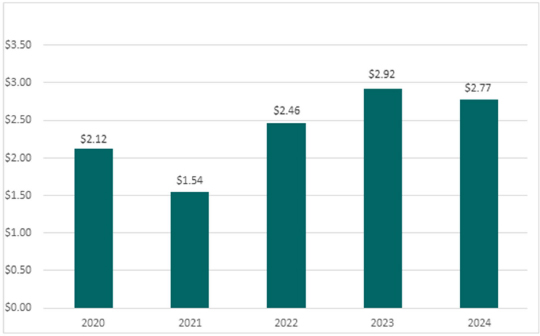
The Company reported earnings per diluted common share of $2.77 for 2024 compared with $2.92 for 2023. The results for 2023 included an after-tax gain of approximately $520 million related to the sale of the insurance business, which was partially offset by after- tax securities portfolio restructuring losses totaling approximately $334 million. Aside from the impact of these items, the Company experienced improvement in several aspects of core operating performance. The Company reported meaningful improvement in both net interest margin and net interest income, stable credit quality, growth in noninterest revenue, and improved operating efficiency.
Return on Average Assets
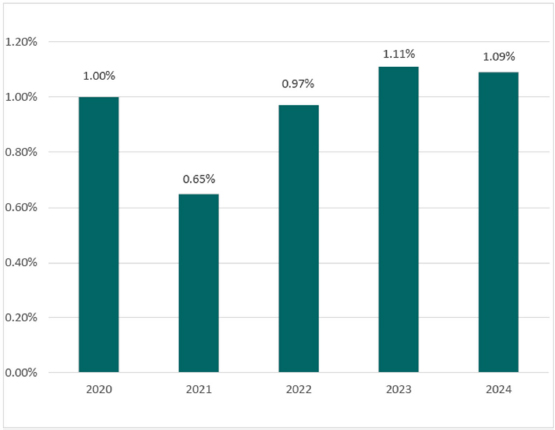
The return on average assets (“ROAA”) was relatively flat at 1.09% for 2024 compared to 1.11% for 2023. The Company’s core operating performance was impacted by improvement in the items noted related to earnings per share.
Proxy Statement Summary
Adjusted Efficiency Ratio
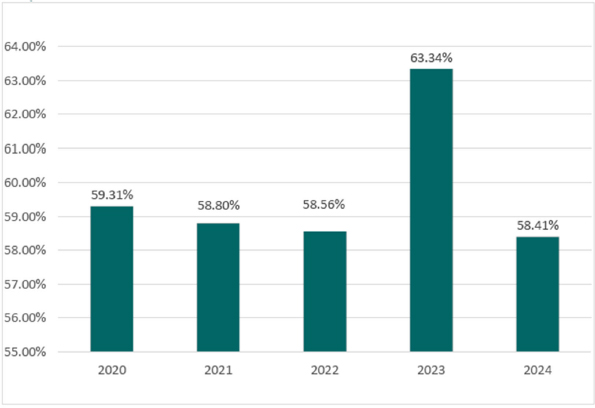
The adjusted efficiency ratio again improved to 58.4% after the increase in 2023. This improvement was driven by a decline in total noninterest expense combined with growth in both net interest revenue and noninterest revenue. The Company implemented several strategic initiatives in 2023 that continued to yield benefits throughout 2024 including branch consolidation and headcount initiatives.
The efficiency ratio (tax equivalent) and the adjusted efficiency ratio (tax equivalent) are supplemental financial measures utilized in management’s internal evaluation of the Company’s use of resources and are not defined under GAAP. The efficiency ratio (tax equivalent) is calculated by dividing total noninterest expense by total revenue, which includes net interest income plus noninterest income plus the tax equivalent adjustment. The adjusted efficiency ratio (tax equivalent) excludes expense items otherwise disclosed as non-routine from total noninterest expense.1
1 Considered a non-GAAP financial measure. Information on reconciliation of non-GAAP measures to financial measures determined in accordance with GAAP may be found in Appendix A.
Proxy Statement Summary
Net Interest Margin – Fully Taxable Equivalent

Our net interest margin improved to 3.30% in 2024 as a result of balance sheet growth, improved earning asset mix, and continued upward repricing of earning asset yields.
At December 31, 2024, the loan to deposit ratio was 83.3% and securities were 15.5% of total assets. The Company’s net interest revenue was $1.44 billion for 2024, an increase from $1.35 billion for 2023. Average interest-earning assets were $43.6 billion in 2024 compared to $44.0 billion in 2023.
Credit Metrics – Net (Recoveries) Charge-offs to Average Loans and Leases
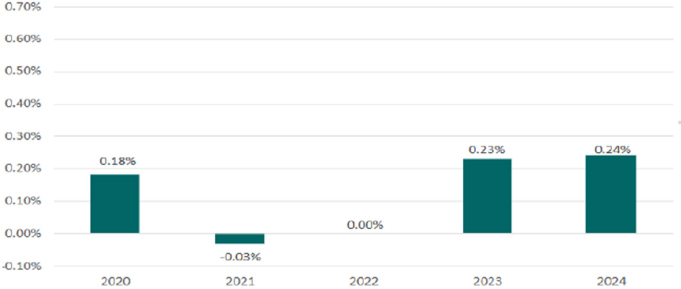
The Company reported net charge-offs of 0.24% of average loans and leases for 2024, which is relatively flat compared to 0.23% for 2023. Credit quality metrics were stable overall year over year including criticized and classified as well as non-performing asset levels. Importantly, the allowance for credit losses remained strong at 1.37% of net loans and leases at December 31, 2024.
Proxy Statement Summary
| Cadence’s
Corporate Engagement and Governance Framework |
Cadence built its integrated Corporate Engagement and Governance Framework around our mission statement to meet customers where they are in their financial journey, and provide expert advice and a broad array of products and services to help them reach their goals. While delivering value to our shareholders, we foster a workplace where teammates thrive and communities prosper.
In addition to the 2024 highlights below, our more detailed 2024 Corporate Engagement and Governance Report is available on the Investor Relations section of the Cadence Bank website at ir.cadencebank.com.

Recent Accolades
 |
Recognitions by Forbes 2024 - Best-In-State Employers for Mississippi. |
|
Linscomb Wealth, a Cadence Bank subsidiary, recognized among Barron’s Top 100 RIA Firms for the third year in a row. |
|
U.S. News & World Report 2024-2025 - Best Companies to Work For - Banking and Best Companies to Work For - In the South. |
|
Recently named a Forbes 2025 America’s Best Large Employers |
|
2024 America Saves Designation of Saving Excellence for promoting savings for the tenth consecutive year. |
|
Voted #1 Regional Bank, #1 Business That Gives Back, #1 Company to Work For, and #1 Regional Investment Firm by Northeast Mississippi Daily Journal Readers 2024. |
|
Recognized by Brands Reimagined - 2024 REBRAND 100® Global Award Winner Silver Award of Distinction. |

Corporate Governance – Board Oversight and Leadership
|
Strong Independent Lead Director with clearly delineated duties. |
|
Director Independence Standards follow the Federal Reserve, U.S. Securities and Exchange Commission (“SEC”), and the New York Stock Exchange (“NYSE”) definition. |
|
All directors serving during 2024 attended more than 88% of the aggregate of all board meetings and 100% of all committee meetings. |
|
12 of 13 of our continuing directors are considered independent under the NYSE standards; the Chairman & CEO is the only non-independent director. |
|
Committed to regular board refreshment through our retirement policy. 54% of our continuing directors have served on the board six years or less. |
|
No director serves on an excess number of outside public boards. |
|
Annual peer-to-peer assessment of the board, its committees, and the Independent Lead Director. The Board conducts an annual evaluation of the CEO’s performance. |
|
Majority voting with director resignation policy. |
|
Significant stock ownership guidelines for our directors and executive officers, with a 12-month holding period post-vesting of equity shares. |
|
Prohibited transactions in our common stock include margin accounts, short selling, trading derivative securities, pledging, and hedging. |
|
No material related-party transactions involving our directors. |
|
Clawback policy for executive compensation for both short and long-term incentives. |
Proxy Statement Summary
Shareholder Rights
|
There are no classes of common stock with unequal voting rights or unequal ability to elect directors. |
|
Shareholders are allowed to call special meetings and may take action by written consent pursuant to the Mississippi Business Corporation Act. |
|
Shareholders may propose bylaw amendments pursuant to the Mississippi Business Corporation Act. |
|
No shareholder rights plan (poison pill). |
Corporate Governance – Operations and Risk Management
|
Risk management policies and procedures provide guidance for the appropriate risk management of technology resources, cybersecurity, legal and regulatory risk, and other such risks as may from time to time be material to our company. |
|
Business Continuity Program manages the threats and impacts associated with a disruption to key resources including people, equipment, facilities, technology and suppliers. |
|
Crisis Management Plan provides the management structure, key responsibilities, emergency assignments and general procedures to follow during and immediately after an emergency. |
Corporate Governance – Information Security Risk
|
We continuously evaluate additional technology measures to defend against potential attacks. |
|
We include Information Security in internal and third-party audits and assessments. |
|
We conduct compliance and training programs, including those for information security awareness. |
|
We collaborate with other financial institutions, regulators, law enforcement officials, other government agencies, internet service providers and internet security experts to analyze and deflect malicious online activity and deliver safe and consistent online services. |
Corporate Governance – Code of Business Conduct and Ethics
|
Equal Opportunity Employer. We strive to eliminate all forms of discrimination. Our policies prohibit all illegal harassment, retaliation and intimidation. |
|
Executive and board oversight of our anti-bribery and anti-corruption program. |
|
Maintain a strong anti-money laundering program to identify and report suspicious activity to the appropriate regulatory agencies. |
|
An independent third party administers our Sarbanes-Oxley Integrity Line, with all complaints reviewed by the Audit Committee of the board of directors. |
|
We regularly evaluate the effectiveness of our sales and incentive programs and the risk profile. We also evaluate new products and services under our risk governance framework with senior leadership oversight. |
Corporate Governance – Vendor Relationships
|
Ongoing monitoring of third-party relationships to verify vendors are performing consistently with the terms of the contracts. |
|
Management assesses, measures, and monitors the risks of each vendor. |
Proxy Statement Summary

Human Capital – Retention
|
Tracked teammate retention relative to industry experience; our turnover rate was in line with industry experience. |
|
Utilized multiple recruitment strategies across the United States to find talented, motivated, and qualified employees. |
|
We used an external compensation benchmarking service to determine market-level compensation for our job roles at similar-sized institutions; assess any necessary modifications to job grades annually. |
|
Maintained established workplace safety procedures and protocols, and provided annual security training to all teammates. |
Human Capital – Professional Development Programs & Training
|
Teammates logged over 140,500 hours of training and professional development; each teammate logged an average of 20 hours of training through the company’s internal learning management system. |
|
Conducted Teammate Engagement Survey, achieving an outstanding 84% participation rate. Results revealed a strong trust and connection between teammates and their managers, as well as a high expectation of staff retention. |
|
Continued the Cadence Bank Management University to help supervisors and managers build important skills, including communication, problem-solving, teammate engagement, leadership development, soft skills and more. |
|
Continued cohort of our Emerging Leaders Mentorship Program in 2024, which focuses on coaching and developing teammates who have significant potential to broaden their role and responsibilities within the company. |
|
Identified potential successors for roles in the bank through multiple levels. |
|
Conducted virtual All Teammate Webinars, providing forums for our executives to connect with teammates across our footprint. |
|
Offered college reimbursement to teammates to help with furthering their education in banking-related areas. |
Human Capital – Employee Benefits & Support
|
Offered competitive compensation and benefits to attract and retain the best people, including paid parental leave to assist and support new parents with balancing work and family matters. |
|
Introduced a 401(k) student debt retirement savings feature in the 401(k) plan for teammates. |
|
Offered wellness initiative called It Pays to Know Your Numbers, encouraging teammates enrolled in the company’s health plan to complete a wellness check, including blood work and other preventive screenings. |
|
Maintained a dedicated healthcare clinic in Tupelo, Mississippi for our teammates and their families, where services are free of charge to employees enrolled in our health benefits programs. |
|
Offered a comprehensive diabetes program, accessible 24/7, 365 days a year for teammates living with Type 2 diabetes as part of our medical benefits plan. |
|
Offered free virtual visits to participants enrolled in select health plans. |
|
Offered a digital physical therapy benefit to teammates participating in our health plans. |
|
Offered free flu shot clinics in strategic office locations to support teammates’ health and welfare. |
|
Helped teammates dealing with issues negatively impacting their lives and the lives of their families through our Employee Assistance Program. |
|
Provided each teammate with one day’s (8 hours) pay to participate in a nonprofit organization or community event to encourage community involvement. |
|
Provided wellness rooms in select locations to support teammate health, with the goal to expand this feature as new locations are built. |
|
Offered Teammate Banking, a first-class, centralized unit of dedicated bankers who exclusively serve the banking and financial needs of new and existing teammates. |
|
Offered flexible work schedules and work-from-home accommodation where possible. |
Proxy Statement Summary
Human Capital – Values and Engagement
|
Encouraged all teammates to create a collaborative environment, which supports teammate engagement and establishes us as productive members of the communities we serve. |
|
Actively recruited prospective teammates from a wide range of institutions of learning, including public and private institutions throughout our footprint. |
|
Continued to support employee-led groups to provide relevant events, resources, networking, professional development, mentoring and leadership opportunities across the organization. |

Community Engagement and Investment
|
Partnered with the Federal Home Loan Bank to award over $3.6 million in grants under the Home Equity Leverage Partnership, Special Needs Assistance Program, Affordable Housing Grant, and Partnership Grant Program to support community-based organizations serving underserved communities in our footprint. |
|
Continued our partnership with Operation HOPE for financial literacy programs, which provide our customers with credit counseling, money management education, homeownership counseling and small business coaching. |
|
Managed approximately $1.2 billion in CRA-qualified investments, including current CRA exam period investments and prior exam period investments still on the books. |
|
Secured funding of approximately $5.1 million in eligible grants and contributions under the Community Reinvestment Act. |
|
Continued our commitment of $1.5 million to Atlanta, Georgia-based Westside Future Fund’s affordable housing initiative. |
|
Cadence Bank and Cadence Bank Foundation collectively contributed approximately $5.4 million to charitable organizations across our footprint. |
|
Donated more than $680,000 through the Cadence Bank Foundation and Cadence Bank in support of affordable housing across the footprint. |
|
Donated more than $70,000 to support numerous Habitat for Humanity chapters throughout the company’s footprint. |
|
Continued our partnership with organizations committed to supporting historically underrepresented communities. |
|
Contributed financial support in the amount of $347,000 for Innovation Depot, Inc., whose mission is to foster a thriving tech ecosystem. |
|
Cadence Cares Holiday Giving Program awarded $150,000 to nine select nonprofit organizations in the communities we serve. The organizations were selected with input from Cadence Bank’s teammates, customers and local communities. |
|
Contributed $100,000 to help expand the Houston, Texas-based Fifth Ward Community Redevelopment Corporation’s certified HUD counseling team. |
|
Contributed $100,000 to Avenue CDC in Houston, Texas to further our company’s commitment to support affordable housing. This partnership will allow for pre-purchase counseling, first-time homebuyer education and foreclosure prevention. |
|
Continued to support historically underserved and underrepresented communities through our Emerging Markets & Outreach program and other community development initiatives. |
Community Engagement and Investment – Lending
|
Originated loans for small businesses of $262 million through Small Business Administration (SBA) 7(a) loans; Cadence Bank ranked as the 17th highest producer of SBA 7(a) loans in the country. |
|
Provided a $1 million equity equivalent investment (EQ2) through 2025 to LiftFund. |
|
Closed nearly 2,000 mortgage loans totaling $524 million in majority-minority census tracts across our footprint. |
|
Provided $1.3 million in assistance to reduce customers’ up-front mortgage loan costs through the |
| Company’s mortgage fee reductions for low - to moderate-income borrowers and borrowers via our Community Heroes program, supporting borrowers employed in teaching, law enforcement, military, first responders and nursing. |
|
Invested over $400,000 to lower the up-front costs of obtaining a mortgage loan in the form of down payment and closing cost assistance for over 140 homeowners under the Bank’s MaxAccess program in majority Black, majority Hispanic, and majority Black and Hispanic census tracts in the Houston, Texas MSA. |
Proxy Statement Summary
|
Closed nearly 2,100 loans totaling $401 million in mortgages made to low- to moderate-income borrowers and in low- to moderate income neighborhoods across all mortgage loan products the bank offers through our Right@Home mortgage program. |
|
Maintained access to over 180 third-party programs offered by state housing authorities, local government agencies and non-profit organizations that provide down payment, closing cost and mortgage credit certificate assistance supporting affordable home mortgages and homeownership. Originated over 330 loans in excess of $62 million in home mortgages using many of these programs. |
|
Continued our relationship with Liberty Bank and Trust, a minority-owned depository institution and Community Development Financial Institution. |
|
Continued our support and partnership with the National Association of Hispanic Real Estate Professionals and the National Association of Real Estate Brokers to positively impact the housing needs of underserved communities and the development of a more diverse mortgage workforce. |
|
Continued our partnership with Community Land Trusts in Houston and Atlanta and with Habitat for Humanity to help stimulate the supply of affordable housing by facilitating mortgage lending for subsidized housing through these programs. |
|
Continued offering the Emerging Communities Credit Builder product, a loan secured by a certificate of deposit to help customers with blemished credit or limited credit history build or rebuild credit, improve credit habits, and save money. |
Customer-Focused Community Engagement and Investment
|
Continued investment in our online and mobile banking platforms for both business and consumer applications. |
|
At year-end 2024, we had over 300 Cadence LIVE Teller-enabled ATMs, which combine innovative technology with the service and expertise of an in-person bank visit, connecting customers with a live teller for personalized support and more flexible/extended hours. |
|
Our Voice of the Customer program includes ongoing measurement of customer satisfaction via proactive and easily accessible surveys. |
|
Continued to expand the role of remote bankers to support customer engagement with new products. |
|
Further developed our universal branches, composed of universal bankers, personal bankers and Cadence LIVE Tellers working in concert with one another. Instead of housing a vault or teller lines, this smaller footprint allows customers to easily conduct business with personal bankers and Cadence LIVE Teller specialists via LIVE Teller-enabled ATM assistance. |
|
Continued to support our customers with resources designed to help address the language needs and preferences of our customers through our Limited English Proficiency initiatives. |
Community Impact
|
Teammates volunteered over 4,000 hours conducting approximately 2,100 financial education programs that reached more than 46,000 adults and youth through financial literacy programs. |
|
Teammates participated in the United Way Employee Campaign, contributing more than $459,000 to support non-profit organizations that foster academic success, family stability, and health and wellness. |
|
Teammates volunteered over 11,500 service hours supporting more than 1,200 organizations in communities across our footprint. |
|
Through the IRS’ VITA program, teammates assisted in the preparation of 732 federal income tax returns and 399 state income tax returns, at no cost, for families and individuals in our communities. |
|
During Hurricanes Beryl, Milton, and Helene, which hit Houston, Georgia, and Florida in July, August, and September of 2024, respectively, we deployed generators and emergency supplies, including food, water and refrigerators to branches and individually impacted teammates. |
Community Engagement – Financial Wellness
|
Offered Budget Smart® Checking, an overdraft avoidance product, to provide our customers with safe, trusted and affordable banking. |
|
Provided spending tools through Online Banking to assist our customers with creating and managing a budget. |
Proxy Statement Summary
|
Educated teammates and customers about cybersecurity threats and fraud prevention and protection measures through a comprehensive fraud communications strategy. |
|
Delivered financial education, insights and resources through the Company’s website and an electronic newsletter published monthly for customers. |

Environment – Offices and Branches
|
Renovated our downtown Birmingham corporate office, reducing our footprint by over 18,000 square feet while modernizing the space for efficiency. We also relocated our Birmingham operations center to a new facility that reduced our square footage by almost 17,000 square feet. |
|
Continued focus on operational efficiency and the reduction of our physical impact with additional office downsizing. |
|
Reduced lighting, energy and water consumption by utilizing occupancy sensors and lighting timers, reduced-flow plumbing fixtures, and low-e glass where practical. We also attempted to minimize demands for landscape irrigation in new landscape design where possible. |
|
Strived for ways to lessen the impact on the environment by choosing “green” materials and building methods, where feasible, for new construction and renovations. |
Environment – Energy Upgrades of Facilities
|
Facilities equipped with interior or exterior LED lighting saved nearly 60 million kilowatt hours of energy and approximately $6 million in energy cost, as well as carbon emissions reduction of approximately 25,869 metric tons of CO2. |
|
Energy efficient mechanical systems with programmable controls provided additional savings on energy cost. |
Environment – Digital Banking
|
Continued to deliver digital banking (online and mobile app) solutions to meet customers’ preferences for self-service transactions utilizing online, mobile and ATM/Cadence LIVE Teller-enabled ATM channels. |
|
Offered a full slate of digital banking solutions, including online banking and mobile apps which help to reduce paper usage. |
Renewable Energy Lending
|
The number of borrower relationships continued to grow, and total funded loans increased to $468.9 million as of December 31, 2024. Additionally, 2024 was Cadence Bank’s inaugural year using our balance sheet and tax capacity to participate in the renewable energy tax credit transfer market. |
|
Our Renewable Energy Group has an extensive background in supporting energy transition by financing solar, wind, battery storage and biogas projects in a responsible, thoughtful manner. The portfolio growth is well-balanced and maintains strong credit quality underwriting. |
Managing Exposure to Investments Subject to Environmental Risk
|
Environmentally conscious in lending arrangements; we consider loans involving property where environmental hazards or contamination exist undesirable except where parties can undertake proper assessments and monitoring. |
|
For credit extended to develop land in a floodplain, or where there are other indications there may be wetlands present, we may require a letter or report from the United States Army Corps of Engineers. |
Proxy Statement Summary
Paper Consumption and Recycling
|
Over 80% of mortgage loan applications were initiated and processed through online and digital processes. |
|
The Mortgage Loan department’s hybrid eClosing solution enhances a customer’s closing experience and reduces the number of paper documents in a closing package. In 2024, 5,560 closings utilized this method, and on average, eClosing reduces paper documents per closing by an average of 63 pages, eliminating more than 350,280 pages in 2024. |
|
Recycling efforts resulted in nearly two million pounds, or 917 tons, of paper being shredded, saving an estimated 15,675 trees, four million kilowatts of energy, 6.4 million gallons of water, 348,520 gallons of oil and 2,751 cubic yards of saved landfill space. |
|
Focused on significantly reducing our consumption of bottled water through a program called “Skip the Bottles, Save the Earth. |
Corporate Governance, Compensation and Board Matters
The Nominating and Corporate Governance Committee, the Executive Compensation and Stock Incentive Committee, and the Board carefully considered our corporate governance and compensation practices in 2024:
Corporate Governance Highlights
| What We Do |
| ✔ | Shareholder Engagement. Annual shareholder engagement program. |
| ✔ | Board recommended governance proposals. The Board recommended three governance proposals, which were approved by shareholders at the 2024 annual meeting. |
 |
To declassify the Board by 2027. |
|
To reduce the threshold for shareholder actions by written consent. |
|
To eliminate the supermajority threshold for shareholder approval of a merger or takeover where the Board does not recommend approval of the proposed transaction. |
| ✔ | Independent Directors. Our Board is composed of 13 continuing directors who are independent under the NYSE standards for independence as well as our Director Independence Standards. The only non-independent director is our CEO. |
| ✔ | Independent Committees. Our Audit, Executive Compensation and Stock Incentive, Nominating and Corporate Governance, and Risk Management Committees are composed entirely of independent directors. |
| ✔ | Independent Lead Director. Strong Independent Lead Director with clearly delineated duties. The Board conducts an annual assessment of the Independent Lead Director. |
| ✔ | Executive Sessions. Independent directors meet in executive sessions at least semi- annually, and met eight times in 2024. |
| ✔ | Outside Advisors. Board and Committees may retain outside advisors independently of management. |
| ✔ | Board Diversity. Diverse Board in terms of qualifications, specific skills, and experiences, as well as gender and ethnicity, with 69% of our continuing directors from under-represented groups (women and minorities). |
| ✔ | Directors Public Company Service. None of the Company’s directors serve on an excess number of public boards. |
| ✔ | Board Involvement and Attendance. All directors serving during 2024 attended approximately 88% of all Board and 100% of all committee meetings in 2024. |
| ✔ | Board and Committee Peer-to-Peer Assessments. Conduct Board and Committee peer-to-peer assessments annually. |
| ✔ | Board Refreshment. Demonstrated commitment to regular board refreshment through retirement policy, with 54% of continuing directors having served 6 years or less. |
| ✔ | Director Resignation Policy. Majority voting with director resignation policy. |
| ✔ | Related-Party Transactions. No material related-party transactions involving our directors. |
| ✔ | Orientation Program. Orientation program for new directors and continuing education for all directors. |
| ✔ | CEO Performance. The Board conducts an annual evaluation of the CEO’s performance. |
Proxy Statement Summary
| ✔ | CEO Public Company Service. CEO does not serve on any outside public company boards. |
| ✔ | Succession Planning. Maintain a formal management succession plan that includes an annual review of management succession planning and requires executives and other managers to regularly identify potential leaders for succession planning. |
| ✔ | Clawback Policy. Maintain a clawback policy which applies to both short-term and long-term incentive plans, and which complies with NYSE rules. |
| ✔ | Stock Ownership Guidelines. Directors and executive officers are subject to significant common stock ownership guidelines, with a 12-month holding period after the vesting of equity awards. |
| ✔ | Special Meetings. Shareholders have the right to call special meetings. |
| ✔ | Shareholder Action by Written Consent. The Company allows shareholders the ability to take action by written consent. |
| What We Don’t Do |
| X | Special Meeting Rights. There are no material restrictions on shareholders’ rights to call special meetings. |
| X | Supermajority Vote. We do not require a supermajority vote to approve amendments to our Articles of Incorporation or Bylaws. Shareholders may amend the Bylaws at any regular or special meeting where a quorum is present. |
| X | No Poison Pill. We do not have a shareholder rights plan. |
| X | No Share Recycling. Shares withheld from awards for taxes or other purposes are not available for re-issuance under our long-term equity incentive plans. |
| X | Short Selling or Use of Derivatives. In addition to the types of short selling prohibited by the Securities Exchange Act of 1934, as amended (the “Exchange Act”), our insider trading policy prohibits our directors and executive officers from any short selling, hedging, or from trading derivative instruments related to our securities. |
| X | Margin Accounts Holding and Pledging of Our Common Stock. Our directors and executive officers are prohibited from holding shares in margin accounts and are not permitted to pledge shares of our common stock as collateral. |
Proxy Statement Summary
Executive Compensation Highlights
| What We Do |
| ✔ | Executive Compensation Policy. We maintain an Executive Compensation Policy, which outlines the principal criteria used to measure the success of our executive officers in achieving our business objectives. |
| ✔ | Review Compensation Program. We review our compensation program against market practices to confirm it is competitive and does not encourage excessive risk-taking. |
| ✔ | Pay for Performance. We provide short-term and long-term incentive awards based on performance targets aligned with identified business performance metrics. |
| ✔ | Balance of Performance Metrics. We use multiple performance metrics and multi-year vesting timeframes to prevent over-emphasis on any single metric and minimize short-term risk-taking. |
| ✔ | Long Vesting Periods. Awards of our restricted stock units prior to 2023 vested on a cliff basis of four years. Beginning in 2023, restricted stock units vest ratably over years 2, 3, and 4. Performance awards have cliff vesting following a three-year performance period. |
| ✔ | Stock Ownership Guidelines. We maintain rigorous stock ownership guidelines for our directors and executive officers, in order to more closely align the financial interests of the directors and executive officers with those of our shareholders. |
| ✔ | “Clawback Policy.” We maintain a clawback policy which sets forth the conditions under which we may recover excess incentive-based compensation (as defined in our policy) paid or awarded to or received by any of our current or former executive officers. |
| ✔ | “Double Triggers.” Our change in control agreements include a “double trigger” requiring both a change in control, and termination of the executive’s employment without cause, or by the executive for good reason, within a set period of time for the executive to receive payment. |
| ✔ | Shareholder Engagement. In late 2024 and January 2025, we conducted a shareholder engagement program, during which we reached out to holders representing 67.53% of our outstanding shares, and holders of 13.65% of our shares met with us. Additionally, we are available year-round for shareholder questions and comments both in person and virtually, and we have ongoing shareholder interactions through direct contact, as well as meetings with advisors, shareholders, and other stakeholders. |
| ✔ | Annual Say-on-Pay Vote. We conduct an annual say-on-pay vote for shareholders to approve executive compensation of our NEOs. |
| What We Don’t Do |
| X | Dividends on Unearned Performance-Based and Restricted Stock Unit Equity Awards. Performance-based equity awards and restricted stock units accrue dividend equivalents during the respective performance and retention period, which are not paid to the executive until vesting. |
| X | Short Selling or Use of Derivatives. Our insider trading policy prohibits our directors and executive officers from any short selling or hedging activities, and from trading derivative instruments related to our securities. |
| X | “Gross Ups.” We do not provide tax “gross up” payments. |
| X | Option Repricing. Our long-term equity incentive plans prohibit option repricing without the approval of our shareholders. |
| X | Option Backdating or “Spring-Loading.” We do not backdate options or grant options retroactively. |
| X | Multi-year Guaranteed Bonuses. We do not award multi-year guaranteed bonuses. |
Voting Process
In an effort to lower the cost of the Annual Meeting and conserve natural resources, we are furnishing our proxy materials to our shareholders via the internet in accordance with the “notice and access” e-proxy rules rather than mailing printed copies of those materials to each shareholder. If you received a Notice of Internet Availability by mail, you will not receive a printed copy of our proxy materials. If, however, you would like to receive a paper copy of our proxy materials, you should follow the instructions for requesting these materials included in the Notice of Internet Availability. If you chose to receive a printed copy of our proxy materials, you will continue to receive these materials by mail unless you affirmatively change to electronic delivery.
The Notice of Internet Availability contains instructions regarding how to access the proxy materials, how to give your proxy authorization to vote your shares by internet, QR code scan, or telephone. This process is designed to expedite shareholders’ receipt of our proxy materials.
| February 28, 2025 | The Record Date. Shareholders on this Date are entitled to notice of, and to vote at, the Annual Meeting. |
| March 14, 2025 | Mailing date of the Notice of Internet Availability of Proxy Materials, including this Proxy Statement, a proxy card, and our Annual Report for the year ending December 31, 2024 to shareholders. |
Record Date, Shares Outstanding, Votes Per Share and Quorum
The close of business on February 28, 2025 has been fixed as the record date for the determination of shareholders entitled to notice of and to vote at the Annual Meeting. As of such date, we had 500,000,000 authorized shares of common stock, $2.50 par value per share, of which 183,525,441 shares were outstanding, and 6,900,000 authorized shares of 5.5% Series A Non- Cumulative Perpetual Preferred Stock, $0.01 par value per share, of which 6,900,000 shares were outstanding. Only holders of shares of our common stock are entitled to vote at the Annual Meeting, and each share of our common stock is entitled to one vote. Holders of a majority of the outstanding shares of our common stock must be present, virtually or by proxy, to constitute a quorum for the transaction of business at the Annual Meeting.
If a proxy is properly given by a shareholder of record and not revoked, it will be voted in accordance with the instructions provided, if any, and if no instructions are provided, it will be voted as shown below.
| Proposal 1 | “FOR” the election of each of the five director nominees to serve on the Board of Directors. |
| Proposal 2 | “FOR” the advisory approval of the compensation of our Named Executive Officers. |
| Proposal 3 | “FOR” the ratification of appointment of Forvis Mazars LLP as our independent registered public accounting firm for the year ending December 31, 2025. |
| Any other proposal properly before the annual meeting |
As recommended by our Board of Directors. |
We encourage shareholders to vote their proxies by internet, QR code scan, or telephone, or, if you request a paper copy of the proxy materials, by mailing a proxy card enclosed with those materials.
| Voting Methods – Each should take only a few minutes to complete | |
| Internet | Follow the instructions in the Notice of Internet Availability. |
| QR code scan | Follow the instructions in the Notice of Internet Availability. |
| Telephone | Follow the instructions in the Notice of Internet Availability. |
| Mailing your proxy card | Follow the instructions in the Notice of Internet Availability to request a paper copy of our proxy materials. Once received, complete, sign, date and return the proxy card by mail using the postage prepaid return envelope included with the paper copy of your proxy materials. |
Voting Process
Frequently Asked Questions:
|
Q: Is a vote submitted via the internet, using a QR code scan, or by telephone as valid as one submitted by mail? |
A: Yes. All methods of voting have equal weight. |
| Q: When is the last day and time I can vote? |
A: If you are voting via the internet, using a QR code scan, or by telephone, you may vote at any time until the voting closes during the Annual Meeting on April 23, 2025.
If you are voting by mail, we must receive your ballot before the voting closes at the Annual Meeting on April 23, 2025. |
| Q: What if I vote by one method, and then I vote using another method? | A: Only the last vote submitted by a shareholder is counted, and we will disregard previous vote(s) if we receive a subsequently voted proxy for your shares. |
| Q: Do I have to vote to attend the Annual Meeting? | A: No. Shareholders are not required to vote in order to attend the annual meeting. |
| Q: If I vote via proxy, can I still attend the Annual Meeting and vote there? | A: Yes, you can still attend the Annual Meeting, no matter if or when you vote your proxy. And if you have previously voted, you may revoke your proxy and vote at the Annual Meeting. We will only count the last vote. |
For a general description of how votes will be counted, please refer to the section below entitled “GENERAL INFORMATION - Counting of Votes.”
If shares entitled to vote are held in “street name” through a broker, bank or other holder of record, the beneficial holder will receive instructions from the registered holder that must be followed in order for the shares to be voted on behalf of the beneficial holder. Please vote as instructed by your broker, bank or other holder of record. If a beneficial holder provides specific voting instructions, the shares will be voted as instructed and as the proxy holders may determine how to vote within their discretion with respect to any other matters that may properly come before the Annual Meeting.
The final voting results of the Annual Meeting will be announced no later than four business days after the Annual Meeting on a Form 8-K which will be filed with the federal banking authorities and which will be available on the Investor Relations section of our website at ir.cadencebank.com.
Our proxy materials have been made available to you by internet access in connection with the solicitation of proxies by our Board of Directors for the purposes set forth in this Proxy Statement and in the accompanying Notice of Annual Meeting of Shareholders. Proxies will be voted at the Annual Meeting and at any adjournments or postponements thereof. We pay the entire cost of soliciting your proxy, including the cost of preparing, assembling, printing, mailing, and otherwise distributing the Notice of Internet Availability of Proxy Materials and these proxy materials, as well as soliciting your vote. If shareholders request paper copies of our proxy materials, we will bear the cost of printing, mailing and other expenses in connection with this solicitation of proxies and will also reimburse brokers and other persons holding shares of common stock in their names or in the names of nominees for their expenses in forwarding paper copies of our proxy materials to the beneficial owners of such shares. Certain of our directors, officers and employees may, without any additional compensation, solicit proxies in person or by telephone.
| Proposal 1: Election of Directors |
Size, Tenure, and Demographics of Board of Directors
Our Second Amended and Restated Articles of Incorporation (the “Articles”) provide that the Board of Directors shall consist of at least nine (9) and no more than twenty (20) members, with the exact number to be determined from time to time by the entire Board of Directors. Currently, the Board of Directors has 15 members. Current directors Alan Perry and Marc Shapiro are not standing for re-election; both reached retirement age per our retirement policy. The Board of Directors has taken action to decrease the size of the Board, effective as of the Annual Meeting, to 13 members.
The Articles provide that the Board of Directors shall be declassified over the course of the annual meeting elections in 2025, 2026, and beginning in 2027, all members of the Board shall stand for election annually. Over 54% of the continuing directors on our Board of Directors have a tenure of six years or less. Additionally, 69% of our continuing directors are from historically under-represented groups, including women and minorities.
Board Skills and Qualifications
All of our directors bring a wealth of executive leadership experience to our Board, particularly at public companies and in roles in the banking and financial services industry. The Board determined that the below skills, presented alphabetically, are linked to prudent Board oversight of the Company as described below:
| Experience and Attributes | Short Description |
| Accounting/Audit Committee of a Public Company/Finance | A director who understands general accounting principles and is able to analyze financial data. |
| Audit Committee Financial Expert | A director who has all of the following attributes: (i) an understanding of generally accepted accounting principles and financial statements; (ii) the ability to apply such principles with the accounting of estimates, accruals and reserves; (iii) experience in preparing, auditing, analyzing or evaluating financial statements as presented in the Company’s financial reporting, or experience in actively supervising one or more persons engaged in such activities; (iv) an understanding of internal controls and procedures for financial reporting; and (v) an understanding of audit committee functions. |
| Audit Committee of a Public Company | A director with experience serving on an Audit Committee of a publicly-traded company. |
| Financial Services Industry | A director who understands the types of financial products and services offered, as well as those the Company chooses not to offer, are critical to the success of the Company. |
| Public Company CEO | A director with experience as a current or former chief executive officer of a publicly-traded company. |
| Corporate Governance | A director who understands the constantly changing corporate governance trends and practices that affect the fundamental operation of a company and how it can have a significant impact on corporate operations and shareholder value. |
| Cybersecurity Technology | A director who has experience in the practice of securing networks, resources, and systems from digital/cyberattacks and taking measures to protect a system or network from cyberattacks. |
Proposal 1: Election of Directors
| Experience and Attributes | Short Description |
| Executive Leadership | A director who has experience leading an organization by providing practical insights on governance, accountability and integrity. |
| Human Resources (compensation, management succession, ethics, diversity) | A director who understands and has experience in various types of executive compensation, benefit options, talent recruitment and retention, succession planning, corporate culture, code of conduct and ethics, and diversity in the workforce. |
| Information Security & Technology | A director who has experience in implementing, establishing, or overseeing technology to include information security systems and protocols. |
| Investment Banking and Trust Services | A director who is knowledgeable in the benefits and risks associated with serving as a fiduciary. |
| Operations Management Technology | A director who possesses the knowledge and experience in providing the best customer experience in business operations and technology by improving processes, services, and products, as well as reducing operational risks. |
| Public Company Board Service | A director with publicly-traded company board service who understands the board’s function, reporting requirements, strategic planning, prudent governance practices and problem-solving. |
| Real Estate Uses and Transactions | A director who has experience in real estate appraisals, values, and transactions over complex real estate matters. |
| Regulatory or Compliance | A director who has experience in understanding the federal and state regulations that impact the Company’s products and services. |
| Risk Management | A director who is familiar with risk management by identifying risks and establishing a risk appetite framework and controls. |
| Strategic Planning – M&A Strategy and Development | A director who understands how to strategically plan for the future of the Company, both in the short-and long-term, and is able to oversee and advise management with respect to the formulation and execution of the Company’s strategic planning, which includes not only organic growth, but growth through mergers and acquisitions. |
| Sustainability Practices | A director who has experience in recognizing risks and opportunities associated with the environmental related issues resulting from the operations of a company; the creation and development of a diverse workforce reflective of the communities served; and transparent governance practices which make the Company’s current operations more resilient and sustainable. |
Proposal 1: Election of Directors
The following chart summarizes each continuing director’s key experience, qualifications and attributes.
| Experience and Attributes | Rol l ins | Araujo | Brown | Cannon | Corley | Evans | Hepner | Holliman | Hood | Jackson | Owodunni | Rodriguez | Stanton |
| Accounting/Audit Committee of a Public Company/Finance | ✓ | ✓ | ✓ | ✓ | ✓ | ✓ | ✓ | ✓ | ✓ | ✓ | ✓ | ✓ | ✓ |
| Audit Committee Financial Expert | - | - | - | ✓ | ✓ | ✓ | ✓ | - | ✓ | ✓ | ✓ | - | ✓ |
| Audit Committee of a Public Company | - | - | - | ✓ | ✓ | - | ✓ | - | ✓ | ✓ | ✓ | - | - |
| Corporate Governance | ✓ | ✓ | ✓ | ✓ | ✓ | ✓ | ✓ | ✓ | ✓ | ✓ | ✓ | ✓ | ✓ |
| Cybersecurity Technology | ✓ | - | - | - | - | - | - | ✓ | ✓ | - | - | - | ✓ |
| Executive Leadership | ✓ | ✓ | ✓ | ✓ | ✓ | ✓ | ✓ | ✓ | ✓ | ✓ | ✓ | ✓ | ✓ |
| Financial Services Industry | ✓ | - | ✓ | ✓ | ✓ | ✓ | ✓ | ✓ | ✓ | ✓ | ✓ | ✓ | ✓ |
| Human Resources (compensation, management succession, ethics, diversity) | ✓ | ✓ | ✓ | ✓ | ✓ | ✓ | ✓ | ✓ | ✓ | ✓ | ✓ | ✓ | ✓ |
| Information Security & Technology | ✓ | ✓ | - | - | ✓ | ✓ | - | ✓ | ✓ | - | - | - | ✓ |
| Investment Banking and Trust Services | ✓ | - | ✓ | ✓ | ✓ | ✓ | ✓ | ✓ | ✓ | ✓ | ✓ | - | - |
| Operations Management and Technology | ✓ | ✓ | ✓ | ✓ | ✓ | ✓ | - | ✓ | ✓ | - | ✓ | ✓ | ✓ |
| Public Company Board Service | ✓ | ✓ | ✓ | ✓ | ✓ | ✓ | ✓ | ✓ | ✓ | ✓ | ✓ | - | ✓ |
| Public Company CEO | ✓ | ✓ | - | - | - | ✓ | - | - | - | - | - | - | ✓ |
| Real Estate Uses and Transactions | ✓ | ✓ | ✓ | - | - | ✓ | ✓ | ✓ | - | ✓ | - | - | - |
| Regulatory or Compliance | ✓ | ✓ | ✓ | ✓ | ✓ | ✓ | ✓ | ✓ | ✓ | ✓ | ✓ | ✓ | ✓ |
| Risk Management | ✓ | ✓ | ✓ | ✓ | ✓ | ✓ | ✓ | ✓ | ✓ | ✓ | ✓ | ✓ | ✓ |
| Strategic Planning – M&A Strategy and Development | ✓ | ✓ | ✓ | ✓ | ✓ | ✓ | ✓ | ✓ | ✓ | ✓ | ✓ | ✓ | ✓ |
Proposal 1: Election of Directors
Our retirement policy serves as a mechanism to encourage director refreshment on our Board by providing that directors retire at age 75. Any director who reaches the age of 75 during his or her term of office may continue to serve until the expiration of the then-current term.
Required Vote and Voting Process
Directors are elected by a plurality of the votes cast by the holders of shares of our common stock represented at a meeting at which a quorum is present. The holders of our common stock do not have cumulative voting rights with respect to the election of directors. Consequently, each shareholder may cast only one vote per share for each nominee. Unless a proxy specifies otherwise, the persons named in the proxy card shall vote the shares covered by the proxy for the nominees listed below. Should any nominee become unavailable for election, shares covered by a proxy will be voted for a substitute nominee selected by the current Board of Directors.
Our Second Amended and Restated Bylaws, as amended (“Bylaws”), provide that, in an uncontested election, any nominee for director who receives a greater number of votes “withheld” from than votes “for” his or her election must promptly tender his or her resignation following certification of the shareholder vote. The Nominating and Corporate Governance Committee will consider any such resignation offer and recommend to the Board of Directors whether to accept it. The Board of Directors will act on any such recommendation of the Nominating and Corporate Governance Committee within 90 days following certification of the shareholder vote.
Last year our shareholders approved an amendment to our Articles to declassify our Board. This year is the first year in which shareholders will vote for directors for a one-year term. The directors up for election this year include the two directors appointed to the Board in January of 2025, Fernando G. Araujo and Alice L. Rodriguez, and are joined by three continuing Board members, Shannon A. Brown, William G. Holliman and the CEO and Chairman of the Board, James D. Rollins III. These five (5) individuals, if elected, will serve until the annual meeting of shareholders in 2026, or until their earlier removal, resignation or retirement.
Each nominee has consented to be a candidate and to serve as a director if elected. The Board has no reason to believe any nominee will be unavailable to serve as a director. Assuming the election of the five (5) director nominees at the Annual Meeting, the Board of Directors will consist of 13 members.
The biographies in the table below show the name, age, principal occupation, and directorships with other public, private, and non-profit companies, and if applicable, information regarding involvement in certain legal or administrative proceedings held by each of the nominees designated by the Board of Directors for election as a director. In addition, each of the nominees has held their principal occupation for more than five (5) years unless otherwise indicated below. We have also provided a brief discussion of the specific experience, qualifications, attributes, or skills that led to the Nominating and Corporate Governance Committee’s conclusion that each nominee should serve as one of our directors.
Proposal 1: Election of Directors
Director Nominees’ Background and Qualifications
| Directors Standing for Election – 1-year Term |
|
Fernando G. Araujo, 57
|
Background and Qualifications: Mr. Araujo, the CEO of Berry Corporation, brings more than 30 years experience in the oil & gas industry to the Board. His extensive career has included domestic, international, and cross-border assignments, among them, several where he oversaw operations in various countries. In addition to Mr. Araujo’s extensive executive experience, he has decades of experience operating a business in a highly-regulated environment with significant compliance obligations. Mr. Araujo’s background also includes a great deal of strategic planning, experience with mergers and acquisitions, sustainability practices, and both operational and risk management skills. He is well-versed in the establishment and maintenance of information security protocols. The experience Mr. Araujo brings to the Board deepens that of the collective group in a number of areas, while expanding it beyond the financial services sector.
Directorships, public:
● Cadence Bank (NYSE: CADE) (Since 2025) ● Berry Corporation (NASDAQ: BRY) (non-independent director)
Directorships, Non-profit:
● Western States Petroleum Association
|

Proposal 1: Election of Directors
|
Shannon A. Brown, 68 |
Background and Qualifications: Mr. Brown is deeply familiar with issues related to the financial services industry and the customers and employees it serves. Mr. Brown previously held a number of senior executive level positions at FedEx Express prior to his retirement in November 2022. At the time of his retirement, Mr. Brown was the Senior Vice President of U.S. Operations, Eastern Division and the Chief Diversity Officer. During his more than three-decade career at FedEx Express, Mr. Brown also served as Senior Vice President, Human Resources and Senior Vice President of Air, Ground, and Freight Services. Through this professional background Mr. Brown possesses expertise in matters relating to recruitment, development, and retention of a diverse workforce, as well as employee benefits and compensation. Mr. Brown also has extensive non-profit experience, through which he has additional expertise related to serving constituencies with a variety of economic, racial, and geographic backgrounds and needs.
Directorships, public:
● Cadence Bank (NYSE: CADE) (Since 2016) ● Universal Insurance Holdings, Inc. (NYSE: UVE)
Directorships, non-profit:
● United Way of the Mid-South ● Central Board of the Boys & Girls Club of Greater Memphis ● Western Governors University Advisory Board ● University of Denver School of Transportation & Supply Chain ● Orpheum Theatre Group ● Atlanta Business League ● Atlanta Convention and Visitors Bureau ● Metal Museum
Former Directorships:
● Buckeye Technologies, Inc. ● Memphis Area Chamber of Commerce ● Teach for America – Memphis ● Memphis International Festival |

Proposal 1: Election of Directors
|
William G. Holliman, 60
|
Background and Qualifications: Mr. Holliman is an experienced executive and entrepreneur whose hands-on business and management experience contributes to the diversity of types of management experience on the Board. He currently serves as President of HomeStretch Furniture, a private company he co-founded, which specializes in furniture manufacturing. Mr. Holliman is a lifelong native Mississippian, whose ties and understanding of one of the primary markets in which the Company has operations, augments the Board’s understanding of the kinds of compensation, diversity, sustainability, strategic planning, and risk management matters the Board oversees.
Directorships, public:
● Cadence Bank (NYSE: CADE) (Since 2020)
Directorships, non-profit:
● North Mississippi Medical Center ● North Mississippi Health Services, Inc. ● Faith Family Ministries |

Proposal 1: Election of Directors
|
Alice L. Rodriguez, 60 |
Background and Qualifications: Ms. Rodriguez brings her experience of over 35 years working for JP Morgan Chase & Co. (and its predecessors). Over the decades, Ms. Rodriguez served the company in a variety of roles, including as the head of the community impact organization and Managing Director, and before that as Managing Director and head of the community and business development organization. Earlier in her career, Ms. Rodriguez served as a wealth management executive in the Texas markets, and as a business banking executive for the California region. She has extensive experience managing large teams of people, and with the related human resources matters, in addition to managing risks more broadly. Ms. Rodriguez also has deep experience with corporate governance, strategic planning, operations management, and regulatory compliance.
Directorships, public:
● Cadence Bank (NYSE: CADE) (Since 2025)
Directorships, private:
● Oncor Holdings
Directorships, non-profit:
● DreamSpring (Chair) ● Latino Business Action Network ● United States Hispanic Chamber of Commerce Education Fund ● Avance Inc ● Perot Museum of Natural Science ● Dallas Arboretum
Former Directorships:
● United States Hispanic Chamber of Commerce (Chair) ● DreamSpring (Chair)
|

Proposal 1: Election of Directors
|
James D. Rollins III, 66
|
Background and Qualifications: Mr. Rollins has served as Chairman of the Board of Cadence Bank since April 2014 and CEO since November 2012. Prior to that, he served as President and Chief Operating Officer of Prosperity Bancshares, Inc., from 2006 to 2012. From 1994-2006, Mr. Rollins held other senior executive positions at Prosperity Bancshares and Prosperity Bank. Before joining Prosperity Bank, Mr. Rollins worked for First State Bank and Trust Company. Mr. Rollins brings his decades of executive, operational, and leadership experience to his role as Chairman of the Board. Reflective of his broad experience in the banking industry, Mr. Rollins is an audit committee financial expert who also has expertise with strategic and risk management, operations management, information and technology security, as well as human resources issues, including compensation, diversity, ethics, and sustainability matters.
Directorships, public:
● Cadence Bank (NYSE: CADE) (Since 2012 and Chair since 2014)
Directorships, non-profit:
● North Mississippi Health Services, Inc. (Past Chair) ● Mississippi Economic Council (Past Chair)
Former Directorships:
● Prosperity Bancshares, Inc. (NYSE: PB) ● Healthcare Foundation of North Mississippi |

The Board of Directors Recommends Shareholders
vote “FOR” each of the five Nominees for Director named above.
Proposal 1: Election of Directors
Continuing Directors’ Background and Qualifications
The biographies in the table below show the name, age, principal occupation and directorships with other public, private, and non-profit companies, held by each of the continuing directors. In addition, each of the continuing directors has held their principal occupation for more than five years unless otherwise indicated. We have also provided a brief discussion of the specific experience, qualifications, attributes or skills that led to the Nominating and Corporate Governance Committee’s conclusion that each continuing director should serve as one of our directors.
| Continuing Directors – Class II – Term Expires 2026 |
|
Deborah M. Cannon, 73 |
Background and Qualifications: Ms. Cannon has extensive experience in the financial services industry, having served in a number of roles at Bank of America over thirty years. At the time of her retirement from Bank of America, Ms. Cannon was an Executive Vice President and President of the Houston region. During the course of her career at Bank of America, Ms. Cannon was a lender in and managed groups of other bankers in local, regional, national, and international regions. Subsequently, Ms. Cannon served as CEO of the Houston Zoo, Inc. for over ten years. Ms. Cannon not only has deep financial experience, she is also an audit committee financial expert. Ms. Cannon additionally has experience relevant to some of the significant regions in which Cadence operates, as well as the employees and customers served in Houston. Ms. Cannon’s experience in talent retention, recruitment, and corporate culture are valuable contributions to the Cadence Board.
Directorships, public:
● Cadence Bank (NYSE: CADE) (Since 2015)
Directorships, non-profit:
● Houston Parks Board ● Teach for America ● Memorial Hermann Accountable Care Organization
Former Directorships:
● Memorial Hermann Health Systems (Chair) ● Deltic Timber Corporation (Audit Committee Member) ● United Way of the Texas Gulf Coast ● Greater Houston Partnership (Chair) |

Proposal 1: Election of Directors
|
Warren A. Hood, Jr., 73 |
Background and Qualifications: Mr. Hood brings the expertise from his long business career running a multi-national company to his Board service. He is currently the Chairman and CEO of Hood Companies, Inc., a corporation with manufacturing and distribution sites throughout the United States, Canada, and Mexico. He is well-versed in a wide variety of relevant matters ranging from human resources, to financial, to strategic planning and risk management, to issues surrounding establishment, maintenance, and protection of technology resources. Mr. Hood has a wealth of prior board service, in financial services companies as well as community and philanthropic boards. Mr. Hood brings skills navigating financial statements and financial disclosure issues, gained through his prior service on the board and the audit committee of another NYSE listed company. Mr. Hood is an audit committee financial expert.
Directorships, public:
● Cadence Bank (NYSE: CADE) (Since 2007)
Directorships, private:
● Hood Companies, Inc. (Chair)
Former Directorships:
● First American Corporation ● First American National Bank ● Mississippi Power Company ● Deposit Guaranty Corporation ● Southern Company (NYSE: SO) (Audit Committee Member) |
|
Precious W. Owodunni, 50 |
Background and Qualifications: Ms. Owodunni was formerly an investment banker and Vice President at Goldman Sachs who is now the CEO of Mountaintop Consulting LLC, a business strategy and branding company that serves leading corporations and financial services, law and private equity firms. She is experienced in business strategy and branding, as well as strategic business combinations and matters of corporate finance. In addition to her financial expertise, Ms. Owodunni is an audit committee financial expert, and she has a deep well of experience related to human resources matters, such as executive leadership and succession planning, as well as experience with governance, regulatory and compliance matters, and risk management.
Directorships, public:
● Cadence Bank (NYSE: CADE) (Since 2021)
Directorships, non-profit:
● Baylor College of Medicine (Trustee)
Former Directorships:
● Cadence Bancorporation and Cadence Bank, N.A. (2019-2021) ● Episcopal Health Foundation ● Houston Parks Board ● Switchback II Corporation, n/k/a Bird Global, Inc. |
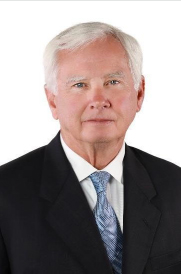

Proposal 1: Election of Directors
|
Thomas R. Stanton, 60 |
Background and Qualifications: Mr. Stanton is a seasoned CEO and Chairman of ADTRAN, Inc., a public computer networking and communications company. He brings invaluable technological expertise to his Board service at Cadence Bank. Mr. Stanton is also a former Director and Chairman of both the Federal Reserve Bank of Atlanta’s Birmingham Branch and the Telecommunications Industry Association. Mr. Stanton has decades of experience with computer networking and technology issues in addition to his expertise with economic development. Moreover, Mr. Stanton brings experience in risk management, strategic planning, and human resources, in addition to his information security, cybersecurity, technology, leadership, corporate governance, and management experience. Mr. Stanton also qualifies as an audit committee financial expert.
Directorships, public:
● Cadence Bank (NYSE: CADE) (Since 2015) ● ADTRAN, Inc. (NASDAQ: ADTN) (Chair)
Directorships, non-profit:
● Economic Development Partnership of Alabama ● Chamber of Commerce of Huntsville/Madison County
Former Directorships:
● Federal Reserve Bank of Atlanta’s Birmingham Branch (Chair) ● Telecommunications Industry Association (Chair) |
| Continuing Directors – Term Expires 2027 | |
|
Charlotte N. Corley, 61 |
Background and Qualifications: Ms. Corley is the former Commissioner of the Mississippi Department of Banking and Consumer Finance (“MDBCF”), who retired from this regulatory body after a 34-year career, which she began as a bank examiner. During Ms. Corley’s career at the MDBCF, she also served as Banking Division Director and later as Deputy Commissioner. Ms. Corley’s prior professional experience leading teams, and then an entire agency, further contribute to her knowledge and understanding of human resources issues, including succession planning, diversity, compensation, and ethics, as well as sustainability practices. Ms. Corley’s varied experiences within the financial services industry provide an additional perspective regarding regulatory and compliance issues.
Directorships, public:
● Cadence Bank (NYSE: CADE) (Since 2020)
Directorships, private:
● Deel, Inc. Advisory Director
Former Directorships:
● Conference of State Bank Supervisors (“CSBS”) (Chair) ● CSBS State Supervisory Processes and Technology Committees ● CSBS Education Foundation (Chair) ● Federal Financial Institutions Examination Council’s Task Force on Examiner Education ● Interagency Supervisory Processes Committee
|


Proposal 1: Election of Directors
|
Joseph W. Evans, 75 |
Background and Qualifications: Mr. Evans is a former bank and financial holding company CEO who brings decades of such experience to his role as a director. Mr. Evans was CEO of State Bank and Trust Company and later Chairman and CEO of State Bank Financial Corporation and State Bank. Prior to that, Mr. Evans was the Chairman and CEO of Flag Financial Corporation, until it was acquired by RBC Centura Bank. Prior to that, Mr. Evans was President and CEO of both Bank Corporation of Georgia and Century South Banks, Inc. In addition to his executive and regulatory experience, Mr. Evans has substantial experience with issues relating to strategic planning, risk management, diversity, real estate, fiduciary based financial services, sustainability practices, and he qualifies as an audit committee financial expert.
Directorships, public:
● Cadence Bank (NYSE: CADE) (Since 2021)
Directorships, private:
● Carter Center Board of Councilors ● The Foundation of the Methodist Home ● Scheller College of Business at Georgia Tech Advisory Board ● Monroe County Sports Hall of Fame
Former Directorships:
● Cadence Bancorporation and Cadence Bank, N.A. (2019-2021) ● State Bank Financial Corporation (Chair) ● State Bank and Trust Company (Chair) ● Flag Financial Corporation (Chair) ● Buckhead Coalition (Chair) ● Georgia Tech Foundation Board of Trustees (Chair) ● Southern Trust Insurance Company |

Proposal 1: Election of Directors
|
Virginia A. Hepner, 67 |
Background and Qualifications: Ms. Hepner is a veteran banking executive and real estate investor, who also previously worked as a consultant to a global technology solutions company. Ms. Hepner worked for 25 years at Wachovia Bank, in various leadership roles, including as a Managing Director of U.S. Corporate Finance, the head of Foreign Exchange and Derivatives Trading, and the Commercial Banking Director in Atlanta. In addition to her executive leadership, banking, and real estate experience, Ms. Hepner is an audit committee financial expert who also has significant knowledge regarding human resources matters, including compensation, ethics, diversity, and sustainability practices. Ms. Hepner additionally brings experience with regulatory and compliance issues related to the financial services industry, risk management, strategic planning, management, and governance to her Board service.
Directorships, public:
● Cadence Bank (NYSE: CADE) (Since 2021) (Chair of the Audit Committee) ● Oxford Industries, Inc. (NYSE: OXM) ● National Vision Holdings, Inc. (NASDAQ: EYE) (Audit Committee)
Directorships, non-profit:
● Westside Future Fund ● Community Foundation for Greater Atlanta Housing and GoAtl Committees ● Penn Institute for Urban Research ● Georgia Chapter of International Women’s Forum ● Russell Innovation Center Finance Committee
Former Directorships:
● Cadence Bancorporation and Cadence Bank, N.A. (2019-2021) ● State Bank Financial Corporation ● State Bank and Trust Company ● Woodruff Arts Center, Life Trustee (former President and CEO) |
|
Keith J. Jackson, 60
|
Background and Qualifications: Mr. Jackson is the President and founder of Positive Atmosphere Reaches Kids, a non-profit organization, which works with at-risk youth to provide positive reinforcement for their success. Mr. Jackson is also a prolific public speaker, where he often focuses on investing in and developing people, as well as leadership. Mr. Jackson has significant business experience in real estate and qualifies as an audit committee financial expert, in addition to his experience with strategic planning, risk management, human resources, executive leadership, corporate governance and fiduciary services.
Directorships, public:
● Cadence Bank (NYSE: CADE) (Since 2007) ● Dun & Bradstreet Holdings, Inc. (NYSE: DNB)
Directorships, non-profit:
● Positive Atmosphere Reaches Kids ● University of Oklahoma Foundation (Trustee) ● The Baptist Health Foundation Board ● Donaghey Foundation (Trustee)
|


Proposal 1: Election of Directors
Executive Officers’ Background and Qualifications
The Board of Directors appointed an Executive Management Committee with policy-making authority. The Executive Management Committee consists of 11 executive officers including Mr. Rollins whose biography is included above. Other members of the Executive Management Committee are set forth below:
| Executive Officer | Age | Position | Position in Past 5 Years with Company (unless otherwise noted) |
|||
| Chris A. Bagley | 64 | President and Chief Credit Officer | President from 2021-2024; President and Chief Operating Officer from 2014-2021 | |||
| Edward H. Braddock | 54 | Senior Executive Vice President, Chief Banking Officer | Senior Executive Vice President, Chief Credit Officer from 2021-2024; Executive Vice President and Chief Lending Officer - Cadence Bancorporation and Cadence Bank, N.A. from 2020-2021; Executive Deposit Strategy Officer from 2019-2020; and Chief Credit Officer from 2021-2024 | |||
| Cathy S. Freeman | 59 | Senior Executive Vice President, Chief Administrative Officer and Corporate Secretary | Senior Executive Vice President, Chief Administrative Officer and Corporate Secretary from 2013 -present | |||
| Jeffrey W. Jaggers | 62 | Senior Executive Vice President, Chief Operating Officer | Senior Executive Vice President, Chief Information Officer from 2017-2021 | |||
| Shanna R. Kuzdzal | 46 | Senior Executive Vice President, Chief Legal Officer | Senior Executive Vice President, Chief Legal Officer from 2023-present; Senior Executive Vice President, General Counsel of Stellar Bancorp, Inc. (2022-2023); Executive Vice President, General Counsel & Corporate Secretary of Allegiance Bancshares, Inc. (2017-2022) | |||
| Tyler L. Lambert | 43 | Senior Executive Vice President, Chief Risk Officer | Executive Vice President and Chief Data Analytics Officer from 2018-2020 | |||
| Kevin H. McMahon | 56 | Senior Executive Vice President, Chief Information Officer | Deputy Chief Operating Officer from 2022-2024; Senior Executive Vice President & U.S. Head of Engineering at BBVA USA (2000-2022) | |||
| Jerrell M. Moore | 48 | Senior Executive Vice President, Chief Human Resources Officer | Executive Vice President and Chief Diversity Officer from 2023-2024; Head of Global Inclusion Programs at Google (2021-2023); Vice President and Chief Diversity Officer at Assurant (2020- 2021) | |||
| Valerie C. Toalson | 59 | Senior Executive Vice President, Chief Financial Officer and President – Banking Services | Chief Financial Officer from 2021-2024; Executive Vice President, Chief Financial Officer of Cadence Bancorporation and Cadence Bank, N.A. from 2013-2021 | |||
| Brian D. Walhood | 58 | Senior Executive Vice President, President Community Bank | Executive Vice President, President Community Bank |
| Corporate Governance |
Role of the Board of Directors
The role of the Board of Directors is to facilitate the Company’s long-term success consistent with its fiduciary responsibilities to its shareholders. In this role, our Board of Directors is responsible for, among other things:
| ● | reviewing, monitoring and changing, when necessary, fundamental operating, financial and other corporate plans, policies, strategies and objectives with the advice and assistance of management; |
| ● | overseeing the management of the Company’s activities, including management’s risk culture and risk appetite; |
| ● | selecting, monitoring, evaluating and, if necessary, replacing the Company’s Chief Executive Officer and senior management; |
| ● | addressing management succession issues in a timely manner; |
| ● | monitoring the Company’s performance against strategic and business plans; |
| ● | overseeing and monitoring compliance with laws, regulations, auditing and accounting principles; |
| ● | exercising oversight for the development and performance of internal controls and the ability of employees and other stakeholders to report unethical or improper conduct; |
| ● | considering and, when advisable or required, approving mergers, acquisitions, and other similar transactions for the Company and its subsidiaries; and |
| ● | overseeing Management’s activities with respect to belonging and inclusion initiatives. |
To ensure it is effective in fulfilling its duties, the Board of Directors conducts an annual peer-to-peer assessment of the Board of Directors as well as assessments of the members of each of its six standing committees, the Independent Lead Director, and CEO performance.
Director Attendance at Board, Committee and Annual Meetings
During 2024, our Board of Directors held eight meetings. Each director attended 100% of the committee meetings and at least 88% of the total number of all meetings of the Board of Directors. We encourage our Board members to attend annual meetings of shareholders. In 2024, all of our directors attended the annual meeting of shareholders.
Corporate Governance
Committees of the Board of Directors
The Board of Directors has six standing committees - the Audit Committee, the Risk Management Committee, the Executive Compensation and Stock Incentive Committee, the Nominating and Corporate Governance Committee, the Credit Risk Committee, and the Trust and Financial Services Committee. A copy of the charter for each of these committees is available on the Investor Relations page of our website at ir.cadencebank.com under the caption “Corporate Governance – Governance Documents.”
The following table, and committee information which follows, shows the committee membership of each committee of the Board of Directors following the annual meeting:
| Director | Audit Committee |
Risk Management Committee |
Executive Compensation and Stock Incentive Committee |
Nominating and Corporate Governance Committee |
Credit Risk Committee |
Trust and Financial Services Committee |
| James D. Rollins III | ||||||
| Fernando G. Araujo* | X | X | ||||
| Shannon A. Brown* | X | Chair | ||||
| Deborah M. Cannon* | X | Chair | ||||
| Charlotte N. Corley* | X | Chair | ||||
| Joseph W. Evans*+ | Chair | X | ||||
| Virginia A. Hepner* | Chair | X | ||||
| William G. Holliman* | X | X | ||||
| Warren A. Hood, Jr.* | X | X | ||||
| Keith J. Jackson* | X | X | ||||
| Precious W. Owodunni* | X | X | ||||
| Alice L. Rodriguez* | X | X | ||||
| Thomas R. Stanton* | Chair | X |
| * | Reflects an independent director. For more information, see the section below entitled “Director Independence.” |
| + | Reflects the Independent Lead Director effective as of the date of the annual meeting, April 23, 2025. |
Corporate Governance
|
Audit Committee
Virginia A. Hepner (Chair)*
*Independent Directors |
Pursuant to its charter, the Audit Committee is responsible for, among other things, monitoring the integrity of our financial statements, our compliance with legal and regulatory requirements and our financial reporting process and systems of internal controls; evaluating the independence and qualifications of our independent registered public accounting firm; evaluating the performance of our independent registered public accounting firm and our internal auditing department; providing an avenue of communication among our independent registered public accounting firm, management, our internal audit department, our subsidiaries, and our Board of Directors; and selecting, engaging, overseeing, evaluating and determining the compensation of our independent registered public accounting firm.
This committee has the authority, in its sole discretion, to select, retain and obtain the advice and services of one or more independent legal counsel, accountants or other advisors as it determines necessary to fulfill or assist with the execution of its duties and responsibilities. |
|
| A peer-to-peer assessment as well as an assessment of the committee’s overall performance is conducted annually. The Board of Directors has determined each member of the Audit Committee is independent under the listing standards of the NYSE. Our Board of Directors has also determined each of Mr. Hood and Mses. Cannon, Corley, and Hepner is an “audit committee financial expert” as defined in rules adopted by the Exchange Act. | ||
| The committee held eight meetings during 2024. | ||
|
Risk Management
Thomas R. Stanton (Chair)*
*Independent Directors |
The Risk Management Committee is responsible for the oversight of our enterprise-wide risk management practices and ascertains whether management has adequately considered all material risks we face, and determines whether procedures have been effectively implemented to sufficiently mitigate the risks identified. This includes oversight of the Company’s Information Security program. In addition, the Committee provides oversight and guidance concerning the Company’s sustainability initiatives. These initiatives are designed to promote the Company’s investments in social capital, human capital, corporate governance, and the environment, and to limit or mitigate attendant risks.
This committee has the authority, in its sole discretion, to select, retain and obtain the advice and services of one or more independent legal counsel, accountants or other advisors as it determines necessary to fulfill or assist with the execution of its duties and responsibilities. |
|
| A peer-to-peer assessment as well as an assessment of the committee’s overall performance is conducted annually. In addition, the Board of Directors has determined each member of the Risk Management Committee is independent under the listing standards of the NYSE. | ||
| The committee held five meetings during 2024. |
Corporate Governance
|
Executive Compensation
Shannon A. Brown (Chair)*
*Independent Directors |
Pursuant to its charter, the Executive Compensation and Stock Incentive Committee reviews corporate goals and objectives pertaining to the compensation of our executive officers, evaluates the performance of our executive officers and determines the salary, benefits and other compensation of our executive officers. This committee also administers our incentive compensation plans, equity-based plans and other compensation plans, policies and programs, including the Executive Compensation Policy. See “COMPENSATION DISCUSSION AND ANALYSIS.” Pursuant to its charter, the committee evaluates and recommends to the Board the form and amount of non-management director compensation and, at least every two years, reviews non-management director compensation. It also oversees the succession planning process for senior management other than the CEO. | |
| This committee has the authority, in its sole discretion, to select, retain and obtain the advice and services of one or more compensation consultants, independent legal counsel, accountants or other advisors as it determines necessary to fulfill or assist with the execution of its duties and responsibilities. | ||
| A peer-to-peer assessment as well as an assessment of the committee’s overall performance is conducted annually. The Board of Directors has determined each member of the Executive Compensation and Stock Incentive Committee is independent under the listing standards of the NYSE and the Exchange Act regulations. | ||
| The committee held six meetings during 2024. | ||
|
Credit Risk Committee
Deborah M. Cannon (Chair)*
*Independent Directors |
The Credit Risk Committee is responsible for advising and informing the Board and management as it relates to: (i) optimization of the risk/return profile of the Company’s consolidated loan portfolio and other real estate owned portfolio; (ii) compliance with the General Loan Policy; and (iii) appropriate classification of loans. To meet its responsibilities, the committee is further responsible for, among other things, assessing the overall quality of the loan portfolio, including the level and direction of risk, monitoring the development of risk mitigation tools, monitoring policies and plans for dealing with other real estate owned, reviewing the Asset Quality Trend Report and making recommendations to management, monitoring the activities of internal loan review, reviewing and commenting on the discussion of allowance for loan and lease loss on a quarterly basis, monitoring the work of the Credit Committee, reviewing the appraisal procedures, reviewing portfolio concentration analyses, reviewing Regulation O and Regulation H reports, and assessing the overall adequacy of the commercial lending staff. | |
| A peer-to-peer assessment as well as an assessment of the committee’s overall performance is conducted annually. The committee’s charter is also evaluated annually. | ||
| The committee held four meetings in 2024. |
Corporate Governance
|
Nominating and
Joseph W. Evans (Chair)*
*Independent Directors |
The Nominating and Corporate Governance Committee identifies and recommends to the Board nominees for election to the Board and candidates for appointment to Board committees consistent with criteria approved by the Board. In considering all director nominees, including those nominated by shareholders, this committee expects all nominees to possess the characteristics of integrity, high personal and professional ethics, sound business judgment and the ability and willingness to commit sufficient time to the Board of Directors. In evaluating the suitability of individual directors, this committee will take into account many factors, including a general understanding of marketing, finance and other disciplines relevant to the success of the Company in the prevailing business environment; an understanding of financial service industry issues and the business of the Company; a good educational and professional background; personal accomplishment; and should represent a range of geographic, gender, age, racial and ethnic backgrounds. This committee will also evaluate each incumbent director to determine whether he or she should be nominated to stand for reelection, based on the types of criteria outlined above as well as the director’s contributions to the Board of Directors during the relevant term. | |
| This committee reviews and re-assesses our Corporate Governance Principles, Related Person Transactions Policies and Procedures, and Stock Ownership Guidelines at least annually. It also oversees the annual peer-to-peer assessment of the Board, recommends to the Board of Directors an Independent Lead Director (as identified in “Board Leadership Structure” below) and reviews, approves, and, where appropriate, recommends to the Board for approval all “related person” transactions. | ||
| This committee has the authority, in its sole discretion, to select, retain and obtain the advice and services of one or more consultants, independent legal counsel, accountants or other advisors as it determines necessary to fulfill or assist with the execution of its duties and responsibilities. | ||
| A peer-to-peer assessment as well as an assessment of the committee’s overall performance is conducted annually. The Board of Directors has determined each member of the Nominating and Corporate Governance Committee is independent under the listing standards of the NYSE. | ||
| The committee held four meetings during 2024. | ||
|
Trust and Financial
Charlotte N. Corley (Chair)*
*Independent Directors |
The Trust and Financial Services Committee is responsible for supervising, reviewing and approving the organization of our Trust and Wealth Management department, Mortgage Lending department and the Company’s subsidiary, Linscomb Wealth, Inc. The committee seeks to ensure the proper exercise of the Company’s fiduciary powers, and the departments and subsidiaries the committee supervises utilize sound risk management practices to minimize risk of loss.
A peer-to-peer assessment of this committee is conducted annually as well as the committee’s overall performance. The committee’s charter is also evaluated annually.
The committee held four meetings in 2024. |
|
Corporate Governance
Communications with the Board of Directors
Interested parties and shareholders may send communications to the Board of Directors, the Independent Lead Director, the non-management directors as a group, or any individual director by writing to the intended recipient(s) in care of the Corporate Secretary at 201 South Spring Street, Tupelo, Mississippi 38804. The Corporate Secretary will directly forward the received written communications to the recipient(s) indicated on the communication.
In addition to the committee charters described above, our Stock Ownership Guidelines, Code of Business Conduct and Ethics Policy, Whistleblower and Unethical Conduct Reporting Policy, Corporate Governance Principles and Director Independence Standards are available on the Investor Relations page of our website at ir.cadencebank.com under the caption “Corporate Governance - Governance Documents.” These materials as well as the committee charters described above are also available in print to any shareholder upon request. Such requests should be sent to the following address:
Cadence Bank
201 South Spring Street
Tupelo, Mississippi 38804
Attention: Corporate Secretary
The Board of Directors reviews the independence of all directors and affirmatively makes a determination as to the independence of each director on an annual basis. No director will qualify as independent unless the Board of Directors affirmatively determines the director has no material relationship with the Company (either directly or indirectly, including, without limitation, as a partner, shareholder or officer of an organization which has a material relationship with the Company). In each case, the Board of Directors broadly considers all relevant facts and circumstances when making independence determinations. To assist the Board of Directors in determining whether a director is independent, the Board of Directors has adopted Director Independence Standards, which are available on the Investor Relations page of our website at ir.cadencebank.com under the caption “Corporate Governance - Governance Documents.”
In determining the independence of each director, the Board considered and deemed immaterial to certain directors’ independence certain transactions involving companies or organizations at which some of our directors were officers or employees during fiscal year 2024, and a lease arrangement with a prior board member, who is a family member of a current board member. In each case, the amount we paid to these companies or organizations in each of the last three fiscal years was below the 2% of total revenue threshold included in our Director Independence Standards. Accordingly, the Board of Directors has determined each of directors Araujo, Brown, Cannon, Corley, Evans, Hepner, Holliman, Hood, Jackson, Owodunni, Perry, Rodriguez, Shapiro, and Stanton, constituting a majority of our Board members both before and following the Annual Meeting, meets our standards as well as the current listing standards of the NYSE for independence, and none of the relationships it considered impaired the independence of our directors.
Director Qualification Standards
The Nominating and Corporate Governance Committee and our Chief Executive Officer actively seek individuals qualified to become members of our Board of Directors for recommendation to our Board of Directors and shareholders. The Nominating and Corporate Governance Committee considers nominees proposed by our shareholders to serve on our Board of Directors who are properly submitted in accordance with our Bylaws as discussed in the section below entitled “GENERAL INFORMATION - Shareholder Nominations and Proposals.” The Nominating and Corporate Governance Committee believes the members who comprise our Board of Directors should represent an array of backgrounds and experiences, and should be capable of articulating a variety of viewpoints. In recommending candidates and evaluating shareholder nominees for our Board of Directors, the Nominating and Corporate Governance Committee considers each candidate’s qualifications in the context of an assessment of the perceived needs of the Company at that point in time. The Nominating and Corporate Governance Committee considers a variety of characteristics, including, but not limited to: independence, background, age, gender, stock ownership, influence, and skills, such as an understanding of financial services industry issues. Our director qualifications are set forth in our Corporate Governance Principles, which are available on the Investor Relations page of our website at ir.cadencebank.com under the caption “Corporate Governance - Governance Documents.” The Nominating and Corporate Governance Committee meets at least annually with our Chief Executive Officer to discuss the qualifications of potential new members of our Board of Directors. After consulting with our Chief Executive Officer, the Nominating and Corporate Governance Committee recommends the director nominees to the Board of Directors for their approval. In 2024, the Company utilized the services and paid a fee to Spencer Stuart to assist the Nominating and Corporate Governance Committee in the director nomination process.
Corporate Governance
The Nominating and Corporate Governance Committee determines the appropriate characteristics, skills and experiences for the Board of Directors as a whole, as well as for individual directors and nominees, with the objective of having a Board with a variety of backgrounds and experiences. In considering the structure of the Board, the Nominating and Corporate Governance Committee evaluates each nominee, with the objective of recommending a group of nominees which can best perpetuate the success of Cadence and represent shareholder interests through the exercise of sound judgment using the Board’s experience.
As specified in our Corporate Governance Principles, the Board of Directors does not have a policy with respect to the separation of the offices of Chairman of the Board and the Chief Executive Officer. The Board believes this structure is part of the succession planning process and it is in the best interests of the Company and our shareholders to retain the flexibility to combine or separate these functions.
Mr. Rollins, our Chief Executive Officer, has served as Chairman of the Board since April 2014. At that time, the Board determined combining the roles of Chairman of the Board and Chief Executive Officer would add a substantial strategic perspective to the chair position, while providing important continuity to Board leadership. Each year, the Board evaluates Mr. Rollins’ dual position as Chief Executive Officer and Chairman of the Board and the strategic vision and perspective he brings to the position of Chairman. The Board is unanimously of the view that Mr. Rollins continues to provide excellent leadership of the Board and his continuing as Chairman serves the best interests of shareholders and the Company.
For 2025, the Nominating and Corporate Governance Committee appointed Joeseph W. Evans to serve as the Independent Lead Director. Joseph W. Evans will continue as Independent Lead Director after the annual meeting. In this role he:
| ● | Presides at all meetings of the Board at which the Chairman of the Board or the Chief Executive Officer is not present, including executive sessions of the independent directors; |
| ● | Serves as liaison between the Chairman of the Board and the independent directors and between senior management and the independent directors; |
| ● | Advises and consults with the Chairman of the Board and the Chief Executive Officer in matters related to corporate governance and performance of the Board; |
| ● | Is available for consultation and direct communication with shareholders of the Company; and |
| ● | Performs such other duties as the Board may from time-to-time delegate. |
Management Succession Planning
Management succession planning is a priority of the Company, which allows the Company to plan for continuity in its leadership. The Company designed its succession plan to identify and prepare a diversified group of candidates for high-level management positions which become vacant as a result of retirement, resignation, death, disability, or the pursuit of new business opportunities. On at least an annual basis, the Executive Management Committee assesses the leadership needs of the Company to ensure the selection of qualified leaders who reflect the Company, the markets it serves, and the communities in which it operates, who possess a range of backgrounds and who possess the necessary skills to serve as a member of the Company’s senior management.
In 2024, the Company expanded its succession analysis, conducting an expanded review covering three-tiers below the Executive Management Committee as well as significant regulatory roles, which resulted in a review of over 300 roles. The Company continued its engagement of professional coaches to prepare certain of these individuals for additional career progression through additional development and personal growth opportunities.
The Executive Management Committee, in conjunction with the Chief Human Resources Officer, is responsible for the Company’s succession planning for each member of senior management, regulatory required positions, and other critical roles, identifying potential candidates to fill future vacancies in those positions. When making succession plans, and in order to create a broad pool of applicants, the Company strives to promote a diverse pool of candidates for employment, including women, minorities, and/or other historically under-represented groups.
Corporate Governance
The Board of Directors has taken an active role in succession planning for members of the Executive Management team and has engaged a third-party consulting firm to provide appropriate development support for successor candidates to expand capability in their current roles and to improve readiness for CEO succession and to other executive roles.
Our independent directors have the opportunity to meet in executive sessions without management and after each board meeting, and do so no less than semi-annually. During 2024, our independent directors met in executive session eight times without management, and the Independent Lead Director presided at those meetings.
We have significant Stock Ownership Guidelines which apply to each director, the Chief Executive Officer, and each other individual identified as an executive officer of the Company (each, a “Covered Participant”). The Stock Ownership Guidelines are available on the Investor Relations page of our website at ir.cadencebank.com under the caption “Corporate Governance - Governance Documents.”
The Stock Ownership Guidelines apply to a Covered Participant only until the effective date of his or her retirement or resignation from the Company. Each Covered Participant must beneficially own shares of our common stock at a minimum ownership level for as long as he or she is a Covered Participant, as follows:
| Position | Minimum Ownership Level |
| Chief Executive Officer | 6x base salary |
| All other Executive Officers | 3x base salary |
| Non-Employee Directors | 3x annual retainer |
Holding Periods for Equity Awards
| Minimum Period | On-going ownership requirements | Exception(s)(2) | ||
| 100% of shares(1) for 1 year | Retention of 75%+ of shares until attain minimum ownership level. |
1. For stock options only, to pay the exercise price and tax liability.
2. To pay tax liability on vesting or other equity incentive awards. |
||
(1) Shares include shares of restricted stock and restricted stock units upon grant date and shares issued upon the vesting date of performance units or upon the exercise of stock options.
(2) The Nominating and Corporate Governance Committee administers the Stock Ownership Guidelines and may, in its discretion, consider exceptions if the guidelines place a severe financial hardship on a Covered Participant, or for charitable gifts, estate planning transactions and certain other limited circumstances.
Our Board of Directors oversees a Company-wide approach to risk management, designed to support the achievement of strategic objectives to improve long-term organizational performance and enhance shareholder value. Effective risk oversight is an important priority of the Board. The Board has implemented a risk governance framework to:
| ● | Understand critical risks in our business and strategy; |
Corporate Governance
| ● | Allocate responsibilities for risk oversight among the full Board, its committees and management; |
| ● | Evaluate our risk management processes and ensure they are functioning adequately; |
| ● | Facilitate open communication between management and the Board; |
| ● | Foster an appropriate culture of integrity and risk awareness; and |
| ● | Monitor and address our risk exposure to cyber-attacks and other security breaches which pose a threat to our operations. |
The Board implements its risk oversight function both as a whole and through its committees. All committees of the Board play a significant role in carrying out the risk oversight function. In particular:
| ● | The Audit Committee oversees risks related to our financial statements, our compliance with legal and regulatory requirements, our financial reporting process and system of internal controls. The Audit Committee evaluates the performance of our independent auditors and our internal auditing department. The Audit Committee periodically meets privately in separate executive sessions with management, our internal audit department, and our independent external auditors. |
| ● | The Risk Management Committee oversees enterprise-wide risk management practices. The committee’s focus includes the identification, monitoring, management and planning for the Company’s exposure to applicable risks, including, without limitation, market risk, interest rate risk, credit risk, liquidity risk, operational risk, capital risk, technology risk (including cybersecurity), legal, compliance, and regulatory risk, human resource risk, reputation risk and acquisition and strategic risk, and other such risks as may from time to time be material to us. The committee seeks to determine whether management has adequately considered all material risks facing us and whether procedures have been effectively implemented in order to sufficiently mitigate the risks identified. The committee provides advice to the Board of Directors and its other committees as to appropriate risk mitigation procedures and structures, which helps the Board fulfill its responsibilities to effectively monitor and review actions of management. The Risk Management Committee uses information from management’s Enterprise Risk Oversight Committee, the Enterprise Risk Management department, and other risk managers in fulfilling the Risk Management Committee’s role relative to risk assessment, monitoring and reporting. In addition, the committee provides oversight and guidance concerning the Company’s responsibility and sustainability initiatives. These initiatives seek to promote the Company’s investments in social capital, human capital, sustainability, corporate governance, the environment, and to limit or mitigate attendant risks. |
| ● | The Executive Compensation and Stock Incentive Committee oversees the risks and rewards associated with our compensation philosophy and programs. As discussed in more detail below in the section entitled “COMPENSATION DISCUSSION AND ANALYSIS,” this committee determines and approves the compensation for our NEOs and the compensation for our other executive officers, approves, administers and evaluates our incentive compensation plans, equity-based plans and other compensation plans, policies and programs and administers the Executive Compensation Policy. For example, the Executive Compensation and Stock Incentive Committee will engage a third party, from time to time, to perform an Incentive Compensation Plan Risk Assessment to assist in assessing risk within the Company’s incentive compensation plans and programs, described below in the “COMPENSATION DISCUSSION AND ANALYSIS - Compensation Program: Process’’ section. |
| ● | The Nominating and Corporate Governance Committee oversees risks related to our Corporate Governance Principles and risks arising from related person transactions. |
| ● | The Credit Risk Committee oversees the overall risks associated with our credit, lending practices, and the overall adequacy of the commercial lending staff. |
| ● | The Trust and Financial Services Committee oversees risks related to our fiduciary powers of trust and wealth management and ensures sound risk management practices are in place to minimize risk of loss. |
Corporate Governance
Although the Board has the ultimate oversight responsibility for the risk management process, management is charged with actively managing risk. Management has internal processes and policies to identify and manage risks and to communicate with the Board. These include the Enterprise Risk Oversight Committee, the Enterprise Risk Management department, a real estate risk management group, regular internal meetings of the executive officers, ongoing long-term strategic planning, regular reviews of regulatory and compliance guidance, as well as litigation and government enforcement actions, a Code of Business Conduct and Ethics Policy, a whistleblower policy, and a comprehensive internal and external audit process. The Board and the Audit Committee monitor and evaluate the effectiveness of the internal controls at least annually. Management communicates routinely with the Board and its committees, and the Risk Management Committee communicates routinely with the Board regarding significant risks and how the Company is managing them.
The Company conducts internal and third-party audits and assessments related to information security in accordance with regulatory guidance and industry standards. It also conducts compliance and training programs, which include information security awareness.
| Security Ownership of Certain Beneficial Owners and Management |
Beneficial Ownership
The table below sets forth certain information, as of January 31, 2025 (except as otherwise specified), with respect to the beneficial ownership of our common stock by: (1) each person known by us to be the beneficial owner of more than 5% of the outstanding shares of our common stock, based on a review of submissions made to the FDIC and the SEC; (2) each director and nominee for director as of the date of this Proxy Statement; (3) each of our NEOs; and (4) all of our directors and executive officers as a group. As of January 31, 2025, a total of 183,526,121 shares of our common stock were outstanding. Our Stock Ownership Guidelines generally require our directors and NEOs to beneficially own a minimum number of shares of our common stock as described in the section above entitled “CORPORATE GOVERNANCE - Stock Ownership Guidelines.” The number of shares of common stock owned by each officer and director reflected in the table below includes such shares.
For purposes of this table, we relied on information supplied by our directors, nominees for director and executive officers as well as submissions made by beneficial owners on Schedule 13G and Schedule 13D.
| Name and Address of Beneficial Owner (1) | Amount and Nature of Beneficial Ownership (2) |
Percent of Class |
| The Vanguard Group, Inc. (3) | 19,330,338 | 10.59% |
| BlackRock, Inc.(4) | 17,647,446 | 9.70% |
| FMR, LLC(5) | 16,375,275 | 8.97% |
| Wellington Management Group LLP(6) | 12,642,169 | 6.92% |
| State Street Corporation(7) | 9,712,739 | 5.30% |
| Dimensional Fund Advisors LP(8) | 9,240,516 | 5.10% |
| Fernando G. Araujo | -- | * |
| Chris A. Bagley(9) | 172,355 | * |
| Edward H. Braddock(10) | 42,075 | * |
| Shannon A. Brown | 19,166 | * |
| Deborah M. Cannon | 28,318 | * |
| Charlotte N. Corley(11) | 11,627 | * |
| Joseph W. Evans | 165,870 | * |
| Virginia A. Hepner | 22,491 | * |
| William G. Holliman (12) | 36,122 | * |
| Warren A. Hood, Jr. | 39,538 | * |
| Keith J. Jackson | 38,172 | * |
| Tyler L. Lambert(13) | 42,993 | * |
| Precious W. Owodunni | 16,079 | * |
| Alan W. Perry | 74,551 | * |
| Alice L. Rodriguez | -- | * |
| James D. Rollins III(14) | 400,097 | * |
| Marc J. Shapiro | 186,100 | * |
| Thomas R. Stanton | 21,037 | * |
| Valerie C. Toalson (15) | 112,271 | * |
| All current directors and executive officers as a group (25 persons) | 1,687,889 | 0.92% |
Beneficial Ownership
| * | Less than 1%. |
| (1) | The address of each person or entity listed, other than The Vanguard Group, Inc., BlackRock, Inc., FMR, LLC, State Street Corporation, and Dimensional Fund Advisors LP, is c/o Cadence Bank, 201 South Spring Street, Tupelo, Mississippi 38804. The address of Vanguard Group, Inc. is 100 Vanguard Blvd. Malvern, PA 19355. The address of Blackrock, Inc. is 50 Hudson Yards, New York, NY 10001. The address for Wellington Group LLP is 280 Congress Street, Boston, MA 02210. The address for State Street Corporation is 1 Congress Street, Suite 1, Boston, MA, 02114. The address for FMR, LLC 245 Summer Street, Boston, MA 02210. The address for Dimensional Fund Advisors LP is 6300 Bee Cave Road, Building One, Austin, TX, 78746. |
| (2) | Beneficial ownership is deemed to include shares of common stock an individual has a right to acquire within 60 days after January 31, 2025. These shares are deemed to be outstanding for the purposes of computing the “percent of class” for that individual, but are not deemed outstanding for the purposes of computing the percentage of any other person. Information in the table for individuals also includes shares held for their benefit in our 401(k) Profit-Sharing Plan, and in individual retirement accounts for which the shareholder can direct the vote. Except as indicated in the footnotes to this table, each person listed has sole voting and investment power with respect to all shares of common stock shown as beneficially owned by him or her pursuant to applicable law. The amount of shares reflected as beneficially owned by some of the executive officers includes unvested restricted stock with regard to which these individuals hold only voting power and not investment power. No shares beneficially owned by executive officers are held in margin accounts, are pledged, or are otherwise available to a lender as security. |
| (3) | Based on shares beneficially owned by The Vanguard Group, Inc. as set forth in a Schedule 13G/A dated February 13, 2024, and filed with the SEC on February 13, 2024. The Vanguard Group, Inc. reported it possesses sole voting power with respect to 0 of such shares, shared voting power with respect to 156,376 of such shares, sole dispositive power with respect to 18,981,875 of such shares, and shared dispositive power to 348,513 of such shares. |
| (4) | Based on shares beneficially owned by BlackRock, Inc. as set forth in a Schedule 13G dated January 24, 2024 and filed with the SEC on January 24, 2024. BlackRock, Inc. reported it possesses sole voting power with respect to 17,341,045 of such shares, shared voting power with respect to 0 of such shares, sole dispositive power with respect to 17,347,446 of such shares, and shared dispositive power to 0 of such shares. |
| (5) | Based on the number of shares beneficially owned by FMR LLC, and Abigail P. Johnson (Ms. Johnson) on behalf of the members of the Johnson family, who form a controlling group with respect to FMR LLC, as set forth in a Schedule 13G dated February 8, 2024, and filed with the SEC on February 9, 2024. FMR LLC reported it possesses sole voting power with respect to 16,359,925 shares, shared voting power with respect to 0 shares, sole dispositive power with respect to 16,375,275 of such shares, and shared dispositive power to 0 of such shares. Ms. Johnson reported the Johnson family possesses sole voting power with respect to 0 shares, shared voting power with respect to 0 shares, sole dispositive power with respect to 16,375,275 of such shares, and shared dispositive power to 0 of such shares. |
| (6) | Based on shares beneficially owned by Wellington Group Holdings LLP, as set forth in a Schedule 13G filed with the SEC on November 8, 2024. Wellington Group Holdings LLP reported it possesses sole voting power with respect to 0 such shares, shared voting power with respect to 10,737,876 shares, sole dispositive power with respect to 0 shares, and shared dispositive power with respect to 12,642,169 of such shares. |
| (7) | Based on shares beneficially owned by State Street Corporation, as set forth in a Schedule 13G filed with the SEC on February 6, 2025. State Street Corporation reported it possesses sole voting power with respect to 0 of such shares, shared voting power with respect to 1,274,452 shares, sole dispositive power with respect to 0 shares, and shared dispositive power to 9,712,739 of such shares. |
| (8) | Based on the number of shares beneficially owned by Dimensional Fund Advisors LP, as set forth in Schedule 13G dated February 14, 2024 and filed with the SEC on February 9, 2024. Dimensional Fund Advisors LP reported it possesses sole voting power with respect to 9,032,970 of such shares, shared voting power with respect to 0 of such shares, sole dispositive power with respect to 9,240,516 shares, and shared dispositive power with respect to 0 shares. |
| (9) | Includes 5,972 restricted stock units and 16,109 performance stock units which vest within 60 days of January 31, 2025. |
| (10) | Includes 1,700 restricted stock units and 4,534 performance stock units which vest within 60 days of January 31, 2025. |
| (11) | Includes 10,286 shares of which Ms. Corley shares voting and investment power with her spouse. |
| (12) | Includes 36,122 shares of which Mr. Holliman shares voting and investment power with his spouse. |
| (13) | Includes 2,359 restricted stock units and 5,568 performance stock units which vest within 60 days of January 31, 2025. |
| (14) | Includes 16,220 restricted stock units and 43,753 performance stock units which vest within 60 days of January 31, 2025. |
| (15) | Includes 3,244 restricted stock units and 8,750 performance stock units which vest within 60 days of January 31, 2025. |
| Compensation Discussion and Analysis |
The purpose of this Compensation Discussion and Analysis is to provide shareholders with insight into the views of the Executive Compensation and Stock Incentive Committee (the “Compensation Committee” or the “Committee”), the Committee’s objectives in selecting and setting the performance metrics and elements of the compensation paid or awarded to our Named Executive Officers (“NEOs”), and to discuss our philosophy, practices and procedures with respect to our executive compensation program.
Our discussion will focus on our NEOs, who are as follows:
| Name | Title |
| James D. Rollins III | Chief Executive Officer |
| Valerie C. Toalson | Chief Financial Officer and President - Banking Services |
| Christopher A. Bagley | President and Chief Credit Officer |
| Edward H. Braddock | Chief Banking Officer |
| Tyler L. Lambert | Chief Risk Officer |
In 2024, the Company improved operating performance through steady balance sheet growth, reduction of debt, stable credit quality, and improved net interest margin and operating efficiency. The accomplishments of management for the year-ended December 31, 2024, are outlined below:
| - | Generated net organic loan growth of $1.2 billion, or 3.8% for the year while core customer deposits, which exclude brokered deposits and public funds, increased $2.2 billion, or 6.9%. |
| - | Reported annual adjusted pre-tax pre-provision net revenue (PPNR)2 from continuing operations of $739.0 million, or 1.54% of average assets, an increase of $126.7 million, or 20.7%, compared to 2023. |
| - | Increased net interest margin for the year by 22 basis points to 3.30%. |
| - | Achieved continued improvement in operating leverage reflected in a decline in the adjusted efficiency ratio2 from 63.3% in 2023 to 58.4% in 2024. |
| - | Recorded stable net charge-offs as a percent of average loans in 2024 of 0.24%, and criticized loans improved 5.9% to $794.5 million at December 31, 2024. |
| - | Repurchased 1,237,021 shares of Company common stock at a weighted average price of $26.74; tangible book value per common share increased to $21.54 per share at December 31, 2024, up $2.22 per share, or 11.5%, compared to December 31, 2023 while tangible common shareholders’ equity to tangible assets increased from 7.44% to 8.67% over the same time period. |
| - | Increased quarterly Common Stock dividend to $0.275 per share in the first quarter of 2025. |
2024 Compensation Highlights and Program Advances
In late 2023 and early 2024, the Compensation Committee met to consider the Company’s 2024 executive compensation program guided by the compensation principles described in the section entitled “Compensation Program: Principles, Philosophy, and Objectives” below. In recent years, the Committee has reconfigured its program, identifying and concentrating on a narrower range of metrics intended to focus attention on short and long-term goals, and making annual increases in the proportion of performance stock units (“PSUs”) to restricted stock units (“RSUs”) until it reached a ratio of 65% PSUs and 35% RSUs in 2024. While the Committee has received favorable feedback from shareholders on these adjustments, in its review of the executive compensation program, the Committee further considered unexpected market conditions in 2023 and the crisis that led to failures of other financial institutions. The Committee recognized the benefit of structurally addressing risk factors that could result from unexpected market conditions. In response to these considerations, the Committee adopted “risk triggers,” which either automatically eliminate or give the Committee discretion to reduce or eliminate annual incentive compensation in response to certain events that could create concerns for the safety and soundness of the Company. Those events include loss of well-capitalized status, which automatically eliminates annual incentives, and serious liquidity and credit downturns as well as other factors, which give the Committee discretion to eliminate all or a part of an annual incentive.
| 2 | Please see Appendix A for additional information and a reconciliation of these measures to financial measures derived in accordance with U.S. GAAP. |
Compensation Discussion and Analysis
The Committee also considered the potential of volatility in the business environment and regulatory actions that make it more challenging to set absolute performance goals. In response to this concern, the Committee adopted a “market condition modifier.” In the 2024 annual incentive grants, the Committee provided a relative measure as an alternate metric in the event the actual operating revenue metric of the annual incentive plan did not meet threshold. The relative measure of PPNR as a percentage of assets may be reviewed by the Committee as compared to peers in the KRX so that the Committee may provide a reduced award based on superior relative performance during unexpected market events.
The Committee believes these two mechanisms work together to provide appropriate incentives and safeguards and the compensation structure as a whole aligns with shareholders’ interests, provides the Company with the ability to retain key talent, and encourages management to take appropriate but not unnecessary risks.
Also, in 2024, the Company reached the third anniversary of the merger of Cadence Bancorporation, N.A. and BancorpSouth Bank as well as the vesting of the merger integration grants (the “Integration Grants”). As described in more detail in the section entitled “Conclusion of the Integration Grants,” the Committee reviewed the progress of the goals and metrics in the Integration Grants and calculated the shares to be awarded. Following completion of the performance period on September 30, 2024, the trailing efficiency ratio for the period ending December 31, 2024, improved. The Committee believes this continued enhancement in the efficiency ratio and focus on expense control was supported by the Integration Grants and has benefitted the Company and shareholders.
Shareholder Outreach and Say-on-Pay Results
When setting compensation policy, the Committee solicits and values the viewpoints of shareholders and other stakeholders. In 2024, our Say-on-Pay vote received support from 98.21% of our shareholders. The Committee routinely seeks to improve our compensation program and has adopted a formal shareholder engagement process. Our formal engagement efforts supplement the many calls, conferences, and other shareholder outreach performed by the Company’s executive management and investor relations team throughout the year.
During late 2024 and early 2025, members of our Board, executive management and investor relations team met with a number of our top institutional shareholders to solicit their views on our compensation program, among other practices. During this engagement process, we contacted our top 25 holders representing 67.53% of our outstanding shares. Five of our shareholders, representing 13.65% of our outstanding shares, met with us. The meetings were led by Joseph Evans, the Company’s Independent Lead Director, who invited discussion on executive compensation, governance, compliance, and any other issues raised by shareholders. Upon completion of the meetings, the Committee reviewed a summary of the shareholder insights, which was provided to the full Board of Directors.
In our meetings, we received positive feedback on the changes we’ve made to our program and disclosures. Below is a summary of the feedback we received from shareholders related to compensation, and how we responded to this feedback.
| What we heard | Action taken |
| Well-designed program | The form of our program is substantially the same, including an emphasis on performance units and eliminating duplication of metrics. In 2024, we added risk triggers to address payments in case of unexpected negative events and market condition modifiers as described above. |
| Supportive of inclusion of Total Shareholder Return (“TSR”) as part of compensation program | In 2024, we changed the role of TSR from a stand alone metric to a modifier that affected all component metrics. |
| Supportive of the use of relative metrics | We continue to adopt relative measures to compare our performance to peers. In 2024, all metrics for long term incentive awards were based on relative performance. |
Compensation Discussion and Analysis
Executive Compensation Governance
The Compensation Committee relies on strong governance practices and compensation metrics which address risk management and are intended to align with the interests of our shareholders. The list below outlines many of our compensation practices.
| What We Do |
| ✔ | Executive Compensation Policy. We maintain an Executive Compensation Policy, which outlines the principal criteria used to measure the success of our executive officers in achieving our business objectives. |
| ✔ | Review Compensation Program. We review our compensation program against market practices to confirm it is competitive and review them to ensure they do not encourage excessive risk-taking. |
| ✔ | Pay for Performance. We provide short-term and long-term incentive awards based on performance targets aligned with identified business performance metrics. |
| ✔ | Balance of Performance Metrics. We use multiple performance metrics and multi-year vesting timeframes to prevent over-emphasis on any single metric and minimize short-term risk-taking. |
| ✔ | Long Vesting Periods. Awards of our restricted stock units prior to 2023 vested on a cliff basis of four years. Beginning in 2023, restricted stock units vest ratably over years 2, 3, and 4. Performance awards have cliff vesting following a three-year performance period. |
| ✔ | Stock Ownership Guidelines. We maintain rigorous stock ownership guidelines for our directors and executive officers, in |
| order to more closely align the financial interests of the directors and executive officers with those of our shareholders. |
| ✔ | “Clawback Policy.” We maintain a clawback policy which sets forth the conditions under which we may recover excess incentive-based compensation (as defined in our policy) paid or awarded to or received by any of our current or former executive officers. |
| ✔ | “Double Triggers.” Our change in control agreements include a “double trigger” requiring both a change in control and termination of the executive’s employment without cause or by the executive for good reason, within a set period of time for the executive to receive payment. |
| ✔ | Shareholder Engagement. In late 2024 and early 2025, we conducted a shareholder engagement program, during which we communicated with holders of over 13% of our shares. Additionally, we are available year-round for shareholder questions and comments both in person and virtually, and we have ongoing shareholder interactions through direct contact, as well as meetings with advisors, shareholders, and other stakeholders. |
| ✔ | Annual Say-on-Pay Vote. We conduct an annual say-on-pay vote for shareholders to approve executive compensation of our NEOs. |
| What We Don’t Do |
| X | Dividends on Unearned PSUs and RSUs. PSUs and RSUs accrue dividend equivalents during the performance period, which are not paid to the executive until vesting. |
| X | Short Selling, Use of Derivatives or Pledging. Our insider trading policy prohibits our directors and executive officers from any short selling or hedging activities, from trading derivative instruments related to our securities, and from pledging our securities. |
| X | “Gross Ups.” We do not provide tax “gross up” payments. |
| X | Option Repricing. Our long-term equity incentive plans prohibit option repricing without the approval of our shareholders. |
| X | Option Backdating or “Spring-Loading.” We do not backdate options or grant options retroactively. |
| X | Multi-year Guaranteed Bonuses. We do not award multi-year guaranteed bonuses. |
Compensation Discussion and Analysis
Compensation Program: Principles, Philosophy and Objectives
Our executive compensation program is designed to provide compensatory incentives to an experienced and engaged management team while the team implements the Company’s short- and long-term strategic goals. The program balances the emphasis placed on growth and earnings with well-considered governance and risk management.
| Compensation Principles | How
Our Program Aligns with Our Principles |
| Developing a market-competitive plan designed to attract quality executive talent |  Base salary, annual cash incentives, and long-term equity incentives are evaluated against the median of our peers Base salary, annual cash incentives, and long-term equity incentives are evaluated against the median of our peers |
| Emphasizing performance-based compensation |
|
| Setting clear and specific annual and long-term goals supporting the Company’s strategic business goals |
|
| Alignment with the long-term interests of shareholders |
|
| Taking into account the opinions and expectations of shareholders and the advice of professionals |
|
| Encourage consistency with safe and sound practices and discourage excessive risk-taking |
|
Compensation Discussion and Analysis
The Compensation Committee is composed entirely of directors who are independent under the listing standards of the NYSE, our Director Independence Standards, and Exchange Act Rule 16b-3. The Director Independence Standards and the charter of the Executive Compensation and Stock Incentive Committee are each available on our website at ir.cadencebank.com on our Investor Relations web page under the caption “Corporate Governance - Governance Documents.” The charter is reviewed annually by the Compensation Committee and was most recently revised in 2024.
In 2024, Aon plc (“Aon”) acted as the Committee’s compensation consultant. The Committee reviewed a letter from Aon dated April 12, 2024, attesting to its independence at its May meeting. The Committee considered independence factors prescribed by applicable regulations and concluded none of the work provided by Aon raised any conflicts of interest and determined Aon met the independence criteria. Aon reported to and was directed by the Committee. Aon provides only compensation consulting services, which includes benchmarking executive compensation against peer institutions, advice to the Committee on non-executive compensation structure, and a risk review of all incentive plans, for the Company. When setting criteria and evaluating performance in 2024, the Committee relied upon the expertise and advice of Aon.
The Compensation Committee engaged Aon beginning in 2023 to conduct a risk assessment of all the Company’s compensation programs, including executive and broad-based employee compensation programs and policies to identify any aspect which could encourage inappropriate risk taking. In 2024, Aon concluded each of our incentive compensation programs and policies are well-designed and do not encourage behaviors which would create material risk to the Company. The incentive compensation programs contain drivers which align with corporate objectives and have plan design features that minimize organizational risk. After reviewing the findings of the risk assessment, the Committee believes there is an appropriate balance in the structure of our incentive compensation programs, and our incentive compensation plans and policies include terms designed to mitigate any potential material risks created by the performance-based metrics used in the incentive compensation plans.
The Committee has adopted a process intended to provide appropriate oversight and to make compensation decisions designed to encourage executives to accomplish the Company’s goals and strategic plans. The Committee held six meetings in 2024, which include its four regular quarterly meetings. Prior to each regular meeting, the materials are provided to each Committee member, including minutes of the previous meeting, an agenda, recommendations for the upcoming meeting and other materials relevant to the agenda items. Historically, the Chief Executive Officer has attended Committee meetings to provide information to the Committee concerning the performance of executive officers, discuss performance measures relating to executive officer compensation and to make recommendations to the Committee concerning the compensation of executive officers. The Committee holds executive sessions consisting only of Committee members and the Independent Lead Director and periodically meets in executive session with the independent compensation consultant retained by the Committee for advice on executive compensation. The Chief Executive Officer does not engage in discussions with the Committee regarding his own compensation, except to respond to questions posed by Committee members outside of executive session deliberations.
In setting the compensation of our NEOs, the Committee reviewed all components of their respective compensation, including base salary, annual non-equity incentive compensation and long-term equity incentive compensation. In addition, the Committee reviewed their compensation history and comparative performance information. The Committee reviewed and discussed the pay, equity incentives, perquisites, and retirement benefits of similarly- situated NEOs from our peer group. The Committee further reviewed and discussed the composition and weighting of the types of equity incentives as well as the typical performance metrics associated with cash and equity incentives. Lastly, the Committee reviewed and discussed Company performance in comparison with peer banks.
The Compensation Committee believes the overall compensation for our NEOs is competitive with our peer group and is commensurate with the goals we have set for them as well as the responsibilities assigned to their respective positions. The differences in the compensation paid to each of our NEOs in relation to one another is a reflection of differences in the level and scope of responsibility of their respective positions, their experience level in their current position, and the market’s pattern of providing progressive award opportunities at higher levels.
Compensation Discussion and Analysis
Our executive compensation program consists of the following primary elements, which are used in conjunction with one another in varying proportions to provide competitive total compensation:
| ● | Base salary is intended to provide a foundation element of compensation that is relatively secure and reflects the skills and experience an executive brings to us; we seek to pay base salaries which are competitive with those paid to executive officers in comparable positions at comparable financial institutions; |
| ● | Annual cash incentive compensation is a variable, cash award based on the achievement of defined goals for a given fiscal year; |
| ● | Long-term equity incentive compensation is a variable, equity element which provides an emphasis on long-term performance goals and stock price performance; |
| ● | Employee benefits are intended to provide reasonable levels of security with respect to retirement, medical, death and disability protection and paid time off; and |
| ● | Certain perquisites are used to supplement the other elements of compensation, facilitating the attraction and retention of executive officers of the caliber we believe necessary to remain competitive. |
The Compensation Committee reviews the compensation of the Chief Executive Officer and our other NEOs relative to the compensation paid to similarly-situated executives at financial institutions we determine to be peer companies. While it does not impose rigid benchmarking as part of the process, the Committee does compare the compensation of the individual NEOs to similarly- situated executives as a point of reference for measurement for the Committee’s review and analysis. Because this peer group analysis is just one of the analytical tools used in setting the compensation of our NEOs, the Committee has discretion in determining the nature and extent of its use.
In May 2024, Aon assisted the Committee in reviewing the peer group using publicly-available information from potential peer companies. The selection criteria included regional banks based on their asset size as set forth below along with the inclusion of a historical competitor, Texas Capital Bancshares, due to geography. The Company’s asset size closely aligns with the median of the group. After conducting this analysis, the Committee reaffirmed the full 2023 peer group for 2024 as follows:
| Associated Banc-Corp | First Horizon Corp. | Texas Capital Bancshares, Inc. |
| BankUnited, Inc. | Hancock Whitney Corp. | UMB Financial Corp. |
| BOK Financial Corp. | Old National Bancorp | Valley National Bancorp. |
| Comerica, Inc. | Pinnacle Financial Partners | Webster Financial Corp. |
| Cullen/Frost Bankers, Inc. | Prosperity Bancshares, Inc. | Wintrust Financial Corp. |
| East West Bancorp, Inc. | SouthState Corp. | Western Alliance Bancorp |
| F.N.B. Corp. | Synovus Financial Corp. | Zions Bancorp. NA |
Compensation Discussion and Analysis
The following charts present the mix of compensation elements which make up the total target compensation for 2024 for our Chief Executive Officer and an average of the compensation targets of the remaining NEOs. For purposes of this chart, total target compensation is composed of (i) base salary; (ii) the value of time-vested equity, (iii) the value of performance-based equity, and (iv) the target annual incentive compensation.
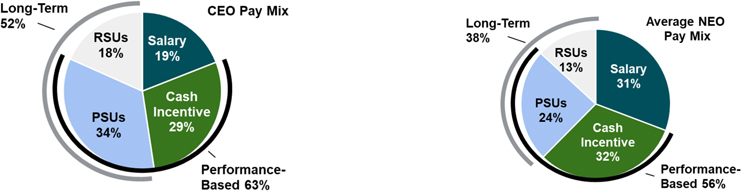
| ** | Values for restricted stock units and regular performance stock units are determined as of the date of the grant. |
2024 Compensation—Executive Opportunities and Committee Decisions
The Compensation Committee focuses both on the mix of individual components that make up each executive’s total compensation as well as the amount of total compensation itself to determine the total compensation package for each NEO. Each of the components of compensation is discussed in more detail below. The charts below set forth the base salaries, the target for the annual cash incentive, and the total equity award targets, divided between PSUs and RSUs, for 2024.
Base salary is intended to provide a foundation element of compensation that is relatively secure and reflects the skills and experience an executive brings to us; we seek to pay base salaries which are competitive with those paid to executive officers in comparable positions at comparable financial institutions.
Following 2023, in which no adjustments were given to Mr. Rollins, Ms. Toalson, or Mr. Bagley, the Compensation Committee increased base salary in 2024 as set forth below after reviewing the market data for the Company’s peers. Mr. Braddock was promoted to Chief Banking Officer and received an increase commensurate with his new position and duties. Mr. Lambert also received a base salary increase as noted below in accordance with the market.
| Name | Base Salary as of Year-End | Absolute Change | Change as a Percentage |
| James D. Rollins III | $1,040,000 | $40,000 | 4.0% |
| Valerie C. Toalson | $600,000 | $50,000 | 8.3% |
| Christopher A. Bagley | $700,000 | $25,000 | 3.8% |
| Edward H. Braddock | $515,000 | $90,000 | 17.5% |
| Tyler L. Lambert | $440,000 | $40,000 | 9.1% |
Compensation Discussion and Analysis
Annual cash incentive compensation is a variable, cash award based on the achievement of defined goals for a given fiscal year. Each NEO has an opportunity to receive annual incentive compensation as a percentage of base salary. The table below provides the opportunities for each NEO.
| Name | Cash Incentive Opportunity(1) | 2024 Target |
| James D Rollins III | 150% of base salary | $1,560,000 |
| Valerie C. Toalson | 100% of base salary | $600,000 |
| Christopher A. Bagley | 125% of base salary | $875,000 |
| Edward H. Braddock | 100% of base salary | $515,000 |
| Tyler L. Lambert | 100% of base salary | $440,000 |
| (1) | The incentive opportunity is shown at target. If all metrics were achieved at maximum or higher, the award would be limited to 200% of target. |
The Committee developed metrics and goals for the 2024 annual performance cycle to support the creation of shareholder value. Below we explain how our goals align with our long-term strategy.
| What Are Our Goals | How We Calculate Achievement | Why Our Goals Matter |
| Adjusted Total Operating Revenue(1) |
Target attainment is determined by the budget approved by the Board.
The calculation of adjusted total operating revenue will generally exclude nonroutine revenue. |
Along with adjusted non-interest expense, provides an appropriate measure of core profitability. |
| Adjusted Non-interest Expense(1) |
Target attainment is determined by the budget approved by the Board.
The calculation of adjusted non-interest expense generally excludes nonroutine expenses. |
Along with adjusted total operating revenue, provides an appropriate measure of core profitability. |
| Relative Net Charge-Offs/Average Loans(2) | Dividing total charge-offs less recoveries by average loans during the fiscal year as compared to the KRX Index. | Targeting credit metrics helps to establish the risk profile of the Company, which the Board monitors closely. The Company’s risk profile assumes the attainment of financial goals without increasing credit risk beyond normal peer levels. |
(1) May be adjusted if performance of non-executive officers in revenue-generating compensation programs exceeds budgets to ensure incentives remain aligned.
(2) Measured by relative performance of net charge-off to average loans as compared to the institutions included in KBW Regional Banking Index (KRX Index). The KRX Index is composed of approximately 50 publicly traded companies that do business as regional banks or thrifts listed on U.S. stock markets.
Compensation Discussion and Analysis
The Committee retained the authority to adjust the final calculation of incentive payout utilizing any of three defined modifiers. Although none of these modifiers were utilized in 2024, the Committee believes the modifiers provide a methodology to calculate appropriate payouts in the event of unforeseen circumstances so that payouts are balanced and fair for the Company, executives and shareholders. The three defined modifiers are as follows: (a) a discretionary adjustment, either individually or as a group, by +/- 20%, (b) a market condition modifier to reward superior performance when unexpected market conditions occur that impact the industry’s ability to achieve absolute revenue targets (described above in footnote 1), and (c) risk triggers that automatically eliminate or provide the Committee with the discretion to eliminate the award in whole or in part. The triggers are described in the charts below.
| Market Condition Modifier | ||||
| Metric Adjustment | Payout/Rationale | Threshold | Target | Maximum |
| Adjusted Operating Total Revenue metric changed to Relative Operating PPNR/Assets if threshold for Adjusted Operating Total Revenue is not met |
Discretionary based on relative ranking; weighted payout lowered so that full payout is not achievable
Rewards superior performance in unexpected market conditions |
25th percentile up to 50th percentile | 50th percentile up to 75th percentile | 75th percentile and above |
|
Weighted payout not to exceed 20%
|
Weighted payout not to exceed 36% | Weighted payout not to exceed 60% | ||
In addition to the formal metrics, the 2024 plan also contained risk triggers that either automatically eliminate or give the Committee discretion to eliminate annual incentive compensation as set forth in the table below.
| Risk Triggers | ||
| Measure | Trigger | Result |
| Well-capitalized status | Falling below well-capitalized status | No annual incentive |
| Liquidity status | Total wholesale funding to total deposits and borrowing >20% | Discretion up to elimination of entire award |
| Credit quality | Material, unanticipated increase in non-performing assets or criticized loans | Discretion up to elimination of entire award |
| Other factors | Including CAMELS rating, MRBAs or non-financial considerations | Discretion up to elimination of entire award |
The metrics and weightings of each goal and the Company’s performance are set forth in the chart below.
| Performance Goal | Factor Weighting |
Threshold | Target | Maximum | Actual Performance |
Weighted Payout |
| Adjusted
Operating Total Revenue (Dollars in Thousands) |
40% | $1,605.94 | $1,784.38 | $2,052.04 | $1,780.70 | 39.37% |
| Adjusted
Non-interest Expense (Dollars in Thousands) |
40% | $1,115.71 | $1,062.58 | $1,009.45 | $1,041.70 | 55.72% |
| Relative Net
Charge Offs/Average Loans |
20% | 35th percentile |
55th percentile | 75th percentile |
33rd percentile |
0.00% |
| Total | 95.09% | |||||
The table below shows the payout by NEO:
| NEO | Actual Performance (% of Target) |
Amount of Payment |
| James D Rollins III | 95.09% | $1,483,404 |
| Valerie C. Toalson | 95.09% | 570,540 |
| Christopher A. Bagley | 95.09% | 832,038 |
| Edward H. Braddock | 95.09% | 489,714 |
| Tyler L. Lambert | 95.09% | 418,396 |
Compensation Discussion and Analysis
Long-Term Equity Incentive Compensation
Long-term incentive compensation is an important part of our executive compensation program. In 2024, the Company’s long- term equity incentive compensation was granted in the form of PSUs and RSUs. Following the results of the shareholder engagement process, a review of the practices of our peers, and consideration of the effect on performance, the Committee reconfigured the ratio of PSUs and RSUs and, in 2024, awarded 65% of each NEO’s equity grant in PSUs and 35% in RSUs. The exception to this split occurred with respect to Mr. Lambert who received a special award of 6,321 RSUs later in the year for retention purposes in connection with the Committee’s review of succession planning.
In determining the total number of equity-based awards to be granted to recipients in the 2024 annual grants, the Compensation Committee determined the number of units by dividing the established dollar value of the award by the volume-weighted average price during March 2024. Mr. Lambert’s October award was determined using the volume-weighted average price during September 2024. In determining the dollar value of each award, the Committee considered factors such as:
| ● | Market competitive data; |
| ● | Scope of responsibility of each officer; |
| ● | Degree to which the business unit(s) influenced by each officer contributed to our profits; |
| ● | Degree to which asset quality and other risk decisions were influenced by each officer’s direction; and |
| ● | Long-term management potential of each officer. |
| Name | Equity Incentive Opportunity | Performance Units at Target | Restricted Stock Units |
| James D. Rollins III | 275% of base salary | 66,991 units | 36,072 units |
| Valerie C. Toalson | 125% of base salary | 17,568 units | 9,459 units |
| Christopher A. Bagley | 150% of base salary | 24,595 units | 13,243 units |
| Edward H. Braddock | 100% of base salary | 11,360 units | 6,117 units |
| Tyler L. Lambert | 100% of base salary | 10,306 units | 11,871 units |
Restricted stock units are the time-based method of equity grant currently utilized by the Committee. The Committee determined awards granted in 2024 should be subject to graded vesting with one-third vested on each of the second, third, and fourth anniversaries of grant. The holder is not entitled to exercise voting rights on the shares until the award is vested and does not receive dividends. However, dividend equivalent payments are accrued on the award and paid when the award becomes vested. Because the value of each RSU varies based upon the price of the Company’s common stock, the Committee views RSUs as an effective performance-related component of equity compensation that aligns the interest of the executive with our shareholders.
Equity-based performance awards also align the interests of our executives with those of our shareholders and encourage attainment of strategically important financial objectives. Performance stock units are subject to a three-year performance period for the attainment of goals. The Company believes a three-year performance period reflects a realistic time period for establishing credible performance goals and also meets the Company’s goals of encouraging retention and focusing on long -term growth. The holder accrues dividend equivalents during the performance period which are only paid when all award vesting conditions have been satisfied. The award cycle for long-term incentive compensation is structured so that a new three-year performance period will begin every year.
Compensation Discussion and Analysis
Performance Stock Units–2024 Awards
The Committee developed metrics and goals for the 2024-26 performance period to support the creation of shareholder value. Below we explain how our goals align with our long-term strategy.
| What Are Our Goals | How We Calculate Achievement | Why Our Goals Matter |
| Relative Core PPNR/Avg. Assets | Core PPNR relative performance will be measured for the three-year performance period, and compared to the KRX Index. Performance will be determined by measuring performance for each year of the three-year period and compared to the KRX Index for that year. |
Provides an appropriate measure of core profitability due to its insulation from the volatility in loan loss provision expense in various economic cycles. The use of core PPNR provides a clear assessment of the operating performance of the Company.
The components of PPNR in the annual incentive plan measure the Company’s attainment of annual financial goals. This relative measure determines the Company’s comparative performance in relation to its peers each year over a three-year period. |
| Relative Growth in core EPS | Measures the growth of core earnings per share over the full performance period. EPS reported by the Company and by the banks represented in the KRX Index will be calculated annually and the Company’s percentile rank determined. The growth rate for the full performance period will be an average of the Company’s ranking over the three-year period. If core EPS for the three-year period is negative, the maximum payout is 100% for this metric. | This measure addresses core net income after tax per share which is a meaningful measure for forward trading multiples and further aligns the interest of the executive with the shareholders over the performance period. Sustained growth in earnings per share at a rate above its peers should generate opportunity for value creation given the increased support for higher stock price, organic capital generation to support growth and support for increasing dividends. |
| Modifier | ||
| Relative Total Shareholder Return | TSR is the overall appreciation in the Company’s stock price plus any dividends paid by the Company during the measurement period relative to the performance of the banks represented in the KRX Index. If TSR is negative, the modifier will not exceed 100% of target. | This measure aligns the interest of the executive with the results provided to shareholders over the period. Above median shareholder return over a sustained period of time, which includes the Company’s ability to provide a strong dividend, directly reflects the Company’s ability to generate attractive returns for its shareholders. |
Compensation Discussion and Analysis
In 2024, the Compensation Committee evaluated a series of metrics and relative goals, including current and historical goals to determine the desired balance of metrics. The Committee decided to focus on two metrics—earnings per share (“EPS”) and relative core PPNR/average assets. The Committee adopted a more rigorous threshold, target, and maximum for EPS in 2024 than adopted in 2023. For the relative core PPNR over average assets, the Committee adopted a stepped approach within the performance period, which is designed to encourage improved core PPNR/average assets in manageable increments as set forth below. The Committee feels that the stepped approach to relative improvement provides a roadmap of their expectations and the target for each year reflects a significant improvement in the Company’s performance as compared to the prior year’s relative ranking, resulting in an above-median target for the final and most heavily-weighted year of the performance period.
| Performance Goal (1) | Threshold Amount (2) | Target Amount (2) | Maximum Amount (2) | Factor Weighting |
| Relative Growth in EPS(3) | 30th percentile | 55th percentile | 80th percentile | 50% |
| Relative Core PPNR/Average Assets | ||||
| Year 1 | 20th percentile | 30th percentile | 45th percentile | 15% |
| Year 2 | 30th percentile | 40th percentile | 55th percentile | 15% |
| Year 3 | 45th percentile | 55th percentile | 70th percentile | 20% |
| Application Modifier | ||||
| TSR(4) | 25th percentile/75% | 50th percentile/100% | 75th percentile/125% | N/A |
| (1) | Performance below the threshold in all measures results in no shares being earned, and performance at target in all measures results in 100% payout. Performance at threshold results in a 25% payout. Performance equal to or above the maximum results in a 200% payout. Straight-line interpolation is applied between points. |
| (2) | Subject to the required service during the performance period, PSUs are earned if at least the threshold performance goal is achieved with respect to one of the performance measures. The number of performance shares actually earned is then determined based on the actual performance achieved with respect to each measure, provided each measure is considered separately and is subject to its own maximum. |
| (3) | If the Company’s EPS declines over the three-year period, the maximum payout under this metric may not exceed target, regardless of relative performance. |
| (4) | If the Company’s TSR during the performance period is negative, the modifier may not exceed 100%, regardless of relative performance. The TSR modifier may reduce the total earned award by up to 25% or increase the total earned award by up to 25%. The maximum payout for the full grant, after applying the modifier is 200% of target. |
Conclusion of the 2022-24 Performance Period
For equity awards granted in 2022, the Company completed the three-year performance period on December 31, 2024, and the Committee evaluated attainment of the goals set forth below. As a result of the calculations set forth in the table below, the Committee determined that the PSUs granted in 2022 covering the performance years 2022-2024, will be paid out at 95.43% of target. Those shares will vest March 31, 2025, and will be released shortly after.
| Performance Goal | Factor Weighing |
Threshold | Target | Maximum | Actual Performance |
Weighted Payout (% of Target) |
| Relative Total Shareholders Return | 33.3% | 30th percentile | 55th percentile | 75th percentile |
83.6th percentile |
50.00% |
| Relative Core PPNR/Average Assets | 33.3% | 30th percentile | 55th percentile | 75th percentile |
34.1st percentile |
12.47% |
| Relative NCO/Average Loans | 16.7% | 25th percentile | 50th percentile | 70th percentile |
51.1st percentile |
17.11% |
| Relative
Nonaccrual loan + OREO/Total Assets |
16.7% | 25th percentile | 50th percentile | 70th percentile |
48.4th percentile |
15.85% |
| Total | 95.43 |
Performance below the threshold in all measures results in no shares being earned, and performance at target in all measures results in 100% payout. Performance at threshold results in a 25% payout. Performance equal to or above the maximum results in a 200% payout. If the Company’s TSR during the performance period is negative, the maximum payout for this component is target, even if actual relative performance is above target. Straight-line interpolation is applied between points. Relative calculations were made according to S&P Capital IQ (“Cap IQ”) to ensure consistency.
Compensation Discussion and Analysis
| NEO | Actual Performance (% of Target) |
Shares Awarded |
| James D. Rollins III | 95.43% | 43,753 |
| Valerie C. Toalson | 95.43% | 8,750 |
| Christopher A. Bagley | 95.43% | 16,109 |
| Edward H. Braddock | 95.43% | 4,534 |
| Tyler L. Lambert | 95.43% | 5,568 |
Conclusion of the Integration Grants
On September 30, 2024, the performance period for the grants issued in connection with the merger of Cadence Bancorporation N.A. into BancorpSouth Bank concluded, and the awards vested on October 29, 2024. The Committee determined the performance of each metric. Each metric is based on the Company’s core or normalized performance which would typically include adjustments for a variety of non-recurring or unusual items. Adjustments in the calculation of performance for the integration grants included (i) exclusion of the gain recognized on the sale Cadence Insurance, Inc. in the fourth quarter of 2023, (ii) exclusion of the pension settlement expense, which resulted from a reduction in force in 2023 achieved primarily through an early retirement program, (iii) exclusion of net service charge rebates, and (iv) deduction of the gain related to the early extinguishment of debt in the fourth quarter of 2023. The Committee considered the purpose of each metric and determined that each of the above items is properly excluded as a non-recurring item from the core ROAA and normalized operating efficiency calculations. Further, the Committee authorized the exclusion of one member of the proxy group due to inconsistencies identified by the Cap IQ model, which excludes that proxy peer from its ROAA calculation. The Committee utilized Cap IQ calculations of ROAA to create a consistent methodology in regard to its peers.
| Performance Goal (1) | Factor Weighing |
Threshold | Target | Maximum | Actual Performance |
Weighted Payout (% of Target) |
| Relative Core ROAA(2) | 40% | 30% | 55% | 75% | 45.55% | 28.66% |
| Normalized Operating Efficiency Ratio(3) | 40% | 60% | 56% | 54% | 59.47% | 14.00% |
| Strategic Goals(4) | ||||||
| Customer Satisfaction | 6.7% | 16% | 12% | 8% | 12.01% | 6.65% |
| Talent Retention | 6.7% | 16 | 12 | 8 | 8 | 10% |
| Systems Integration | 6.7% | 4Q23 | 2Q23 | 4Q22 | 4Q22 | 10% |
| Total | 69.3% | |||||
| (1) | Performance below the threshold in all measures results in no shares being earned, and performance at target in all measures results in 100% payout. Performance at threshold results in 25% payout. Performance equal to or above the maximum results in a 200% payout. Straight-line interpolation is applied between points. |
| (2) | Relative Core ROAA was calculated using the Cap IQ calculations for the proxy peers as they existed in 2021 at the time of the grant. This metric measures core net income divided by total average assets and was calculated for trailing 36, 24, and 12 month period prior to the vesting date, utilizing the best percentage. The Committee calculated the most recent 12-month period. Core net income is defined as net income after taxes and before extraordinary items, for example, net income attributable to a non-controlling interest, gain on the sale of held to maturity and available for sale securities, the items described above, amortization of intangibles and goodwill and nonrecurring items, such as merger expenses. |
| (3) | Normalized Operating Efficiency Ratio is the GAAP Efficiency Ratio adjusted for non-routine items, including merger expense, pension expense, gain on sales of securities, and Mortgage Servicing Rights Market Value Adjustment. The Committee then sought a “normalized” operating efficiency ratio to reflect the achievement of ongoing expense efficiencies. Under this rubric, the following adjustments were made: net service charge regulatory rebate expense, severance, intangible asset amortization, purchase accounting accretion, amortization of unfunded unused fair value mark, alternative investments income, and SBA servicing rights market value adjustment. |
| (4) | The three components of Strategic goals were calculated as follows: (a) customer satisfaction was determined by the annualized loss rate of legacy Cadence Bancorporation non-interest bearing customer accounts, (b) talent retention was determined by calculating the number of employees from a pre-identified list who left employment voluntarily and not through an expected retirement, and (c) systems integration was determined by the date on which the core system conversion was completed. |
Compensation Discussion and Analysis
The table below shows the actual performance and the shares awarded under the integration grant for each NEO:
| NEO | Actual Performance (% of Target) |
Shares Awarded |
| James D. Rollins III | 69.3% | 114,887 |
| Valerie C. Toalson | 69.3% | 25,275 |
| Christopher A. Bagley | 69.3% | 38,775 |
| Edward H. Braddock | 69.3% | 8,616 |
| Tyler L. Lambert | 69.3% | 16,085 |
OTHER ELEMENTS OF COMPENSATION
We provide our executive officers with benefits in amounts we believe are reasonable, competitive and consistent with our executive compensation program. We believe such benefits help us to attract, motivate and retain executive officers of the caliber we believe necessary to remain competitive. We offer group life, disability, medical, dental and vision insurance to all of our employees, including our NEOs. We also maintain retirement benefit programs which are discussed in detail below in the section entitled “Retirement Benefits.” In addition, we maintain bank-owned life insurance that can be used for funding supplemental benefits to certain executive officers.
We provide our executive officers with perquisites in amounts we believe help us attract and retain highly-qualified leaders. For certain executives, including the NEOs, we provide a Company automobile or an automobile allowance and a cell phone allowance. In addition, we own and operate corporate aircraft to facilitate the business travel of our executive officers (including the NEOs) and the attendance of Board members at Board meetings. Executives other than Messrs. Rollins and Bagley are generally not entitled to use our aircraft for personal travel except for limited circumstances as described in the Company’s Corporate Aircraft Policy. The Company has dual headquarters located in Tupelo, Mississippi, and Houston, Texas, and our executives frequently travel between the headquarters and within the footprint. While there are plentiful air travel options from Houston, there are limited service options through the Tupelo airport and fewer within the Company’s footprint. Company air travel for executives provides a meaningful benefit to the Company.
Letter, Change in Control and Consulting Agreements
Letter Agreements
In connection with the 2021 merger of Cadence Bancorporation, N.A. into the Company, each of Mr. Rollins, Ms. Toalson, and Mr. Bagley executed a letter agreement with a three-year service term with up to two one-year renewals. As of December 31, 2024, the three-year service period ended, and the first one-year renewal began. Details of the various post-severance payments available under the agreements and restrictive covenants are described below in the section entitled “Potential Payments Upon Termination or Change in Control” set forth below. As discussed above, base salary and target annual cash and long-term equity incentives are specified by the letter agreements and are reflected in the salaries and award levels set by the Committee. In 2024, the agreements of Mr. Bagley and Ms. Toalson were amended to limit payment events upon a “good reason” separation from service.
Change in Control Agreements
We previously entered into Change in Control Agreements with certain of our executives that provide certain benefits in the event we experience a change in control and the executive’s employment is terminated within 12 months without cause or for good reason. For more information about the eligibility conditions and amounts payable to the NEOs under the Change in Control Agreements, see the section below entitled “Potential Payments Upon Termination or Change in Control.”
Compensation Discussion and Analysis
We maintain additional compensatory arrangements as part of our executive compensation program intended to provide payments to certain of our employees, including the NEOs, upon their resignation or retirement. These include our 401(k) Plan, a defined benefit plan referred to as our Retirement Plan, supplemental defined benefit plan referred to as our Restoration Plan, our Supplemental Executive Retirement Plan, which is frozen to new entrants, and a frozen contributory deferred compensation arrangement referred to as our Deferred Compensation Plan. The purpose of these plans is to provide competitive retirement benefits that enable us to attract and retain talented leaders who will exert considerable influence on our direction and success.
We make a matching contribution of up to 5% of eligible compensation for participants in the 401(k) Plan, and participants accrue a cash balance benefit in the Retirement Plan of 2.5% of eligible compensation plus an interest calculation.
Our nonqualified retirement-style plans include the Restoration Plan, the Supplemental Executive Retirement Plan, and a frozen Deferred Compensation Plan. The Restoration Plan provides a benefit similar to the Retirement Plan for participants who earn in excess of the compensation the Internal Revenue Service allows a plan to consider. The Supplemental Executive Retirement Plan provides a ten-year benefit based upon 15% of final average compensation as defined in the Retirement Plan. The Deferred Compensation Plan is frozen, and none of the NEOs participate in this plan. Our nonqualified plans are limited to a select group of management employees.
All of our NEOs are eligible to participate in the Retirement Plan and the Restoration Plan. Each NEO is currently an active participant and accrued benefits in 2024 based on a cash balance formula. All NEOs have a vested benefit in the 401(k) Plan. Each NEO has vested benefits in the Retirement and Restoration Plans. Because the Retirement Plan is cash balance with no subsidies, each NEO will be entitled to receive his or her vested benefit upon termination of service. There is no need to satisfy a “retirement” definition to be eligible for benefits. All NEOs except Mr. Braddock are eligible for benefits under the Supplemental Executive Retirement Plan after separation from employment. The amounts each NEO would have received under these plans if they had left service on December 31, 2024, are provided below in the section entitled “Potential Payments Upon Termination or Change in Control.”
Cadence Bank maintains a Split Dollar Life Insurance Plan providing death benefits to all NEOs except Mr. Braddock. The death benefit equals an amount up to 250% of the participant’s total compensation, subject to certain limitations and a maximum death benefit of $2.5 million. Cadence Bank is the sole owner of the corresponding life insurance policies and pays the premiums due on the policies. The Split Dollar Life Insurance Plan provides that a participant’s beneficiary will be entitled to certain death benefits if the participant’s death occurs:
| ● | Before separation from service; |
| ● | Within 24 months following a change in control (as defined in the Split Dollar Life Insurance Plan); |
| ● | After attainment of age 55 and completion of five years of participation; or |
| ● | Following separation from service due to disability or resignation for good reason (as defined in the Split Dollar Life Insurance Plan). |
All proceeds in excess of the death benefits received by the participant’s beneficiary are retained by Cadence Bank to offset the cost of providing the benefit.
Compensation Discussion and Analysis
Risk Management Considerations
The Compensation Committee reviews the risks and rewards associated with our compensation program. The Committee designs our compensation program with features that mitigate risk without diminishing the incentive nature of the compensation. The Committee believes our compensation program encourages and rewards prudent business judgment and appropriate risk-taking over the long term. As discussed above in the section entitled “Executive Summary,” we believe our incentive compensation plans and policies include terms designed to mitigate any potential material risks created by the performance-based metrics used in the incentive compensation plans. In 2024, the Committee added risk triggers that will reduce or eliminate eligibility for an annual incentive in the case of certain unexpected events. In the event the bank is not well-capitalized, annual executive bonuses are automatically eliminated. In the case of other events, such as an adverse liquidity status or materially negative credit quality, the Committee has the discretion to lower or fully eliminate the annual incentive. The Committee reserved the right to make reductions on a discretionary basis for other unanticipated factors.
Together, the features of our executive compensation program are intended to:
| ● | Ensure our compensation opportunities do not encourage excessive risk taking; and |
| ● | Focus our executive officers on managing Cadence towards creating long-term, sustainable value for our shareholders. |
Executive Compensation Clawback Policy
The Company’s Executive Compensation Policy, the Clawback Policy, and the underlying Variable Compensation Policy set forth the conditions under which we may recover excess incentive-based compensation paid or awarded to or received by any of our NEOs and any other executive officers identified by our Compensation Committee. In the event we are required to prepare an accounting restatement of our financial statements as a result of material noncompliance with any financial reporting requirement under applicable federal securities laws that is a result of misconduct, we will recover from each former or current executive officer who is subject to the policy any excess incentive-based compensation paid or awarded to or received during the three-year period preceding the date of filing of the latest document containing materially non-compliant financial statements which are subject to the restatement. The Company is entitled to recover amounts paid in error or due to the use of materially inaccurate financial information or performance metrics used to determine the amount of the compensation, regardless of fault. Finally, the Company may recover any amount paid due to an executive’s fraudulent, dishonest, or bad faith conduct. We require each covered executive to acknowledge the policy prior to the making of an award.
We have rigorous Stock Ownership Guidelines which generally require our directors, the Chief Executive Officer, and any executive officer to beneficially own a minimum number of shares of our common stock - six times base salary, in the case of the Chief Executive Officer, and three times their base salaries, in the case of such other executive officer. Each of these officers is also required to hold stock awards until the minimum ownership is reached and, in all cases, for 12 months after they become vested. Mr. Rollins, Ms. Toalson, and Mr. Bagley, as longer-serving executives, have met this standard. The remaining NEOs have made significant progress.
Our Insider Trading Policy prohibits directors, officers and other employees from engaging in short sales, from hedging the economic risk of ownership of any shares of our securities they own, and from pledging Company securities.
The Compensation Committee approves and grants annual equity awards at approximately the same time every year. Outside of the annual grant cycle, we may make equity awards in connection with a new hire package or retention grant. Annual grants are made on or about April 1. Off-cycle retention and new-hire grants are made July 1 or October 1. Equity awards are not granted in anticipation of the release of material non-public information, and the release of material non-public information is not timed on the basis of equity grant dates.
Compensation Discussion and Analysis
| Compensation Committee Interlocks and Insider Participation |
The Executive Compensation and Stock Incentive Committee is currently composed of Messrs. Brown (Chair), Holliman, Shapiro, and Stanton, and Ms. Hepner.
None of the members of the Committee has at any time been one of our officers or employees. Members of the Committee may, from time to time, have banking relationships in the ordinary course of business with Cadence, as described below in the section entitled “CERTAIN RELATIONSHIPS AND RELATED TRANSACTIONS.” Except as described in that section and in the section above entitled “Director Independence,” none of the members had any other relationship during 2024 requiring disclosure by us.
During 2024, none of our executive officers served as a member of another entity’s compensation committee if such entity employed an executive officer who served on our Compensation Committee or on our Board of Directors. Further, none of our executive officers served as a director of another entity if that entity employed an executive officer who served on our Compensation Committee.
| Executive Compensation and Stock Incentive Committee Report |
The Executive Compensation and Stock Incentive Committee has reviewed and discussed the Compensation Discussion and Analysis with management. Based on such review and discussions, the Committee recommended to the Board of Directors the Compensation Discussion and Analysis be included in this Proxy Statement and incorporated by reference in Cadence’s Annual Report on Form 10-K for the year ended December 31, 2024.
The members of the Committee are set forth below.
Executive Compensation and Stock Incentive Committee:
Shannon A. Brown (Chair)
Virginia A. Hepner
William G. “Skipper” Holliman
Marc J. Shapiro
Thomas R. Stanton
| Executive Compensation |
The following table sets forth certain information concerning compensation paid or accrued by us for the last three years with respect to each of our NEOs – the Chief Executive Officer, the Chief Financial Officer, and our three other most highly compensated executive officers who were serving as executive officers at December 31, 2024:
| Name and Principal Position |
Year | Salary | Non-Equity Incentive Plan Compensation |
Stock Awards (1) | Change in Pension Value and Nonqualified Deferred Compensation Earnings (2) |
All Other Compensation (3) |
Total |
| James
D. Rollins III Chairman and Chief Executive Officer |
2024 | $1,040,000 | $1,483,404 | $3,089,262 | $56,032 | $80,080 | $5,748,777 |
| 2023 | 1,000,000 | 996,460 | 2,485,465 | 380,056 | 245,963 | 5,107,944 | |
| 2022 | 1,000,000 | 1,946,571 | 2,600,527 | 150,125 | 185,262 | 5,882,486 | |
| Valerie
C. Toalson Chief Financial Officer and President - Banking Services |
2024 | $600,000 | $570,540 | $810,122 | $85,337 | $47,879 | $2,113,878 |
| 2023 | 550,000 | 365,369 | 497,093 | 76,603 | 117,043 | 1,606,109 | |
| 2022 | 550,000 | 713,743 | 520,094 | 399,560 | 137,849 | 2,321,246 | |
| Christopher
A. Bagley President and Chief Credit Officer |
2024 | $700,000 | $832,038 | $1,134,176 | $84,399 | $146,205 | $2,896,818 |
| 2023 | 675,000 | 560,509 | 915,103 | 307,585 | 115,331 | 2,573,528 | |
| 2022 | 675,000 | 1,094,946 | 957,462 | 142,885 | 119,717 | 2,990,010 | |
| Edward
H. Braddock Chief Banking Officer |
2024 | $515,000 | $489,714 | $523,864 | $16,759 | $60,741 | $1,606,078 |
| 2023 | 403,077 | 211,748 | 549,338 | 24,439 | 55,902 | 1,224,505 | |
| Tyler L.
Lambert Chief Risk Officer |
2024 | $440,00 | $418,396 | $668,318 | $74,762 | $37,914 | $1,639,390 |
| (1) | The amount shown in the Stock Awards column represents the grant date fair value of stock awards granted to our NEOs in the fiscal year shown, which was calculated as follows: (i) for restricted stock units and shares of restricted stock, calculated by multiplying the number of shares subject to the award by the closing sale price of our common stock on the grant date; (ii) for the 2022 PSUs, calculated using the lattice valuation model with the following assumptions: risk free interest rate, 4.51%; expected volatility rate, 45.7%; expected term, 2.75; and dividend yield, 2.71%; (iii) for the 2023 PSUs, calculated using a lattice valuation model with the following assumptions: continuous rate, 4.19%; discrete risk free rate, 4.23%; expected term, 2; and dividend yield, 3.18%. and (iv) for the 2024 PSUs, calculated using the lattice valuation model with the following assumptions: risk free interest rate, 2.55%; expected volatility rate, 36.0%; expected term, 2.75; and dividend yield, 3.27%. Refer to Note 14, “Share-Based Compensation,” to the consolidated audited financial statements in our Annual Report on Form 10-K for the fiscal year ended December 31, 2024 for additional discussion. Assuming the maximum performance level is achieved, the values of the PSUs as of the grant date for fiscal years 2024, 2023, and 2022, for each NEO are as follows: |
| Name and Principal Position | Year | PSUs Determined at Maximum |
| James D. Rollins Chairman and Chief Executive Officer |
2024 | $4,497,765 |
| 2023 | 4,236,566 | |
| 2022 | 3,013,618 | |
| Valerie C. Toalson Chief Financial Officer and President - Banking Services |
2024 | $1,179,489 |
| 2023 | 847,323 | |
| 2022 | 602,719 | |
| Christopher A. Bagley President and Chief Credit Officer |
2024 | $1,651,303 |
| 2023 | 1,559,831 | |
| 2022 | 1,109,551 | |
| Edward H. Braddock Chief Banking Officer |
2024 | $762,708 |
| 2023 | 444,819 | |
| Tyler L. Lambert Chief Risk Officer |
2024 | $885,002 |
Executive Compensation
For more information about the restricted stock units and performance stock units, see the sections above entitled “COMPENSATION DISCUSSION AND ANALYSIS - Components of Compensation - Long -Term Equity Incentive Compensation - Restricted Stock Units” and “COMPENSATION DISCUSSION AND ANALYSIS - Components of Compensation - Long-Term Equity Incentive Compensation - Performance Stock Units,” respectively, and refer to Note 14, “Share Based Compensation” to the consolidated audited financial statements in our Annual Report on Form 10-K for the fiscal year ended December 31, 2024 and the table setting forth “Dividends on Unvested Restricted Stock.”
| (2) | The key assumptions used to determine the pension values are described below in the section entitled “Pension Benefits – Assumptions Used to Calculate Pension Values.” |
| (3) | Details of the amounts reported as All Other Compensation for 2024 are as follows: |
| Name | 401(k) Contribution |
Country Club Dues |
Company Automobile |
Cell Phone Allowance |
Imputed Income for Life Insurance Benefit |
Personal Use of Corporate Aircraft |
Dividends on Unvested Restricted Stock |
Total |
| James D. Rollins III | $17,250 | $0 | $18,656 | $1,560 | $5,800 | $36,814 | $0 | $80,080 |
| Valerie C. Toalson | $17,250 | $8,574 | $17,458 | $1,560 | $3,038 | $0 | $0 | $47,879 |
| Christopher A. Bagley | $17,250 | $0 | $20,901 | $1,560 | $4,625 | $101,869 | $0 | $146,205 |
| Edward H. Braddock | $17,250 | $13,711 | $26,410 | $1,300 | $2,070 | $0 | $0 | $60,741 |
| Tyler L. Lambert | $17,250 | $0 | $18,291 | $1,560 | $813 | $0 | $0 | $37,914 |
| * | Reflects the amount of imputed income with respect to participation in Cadence’s life insurance plans. For more information about these plans, see the section above entitled “COMPENSATION DISCUSSION AND ANALYSIS-Life Insurance Plan.” |
| ** | We report the use of corporate aircraft by the NEOs as a perquisite or other personal benefit only if it is not “integrally and directly related” to the performance of the executive’s duties. While we maintain aircraft, only Messrs. Rollins and Bagley are generally entitled to use our aircraft for personal travel, while Ms. Toalson, Mr. Braddock and Mr. Lambert may use our aircraft for personal travel only in limited circumstances described in the Company’s Corporate Aircraft Policy. We report such use as compensation in an amount equal to our aggregate incremental cost. We estimate our aggregate incremental cost to be equal to the average operating cost per hour for the year (which includes items such as fuel, maintenance, landing fees, additional crew expenses and other expenses incurred based on the number of hours flown per year) multiplied by the number of hours for each flight. The amount reported for Messrs. Rollins and Bagley represents the total flight hours attributable to their personal use of our corporate aircraft multiplied by our incremental cost rate for 2024 of $5,043 per hour. |
Change in Pension Value and Nonqualified Deferred Compensation Earnings
The change in each executive’s pension value reported in the Summary Compensation Table is the change in our obligation to provide pension benefits (at a future retirement date) from the beginning of the fiscal year to the end of the fiscal year. The obligation is the value of a benefit, as of December 31 of each respective year, which will be paid at the executive’s normal retirement date (age 65) based on the benefit formula and the executive’s current pay and service.
Change in pension values may be a result of various sources such as:
Service accruals. As the executive earns an additional year of service, the present value of the liability increases because the executive has earned one year more service than he had at the prior measurement date.
Compensation increases/decreases. Changes in compensation do not result in a change in pension values. Since 2017, the accrual rate has been based on a “cash balance” formula where changes in compensation do not affect previously accrued benefits. Average compensation under the final average pay formula was frozen in 2016, and none of the NEOs were eligible to participate in that portion of the Retirement Plan.
Aging. The change in pension values shown in the Summary Compensation Table are present values of retirement benefits to be paid in the future. Generally, as the executive approaches retirement age, the present value of the liability increases because the executive is one year closer to retirement.
Changes in assumptions. The change in pension values shown in the Summary Compensation Table is the present value of the increase in pension benefits during the applicable year. A discount rate and mortality table are used to calculate these values. The discount rates under the Retirement Plan, the Restoration Plan and the Supplemental Executive Retirement Plan increased slightly since the prior year.
Executive Compensation
Vesting Event. The merger with Legacy Cadence resulted in a vesting event for then-current participants in the Supplemental Executive Retirement Plan, which required the full vesting of the unreduced benefits of Mr. Rollins, Mr. Bagley, and Mr. Lambert as of the merger date. For purposes of the Pension Benefits Table and Summary Compensation Table calculations, the fully vested unreduced benefit which would have otherwise been payable at age 65 is now available for payment upon retirement at the executive’s current age.
The pension benefits and assumptions used to calculate these values are described in more detail in the section below entitled “Pension Benefits.”
Grants of Plan-Based Awards During Fiscal Year 2024
The following table sets forth certain information regarding plan-based awards granted to the NEOs during 2024:
| Estimated Possible Payouts Under Non-Equity Incentive
Plan Awards (1) ($) |
Estimated Future Payouts Under Equity Incentive Plan Awards (#) |
||||||||
| Name | Date | Threshold (5) | Target | Maximum | Threshold (5) | Target | Maximum | All Other Stock Awards: Number of Shares of Stock or Units |
Grant Date Fair Value of Awards (6) |
| James D. Rollins III | $48,750 | $1,560,000 | $3,120,000 | ||||||
| 4/1/2024 (2) | 8,374 | 66,991 | 100,487 | $2,053,274 | |||||
| 4/1/2024 (3) | 36,072 | $1,035,988 | |||||||
| Valerie C. Toalson | $18,750 | $600,000 | $1,200,000 | ||||||
| 4/1/2024 (2) | 2,196 | 17,568 | 26,352 | $538,459 | |||||
| 4/1/2024 (3) | 9,459 | 271,662 | |||||||
| Christopher A. Bagley | $27,344 | $875,00 | $1,750,000 | ||||||
| 4/1/2024 (2) | 3,074 | 24,595 | 36,893 | $753,837 | |||||
| 4/1/2024 (3) | 13,243 | 380,339 | |||||||
| Edward H. Braddock | $16,094 | $515,000 | $1,030,000 | ||||||
| 4/1/2024 (2) | 1,420 | 11,360 | 17,040 | $348,184 | |||||
| 4/1/2024 (3) | 6,117 | 175,680 | |||||||
| Tyler L. Lambert | $13,750 | $440,00 | $880,000 | ||||||
| 4/1/2024 (2) | 1,288 | 10,306 | 15,459 | $315,879 | |||||
| 4/1/2024 (3) | 5,550 | 159,396 | |||||||
| 10/1/2024(4) | 6,321 | 193,043 | |||||||
| (1) | Reflects non-equity incentive plan awards granted under the Executive Performance Incentive Plan, where receipt is contingent upon the achievement of certain performance goals. For more information about the awards and goals, see the section above entitled “COMPENSATION DISCUSSION AND ANALYSIS - Annual Incentive Compensation.” |
| (2) | Reflects PSUs granted under the LTEIP on April 1, 2024, which require certain performance conditions be met based on the performance criteria as set forth above during the performance period. PSUs vest March 31, 2027. For additional information about the award and goals, see the section above entitled “COMPENSATION DISCUSSION AND ANALYSIS - Long-Term Equity Incentive Compensation - Performance Stock Units.” |
| (3) | Reflects shares of restricted stock units granted under the LTEIP at the annual April grant, which vest ratably at the second, third, and fourth anniversary dates of the grant. |
| (4) | Reflects shares of restricted stock units granted under the LTEIP in a special October grant, which vest ratably based at years two and one-half, three and one-half, and four and one-half. |
| (5) | Reflects the minimum award available as the result of attainment of the lowest weighted metric at threshold. |
| (6) | Reflects the aggregate grant date fair value of stock awards granted in 2024. Refer to Note 14, “Share Based Compensation” to the consolidated audited financial statements in our Annual Report on Form 10-K for the fiscal year ended December 31, 2024, and footnote 1 under the Summary Compensation table for a discussion of the relevant assumptions used to determine the grant date fair value of these awards. Performance award values are based on earning the target number of units. |
Executive Compensation
Outstanding Equity Awards at 2024 Fiscal Year-End
The following table provides certain information with respect to the NEOs regarding outstanding option awards and stock awards as of December 31, 2024:
| STOCK AWARDS | |||||
| Name | Grant Date | Number of Shares of Units of Stock That Have Not Vested # |
Market Value of Shares of Units that Have not Vested (12) $ |
Equity Incentive Plan Awards: Number of Unearned Shares, Units of Other Rights That Have Not Vested # |
Equity Incentive Plan Awards Market or Payout Value of Unearned Shares, Units or Other Rights That Have Not Vested (11) $ |
| James D. Rollins III | 1/22/20 | 30,661 (1) | 1,056,271 | ||
| 1/26/21 | 26,562 (2) | 915,061 | |||
| 4/1/22 | 89,602 (3) | 3,086,789 | |||
| 4/1/23 | 48,664 (4) | 1,676,475 | 72,996 (13) | 2,514,712 | |
| 4/1/24 | 36,072 (5) | 1,242,680 | 100,487 (14) | 3,461,777 | |
| Valerie C. Toalson | 4/1/22 | 17,920 (6) | 617,344 | ||
| 4/1/23 | 9,733 (4) | 335,302 | 14,599 (13) | 502,936 | |
| 4/1/24 | 9,459 (5) | 325,863 | 26,352 (14) | 907,826 | |
| Christopher A. Bagley | 1/22/20 | 15,398 (1) | 530,461 | ||
| 1/26/21 | 17,787 (2) | 612,762 | |||
| 4/1/22 | 32,990 (7) | 1,136,506 | |||
| 4/1/23 | 17,917 (4) | 617,241 | 26,876 (13) | 925,878 | |
| 4/1/24 | 13,243 (5) | 456,221 | 36,893 (14) | 1,270,964 | |
| Edward H. Braddock | 4/1/22 | 9,286 (8) | 319,903 | ||
| 4/1/23 | 5,110 (4) | 176,040 | 7,664 (13) | 264,025 | |
| 10/1/23 | 13,884 (9) | 478,304 | |||
| 4/1/24 | 6,117 (5) | 210,731 | 17,040 (14) | 587,028 | |
| Tyler L. Lambert | 1/22/20 | 1,078 (1) | 37,137 | ||
| 1/26/21 | 4,995 (2) | 172,078 | |||
| 4/1/22 | 11,404 (10) | 392,868 | |||
| 4/1/23 | 7,078 (4) | 243,837 | 10,618 (13) | 365,790 | |
| 4/1/24 | 5,550 (5) | 191,198 | 15,459 (14) | 532,563 | |
| 10/1/24 | 6,321 (11) | 217,758 | |||
| (1) | Reflects shares of restricted stock granted under the LTEIP which vest on May 15, 2025. |
| (2) | Reflects restricted stock units granted under the LTEIP which vest on May 15, 2026. |
| (3) | Reflects 45,849 restricted stock units granted under the LTEIP which vest on March 31, 2026, and 43,753 PSUs which converted to time vesting on December 31, 2024, and vest on March 31, 2025. |
| (4) | Reflects restricted stock units granted under the LTEIP which vest on ratably over a three year period beginning March 31, 2025, and ending March 31, 2027. |
| (5) | Reflects restricted stock units granted under the LTEIP which vest on ratably over a three year period beginning March 31, 2026, and endin6g March 31, 2028. |
| (6) | Reflects 9,170 restricted stock units granted under the LTEIP which vest on March 31, 2026, and 8,750 PSUs which converted to time vesting on December 31, 2024, and vest on March 31, 2025. |
| (7) | Reflects 16,881 restricted stock units granted under the LTEIP which vest on March 31, 2026, and 16,109 PSUs which converted to time vesting on December 31, 2024, and vest on March 31, 2025. |
| (8) | Reflects 4,752 restricted stock units granted under the LTEIP which vest on March 31, 2026, and 4,534 PSUs which converted to time vesting on December 31, 2024, and vest on March 31, 2025. |
Executive Compensation
| (9) | Reflects restricted stock units granted under the LTEIP, which vest ratably over a three-year period beginning March 31, 2026, and ending March 31, 2028. |
| (10) | Reflects 5,836 restricted stock units granted under the LTEIP which vest on March 31, 2026, and 5,568 PSUs which converted to time vesting on December 31, 2024, and vest on March 31, 2025. |
| (11) | Reflects restricted stock units granted under the LTEIP which vest on ratably over a three year period beginning March 31, 2027, and ending March 31, 2029. |
| (12) | Based upon the closing sale price of our common stock of $34.45 per share, as reported on the NYSE on December 31, 2024. |
| (13) | Reflects the number of performance units at target available to be earned by the NEO pursuant to performance unit awards granted to the NEO in April 2023 under the LTEIP (the “2023 Performance Units”). The 2023 Performance Units have a performance period ending on December 31, 2025. After completion of the second fiscal year, performance has exceeded the threshold in a sufficient number of determinable metrics, thus we report the award at the target level. |
| (14) | Reflects the number of performance units at target available to be earned by the NEO pursuant to performance unit awards granted to the NEO in April 2024 under the LTEIP (the “2024 Performance Units”). The 2024 Performance Units have a performance period ending on December 31, 2026. After completion of the first fiscal year, performance has exceeded the target in a sufficient number of determinable metrics, thus we report the award at the maximum level. |
The following table shows the amounts received by the NEOs upon option exercise or vesting of restricted stock or performance stock units during 2024:
| Option Awards | Stock Awards | |||
| Name | Number of Shares Acquired on Exercise |
Value Realized on Exercise |
Number of Shares Acquired on Vesting |
Value Realized on Vesting |
| James D. Rollins III(1) | N/A | N/A | 220,326 | $7,014,729 |
| Valerie C. Toalson(2) | 181,662 | $1,145,383 | 49,899 | $1,569,655 |
| Christopher A. Bagley(3) | N/A | N/A | 81,326 | $2,574,040 |
| Edward H. Braddock(4) | N/A | N/A | 17,921 | $561,497 |
| Tyler L. Lambert(5) | N/A | N/A | 21,295 | $698,807 |
| (1) | Reflects 39,095 shares of restricted stock that vested on May 15, 2024, and 66,344 performance stock units that vested on January 1, 2024, and 114,887 performance stock units that vested on October 29, 2024. With respect to the vested restricted stock, this column is based upon the closing sale price of our common stock of $29.74 per share, as reported on the NYSE on May 15, 2024. With respect to the vested performance stock units that vested on January 1, this column is based upon the closing sale price of our common stock of $29.59 per share, as reported on the NYSE on December 31, 2023. With respect to the performance stock units that vested on October 29, this column is based upon the closing sale price of our common stock of $33.85 per share, as reported on the NYSE on October 29, 2024. |
| (2) | Reflects 24,624 shares of restricted stock that vested on March 31, 2024, and 25,275 performance stock units that vested on October 29, 2024. With respect to the vested restricted shares, this column is based upon the closing sale price of our common stock of $29.00 share, as reported on the NYSE on March 31, 2024. With respect to the performance stock units that vested on October 29, this column is based upon the closing sale price of our common stock of $33.85 per share, as reported on the NYSE on October 29, 2024. In addition, reflects 181,662 options exercised July 26, 2024, with a sale price of $33.70. |
| (3) | Reflects 16,147 shares of restricted stock that vested on May 15, 2024, and 26,404 performance stock units that vested on March 1, 2024, and 38,775 performance stock units that vested on October 29, 2024. With respect to the vested restricted stock, this column is based upon the closing sale price of our common stock of $29.74 per share, as reported on the NYSE on May 15, 2024. With respect to the performance stock units that vested on January 1, this column is based upon the closing sale price of our common stock of $29.59 per share, as reported on the NYSE on December 31, 2023. With respect to the performance stock units that vested on October 29, this column is based upon the closing sale price of our common stock of $33.85 per share, as reported on the NYSE on October 29, 2024. |
| (4) | Reflects 9,305 shares of restricted stock that vested on March 31, 2024, and 8,616 performance stock units that vested on October 29, 2024. With respect to the vested restricted stock, this column is based upon the closing sale price of our common stock of $29.00 share, as reported on the NYSE on March 31, 2024. With respect to the performance stock units that vested on October 29, this column is based upon the closing sale price of our common stock of $33.85 per share, as reported on the NYSE on October 29, 2024. |
| (5) | Reflects 1,108 shares of restricted stock that vested on May 15, 2024, and 4,102 performance stock units that vested on March 1, 2024, and 16,085 performance stock units that vested on October 29, 2024. With respect to the vested restricted stock, this column is based upon the closing sale price of our common stock of $29.74 per share, as reported on the NYSE on May 15, 2024. With respect to the performance stock units that vested on January 1, this column is based upon the closing sale price of our common stock of $29.59 per share, as reported on the NYSE on December 31, 2023. With respect to the performance stock units that vested on October 29, this column is based upon the closing sale price of our common stock of $33.85 per share, as reported on the NYSE on October 29, 2024. |
Executive Compensation
The following table provides information regarding the present value of the accumulated benefit to each of the NEOs as of December 31, 2024:
| Name | Plan Name | Years of Credited Service (through December 31, 2016) |
Present Value of Accumulated Benefit |
Payments During Last Fiscal Year |
| James D. Rollins III | Retirement Plan | N/A | $103,172 | $0 |
| Restoration Plan | N/A | 582,392 | 0 | |
| Supplemental Executive Retirement Plan | N/A | 3,149,004 | 0 | |
| Valerie C. Toalson | Retirement Plan | N/A | $24,042 | $0 |
| Restoration Plan | N/A | 62,441 | 0 | |
| Supplemental Executive Retirement Plan | N/A | 1,020,855 | 0 | |
| Christopher A. Bagley | Retirement Plan | N/A | $84,550 | $0 |
| Restoration Plan | N/A | 239,908 | 0 | |
| Supplemental Executive Retirement Plan | N/A | 1,824,302 | 0 | |
| Edward H. Braddock | Retirement Plan | N/A | $22,093 | $0 |
| Restoration Plan | N/A | 19,105 | 0 | |
| Supplemental Executive Retirement Plan | N/A | 0 | 0 | |
| Tyler L. Lambert | Retirement Plan | N/A | $63,639 | $0 |
| Restoration Plan | N/A | 20,034 | 0 | |
| Supplemental Executive Retirement Plan | N/A | 402,995 | 0 |
Retirement Plan
We maintain a tax- qualified, non-contributory, defined benefit retirement plan for our employees who have reached the age of 18 and have completed one year of service. Eligible employees accrue benefits in the Retirement Plan through a cash balance formula. Through December 31, 2016, the Retirement Plan also included a final average pay formula for employees who were hired prior to January 1, 2006. No NEO participated in the final average pay formula. Beginning January 1, 2017, all benefits are accrued under the cash balance formula for all eligible employees.
The key provisions of the Retirement Plan applicable to our NEOs are as follows:
Cash balance formula. The cash balance formula is based on the following:
| ● | Retirement benefit will be based on the value of a hypothetical account balance which is credited with 2.5% of pay (at the IRS maximum, which is $345,000 in 2024) for each year the participant works at least 1,000 hours; and |
| ● | Interest credits will be added to the hypothetical account each year based on the yield of the six-month Treasury Bill as of the prior September, plus 1.5%. |
| ● | Vesting. Participants become vested after reaching three years of service. |
| ● | Early retirement benefits. Participants who are at least age 55 and have at least ten years of vesting service may elect to retire prior to their normal retirement date. The normal form of monthly benefit is a single life annuity which is actuarially equivalent to the cash balance account value payable as of the early retirement date. There is no reduction for early retirement under the cash balance formula. |
| ● | Death benefits. The participant’s beneficiary will receive the value of the accrued benefit under the cash balance formula upon the death of the participant. |
| ● | Disability benefits. Disabled participants will receive their accrued benefit determined as of the date of disability. |
| ● | Lump sum payments. Participants may elect to waive the annuity form of payment and receive a lump sum payment of the entire benefit accrued under the plan. |
Executive Compensation
This plan provides a supplement to our Retirement Plan for amounts that exceed the statutory limits on qualified plans under the Code. As a result, the executives, officers and management employees designated to participate in this plan will have a similar total retirement income as a percentage of total compensation as our other employees. This plan applies to compensation earned in excess of the limitation of Section 401(a)(17) of the Code (i.e., $345,000 in 2024). Benefits are calculated by applying the same benefit formula applied under the Retirement Plan to the compensation earned by the participant in excess of the compensation limit and in amounts exceeding the limit on annual annuity payments. For this purpose, compensation is the same as defined in the Retirement Plan but excludes commissions and includes compensation deferred under the Deferred Compensation Plan. Benefits are forfeited if the participant terminates employment prior to earning three years of vesting service, if terminated for cause at any time, or the participant violates certain non-competition or confidentiality covenants. Benefits are paid out of our general assets and are not dependent on investment returns or interest earned. Benefits under the cash balance formula are paid as a lump sum within 90 days after separation from service.
Supplemental Executive Retirement Plan
We sponsor a non-qualified, non-contributory, unfunded defined benefit pension arrangement for a select group of key management employees; however, participation in this plan is extremely limited. The plan is closed to new entrants. Benefits are paid out of our general assets and are not impacted by investment returns or interest earned. The key provisions of the Supplemental Executive Retirement Plan are as follows:
| ● | Monthly benefit. Eligible participants will receive 15% of average compensation, payable on the date of the participant’s normal retirement date (age 65) or earlier if vested. The Committee has the authority to provide additional benefits in an amount up to $1,000 per month for the maximum payment period. |
| ● | Average compensation. Average compensation is calculated by dividing eligible pay earned over a 36-month period by 36. The period is determined by selecting the highest 36 consecutive months of eligible pay. |
| ● | Eligibility. The plan is frozen to new participants. |
| ● | Early retirement benefits. Participants may elect to retire and commence payments as early as age 55. The monthly benefit is calculated in the same manner as the normal retirement benefit, but is reduced 5% for each year the participant elects to retire prior to age 65 except for Messrs. Rollins, Bagley, and Lambert who vested in their benefits following the merger of Cadence Bancorporation N.A. into the Company, as set forth below. |
| ● | Death, disability and change in control benefits. If a participant dies or becomes totally and permanently disabled prior to retirement, the participant’s designated beneficiary will receive the early retirement benefit described above, but such an amount will not be less than one-half of the normal retirement benefit (i.e., 7.5% of average monthly compensation). Upon termination of employment following a change in control, the participant will receive the full retirement benefit with no reduction for termination prior to age 65. The merger with Cadence Bancorporation, N.A. entitled Mr. Rollins, Mr. Bagley, Mr. Lambert and other participants prior to the merger to an early, unreduced benefit. |
| ● | Form of benefit payment. All benefits will be paid in equal consecutive monthly installments over a period of ten years. |
| ● | Forfeiture of benefits. Except in the event of death, disability or a change in control, benefits under the plan are forfeited by participants who terminate employment prior to age 55. Benefits are also forfeited if a participant violates non-competition or confidentiality covenants. |
Executive Compensation
Compounding Effect of Compensation Increases
The Compensation Committee is aware that compensation increases for executive officers can have the effect of enhancing benefits under certain types of pension plans. Through December 31, 2016, the Retirement Plan and the Restoration Plan provided benefits based on a final average pay formula and benefits were affected by changes in compensation. However, effective January 1, 2017, benefits for the Retirement Plan and the Restoration Plan are calculated under a cash balance formula so compensation increases do not tend to have a compounding effect on benefits. Fidelity Workplace Consulting, in its capacity as benefits consultant and pension actuary, provides us with relevant information so the Committee is able to consider the compounding effect of compensation adjustments under these programs.
Assumptions Used to Calculate Pension Values
| Assumption | Basis for Assumption | December 31, 2024 | December 31, 2023 |
| Discount rate | Under SEC rules, discount rate used to measure pension liabilities under FASB ASC Topic 715. | 5.60% for the Retirement Plan; 5.50% for the Restoration Plan; 5.31% for the Supplemental Executive Retirement Plan | 5.29% for the Retirement Plan; 5.22% for the Restoration Plan; 5.05% for the Supplemental Executive Retirement Plan |
| Rate of future salary Increases | Under SEC rules, no salary projection. | 0% | 0% |
| Cash Balance Interest Crediting Rate | |||
| Retirement Plan | 4.08% | 3.79% | |
| Restoration Plan | 4.08% | 3.79% | |
| Normal Form of payment | Retirement Plan(1) | Life annuity | Life annuity |
| Restoration Plan(2) | Life annuity | Life annuity | |
| Supplemental Executive Retirement Plan | Ten-year certain annuity | Ten-year certain annuity | |
| Date of retirement | For Summary Compensation Table and Pension Benefits Table, use normal retirement age pursuant to SEC rules. | Later of current age or age 65 for Retirement Plan and Restoration Plan; earlier of age 65 and fully-vested age for Supplemental Executive Retirement Plan | Later of current age or age 65 for Retirement Plan and Restoration Plan; earlier of age 65 and fully-vested age for Supplemental Executive Retirement Plan |
| For Potential Payments Upon Termination or Change-in Control Tables, use the determination date. | Immediate(3) | Immediate(3) | |
| Lump sum interest rate | For Summary Compensation Table and Pension Benefits Table, use same assumption to measure pension liabilities under FASB ASC Topic 715. For Potential Payments Upon Termination or Change- in-Control Tables, use interest rate defined by the plan for the upcoming plan year pursuant to §417(e) of the Code. | Assumed equal to the discount rate used for the Retirement Plan. Rates as specified at the time of payment by the Treasury under §417(e) of the Code. | Assumed equal to the discount rate used for the Retirement Plan. Rates as specified at the time of payment by the Treasury under §417(e) of the Code. |
| Assumption | Basis for Assumption | December 31, 2024 | December 31, 2023 |
| Post-retirement mortality | For Summary Compensation Table and Pension Benefits Table, use same assumption to measure pension liabilities under FASB ASC Topic 715. For Potential Payments Upon Termination or Change- in-Control Tables, use Mortality Table pursuant to §417(e) of the Code. | Pri-2012 Healthy Annuitants mortality tables for males and females projected generationally using Scale MP-2021 (Restoration Plan adds white collar adjustments) | Pri-2012 Healthy Annuitants mortality tables for males and females projected generationally using Scale MP-2021 (Restoration Plan adds white collar adjustments) |
Because the pension amounts shown in the Summary Compensation Table and the Pension Benefits Table are projections of future retirement benefits, numerous assumptions have been applied. In general, the assumptions should be the same as those used to calculate the pension liabilities in accordance with Financial Accounting Standards Board Accounting Standards Codification Topic 715, “Compensation - Retirement Benefits,” or FASB ASC Topic 715, on the measurement date, although SEC rules specify certain exceptions (as noted in the table).
Executive Compensation
The changes in pension values shown in the Summary Compensation Table is the present value of the increase in pension benefits during the fiscal year and the impact of changing discount rates and mortality tables used to calculate these values. The accumulated pension values shown in the Pension Benefits Table are based on the assumptions applied as of December 31, 2024.
The following key assumptions are used to determine the pension values:
| (1) | For the Retirement Plan, information in the Summary Compensation Table and the Pension Benefits Table assumes each participant elects a lump sum. Results in the Potential Payments Upon Termination or Change-in-Control Tables show the lump sum value of the participant’s accrued benefit as of December 31, 2024. |
| (2) | For the Restoration Plan, it is assumed participants elect a lump sum payment for the cash balance benefit. Results in the Potential Payments Upon Termination or Change-in-Control Tables show the appropriate value of the participant’s accrued benefit as of December 31, 2024. |
| (3) | For the Retirement Plan and the Restoration Plan, cash balance formula benefits are payable as a lump sum at any time after termination, with the option to elect an actuarially equivalent annuity. For the Supplemental Executive Retirement Plan, participants may retire immediately under the early retirement provisions of the plan if they have reached age 55. Participants who terminate employment prior to retirement eligibility will not be eligible for a benefit under the Supplemental Executive Retirement Plan. Mr. Rollins, Mr. Bagley, and Mr. Lambert are entitled to an unreduced benefit under the Supplemental Retirement Plan as of the merger date as a result of vesting due to the merger with Legacy Cadence. |
Nonqualified Deferred Compensation
We have maintained the Deferred Compensation Plan as a nonqualified contribution benefit arrangement for our executive officers. None of the NEOs participate in this plan, and the plan is frozen.
Potential Payments Upon Termination or Change in Control
The following tables show the amounts each NEO would have received assuming the NEO resigned or retired, his or her employment was terminated without cause, he or she terminated employment for good reason, a change in control occurred with a resulting termination of employment, or he or she died or became disabled, in each case effective December 31, 2024. Additional information regarding the payments described below is summarized above under “COMPENSATION DISCUSSION AND ANALYSIS - Letter Agreements and Change in Control Agreements” and under “Pension Benefits.”
The Company executed individual letter agreements with Ms. Toalson and Messrs. Rollins and Bagley. Neither Mr. Braddock nor Mr. Lambert has entered into a letter agreement. The discussion below applies only to Ms. Toalson and Messrs. Rollins and Bagley unless specifically noted.
Base Payments. In any termination, the executive is entitled to accrued, but unpaid compensation, such as salary, vacation, and incentive pay as well as any employee benefits which are due pursuant to the relevant plan. Other compensation may be payable upon a good reason termination by the executive, a not-for-cause termination by the Company, death, or disability as described below or in the accompanying table. Except for accrued, but unpaid compensation, each payment or benefit due under any of the letter agreements requires timely execution and non-revocation of a release.
Good Reason or Without Cause. With respect to a good reason termination by the executive or a not-for-cause termination by the Company, Mr. Rollins, Ms. Toalson, and Mr. Bagley, each receive (a) a pro-rated portion of any partial year target incentive payment for the year of termination, (b) the employer cost of continuation coverage under the Company’s group health plans for a 24-month period, excluding any employee contribution and (c) severance equal to a multiple of annual salary plus the target incentive. With respect to Mr. Rollins, the multiple is three, and with respect to Ms. Toalson and Mr. Bagley, two.
In addition to the payments and benefits above resulting from termination without cause or a good reason termination by the executive, Mr. Rollins is entitled to enhancements of their long-term equity benefits. Mr. Rollins is entitled to accelerated vesting and lapse of any restrictions on all outstanding long-term incentive awards with performance to be determined in the same manner as other senior executives.
Executive Compensation
A good reason termination may occur if the executive experiences any of the following: (a) a diminution in annual base pay, excluding a temporary reduction which applies to similarly-situated executives, or a diminution in the target incentive payment, (b) a material diminution in position, title, authority, duties, or responsibilities, (c) a change in the party to whom executive reports, (d) a required change in the location where services are performed, (e) a material breach of the letter agreement, or (f) a failure by the Company to require a successor to assume the letter agreement. For Ms. Toalson and Mr. Bagley, a material diminution under subsection (b) must also result in the loss of a position on the Executive Management Committee.
A termination without cause excludes a termination as a result of death or disability as well as a for-cause termination. With respect to the NEOs with a letter agreement, such executive’s employment may be terminated for cause if the executive (a) engages in an act of misconduct or dishonesty that is injurious to the Company, (b) engages in an act of fraud, embezzlement, theft, or any other crime of moral turpitude, without the necessity of formal charges, (c) willfully violated a material, written policy or procedure, (d) is suspended or temporarily prohibited from participating in the affairs of the Company by the FDIC, or (e) breaches the restrictive covenants contained in the letter agreement. Any other terminations by the Company, excluding death and disability, are deemed to be without cause for purposes of the letter agreement.
Disability or Death. In the event of the executive’s disability or death, the executive or the estate is entitled to receive (a) a pro-rated portion of any partial year target incentive payment for the year of termination, (b) the cost of continuation coverage under the Company’s group health plans (i) for the period of disability up to a maximum of 29 months for Mr. Rollins and (ii) for 12 months for Ms. Toalson and Mr. Bagley, and (c), for Mr. Rollins, accelerated vesting and lapse of any restrictions on outstanding long-term incentive awards and of any service requirements related to performance-vesting with achievement determined on the basis of other similarly-situated executives for Mr. Rollins. With respect to any long-term incentive awards applicable upon retirement or stock options or stock appreciation rights, those remain outstanding and exercisable for the full term.
Section 280G. If any payment under the letter agreement or any other similar agreement would trigger an excise tax to the executive as a result of Sections 280G and 4999 of the Internal Revenue Code, a determination is made by an independent accounting firm whether to reduce the amount of the payments under the letter agreement so the aggregate after-tax payments to the executive after the reduction exceeds the amount that would have been paid absent the reduction.
Restrictive Covenants. The letter agreements also contain restrictive covenants. Each agreement requires perpetual mutual non-disparagement and confidentiality as well as non-solicitation and non-competition provisions with differing lengths. Messrs. Rollins and Bagley’s and Ms. Toalson’s non-solicitation and non-competition restrictions end 12 months following termination of employment.
Amount of Change in Control Benefit. Each on-going NEO is entitled to a payment of a multiple of base salary plus target bonus upon a termination of employment without cause or for good reason within 12 months after a change in control, as well as vesting of outstanding equity. The multiples are as follows: Mr. Rollins, three; Ms. Toalson and Mr. Bagley, two and one-half; Mr. Braddock and Mr. Lambert, two. The change in control agreements provide for additional multiples of perquisites and insurance benefits, ranging from two to three, depending upon the multiple in the individual’s agreement.
Good Reason or Without Cause. The change in control benefit is limited to an involuntary termination by the surviving entity without “cause” or termination by the executive for “good reason” within 12 months of the change in control. The definitions of cause and good reason are materially the same as the definitions under the letter agreements, provided that a reduction in pay applicable to similarly-situated executives may trigger a good reason termination under the relevant Change in Control Agreement.
Double Trigger. Each agreement includes a “double trigger” (i.e., requiring both a change in control and termination of the executive’s employment) so the executive will only receive additional benefits if a change in control also has an adverse impact on the executive. With respect to stock incentive awards granted prior to 2021, only 50% of the award becomes vested on a change in control while the other 50% is subject to the “double trigger” described above.
Section 280G. As described above with respect to the letter agreements, covered executives are not entitled to a tax gross up due to excise taxes under Section 280G of the Code. Compensatory payments and benefits to be received on a change in control may be reduced in the event the aggregate change in control payments triggers an excise tax under Section 280G with respect to the benefit of any of the NEOs as set forth above with respect to letter agreements.
Executive Compensation
Restrictive Covenants. The terms of the Change in Control Agreements contain restrictive covenants. Under these covenants, Mr. Rollins and Mr. Bagley may not at any time divulge confidential information about the Company or its affiliates and, for during the term of employment and a period of two years following termination of employment (except in the case of a resignation for good reason), operate, own, be employed by or consult with any competing business, or directly or indirectly solicit customers or employees of Cadence or any of its affiliates. The agreements of Ms. Toalson, Mr. Braddock, and Mr. Lambert contain similar restrictions on disclosure of confidential information and are restricted from directly or indirectly soliciting customers or employees of Cadence and affiliates for one year.
Mr. Rollins
| Executive Benefits and Payments upon Termination | Retirement | Involuntary Termination without Cause/Good Reason |
Involuntary or Good Reason Termination Related to Change in Control (1) |
Death or Disability | ||||||||
| Base Salary(2) | $0 | $3,120,000 | $3,120,000 | $0 | ||||||||
| Non-Equity Incentive Plan Compensation(3) | 0 | 4,680,000 | 4,680,000 | 0 | ||||||||
| Restricted Stock (unvested)(4) | 0 | 1,056,271 | (5) | 1,056,271 | (5) | 1,056,271 | (5) | |||||
| Restricted Stock Units (unvested)(4) | 6,862,922 | (6) | 6,921,005 | (7) | 6,921,005 | (7) | 6,921,005 | (7) | ||||
| Performance Units (unvested)(4)(8) | 4,822,522 | 4,822,522 | 4,822,522 | 4,822,522 | ||||||||
| Health and Fringe Benefits | 0 | 20,953 | (9) | 57,118 | (10) | 20,953 | (9) | |||||
| Split Dollar Life Plan | 5,800 | (11) | 5,800 | (11) | 5,800 | (11) | 2,500,000 | (12) | ||||
| Restoration Plan(13) | 582,392 | 582,392 | 582,392 | 582.392 | ||||||||
|
Supplemental Executive Retirement Plan(14) |
404,226 | 404,226 | 404,226 | 404,226 | ||||||||
| Accrued Vacation | 120,000 | 120,000 | 120,000 | 120,000 | ||||||||
| Perquisites | 0 | 0 | 60,649 | (15) | 0 | |||||||
| (1) | Amounts shown as a result of a termination after a change in control may be reduced according to the terms of the applicable agreement, which require reductions after application of the excise tax imposed under Code Section 4999 if the aggregate after-tax payments to the executive after the reduction exceeds the amount that would have been paid absent the reduction, as set forth above. |
| (2) | The amounts shown reflect the product of three multiplied by Mr. Rollins’ base salary pursuant to the terms of Mr. Rollins’ letter agreement and his change in control agreement, respectively. No amount of base salary is payable upon retirement, death or disability under the letter agreement. |
| (3) | The amounts shown reflect the product of three multiplied by Mr. Rollins’ target annual cash incentive pursuant to the terms of his letter agreement and his change in control agreement as modified by the letter agreement, respectively. No amount of annual cash incentive is payable upon retirement, death or disability. |
| (4) | All calculations of restricted stock awards, restricted stock units, and performance stock units are based on the closing sale price of our common stock of $34.45 per share, as reported on the NYSE on December 31, 2024. See Outstanding Equity Awards at 2024 Fiscal Year-End for more information. |
| (5) | The amounts shown reflect the market value of 30,661 shares of restricted stock from the 2020 award. All outstanding restricted stock awards vest upon termination, except for retirement, pursuant to Mr. Rollins’ letter agreement. |
| (6) | Vesting as a result of retirement under the restricted stock unit awards is available to all employees who retire in good standing with notice on or after age 60 with at least five years of service and the execution of an agreement containing a two-year non-competition, non-solicitation and other restrictive covenants. The amount shown reflects the market value of 155,461 restricted stock units, composed of a pro-rated amount of 24,876 restricted stock units from the April 2021 award; the full 45,849 from the April 2022 award; the full 48,664 from the April 2023 award, and the full 36,072 from the April 2024 award. In addition, the amount shown reflects the market value of 43,753 performance stock units that converted to time-based vesting on December 31, 2024, after completion of the performance period. Those units will vest March 31, 2025. |
| (7) | The amount shown reflects the market value of 157,147 restricted stock units, composed of 26,562 restricted stock units from the April 2021 award; the full 45,849 from the April 2022 award; the full 48,664 from the April 2023 award, and the full 36,072 from the April 2024 award. In addition, the amount shown reflects the market value of 43,753 performance stock units that converted to time-based vesting on December 31, 2024, after completion of the performance period. All outstanding restricted stock units vest upon an involuntary or good reason termination pursuant to Mr. Rollins’ letter agreement or change in control agreement, as applicable. |
Executive Compensation
| (8) | The amounts shown reflect the market value of 139,987 performance stock units, composed of 72,996 performance units granted in April 2023 and 66,991 performance units granted in April 2024, each determined at the target performance level. Both performance unit agreements provide for full vesting upon retirement in good standing on or after age 60 with at least five years of service and execution of an agreement containing a two-year non-competition, non-solicitation, and other restrictive covenants. All outstanding performance units continue to vest pursuant to Mr. Rollins’ letter agreement as a result of death, disability, or an involuntary or good reason termination. Additionally, his change in control agreement vests such awards as a result of an involuntary or good reason termination in connection with a change in control. Upon completion of the performance period, the payout percentage will be calculated according to the percentage paid for similarly-situated executives. |
| (9) | The amount shown reflects the employer-cost of participation in our health and welfare plans for a period of 24 months as required by Mr. Rollins’ letter agreement as a result of involuntary termination, good reason termination, or disability. No amount is payable upon death. |
| (10) | The amount shown reflects the value for participation in our health and welfare benefit plans and fringe benefits for a 36-month period following a change in control in accordance with the terms of Mr. Rollins’ change in control agreement. |
| (11) | The amounts reflect the value of one year of the split dollar benefit, which vests upon completion of five years of service after age 55, under the terms of the Split Dollar Plan. |
| (12) | The amount shown reflects the proceeds due under our split dollar life insurance program in the event of death on or before December 31, 2024. There is no disability benefit under this program; however, because the benefit is vested, Mr. Rollins would also have imputed income in the event of disability, in the same amount as any non-death termination of employment. |
| (13) | The amount shown reflects the lump sum present value of benefits accrued that would be payable under the Restoration Plan. |
| (14) | The amounts shown reflect the annual benefit payable upon retirement at age 66 years and one month. |
| (15) | The amount shown is equal to 300% of the value of perquisites provided to Mr. Rollins under his change in control agreement. |
Ms. Toalson
| Executive Benefits and Payments upon Termination |
Retirement | Involuntary Termination without Cause/ Good Reason |
Involuntary or Good Reason Termination Related to Change in Control (1) |
Death or Disability |
||||||||
| Base Salary (2) | $0 | $1,200,000 | $1,500,000 | $0 | ||||||||
| Non-Equity Incentive Plan Compensation(3) | 0 | 1,200,000 | 1,500,000 | 0 | ||||||||
| Restricted Stock Units (unvested)(4) | 0 | 0 | 1,278,508 | (5) | 517,332 | (6) | ||||||
| Performance Units (unvested)(4) | 0 | 0 | 1,108,153 | (7) | 537,030 | (8) | ||||||
| Health and Fringe Benefits | 0 | 34,475 | (9) | 78,250 | (10) | 17,237 | (9) | |||||
| Split Dollar Life Plan(11) | 0 | 3,038 | 3,038 | 2,500,000 | ||||||||
| Restoration Plan(12) | 67,272 | 67,272 | 67,272 | 67,272 | ||||||||
| Supplemental Executive Retirement Plan(13) | 121,926 | 121,926 | 174,180 | 121,926 | ||||||||
| Accrued Vacation | 86,011 | 86,011 | 86,011 | 86,011 | ||||||||
| Perquisites | 0 | 0 | 68,979 | (14) | 0 | |||||||
| (1) | Amounts shown as a result of a termination after a change in control may be reduced according to the terms of the applicable agreement, which require reductions after application of the excise tax imposed under Code Section 4999 if the aggregate after-tax payments to the executive after the reduction exceeds the amount that would have been paid absent the reduction, as set forth above. |
| (2) | The amounts shown reflect the product of two multiplied by Ms. Toalson’s base salary with respect to an involuntary termination without cause/good-reason and the product of base salary multiplied by two and one-half with respect to a termination related to change in control, pursuant to her letter agreement and change in control agreement, respectively. No amount is payable upon retirement, death or disability under the letter agreement or the change in control agreement. |
Executive Compensation
| (3) | The amounts shown reflect the product of Ms. Toalson’s target incentive multiplied by two with respect to an involuntary termination without cause/good-reason and the product of the target incentive multiplied by two and one-half with respect to a termination related to change in control, pursuant to her letter agreement and change in control agreement, respectively. |
| (4) | All calculations of restricted stock awards, restricted stock units, and performance stock units are based on the closing sale price of our common stock of $34.45 per share, as reported on the NYSE on December 31, 2024. See Outstanding Equity Awards at 2024 Fiscal Year-End for more information. |
| (5) | The amount shown reflects the market value of 28,362 outstanding restricted stock units, composed of 9,170 restricted stock units from the April 2022 award; 9,733 from the April 2023 award; and 9,459 from the April 2024 award. In addition, the amount shown reflects the market value of 8,750 performance stock units that converted to time-based vesting on December 31, 2024, after completion of the performance period. All outstanding restricted stock units vest upon an involuntary or good reason termination following a change in control according to Ms. Toalson’s change in control agreement and are paid at the same rate as other similarly-situated executives. |
| (6) | A pro rata portion of the restricted stock units vest on death or disability according to the terms of the awards. The pro rata portion is determined by dividing the months since grant by the number of months from the date of grant to vesting for each award (or each tranche of an award) and applying that percentage to the award. The amounts shown reflect the market value of 15,017 outstanding restricted stock units. In addition, the amount shown reflects the market value of 8,750 performance stock units that converted to time-based vesting on December 31, 2024, after completion of the performance period. |
| (7) | The amount shown reflects the value of 32,167 performance units composed of 14,599 performance units granted in April 2023 and 17,568 performance units granted in April 2024, each determined at the target performance level. All outstanding performance units continue to vest pursuant to her change in control agreement as a result of an involuntary or good reason termination in connection with a change in control. Upon completion of the performance period, the payout percentage will be calculated according to the percentage paid for similarly-situated executives. |
| (8) | The amount shown reflects the value of 15,589 performance units composed of 9,733 performance units granted in April 2023 and 5,856 performance units granted in April 2024, each determined at the target performance level. The awards are pro-rated to reflect the remainder of the performance period as of December 31, 2024. Upon completion of the performance period, the payout percentage will be calculated according to the percentage paid for similarly-situated executives. |
| (9) | The amounts shown reflect the employer portion of the premiums paid for any health, dental or vision that Ms. Toalson has elected. With respect to an involuntary or good-reason termination, the period is 24 months and with respect to a disability termination, the period is 12 months. No health, dental or vision premium is paid as a result of death; however, Ms. Toalson is entitled to the value of other executive benefits in the event of her death under the split dollar plan, which is described below. |
| (10) | The amount shown reflects the value of Ms. Toalson’s participation in our health and welfare benefit plans and fringe benefits for a 36-month period following a change in control in accordance with the terms of the Company’s change in control agreement. |
| (11) | The amounts reflect the value of one year of the split dollar benefit, which vests upon completion of five years of service after age 55, under the terms of the Split Dollar Plan. Ms. Toalson is entitled to a split dollar benefit upon her death, but she was not yet vested in the benefit if she left service on December 31, 2024. |
| (12) | The amount shown reflects the lump sum present value of benefits accrued that would be payable under the Restoration Plan. |
| (13) | The amount shown is the annual benefit at age 59 years, six months. |
| (14) | The amount shown is equal to 250% of the value of perquisites according to the change in control multiplier in Ms. Toalson’s letter agreement. |
Executive Compensation
Mr. Bagley
| Executive Benefits and Payments upon Termination | Retirement | Involuntary Termination without Cause/Good Reason |
Involuntary or Good |
Death or Disability | ||||||||
| Base Salary (2) | $0 | $1,400,000 | $1,750,000 | $0 | ||||||||
| Non-Equity Incentive Plan Compensation (3) | 0 | 1,750,000 | 2,187,500 | 0 | ||||||||
| Restricted Stock (unvested) (4) | 0 | 0 | 530,461 | (5) | 496,781 | (6) | ||||||
| Restricted Stock Units (unvested) (4) | 2,783,824 | (7) | 0 | 2,822,730 | (8) | 1,925,545 | (9) | |||||
| Performance Units (unvested) (4) | 1,773,776 | (10) | 0 | 1,773,776 | (10) | 899,685 | (11) | |||||
| Health and Fringe Benefits | 0 | 24,954 | (12) | 55,478 | (13) | 12,477 | (14) | |||||
| Split Dollar Life Plan | 4,625 | (15) | 4,625 | (15) | 4,625 | (15) | 2,500,000 | (16) | ||||
| Restoration Plan (17) | 242,906 | 242,906 | 242,906 | 242,906 | ||||||||
|
Supplemental Executive Retirement Plan (18) |
234,179 | 234,179 | 234,179 | 234,179 | ||||||||
| Accrued Vacation | 94,230 | 94,230 | 94,230 | 94,230 | ||||||||
| Perquisites | 0 | 0 | 56,153 | (19) | 0 | |||||||
| (1) | Amounts shown as a result of a termination after a change in control may be reduced according to the terms of the applicable agreement, which require reductions after application of the excise tax imposed under Code Section 4999 if the aggregate after-tax payments to the executive after the reduction exceeds the amount that would have been paid absent the reduction, as set forth above. |
| (2) | The amounts shown reflect the product of Mr. Bagley’s base salary multiplied by two with respect to an involuntary termination without cause/good reason pursuant to his letter agreement and the product of his base salary multiplied by two and one-half with respect to a termination related to a change in control pursuant to his change in control agreement. No amount is payable on retirement, death or disability. |
| (3) | The amounts shown reflect the product of Mr. Bagley’s target incentive multiplied by two with respect to an involuntary termination without cause/good reason pursuant to his letter agreement and the product of the target incentive multiplied by two and one-half with respect to a termination related to a change in control pursuant to his change in control agreement as modified by his letter agreement. No amount is payable on retirement, death or disability. |
| (4) | All calculations of restricted stock awards, restricted stock units, and performance stock units are based on the closing sale price of our common stock of $34.45 per share, as reported on the NYSE on December 31, 2024. See Outstanding Equity Awards at 2024 Fiscal Year-End for more information. |
| (5) | The amount shown reflects the market value of 15,398 shares of restricted stock. All outstanding restricted stock vests upon termination without cause or for good-reason in connection with a change in control pursuant to Mr. Bagley’s change in control agreement. |
| (6) | The amount shown reflects the market value of 14,420 shares of restricted stock, composed of pro-rated portions of awards vesting in May 2025. In the case of death or disability, a pro rata number of restricted stock awards vest pursuant to the relevant restricted stock agreements. The prorated number is determined for each award by multiplying the award by a fraction, the numerator of which is the number of whole months between award date and the date of death or disability and the denominator of which is the number of whole months in the vesting period. |
| (7) | The amount shown reflects the market value of 64,699, composed of 16,658 restricted stock units from the April 2021 award, 16,881 restricted stock units from the April 2022 award; 17,917 from the April 2023 award; and 13,243 from the April 2024 award. In addition, the amount shown reflects the market value of 16,109 performance stock units that converted to time-based vesting on December 31, 2024, after completion of the performance period. Upon retirement in good standing on or after age 60 with at least five years of service and execution of an agreement containing two-year non-competition, non-solicitation and other restrictive covenants, Mr. Bagley is eligible to vest in these units. |
| (8) | The amount shown reflects the market value of 65,828 outstanding restricted stock units, composed of 17,787 restricted stock units from the April 2021 award; 16,881 restricted stock units from the April 2022 award; 17,917 from the April 2023 award; and 13,243 from the April 2024 award. In addition, the amount shown reflects the market value of 16,109 performance stock units that converted to time-based vesting on December 31, 2024, after completion of the performance period. All outstanding restricted stock units vest upon an involuntary or good reason termination following a change in control according to Mr. Bagley’s change in control agreement. |
Executive Compensation
| (9) | A pro rata portion of the restricted stock units vest on death or disability according to the terms of the awards. The pro rata portion is determined by dividing the months since grant by the number of months from the date of grant to vesting for each award (or each tranche of an award) and applying that percentage to the award. The amounts shown reflect the market value of 39,785 outstanding restricted stock units. In addition, the amount shown reflects the market value of 16,109 performance stock units that converted to time-based vesting on December 31, 2024, after completion of the performance period. |
| (10) | The amounts shown reflect the market value of 51,471 performance stock units, composed of 26,876 performance stock units granted in April 2023 and 24,595 performance stock units granted in April 2024, each determined at the target performance level. Both performance unit agreements provide for continued vesting upon retirement in good standing on or after age 60 with at least five years of service and execution of an agreement containing a two-year non-competition, non-solicitation, and other restrictive covenants. Additionally, Mr. Bagley’s change in control agreement vests such awards as a result of an involuntary or good reason termination in connection with a change in control. |
| (11) | The amount shown reflects the value of 26,116 performance units composed of 17,917 performance units granted in April 2023 and 8,198 performance units granted in April 2024, each determined at the target performance level. The awards are pro-rated to reflect the remainder of the performance period as of December 31, 2024. Upon vesting, the percentage will be calculated according to the percentage paid for similarly-situated executives. |
| (12) | The amount shown reflects the employer-cost of participation in our health and welfare plans for a period of 24 months in accordance with the terms of the letter agreement with Mr. Bagley. |
| (13) | The amount shown reflects the value for participation in our health and welfare benefit plans for a 36-month period in accordance with the terms of Mr. Bagley’s change in control agreement. |
| (14) | The amount shown reflects the employer-cost of participation in our health and welfare plans for a period of 12 months in the event of his disability in accordance with the terms of the letter agreement with Mr. Bagley. |
| (15) | The amount reflects the value of one year of the split dollar benefit, which vests upon completion of five years of service after age 55, under the terms of the Split Dollar Plan. |
| (16) | The amount shown reflects the proceeds due under our split dollar life insurance program in the event of death on or before December 31, 2024. There is no disability benefit under this program; however, because the benefit is vested, Mr. Bagley would also have imputed income in the event of disability, in the same amount as any non-death termination of employment. |
| (17) | The amount shown reflects the lump sum present value of benefits accrued that would be payable under the Restoration Plan. |
| (18) | The amount shown reflects the annual benefit payable upon retirement at 64 years and 1 month. |
| (19) | The amount shown is equal to 300% of the value of perquisites provided to Mr. Bagley under his change in control agreement. |
Mr. Braddock
| Executive Benefits and Payments upon Termination | Retirement | Involuntary Termination without Cause/Good Reason |
Involuntary or Good Reason Termination Related to Change in Control (1) |
Death or Disability | ||||||||
| Base Salary (2) | $0 | $0 | $1,030,000 | $0 | ||||||||
| Non-Equity Incentive Plan Compensation (3) | 0 | 0 | 1,030,000 | 0 | ||||||||
| Restricted Stock Units (unvested) (4) | 0 | 0 | 1,184,977 | (5) | 739,334 | (6) | ||||||
| Performance Units (unvested) (4) | 0 | 0 | 655,377 | (7) | 306,467 | (8) | ||||||
| Health and Fringe Benefits | 0 | 0 | 54,057 | (9) | 0 | |||||||
| Split Dollar Life Plan | 0 | 0 | 0 | 0 | ||||||||
| Restoration Plan (10) | 22,276 | 22,276 | 22,276 | 22,276 | ||||||||
| Supplemental Executive Retirement Plan | 0 | 0 | 0 | 0 | ||||||||
| Accrued Vacation | 53,688 | 53,688 | 53,688 | 53,688 | ||||||||
| Perquisites | 0 | 0 | 82,842 | (11) | 0 | |||||||
| (1) | Amounts shown as a result of a termination after a change in control may be reduced according to the terms of the applicable agreement, which require reductions after application of the excise tax imposed under Code Section 4999 if the aggregate after-tax payments to the executive after the reduction exceeds the amount that would have been paid absent the reduction, as set forth above. |
Executive Compensation
| (2) | The amounts shown reflect the product of Mr. Braddock’s base salary multiplied by two with respect to a good reason or involuntary termination in connection with a change in control pursuant to his change in control agreement. No amount is payable due to an involuntary or good reason termination outside the change of control context, or on retirement, death or disability. |
| (3) | The amounts shown reflect the product of Mr. Braddock’s annual target cash incentive multiplied by two with respect to a good reason or involuntary termination in connection with a change in control pursuant to his change in control agreement. No amount is payable due to an involuntary or good reason termination outside the change of control context, or on retirement, death or disability. |
| (4) | All calculations of restricted stock awards, restricted stock units, and performance stock units are based on the closing sale price of our common stock of $34.45 per share, as reported on the NYSE on December 31, 2024. See Outstanding Equity Awards at 2024 Fiscal Year-End for more information. |
| (5) | The amount shown reflects the market value of 29,863 outstanding restricted stock units, composed of 4,752 restricted stock units from the April 2022 award; 18,994 from the April 2023 and October 2023 awards; and 6,117 from the April 2024 award. In addition, the amount shown reflects the market value of 4,534 performance stock units that converted to time-based vesting on December 31, 2024, after completion of the performance period. All outstanding restricted stock units vest upon an involuntary or good reason termination following a change in control according to Mr. Braddock’s change in control agreement and are paid at the same rate as other similarly-situated executives. |
| (6) | A pro rata portion of the restricted stock units vest on death or disability according to the terms of the awards. The pro rata portion is determined by dividing the months since grant by the number of months from the date of grant to vesting for each award (or each tranche of an award) and applying that percentage to the award. The amounts shown reflect the market value of 16,927 outstanding restricted stock units. In addition, the amount shown reflects the market value of 4,534 performance stock units that converted to time-based vesting on December 31, 2024, after completion of the performance period. |
| (7) | The amount shown reflects the value of 19,024 performance units composed of 7,664 performance units granted in April 2023 and 11,360 performance units granted in April 2024, each determined at the target performance level. All outstanding performance units continue to vest pursuant to his change in control agreement as a result of an involuntary or good reason termination in connection with a change in control. Upon vesting, the percentage will be calculated according to the percentage paid for similarly-situated executives. |
| (8) | The amount shown reflects the value of 15,589 performance units composed of 9,733 performance units granted in April 2023 and 5,856 performance units granted in April 2024, each determined at the target performance level. The awards are pro-rated to reflect the remainder of the performance period as of December 31, 2024. Upon vesting, the percentage will be calculated according to the percentage paid for similarly-situated executives. |
| (9) | The amount shown reflects the value for participation in our health and welfare benefit plans for a 24-month period in accordance with the terms of Mr. Braddock’s change in control agreement. |
| (10) | The amount shown reflects the lump sum present value of benefits accrued that would be payable under the Restoration Plan. |
| (11) | The amount shown is equal to 200% of the value of perquisites provided to Mr. Braddock under his change in control agreement. |
Executive Compensation
Mr. Lambert
| Executive Benefits and Payments upon Termination | Retirement | Involuntary Termination without Cause/Good Reason |
Involuntary of Good Reason Termination Related to Change in Control (1) |
Death or Disability | ||||||||
| Base Salary (2) | $0 | $0 | $880,000 | $0 | ||||||||
| Non-Equity Incentive Plan Compensation (3) | 0 | 0 | 880,000 | 0 | ||||||||
| Restricted Stock (unvested) (4) | 0 | 0 | 37,137 | (5) | 34,779 | (6) | ||||||
| Restricted Stock Units (unvested) (4) | 0 | 0 | 1,254,875 | (7) | 682,216 | (8) | ||||||
| Performance Units (unvested) (4) | 0 | 0 | 720,832 | (9) | 362,207 | (10) | ||||||
| Health and Fringe Benefits | 0 | 0 | 36,647 | (11) | 0 | |||||||
| Split Dollar Life Plan | 0 | 813 | (12) | 813 | (12) | 2,500,000 | (13) | |||||
| Restoration Plan (14) | 26,932 | 26,932 | 26,932 | 26,932 | ||||||||
| Supplemental Executive Retirement Plan (15) | 95,420 | 95,420 | 95,420 | 95,420 | ||||||||
| Accrued Vacation | 33,845 | 33,845 | 33,845 | 33,845 | ||||||||
| Perquisites | 0 | 0 | 39,702 | (16) | 0 | |||||||
| (1) | All calculations of restricted stock awards, restricted stock units, and performance stock units are based on the closing sale price of our common stock of $34.45 per share, as reported on the NYSE on December 31, 2024. See Outstanding Equity Awards at 2024 Fiscal Year-End for more information. |
| (2) | Amounts shown as a result of a termination after a change in control may be reduced according to the terms of the applicable agreement, which require reductions after application of the excise tax imposed under Code Section 4999 if the aggregate after-tax payments to the executive after the reduction exceeds the amount that would have been paid absent the reduction, as set forth above. |
| (3) | The amounts shown reflect the product of Mr. Lambert’s base salary multiplied by two with respect to a good reason or involuntary termination in connection with a change in control pursuant to his change in control agreement. No amount is payable due to an involuntary or good reason termination outside the change of control context, or on retirement, death or disability. |
| (4) | The amounts shown reflect the product of Mr. Lambert’s annual target cash incentive multiplied by two with respect to a good reason or involuntary termination in connection with a change in control pursuant to his change in control agreement. No amount is payable due to an involuntary or good reason termination outside the change of control context, or on retirement, death or disability. |
| (5) | The amount shown reflects the market value of 1,078 shares of restricted stock. All outstanding restricted stock vests upon termination without cause or for good-reason in connection with a change in control pursuant to Mr. Lambert’s change in control agreement. |
| (6) | The amount shown reflects the market value of 1,010 shares of restricted stock, composed of pro-rated portions of awards vesting in May 2025. In the case of death or disability, a pro rata number of restricted stock awards vest pursuant to the relevant restricted stock agreements. The prorated number is determined for each award by multiplying the award by a fraction, the numerator of which is the number of whole months between award date and the date of death or disability and the denominator of which is the number of whole months in the vesting period. |
| (7) | The amount shown reflects the market value of 30,858 outstanding restricted stock units, composed of 4,995 restricted stock units from the January 2021 award; 5,836 restricted stock units from the April 2022 award; 7,078 from the April 2023 award; and 11,871 from the April 2024 and October 2024 awards. In addition, the amount shown reflects the market value of 5,568 performance stock units that converted to time-based vesting on December 31, 2024, after completion of the performance period. All outstanding restricted stock units vest upon an involuntary or good reason termination following a change in control according to Mr. Lambert’s change in control agreement and are paid at the same rate as other similarly-situated executives. |
| (8) | A pro rata portion of the restricted stock units vest on death or disability according to the terms of the awards. The pro rata portion is determined by dividing the months since grant by the number of months from the date of grant to vesting for each award (or each tranche of an award) and applying that percentage to the award. The amounts shown reflect the market value of 14,235 outstanding restricted stock units. In addition, the amount shown reflects the market value of 5,568 performance stock units that converted to time-based vesting on December 31, 2024, after completion of the performance period. |
Executive Compensation
| (9) | The amount shown reflects the value of 20,924 performance units composed of 10,618 performance units granted in April 2023 and 10,306 performance units granted in April 2024, each determined at the target performance level. All outstanding performance units continue to vest pursuant to his change in control agreement as a result of an involuntary or good reason termination in connection with a change in control. Upon vesting, the percentage will be calculated according to the percentage paid for similarly-situated executives. |
| (10) | The amount shown reflects the value of 10,514 performance units composed of 7,079 performance units granted in April 2023 and 3,345 performance units granted in April 2024, each determined at the target performance level. The awards are pro-rated to reflect the remainder of the performance period as of December 31, 2024. Upon vesting, the percentage will be calculated according to the percentage paid for similarly-situated executives. |
| (11) | The amount shown reflects the value for participation in our health and welfare benefit plans for a 24-month period in accordance with the terms of Mr. Lambert’s change in control agreement. |
| (12) | The amount reflects the value of one year of the split dollar benefit, which vests upon completion of five years of service after age 55, under the terms of the Split Dollar Plan. |
| (13) | Mr. Lambert’s heirs would be entitled to a split dollar benefit upon his death in service, but he is not yet vested if he leaves service. |
| (14) | The amount shown reflects the lump sum present value of benefits accrued that would be payable under the Restoration Plan. |
| (15) | The amount shown reflects the annual benefit payable upon retirement at 43 years and 2 months. Mr. Lambert’s benefit as of October 21, 2021, is vested. |
| (16) | The amount shown is equal to 200% of the value of perquisites provided to Mr. Lambert under his change in control agreement. |
Executive Compensation
As required by Section 953(a) of the Dodd-Frank Wall Street Reform and Consumer Protection Act, and Item 402(v) of Regulation S-K, the chart below reflects the “compensation actually paid” to Mr. Rollins, our PEO, and an average of the “compensation actually paid” to our remaining NEOs, in each case as calculated in accordance with Item 402(v) of Regulation S-K, as compared to our total shareholder return, the total shareholder return of the KBW Regional Bank index peer group, our net income, and the measure the Company has identified as the most important element of its executive compensation program, adjusted PPNR.
| Year |
Summary PEO(1) |
Compensation to PEO |
Average NEOs(2) |
Average NEOs |
Value of Fixed Initial $100 Investment | Net Income (Thousands)(5) |
Adjusted PPNR (6) |
|
|
Total |
Peer Group Return(4) |
|||||||
| 2024 | $5,748,777 | $7,701,534 | $1,157,752 | $1,388,809 | 129.66 | 132.63 | $523,604 | $739,005 |
| 2023 | 5,011,483 | 8,325,510 | 2,819,001 | 3,557,028 | 107.73 | 96.66 | 542,304 | 612,300 |
| 2022 | 5,882,485 | 4,162,954 | 3,421,152 | 3,107,650 | 86.21 | 97.53 | 463,237 | 722,337 |
| 2021 | 10,577,641 | 10,924,106 | 4,461,822 | 5,176,367 | 100.65 | 124.08 | 195,162 | 452,965 |
| 2020 | 4,395,720 | 2,336,256 | 1,473,908 | 1,029,038 | 90.37 | 89.69 | 228,051 | 400,536 |
| (1) | The Principal Executive Officer, or PEO, for each year is Mr. Rollins. |
| (2) | The non-PEO NEOs for 2024 are Ms. Toalson, Mr. Bagley, Mr. Braddock, and Mr. Lambert; for 2023, they are Ms. Toalson, Mr. Bagley, Mr. Braddock, the former Chief Banking Officer Mr. Holmes, the former Executive Vice Chairman Mr. Murphy, and the former President - Banking Services Michael Meyer; for 2022 they are Ms. Toalson, Mr. Murphy, Mr. Bagley, and Mr. Holmes; for 2021, they are Ms. Toalson, the former Chief Financial Officer Mr. Copeland, Mr. Murphy, Mr. Bagley, and Mr. Holmes; and for 2020, they are Mr. Copeland, Mr. Bagley, Mr. Meyer, and the former Chief Legal Officer Charles Pignuolo. |
| (3) | Reflects the Company’s cumulative shareholder return for the years ended December 31, 2024, 2023, 2022, 2021, and 2020, assuming the investment of $100 in our common stock and reinvestment of all dividends. |
| (4) | Reflects the peer group’s cumulative shareholder returns for the years ended December 31, 2024, 2023, 2022, 2021, and 2020, assuming the investment of $100 in the peer group and the reinvestment of all dividends and weighted according to the respective companies’ stock market capitalization at the beginning of each period for which a return is indicated. The Company selected the KBW Regional Bank Index as its peer group as set forth in the Company’s Annual Report filed on the Form 10-K, for the fiscal year ended December 31, 2024. |
| (5) | Net income is calculated in accordance with U.S. GAAP and is reflected in the Company’s Annual Reports filed on Form 10-K, for each of the years ended December 31, 2024, 2023, 2022, 2021, and 2020. |
| (6) | Adjusted PPNR is the Company-selected measure. Please see Appendix A for additional information and a reconciliation of these measures to financial measures derived in accordance with U.S. GAAP. |
Executive Compensation
The chart below shows the amounts deducted from and added to Summary Compensation Table total compensation to calculate “compensation actually paid,” or CAP, as required by the SEC’s rules. The dollar amounts reported as CAP do not reflect the actual amount of compensation earned by or paid to the PEO or the Non-PEO NEOs, respectively, during the applicable year.
| PEO | Non-PEO NEO | |||||||||
|
Adjustments to Summary Compensation Table Compensation |
2024 | 2023 | 2022 | 2021 | 2020 | 2024 | 2023 | 2022 | 2021 | 2020 |
| Less Change in Pension Value from Compensation Table | $56,032 | $388,056 | $150,125 | $322,091 | $654,781 | $37,322 | $137,782 | $533,844 | $373,602 | $174,766 |
| Plus by Pension Service Cost (1) | 50,628 | 299,066 | 557,599 | 277,780 | 371,483 | 31,863 | 157,002 | 775,645 | 383,373 | 95,645 |
| Less Stock Awards Value in Summary Compensation Table | 3,089,262 | 2,485,465 | 2,600,527 | 7,154,737 | 1,391,228 | 448,069 | 737,003 | 901,317 | 661,063 | 390,187 |
|
Plus Fair Value of RSAs and RSUs granted in the applicable year (2) |
1,242,680 | 1,439,968 | 1,130,636 | 791,282 | 841,338 | 200,253 | 467,625 | 391,872 | 109,704 | 235,957 |
| Plus Fair Value of PSUs granted in the applicable year (2) | 2,467,948 | 2,286,379 | 997,194 | 6,455,883 | 420,655 | 335,923 | 633,774 | 345,613 | 1,155,444 | 117,985 |
|
Adjusted by Change in Year-end Fair Value of unvested RSUs, RSA, or PSUs granted in a prior year (2) (3) |
2,248,108 | 2,603,348 | (1,743,083) | 355,052 | (734,561) | 266,236 | 544,566 | (542,560) | 100,727 | (167,747) |
|
Adjusted by Change in Year-end Fair Value of RSUs, RSA, or PSUs that vested in the applicable year (2) |
811,481 | (405,112) | (189,987) | 157,293 | (427,337) (3) | 72,294 | (226,994) | 57,496 | 24,453 | (47,518) |
| Adjustment to value for performance in relation to target | (1,722,796) | 316,209 | 0 | (311,285) | (485,033) | (190,121) | 87,994 | 0 | (45,314) | $114,238) |
| Plus Dividends paid by the Company and accrued | 0 | 371,402 | 278,762 | 97,288 | 0 | 0 | 90,678 | 93,593 | 22,823 | 0 |
| (1) | Reflects the “service cost,” calculated as the actuarial present value of the PEO’s or Non-PEO NEO’s, as applicable, benefit under the Retirement Plan and the Restoration Plan for all NEOs and the Supplemental Executive Retirement Plan for all NEOs except Mr. Copeland, Mr. Braddock, and Mr. Holmes, attributable to services rendered during the covered year. |
| (2) | The fair values of the RSAs, RSUs, and 2021 PSUs were determined based on the stock price on the applicable valuation dates. The fair value of the PSUs granted in 2022, 2023, and 2024 with a market condition was determined based on the probable outcome of the performance condition and the stock price on the applicable valuation dates, using a lattice model as described in the Summary Compensation Table. Except as described in footnote 3, the assumptions used in calculating the fair value of the RSAs, RSUs and PSUs did not differ in any material respect from the assumptions used to calculate the grant date fair value of the awards as reported in the Summary Compensation Table for the applicable year. The fair value calculation used herein is consistent with the fair value methodology used to account for share-based payments in the Company’s financial statements. |
| (3) | PSUs vesting in 2020 and 2021 were awarded at maximum. PSUs vesting in 2022, 2023, vested at 21%, 26%, and 119.4% of target, respectively. Shares to be awarded under all other PSUs are determined at target. PSUs and RSUs provide for vesting on retirement; however, there are substantial conditions required for vesting including a significant notice period and restrictive covenants, and, accordingly, the CEO or a Non-PEO’s retirement eligibility, as applicable, is not considered satisfaction of a vesting condition for purposes of this table. |
Executive Compensation
Required Tabular Disclosure of Most Important Measures to Determine FY2024 CAP
| Most Important Metrics | ||
| Adjusted PPNR | Relative Net Charge Offs | Relative Non Accruing Loans |
Company Total Shareholder Return v. KBW Regional Bank Index Total Shareholder Return
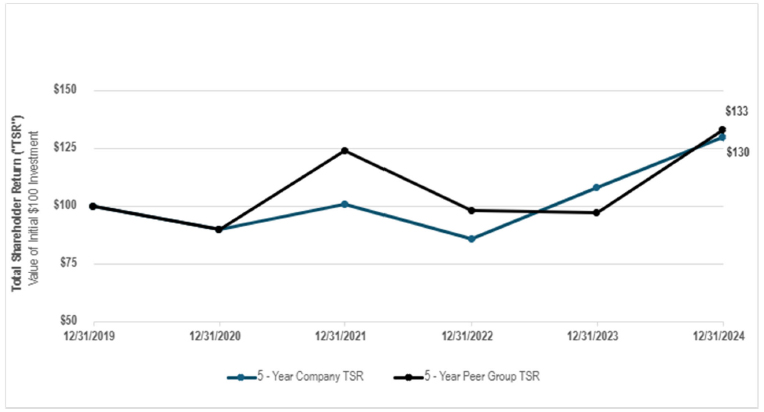
Relationship between CAP paid to PEO and non-PEO NEOs and Cumulative TSR
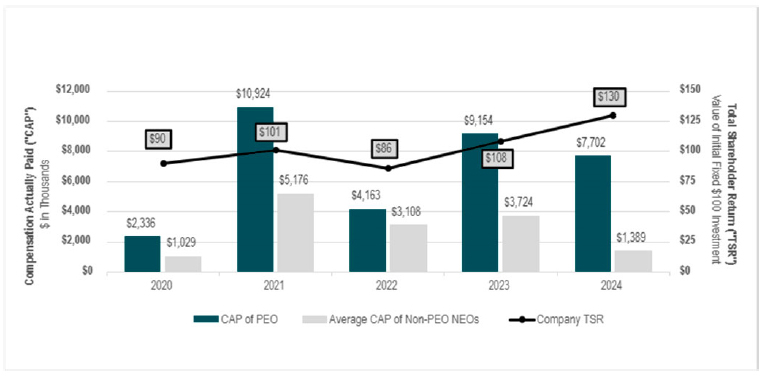
Executive Compensation
Relationship between CAP paid to PEO and non-PEO NEOs and Net Income
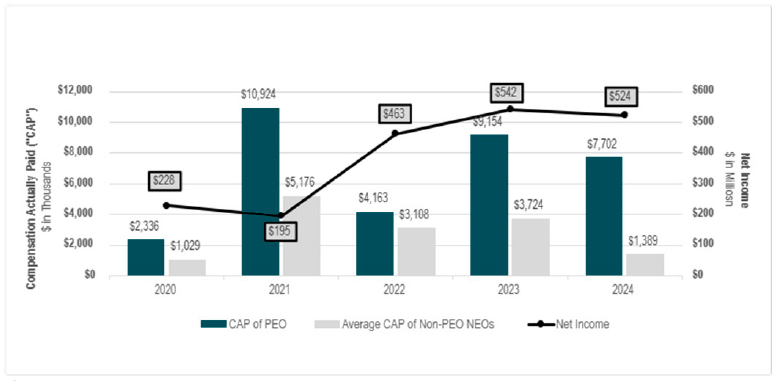
Relationship between CAP paid to PEO and non-PEO NEOs and Adjusted PPNR
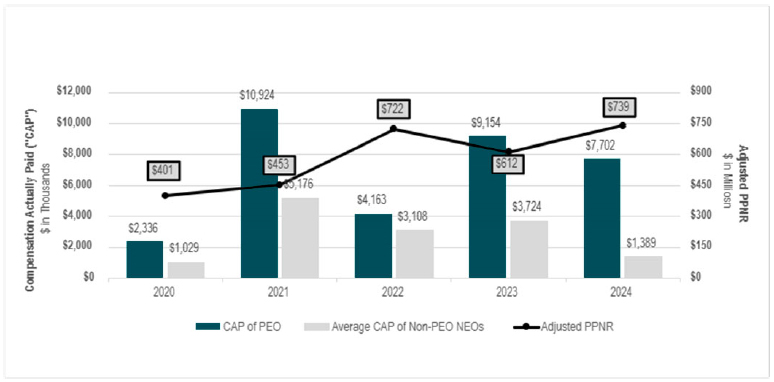
Executive Compensation
For 2024, the ratio of the annual total compensation of our CEO to the median of the annual total compensation of all employees is estimated to be 88.10 to 1.
To identify the “median employee,” we analyzed multiple pay elements from our payroll records as of December 21, 2024 (the last day of our payroll year) for all employees, excluding our CEO, who were employed by the Company on that date and consistently applied the same measure of pay elements for all individuals, excluding our CEO, who were employed by the Company on that date. Our employee population, as defined above, consisted of approximately 5,276 individuals during 2024. All of our employees are located in the United States.
We analyzed multiple pay elements within our payroll records to determine annual total compensation of all employees, including, without limitation, 2024 salary received, overtime pay received, annual incentive payments received, bonuses received, vacation pay, sick pay, commissions, restricted stock dividends, and vested fair value of any equity-based awards received in 2024, as of the determination date. Once we determined the median of the annual total compensation of all employees of the Company (other than our CEO), we were then able to determine the “median employee” for purposes of evaluating the CEO pay ratio.
After identifying the “median employee” in the manner described above, we calculated this employee’s compensation for 2024 in accordance with the requirements of applicable Exchange Act rules and arrived at an estimated annual total compensation of our median employee of $57,850. This amount is different (greater) than the amount reported to our median employee in Box 1 of Form W-2 because it includes some non-taxable items, such as the value of our contributions to the 401(k) plan, premiums we pay for life insurance, as well as premiums we pay for medical insurance. We calculated the annual total compensation of our median employee on this basis because it permits us to more accurately compare the total compensation received by this employee to the total compensation of our CEO.
The CEO pay ratio compares the annual total compensation of our CEO to the annual total compensation of our median employee. For this comparison, we are required to calculate our CEO’s “annual total compensation” as the amount we reported in the “Total” column of the 2024 Summary Compensation Table above.
| Director Compensation |
The following table provides information with respect to non-employee director compensation for the fiscal year ended December 31, 2024 and excludes Mr. Araujo and Ms. Rodriguez who were appointed in 2025:
| Fees Earned | |||
| or Paid in | Restricted Stock | ||
| Name | Cash | Unit Awards (1) | Total |
| Shannon A. Brown** | $99,167 | $81,218 | $180,385 |
| Deborah M. Cannon** | $99,167 | $81,218 | $180,385 |
| Charlotte N. Corley** | $107,500 | $81,218 | $188,718 |
| Joseph W. Evans**+ | $130,833 | $81,218 | $212,051 |
| Virginia A. Hepner** | $112,500 | $81,218 | $193,718 |
| William G. Holliman | $82,500 | $81,218 | $163,718 |
| Warren A. Hood, Jr. | $82,500 | $81,218 | $163,718 |
| Keith J. Jackson | $82,500 | $81,218 | $163,718 |
| Larry G. Kirk* | $46,669 | — | $46,669 |
| Precious W. Owodunni | $82,500 | $81,218 | $163,718 |
| Alan W. Perry | $90,833 | $81,218 | $172,051 |
| James D. Rollins III(2) | — | — | — |
| Marc J. Shapiro | $90,833 | $81,218 | $172,051 |
| Thomas R. Stanton** | $99,167 | $81,218 | $180,385 |
| Kathy N. Waller* | $26,667 | — | $26,667 |
| * | Served as a Director until the 2024 Annual Meeting. |
| ** | Served as Chair of a committee of the Board of Directors of Cadence in 2024. |
| + | Serves as Independent Lead Director. |
| (1) | Reflects the aggregate grant date fair value of restricted stock units awarded on May 1, 2024 to non-employee directors of Cadence pursuant to the terms of our 2021 LTEIP, each according to its appropriate valuation date. The shares of our common stock underlying these awards will vest on the date of the Annual Meeting. |
| (2) | Mr. Rollins was employed by us in 2024, and did not receive compensation for serving as a member of the Board of Directors. |
Our non- employee directors received the following compensation for their service in 2024:
| Annual Board Retainer - Cash | $90,000 | (1) | |
| Annual Board Retainer - Equity | $90,000 | (1) | |
| Annual Audit Committee Chair Cash Retainer | $30,000 | ||
| Annual Cash Retainer for all Other Committee Chairs | $25,000 | ||
| Annual Cash Retainer for Independent Lead Director | $35,000 |
| (1) | Annual retainer was increased from $80,000 to $90,000 effective October 1, 2024. |
Directors are also reimbursed for necessary travel expenses. On May 1, 2024, each of our non- employee directors was awarded 2,877 restricted stock units pursuant to our Long Term Incentive Plan. All of the shares of our common stock underlying these awards will vest on the date of the Annual Meeting.
|
Proposal 2: Non-Binding, Advisory Vote Regarding the Compensation of the Named Executive Officers |
In accordance with the Dodd-Frank Wall Street Reform and Consumer Protection Act of 2010, as amended, the Exchange Act and the SEC’s rules promulgated thereunder, we are asking our shareholders to vote to approve, on a non-binding, advisory basis, the compensation of our Named Executive Officers as disclosed in this Proxy Statement. This Proposal 2, commonly known as a “Say-On-Pay” proposal, gives our shareholders the opportunity to express their views on the compensation of our Named Executive Officers. This vote is not intended to address any specific item of compensation, but rather the overall compensation of our Named Executive Officers and the philosophy, policies and practices described in this Proxy Statement. We conduct our Say-On-Pay votes annually, consistent with the recommendation of our Board of Directors and the advisory vote of our shareholders at our 2023 annual meeting. A new advisory vote on the frequency of shareholder votes on executive compensation, which will occur no later than the Company’s annual meeting of stockholders in 2029.
A significant component of our executive compensation program is performance-based, and it is designed to attract, motivate and retain our executive officers, who are critical to our success. Under this program, our Named Executive Officers are rewarded for the achievement of specific annual, long-term or strategic goals, corporate goals, and the overall realization of increased shareholder value. Our Executive Compensation and Stock Incentive Committee regularly reviews our executive compensation program to ensure it achieves the desired goals of aligning our executive compensation structure with our shareholders’ interests and current market practices. Our Board of Directors requires certification of achievement of performance goals under the Amended and Restated Executive Performance Incentive Plan, and payment of the corresponding cash bonus payments following the filing of our Annual Report on Form 10-K, rather than upon the announcement of preliminary unaudited financial results. In addition, our Board of Directors adopted the Executive Compensation Policy, which sets forth the conditions under which we may recover any excess incentive-based compensation paid or awarded to our executive officers. A more detailed discussion regarding the compensation of our Named Executive Officers is provided under the captions “COMPENSATION DISCUSSION AND ANALYSIS” and “EXECUTIVE COMPENSATION,” and we encourage you to read those sections in full.
The Board of Directors and the Executive Compensation and Stock Incentive Committee believe our executive compensation program is meeting its objectives. Accordingly, we ask our shareholders to vote “FOR” the following resolution at the annual meeting:
RESOLVED, that the shareholders of Cadence Bank approve, on a non-binding, advisory basis, the compensation of Cadence Bank’s named executive officers, which is disclosed pursuant to Item 402 of Regulation S-K in the Compensation Discussion and Analysis, executive compensation tables, and narrative discussions appearing in Cadence Bank’s Proxy Statement for the 2025 annual meeting of shareholders.”
Summary Compensation Decisions for 2024
After assessing the Company’s financial and strategic performance for 2024, and after further evaluating the individual performance of our current NEOs, the Executive Compensation and Stock Incentive Committee exercises its discretion to award total annual direct compensation for 2024 to our NEOs as set forth in the Summary Compensation Table contained in the “COMPENSATION DISCUSSION AND ANALYSIS.”
Vote is Non-Binding and Advisory
Because your vote is advisory, it will not be binding upon the Board of Directors or the Executive Compensation and Stock Incentive Committee, will not override any decision made by the Board of Directors or the Executive Compensation and Stock Incentive Committee or create or imply any additional fiduciary duty of the Board of Directors or the Executive Compensation and Stock Incentive Committee. However, the Board of Directors and the Executive Compensation and Stock Incentive Committee value the opinions of our shareholders. Accordingly, to the extent there is any significant vote against the compensation of our NEOs as disclosed in this Proxy Statement, we will carefully consider our shareholders’ concerns, and the Board of Directors and the Executive Compensation and Stock Incentive Committee will evaluate whether any actions are necessary to address such concerns.
Proposal 2: Non-Binding, Advisory Vote Regarding the
Compensation of the Named Executive Officers
If there is a quorum, the resolution to approve, on a non-binding, advisory basis, the compensation of our NEOs will be approved if the votes cast “for” Proposal 2 outnumber the votes cast “against” Proposal 2.
The Board of Directors recommends Shareholders vote “FOR” the
resolution to approve, on a non-binding, advisory basis, the
compensation of our NEOs.
|
Proposal 3: Ratification of Appointment of Independent Registered Public Accounting Firm |
“Proposal 3: Ratification of Appointment of Independent Registered Public Accounting Firm.”
The Audit Committee of the Board of Directors appointed Forvis Mazars, LLP (“Forvis”) (f/k/a FORVIS, LLP) as our independent registered public accounting firm for the year ending December 31, 2025 and seeks ratification of the appointment by our shareholders.
Services and Fees of Independent Registered Public Accounting Firm
In addition to rendering audit services for the year ended December 31, 2024, Forvis performed various other services for us and our subsidiaries. The following table presents the aggregate fees billed for the services rendered to us by Forvis for the year ended December 31, 2023 and December 31, 2024:
| Fee Type | 2024 | 2023 |
| Audit Fees(1) | $1,986,000 | $1,816,000 |
| Audit-Related | $43,300 | $41,000 |
| Fees(2) | ||
| Tax Fees | - | - |
| All Other Fees(3) | - | $7,000 |
| Total | $2,029,300 | $1,864,000 |
(1) Audit Fees for the year ended December 31, 2024 and 2023 represent the aggregate fees billed to us by our independent registered public accounting firm for professional services rendered for the audit of our financial statements, including the audit of internal control over financial reporting, and for services normally provided by our independent registered public accounting firm in connection with regulatory filings or engagements.
(2) Audit-Related Fees for the years ended December 31, 2024 and 2023 consisted principally of fees for audits of financial statements of certain employee benefit plans.
(3) All Other Fees for the year ended December 31, 2023 represent the aggregate fees billed to us by our independent registered public accounting firm for certain one-time professional services related to the sale of Cadence Insurance, Inc.
Pre-Approval of Audit and Non-Audit Services
The Audit Committee specifically reviews and pre-approves all audit and non-audit services provided by Forvis prior to its engagement to perform such services. The Audit Committee has not adopted any other pre- approval policies or procedures.
Presence of Representatives of Independent Registered Public Accounting Firm
Representatives of Forvis will attend the Annual Meeting virtually, will have an opportunity to make a statement if they desire, and will be available to respond to appropriate questions.
Shareholder ratification of the Audit Committee’s appointment of Forvis as our independent registered public accounting firm for the year ending December 31, 2025 is not required by our Amended and Restated Bylaws or otherwise. Nonetheless, the Board of Directors elected to submit the appointment of Forvis to our shareholders for ratification.
If a quorum is present, this Proposal 3 will be approved if the votes cast for ratification exceed the votes cast against ratification. If this Proposal 3 is not approved, the matter will be referred to the Audit Committee for further review.
Proposal 3: Ratification of Appointment of Independent
Registered Public Accounting Firm
The Board of Directors Recommends Shareholders Vote “FOR” Ratification of the Appointment of Forvis Mazars, LLP as Our Independent Registered Public Accounting Firm for the Year Ending December 31, 2025.
| Audit Committee Report |
The Audit Committee of the Board of Directors consisted of five directors until the 2024 Annual Meeting, and four directors for the remainder of 2024, each of whom is “independent” as defined by the listing standards of the NYSE. The Audit Committee held eight meetings in 2024. These meetings facilitated communication with executive officers, the internal auditors and Cadence’s independent registered public accounting firm. During 2024, the Audit Committee held discussions with the internal auditors and Cadence’s independent registered public accounting firm, both with and without management present, on the results of their examinations and the overall quality of Cadence’s financial reporting and internal controls.
The role and responsibilities of the Audit Committee are set forth in the charter adopted by the Board of Directors, a copy of which is available on the Investor Relations page of Cadence’s website at ir.cadencebank.com under the caption “Corporate Governance – Governance Documents.” In fulfilling its responsibilities, the Audit Committee:
● Reviewed and discussed with management Cadence’s audited consolidated financial statements for the year ended December 31, 2024 and Cadence’s unaudited quarterly consolidated financial statements during 2024 (including the disclosures contained in Cadence’s Annual Report on Form 10-K and its Quarterly Reports on Form 10-Q in the sections entitled “Management’s Discussion and Analysis of Financial Condition and Results of Operations”);
● Discussed with Forvis Mazars, LLP (f/k/a FORVIS, LLP) (“Forvis”), Cadence’s independent registered public accounting firm, the matters required to be discussed under Auditing Standard No. 1301, both with and without management present; and
● Received the written disclosures and the letter from Forvis required by the applicable requirements of the Public Company Accounting Oversight Board regarding the independent accountants’ communications with the Audit Committee concerning independence, as fully described above, and discussed with Forvis their independence, and determined Forvis’s independence with respect to Forvis’s audit of Cadence’s 2024 financial statements.
Based on the Audit Committee’s review and discussions as described above, and in reliance thereon, the Audit Committee recommended to Cadence’s Board of Directors that Cadence’s audited consolidated financial statements for the year ended December 31, 2024 be included in Cadence’s Annual Report on Form 10-K for the year ended December 31, 2024 for filing with the federal banking regulators.
Audit Committee:
Virginia A. Hepner (Chair)
Deborah M. Cannon
Charlotte N. Corley
Warren A. Hood, Jr.
| Certain Relationships and Related Transactions |
Cadence conducts banking transactions in the ordinary course of business with our officers and directors and their associates, affiliates, and family members. While certain provisions of the Sarbanes-Oxley Act of 2002 generally prohibit us from making personal loans to our executive officers and directors, it permits Cadence to make loans to our executive officers and directors so long as such loans are subject to the insider lending restrictions of Section 22(h) of the Federal Reserve Act and Regulation O promulgated thereunder. During the year ended December 31, 2024, Cadence made loans to our executive officers, directors and their family members which were made in the ordinary course of business, were made on substantially the same terms, including interest rates and collateral, as those prevailing at the time for comparable loans with persons not related to Cadence, and did not involve more than the normal risk of collectability or present other unfavorable features. Further, our written Related Person Transaction Policies and Procedures, approved by our Board of Directors, permits extensions of credit by Cadence or its subsidiaries to a related person, so long as such extensions of credit are made in compliance with applicable law, including Regulation O, Sections 23A and 23B of the Federal Reserve Act and Section 13(k) of the Exchange Act.
Pursuant to its written charter and the Related Person Transaction Policies and Procedures, the Nominating and Corporate Governance Committee reviews and approves all “related person” transactions between Cadence and any of their “related persons” or affiliates, or transactions in which any of such persons directly or indirectly is interested or benefitted. If advance approval of a related person transaction by the Nominating and Corporate Governance Committee is not practicable, then the related person transaction shall be considered and, if the committee determines it to be appropriate, ratified at the committee’s next regularly scheduled meeting. In determining whether to approve or ratify a related person transaction, the Nominating and Corporate Governance Committee takes into account, among other factors it deems appropriate, whether the related person transaction is on terms no less favorable than terms generally available to an unaffiliated third-party under the same or similar circumstances and the extent of the related person’s interest in the transaction. In accordance with the Related Person Transaction Policies and Procedures, no director is permitted to participate in any discussion or approval of a related person transaction for which he or she is a related person, except the director shall provide all material information concerning the related person transaction to the Nominating and Corporate Governance Committee. In addition, the policy enumerates certain related person transactions which are deemed to be pre-approved or ratified, as applicable, by the committee.
| General Information |
All matters specified in this Proxy Statement to be voted on at the Annual Meeting will be voted on by ballot. Inspectors of election will be appointed to, among other things:
| ● | Determine the number of shares of our common stock outstanding, the shares of common stock represented at the Annual Meeting, the existence of a quorum and the authenticity, validity and effect of proxies; |
| ● | Receive votes on ballots; |
| ● | Hear and determine all challenges and questions in any way arising in connection with the right to count and tabulate all votes; and |
| ● | Determine the voting results. |
Each proposal presented herein to be voted on at the Annual Meeting must be approved by the vote described under such proposal.
These instructions incorporate the instructions required by the Universal Proxy Rule.
| Proposal | Voting Options | Routine? | |
| 1. | Directors | “For” or “Withhold” individually | No |
| No slates of directors | |||
| 2. | Say on Pay (non-binding) | “For,” “Against,” or “Abstain” | No |
| 3. | Ratification of Appointment of Independent | “For,” “Against,” or “Abstain” | Yes |
| Registered Public Accounting Firm | |||
Inspectors of election will treat the following shares of common stock as present and entitled to vote for purposes of determining a quorum:
| ● | properly submitted proxies which reflect “against votes” |
| ● | “withhold” votes |
| ● | abstentions |
| ● | broker non-votes(1) |
| (1) | Broker non-votes are shares of common stock held “of record” by brokers or nominees as to which voting instructions have not been received from the beneficial owner with respect to any proposal which does not relate to a “routine” matter. |
Non-routine matters. If the shares entitled to vote are held in “street name” through a broker or other holder of record and the beneficial holder does not indicate how to vote on these matters, the record holder will not vote the beneficial holder’s shares on those matters.
Abstentions and broker non-votes are counted as shares presented at the Annual Meeting and entitled to vote for purposes of determining the presence of a quorum, but will not be counted as votes cast and will not have any effect on voting for any of the proposals presented in this Proxy Statement.
Undervoting. If a shareholder under-votes their proxy, the vote “for” or “withheld” for each nominee shall be counted as cast.
Overvoting. If a shareholder over-votes their proxy card, the card shall be counted to establish a quorum, and votes for shareholder nominees shall be counted in the order in which they appear on the card, but no vote for a nominee beyond the number allowed shall have any effect on the vote totals.
General Information
Signed, unvoted proxy cards. If a shareholder signs and sends in their proxy card, but votes for no nominees and no proposals, such proxy cards shall be deemed to grant authority for each proposal or nominee as recommended by management and the proxies.
“Withhold” votes for purposes of the election of directors will not have any effect on the vote for election of directors; however, our Bylaws provide that, in an uncontested election, any nominee for director who receives a greater number of votes “withheld” than votes “for” his or her election must promptly tender his or her resignation following certification of the shareholder vote. For more information, see “Proposal 1: Election of Directors - Majority Vote Policy.”
Shareholder Nominations and Proposals
Shareholders who would like to recommend director nominees or make a proposal for consideration at the 2026 annual meeting of shareholders should submit the nomination or proposal, along with proof of ownership of our common stock in accordance with Rule 14a-8(b)(2) promulgated under the Exchange Act in writing and mailed to the Corporate Secretary at the address listed below. If a shareholder nominates an individual to stand for election as a director, but the shareholder then fails to comply with Rule 14a regulations governing those nominations, any proxy authority granted for such shareholder nominees shall not be counted, and that proxy card shall be counted for the purposes of establishing a quorum only. We must receive all such nominations and proposals not before November 14, 2025 and not later than December 15, 2025 in order for the nomination or proposal to be included in our proxy statement. Shareholder nominations and proposals received after December 15, 2025, shall be considered untimely and will not be included in our proxy statement, but may be included in the agenda for our 2026 annual meeting if submitted to our Corporate Secretary at the address listed below and if such nomination or proposal includes:
| ● | The name and address of the shareholder; |
| ● | The class and number of shares of common stock held of record and beneficially owned by such shareholder; |
| ● | The name(s), including any beneficial owners, and address(es) of such shareholder(s) in which all such shares of common stock are registered on our stock transfer books; |
| ● | A representation that the shareholder intends to appear at the meeting virtually or by proxy to submit the business specified in such notice; |
| ● | A brief description of the business desired to be submitted to the annual meeting of shareholders, the complete text of any resolutions intended to be presented at the annual meeting and the reasons for conducting such business at the annual meeting of shareholders; |
| ● | Any personal or other material interest of the shareholder in the business to be submitted; |
| ● | As to each person whom the shareholder proposes to nominate for election or reelection as a director, all information relating to such person required to be disclosed in solicitations of proxies for election of directors, or is otherwise required, in each case pursuant to Regulation 14A under the Exchange Act (including such person’s written consent to being named in the proxy statement as a nominee and to serving as a director if elected); and |
| ● | All other information relating to the nomination or proposed business which may be required to be disclosed under applicable law. |
In addition, a shareholder seeking to submit such nominations or business at the meeting shall promptly provide any other information we reasonably request. Such notice shall be sent to the following address:
Cadence Bank
201 South Spring Street
Tupelo, Mississippi 38804
Attention: Corporate Secretary
In addition to the requirements to comply with the Rule 14a regulations for a shareholder nominee listed above, if a nomination for director or other proposal by a shareholder is not timely submitted and does not comply with any of these notice requirements, such proposal or nomination will be disregarded and, upon the instructions of the presiding officer of the annual meeting, all votes cast for each such nominee and any such proposal will be disregarded.
General Information
The individuals named as proxies on the proxy card for our 2026 annual meeting of shareholders will be entitled to exercise their discretionary authority in voting proxies on any shareholder proposal which is not included in our proxy statement for the 2026 annual meeting, unless we receive notice of the matter to be proposed not earlier than November 14, 2025 nor later than December 16, 2025, and in accordance with the requirements listed above and the Company’s advance notice provisions of the by-laws. These dates are based on a distribution date of our proxy materials of March 14, 2025 and the advance notice provisions of the Company’s by-laws. Even if proper notice is received within such time period, the individuals named as proxies on the proxy card for that meeting may nevertheless exercise their discretionary authority with respect to such matter by advising shareholders of the proposal and how the proxies intend to exercise their discretion to vote on these matters, unless the shareholder making the proposal solicits proxies with respect to the proposal to the extent required by Rule 14a-4(c)(2), 14a-8, and 14a-19(a)(3) under the Exchange Act.
Householding of Proxy Materials
The applicable regulatory rules regarding delivery of proxy statements and annual reports may be satisfied by delivering a single Notice of Internet Availability and, if requested, a single set of our proxy materials to an address shared by two or more of our shareholders. This method of delivery is referred to as “householding” and can result in meaningful cost savings for us. In order to take advantage of this opportunity, we may deliver only one Notice of Internet Availability and, if requested, a single set of our proxy materials to multiple shareholders who share an address, unless we have received contrary instructions from one or more of the shareholders. We undertake to deliver promptly upon request paper copies of our proxy materials, as requested, to shareholders at a shared address. If you hold our common stock as a registered shareholder and prefer to receive a paper copy of our proxy materials either now or in the future, please call 1-800-368-5948 or send a written request to:
Cadence Bank
201 South Spring Street
Tupelo, Mississippi 38804
Attention: Corporate Secretary
If your shares of common stock are held through a broker or bank and you prefer to receive a paper copy of our proxy materials either now or in the future, please contact such broker or bank. Shareholders who share an address and elect to receive printed copies of our proxy materials may request to receive a single copy of such materials, either now or in the future, by calling 1-800-368-5948 or sending a written request to the address above.
Special Meetings of Shareholders
As it relates to the ability of our shareholders to convene a special meeting, the Articles provide that shareholders owning 20% or more of our shares of common stock can call a special meeting. A majority of the shares entitled to vote will constitute a quorum for the transaction of any business at a special shareholders’ meeting.
A copy of our Annual Report on Form 10-K for the year ended December 31, 2024 can be accessed by following the instructions contained on the Notice of Internet Availability mailed to shareholders of record as of the record date on or about March 14, 2025. A copy of our 2024 Annual Report may also be obtained without charge on the Investor Relations section of our website at ir.cadencebank.com under the caption “Public Filings.”
In addition, a copy of our 2024 Annual Report will be furnished without charge to any shareholder who requests such report by sending a written request to:
Cadence Bank
201 South Spring Street
Tupelo, Mississippi 38804
Attention: Corporate Secretary
General Information
Our management is not aware of any matters other than those described above which may be presented for action at the Annual Meeting. If any other matters properly come before the Annual Meeting, the proxies will be voted with respect to such matters in accordance with the judgment of the person or persons voting such proxies, subject to the direction of our Board of Directors.
| Cadence Bank | |
 |
|
| James D. “Dan” Rollins III | |
| Chairman of the Board and | |
| March 14, 2025 | Chief Executive Officer |
Appendix A contains reconciliations for the following: (1) total noninterest expense to adjusted total noninterest expense and total noninterest revenue to adjusted total noninterest revenue for purposes of the Compensation Committee's determination of performance under the Executive Performance Incentive Plan; (2) adjusted PPNR for purpose of the pay versus performance table; (3) normalized operating efficiency ratio and adjusted ROAA for purposes of calculating the Integration grants; and (4) the adjusted effieciency ratio as set forth in the proxy. The Company supplements the financial reporting it does according to Generally Accepted Accounting Principles (GAAP), by utilizing certain financial measures not calculated in accordance with GAAP. The Company included a limited number of these non-GAAP financial measures in this proxy statement for the applicable periods presented. Management believes that the presentation of these non-GAAP financial measures: (i) provides important supplemental information that contributes to a proper understanding of the Company’s capital position and adjusted performance; (ii) enables a more complete understanding of factors and trends affecting the Company’s business; and (iii) allows investors to evaluate the Company’s performance in a manner similar to management, the financial services industry, bank stock analysts and bank regulators. Reconciliations of these non-GAAP financial measures to the most directly comparable GAAP financial measures are presented in the tables below. These non-GAAP financial measures should not be considered substitutes for GAAP financial measures, and the Company strongly encourages investors to review the GAAP financial measures included in this proxy statement and not to place undue reliance upon any single financial measure. In addition, because non-GAAP financial measures are not standardized, it may not be possible to compare the non-GAAP financial measures presented in this proxy statement with other companies’ non-GAAP financial measures having the same or similar names.
| 2024 | |||||
| Reconciliation of Total Noninterest Expense to Adjusted Total Noninterest Expense | |||||
| Total noninterest expense | $ | 1,045,528 | |||
| Less: | Gain on extinguishment of debt | (1,674 | ) | ||
| Restructuring and other nonroutine expenses | 5,501 | ||||
| Adjusted Total Noninterest Expense | $ | 1,041,701 | |||
| 2024 | |||||
| Reconciliation of Total Noninterest Revenue to Adjusted Total Noninterest Revenue | |||||
| Total noninterest revenue | $ | 356,510 | |||
| Less: | Security losses, net | (2,962 | ) | ||
| Gain on sale of business | 14,980 | ||||
| Adjusted Total Noninterest Revenue | $ | 344,492 | |||
| Year-to-date | |||||||||||||||||||||
| Dec 2024 | Dec 2023 | Dec 2022 | Dec 2021 | Dec 2020 | |||||||||||||||||
| Reconciliation of Net Income to Adjusted Pre-Tax Pre-Provision Net Revenue | |||||||||||||||||||||
| Net Income | $ | 523,604 | $ | 542,304 | $ | 463,237 | $ | 195,162 | $ | 228,051 | |||||||||||
| Plus: | Provision for credit losses | 71,000 | 80,000 | 7,000 | 138,062 | 89,044 | |||||||||||||||
| Merger expense | - | 5,192 | 51,214 | 59,896 | 5,345 | ||||||||||||||||
| Incremental merger related expense | - | 18,131 | 52,247 | 4,633 | - | ||||||||||||||||
| Gain on extinguishment of debt | (1,674 | ) | (1,792 | ) | - | - | - | ||||||||||||||
| Restructuring and other nonroutine expenses/branch closing expense | 5,501 | 57,548 | 3,094 | - | - | ||||||||||||||||
| Pension settlement expense | - | 11,826 | 9,023 | 3,051 | 5,846 | ||||||||||||||||
| Income tax expense (benefit) | 152,593 | (4,594 | ) | 136,138 | 51,766 | 59,494 | |||||||||||||||
| Less: | Security (losses) gains, net | (2,962 | ) | (435,652 | ) | (384 | ) | (395 | ) | 58 | |||||||||||
| Gain on sale of business | 14,980 | - | - | - | - | ||||||||||||||||
| Nonroutine (losses) gains | - | (6,653 | ) | - | - | - | |||||||||||||||
| Income from discontinued operations, net of income taxes (1) | - | 538,620 | - | - | - | ||||||||||||||||
| Adjusted pre-tax pre-provision net revenue from continuing operations (1) | $ | 739,006 | $ | 612,300 | $ | 722,337 | $ | 452,965 | $ | 387,722 | |||||||||||
(1) Fiscal years 2023 and 2024 reflects income from continuing operations only. Fiscal years 2020, 2021, and 2022 include both continuing and discontinued operations.
| Dec 2024 | Dec 2023 | Dec 2022 | Dec 2021 | Dec 2020 | |||||||||||||||||
| Adjusted Efficiency Ratio | |||||||||||||||||||||
| Adjusted non-interest expense | $ | 1,041,701 | $ | 1,065,018 | $ | 994,545 | $ | 618,241 | $ | 533,449 | |||||||||||
| Net interest income FTE | 1,438,838 | 1,355,540 | 1,355,503 | 808,099 | 693,733 | ||||||||||||||||
| Non-interest income | 356,510 | (116,343 | ) | 342,485 | 242,905 | 205,726 | |||||||||||||||
| Less: | Security (losses) gains, net | (2,962 | ) | (435,652 | ) | (384 | ) | (395 | ) | 58 | |||||||||||
| Gain on sale of businesses | 14,980 | - | - | - | - | ||||||||||||||||
| Nonroutine (losses) gains | - | (6,653 | ) | - | - | - | |||||||||||||||
| Total adjusted revenue | $ | 1,783,330 | $ | 1,681,502 | $ | 1,698,372 | $ | 1,051,399 | $ | 899,401 | |||||||||||
| Adjusted efficiency ratio | 58.4 | % | 63.3 | % | 58.6 | % | 58.8 | % | 59.3 | % | |||||||||||
| 10/1/2023- | |||||
| (Dollars in Thousands) | 9/30/2024 Total | ||||
| Normalized Operating Efficiency Ratio | |||||
| Non-Interest Expense | $ | 1,108,709 | |||
| Less: | Incremental Merger Related Expenses | 7,500 | |||
| Restructuring and other Nonroutine Expenses | 47,528 | ||||
| Pension Settlement Expense | 11,226 | ||||
| Gain on Extinguishment of Debt | (2,326 | ) | |||
| Adjusted Non-Interest Expense | 1,044,782 | ||||
| Less: | Amortization of Intangibles | 16,403 | |||
| Adjustment to Service Charge Refund Expense | (2,750 | ) | |||
| Total Normalized Adjusted Expenses | $ | 1,031,129 | |||
| Interest Revenue (1) | $ | 2,545,185 | |||
| Interest Expense | 1,135,935 | ||||
| Net Interest Revenue | 1,409,250 | ||||
| Non-Interest Revenue | (41,115 | ) | |||
| Less: | Gain on Sale of Businesses | 14,980 | |||
| Securities Losses, net | (387,484 | ) | |||
| Adjusted Non-Interest Revenue | 331,389 | ||||
| Total Adjusted Revenue | 1,740,639 | ||||
| Less: | Accretion Income on Acquired Loans | 13,616 | |||
| Amortization of Loan Unfunded Commitment Fair Value Marks | 704 | ||||
| Earnings from Limited Partnerships | 10,568 | ||||
| Change in fair value of SBA servicing rights | (1,364 | ) | |||
| Market Value Adjustment on MSR Hedge | (9,288 | ) | |||
| Service Charges Refund Expense | (8,000 | ) | |||
| Plus: | Amortization of Fixed Maturity Deposit Fair Value Marks | (427 | ) | ||
| Total Normalized Adjusted Revenues | $ | 1,733,976 | |||
| Normalized Operating Efficiency Ratio | 59.47 | % | |||
(1) Includes taxable equivalent adjustment to interest of $1.9 million, using an effective tax rate of 21%.
| 3Q24 | 2Q24 | 1Q24 | 4Q23 | ||||||||||||||
| Adjusted Return on Average Assets | |||||||||||||||||
| Income (Loss) from Continuing Operations | $ | 136,439 | $ | 137,472 | $ | 116,978 | $ | (263,737 | ) | ||||||||
| Plus: | Incremental Merger Related Expense | - | - | - | 7,500 | ||||||||||||
| Restructuring and Other Nonroutine Expenses | (920 | ) | 6,675 | 251 | 41,522 | ||||||||||||
| Gain on Extinguishment of Debt | - | (1,098 | ) | (576 | ) | (652 | ) | ||||||||||
| Pension Settlement Expense | - | - | - | 11,226 | |||||||||||||
| Service Charges Refund Expense | - | - | - | 8,000 | |||||||||||||
| Adjustment to Service Charge Refund Expense | - | (2,750 | ) | - | - | ||||||||||||
| Amortization of Intangibles | 3,933 | 3,999 | 4,066 | 4,405 | |||||||||||||
| Less: | Securities Losses, net | (2,947 | ) | (4 | ) | (9 | ) | (384,524 | ) | ||||||||
| Gain on Sale of Businesses | - | 14,980 | - | - | |||||||||||||
| Tax Adjustment | 1,252 | (1,712 | ) | 788 | 95,870 | ||||||||||||
| Adjusted Income from Continuing Operations | $ | 141,147 | $ | 131,034 | $ | 119,941 | $ | 96,918 | |||||||||
| Average Assets | $ | 47,803,977 | $ | 48,192,719 | $ | 48,642,540 | $ | 48,444,176 | |||||||||
| Adjusted Return on Average Assets* | 1.18 | % | 1.09 | % | 0.99 | % | 0.80 | % | |||||||||
* Annualized